
Technical Notes Waqf Core Principles BACKGROUND AND DEVELOPMENT

Technical Notes Waqf Core Principles BACKGROUND AND DEVELOPMENT Prof. DR. Raditya Sukmana Head of Islamic Economic Department, Faculty of Economics and Business, Universitas Airlangga, Indonesia

Background 1 • Waqf is part of the Islamic economics which is important for socio economic development • It was proved to be important engine growth for the Islamic countries in the past • Due to certain factors, waqf was down for quite some times but it gains more attention in recent years • Currently, waqf asset in the form empty land, small mosque on top of waqf land etc are abundant in numbers • Those lands needs to be utilized for productive purposes whenever possible

Background 2 • The characteristics of waqf which the asset should remain intact necessitates extra proper governance • Waqf asset has to be secured/prevented at all times • For other sector such as banking, there exist universal acceptable governance standard to ensure depositor’s funds are safe and financial intermediation function is properly worked • The Bank for International Settlement (BIS) which produce Basel Core Principle (BCP) is for governing the banking and International Financial Service Board (IFSB) is for governing the Islamic banking

Background 3 • Do we have standardization which is universally accepted for waqf? So far NO. • Or at least do we have standard setting body (universally accepted) for waqf governance? So far No • Badan Wakaf Indonesia (Indonesian waqf regulator) and Bank Indonesia initiated to have waqf governance standard • This is called Waqf Core Principle (WCP) which was eventually launched in Bali during World Bank-IMF Annual Meeting 2018


Development • WCP is the guidelines for the waqf industry to ensure the smoothness of waqf operation • More over, this guidelines also important for the regulator for the waqf policies • We do not reinvesting the wheel, this WCP adopt what has been the universally acceptable governance for banking namely BCP with some adjustment • We adopt the principles in BCP which is still relevant for waqf governance (for ex: The role of regulator) and we omit those which do not relevant

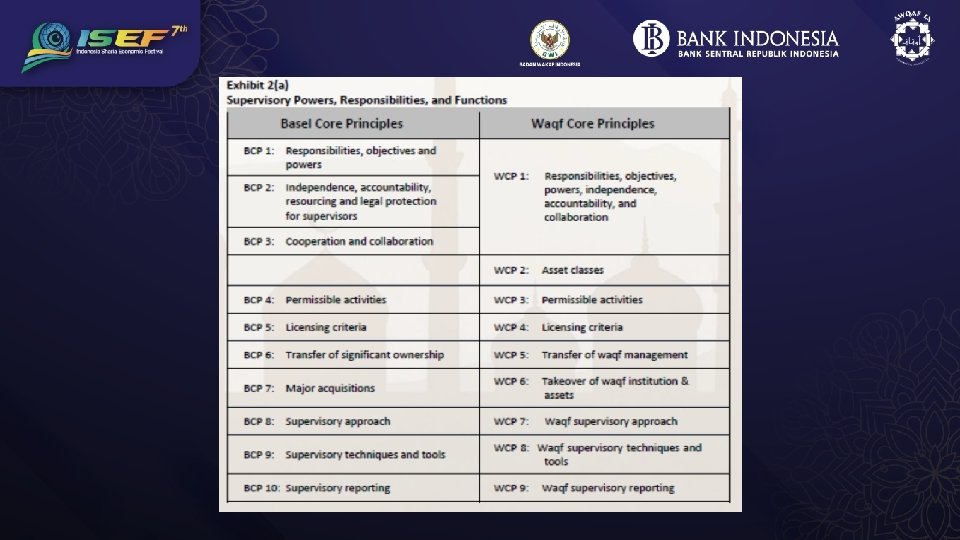
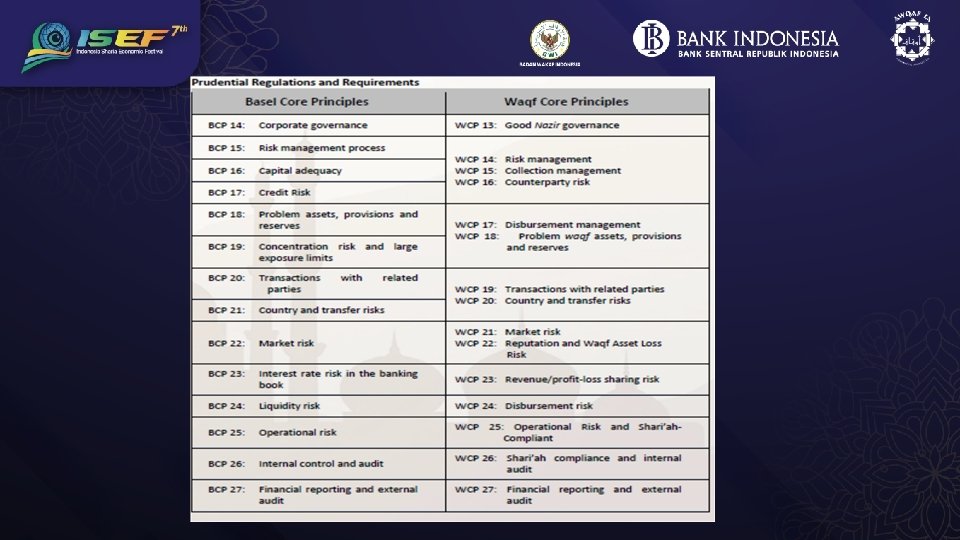

Development • The future of awqaf institutions will be largely determined by the ability of waqf management in dealing with various rapid changes that occur unexpectedly • It requires all the elements a higher skill of risk management; otherwise, the awqaf sector will not be developed at its fullest capacity. • of risk management for awqaf sector can benefit from the current development of risk management of the other financial sectors i. e banking sector and financial market.

Development • many awqaf institutions which operate within the Islamic countries are still in the shape of simplicity. • regulatory framework developed for awqaf sector should be able to accommodate both the traditional as well as the sophisticated operations. • sustained awqaf sector development requires the implementation of sound risk management to ensure that the values of the assets are always kept within the tolerable risks involved in the operations, • the availability of technical documents which are able to translate sound supervisory concept into operational risk management practices is very essential.

Technical Notes on Waqf Principles • Objectives 1. The Technical Notes of the Waqf Core Principles are formulated to address some specific objectives as follows: i. to provide a technical explanation on the Waqf Core Principles in the area of risk management system so that all the risks involved in the Waqf activities can be effectively identified, measured, mitigated, and monitored. ii. to provide a technical guidance to the supervisors in determining supervisory measures to minimize possible agency problems. The agency problem can be in the form of fraudulent practices performed by the asset managers (moral hazard) and poor entry and exit policy (adverse selection problem).

List of Risks within Waqf Institution
Notes • Mobilization: raise Waqf Asset • Management : manage the waqf Asset • Distribution : Distribute the profit from waqf • Commercial • Investment : Cash Waqf Financing • Non Investment : productive waqf asset (hotel, office etc) • Social : waqf asset for social (non profit mosque, schools etc)
Example: Mobilization (Reputation risk) Identification Reputation relates with the ability of human resource (in this case nazhir) to perform its task. When company mistakenly announce public information, it may adversely influence the people perception which eventually jeopardize the reputation of the institution (nazhir). Measurement it can be measured qualitatively and quantitatively by getting feedback from the people (perception) Mitigation The establishment of public relation division to ensure the smoothness of the communication and make quick response to anticipate the adverse information available. Monitoring on all information pertaining to the waqf managed by nazhir. It follows with the recording important notes for the future improvement.
Example: Management (Counter-party Risk) Identification Various risks have to be identified when nazhir eventually appoint fund manager to manage the funds. Low return obtained from investing the cash waqf can also be the risk. another risk is the fund manager utilizing cash waqf into the high risk investment type which may create losses to the cash waqf corpus Measurement Quantitative default analysis is adopted or when counter party make investment in islamic stock market, then alpha, confidence interval need to be decided and tolerable losses need to be taken into consideration. Mitigation In order to mitigate the risk, nazhir should consider to appoint more than one fund manager with different expertise. For example, fund manager A specialize in make investment in Islamic capital Market and fund manager B specialize in make investment in join venture (buy bad company, restructure, recap, reorganize until become good company and sell it with profit. Monitoring Criteria to choose certain counter party shall be monitored, evaluated for the purpose of future improvement. After evaluation, decision can be made to keep appoint the same fund manager or look for other alternative.
Example: Distribution (Distribution risk) (i) Identification • This is the risk raised on the disbursement to the beneficieries. unlike zakah whereby the disbursement has to be only to 8 ashnaf hence disbursement risk is high, waqf profit disbursement is not regulated specifically stated in Al Qur’an or hadist, hence risk is not that high as compare to zakah. However, priority shall be identified within Standard Operating Procedure. (i) Measurement • Qualitative measure especially from negative impact on those communities which are not receiveing benefits (i) Mitigation • Regular evaluation to come up with the most priority to be given support (i) Monitoring • Monitoring specifically on the all possible effect once disburesement has been done
Thank You Email : Raditya-s@feb. unair. ac. id Mobile number : +62 878 5421 6776
- Slides: 18