
Technical file contents according to EU reg 2017745










- Slides: 68
Technical file contents according to EU reg. 2017/745 Annex I, Annex II
Technical documentation Annex II • Technical documentation – clear, organized, readily searchable and unequivocal way • STED – Summary of technical documentation
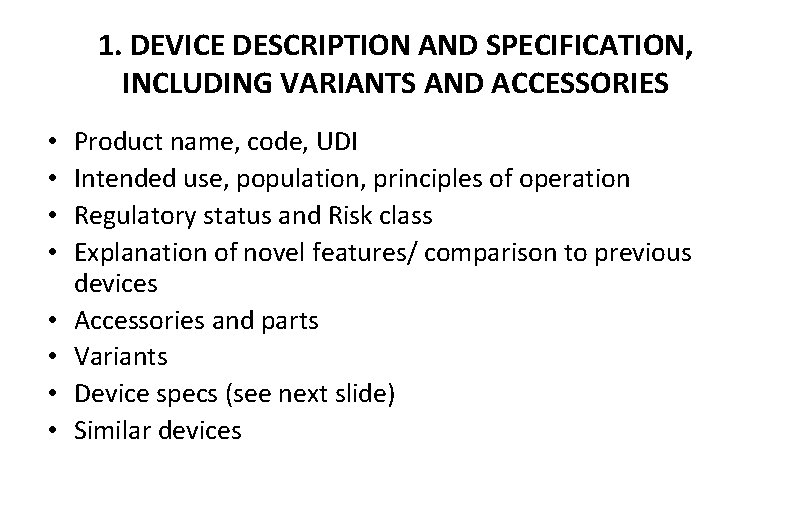
1. DEVICE DESCRIPTION AND SPECIFICATION, INCLUDING VARIANTS AND ACCESSORIES • • Product name, code, UDI Intended use, population, principles of operation Regulatory status and Risk class Explanation of novel features/ comparison to previous devices Accessories and parts Variants Device specs (see next slide) Similar devices
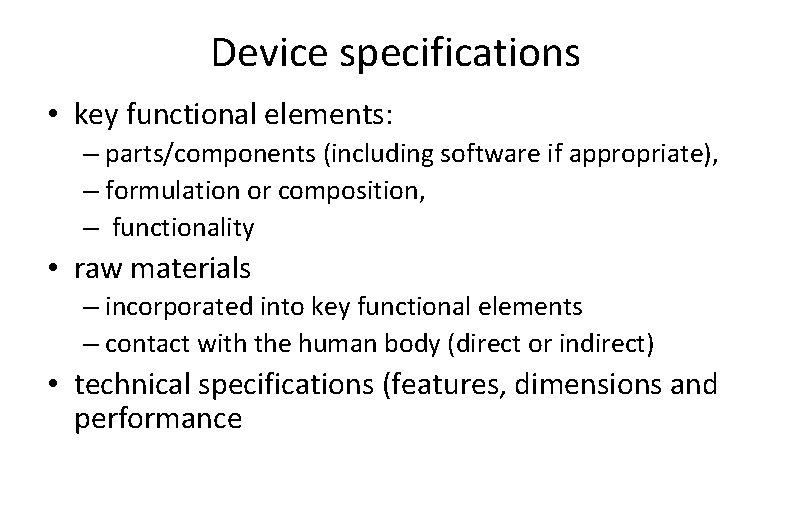
Device specifications • key functional elements: – parts/components (including software if appropriate), – formulation or composition, – functionality • raw materials – incorporated into key functional elements – contact with the human body (direct or indirect) • technical specifications (features, dimensions and performance
2. INFORMATION SUPPLIED BY THE MANUFACTURER • Complete set of labels and IFU – All packaging – including logistic containers in case of special transport conditions • All translations
3. DESIGN AND MANUFACTURING INFORMATION 1/2 • Understanding the design stages – Input & output – Review – Verification and validation – Design change • Design and manufacturing location – At manufacturer – Subcontractors – Suppliers
3. DESIGN AND MANUFACTURING INFORMATION 2/2 • Complete information and specifications, – Product specs (drawings, composition, SW modules) – Raw material specs – Manufacturing processes and their validation, • adjuvants & residuals – Quality control • continuous monitoring • final product testing.
4. GENERAL SAFETY AND PERFORMANCE REQUIREMENT • RES checklist – Justification of NA – Methods of compliance and validations – Application of standards/ common standards and justification of NA – precise identity of the controlled documents offering evidence and cross reference
5. RISK/BENEFIT ANALYSIS AND RISK MANAGEMENT • Risk benefit analysis • Risk control measures • Results of risk control – Clinical evidence • NOTE: EN ISO 14971: 2012
6. PRODUCT VERIFICATION AND VALIDATION • All the verification and validation testing – Rationale for no new testing (example: for biocompatibility) • Their critical analysis – Statistical relevance – Applicable standards/ Common Specifications
6. 1. a Pre-clinical data • Engineering, laboratory, simulated use, animal tests • Published literature applicable – Substantially equivalent device • Manufacturer’s testing – test design, complete test or study protocols, – methods of data analysis, – data summaries and test conclusions
6. 1 b Required preclinical data • Biocompatibility – all materials in direct or indirect contact • • • Physical, chemical profile Microbiological characterisation; Electrical safety and electromagnetic compatibility; Software verification and validation Stability/shelf life Performance and safety
6. 1. c/d Clinical data • Clinical evaluation plan – Include clinical investigations • Clinical evaluation report ant its updates (Part A of Annex XIII) • PMCF plan and report (Part B of Annex XIII )
6. 2. Additional information in specific cases • Drug: file for safety, quality and usefulness • Human and Animal origin: identification and risk profile (see RES 10) • Absorbables: absorption studies, local tolerance, interaction with drugs, ISO 10993 toxicity • Sterile: stetilization validation and cleanroom specs • Measuring: accuracy proof • Accessories/ combination: validation of combined use
Annexes to the tech file RES checklist (see Annex I) Label and IFU as per Annex I. 2 EU Declaration of conformity Summary of safety and clinical performance (class III) • Surveillance SOP (Annex II. a) • •
Essential Requirements Annex I • High focus on risk management & risk -benefit assessment • Clear integration with machinery Directive (RES 6 a) and radiation Directive (RES 13. 5 aa) • Detailed RES on phthalates • RES on disposal validation and info in IFU (RES 11. 7) • RES on SW life process and validation (RES 14) • Focus on ergonomy, RES for use by the layperson (RES 18) • Labeling very similar to pharma
RES 1 to 5: risk management • 1 a. The manufacturer has to establish, implement, document and maintain a risk management process – EN ISO 14971 – Upgrade according to PMS – RCM in the usual order: design, protection, information – Attention to ergonomic features
RES 2 on risk • Preferred order of RES: – Safe design and construction – Protection from uneliminable risk, – Information for safety (safe use description) and training • Information on residual risk SHALL be provided
RES 7 on design • Impact of processes on material properties • Mechanical, surface, chemical properties and specs – Including (nano) materials released into the body (RES 7. 6) • Compatibility between the materials and substances used and biological tissues, cells, and body fluids taking account of the intended purpose of the device and absorption, distribution, metabolism and excretion
Carcinogenic, mutagenic or toxic: RES 7. 4 • Dedicated labeling and dedicated risk management – High contact devices: invasive, transport of fluids, storage of fluids – Concentration of 0. 1% or above by mass • Special attention children, pregnant & nursing women
RES 8 on infection and contamination • Design to – allow handling, cleaning, sterilization – Reduce exposure to contamination, prevent contamination – Easy performance of cleaning and resterilization – Clear user indication of sterile state • Differentiated labeling for devices sold both sterile and not sterile
RES 9: Drug-like devices • Metabolism related devices – Incorporating a medicinal substance – Absorbed – Locally dispersed • Application of the medicinal products directive Directive 2001/83/EC – By analogy – For absorbed and dispersed “where applicable” and “not covered by this Regulation”
RES 10: biological origin • • • Human or animal Rendered non viable Safety regarding transmission of agents Traceability Inactivation of TSE prion • Still valid Commission Regulation (EU) No 722/2012 of 8 August 2012
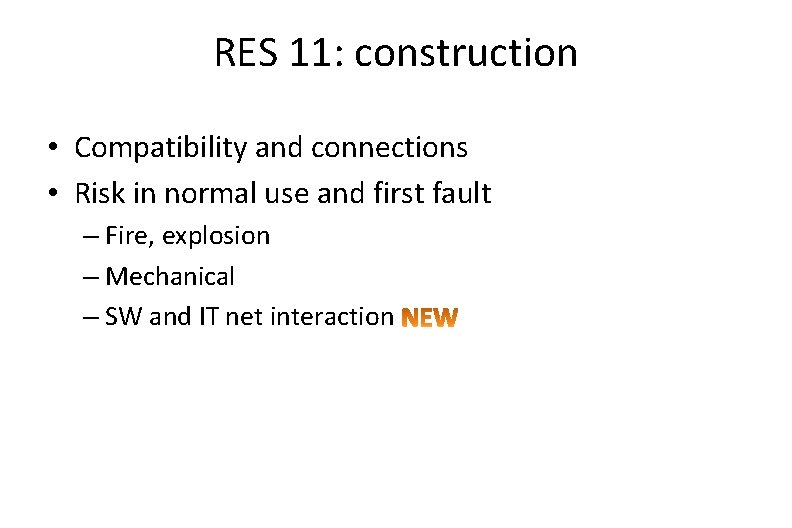
RES 11: construction • Compatibility and connections • Risk in normal use and first fault – Fire, explosion – Mechanical – SW and IT net interaction
RES 14: SW • Ensure repeatability, reliability and performance • Risk control in first fault • Software : control of development life cycle, risk management, including information security, verification and validation – CEI 62304 – Definition of HW and IT requirements
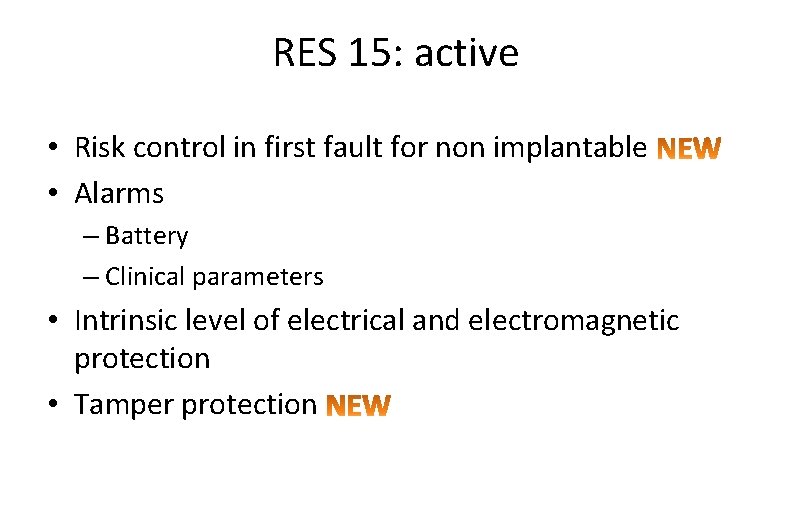
RES 15: active • Risk control in first fault for non implantable • Alarms – Battery – Clinical parameters • Intrinsic level of electrical and electromagnetic protection • Tamper protection
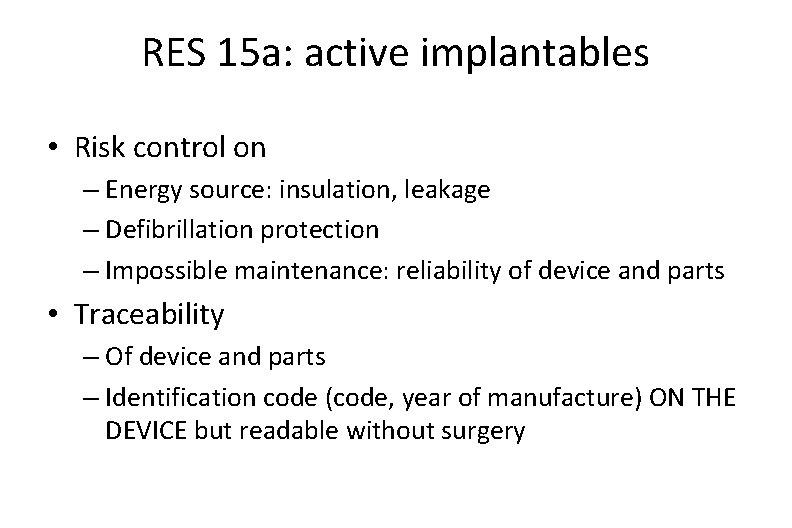
RES 15 a: active implantables • Risk control on – Energy source: insulation, leakage – Defibrillation protection – Impossible maintenance: reliability of device and parts • Traceability – Of device and parts – Identification code (code, year of manufacture) ON THE DEVICE but readable without surgery
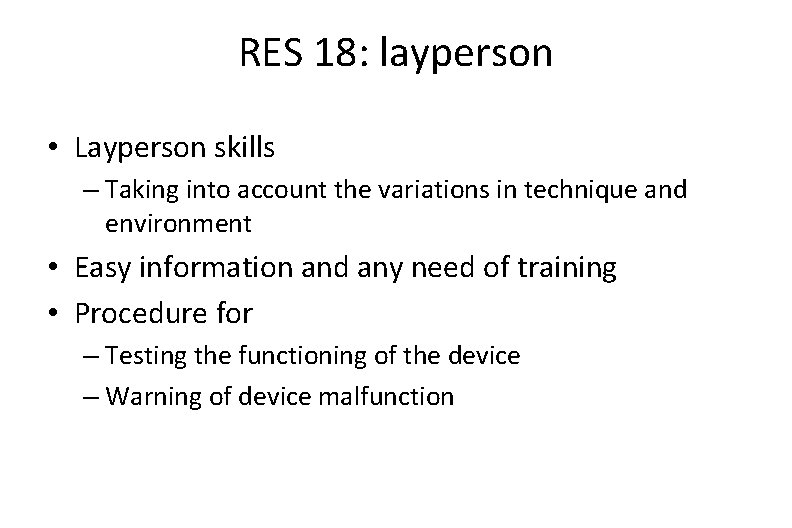
RES 18: layperson • Layperson skills – Taking into account the variations in technique and environment • Easy information and any need of training • Procedure for – Testing the functioning of the device – Warning of device malfunction
RES 19: information • Appropriate for the intended user (easy to understand) • May be only electronic according to Commission Regulation (EU) No 207/2012 • Must include info on residual risk as warnings • Include registration number of the manufacturer and UDI
RES 19. 3: IFU • With clear specification of target group(s), indications, contraindications including the intended user • A specification of clinical benefits to be expected, where applicable, together with links to the summary of safety and performance • Information to brief the patient of any warnings, precautions, contra - indications measures to be taken and limitations of use regarding the device
RES 19. 3 IFU • Information needed to verify whether the device is properly installed and is ready to perform safely and as intended by the manufacturer • Warnings or precautions to be taken in order to facilitate the safe disposal of the device, its accessories and the consumables used with it, if any • For non medical devices, information regarding the absence of a clinical benefit and the risks related to the use of the device.
Clinical evaluation Article 49 • Clinical data SHALL provide sufficient clinical evidence about: – characteristics of safety and performances under the normal conditions of the intended use – evaluation of the undesirable side-effects – acceptability of the benefit/risk ratio • Manufacturers shall plan, conduct and document a clinical evaluation
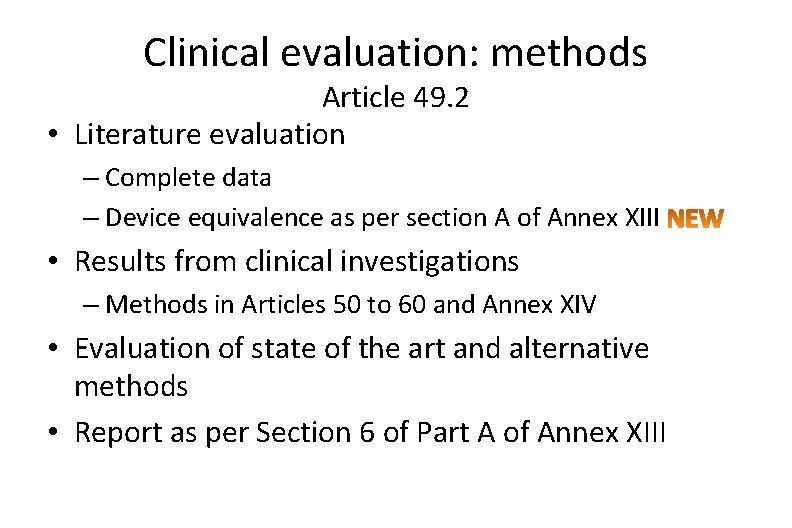
Clinical evaluation: methods Article 49. 2 • Literature evaluation – Complete data – Device equivalence as per section A of Annex XIII • Results from clinical investigations – Methods in Articles 50 to 60 and Annex XIV • Evaluation of state of the art and alternative methods • Report as per Section 6 of Part A of Annex XIII
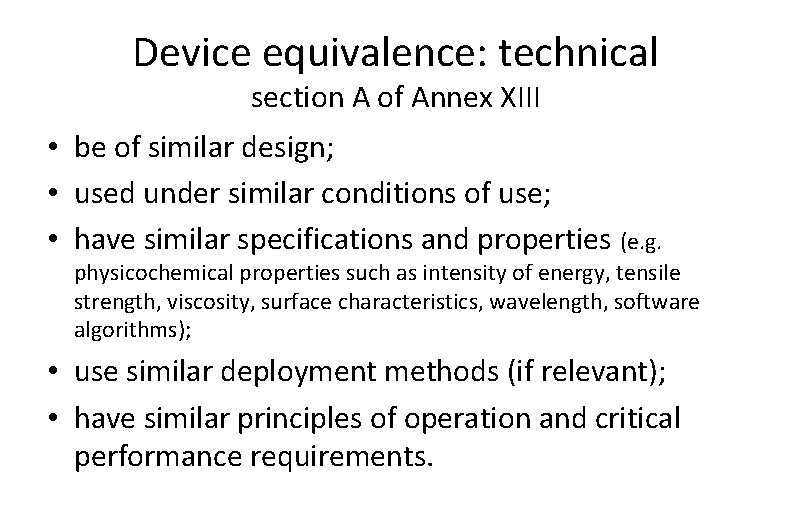
Device equivalence: technical section A of Annex XIII • be of similar design; • used under similar conditions of use; • have similar specifications and properties (e. g. physicochemical properties such as intensity of energy, tensile strength, viscosity, surface characteristics, wavelength, software algorithms); • use similar deployment methods (if relevant); • have similar principles of operation and critical performance requirements.
Device equivalence: biological section A of Annex XIII • Use same materials or substances • in contact with the same human tissues or body fluids • similar kind and duration of contact • similar release characteristics of substances, including degradation products and leachables.
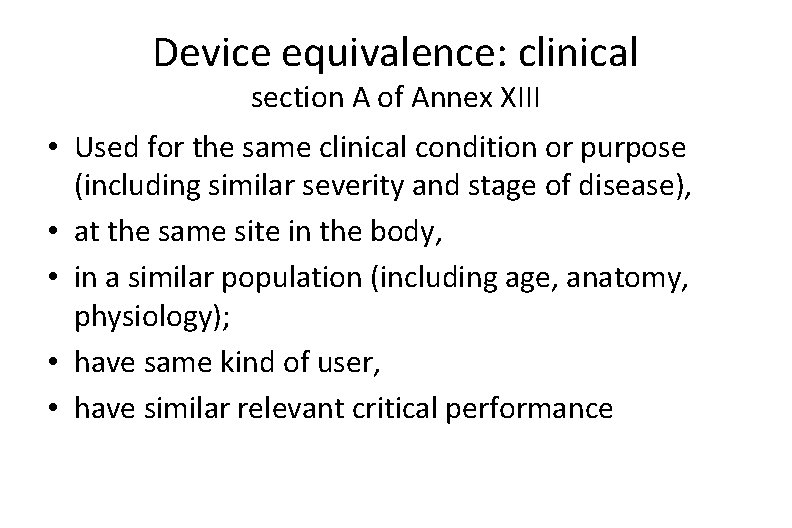
Device equivalence: clinical section A of Annex XIII • Used for the same clinical condition or purpose (including similar severity and stage of disease), • at the same site in the body, • in a similar population (including age, anatomy, physiology); • have same kind of user, • have similar relevant critical performance
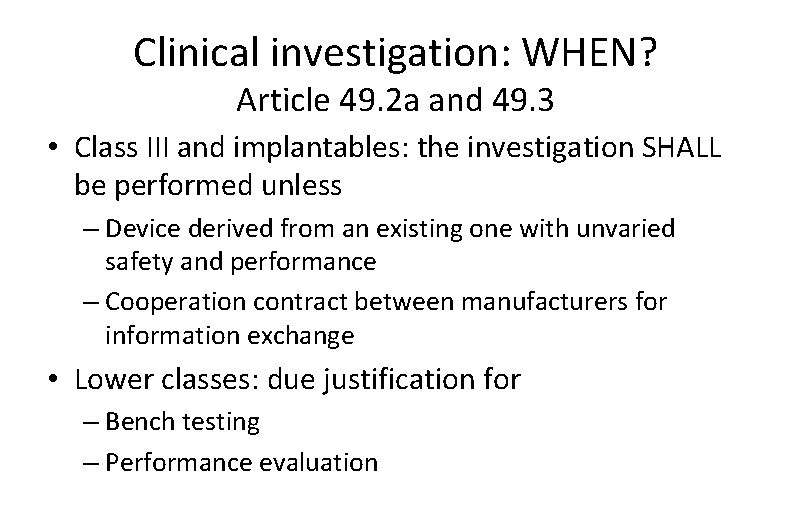
Clinical investigation: WHEN? Article 49. 2 a and 49. 3 • Class III and implantables: the investigation SHALL be performed unless – Device derived from an existing one with unvaried safety and performance – Cooperation contract between manufacturers for information exchange • Lower classes: due justification for – Bench testing – Performance evaluation
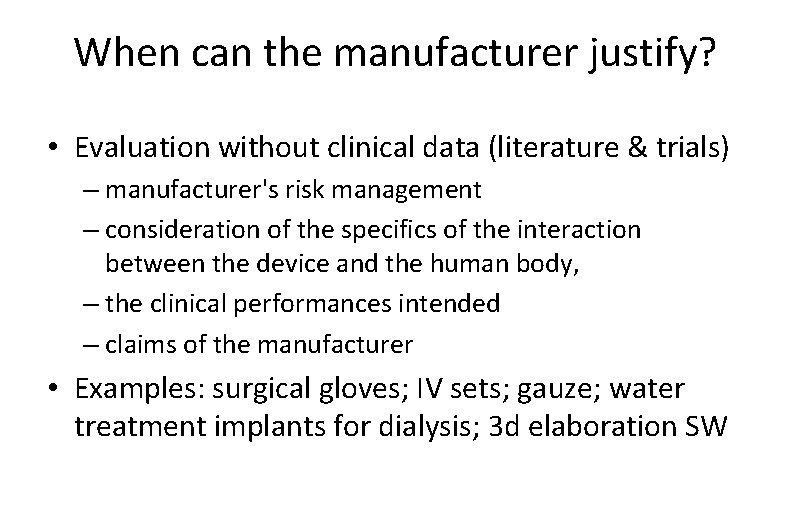
When can the manufacturer justify? • Evaluation without clinical data (literature & trials) – manufacturer's risk management – consideration of the specifics of the interaction between the device and the human body, – the clinical performances intended – claims of the manufacturer • Examples: surgical gloves; IV sets; gauze; water treatment implants for dialysis; 3 d elaboration SW
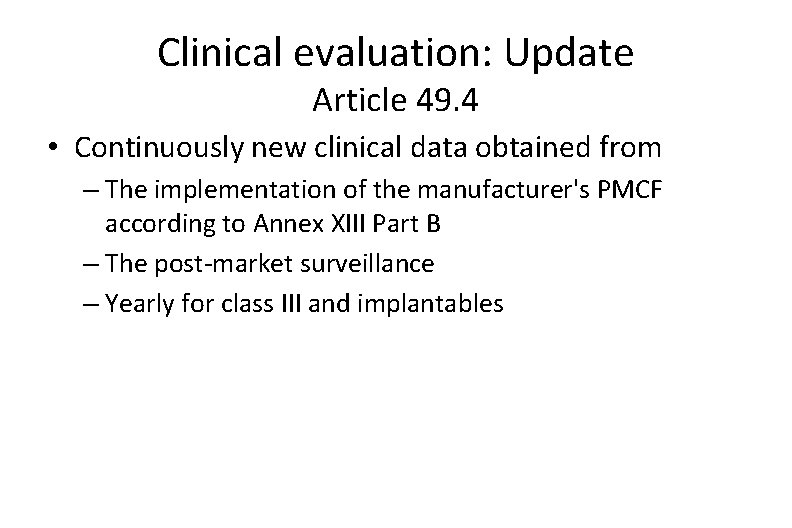
Clinical evaluation: Update Article 49. 4 • Continuously new clinical data obtained from – The implementation of the manufacturer's PMCF according to Annex XIII Part B – The post-market surveillance – Yearly for class III and implantables
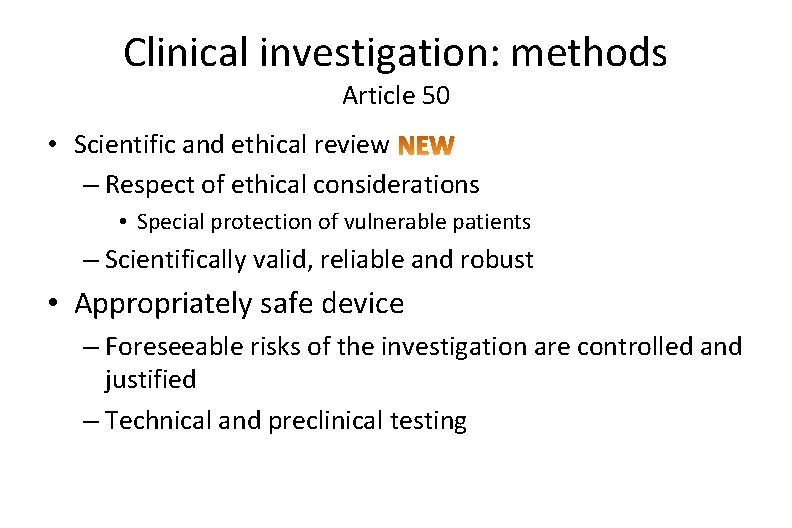
Clinical investigation: methods Article 50 • Scientific and ethical review – Respect of ethical considerations • Special protection of vulnerable patients – Scientifically valid, reliable and robust • Appropriately safe device – Foreseeable risks of the investigation are controlled and justified – Technical and preclinical testing
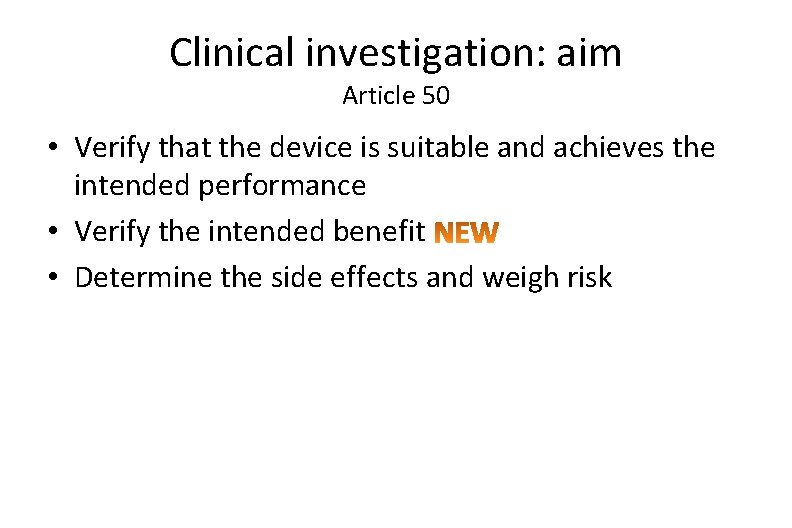
Clinical investigation: aim Article 50 • Verify that the device is suitable and achieves the intended performance • Verify the intended benefit • Determine the side effects and weigh risk
Clinical investigation: authorization Article 51 and 56 • Electronic application on EU databes – Class I, non invasive IIa and IIb: start after data validation in the database – Class III and all invasives: wait formal authorisation OR wait for 45 days • General database for all investigations – Exchange of information in the EU – Report of device deficiencies and incidents
PM investigations Article 54 • PMCFU Investigation: device is used according to its intended purpose – Any device or purpose modification lead to a full investigation procedure • Simple notification to the EU database
Adverse events Article 59 • Sponsor responsibility to record and report – Adverse (serious) events – Device deficiencies • EU data base of notificaitons
Clinical investigations planning Annex XIV • Study design – latest scientific and technical knowledge – confirm or refute the manufacturer's claims • Statistic relevance – adequate number of observations, – Sufficient number of intended users – Representative clinical environment – Trained operators
Expert opinion Article 49. 1 a • The manufacturer may, prior to its clinical evaluation and/or investigation, consult an expert panel – with the aim to review the manufacturer’s intended clinical evaluation development strategy and proposals for clinical investigation(s). • The manufacturer shall give due consideration to the views expressed by the expert panel.
Clinical investigations planning Annex XIV. 1 • Relationship between device features and subject outcome • Endpoints: – Benefits to patients – Performance of the device – Safety of the device • Appropriat training to users (Investigator Brochure)
Investigator brochure Annex XIV. 2 • Non clinical information – Identification and description – Risk classification – Manufacturing • Clinical information – Preclinical testing – Existing clinical data – Intended use during the investigation • Summary of risk benefit assessment and of RES
Contents of the plan Annex XIV. 3 • • Identification of CIP, sponsor, centers, … Device description and risks Objectives and hypotheses Design of the clinical investigation – Justification of its scientific robustness and validity – Control device / predicate device – Endpoints – Subjects
Contents of the plan Annex XIV. 3 • Monitoring plan • Follow up and management of any changes • Data management (including privacy and patient protection) – Informed consent – Publication of data • Safety reporting • Follow up on participants after study conclusion
Sponsor obligations • • • Data protection Monitoring of study and evidence of GCP Insurance (article 50 d) Reporting of adverse events in a timely manner Reporting of study outcome Filing for at least 15 years
Summary of safety and clinical performance (Article 26) • Devices classified as class III and implantable devices • Written for the layperson, available to the public via Eudamed – Uploaded by the NB – Reference in the label and IFU
Summary contents 1/2 Article 2. 1 a • (a) the identification of the device and the manufacturer, ; • (b) the intended purpose of the device, including indications, contra-indications and target populations; • (c) a description of the device, – reference to previous generation(s) or variants if such exist, and the description of the differences, – accessories, – other medical devices and other products that are not medical devices, which are intended to be used in combination
Summary contents 2/2 Article 2. 1 a • (d) suggested position in treatment options; • (e) reference to harmonized standards and common specifications; • (f) the summary of the clinical evaluation report • relevant information on the post-market clinical follow up; • (g) suggested profile and training for users; • (h) information on any residual risks and any undesirable effects, warnings and precautions.
Vigilance Article 61 • Electronic reporting system for – Serious adverse events – Field safety corrective actions • Stricter time limits as in the Meddev (example: 2 days for serious public health threat) • Reporting of dubious/ potential events • Allowed trend reports of similar events
Vigilance methods • Investigations to include a risk assessment of the incident and field safety corrective action • Manufacturer shall co-operate with the competent authorities and NB – No investigations that may alter the device • Final reporting in the electronic system to be evaluated by CA (risk assessment by CA)
Field safety notice contents Article 63. 5 • Contents to be revised by CA before release • Identification of the device (UDI), and of the manufacturer, including the SRN • Explain, in a clear manner, without playing down the level of risk, the reasons for field safety corrective action with reference to the device deficiency or malfunction and associated risks for patient, user or other person • Indicate all the actions to be taken • To be entered in the electronic system
POST-MARKET SURVEILLANCE Annex IIa • Post-market surveillance plan: a proactive and systematic process – Includes a post-market clinical follow-up plan according to Part B of Annex XIII – OR justification of waiving the PMS clinical follow-up • Periodic safety update report
PMS plan: proactive and systematic process • Gather, record data from various sources • Analyse data on quality, performance and safety (entire lifetime) – evaluate data with appropriate indicators/thresholds • Investigate complaints • Perform CA including tracing the involved devices
Which info? • serious incidents, including periodic safety update report, field safety corrective actions, trend reporting • records referred to not serious incident and data on any undesirable side effects, (complaints) • specialist or technical literature, databases and/or registers, • feedbacks and complaints: from users, distributors, importers, • public info about similar medical devices – Literature, congress, media, MAUDE, EUDAMED • data from the PM clinical follow up investigation (see following slides)
Outcome of plan • Draw conclusions and update – risk management, – Design, manufacturing, IFU – clinical evaluation, summary of safety and clinical performance • Contribute to own and other devices surveillance • Communicate effectively with CA, NB, economic operators, users and patients
POST-MARKET CLINICAL FOLLOW-UP Annex XIII part B • Continuous process to update the clinical evaluation – proactively collect and evaluate clinical data from the use according to the intended purpose • Part of the PM surveillance procedure
Aim: confirm the risk benefit ratio Annex XIII part B 2. 1 • (a) confirming the safety and performance of the device throughout its expected lifetime, • (b) identifying previously unknown side-effects and monitoring the identified side-effects and contra-indications, • (c) identifying and analysing emergent risks on the basis of factual evidence, • (d) assuring the continued acceptability of the benefit/risk ratio referred to in Sections 1 and 5 of Annex I, and • (e) identifying possible systematic misuse or off-label use of the device with a view to verify the correctness of its intended purpose.
PMCF plan contents 1/2 Annex XIII part B 2. 2 • Methods: – Clinical experience – Feedback from users (interview) – Literature (overlaps with the PMS plan) including • Registers and databases • Other PMCF studies • Justification of methods (risk based)
PMCF plan contents 2/2 Annex XIII part B 2. 2 • Reference to existing risk benefit ratio – Specific objectives of the study • Reference to standards applicable to the conduct of the study • Detailed and adequately justified time schedule for PMCF activities (e. g. analysis of PMCF data and reporting) to be undertaken by the manufacturer
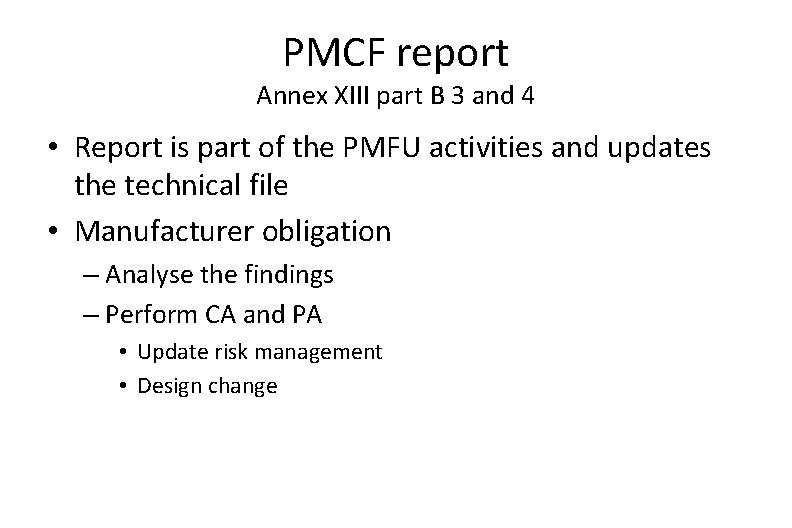
PMCF report Annex XIII part B 3 and 4 • Report is part of the PMFU activities and updates the technical file • Manufacturer obligation – Analyse the findings – Perform CA and PA • Update risk management • Design change
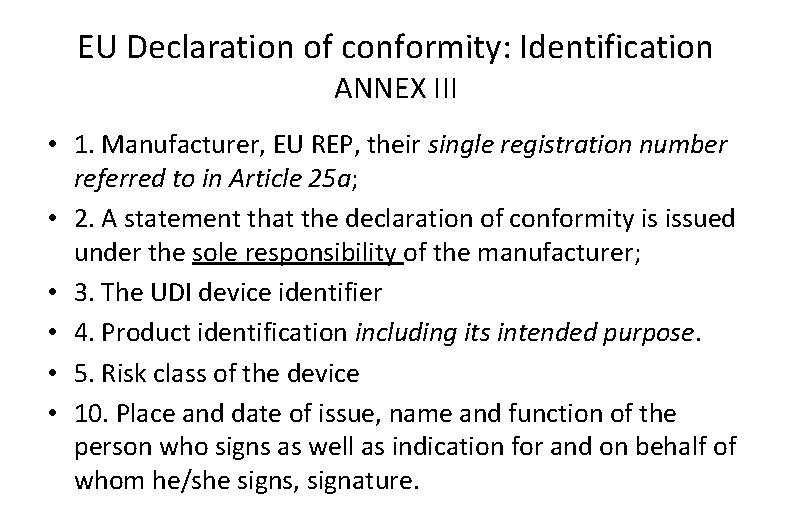
EU Declaration of conformity: Identification ANNEX III • 1. Manufacturer, EU REP, their single registration number referred to in Article 25 a; • 2. A statement that the declaration of conformity is issued under the sole responsibility of the manufacturer; • 3. The UDI device identifier • 4. Product identification including its intended purpose. • 5. Risk class of the device • 10. Place and date of issue, name and function of the person who signs as well as indication for and on behalf of whom he/she signs, signature.
EU Declaration of conformity: declarations ANNEX III • 6. A statement of conformity with Regulation and, any other Union legislation • 7. Relevant harmonised standards or CS used; • 8. Where applicable, name and identification number of the notified body, description of the conformity assessment procedure performed and identification of the certificate(s) issued; • 9. Where applicable, additional information;