
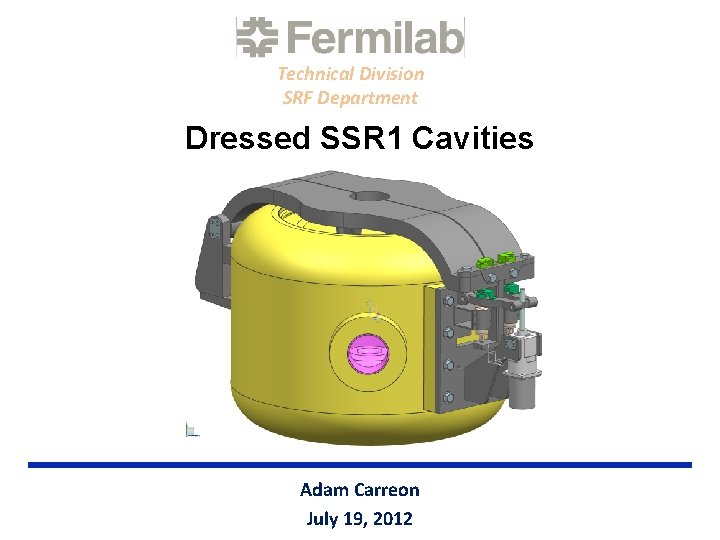
Technical Division SRF Department Dressed SSR 1 Cavities
- Slides: 27
Technical Division SRF Department Dressed SSR 1 Cavities Adam Carreon July 19, 2012
Assignments 1. Engineering Note • Learn the SSR 1 resonator’s components and their purpose (specifically helium pressure vessel) • Read and understand ASME Boiler and Pressure Vessel Code, Division 2: Design-By-Analysis • Create main body of Note from failure modes in ASME Code • Understand discuss material properties, system properties, CAD models, and other specifications to fill Note • Help perform analyses of failure modes and report results in Note 2. Tuner Support Arms • Understand how the tuner of a cavity works • Understand the support arms purpose in the tuner system • Get requirements for the support arms to begin theoretical design • Perform analyses on support arms in several phases SSR 1 cryomodule development for PXIE Page 2
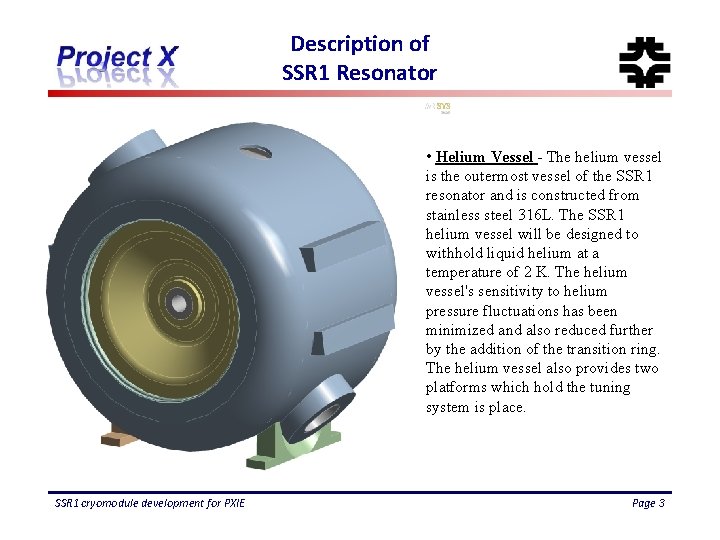
Description of SSR 1 Resonator • Helium Vessel - The helium vessel is the outermost vessel of the SSR 1 resonator and is constructed from stainless steel 316 L. The SSR 1 helium vessel will be designed to withhold liquid helium at a temperature of 2 K. The helium vessel's sensitivity to helium pressure fluctuations has been minimized and also reduced further by the addition of the transition ring. The helium vessel also provides two platforms which hold the tuning system is place. SSR 1 cryomodule development for PXIE Page 3
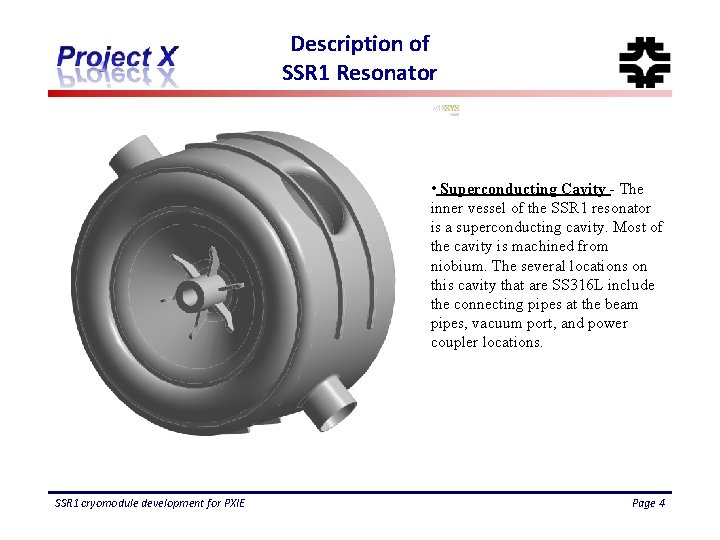
Description of SSR 1 Resonator • Superconducting Cavity - The inner vessel of the SSR 1 resonator is a superconducting cavity. Most of the cavity is machined from niobium. The several locations on this cavity that are SS 316 L include the connecting pipes at the beam pipes, vacuum port, and power coupler locations. SSR 1 cryomodule development for PXIE Page 4
ASME Boiler and Pressure Vessel Code In the Code's Section VIII, Div. 2, Part 5, one can find detailed design procedures that make use of the results from the stress analysis to test the system for plastic collapse, local failure, buckling, and cyclic loading. • Plastic Collapse - The analysis for this failure mode focuses on the internal pressure of the vessel and prevents plastic instability, ensuring that the pressure vessel does not experience plastic deformation that may lead to collapse. Also, the analysis avoids unbound displacement in each cross-section of the SSR 1 resonator. • Local Failure - The analysis for this failure mode focuses on the local strain limit for locations that have high stress values. It is a procedure to check and verify all the details of the SSR 1 resonator (i. e. joints). This analysis ensures that the pressure vessel does not experience fracturing under the designed loads. • Buckling - The analysis for this failure mode focuses on the compressive stress of the vessel. The failure is characterized by a sudden failure of a structural component subjected to a high compressive stress. A point of failure will occur where the actual compressive stress is greater than the ultimate compressive stress the material can withstand. • Cyclic Loading - The analysis for this failure mode focuses on vessel components that experience a cyclic operation. The purpose of this analysis is to make an evaluation for fatigue based on the number of cycles the vessel will experience. SSR 1 cryomodule development for PXIE Page 5
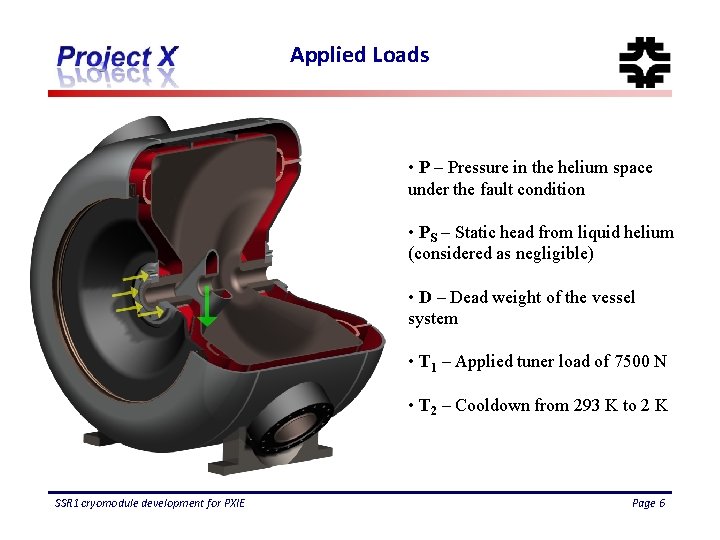
Applied Loads • P – Pressure in the helium space under the fault condition • PS – Static head from liquid helium (considered as negligible) • D – Dead weight of the vessel system • T 1 – Applied tuner load of 7500 N • T 2 – Cooldown from 293 K to 2 K SSR 1 cryomodule development for PXIE Page 6
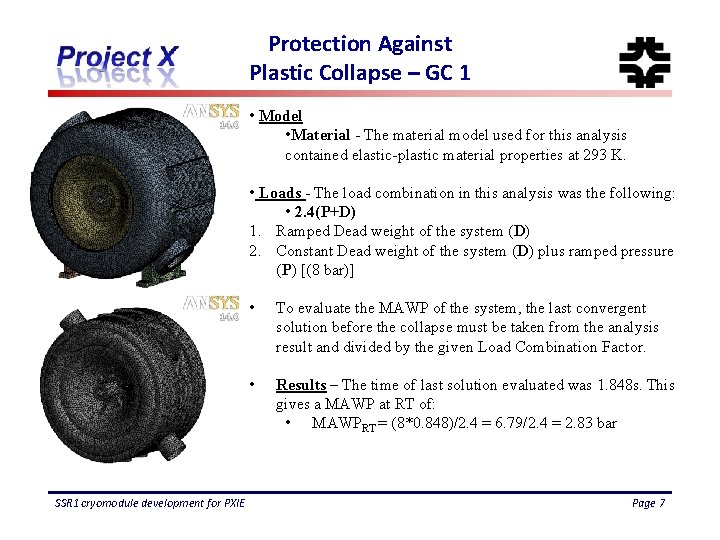
Protection Against Plastic Collapse – GC 1 • Model • Material - The material model used for this analysis contained elastic-plastic material properties at 293 K. • Loads - The load combination in this analysis was the following: • 2. 4(P+D) 1. Ramped Dead weight of the system (D) 2. Constant Dead weight of the system (D) plus ramped pressure (P) [(8 bar)] SSR 1 cryomodule development for PXIE • To evaluate the MAWP of the system, the last convergent solution before the collapse must be taken from the analysis result and divided by the given Load Combination Factor. • Results – The time of last solution evaluated was 1. 848 s. This gives a MAWP at RT of: • MAWPRT = (8*0. 848)/2. 4 = 6. 79/2. 4 = 2. 83 bar Page 7
Protection Against Plastic Collapse – GC 2 • Model – GC 2: RT • Material - The material model used for this analysis contained elasticplastic material properties at 293 K. • Model – GC 2: CT • Material - The material model used for this analysis contained elasticplastic material properties at 2 K. • Loads - The load combination in this analysis was the following: • 2. 1(P+D+T 1) 1. Ramped Dead weight of the system (D) plus ramped Tuner system forces (T 1) 2. Constant Dead weight of the system (D) plus ramped pressure (P) [(8 bar)] • Loads - The load combination in this analysis was the following: • 2. 1(P+D+T 1+T 2) 1. Ramped Dead weight of the system (D) plus ramped Thermal cooldown (T 2) 2. Constant Dead weight of the system (D) plus ramped pressure (P) [(20 bar)] • • Results – The time of last solution evaluated was 1. 731 s. This gives a MAWP at RT of: MAWPRT = (8*0. 731)/2. 1 = 5. 85/2. 1 = 2. 78 bar SSR 1 cryomodule development for PXIE Results – The time of last solution evaluated was 1. 94226 s. This gives a MAWP at CT of: MAWPCT = (20*0. 94226)/2. 1 = 18. 8/2. 1 = 8. 97 bar Page 8
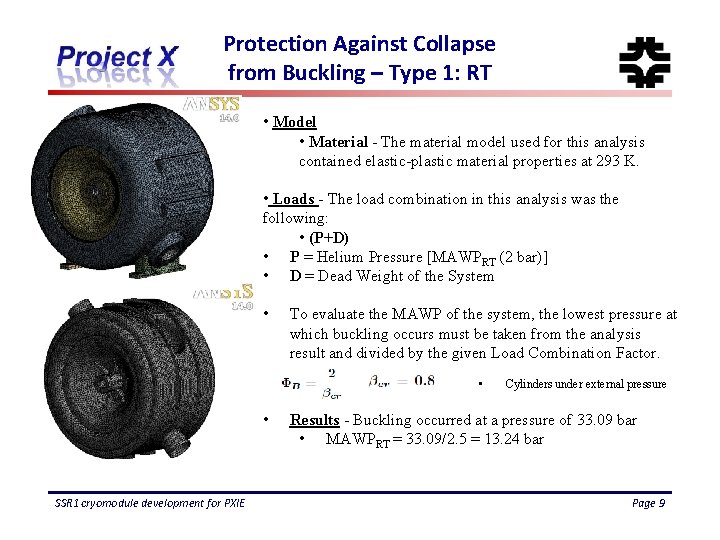
Protection Against Collapse from Buckling – Type 1: RT • Model • Material - The material model used for this analysis contained elastic-plastic material properties at 293 K. • Loads - The load combination in this analysis was the following: • (P+D) • P = Helium Pressure [MAWPRT (2 bar)] • D = Dead Weight of the System • To evaluate the MAWP of the system, the lowest pressure at which buckling occurs must be taken from the analysis result and divided by the given Load Combination Factor. • • SSR 1 cryomodule development for PXIE Cylinders under external pressure Results - Buckling occurred at a pressure of 33. 09 bar • MAWPRT = 33. 09/2. 5 = 13. 24 bar Page 9
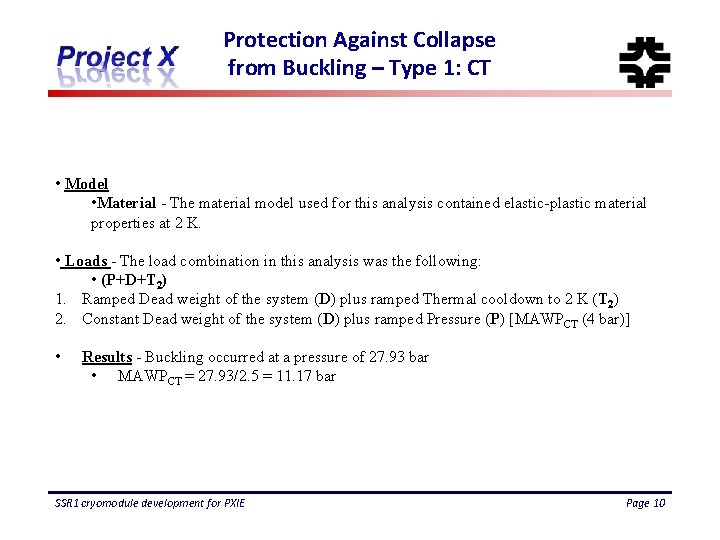
Protection Against Collapse from Buckling – Type 1: CT • Model • Material - The material model used for this analysis contained elastic-plastic material properties at 2 K. • Loads - The load combination in this analysis was the following: • (P+D+T 2) 1. Ramped Dead weight of the system (D) plus ramped Thermal cooldown to 2 K (T 2) 2. Constant Dead weight of the system (D) plus ramped Pressure (P) [MAWPCT (4 bar)] • Results - Buckling occurred at a pressure of 27. 93 bar • MAWPCT = 27. 93/2. 5 = 11. 17 bar SSR 1 cryomodule development for PXIE Page 10
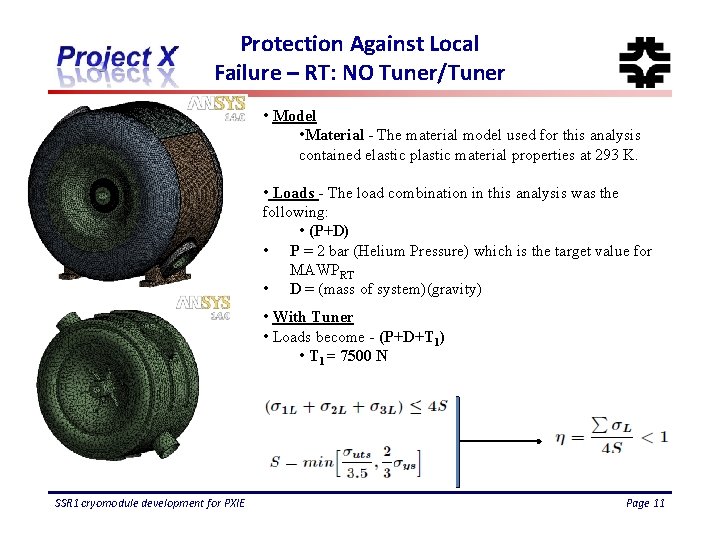
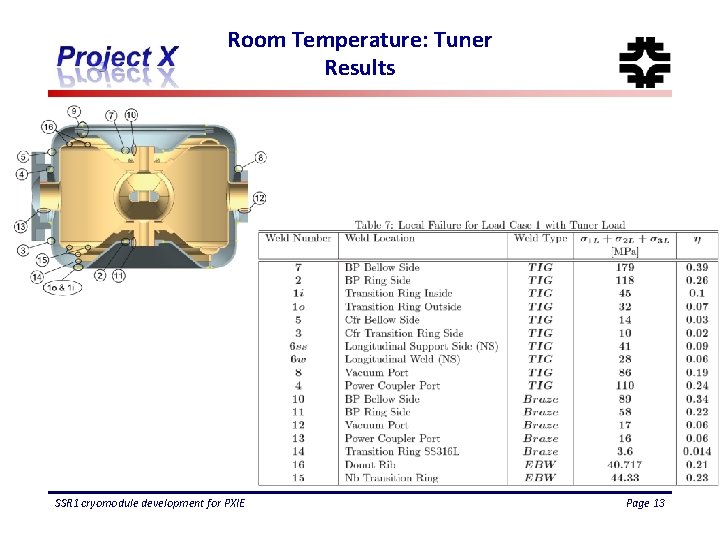
Protection Against Local Failure – RT: NO Tuner/Tuner • Model • Material - The material model used for this analysis contained elastic plastic material properties at 293 K. • Loads - The load combination in this analysis was the following: • (P+D) • P = 2 bar (Helium Pressure) which is the target value for MAWPRT • D = (mass of system)(gravity) • With Tuner • Loads become - (P+D+T 1) • T 1 = 7500 N SSR 1 cryomodule development for PXIE Page 11
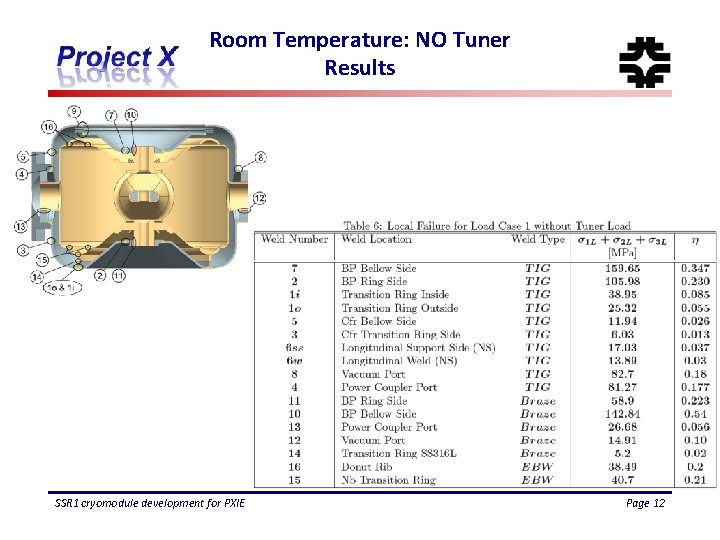
Room Temperature: NO Tuner Results SSR 1 cryomodule development for PXIE Page 12
Room Temperature: Tuner Results SSR 1 cryomodule development for PXIE Page 13
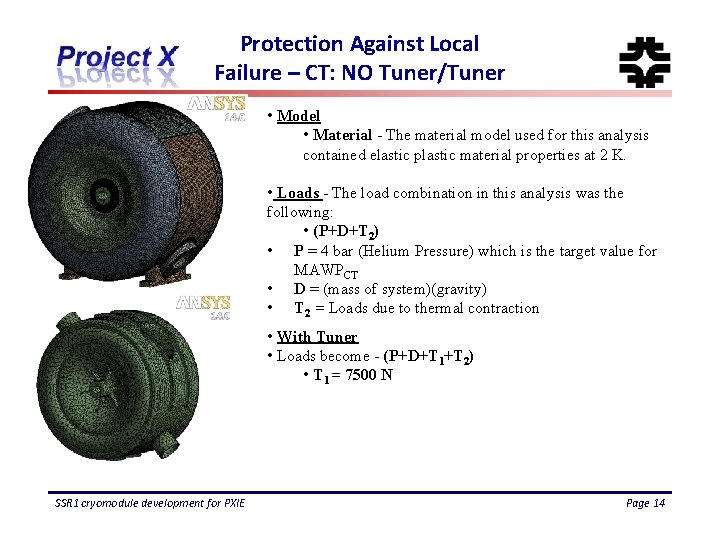
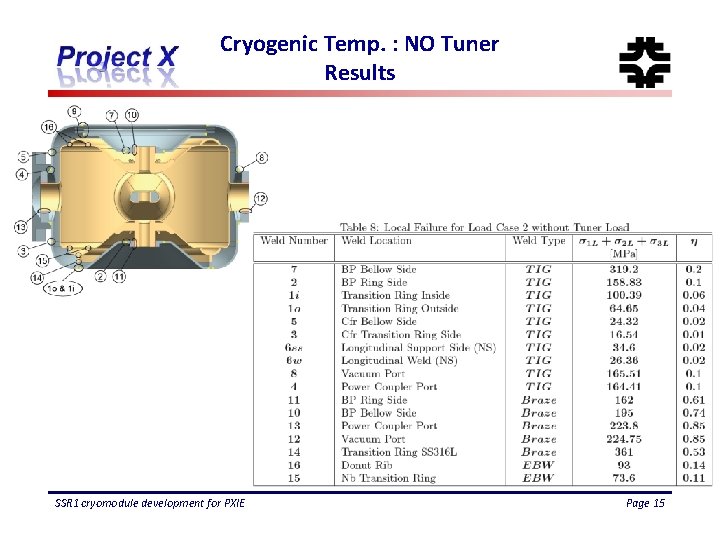
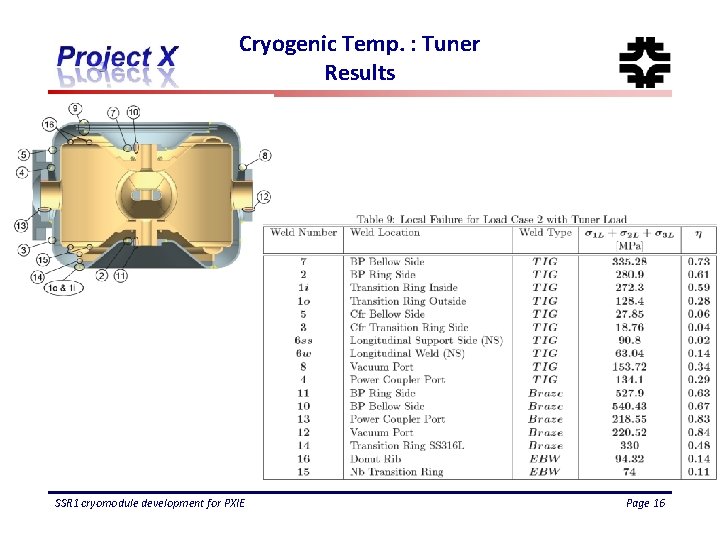
Protection Against Local Failure – CT: NO Tuner/Tuner • Model • Material - The material model used for this analysis contained elastic plastic material properties at 2 K. • Loads - The load combination in this analysis was the following: • (P+D+T 2) • P = 4 bar (Helium Pressure) which is the target value for MAWPCT • D = (mass of system)(gravity) • T 2 = Loads due to thermal contraction • With Tuner • Loads become - (P+D+T 1+T 2) • T 1 = 7500 N SSR 1 cryomodule development for PXIE Page 14
Cryogenic Temp. : NO Tuner Results SSR 1 cryomodule development for PXIE Page 15
Cryogenic Temp. : Tuner Results SSR 1 cryomodule development for PXIE Page 16
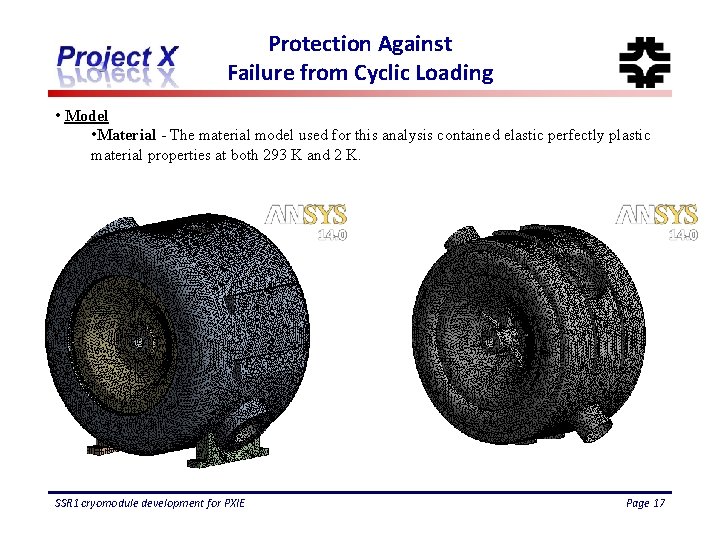
Protection Against Failure from Cyclic Loading • Model • Material - The material model used for this analysis contained elastic perfectly plastic material properties at both 293 K and 2 K. SSR 1 cryomodule development for PXIE Page 17
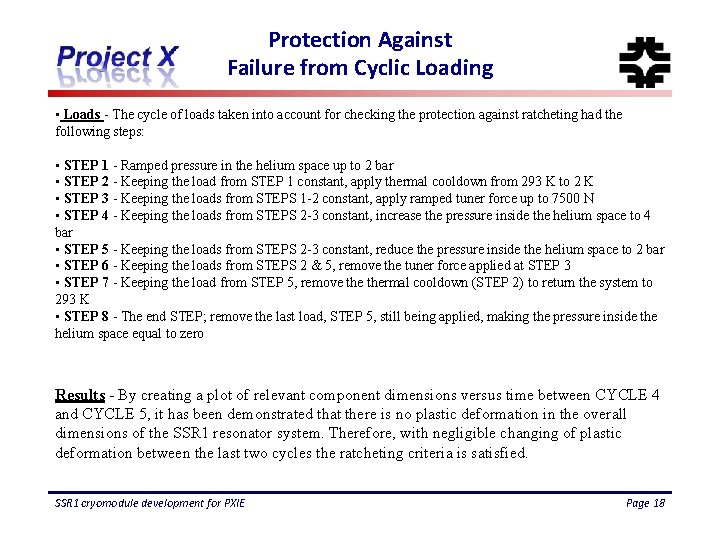
Protection Against Failure from Cyclic Loading • Loads - The cycle of loads taken into account for checking the protection against ratcheting had the following steps: • STEP 1 - Ramped pressure in the helium space up to 2 bar • STEP 2 - Keeping the load from STEP 1 constant, apply thermal cooldown from 293 K to 2 K • STEP 3 - Keeping the loads from STEPS 1 -2 constant, apply ramped tuner force up to 7500 N • STEP 4 - Keeping the loads from STEPS 2 -3 constant, increase the pressure inside the helium space to 4 bar • STEP 5 - Keeping the loads from STEPS 2 -3 constant, reduce the pressure inside the helium space to 2 bar • STEP 6 - Keeping the loads from STEPS 2 & 5, remove the tuner force applied at STEP 3 • STEP 7 - Keeping the load from STEP 5, remove thermal cooldown (STEP 2) to return the system to 293 K • STEP 8 - The end STEP; remove the last load, STEP 5, still being applied, making the pressure inside the helium space equal to zero Results - By creating a plot of relevant component dimensions versus time between CYCLE 4 and CYCLE 5, it has been demonstrated that there is no plastic deformation in the overall dimensions of the SSR 1 resonator system. Therefore, with negligible changing of plastic deformation between the last two cycles the ratcheting criteria is satisfied. SSR 1 cryomodule development for PXIE Page 18
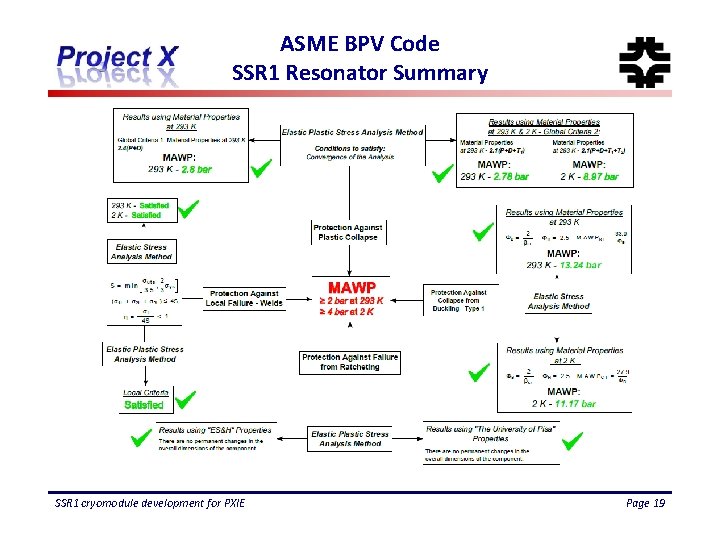
ASME BPV Code SSR 1 Resonator Summary SSR 1 cryomodule development for PXIE Page 19
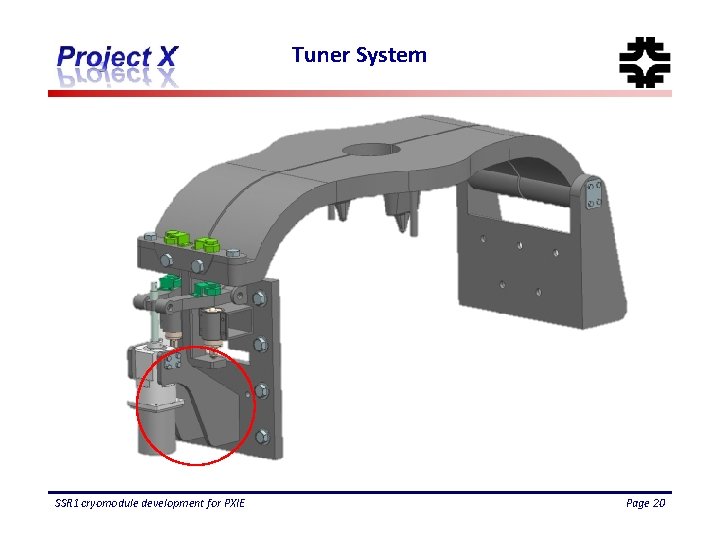
Tuner System SSR 1 cryomodule development for PXIE Page 20
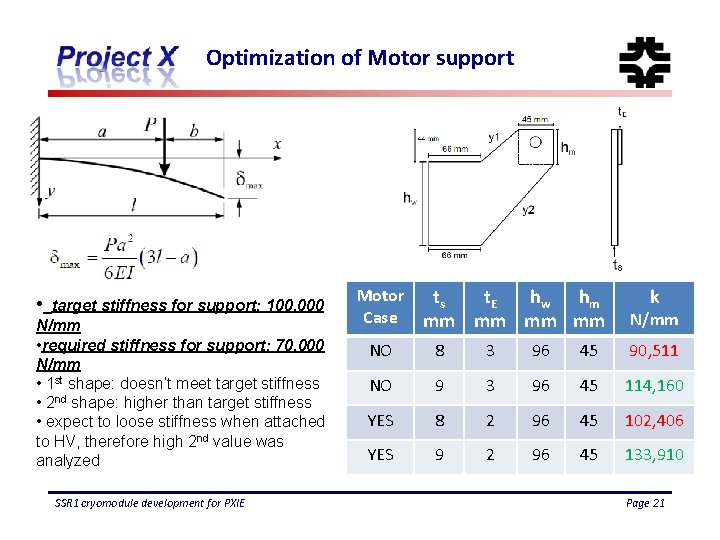
Optimization of Motor support • target stiffness for support: 100, 000 N/mm • required stiffness for support: 70, 000 N/mm • 1 st shape: doesn’t meet target stiffness • 2 nd shape: higher than target stiffness • expect to loose stiffness when attached to HV, therefore high 2 nd value was analyzed SSR 1 cryomodule development for PXIE Motor Case ts t. E hw hm mm mm k N/mm NO 8 3 96 45 90, 511 NO 9 3 96 45 114, 160 YES 8 2 96 45 102, 406 YES 9 2 96 45 133, 910 Page 21
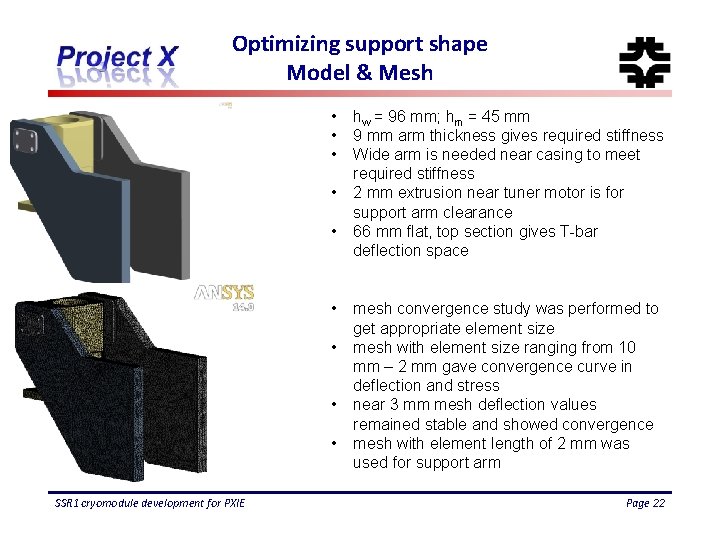
Optimizing support shape Model & Mesh • • • SSR 1 cryomodule development for PXIE hw = 96 mm; hm = 45 mm 9 mm arm thickness gives required stiffness Wide arm is needed near casing to meet required stiffness 2 mm extrusion near tuner motor is for support arm clearance 66 mm flat, top section gives T-bar deflection space mesh convergence study was performed to get appropriate element size mesh with element size ranging from 10 mm – 2 mm gave convergence curve in deflection and stress near 3 mm mesh deflection values remained stable and showed convergence mesh with element length of 2 mm was used for support arm Page 22
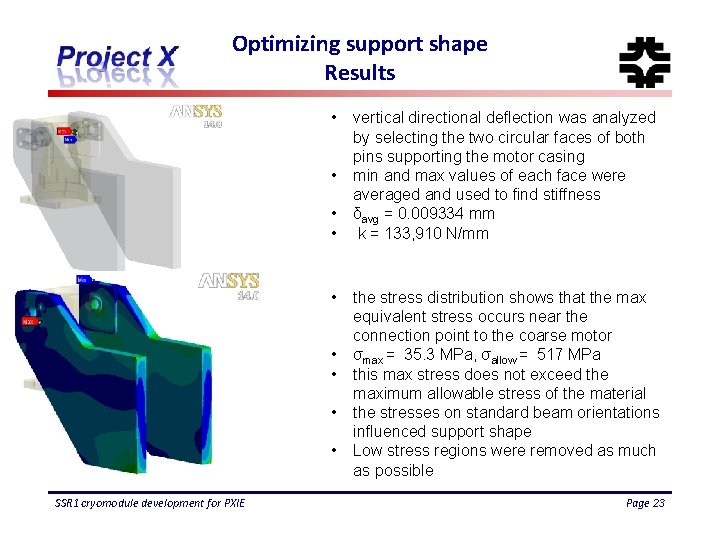
Optimizing support shape Results • • • SSR 1 cryomodule development for PXIE vertical directional deflection was analyzed by selecting the two circular faces of both pins supporting the motor casing min and max values of each face were averaged and used to find stiffness δavg = 0. 009334 mm k = 133, 910 N/mm the stress distribution shows that the max equivalent stress occurs near the connection point to the coarse motor σmax = 35. 3 MPa, σallow = 517 MPa this max stress does not exceed the maximum allowable stress of the material the stresses on standard beam orientations influenced support shape Low stress regions were removed as much as possible Page 23
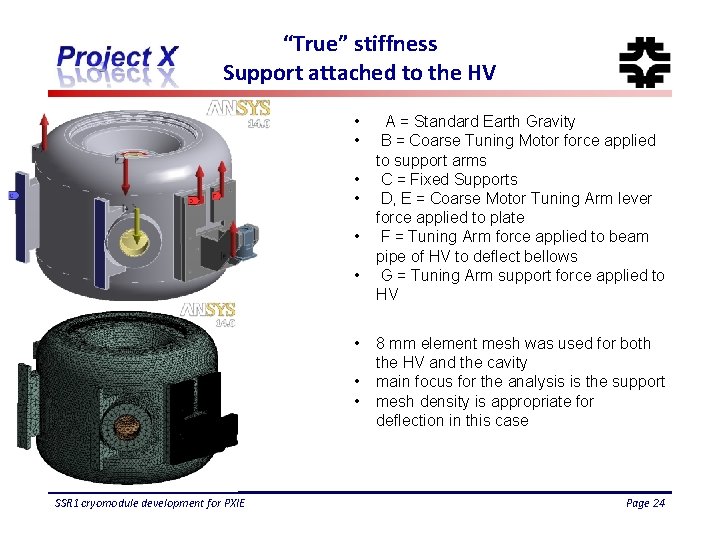
“True” stiffness Support attached to the HV • • • SSR 1 cryomodule development for PXIE A = Standard Earth Gravity B = Coarse Tuning Motor force applied to support arms C = Fixed Supports D, E = Coarse Motor Tuning Arm lever force applied to plate F = Tuning Arm force applied to beam pipe of HV to deflect bellows G = Tuning Arm support force applied to HV 8 mm element mesh was used for both the HV and the cavity main focus for the analysis is the support mesh density is appropriate for deflection in this case Page 24
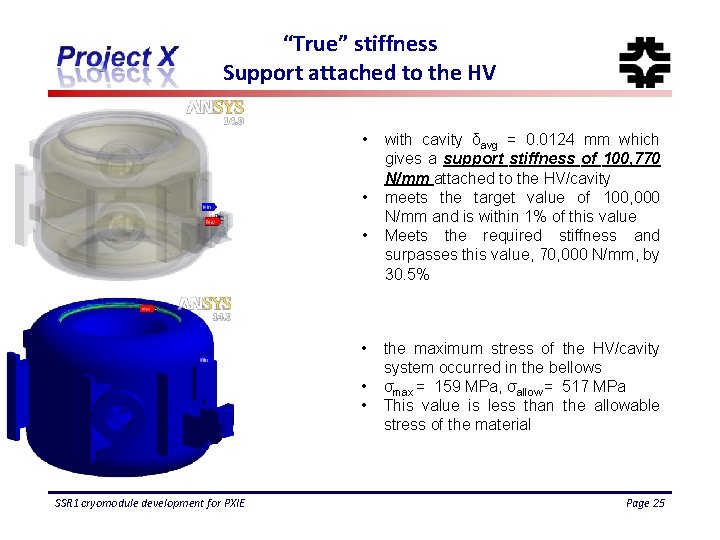
“True” stiffness Support attached to the HV • • • SSR 1 cryomodule development for PXIE with cavity δavg = 0. 0124 mm which gives a support stiffness of 100, 770 N/mm attached to the HV/cavity meets the target value of 100, 000 N/mm and is within 1% of this value Meets the required stiffness and surpasses this value, 70, 000 N/mm, by 30. 5% the maximum stress of the HV/cavity system occurred in the bellows σmax = 159 MPa, σallow = 517 MPa This value is less than the allowable stress of the material Page 25
Acknowledgements Leonardo Ristori Donato Passarelli Margherita Merio SIST Committee Members SSR 1 cryomodule development for PXIE Page 26
Thank You QUESTIONS? SSR 1 cryomodule development for PXIE Page 27