
TECHNICAL COMMUNICATION WRITING as a PROCESS 2 SIMILARITIES







- Slides: 68
TECHNICAL COMMUNICATION WRITING as a PROCESS
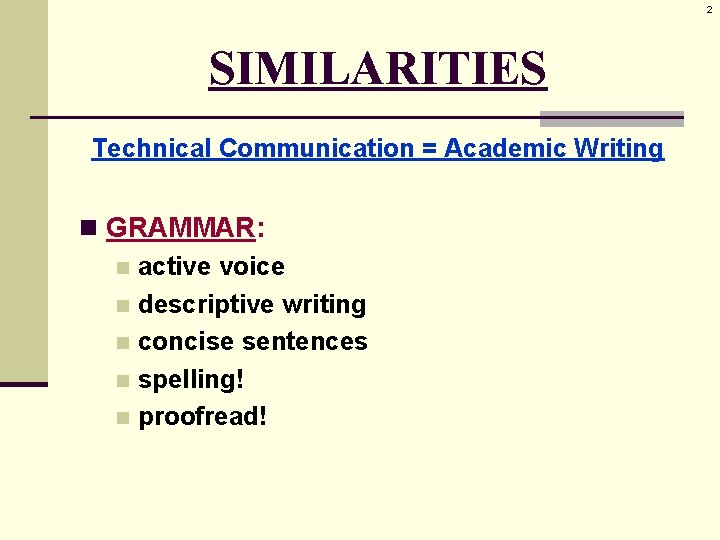
2 SIMILARITIES Technical Communication = Academic Writing n GRAMMAR: n active voice n descriptive writing n concise sentences n spelling! n proofread!
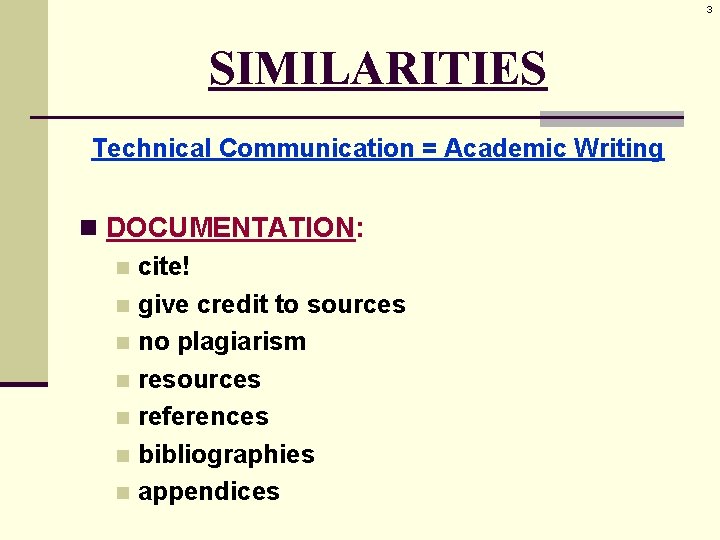
3 SIMILARITIES Technical Communication = Academic Writing n DOCUMENTATION: n cite! n give credit to sources n no plagiarism n resources n references n bibliographies n appendices
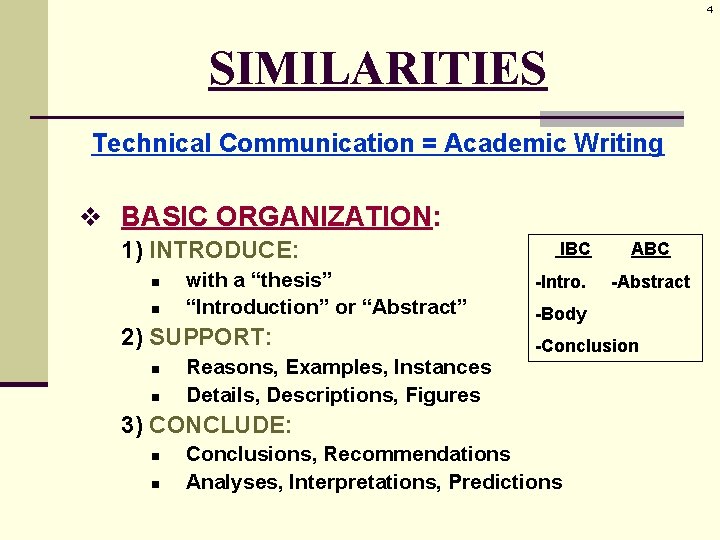
4 SIMILARITIES Technical Communication = Academic Writing v BASIC ORGANIZATION: 1) INTRODUCE: n n with a “thesis” “Introduction” or “Abstract” 2) SUPPORT: n n Reasons, Examples, Instances Details, Descriptions, Figures IBC -Intro. n -Abstract -Body -Conclusion 3) CONCLUDE: n ABC Conclusions, Recommendations Analyses, Interpretations, Predictions
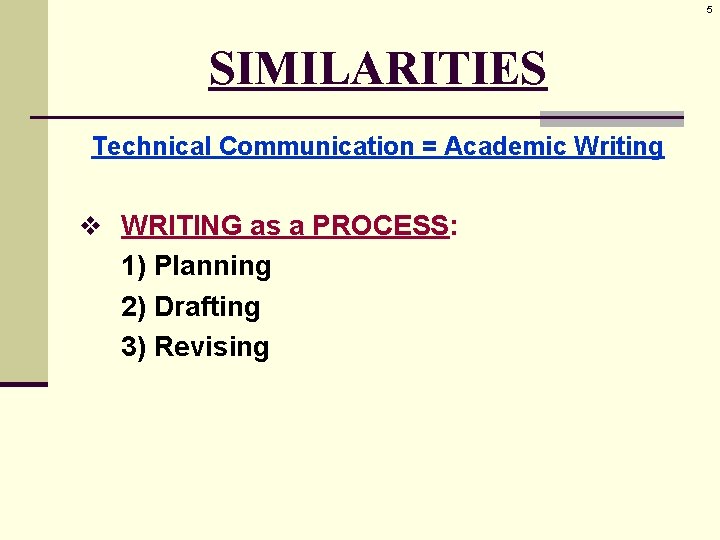
5 SIMILARITIES Technical Communication = Academic Writing v WRITING as a PROCESS: 1) Planning 2) Drafting 3) Revising
I. PLANNING
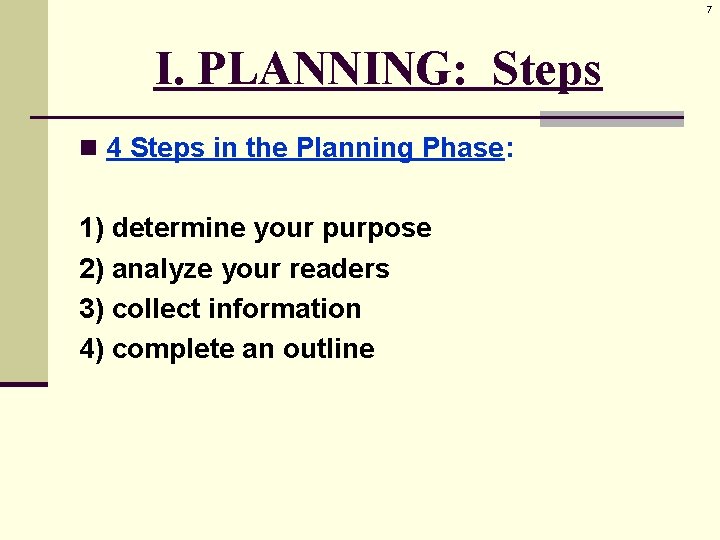
7 I. PLANNING: Steps n 4 Steps in the Planning Phase: 1) determine your purpose 2) analyze your readers 3) collect information 4) complete an outline
8 I. PLANNING: 1) Purpose
9 I. PLANNING: Purpose n Determining your Purpose: n Answer: n Why am I writing this? § This memo will … § To inform § To persuade n What response do I want? § Persuasion § Awareness § Action
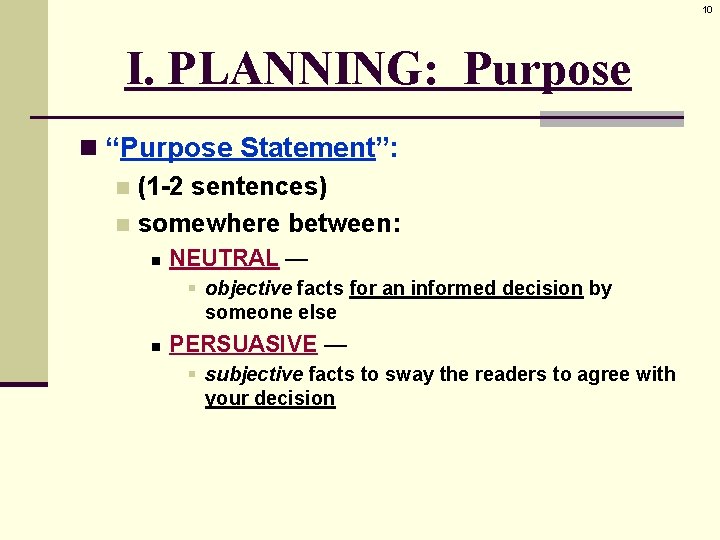
10 I. PLANNING: Purpose n “Purpose Statement”: n (1 -2 sentences) n somewhere between: n NEUTRAL — § objective facts for an informed decision by someone else n PERSUASIVE — § subjective facts to sway the readers to agree with your decision
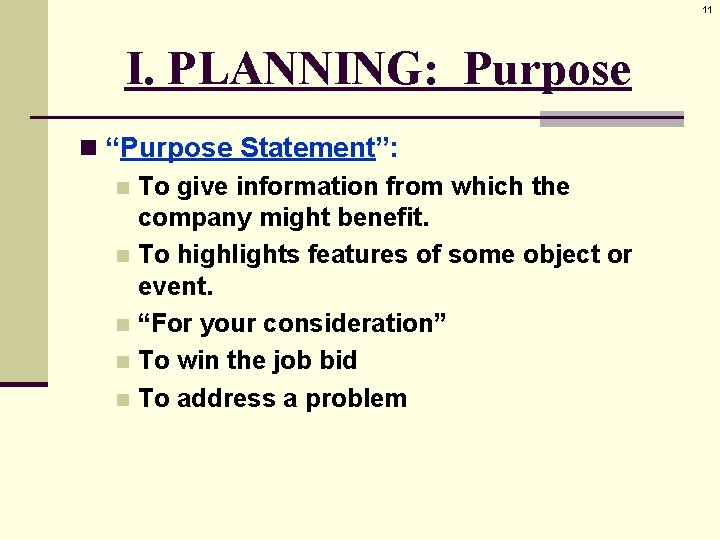
11 I. PLANNING: Purpose n “Purpose Statement”: n To give information from which the company might benefit. n To highlights features of some object or event. n “For your consideration” n To win the job bid n To address a problem
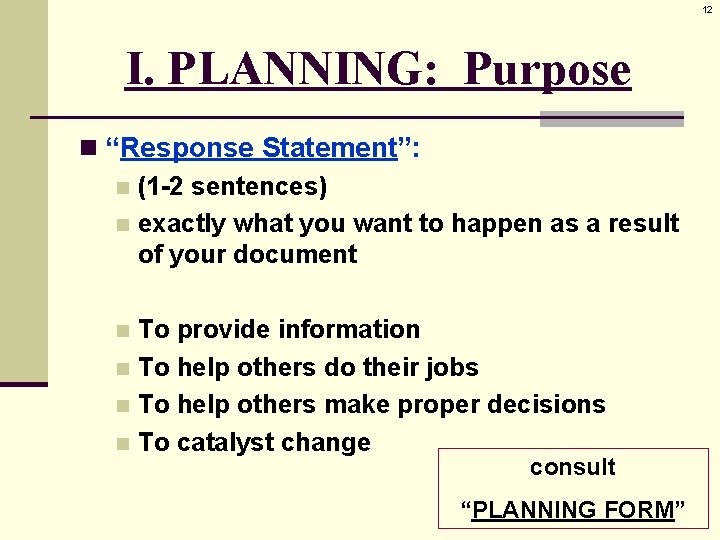
12 I. PLANNING: Purpose n “Response Statement”: n (1 -2 sentences) n exactly what you want to happen as a result of your document To provide information n To help others do their jobs n To help others make proper decisions n To catalyst change n consult “PLANNING FORM”
13 I. PLANNING: 2) Reader Analysis
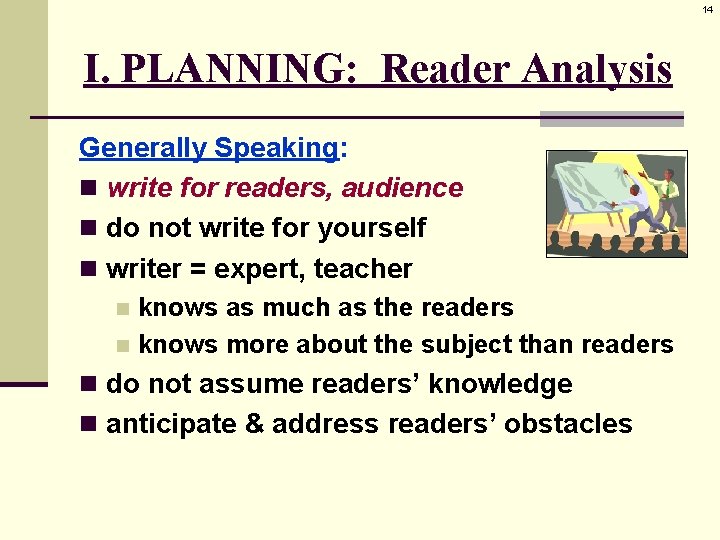
14 I. PLANNING: Reader Analysis Generally Speaking: n write for readers, audience n do not write for yourself n writer = expert, teacher knows as much as the readers n knows more about the subject than readers n n do not assume readers’ knowledge n anticipate & address readers’ obstacles
15 I. PLANNING: Reader Analysis OBSTACLES n Problems for the readers: n constant interruptions n n n phone calls emails conferences meetings impatience with finding information n n difficult to locate no lists, headings, graphics
16 I. PLANNING: Reader Analysis OBSTACLES n Problems for the readers: n different technological background from the writer n n n lost in technical sophistication missing definitions for technical terms decision-making = shared with others n n n more than 1 reader superiors committee
17 I. PLANNING: Reader Analysis 1) Write what you know about the reader: n What is the person’s technical, educational background? n What main question does the person need answered? n What main actions do you want the reader to take?
18 I. PLANNING: Reader Analysis 1) Write what you know about the reader: n What is her/his personality and how might it affect the reading? n What are the person’s preferences in terms of format n style n organization? n consult “PLANNING FORM”
19 I. PLANNING: Reader Analysis 2) Talk to colleagues who have written to this reader: n fellow office personnel n search company files n take notes
20 I. PLANNING: Reader Analysis 3) Find out who makes the decisions: n decision-makers = most important readers n design your document with them in mind
21 I. PLANNING: Reader Analysis 4) KISS: n Keep It Short and Simple. n concise, simple writing n write to cross ALL technical backgrounds n translate technical ideas into language that non-technical people will understand: YOU = EDUCATOR n write with technical sophistication n BUT in “plain language” n
22 I. PLANNING: Reader Analysis PLAIN LANGUAGE TRAITS: n simplistic: n straightforward, clear, precise n not necessarily baby-talk not necessarily dumbing-down common, everyday words, n except for necessary technical terms “you” and other pronouns n active voice n short sentences n
23 I. PLANNING: Reader Analysis PLAIN LANGUAGE TRAITS: n simplistic: “user-friendly” documents n “readability” n “laymen’s terms” n
24 I. PLANNING: Reader Analysis PLAIN LANGUAGE TRAITS: n antithesis of: “gobbledygook” n “doublespeak” n “lawyer-ese” n “tax-code” n
25 I. PLANNING: Reader Analysis PLAIN LANGUAGE BENEFITS: n Readers understand documents better. n Readers locate information faster. n Documents are easier to update. n Documents are more cost-effective. n It is easier to train people.
26 I. PLANNING: Reader Analysis TYPES of READERS: 1) Managers 2) Experts 3) Operators 4) General Readers
27 I. PLANNING: Reader Analysis TYPES of READERS: 1) Managers’ traits: n removed from hands-on technological details n manage people, set budgets, make decisions n NOT familiar with fine technological points n forgot details of your project
28 I. PLANNING: Reader Analysis TYPES of READERS: 1) Managers’ needs: n background information n definitions of technical terms n highlights – lists and other format devices that emphasize the main points n clear statements about what happens next
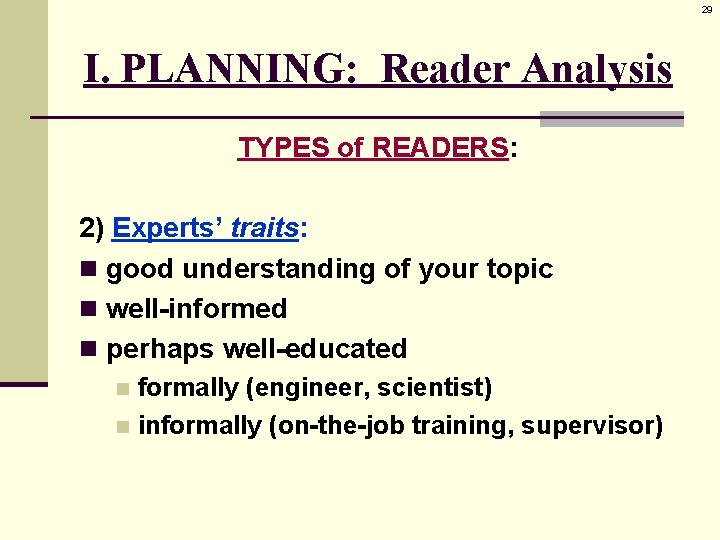
29 I. PLANNING: Reader Analysis TYPES of READERS: 2) Experts’ traits: n good understanding of your topic n well-informed n perhaps well-educated formally (engineer, scientist) n informally (on-the-job training, supervisor) n
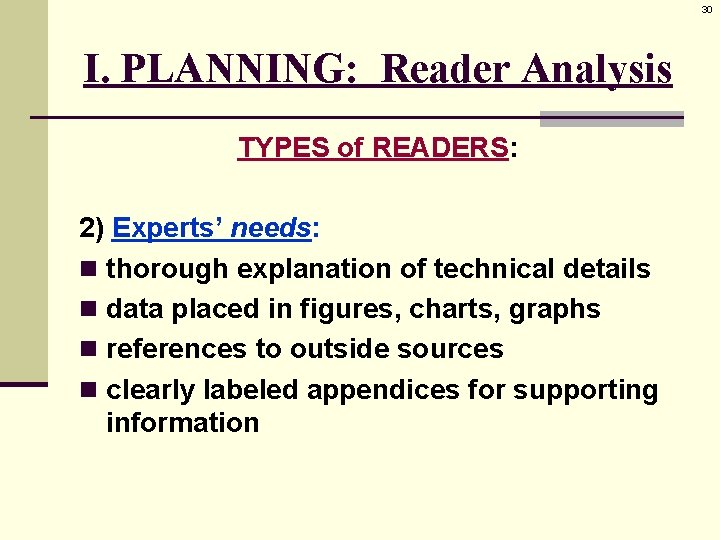
30 I. PLANNING: Reader Analysis TYPES of READERS: 2) Experts’ needs: n thorough explanation of technical details n data placed in figures, charts, graphs n references to outside sources n clearly labeled appendices for supporting information
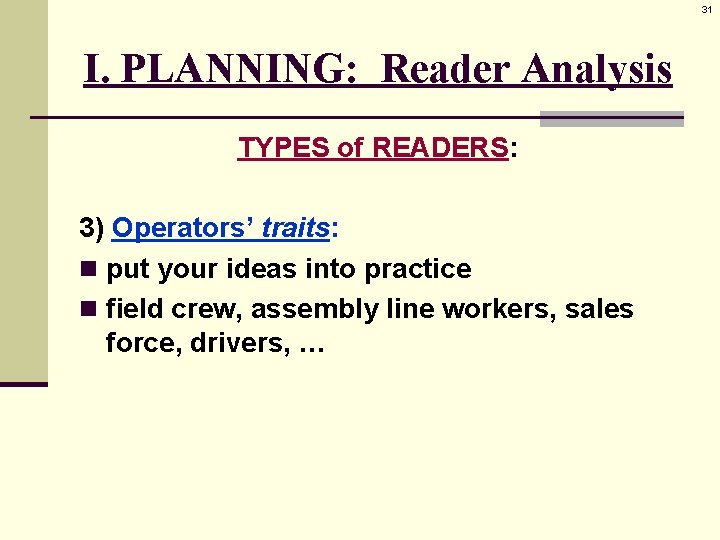
31 I. PLANNING: Reader Analysis TYPES of READERS: 3) Operators’ traits: n put your ideas into practice n field crew, assembly line workers, sales force, drivers, …
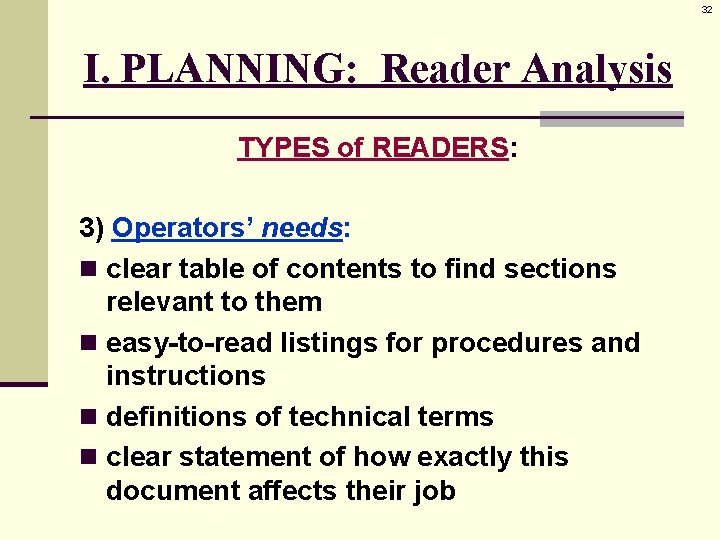
32 I. PLANNING: Reader Analysis TYPES of READERS: 3) Operators’ needs: n clear table of contents to find sections relevant to them n easy-to-read listings for procedures and instructions n definitions of technical terms n clear statement of how exactly this document affects their job
33 I. PLANNING: Reader Analysis TYPES of READERS: 4) General Readers’ traits: n possess the least amount of knowledge regarding your topic, field n “lay persons” n little technical understanding
34 I. PLANNING: Reader Analysis TYPES of READERS: 4) General Readers’ needs: n definitions of technical terms n (3 of 4 reader-types) n frequent use of graphs, charts, photos n clear distinction between fact and opinion n assurance that nothing has been omitted n (card stacking)
35 I. PLANNING: Reader Analysis LEVELS of DECISION-MAKERS: 1) Decision-Makers: n MUST act, accept, reject n translate information into action n Examples: usually managers n also technical experts n committees n
36 I. PLANNING: Reader Analysis LEVELS of DECISION-MAKERS: 2) Advisors: n influencers n expert advice n Examples: engineers n accountants n
37 I. PLANNING: Reader Analysis LEVELS of DECISION-MAKERS: 3) Receivers: n only “receive” information n no decision-making n put changes/plans into effect n Examples: “operators” (#3) n store managers n
38 I. PLANNING: Planning Form
39 I. PLANNING: 3) Research
40 I. PLANNING: Research n Information Collection n Data Retrieval
41 I. PLANNING: Research 1) Determine what kind of research you need: n Which will be the most helpful to support your project goals? • PRIMARY research • SECONDARY research
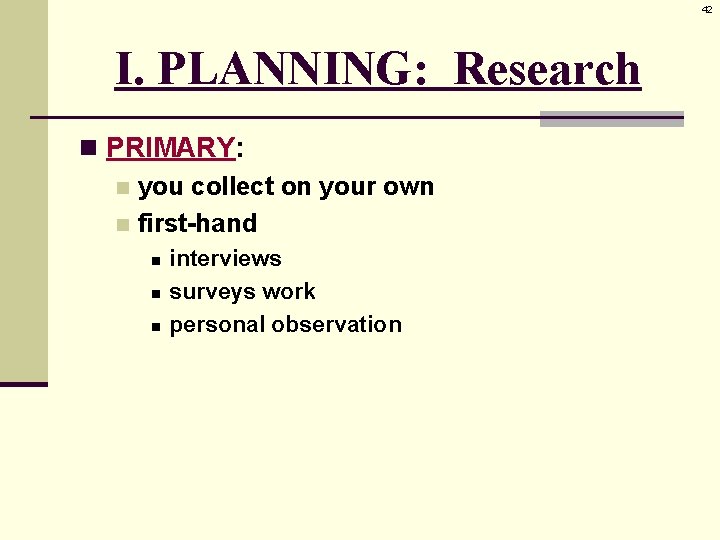
42 I. PLANNING: Research n PRIMARY: n you collect on your own n first-hand n n n interviews surveys work personal observation
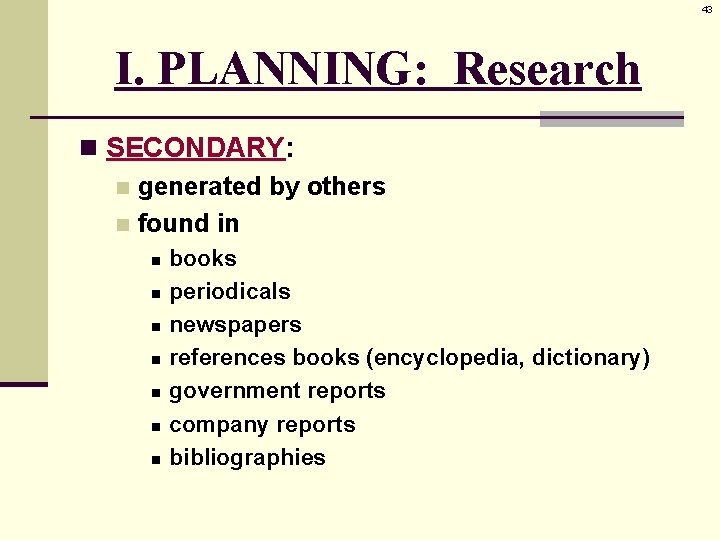
43 I. PLANNING: Research n SECONDARY: n generated by others n found in n n n books periodicals newspapers references books (encyclopedia, dictionary) government reports company reports bibliographies
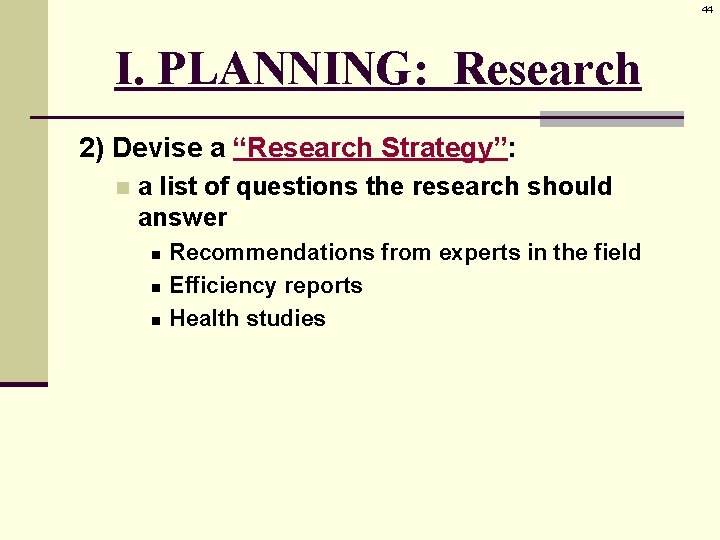
44 I. PLANNING: Research 2) Devise a “Research Strategy”: n a list of questions the research should answer n n n Recommendations from experts in the field Efficiency reports Health studies
45 I. PLANNING: 4) Outline
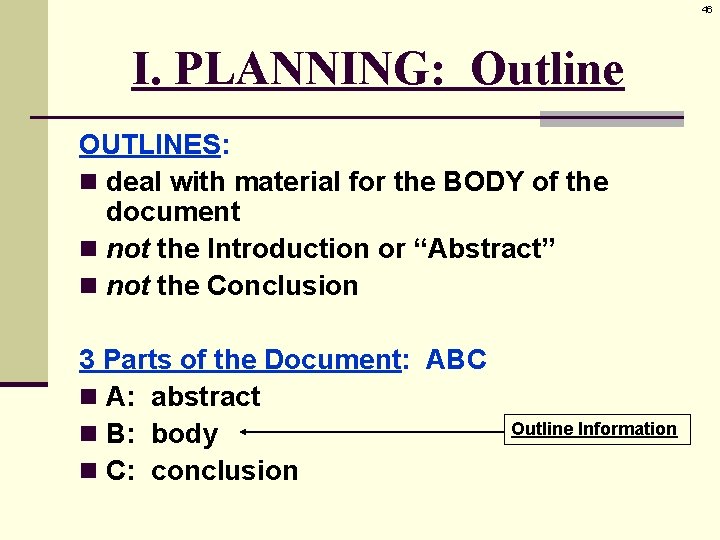
46 I. PLANNING: Outline OUTLINES: n deal with material for the BODY of the document n not the Introduction or “Abstract” n not the Conclusion 3 Parts of the Document: ABC n A: abstract n B: body n C: conclusion Outline Information
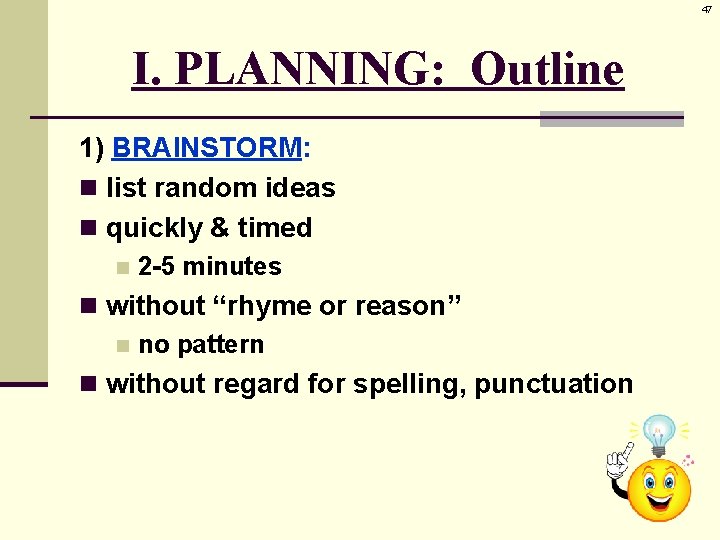
47 I. PLANNING: Outline 1) BRAINSTORM: n list random ideas n quickly & timed n 2 -5 minutes n without “rhyme or reason” n no pattern n without regard for spelling, punctuation
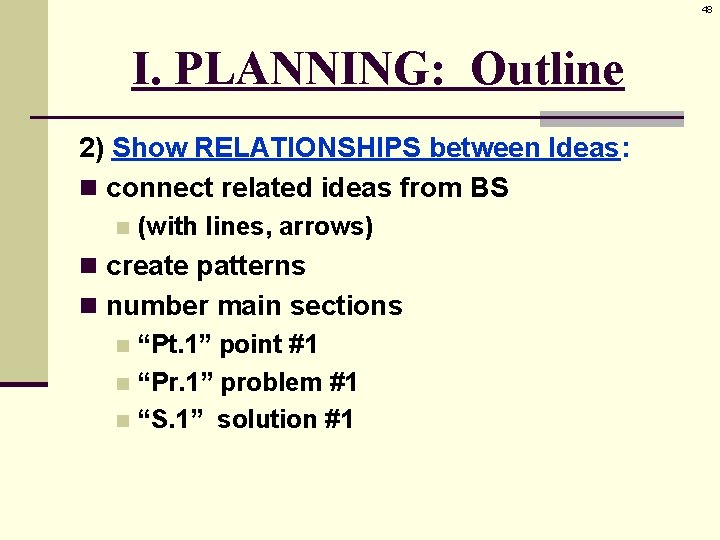
48 I. PLANNING: Outline 2) Show RELATIONSHIPS between Ideas: n connect related ideas from BS n (with lines, arrows) n create patterns n number main sections n “Pt. 1” point #1 n “Pr. 1” problem #1 n “S. 1” solution #1
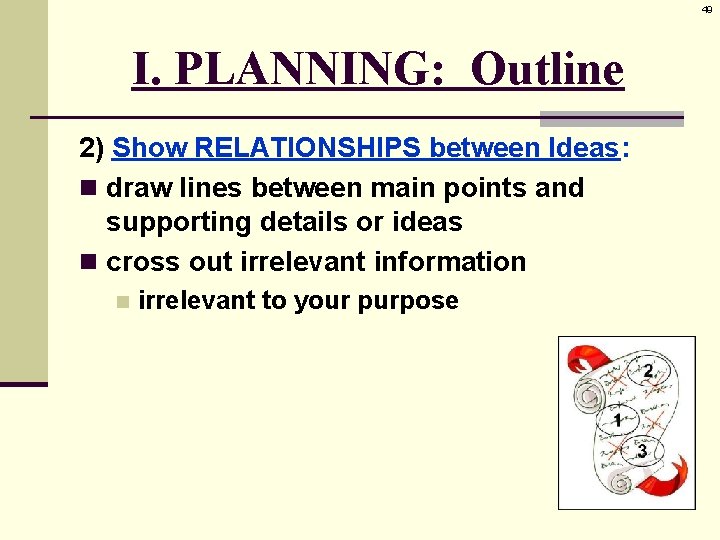
49 I. PLANNING: Outline 2) Show RELATIONSHIPS between Ideas: n draw lines between main points and supporting details or ideas n cross out irrelevant information n irrelevant to your purpose
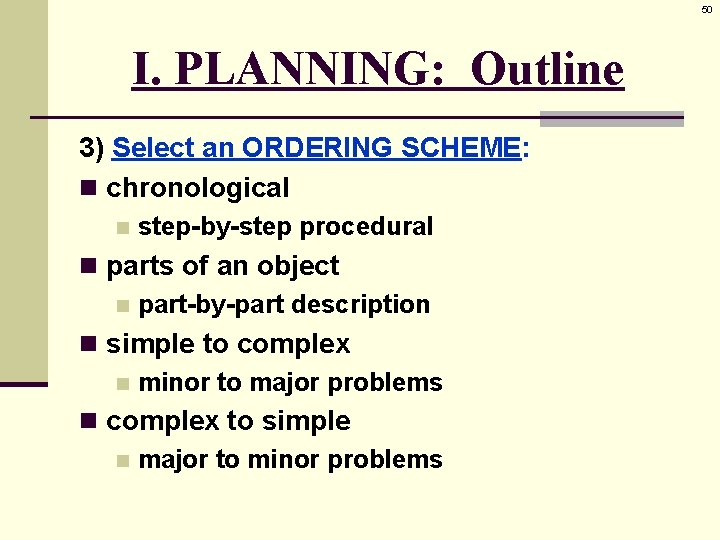
50 I. PLANNING: Outline 3) Select an ORDERING SCHEME: n chronological n step-by-step procedural n parts of an object n part-by-part description n simple to complex n minor to major problems n complex to simple n major to minor problems
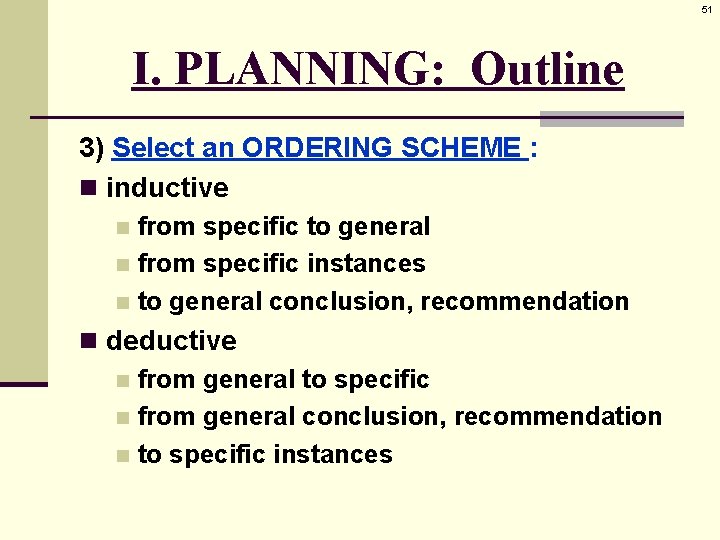
51 I. PLANNING: Outline 3) Select an ORDERING SCHEME : n inductive from specific to general n from specific instances n to general conclusion, recommendation n n deductive n from general to specific n from general conclusion, recommendation n to specific instances
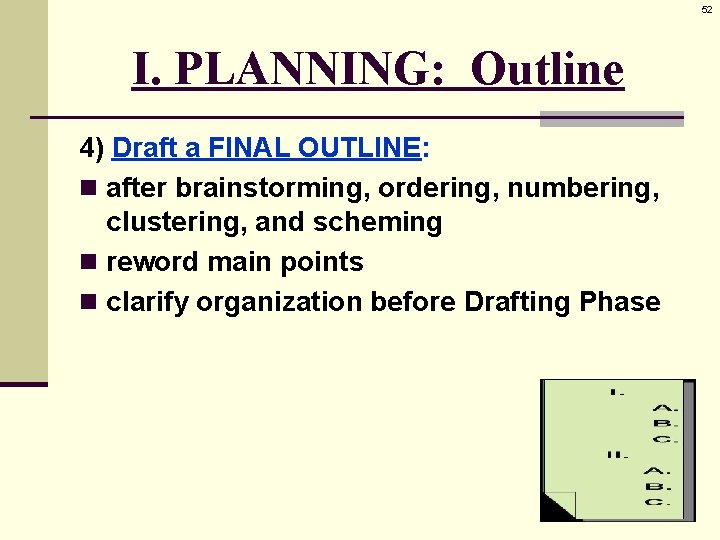
52 I. PLANNING: Outline 4) Draft a FINAL OUTLINE: n after brainstorming, ordering, numbering, clustering, and scheming n reword main points n clarify organization before Drafting Phase
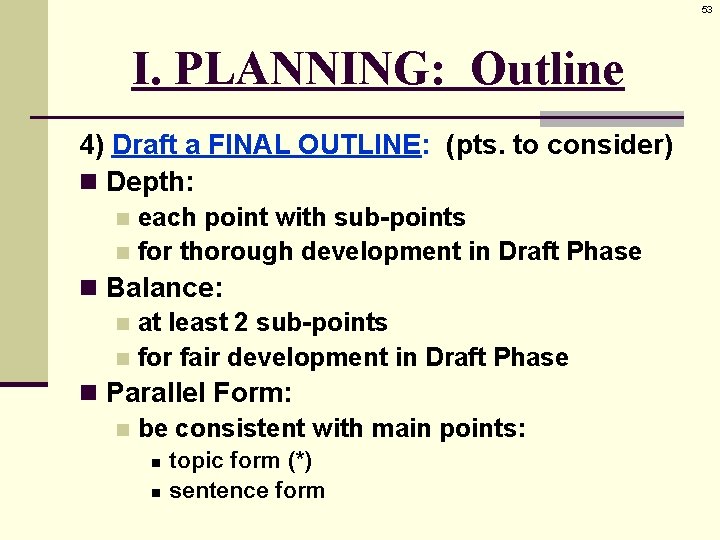
53 I. PLANNING: Outline 4) Draft a FINAL OUTLINE: (pts. to consider) n Depth: each point with sub-points n for thorough development in Draft Phase n n Balance: n at least 2 sub-points n for fair development in Draft Phase n Parallel Form: n be consistent with main points: n n topic form (*) sentence form
54 I. PLANNING: Outline 4) Draft a FINAL OUTLINE: (future reference) n “Points” n can become headings in Rough Draft n “Sub-Points” n can become subheadings in Rough Draft n “Outline” n can become the Table of Contents
55 I. PLANNING: Outline 5) Consider GRAPHICS: n Where would charts, graphs, tables, maps, and such be best used to reinforce textual information? n Their future placement? n Types of readers and their needs?
II. DRAFTING
57 II. DRAFTING FREEWRITE: n prescribed time limit 1 hour n no interruptions n no distractions n
58 II. DRAFTING FREEWRITE: n no editing n no order start with whichever is the easiest section n “Abstract” or “Summary” = written last n n cannot summarize before it’s written
III. REVISING
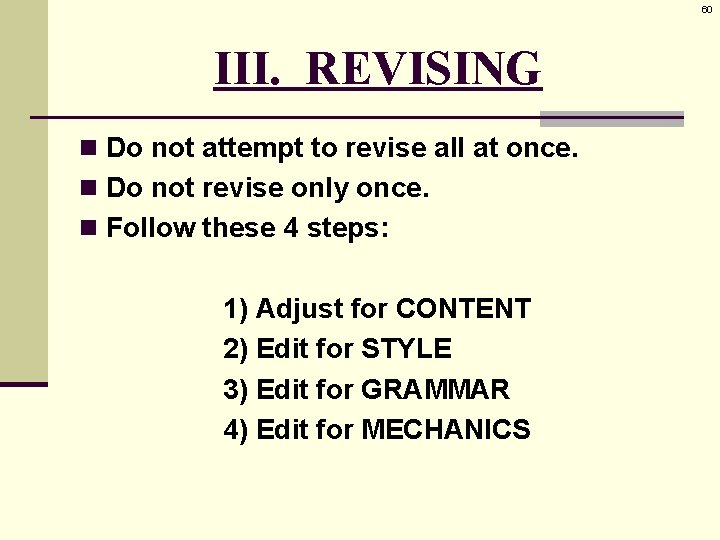
60 III. REVISING n Do not attempt to revise all at once. n Do not revise only once. n Follow these 4 steps: 1) Adjust for CONTENT 2) Edit for STYLE 3) Edit for GRAMMAR 4) Edit for MECHANICS
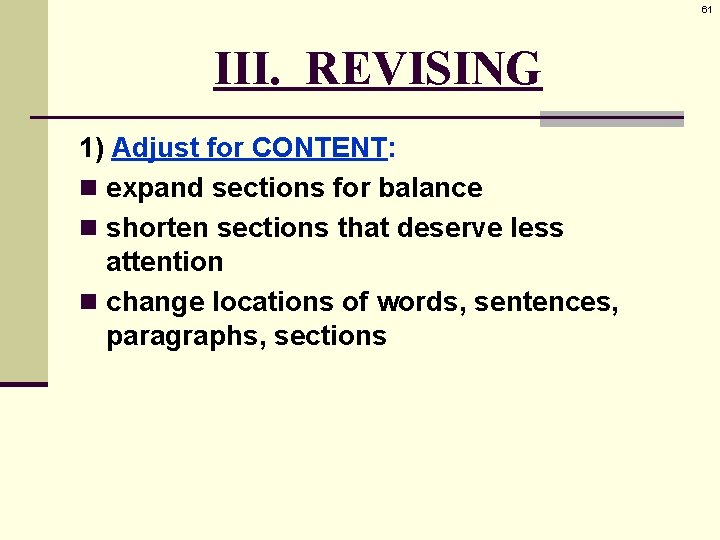
61 III. REVISING 1) Adjust for CONTENT: n expand sections for balance n shorten sections that deserve less attention n change locations of words, sentences, paragraphs, sections
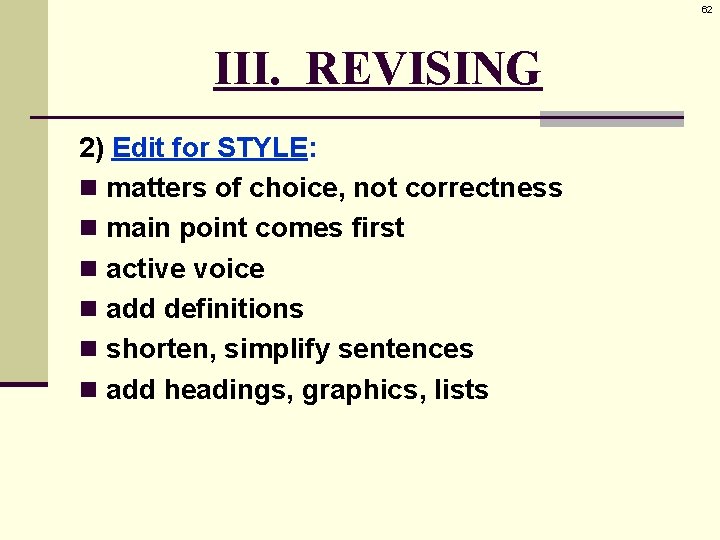
62 III. REVISING 2) Edit for STYLE: n matters of choice, not correctness n main point comes first n active voice n add definitions n shorten, simplify sentences n add headings, graphics, lists
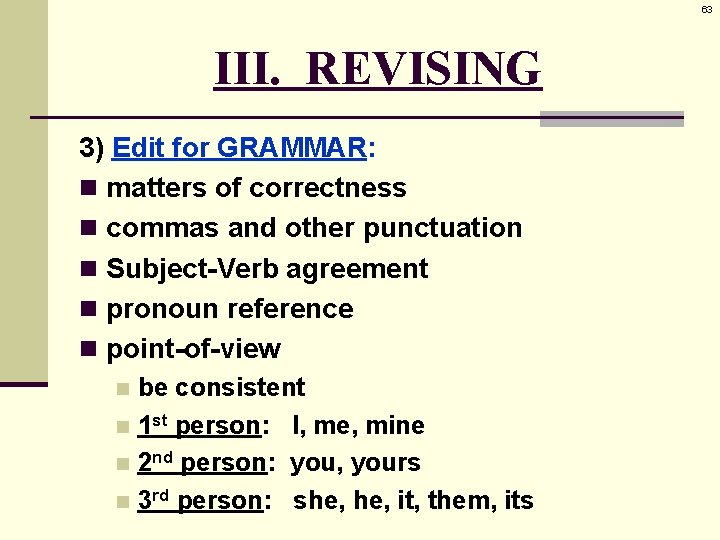
63 III. REVISING 3) Edit for GRAMMAR: n matters of correctness n commas and other punctuation n Subject-Verb agreement n pronoun reference n point-of-view be consistent n 1 st person: I, me, mine n 2 nd person: you, yours n 3 rd person: she, it, them, its n
64 III. REVISING 4) Edit for MECHANICS: n matters of correctness n spelling homophones n technical terms n n misplaced pages n missing graphics n erroneous figures, statistics, numbers
IV. COLLABORATING
66 IV. COLLABORATING n Group Work n Collaborative Writing n “Shared” writing: n not done by a single person n but all members of the group participate in the planning, drafting, & revising phases n Examples: n teams n panels n committees
67 IV. COLLABORATING Guidelines for Successful Groups: n clearly defined roles & responsibilities n effective leadership n clear goals & ground rules n non-judgmental brainstorming n “storyboarding” with drafting n revision standards: n project goals over personal agendas
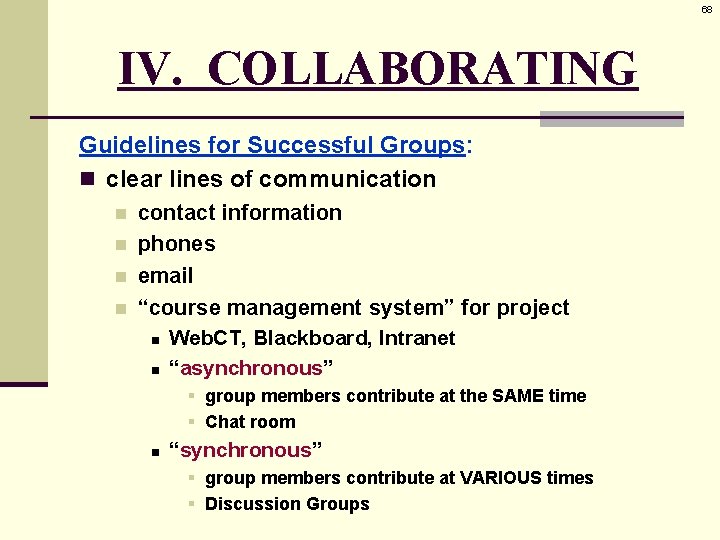
68 IV. COLLABORATING Guidelines for Successful Groups: n clear lines of communication n n contact information phones email “course management system” for project n Web. CT, Blackboard, Intranet n “asynchronous” § group members contribute at the SAME time § Chat room n “synchronous” § group members contribute at VARIOUS times § Discussion Groups