
Technical Brief Part 2 Construction Phase Plan CPP
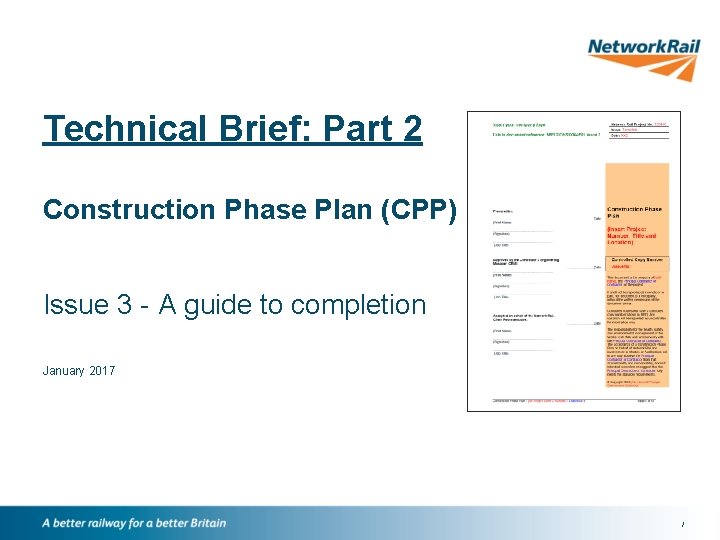
Technical Brief: Part 2 Construction Phase Plan (CPP) Issue 3 - A guide to completion January 2017 /
Construction Phase Plan: Issue 3 - A Guide to Completion Construction Phase Plan – What is it? A document that must record the: Øhealth and safety arrangements for the construction phase Øsite rules Øspecific measures concerning work that falls within one or more of the categories listed in Schedule 3 Øarrangements for managing the significant health and safety risks / 2
Construction Phase Plan: Issue 3 - A Guide to Completion Construction Phase Plan – What is it? The emphasis is that it: Øis relevant to the project Øhas sufficient detail to clearly set out the arrangements, site rules and special measures needed to manage the construction phase; but Øis still proportionate to the scale and complexity of the project and the risks involved Click here for the HSE Guidance to CDM Regulations 2015 / 3
Construction Phase Plan: Issue 3 - A Guide to Completion Construction Phase Plan – Legal Duties • The Client must ensure that Ø a construction phase plan is drawn up before the construction phase begins Ø the (principal) contractor is provided with all the available relevant information they need to draw up the plan, e. g. the pre-construction information Ø the plan adequately addresses the arrangements for managing the risks Ø the principal contractor (or contractor) regularly reviews and revises the plan to ensure it takes account of any changes that occur as construction progresses and continues to be fit for purpose / 4
Construction Phase Plan: Issue 3 - A Guide to Completion Construction Phase Plan – Legal Duties • The Designer must Ø take all reasonable steps to provide with the design sufficient information about aspects of the design to help contractors (including principal contractors) to comply with their duties e. g. information about significant risks that cannot be eliminated • The Principal Designer Ø must help the principal contractor to prepare the construction phase plan by providing any relevant information they hold Ø should regularly check that the principal contractor has the information needed to prepare the plan / 5

Construction Phase Plan: Issue 3 - A Guide to Completion Construction Phase Plan – Legal Duties • The Principal Contractor must Ø (where more than one contractor) take the lead in preparing, reviewing, updating and revising the construction phase plan Ø draw up the plan or make arrangements for it to be drawn up during the pre-construction phase and before the construction site is set up Ø liaise with the contractors to ensure that the plan takes into account their views on the arrangements for managing the construction phase Ø ensure that the construction phase plan is appropriately reviewed, updated and revised from time to time / 6
Construction Phase Plan: Issue 3 - A Guide to Completion Construction Phase Plan – Legal Duties • The Contractor Ø must (where more than one contractor) follow the parts of the construction phase plan prepared by the principal contractor that are relevant to their work Ø for single contractor projects, ensure that a construction phase plan is drawn up / 7
Construction Phase Plan: Issue 3 - A Guide to Completion Construction Phase Plan – Issue 3 • The new Network Rail template has been updated to reflect changes in CDM 2015 • Must be used for all construction work - the level of detail required must relate to the complexity of the work • Replaces the Low Level Risk CPP Issue 4 / 8

Construction Phase Plan: Issue 3 - A Guide to Completion Construction Phase Plan – Rules for use • Text has been specifically coloured to aid the construction of the document – green text provides guidance throughout • Never re-badge a previous CPP – always use a new template • This is a LIVE document that needs to be maintained throughout the construction phase / 9

Construction Phase Plan: Issue 3 - A Guide to Completion Construction Phase Plan Template • Front page Ø The CPP must be • approved by the Contractor’s Engineering Manager (or as agreed and authorised in the CDM Plan) • accepted on behalf of the Network Rail Client Representative (as detailed in the CDM Plan) • Approved and accepted each time that significant changes are made Ø Wet (not electronic) signatures must be used / 10
Construction Phase Plan: Issue 3 - A Guide to Completion Section 2 Planning for the Construction Phase / 11

Construction Phase Plan: Issue 3 - A Guide to Completion Construction Phase Plan Template • Section 2. 1 Ø This section should detail specific H&S goals that have been agreed with the Client Ø Some H&S goals may have been defined as part of preconstruction information or the project safety plan and should be included Ø Goals should be proactive and promote safe working and wellbeing, rather than lagging targets relating to zero accidents or accident rate targets / 12

Construction Phase Plan: Issue 3 - A Guide to Completion Construction Phase Plan Template • Section 2. 2 Ø Brief description of work • This only needs to be an overview of the main works; not full detail of each stage or methodology Ø Key construction stages • Detail the main key stages, including start / end date and WPP reference that are known at the time • If the exact dates and WPP reference are not known then this can be updated later / 13
Construction Phase Plan: Issue 3 - A Guide to Completion Construction Phase Plan Template • Section 2. 3 Ø Service and isolation points • Detail any services that might need to be disconnected or connected before construction work starts • This can be signposted to a separate table in an appendix if necessary • This section can be updated as the project progresses • Section 2. 4 Ø Access Restrictions • Detail any access restrictions i. e. no-go areas • This section is not for detailing how access / egress is gained! / 14
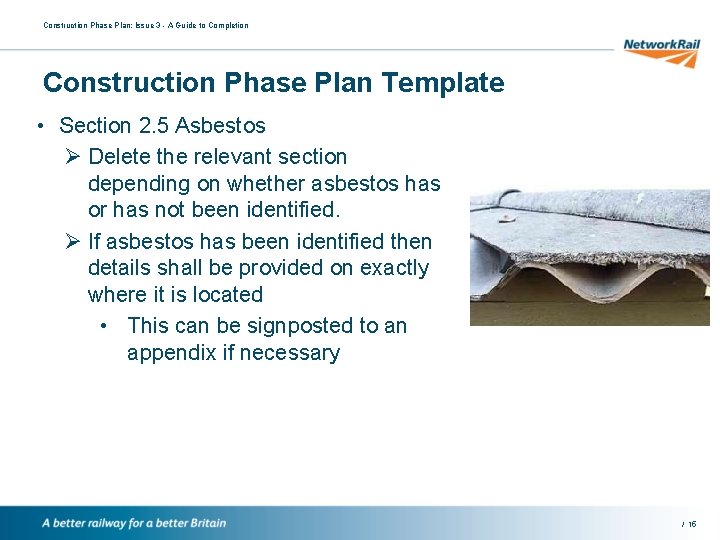
Construction Phase Plan: Issue 3 - A Guide to Completion Construction Phase Plan Template • Section 2. 5 Asbestos Ø Delete the relevant section depending on whether asbestos has or has not been identified. Ø If asbestos has been identified then details shall be provided on exactly where it is located • This can be signposted to an appendix if necessary / 15

Construction Phase Plan: Issue 3 - A Guide to Completion Construction Phase Plan Template • Section 2. 6 Any line open operations Ø Delete the relevant section depending on whether ALO activities are proposed or not Ø If ALO is being proposed then details shall be provided on exactly when and what ALO activities will take place - this can be signposted to an appendix if necessary Ø Include the names of all those accountable for the safe planning and delivery of ALO activities Ø Click here for guidance on ALO / 16

Construction Phase Plan: Issue 3 - A Guide to Completion Construction Phase Plan Template • Section 2. 7 Temporary Works Ø Delete the relevant section depending on whether temporary works are required or not Ø If temporary works are required then a summary of the proposed temporary works shall be provided • This can be signposted to an appendix if necessary Ø Include the names of all those accountable for the safe design, planning and implementation of temporary works / 17
Construction Phase Plan: Issue 3 - A Guide to Completion Construction Phase Plan Template • Section 2. 7 Temporary Works Temporary works include (not an exhaustive list) • Earthworks v Trenches, excavations, temporary slopes and stockpiles, cofferdams • Structures v Formwork, falsework, propping, façade retention, needling, shoring, edge protection, temporary bridges, site hoarding and signage, site fencing • Equipment/plant foundations v Tower crane bases, supports, anchors and ties for hoists, crane and piling platforms • Electrification & Plant v Temporary substation and cable arrangements / 18
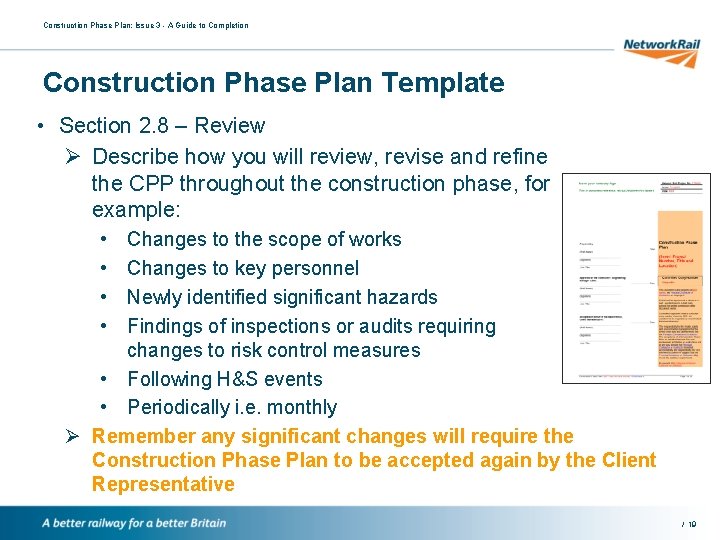
Construction Phase Plan: Issue 3 - A Guide to Completion Construction Phase Plan Template • Section 2. 8 – Review Ø Describe how you will review, revise and refine the CPP throughout the construction phase, for example: • • Changes to the scope of works Changes to key personnel Newly identified significant hazards Findings of inspections or audits requiring changes to risk control measures • Following H&S events • Periodically i. e. monthly Ø Remember any significant changes will require the Construction Phase Plan to be accepted again by the Client Representative / 19
Construction Phase Plan: Issue 3 - A Guide to Completion Section 3 Working together / 20
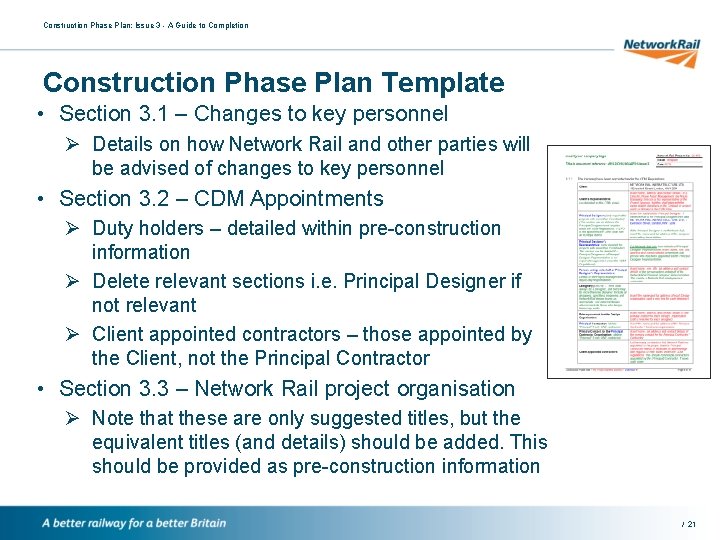
Construction Phase Plan: Issue 3 - A Guide to Completion Construction Phase Plan Template • Section 3. 1 – Changes to key personnel Ø Details on how Network Rail and other parties will be advised of changes to key personnel • Section 3. 2 – CDM Appointments Ø Duty holders – detailed within pre-construction information Ø Delete relevant sections i. e. Principal Designer if not relevant Ø Client appointed contractors – those appointed by the Client, not the Principal Contractor • Section 3. 3 – Network Rail project organisation Ø Note that these are only suggested titles, but the equivalent titles (and details) should be added. This should be provided as pre-construction information / 21
Construction Phase Plan: Issue 3 - A Guide to Completion Construction Phase Plan Template • Section 3. 4 – Principal Contractor’s delivery organisation Ø Delete “Principal” if only one contractor Ø Note – only suggested titles; the equivalent titles (and details) should be added Ø Contractor’s Responsible Engineer • This section should list the CRE for each discipline that will apply during the construction phase Ø Authorised signatories • Details those authorised to sign on behalf of the CRE for documentation such as Task Briefing Sheets Ø Specialist contractors and/or individuals • Details the companies, specialist contractors and/or individuals, appointed by the PC, involved during the construction phase / 22
Construction Phase Plan: Issue 3 - A Guide to Completion Construction Phase Plan Template • Section 3. 5 – Communication • You need to identify the stakeholders that will be involved or affected throughout the construction phase • You need to define the strategy for communicating with each of the stakeholders, for example: Ø who is accountable and responsible for communicating at each stage? Ø how often you will communicate? Ø how you should provide information on the job? Ø how you will coordinate the work? / 23
Construction Phase Plan: Issue 3 - A Guide to Completion Construction Phase Plan Template • Section 3. 6/3. 7 – Design Ø Detail the process for exchanging design information between relevant parties i. e. Principal Designer / Contractor (if relevant), Contractors and Designers Ø Detail how changes to the design (once the construction phase has started) will be managed and formally accepted by those accountable and responsible for design. Ø Both sections should make reference to Network Rail standard NR/L 2/INI/02009 – Engineering Management of Projects / 24
Construction Phase Plan: Issue 3 - A Guide to Completion Section 4 Hazard Management / 25
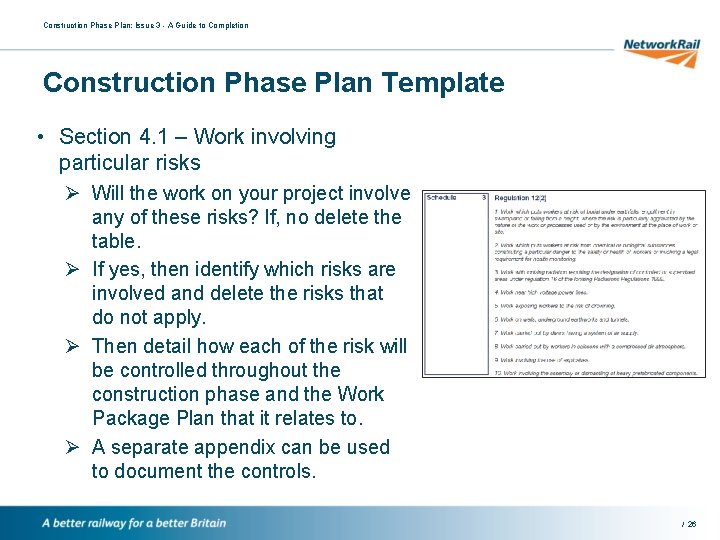
Construction Phase Plan: Issue 3 - A Guide to Completion Construction Phase Plan Template • Section 4. 1 – Work involving particular risks Ø Will the work on your project involve any of these risks? If, no delete the table. Ø If yes, then identify which risks are involved and delete the risks that do not apply. Ø Then detail how each of the risk will be controlled throughout the construction phase and the Work Package Plan that it relates to. Ø A separate appendix can be used to document the controls. / 26

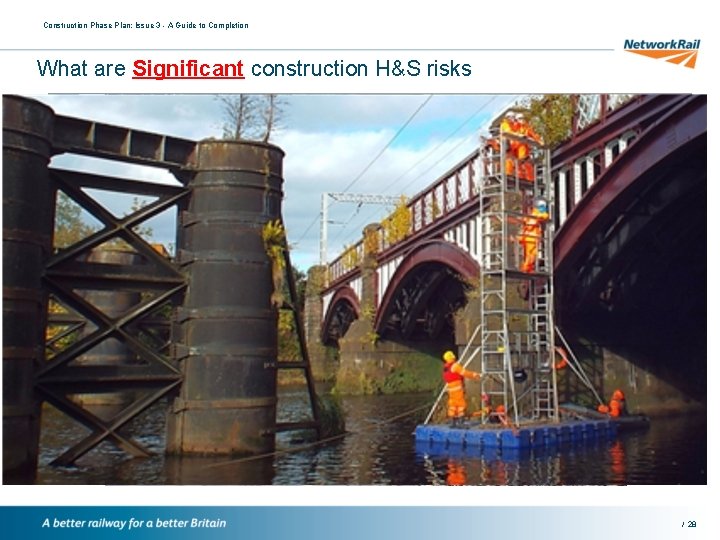
Construction Phase Plan: Issue 3 - A Guide to Completion Construction Phase Plan Template • Section 4. 2 – Significant construction H&S risks Ø The hazards must be project and site specific – not generic Ø The hazards must be present and give rise to risks that are assessed to have a significant impact (post mitigation) on: • the safe operation of the railway; and/or • The health and safety of workers Ø Detail when and where they will be present and how the risk will be controlled, and the Work Package Plan that it relates to / 27
Construction Phase Plan: Issue 3 - A Guide to Completion What are Significant construction H&S risks / 28
Construction Phase Plan: Issue 3 - A Guide to Completion Section 5 Organise / 29

Construction Phase Plan: Issue 3 - A Guide to Completion Construction Phase Plan Template Brief outline of work methodology – Good or Bad? Project is a bridge replacement. Methodology is to The project is torenewal stabilise the embankment miles 1. Site Plain line set-up track between 126 miles at 32 demolish and remove existing structure utilising The 48 chains between Ash line Vale and Aldershot. and 130 miles on the Down 2. De-veg disruptive possessions and isolations. replacement work involves the de-vegetation of the The site before 3. Brickworks bridge isof toabe pre-fabricated off-site, to site building piling platform. The worktransported then includes the 4. via Demobilise road – requiring convoy Once site the installation of sheet piling onescort. the down lineatembankment, structure is to be the lifted into position using preat 4 metres from nearest running line, two using a Movax positioned 500 t cranes in a tandem lifting operation. type high frequency vibrating piling hammer on a 12 Local roads will be closed. cabling will betore-routed tonne excavator. Due to the. HV close proximity the prior to demolition. running line all work will be undertaken during line blockages or possession to eliminate any line open (ALO) operations. / 30
Construction Phase Plan: Issue 3 - A Guide to Completion Construction Phase Plan Template • Section 5. 1 – Brief outline of work methodology Ø This must not be: • a copy of the brief description of the project • a list of Work Package Plans and/or Task Briefing Sheets Ø The methodology must provide sufficient detail to: • determine how the work will be undertaken i. e. the plant to be used; requirements for temporary works; ALO • help identify what significant risks may be involved / 31
Construction Phase Plan: Issue 3 - A Guide to Completion Construction Phase Plan Template • Section 5. 2 – Management of Work Package Plans Ø This section should detail: • How WPPs will be managed from production through to acceptance, incl. document control and review • Those persons responsible for review and approval of WPPs Ø This section should also: • outline how additional WPPs are identified (once the construction phase starts) • Highlight the parties involved in making decisions on risks and the methodology and criteria that was used / 32
Construction Phase Plan: Issue 3 - A Guide to Completion Construction Phase Plan Template • Section 5. 3 – Work Package Plans Schedule Ø A separate appendix can be used for multiple plans Ø Needs to specify dates for preparation, review and approval by the (Principal) Contractor and if necessary acceptance by Network Rail Ø Work Package Plans, for review and acceptance by Network Rail need to be provided: • a minimum of 21 consecutive days prior to the work commencing; • or an agreed alternative timescale, as detailed in the CDM Plan / 33
Construction Phase Plan: Issue 3 - A Guide to Completion Construction Phase Plan Template • Section 5. 3 – Work Package Plans Schedule Ø Acceptance by Network Rail: • Work involving any of the particular risk(s), as detailed in Regulation 12 (2), (Schedule 3) of the CDM Regulations 2015 • Hazards are present that give rise to risks that are assessed to have a significant impact (post mitigation) on the safe operation of the railway and / or the health and safety of workers • The mitigation measures put in place to control risk are unusual, complex, or rely on a high level of engagement or competence within the workforce or other stakeholders • There is the likelihood of a significant level of change to the assessed risks due to emerging conditions on site or the immature level of detail presented in the design documentation / 34
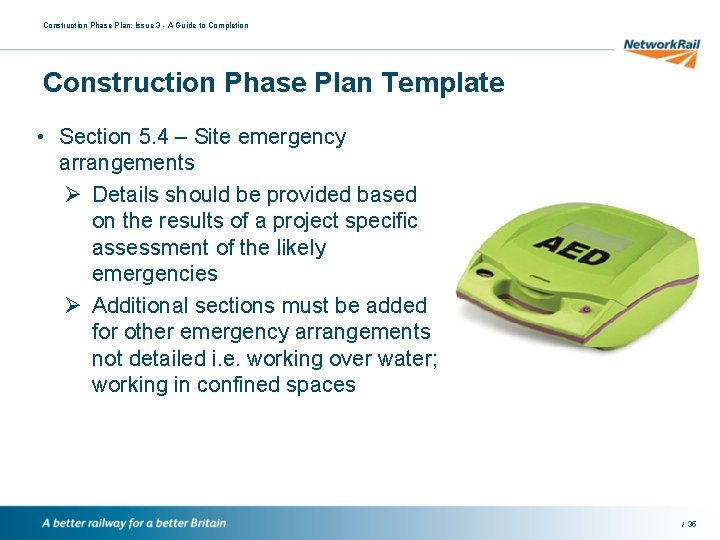
Construction Phase Plan: Issue 3 - A Guide to Completion Construction Phase Plan Template • Section 5. 4 – Site emergency arrangements Ø Details should be provided based on the results of a project specific assessment of the likely emergencies Ø Additional sections must be added for other emergency arrangements not detailed i. e. working over water; working in confined spaces / 35
Construction Phase Plan: Issue 3 - A Guide to Completion Construction Phase Plan Template • Section 5. 4. 1 – First aid arrangements Ø This should be based on the type and level of injuries that could arise on the site Ø Should consider non-accident events (i. e. heart attacks) and the ability and ease for emergency services to attend • Confined spaces; remote locations Ø Must not just be directions to the local hospital Ø Detail must include: • the number and qualifications of first aiders • the amount and location of equipment required • Specialist first aid equipment i. e. rescue stretchers, burns kits Ø Can be provided as an appendix / 36
Construction Phase Plan: Issue 3 - A Guide to Completion Construction Phase Plan Template • Section 5. 4. 2 – Evacuation procedure Ø This should be based on the type and level of work activities that are taking place Ø Should consider: • evacuation of the entire site and/or an individual casualty • potential changes to the site layout • The maximum number of people on site at any one time (including any lone workers, such as security guards) • means for accounting for all persons present on site Ø Must not just be directions to the local hospital Ø Should consider evacuation for security reasons Ø Can be provided as an appendix / 37
Construction Phase Plan: Issue 3 - A Guide to Completion Construction Phase Plan Template • Section 5. 4. 3 – Fire safety Ø This should be based on the actual risk of fire present during the construction phase Ø Should consider: • measures to prevent fires starting (e. g. control of hot works, smoking or re-fuelling activities • Methods for raising the alarm • Fire-fighting arrangements • Details for temporary fire alarm panels or connections to permanent fire alarm systems • Locating existing fire alarm equipment (i. e. smoke or heat detectors) that might be affected during construction Ø Can be provided as an appendix / 38
Construction Phase Plan: Issue 3 - A Guide to Completion Construction Phase Plan Template • Section 5. 4. 4 – Security Ø Based on pre-construction information and other site surveys Ø Should consider: • Arrangements for preventing unauthorised access to: v the construction site v the operational railway (and associated infrastructure) • Security arrangements, such as security guards, cameras • Potential terrorism threats Ø For activities and sites that are likely to attract unwelcome attention then contact the British Transport Police and/or Railway Route Crime Prevention Specialist. / 39
Construction Phase Plan: Issue 3 - A Guide to Completion Construction Phase Plan Template • Section 5. 4. 5 – Summoning emergency services Ø Detail: • How emergency services will be summoned • Who will call the emergency services • Who will meet the emergency services, and where • How the emergency services will access the site • Who will escort the emergency services Ø Consider prior contact with the emergency services and possible simulated emergency exercises Ø Consider other emergency services i. e. bomb disposal; mountain rescue; coastguard and lifeboat; utilities Ø Can be provided as an appendix / 40
Construction Phase Plan: Issue 3 - A Guide to Completion Construction Phase Plan Template • Section 5. 4. 6 – Railway emergency Ø This section should consider the specific arrangements for: • Stopping trains in an emergency • Isolating the hazard of electricity • Contact details for each Signaller, Electrical Control Room (where applicable) and Route Control Ø Note - checks should be made in advance to confirm the correct contact details (including any placed on information boards at access points) / 41
Construction Phase Plan: Issue 3 - A Guide to Completion Construction Phase Plan Template • Section 5. 4. 7 – Asbestos Ø Detail the arrangements for responding to the unexpected discovery of asbestos containing materials • Even if asbestos has not been identified in any surveys Ø Include the arrangements for : • Informing workers on stopping work if suspected • Isolating and securing the affected area / 42
Construction Phase Plan: Issue 3 - A Guide to Completion Construction Phase Plan Template • Section 5. 4. 8 – Utilities Ø Detail the arrangements for responding to the unexpected discovery of utilities - even if utilities has not been identified in any surveys Ø Include: • Emergency contact details for all utilities operating in the location of construction • Arrangements for isolating and securing the affected area / 43
Construction Phase Plan: Issue 3 - A Guide to Completion Construction Phase Plan Template • Section 5. 4. 9 – Other emergency arrangements Ø Detail arrangements for any other emergencies that could potentially arise during construction, for instance: • • • working over water; working in confined spaces; working in excavations working at height unexploded ordinance flooding Ø Note environmental emergencies will detailed in your Environment Management Plan and Work Package Plans / 44
Construction Phase Plan: Issue 3 - A Guide to Completion Construction Phase Plan Template • Section 5. 5 – S&E event reporting and recording Ø Detail the arrangements for reporting and recording safety and environmental events, including: • Accidents, incidents (i. e. buried service strikes), Operational Close Calls, environmental incidents, close calls • Contact details for reporting within Network Rail • Investigation process, including: v those responsible for undertaking the initial and further investigations v Process for completing actions from investigations / 45
Construction Phase Plan: Issue 3 - A Guide to Completion Construction Phase Plan Template • Section 5. 6 – Site specific rules Ø Not generic i. e. general PPE requirements Ø Must be those not expected by workers, for instance: • Restrictions on site working • Specific hazards and controls for the site • Restricted areas Ø Must be included in site specific inductions and communicated to everyone / 46
Construction Phase Plan: Issue 3 - A Guide to Completion Construction Phase Plan Template • Section 5. 7 – Induction Ø Provide details on site specific arrangements, for instance: • How the induction will be delivered, including briefing of the CPP, Work Package Plans and Task Briefing Sheets • Who will deliver the induction • How it will be recorded • Arrangements for site workers and visitors Ø Delete relevant section on Industry Common Induction / 47
Construction Phase Plan: Issue 3 - A Guide to Completion Construction Phase Plan Template • Section 5. 8 – Welfare Ø Provide details on site specific arrangements, for instance: • The maximum number of people on site at any one time during the construction phase • The number of toilets, wash hand basins, eating facilities, etc • PPE and personal storage arrangements Ø Network Rail standard NR/L 3/INI/CP 0036 provides a form for quantifying welfare arrangements – this should be used as an appendix and displayed on site / 48
Construction Phase Plan: Issue 3 - A Guide to Completion Construction Phase Plan Template • Section 5. 9. 1 – Monitoring arrangements Ø Provide details on how the construction phase will be monitored, including (but not limited to): • • Site management inspections of all work areas Inspections by other e. g. company HSEA specialists Safety tours / safety conversations by senior managers Specific inspections in relation to works being undertaken e. g. temporary works, scaffolding, encapsulations etc. • Medical interventions required for legal compliance e. g. hearing testing, blood tests for lead, HAVs, etc. • Drug and alcohol monitoring/testing • Periodic reviews and audits of the site and its management by persons external to the site team / 49

Construction Phase Plan: Issue 3 - A Guide to Completion Construction Phase Plan Template • Section 5. 9. 2 – Monitoring arrangements Ø Provide details on monitoring activities by Network Rail, including (but not limited to): • Inspections of the site, work area etc. • Safety tours / safety conversations by senior managers • Inspections following safety events Ø Monitoring may be undertaken by specialists from project management, engineering, construction management, health and safety, audit and assurance disciplines Ø These arrangements must be discussed and agreed with the Network Rail Project Manager (or equivalent) / 50
Construction Phase Plan: Issue 3 - A Guide to Completion Construction Phase Plan Template • Section 5. 10 – Management reporting arrangements Ø Provide details on the reporting arrangements, including (but not limited to): • • • Project start up meeting Periodic project progress meetings Readiness reviews Design review meetings Client update meetings Method of calling other meetings, as required for dealing with specific issues relating to the project Ø The (Principal) Contractor and the Network Rail nominated person authorised to deal with issues will agree the reporting arrangements for the project / 51
Construction Phase Plan: Issue 3 - A Guide to Completion Section 6 Health and Safety File / 52
Construction Phase Plan: Issue 3 - A Guide to Completion Construction Phase Plan Template • Section 6 – H&S File arrangements Ø Provide details on the arrangements for providing H&S information during and at the end of the construction phase, including: • The information that will be needed relating to the asset(s) being worked on (this should be requested via the QF 705 form) or in writing to the Client Representative • How the H&S File will be compiled (as agreed in QF 703 form) Ø On large projects or projects that involve a number of separate sites it may be possible to update the health and safety information as each distinct part of the project is completed. / 53
- Slides: 53