
TECH MATHS ALGEBRAIC EXPRESSIONS Revision Gr 10 ALGEBRAIC

TECH MATHS ALGEBRAIC EXPRESSIONS Revision Gr 10
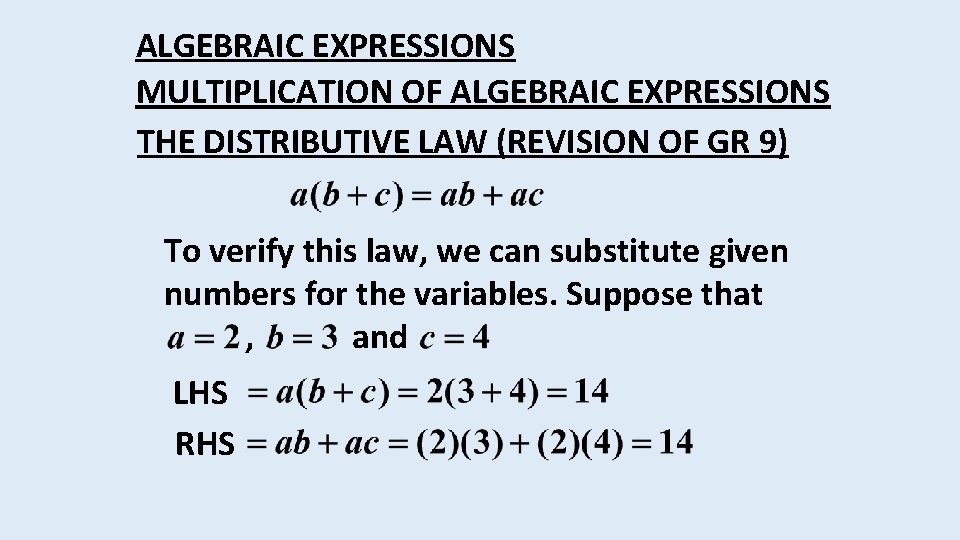
ALGEBRAIC EXPRESSIONS MULTIPLICATION OF ALGEBRAIC EXPRESSIONS THE DISTRIBUTIVE LAW (REVISION OF GR 9) To verify this law, we can substitute given numbers for the variables. Suppose that , and LHS RHS
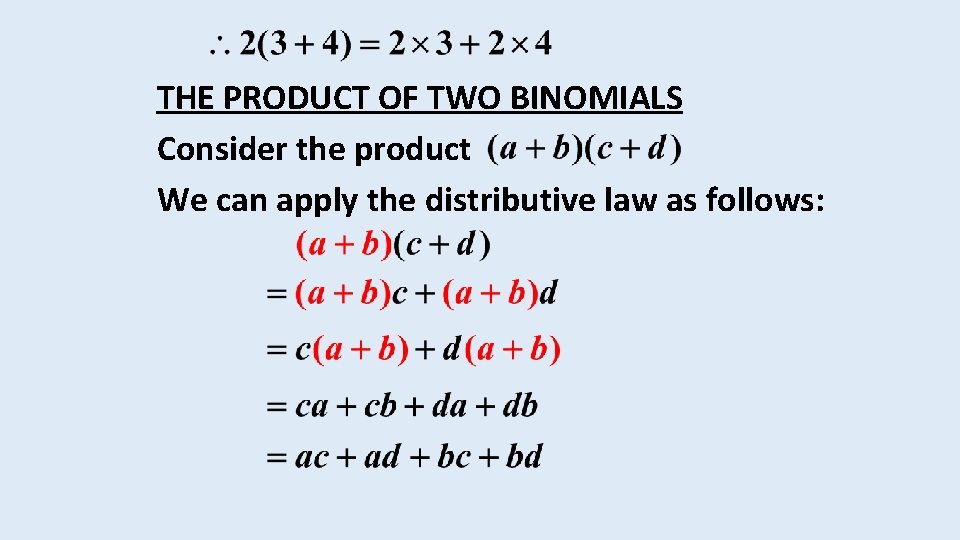
THE PRODUCT OF TWO BINOMIALS Consider the product We can apply the distributive law as follows:
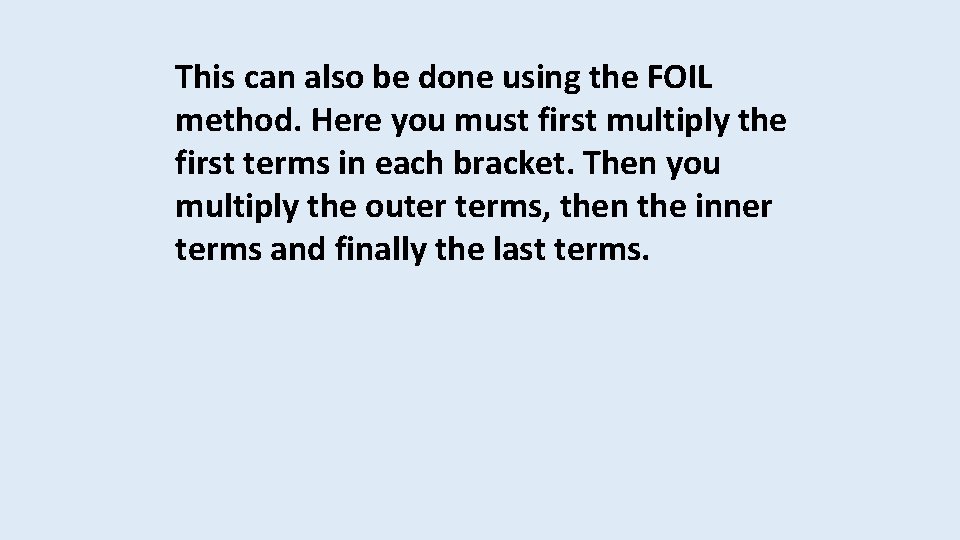
This can also be done using the FOIL method. Here you must first multiply the first terms in each bracket. Then you multiply the outer terms, then the inner terms and finally the last terms.
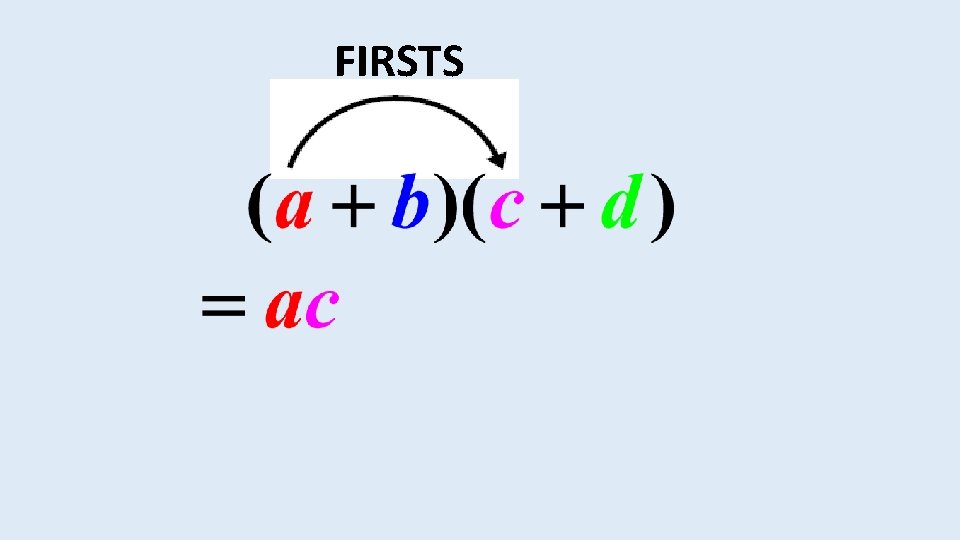
FIRSTS
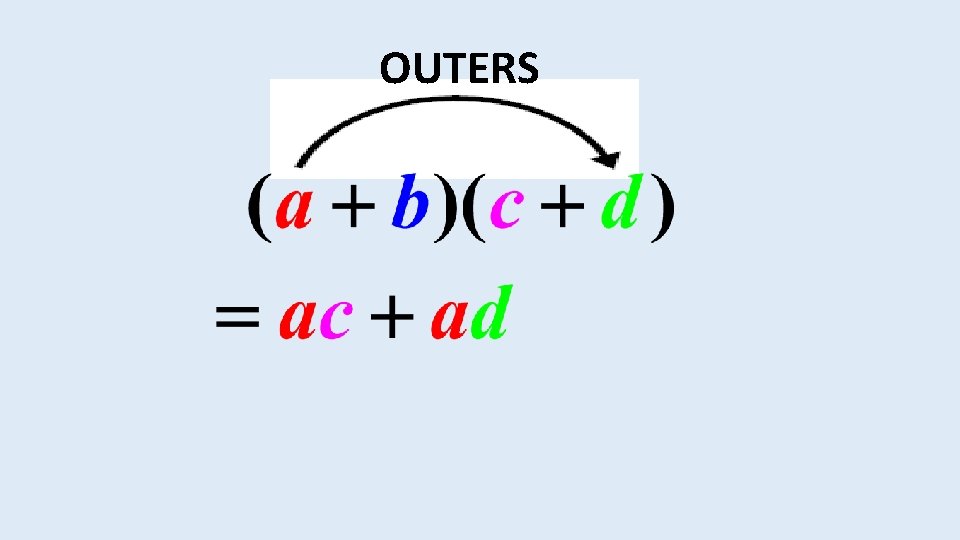
OUTERS
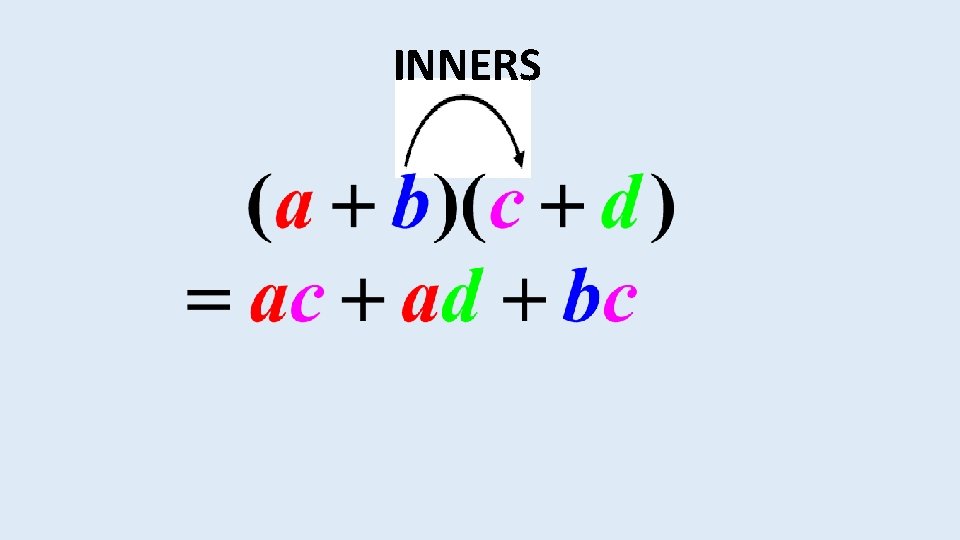
INNERS
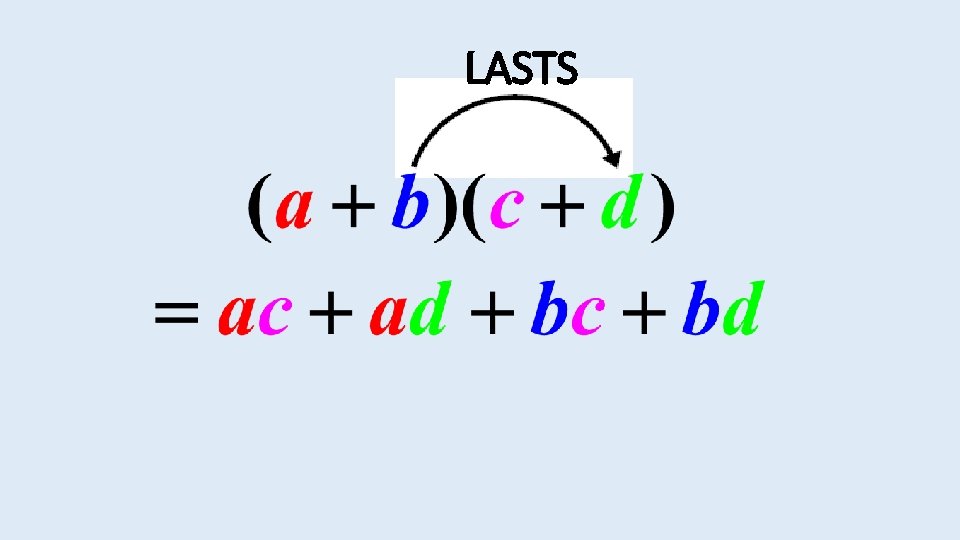
LASTS
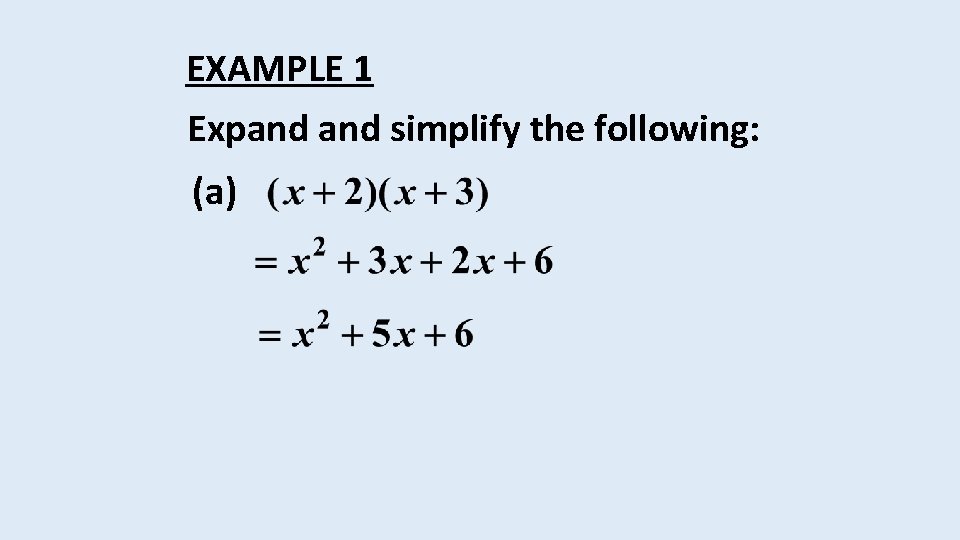
EXAMPLE 1 Expand simplify the following: (a)
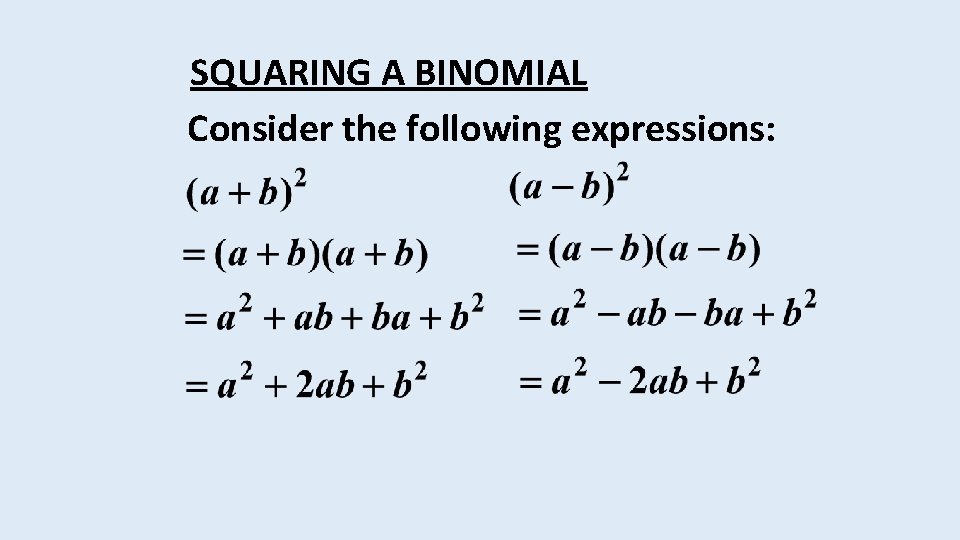
SQUARING A BINOMIAL Consider the following expressions:
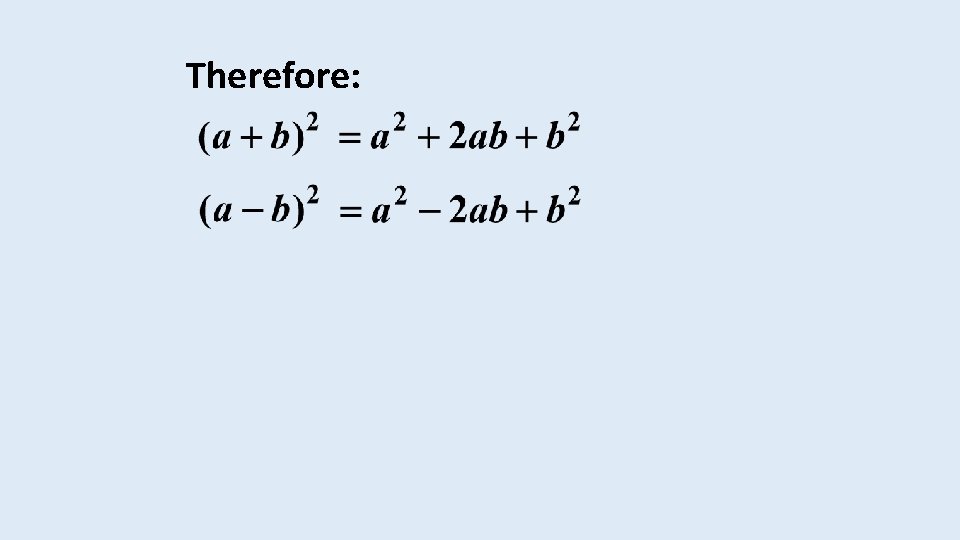
Therefore:
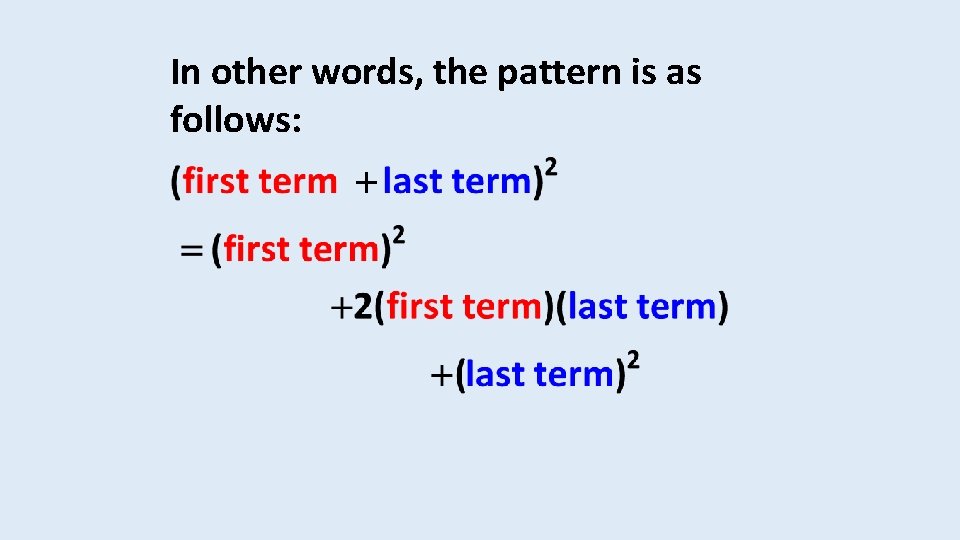
In other words, the pattern is as follows:
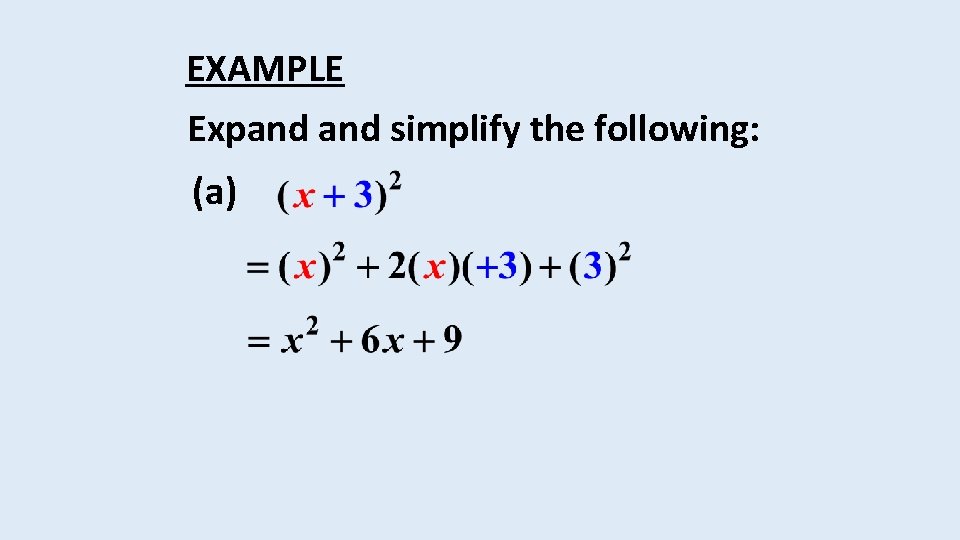
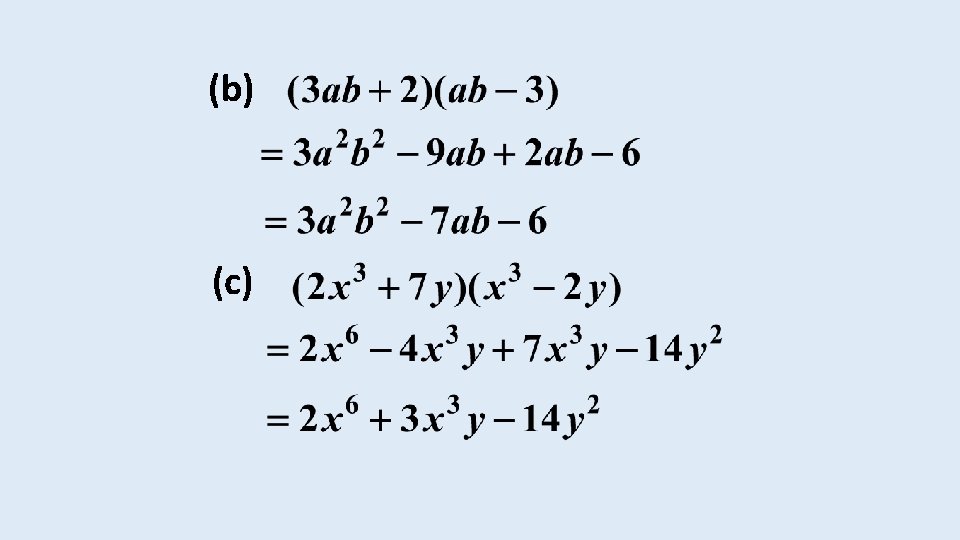
EXAMPLE Expand simplify the following: (a)
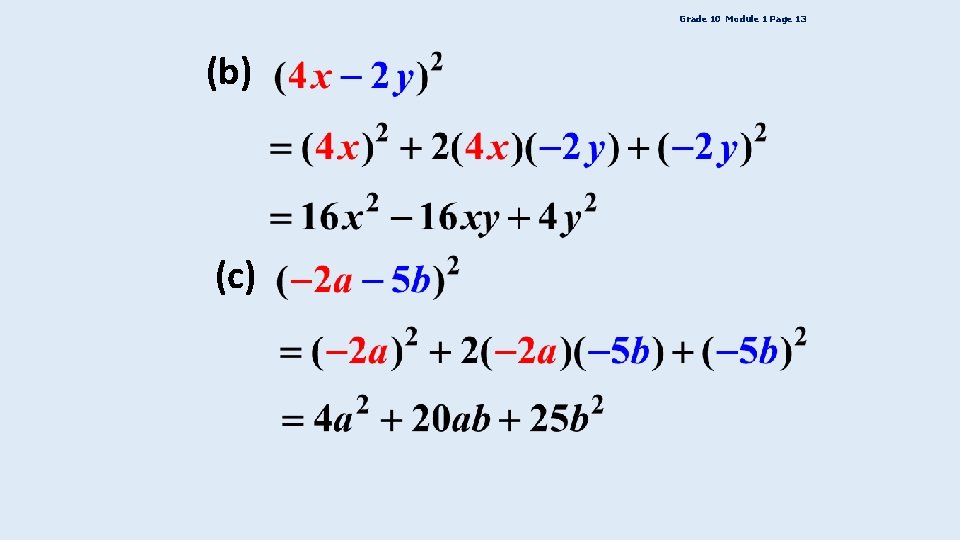
Grade 10 Module 1 Page 13 (b) (c)
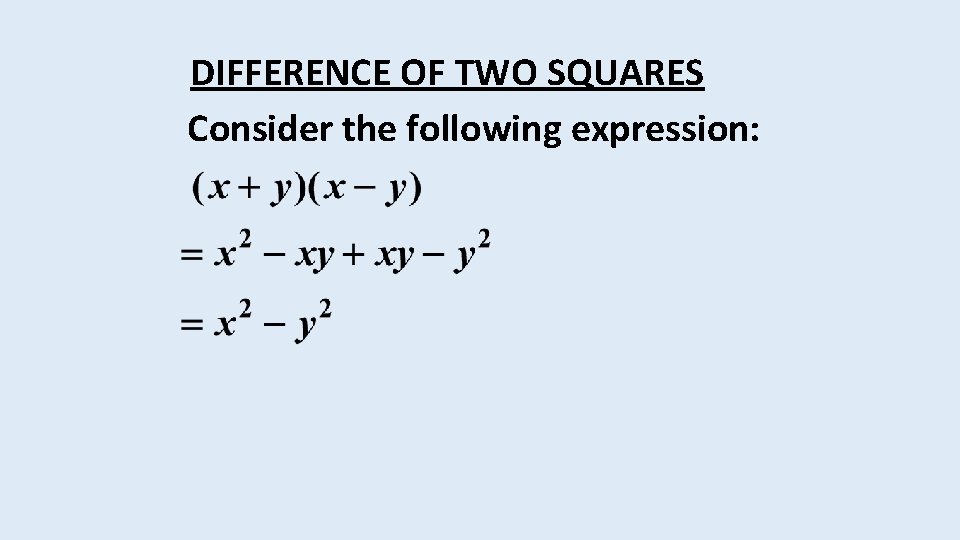
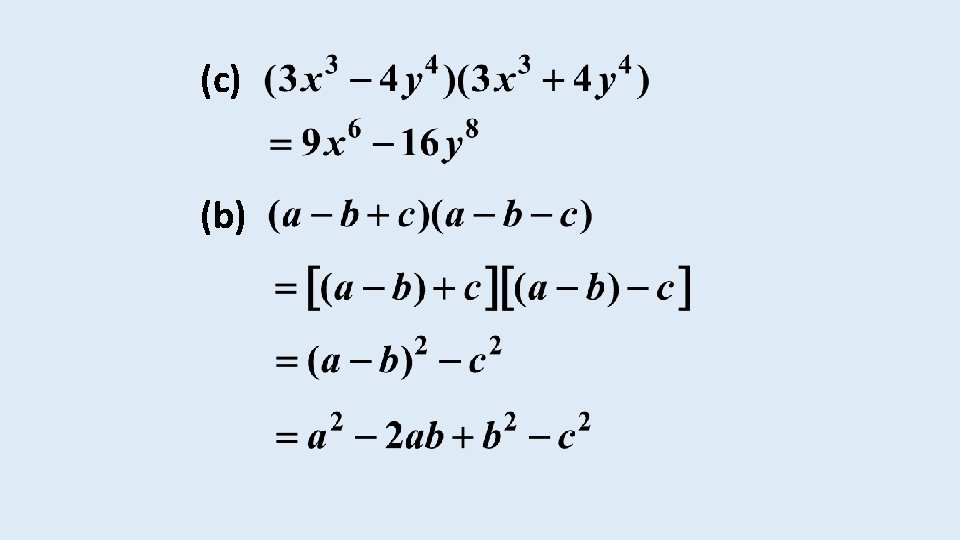
DIFFERENCE OF TWO SQUARES Consider the following expression:
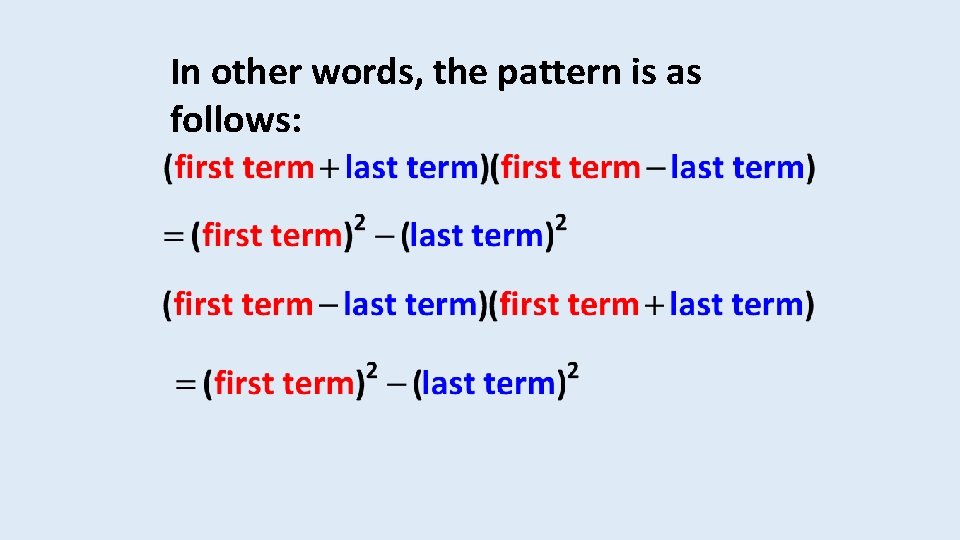
In other words, the pattern is as follows:
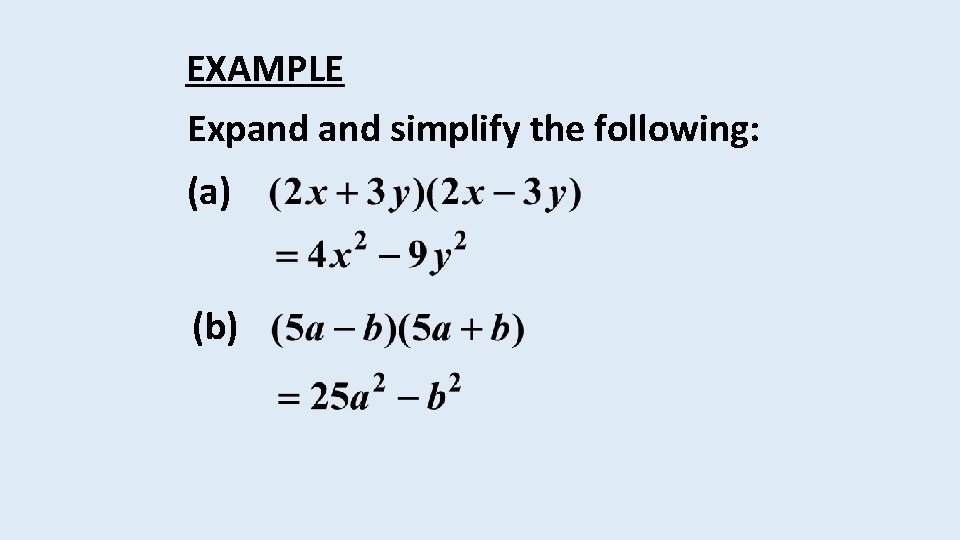
EXAMPLE Expand simplify the following: (a) (b)
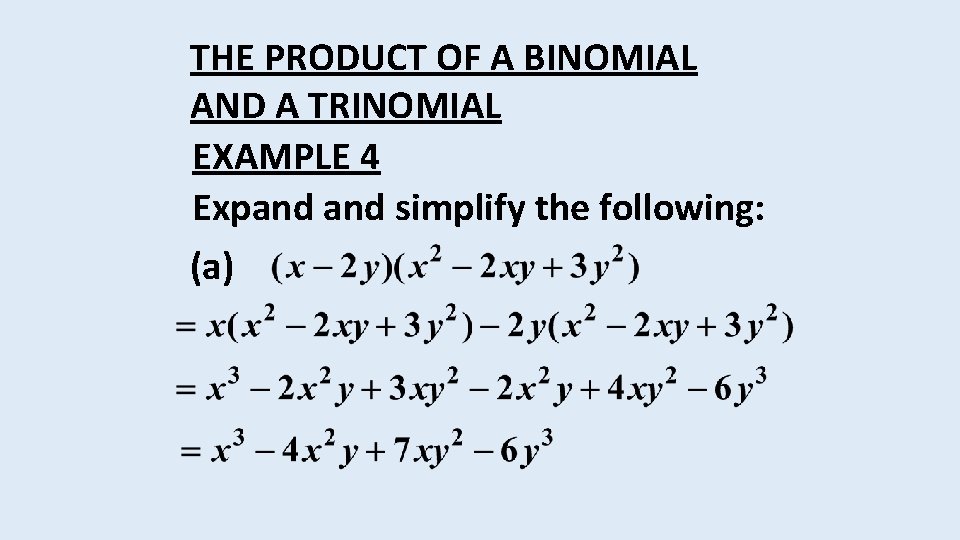
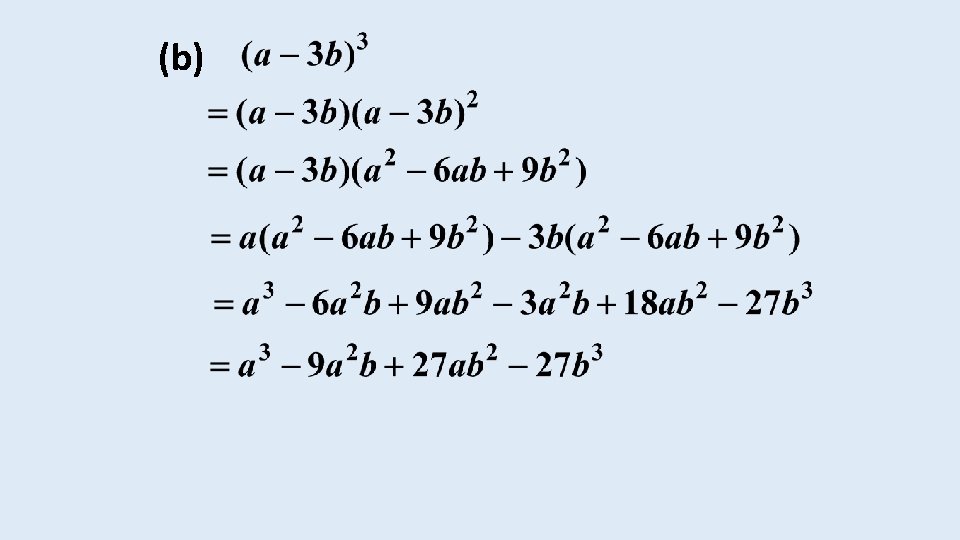
THE PRODUCT OF A BINOMIAL AND A TRINOMIAL EXAMPLE 4 Expand simplify the following: (a)
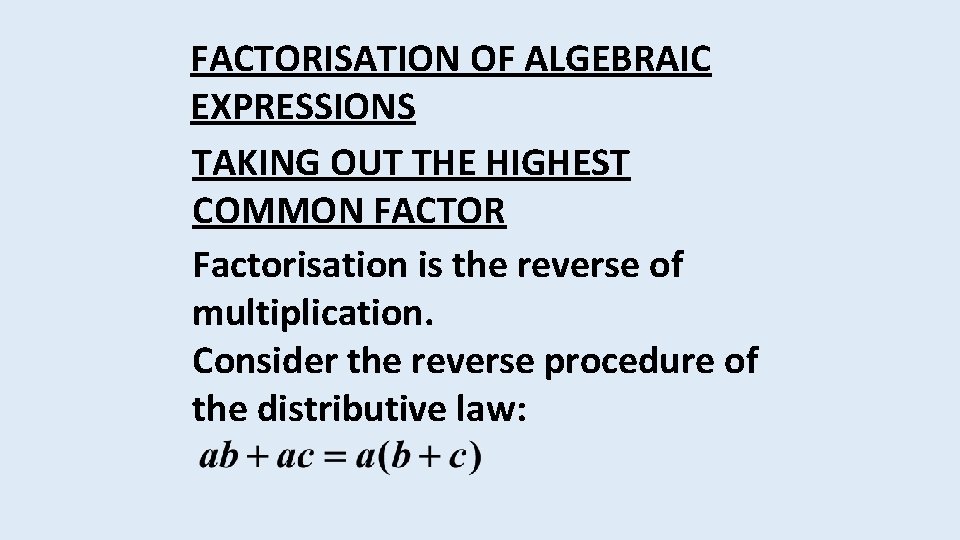
FACTORISATION OF ALGEBRAIC EXPRESSIONS TAKING OUT THE HIGHEST COMMON FACTOR Factorisation is the reverse of multiplication. Consider the reverse procedure of the distributive law:
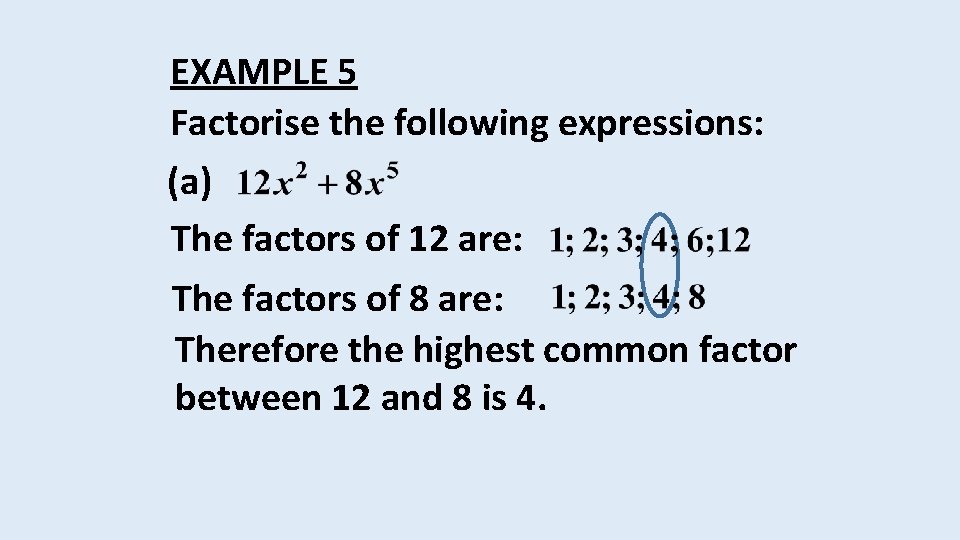
EXAMPLE 5 Factorise the following expressions: (a) The factors of 12 are: The factors of 8 are: Therefore the highest common factor between 12 and 8 is 4.
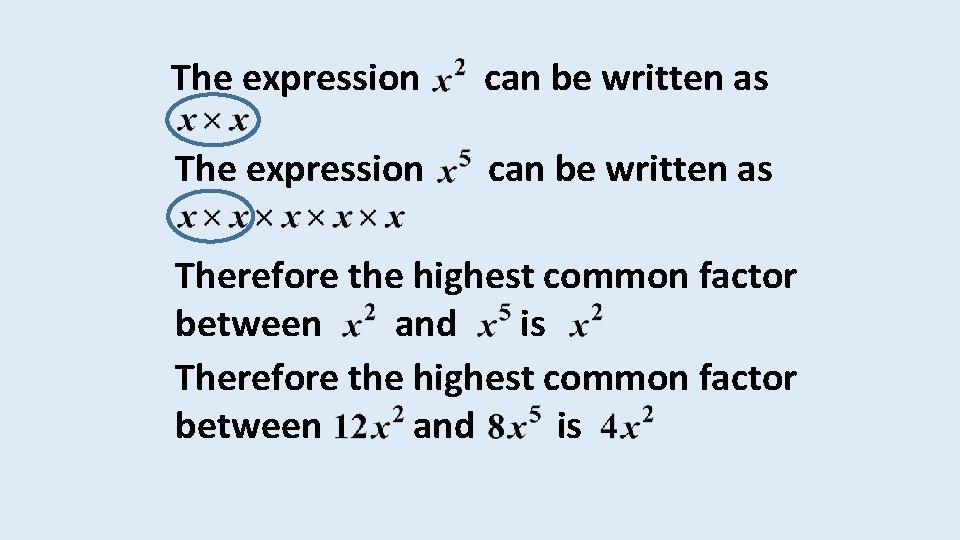
The expression can be written as Therefore the highest common factor between and is
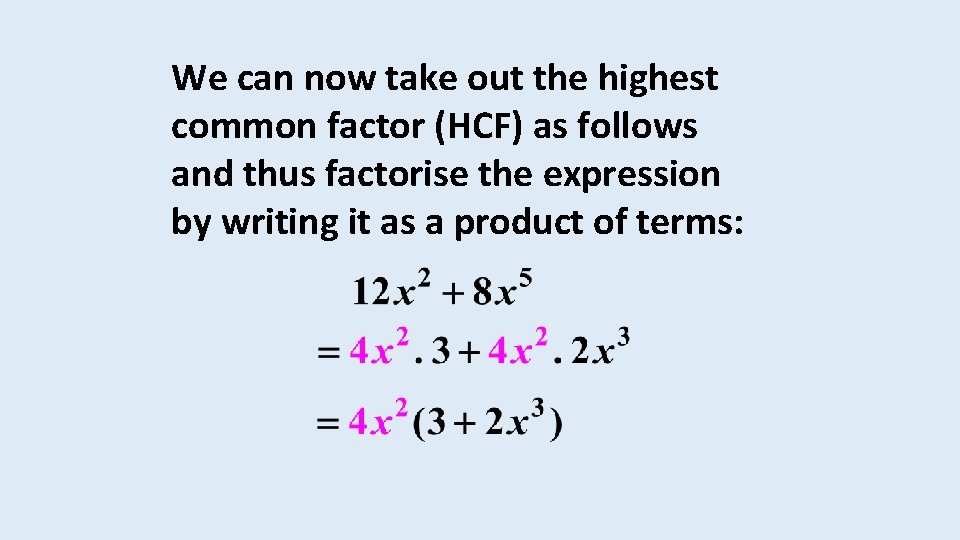
We can now take out the highest common factor (HCF) as follows and thus factorise the expression by writing it as a product of terms:
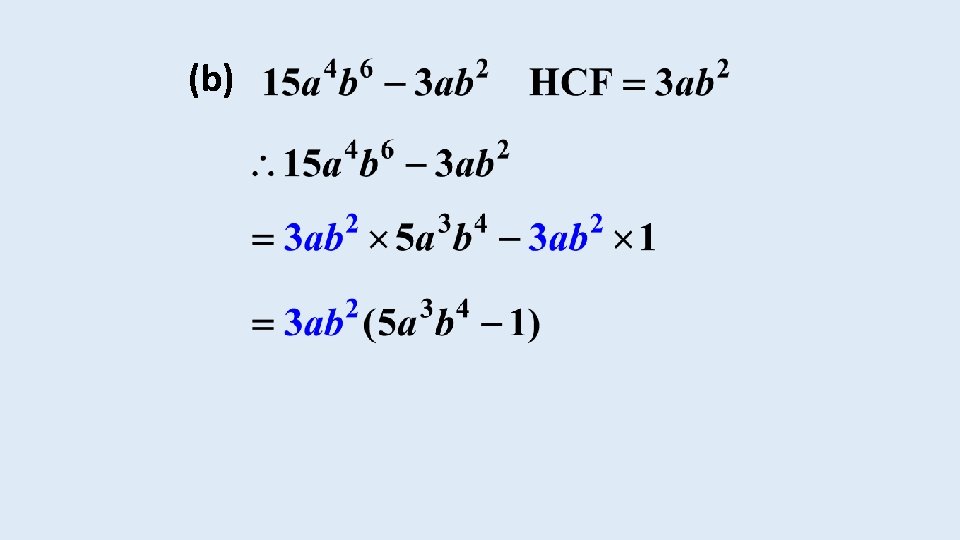
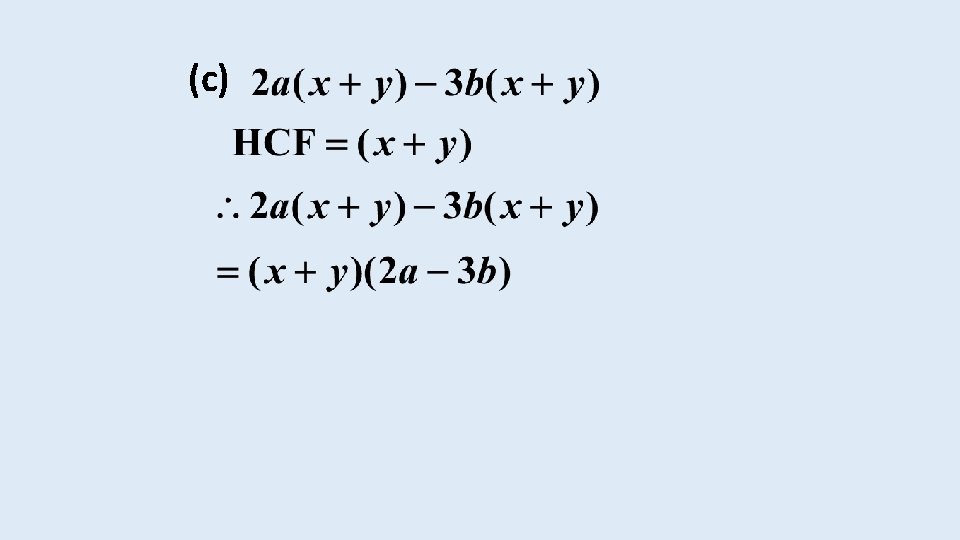
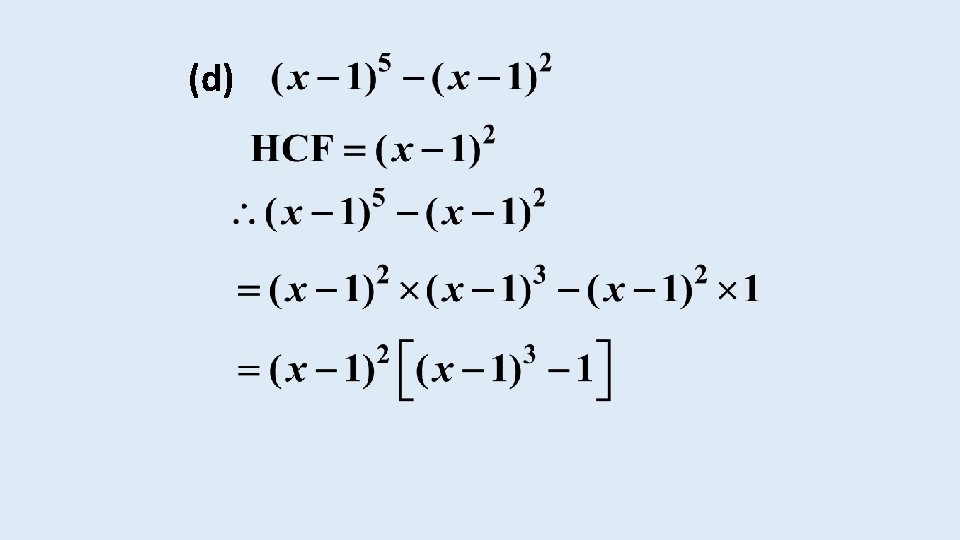
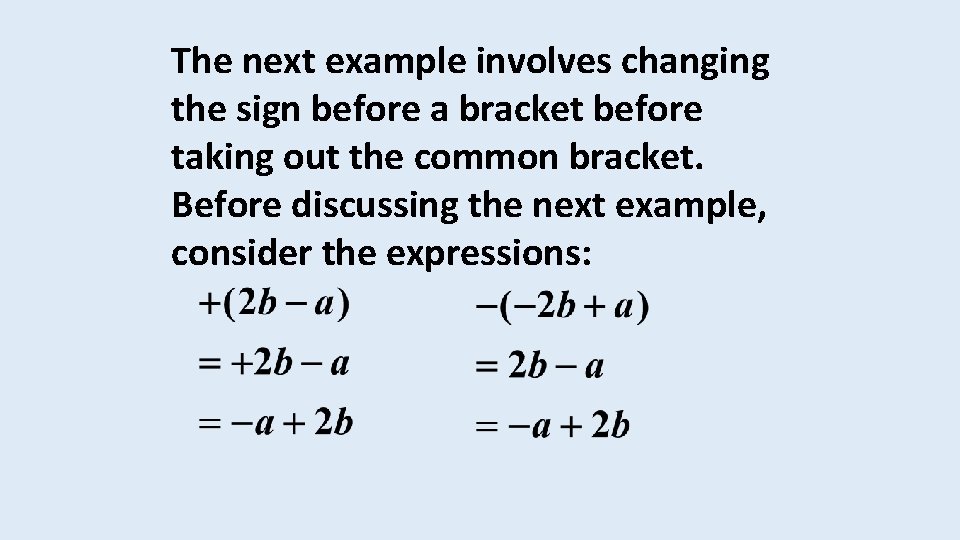
The next example involves changing the sign before a bracket before taking out the common bracket. Before discussing the next example, consider the expressions:

Therefore it is true that: You can write this as: For example:
Therefore, if you change the sign before the bracket, change the signs of the terms when writing them in the brackets.
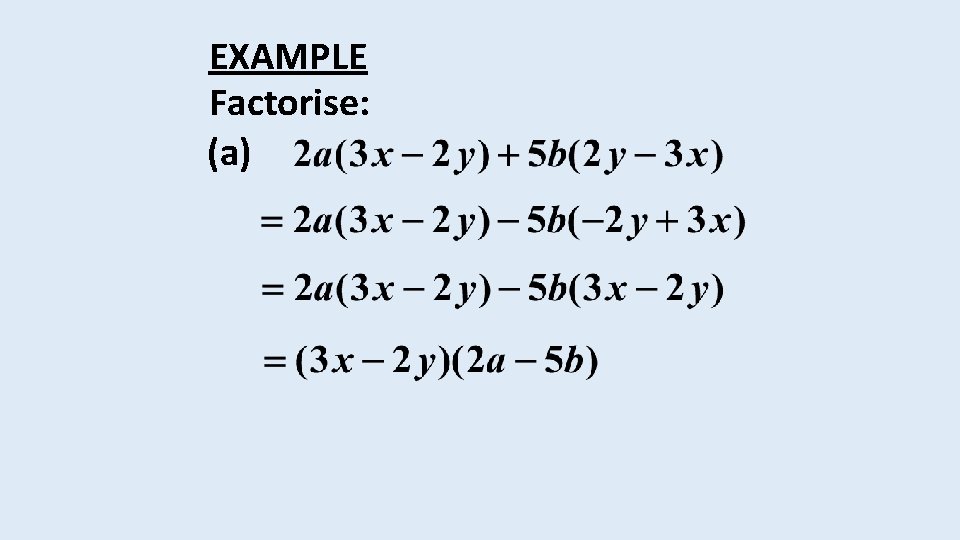
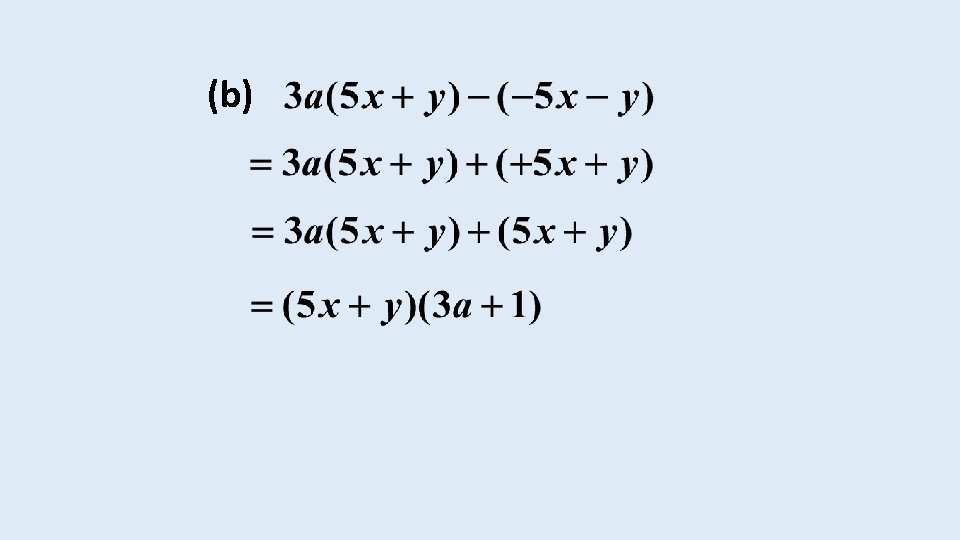
EXAMPLE Factorise: (a)
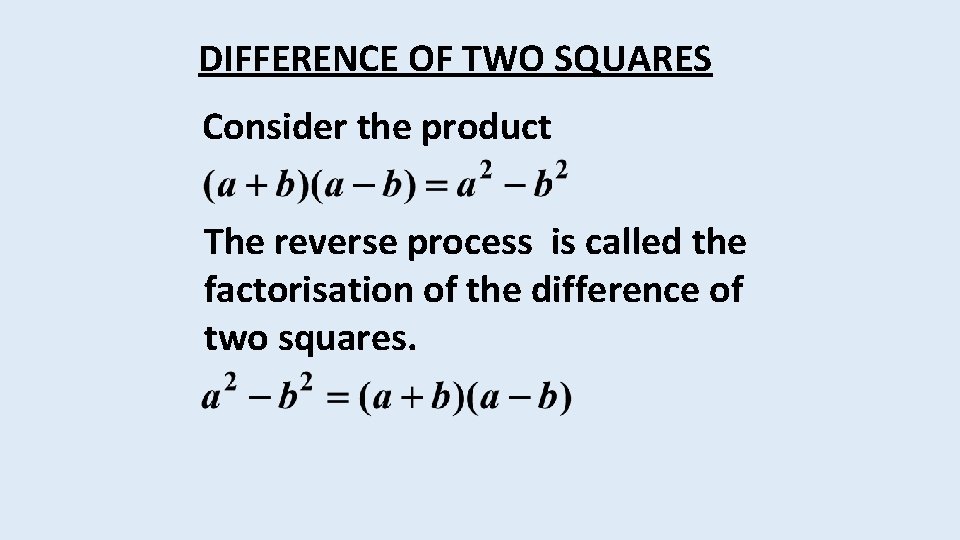
DIFFERENCE OF TWO SQUARES Consider the product The reverse process is called the factorisation of the difference of two squares.
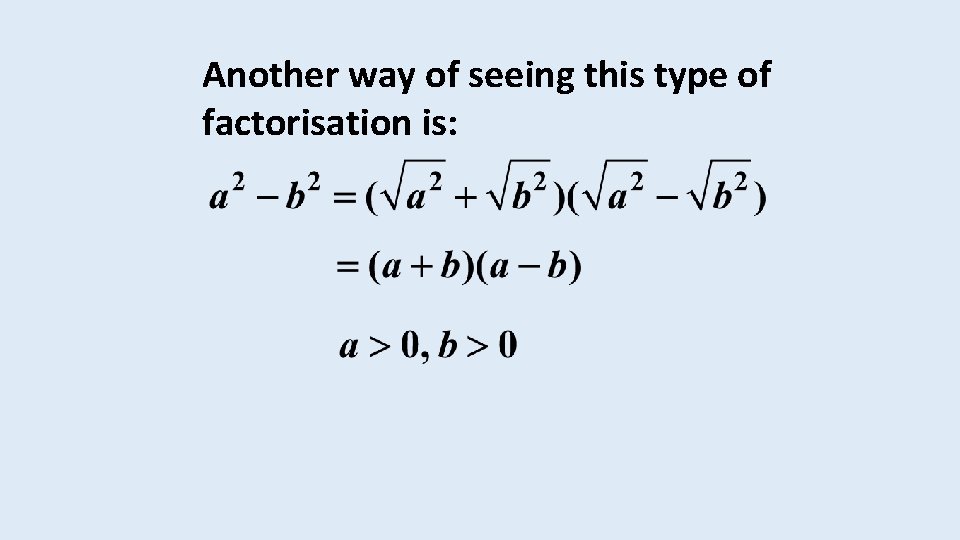
Another way of seeing this type of factorisation is:
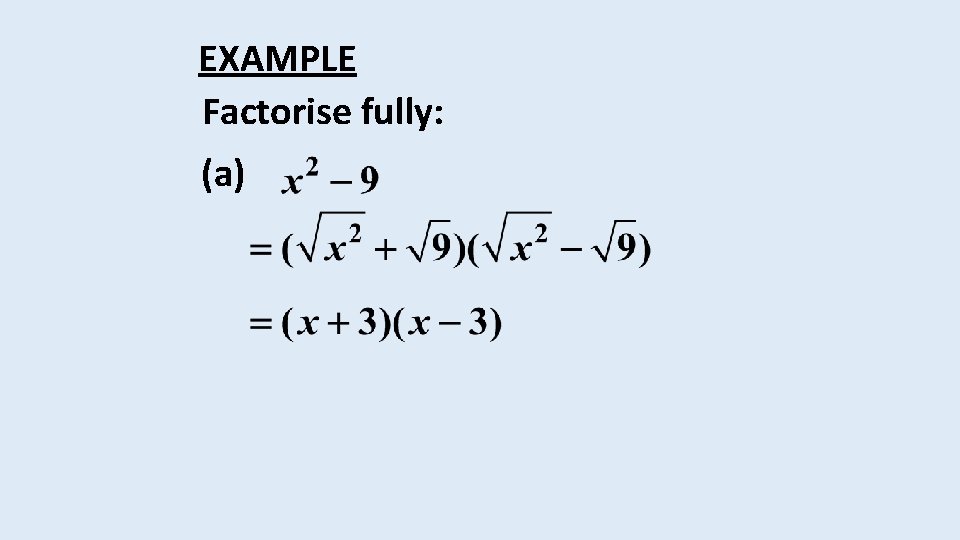
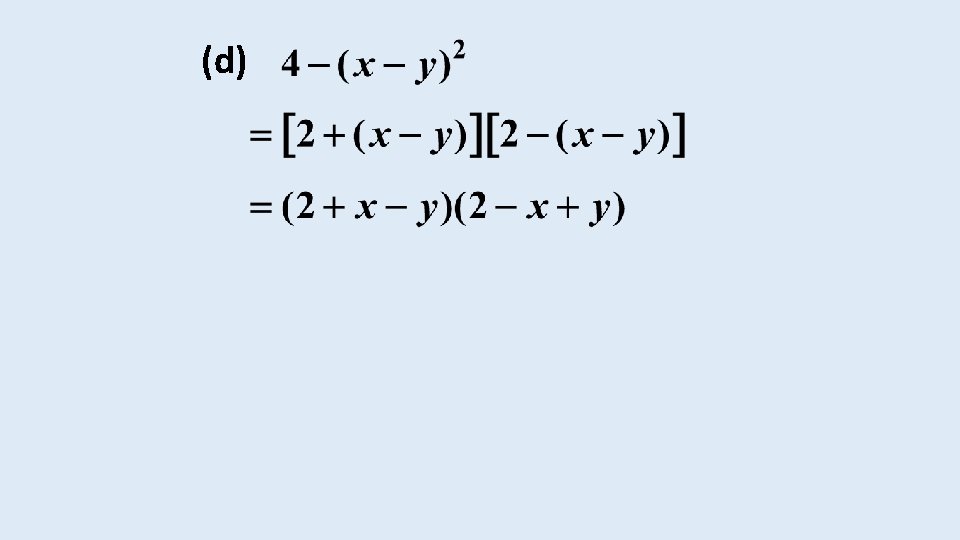
EXAMPLE Factorise fully: (a)

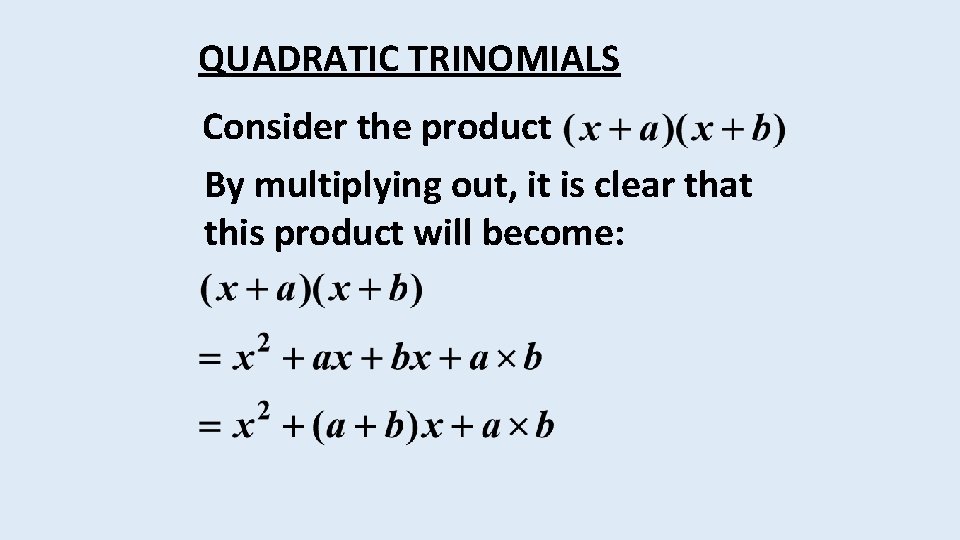
QUADRATIC TRINOMIALS Consider the product By multiplying out, it is clear that this product will become:
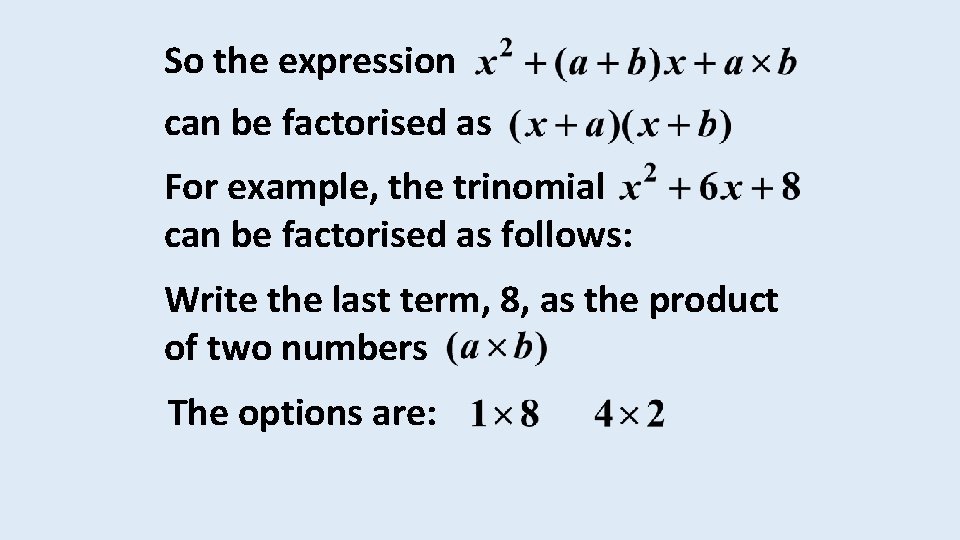
So the expression can be factorised as For example, the trinomial can be factorised as follows: Write the last term, 8, as the product of two numbers The options are:
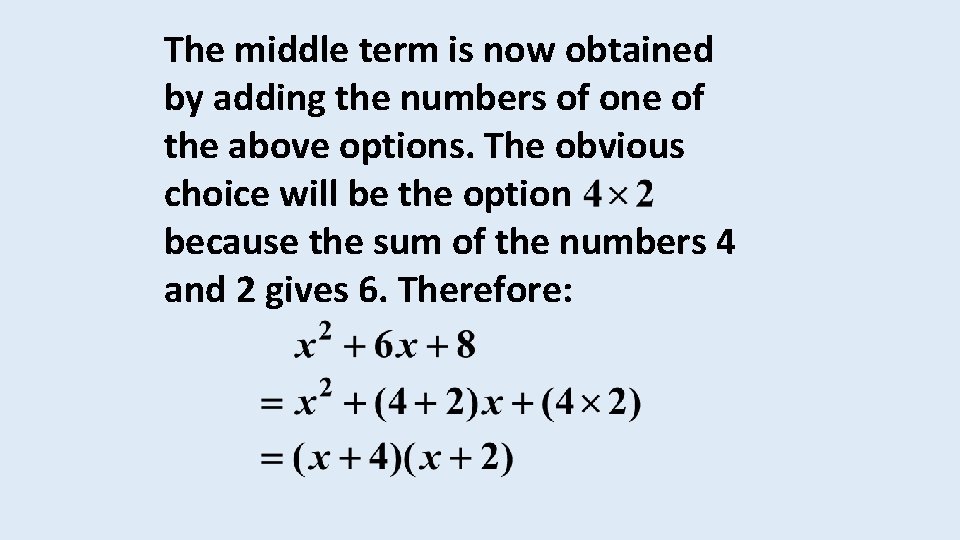
The middle term is now obtained by adding the numbers of one of the above options. The obvious choice will be the option because the sum of the numbers 4 and 2 gives 6. Therefore:
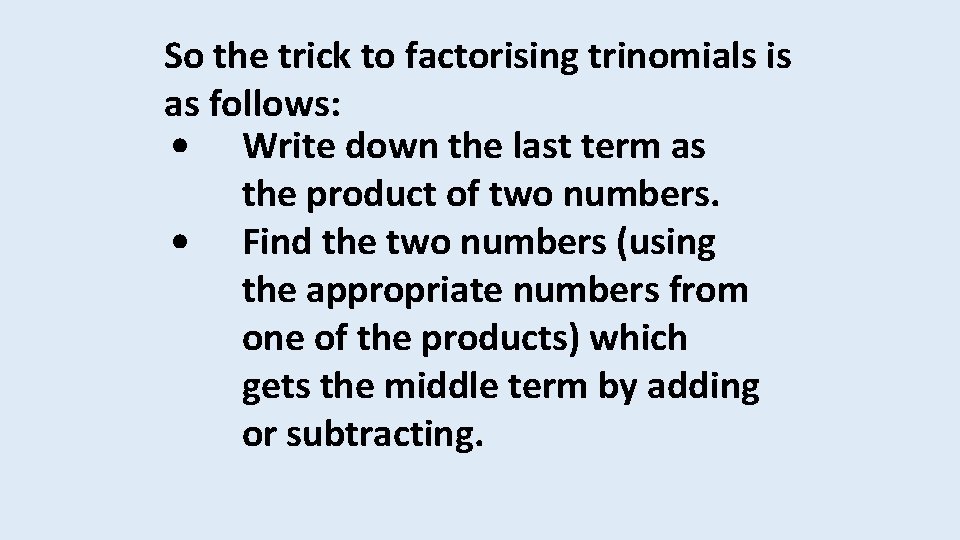
So the trick to factorising trinomials is as follows: • Write down the last term as the product of two numbers. • Find the two numbers (using the appropriate numbers from one of the products) which gets the middle term by adding or subtracting.
• Check that when you multiply these numbers you get the last term.
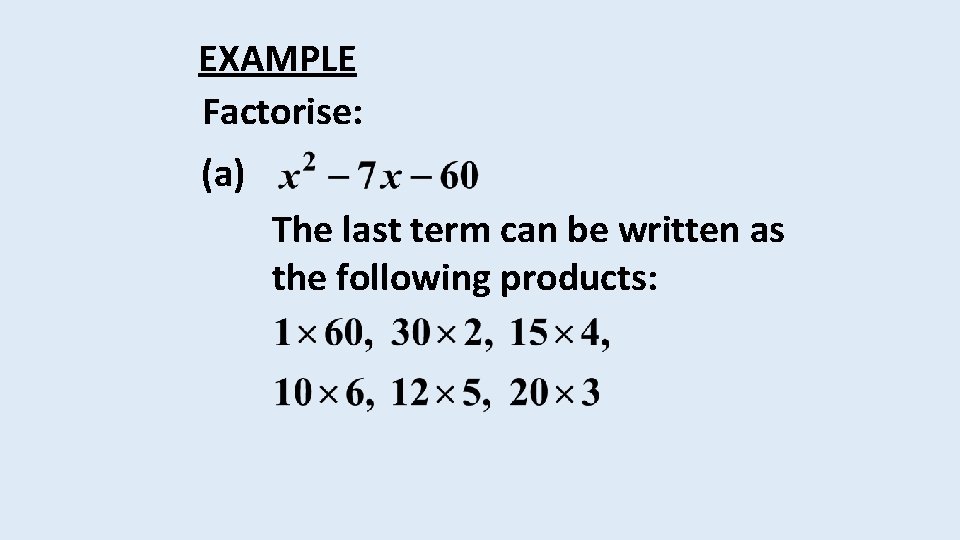
EXAMPLE Factorise: (a) The last term can be written as the following products:
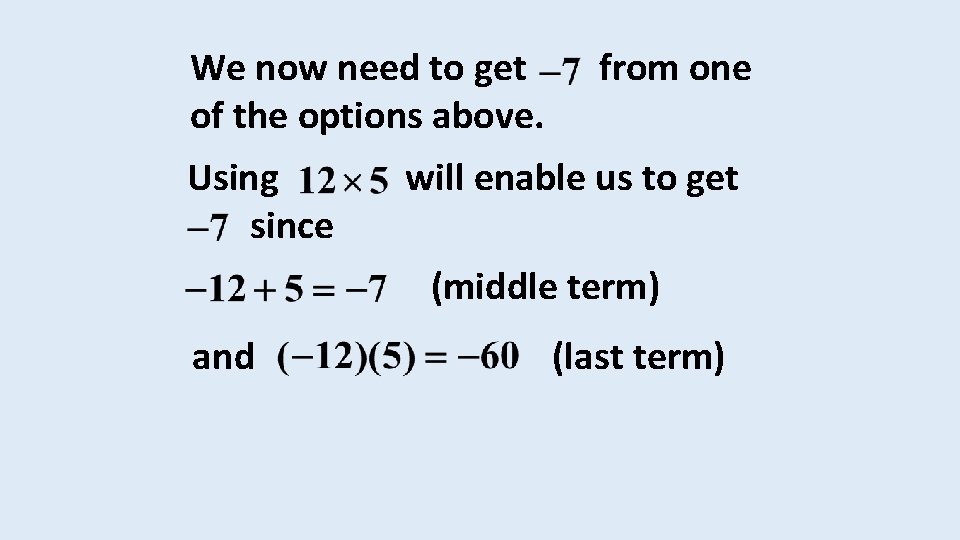
We now need to get of the options above. Using since from one will enable us to get (middle term) and (last term)
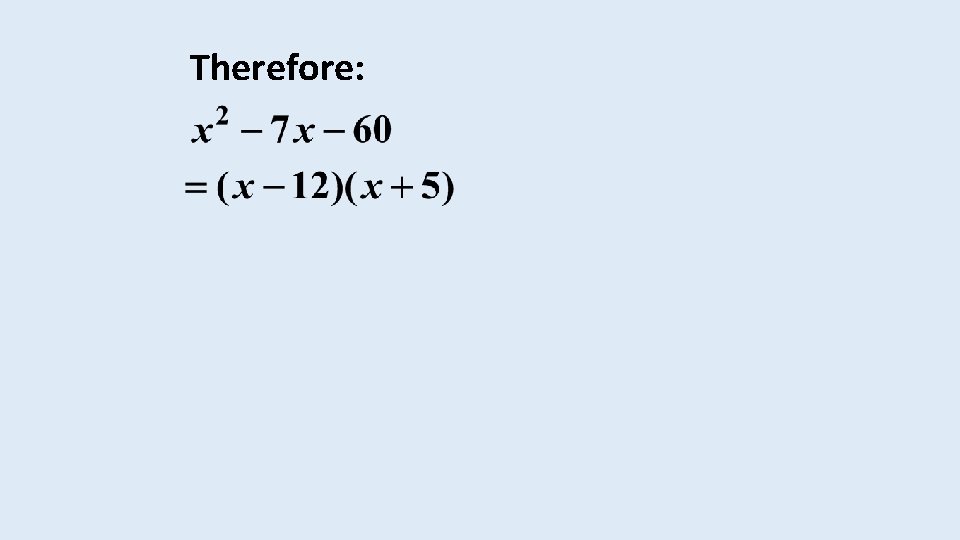
Therefore:
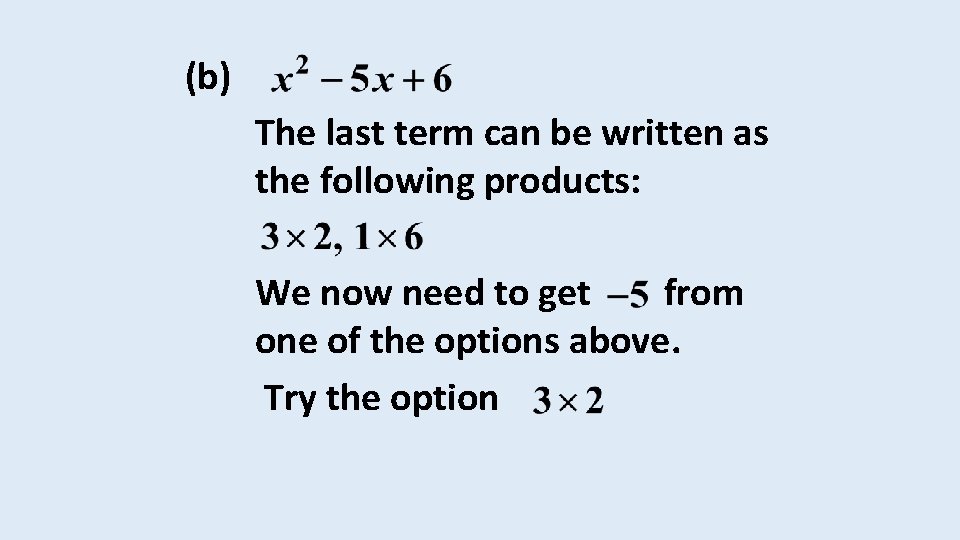
(b) The last term can be written as the following products: We now need to get from one of the options above. Try the option
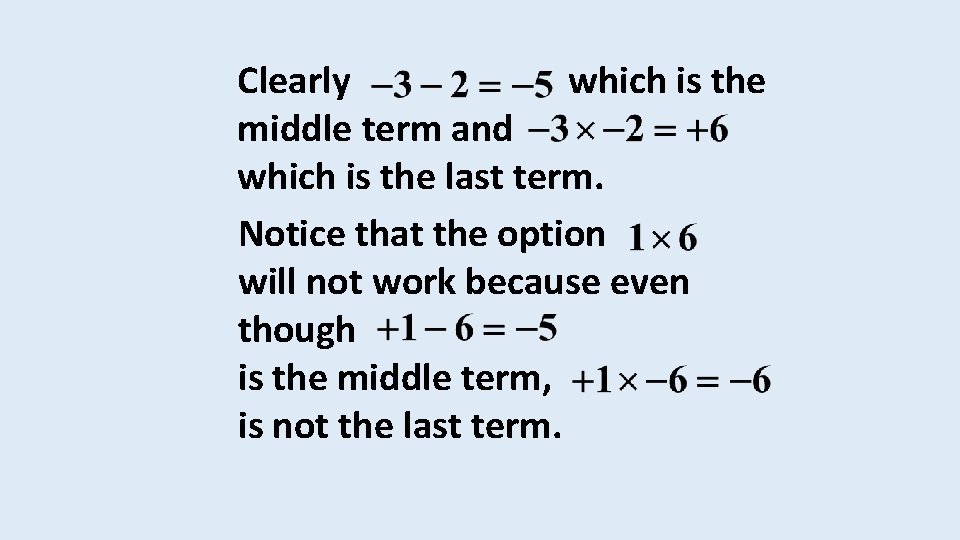
Clearly which is the middle term and which is the last term. Notice that the option will not work because even though is the middle term, is not the last term.
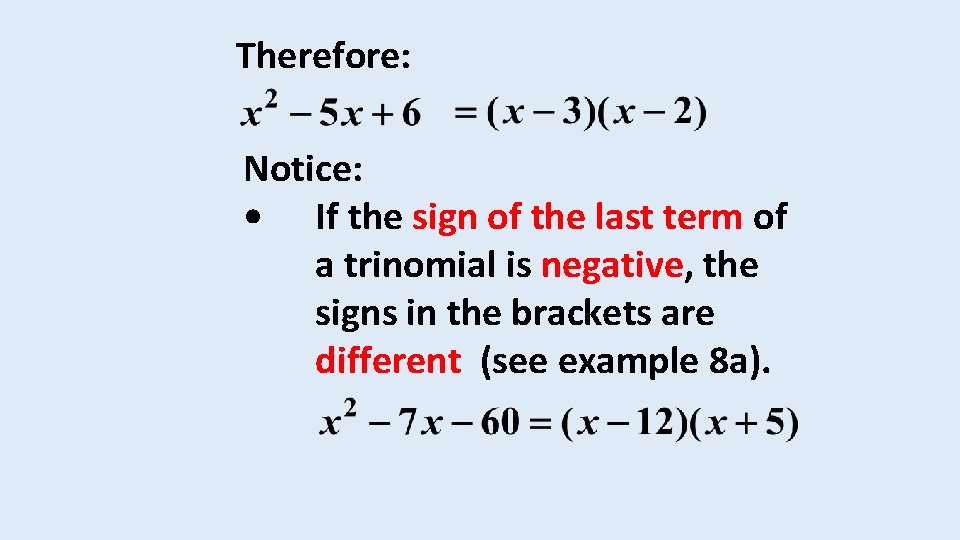
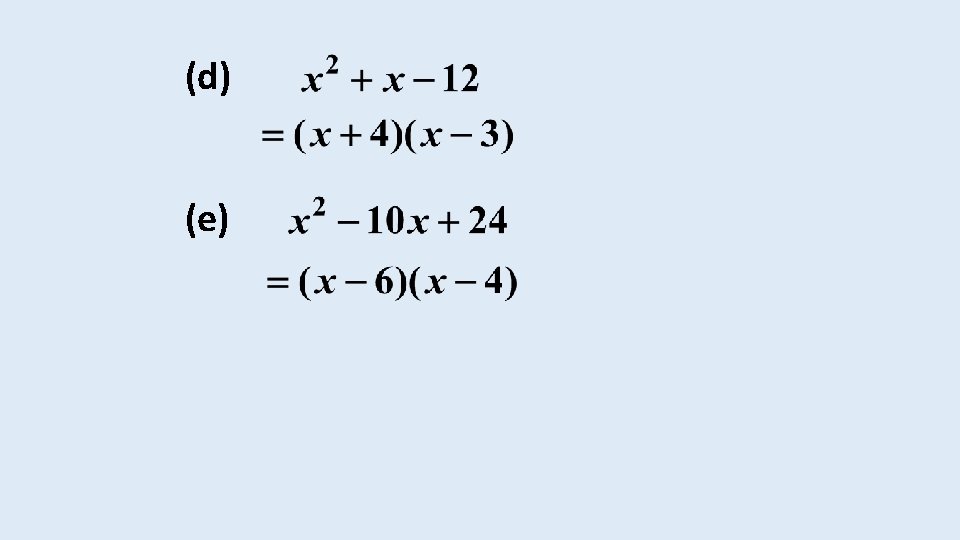
Therefore: Notice: • If the sign of the last term of a trinomial is negative, the signs in the brackets are different (see example 8 a).
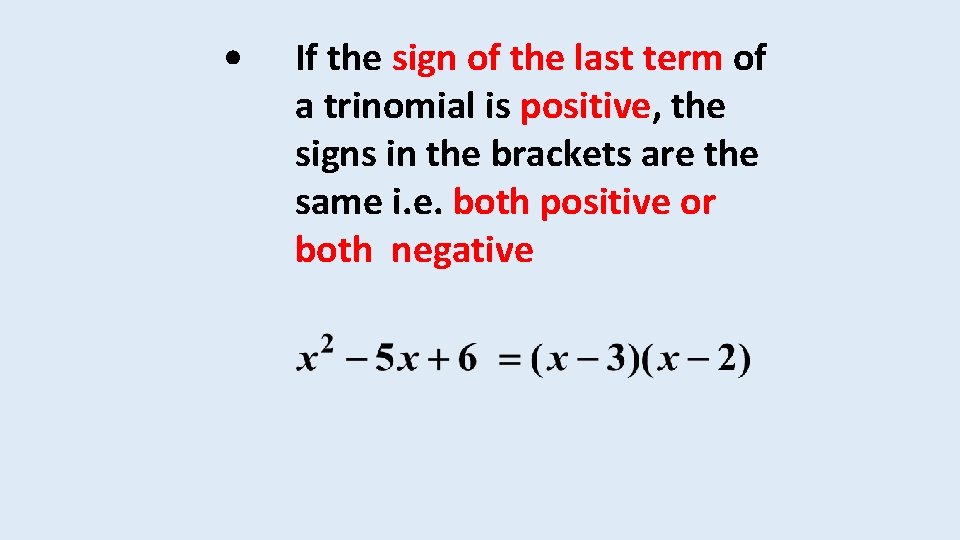
• If the sign of the last term of a trinomial is positive, the signs in the brackets are the same i. e. both positive or both negative
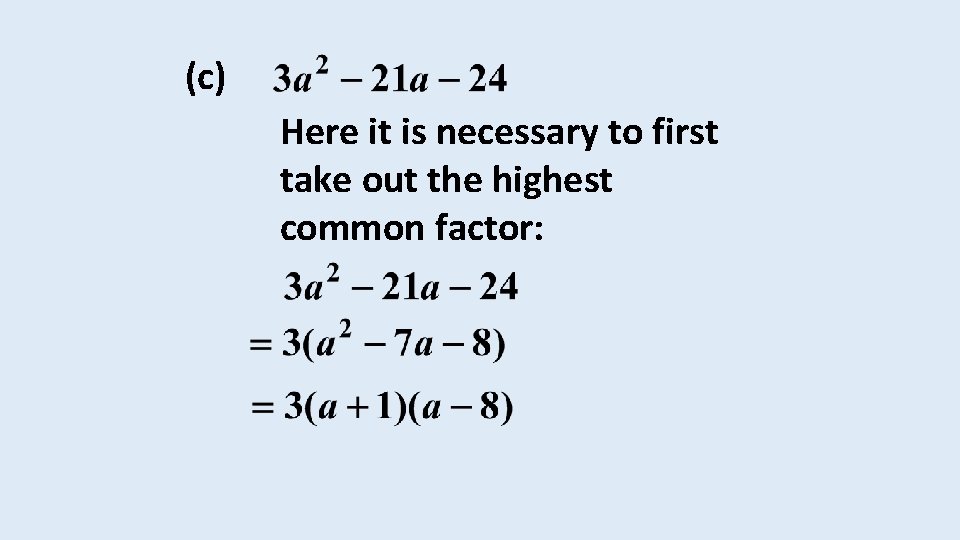
(c) Here it is necessary to first take out the highest common factor:
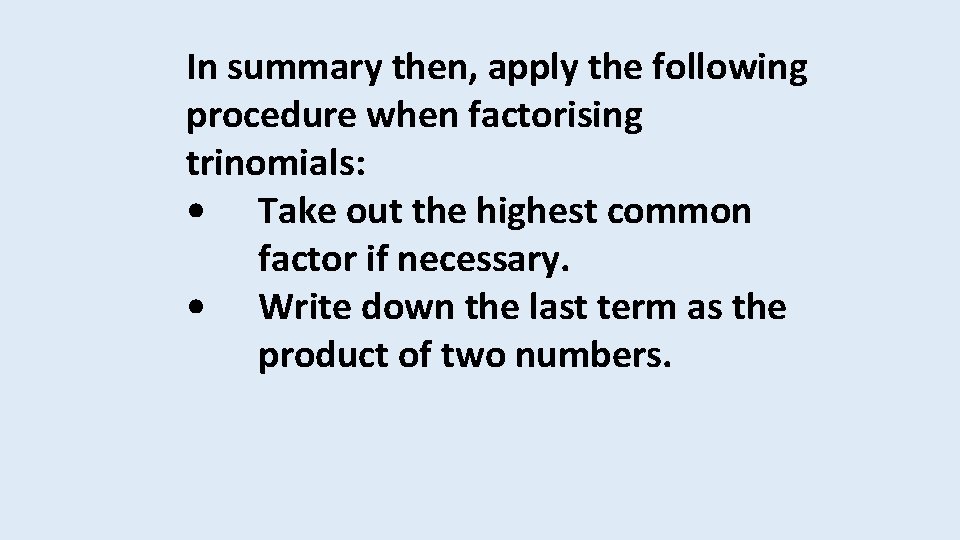
In summary then, apply the following procedure when factorising trinomials: • Take out the highest common factor if necessary. • Write down the last term as the product of two numbers.
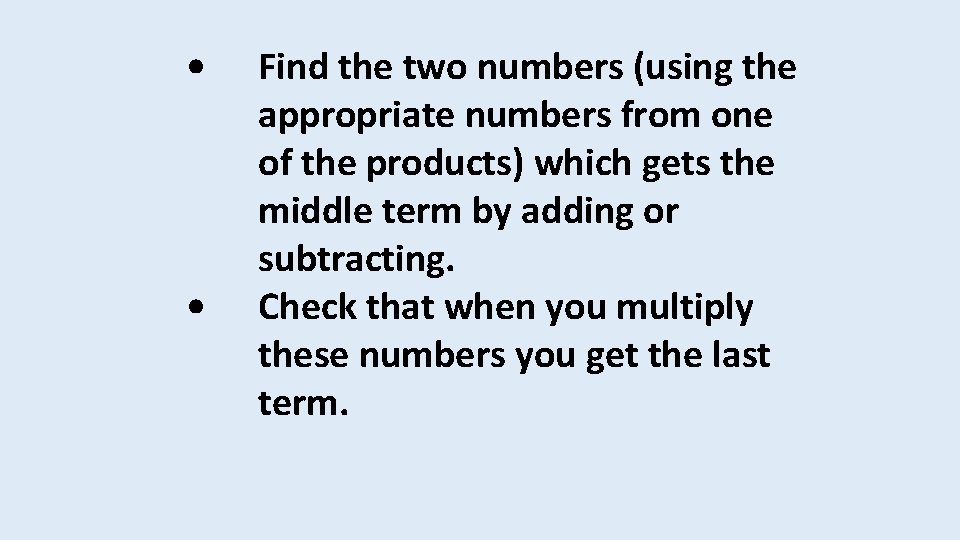
• • Find the two numbers (using the appropriate numbers from one of the products) which gets the middle term by adding or subtracting. Check that when you multiply these numbers you get the last term.
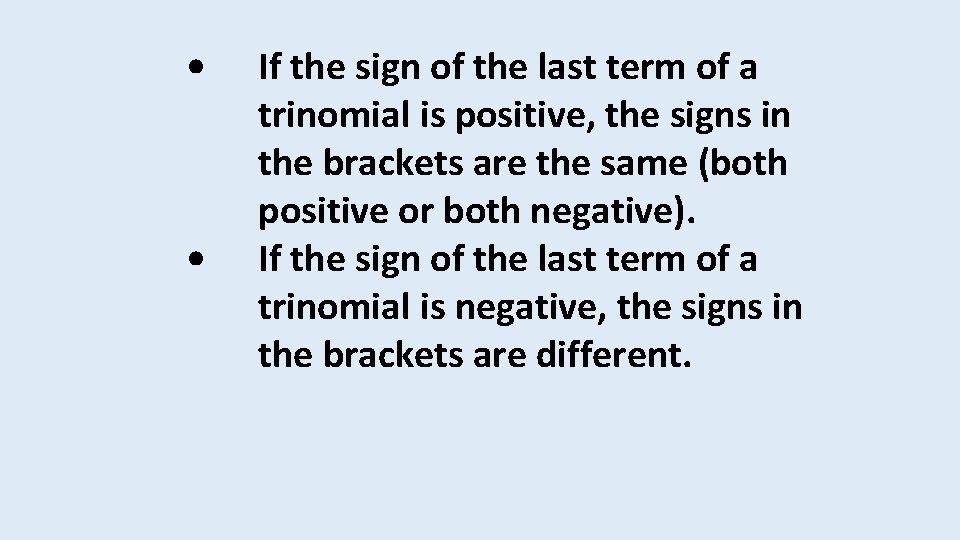
• • If the sign of the last term of a trinomial is positive, the signs in the brackets are the same (both positive or both negative). If the sign of the last term of a trinomial is negative, the signs in the brackets are different.
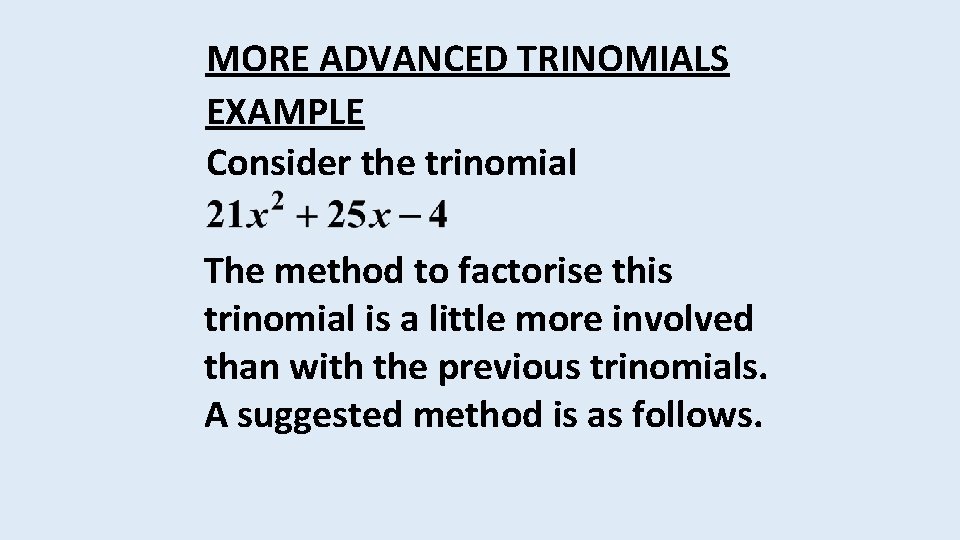
MORE ADVANCED TRINOMIALS EXAMPLE Consider the trinomial The method to factorise this trinomial is a little more involved than with the previous trinomials. A suggested method is as follows.
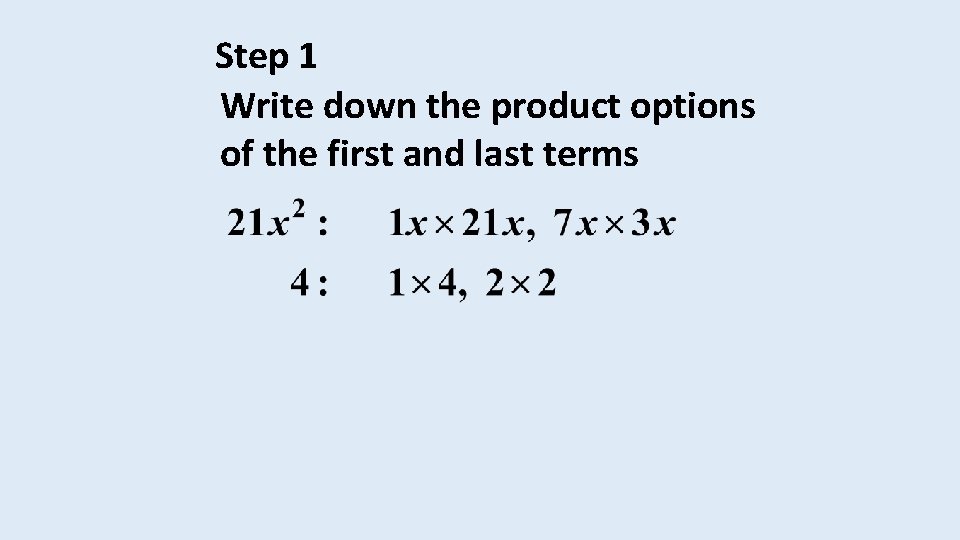
Step 1 Write down the product options of the first and last terms
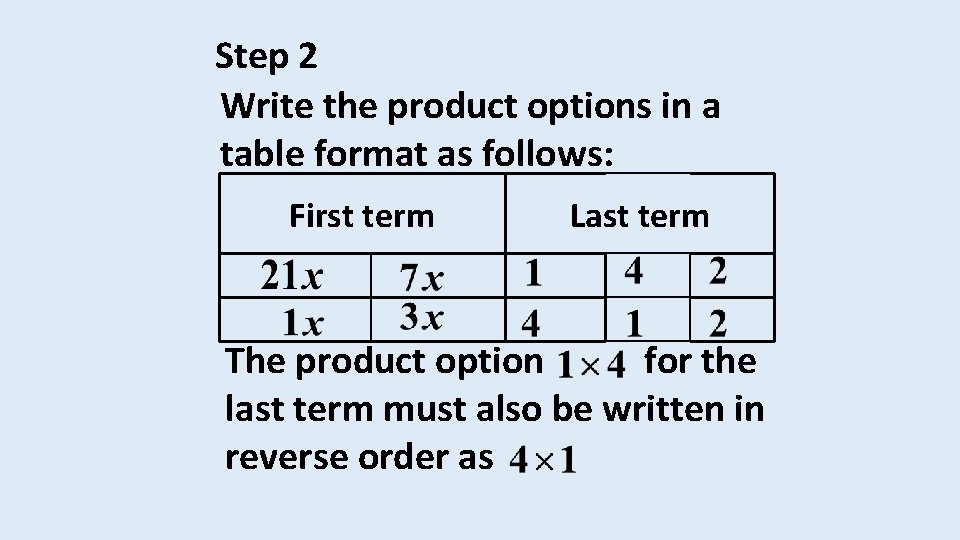
Step 2 Write the product options in a table format as follows: First term Last term The product option for the last term must also be written in reverse order as
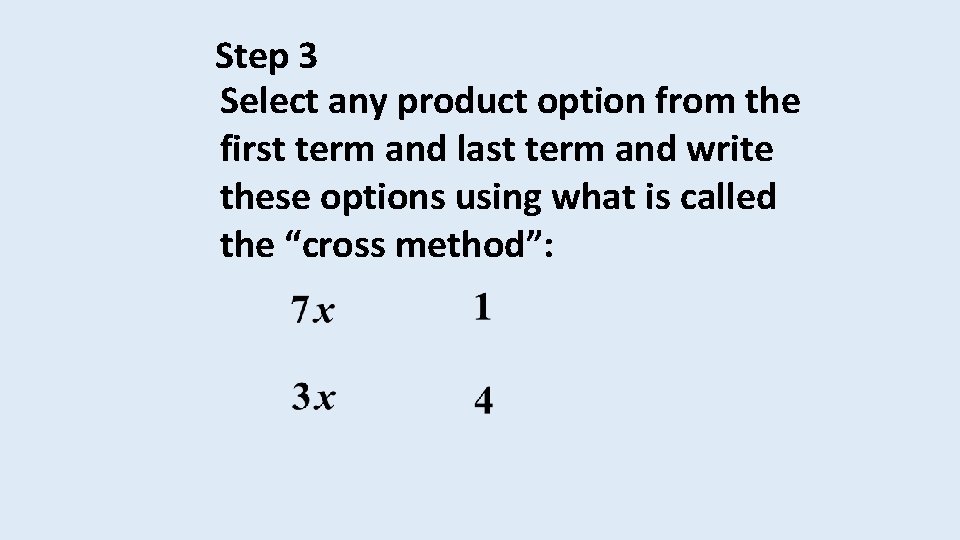
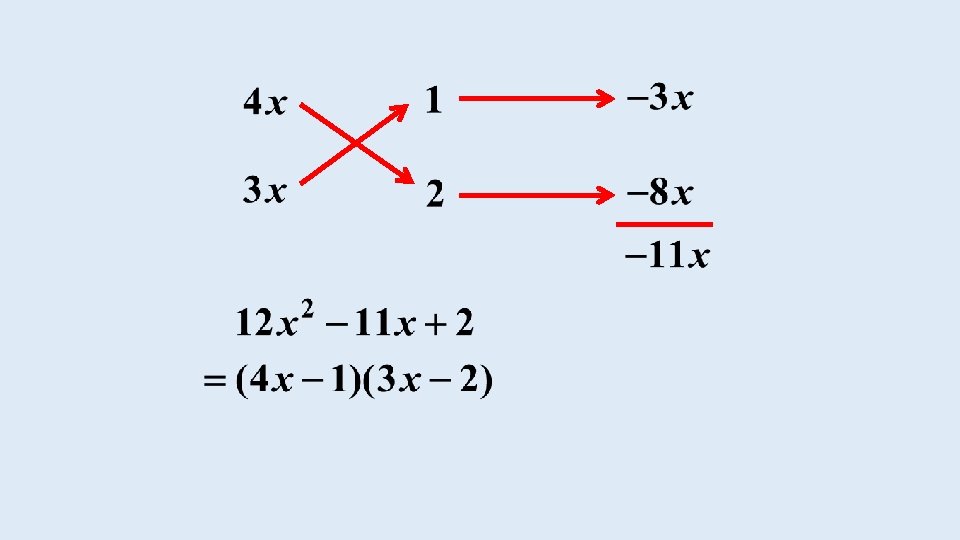
Step 3 Select any product option from the first term and last term and write these options using what is called the “cross method”:
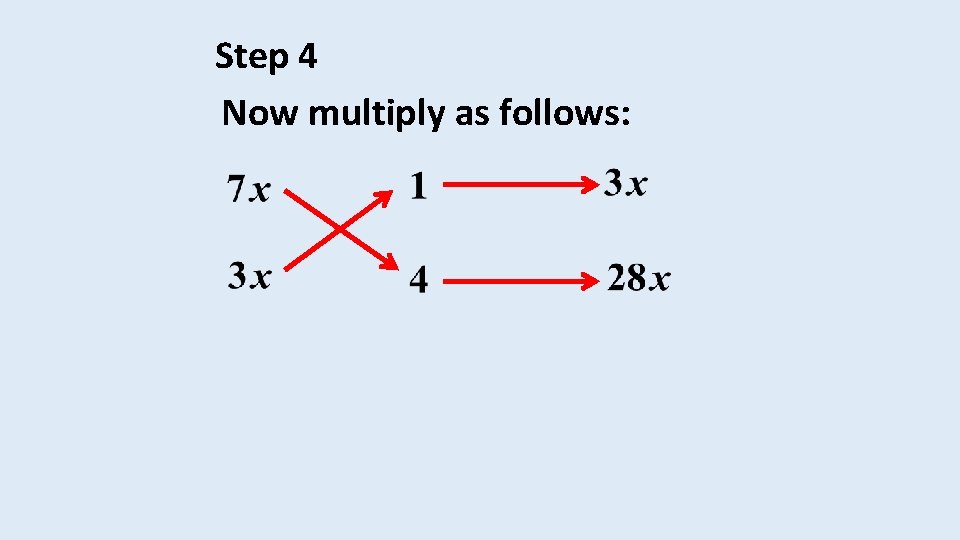
Step 4 Now multiply as follows:
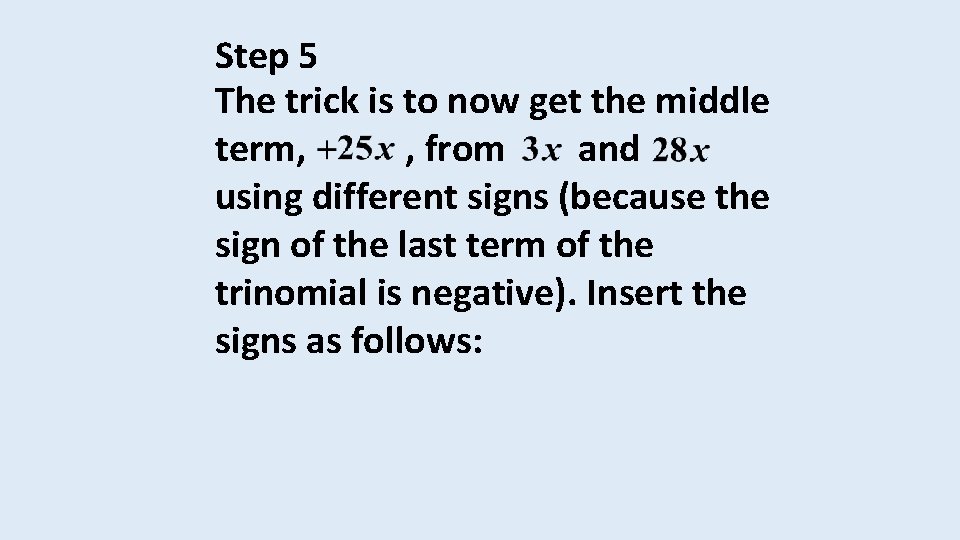
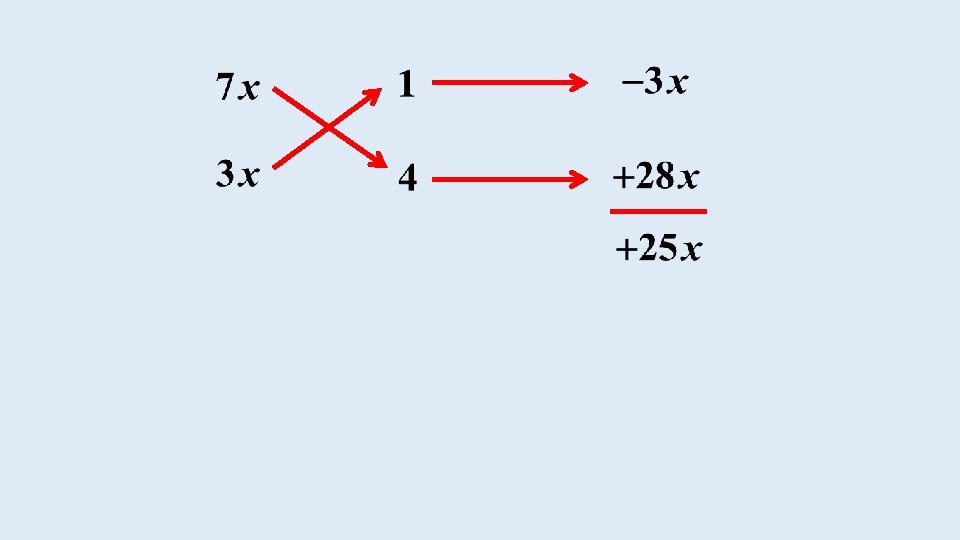
Step 5 The trick is to now get the middle term, , from and using different signs (because the sign of the last term of the trinomial is negative). Insert the signs as follows:
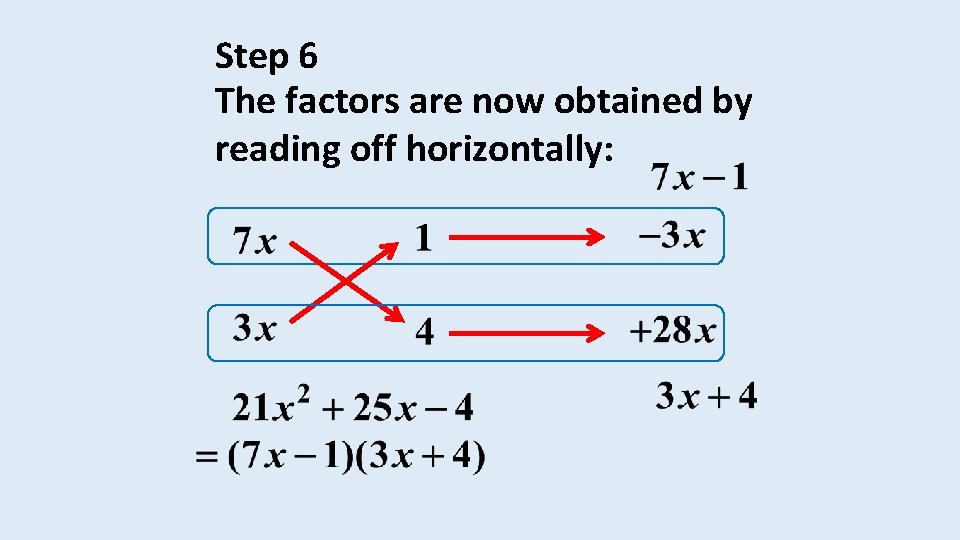
Step 6 The factors are now obtained by reading off horizontally:
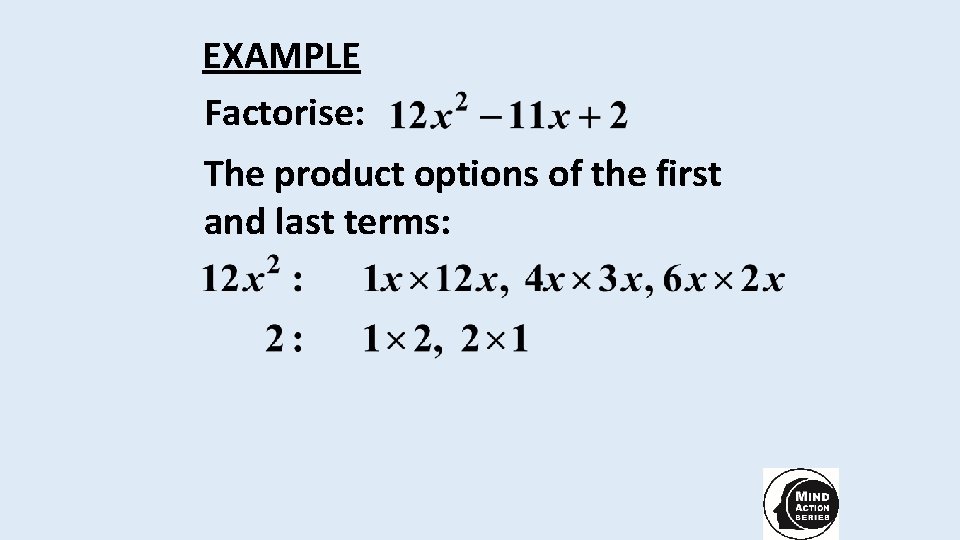
EXAMPLE Factorise: The product options of the first and last terms:
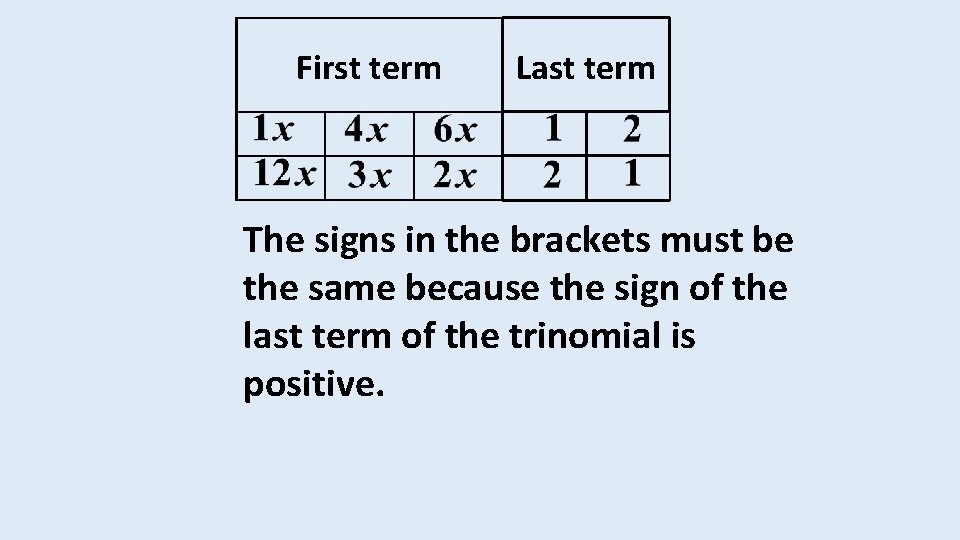
First term Last term The signs in the brackets must be the same because the sign of the last term of the trinomial is positive.
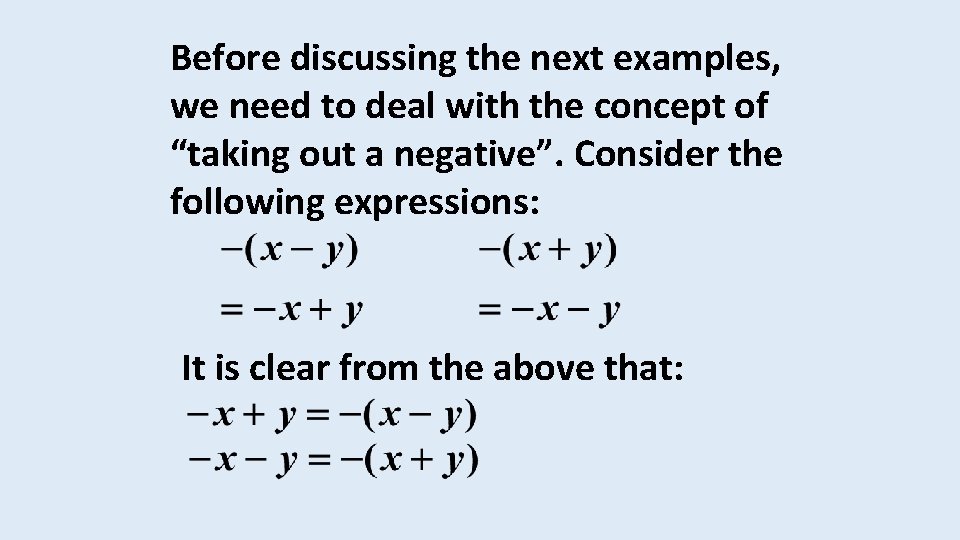
Before discussing the next examples, we need to deal with the concept of “taking out a negative”. Consider the following expressions: It is clear from the above that:
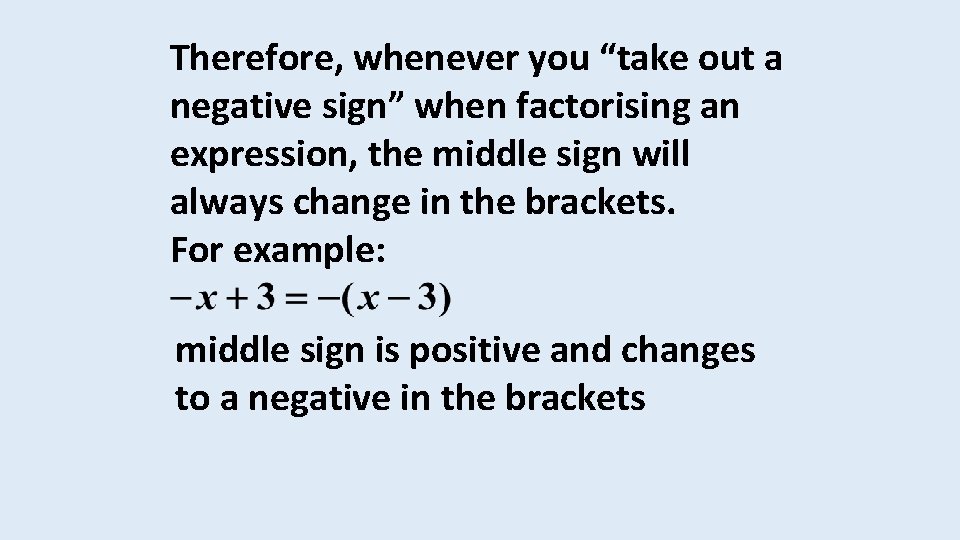
Therefore, whenever you “take out a negative sign” when factorising an expression, the middle sign will always change in the brackets. For example: middle sign is positive and changes to a negative in the brackets
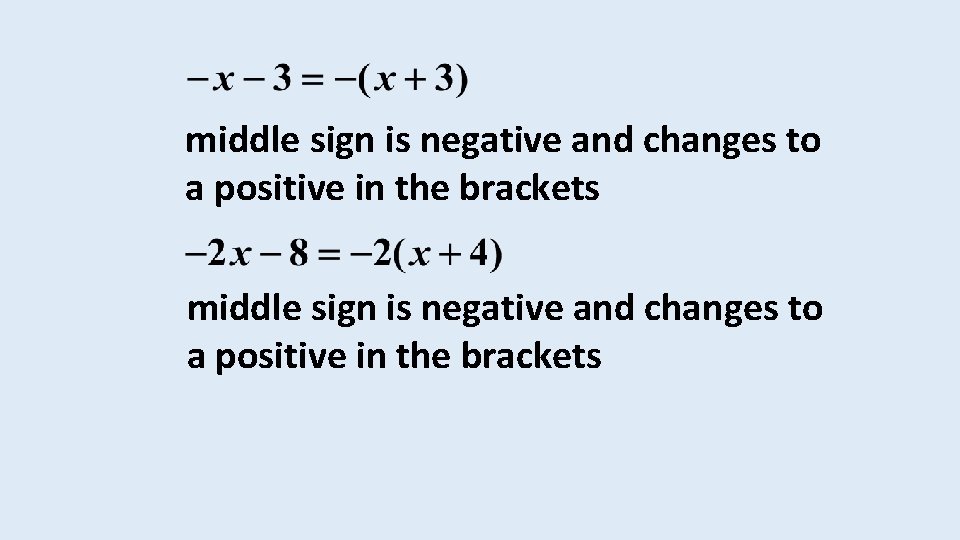
middle sign is negative and changes to a positive in the brackets
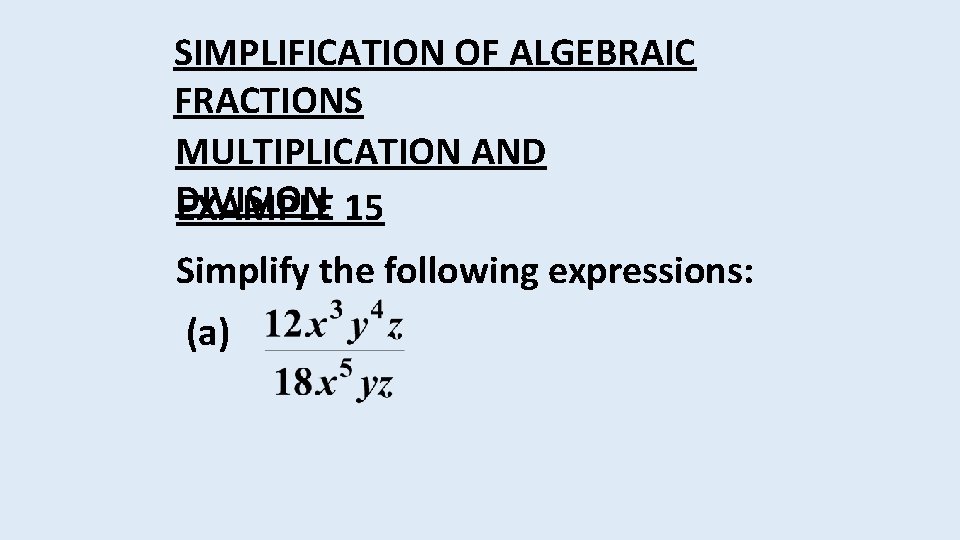
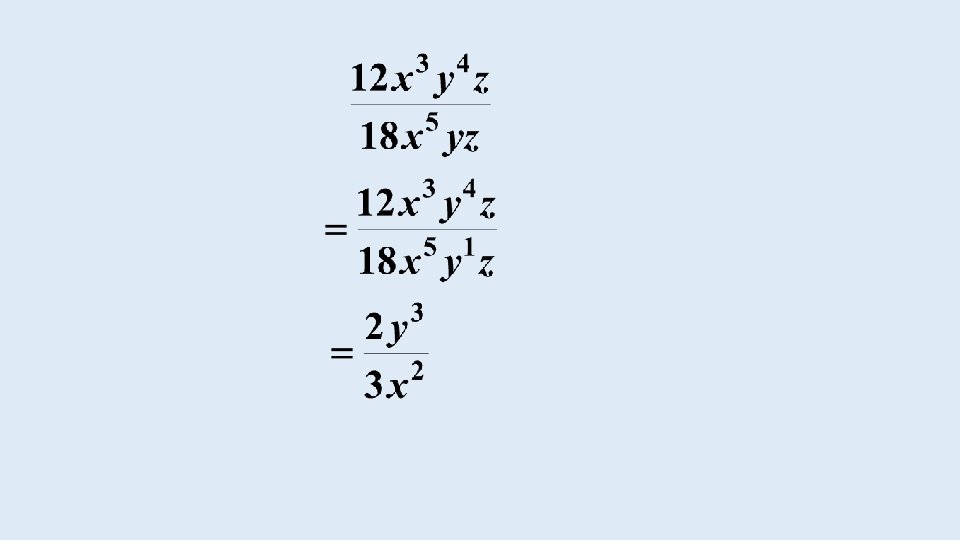
SIMPLIFICATION OF ALGEBRAIC FRACTIONS MULTIPLICATION AND DIVISION EXAMPLE 15 Simplify the following expressions: (a)
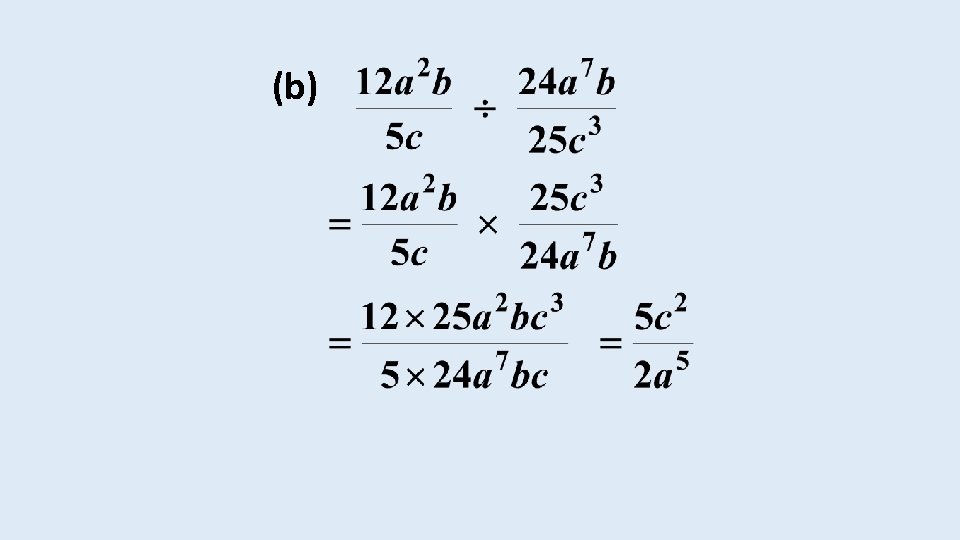
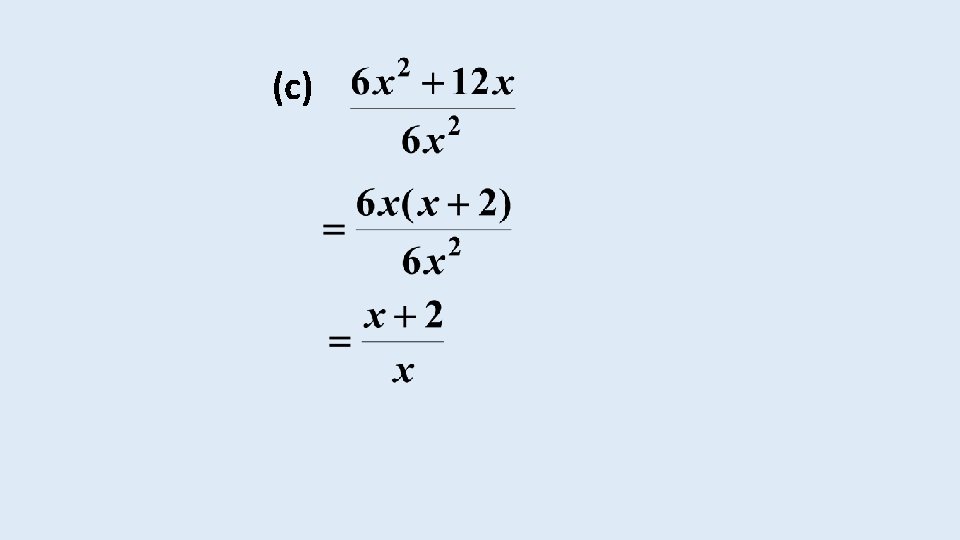
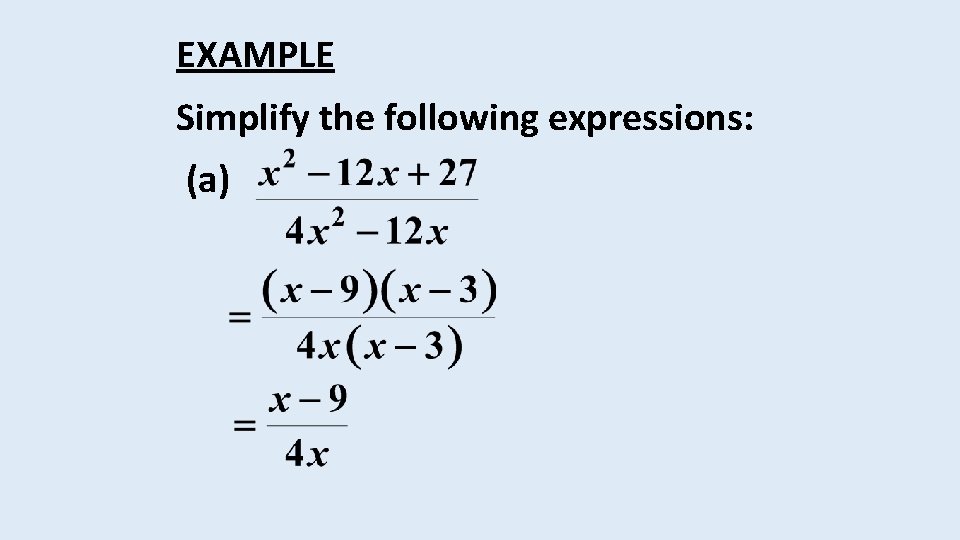
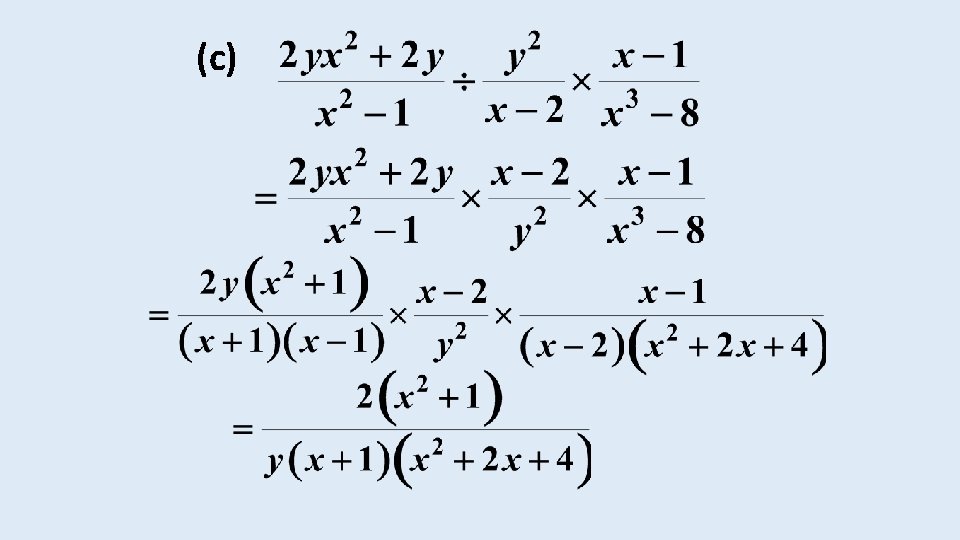
EXAMPLE Simplify the following expressions: (a)
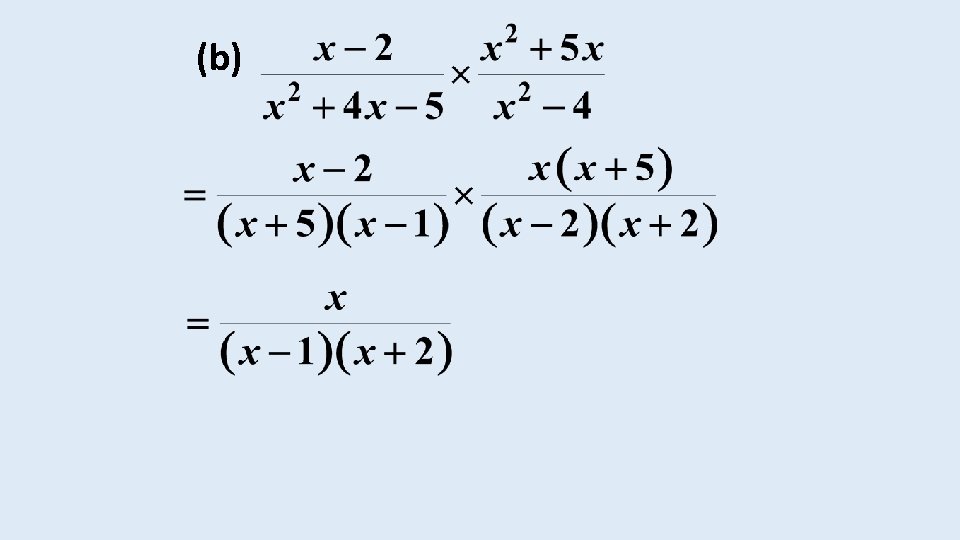
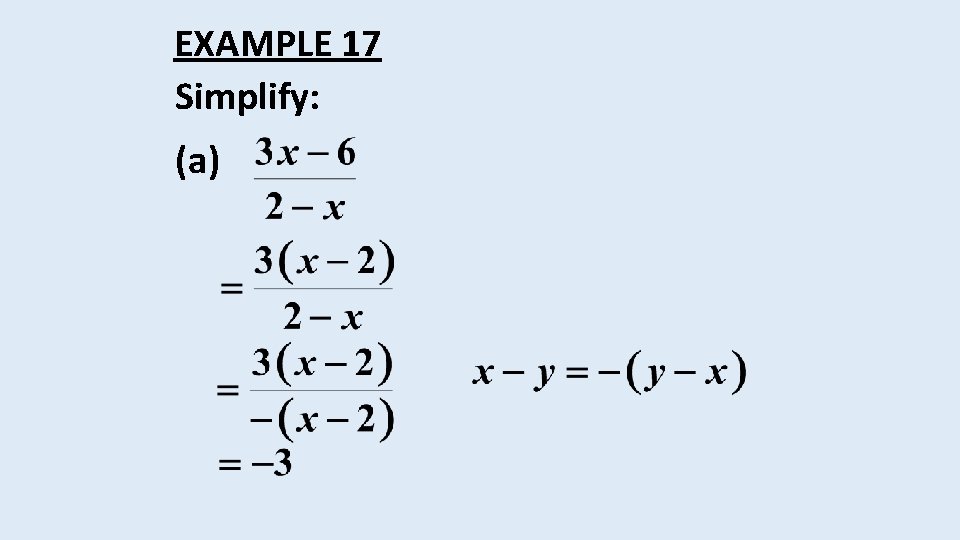
EXAMPLE 17 Simplify: (a)

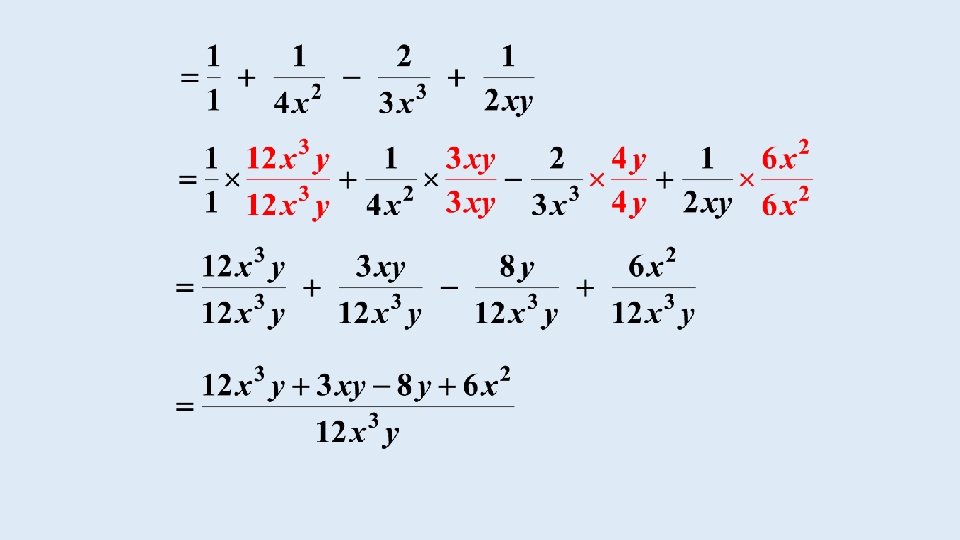
EXAMPLE 18 Simplify:
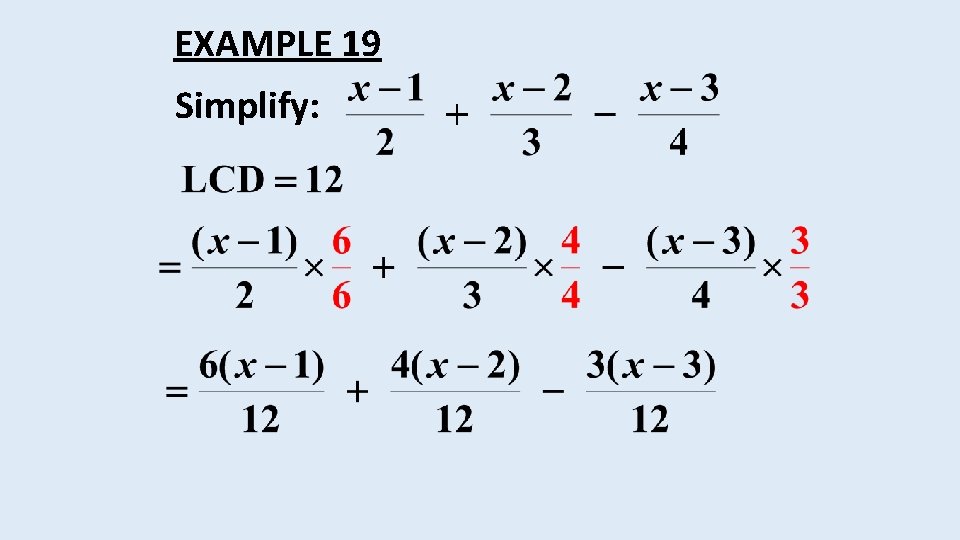
EXAMPLE 19 Simplify:
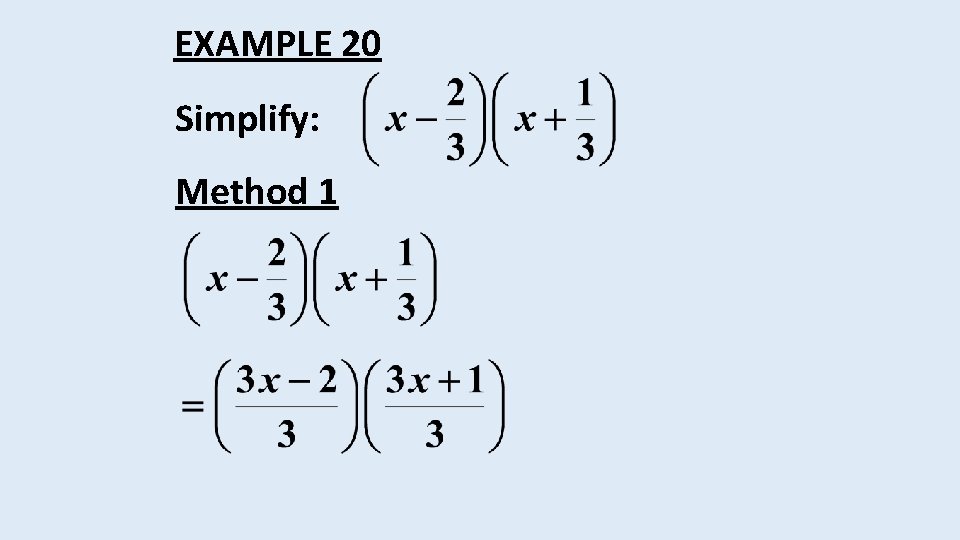
EXAMPLE 20 Simplify: Method 1
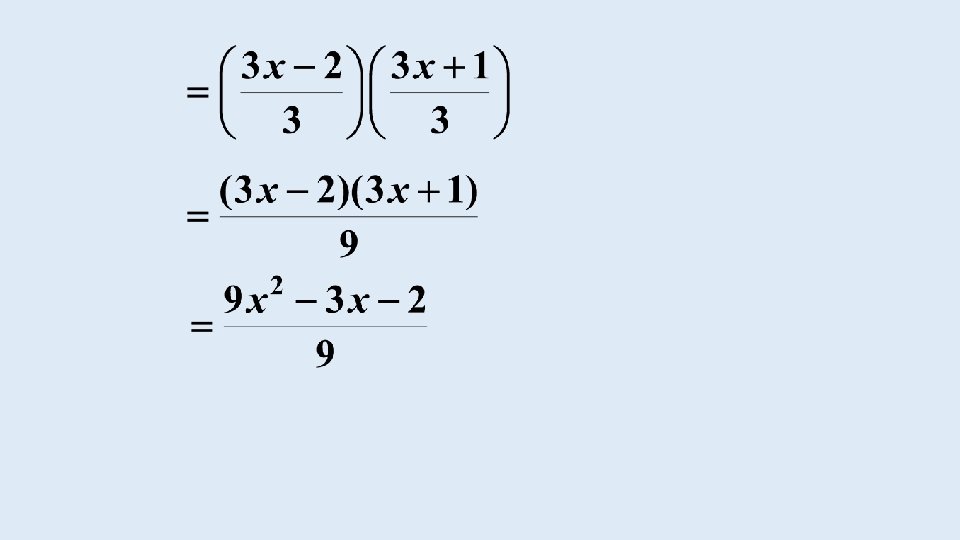
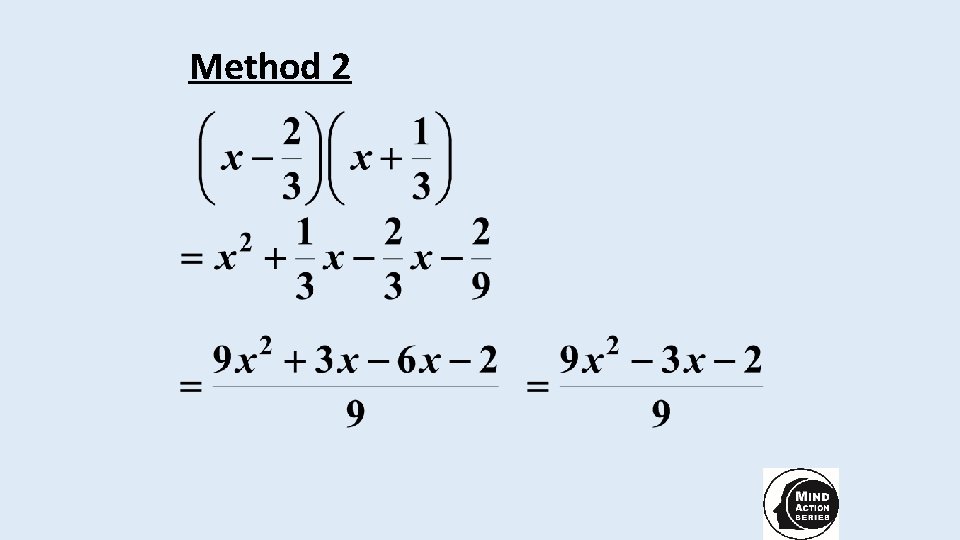
Method 2
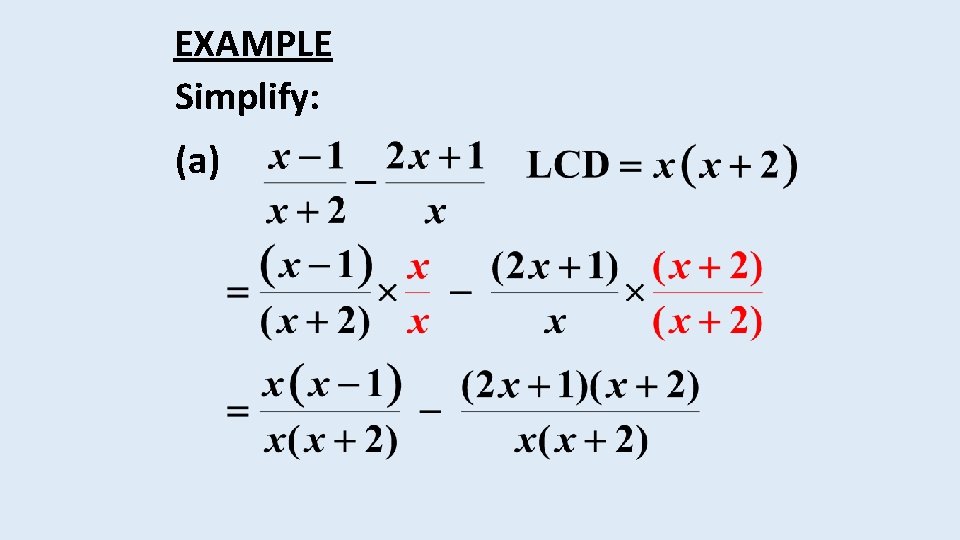
EXAMPLE Simplify: (a)
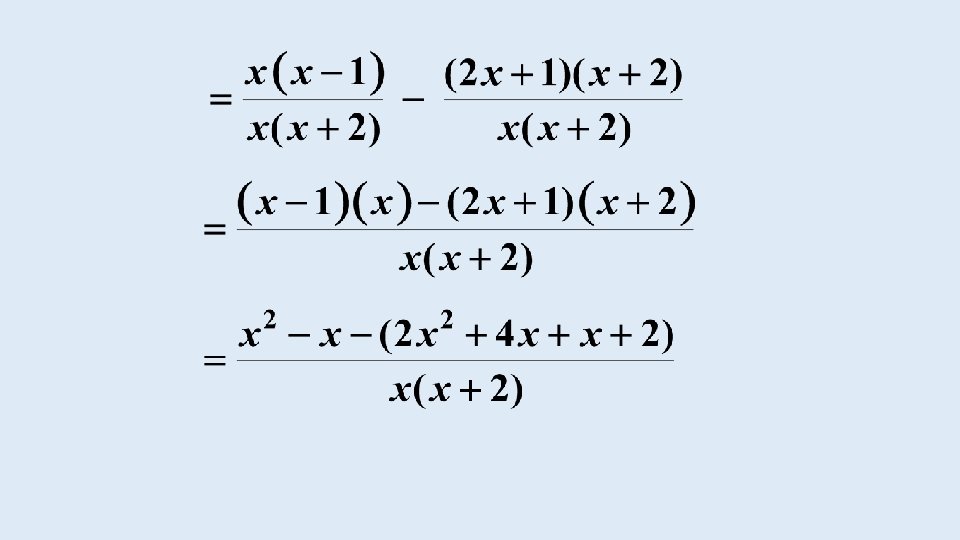
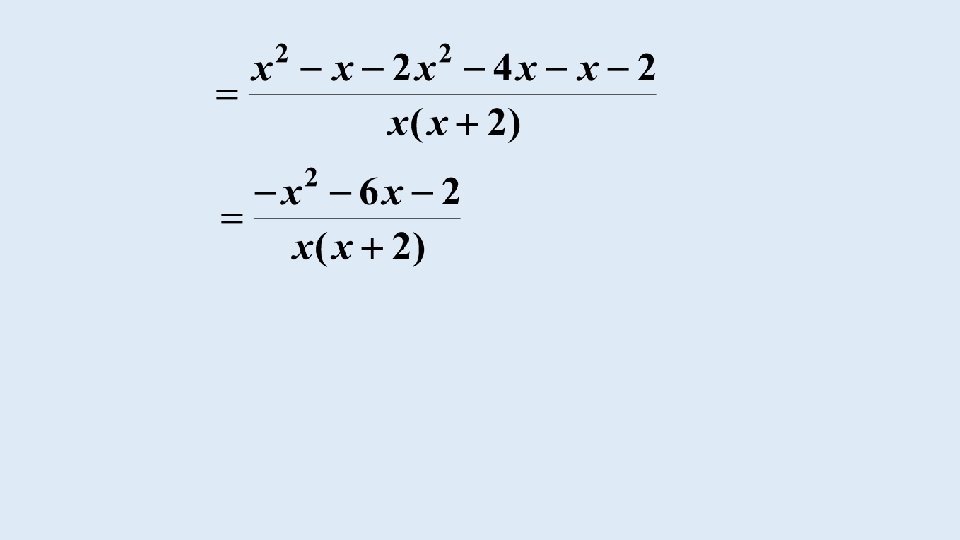
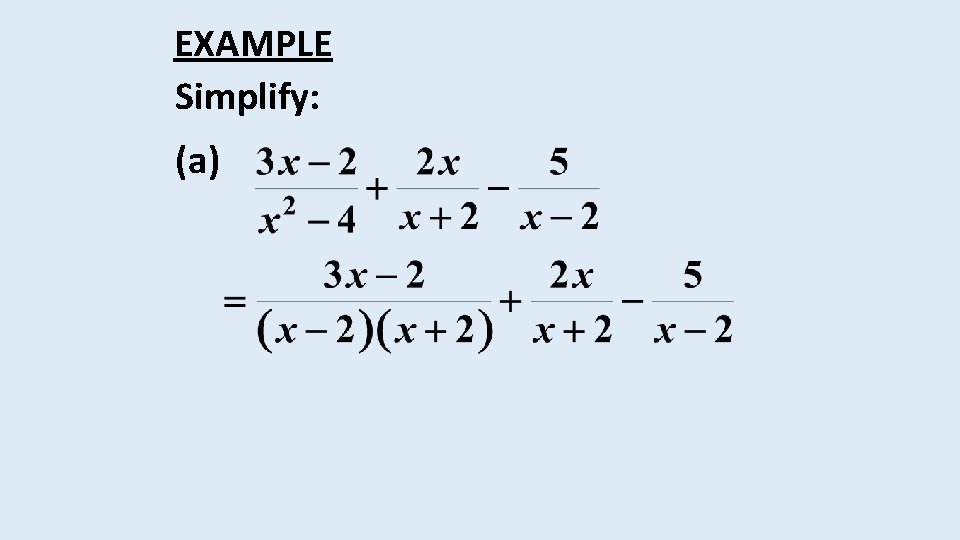
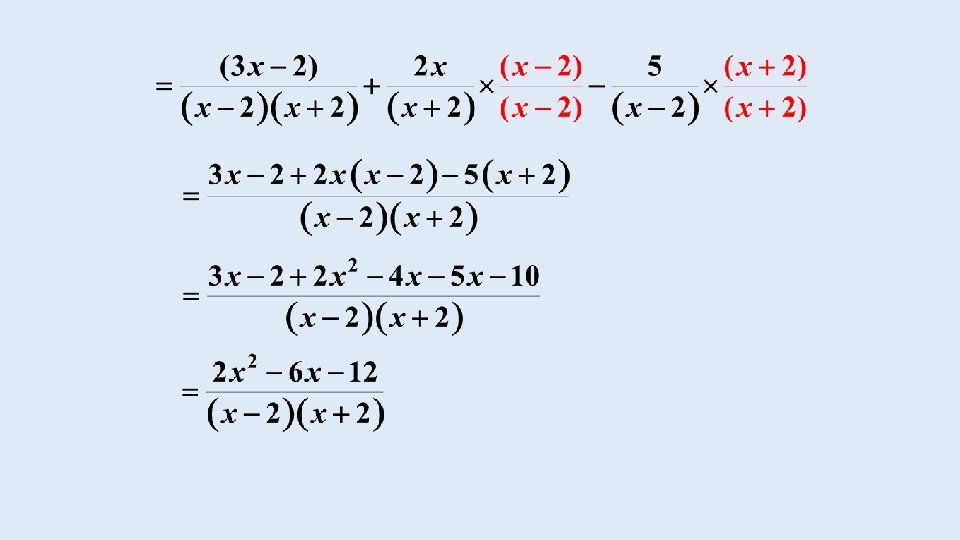
EXAMPLE Simplify: (a)
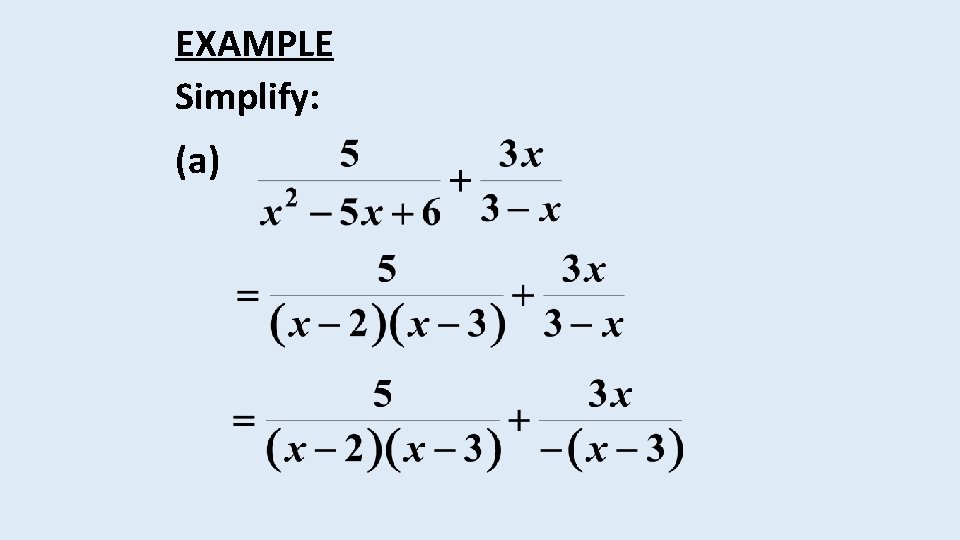
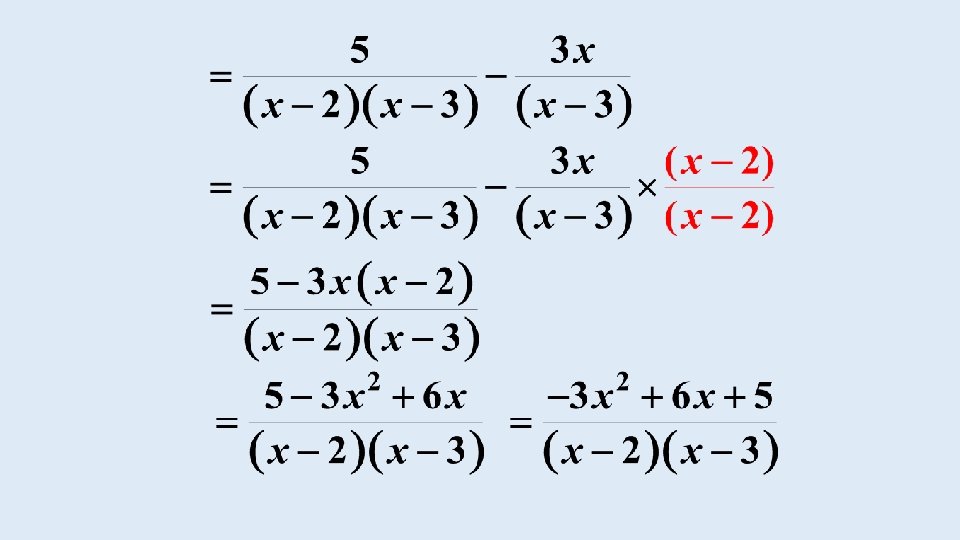
EXAMPLE Simplify: (a)

THE END
- Slides: 91