
Teamwork Training Improves the Clinical Care of Trauma
- Slides: 17
Teamwork Training Improves the Clinical Care of Trauma Patients Jeannette Capella, MD, Stephen Re. Mine, MD, Stephen Smith, MD, Allan Philp, MD, Tyler Putnam, MD, Carol Gilbert, MD, William Fry, MD, David Baker, Ph. D, Sonya Ranson, Ph. D, Ellen Harvey, MSN, Andi Wright, MSN, Krista Henderson, MSN Virginia Tech Carilion School of Medicine Roanoke, Virginia
Introduction Healthcare team performance – Needs to be better – Key to improved patient care Evidence – Obstetrics – Neillsen et al, Siassakos et al – Medicine - Strasser et al
Introduction Trauma – Fox et al. , 2009 – Improved clinician perception of teamwork – Improved teamwork – Team. STEPPS, no simulation Today you will see evidence that team training yields better clinical care in the trauma room
Purpose Does formal trauma team training improve team behaviors in the trauma resuscitation bay? If yes, then does improved teamwork lead to more efficiency in the trauma bay and/or improved clinical outcomes?
Methods Design Intervention Subjects Timeline Measurement
Design Pre/post intervention study Quality improvement project
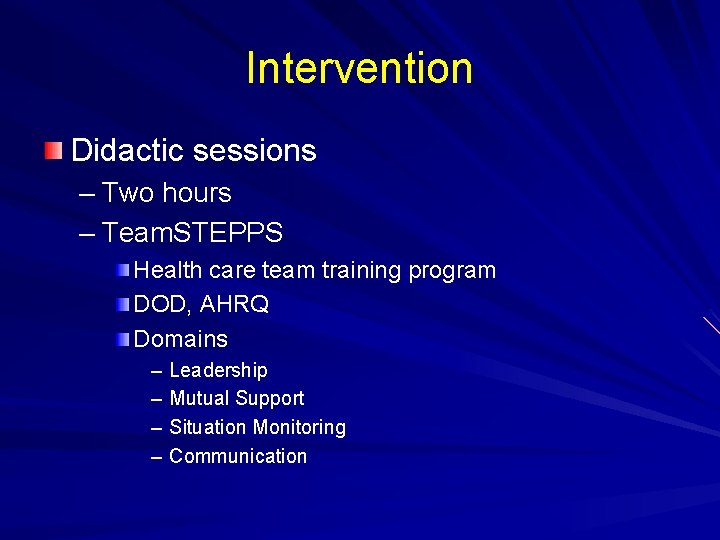
Intervention Didactic sessions – Two hours – Team. STEPPS Health care team training program DOD, AHRQ Domains – Leadership – Mutual Support – Situation Monitoring – Communication
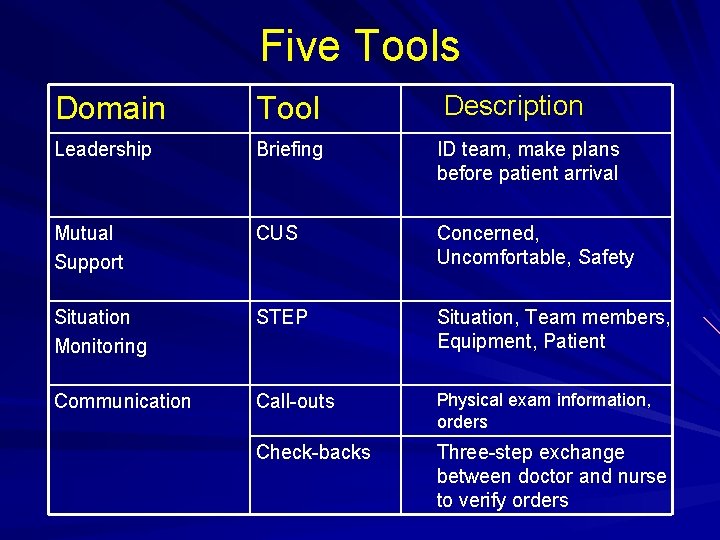
Five Tools Description Domain Tool Leadership Briefing ID team, make plans before patient arrival Mutual Support CUS Concerned, Uncomfortable, Safety Situation Monitoring STEP Situation, Team members, Equipment, Patient Communication Call-outs Physical exam information, orders Check-backs Three-step exchange between doctor and nurse to verify orders
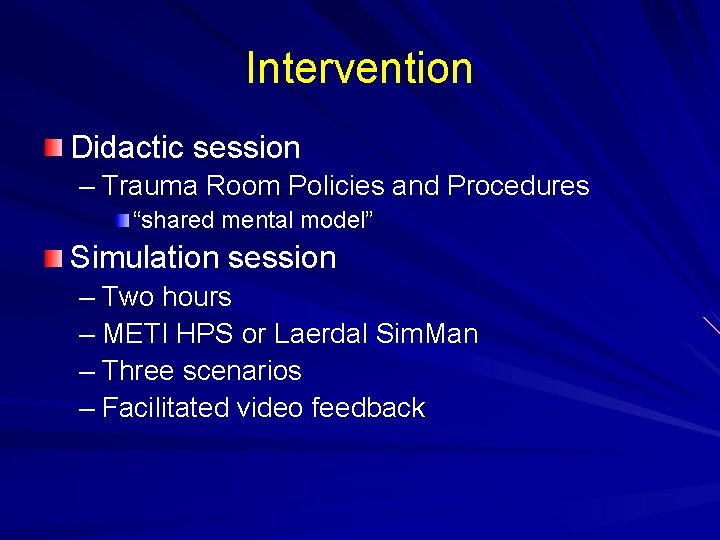
Intervention Didactic session – Trauma Room Policies and Procedures “shared mental model” Simulation session – Two hours – METI HPS or Laerdal Sim. Man – Three scenarios – Facilitated video feedback
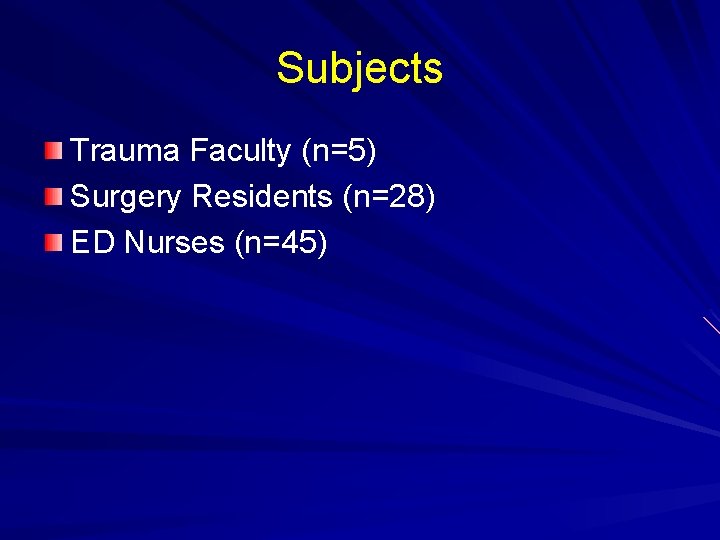
Subjects Trauma Faculty (n=5) Surgery Residents (n=28) ED Nurses (n=45)
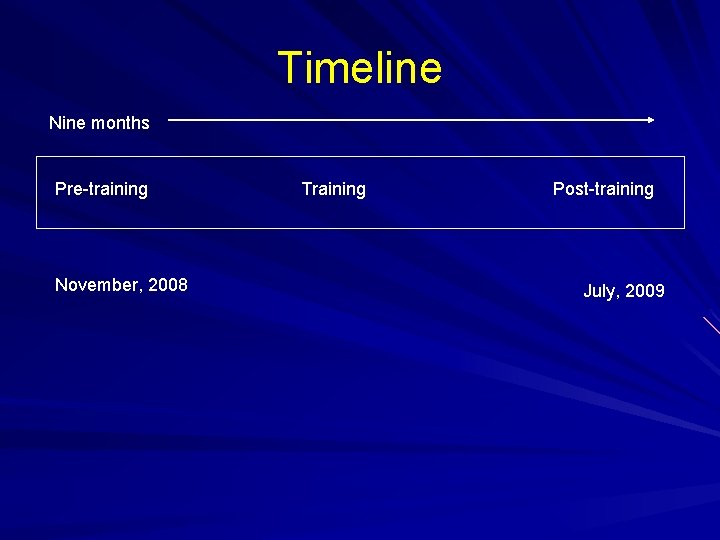
Timeline Nine months Pre-training November, 2008 Training Post-training July, 2009
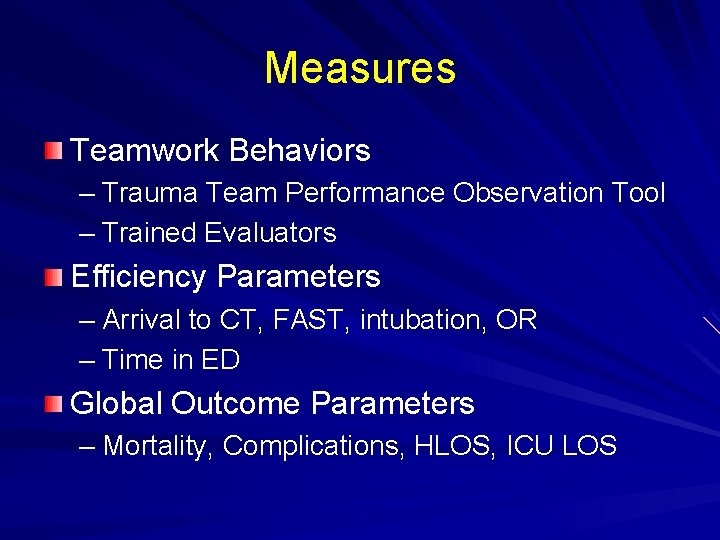
Measures Teamwork Behaviors – Trauma Team Performance Observation Tool – Trained Evaluators Efficiency Parameters – Arrival to CT, FAST, intubation, OR – Time in ED Global Outcome Parameters – Mortality, Complications, HLOS, ICU LOS
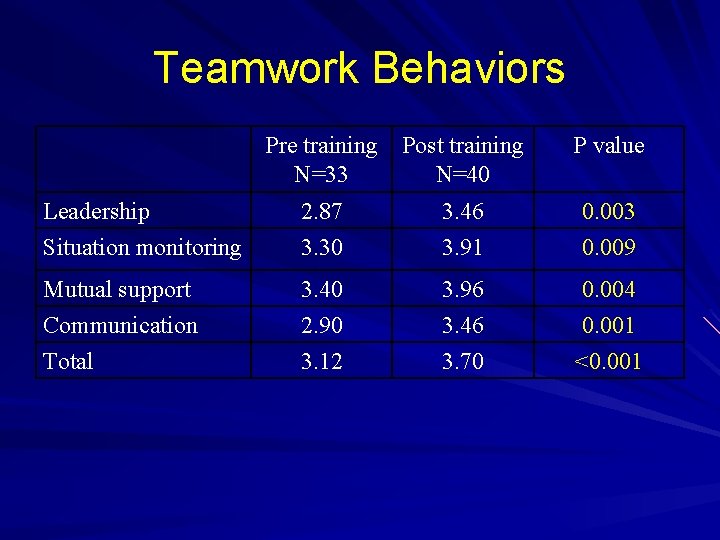
Teamwork Behaviors Pre training Post training N=33 N=40 P value Leadership Situation monitoring 2. 87 3. 30 3. 46 3. 91 0. 003 0. 009 Mutual support Communication 3. 40 2. 90 3. 96 3. 46 0. 004 0. 001 Total 3. 12 3. 70 <0. 001
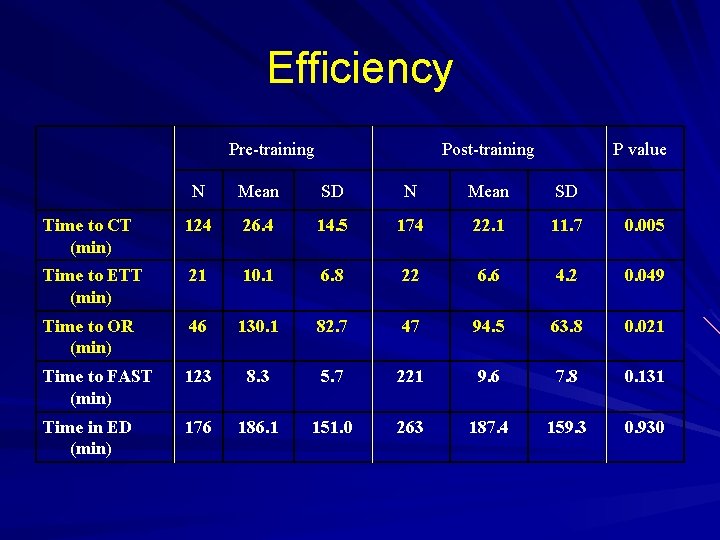
Efficiency Pre-training Post-training P value N Mean SD Time to CT (min) 124 26. 4 14. 5 174 22. 1 11. 7 0. 005 Time to ETT (min) 21 10. 1 6. 8 22 6. 6 4. 2 0. 049 Time to OR (min) 46 130. 1 82. 7 47 94. 5 63. 8 0. 021 Time to FAST (min) 123 8. 3 5. 7 221 9. 6 7. 8 0. 131 Time in ED (min) 176 186. 1 151. 0 263 187. 4 159. 3 0. 930
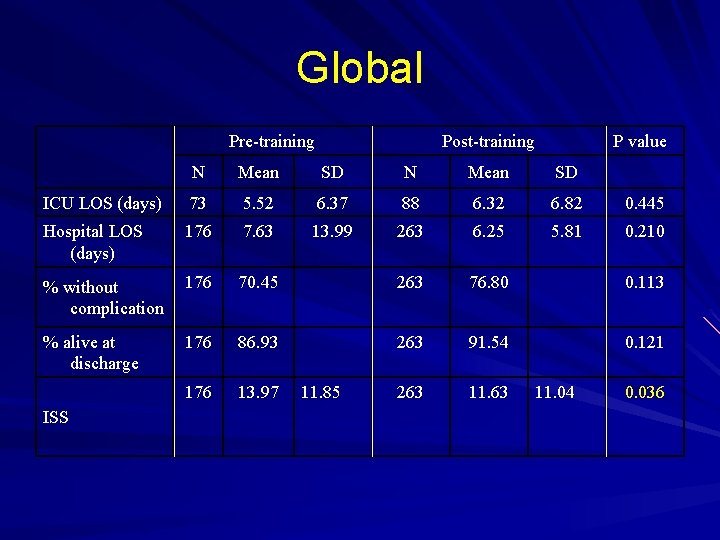
Global Pre-training Post-training P value N Mean SD ICU LOS (days) 73 5. 52 6. 37 88 6. 32 6. 82 0. 445 Hospital LOS (days) 176 7. 63 13. 99 263 6. 25 5. 81 0. 210 % without complication 176 70. 45 263 76. 80 0. 113 % alive at discharge 176 86. 93 263 91. 54 0. 121 176 13. 97 263 11. 63 ISS 11. 85 11. 04 0. 036
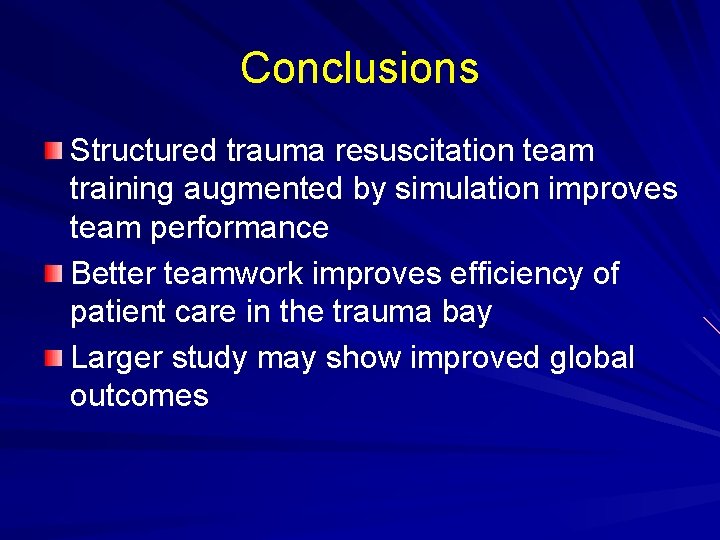
Conclusions Structured trauma resuscitation team training augmented by simulation improves team performance Better teamwork improves efficiency of patient care in the trauma bay Larger study may show improved global outcomes
Recommendation Formal teamwork training augmented by simulation should be included in surgery residency training as well as ATLS