
Teamwork and Collaboration Developing Skills that Advance Evidencebased
Teamwork and Collaboration: Developing Skills that Advance Evidence-based Practice to Improve Quality and Safety in Patient Care Gerry Altmiller, Ed. D, APRN, ACNS-BC Associate Professor of Nursing The College of New Jersey
The presenter reports no conflict of interest
Today’s Objectives Participants will be able to: 1. Describe the process of steering an evidence-based practice project from idea to publication. 2. Discuss strategies that support successful projects by building teamwork and improving communication between colleagues. 3. Value our individual role in improving the quality and safety of patient care through collaboration in research and evidence-based practice.
The best thing for sadness is to learn something. It is the only thing that can’t be taken from you…. . Learning is the thing for you. It is the only thing that doesn’t fail. Merlin to Arthur Once and Future King
QSEN Competencies • The six QSEN competencies are focused on changing the identity of nursing to be competent to continuously improve the quality and the safety of the health care systems in which they work. • The QSEN competencies include: – Patient-Centered Care – Teamwork and Collaboration – Evidence-Based Practice – Quality Improvement – Informatics – Safety Integrate best current evidence with clinical expertise and patient/family preferences and values for delivery of optimal health care.
Ethics vs Values Ethics = Study of how a moral person should behave Values = Core beliefs that determine how a person behaves
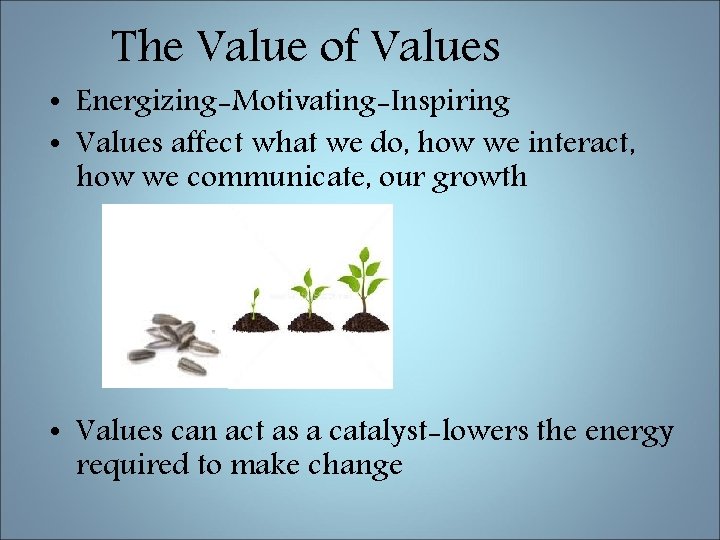
The Value of Values • Energizing-Motivating-Inspiring • Values affect what we do, how we interact, how we communicate, our growth • Values can act as a catalyst-lowers the energy required to make change
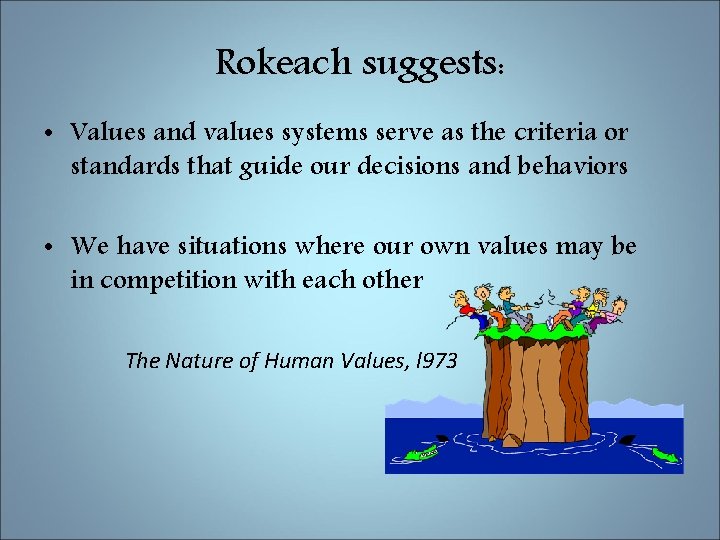
Rokeach suggests: • Values and values systems serve as the criteria or standards that guide our decisions and behaviors • We have situations where our own values may be in competition with each other The Nature of Human Values, l 973

Advantages of Thinking About Values Allows us to Be mindful about what we really care about Focus on what we really care about Defend what we really care about Gives us purpose and drive for the future
In healthcare professions: I not only have to do my job, but always be focused on how I can do my job better.

“It’s not just a thing to do; It’s more of a way to be. ” Connect our work to values.
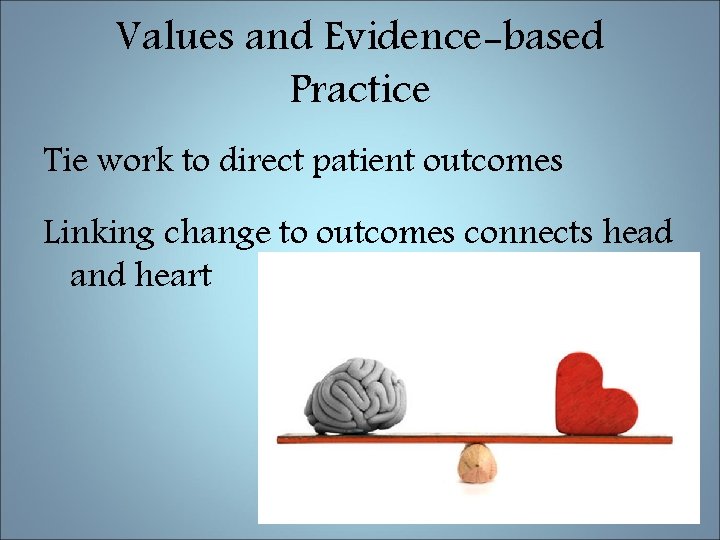
Values and Evidence-based Practice Tie work to direct patient outcomes Linking change to outcomes connects head and heart
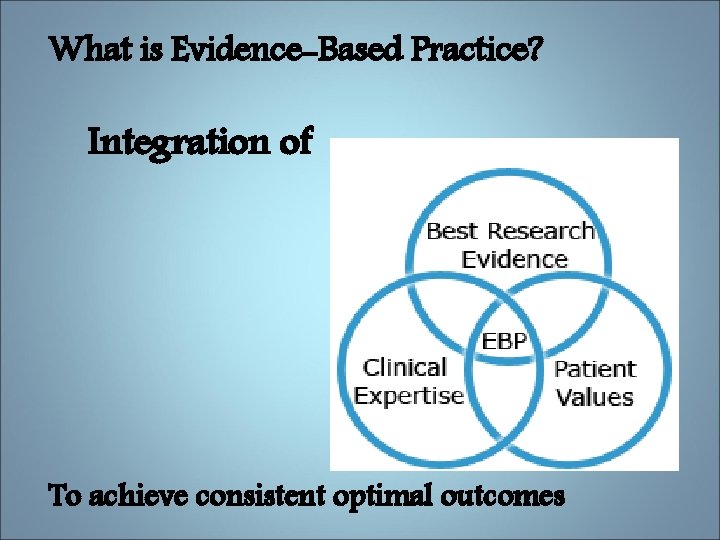
What is Evidence-Based Practice? Integration of To achieve consistent optimal outcomes
• Steps: How is it done? – Ask a question – Search for the best evidence – Critically appraise the evidence found – Integrate the evidence with personal expertise and patient preferences and put into practice – Evaluate the outcomes – Disseminate the change
Why Should Nurses become experts at this? • • • To improve care for patients To improve outcomes of practice To reduce variation in practice Because research is what guides practice To make academic contribution to practice It is an expected core competency of all health care clinicians (Institute of Medicine)
Organizing a Team • Teams provide a safety net for individuals – An individual, no matter how professional or experienced, can never be as reliable as a team Nance 2008
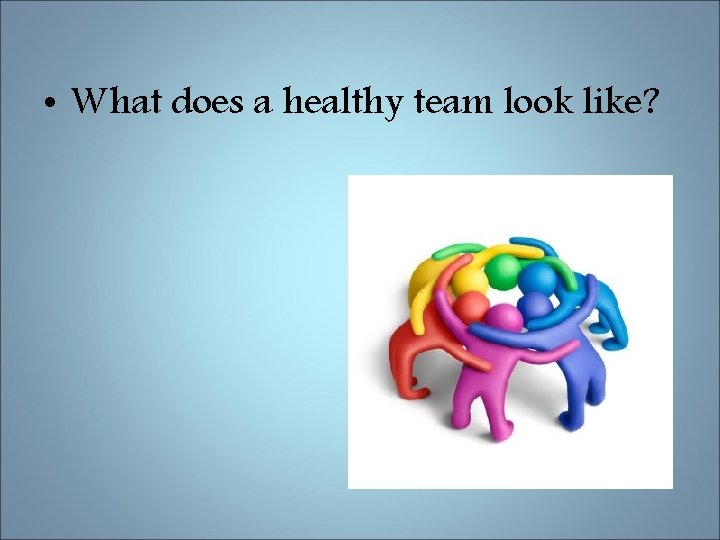
• What does a healthy team look like?
How do you keep your team on track? • Create a timeline • Promote civility • Give constructive feedback – Task – Process – Self-regulation
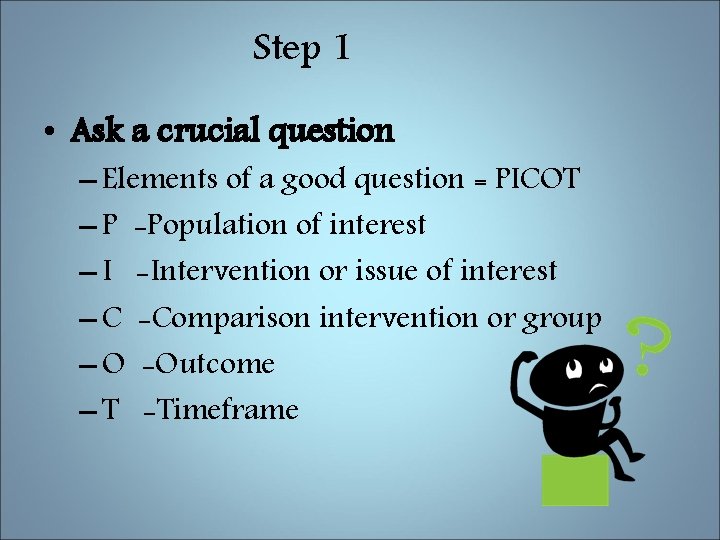
Step 1 • Ask a crucial question – Elements of a good question = PICOT – P -Population of interest – I -Intervention or issue of interest – C -Comparison intervention or group – O -Outcome – T -Timeframe
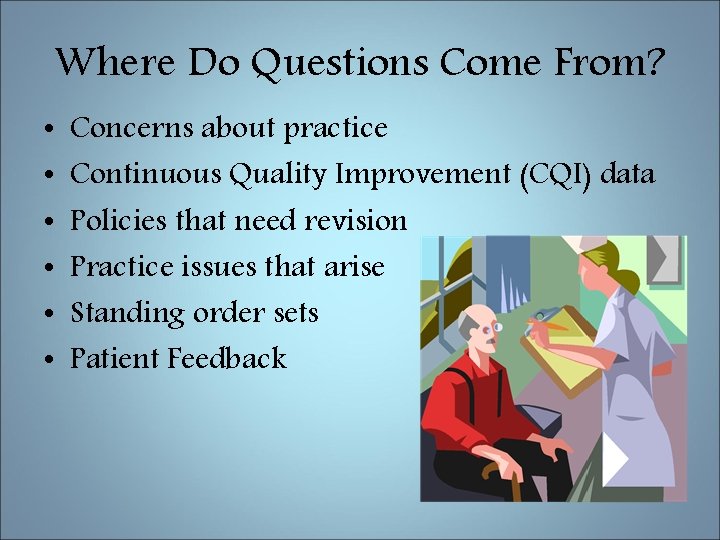
Where Do Questions Come From? • • • Concerns about practice Continuous Quality Improvement (CQI) data Policies that need revision Practice issues that arise Standing order sets Patient Feedback
PICOT Format • In full term infants with sign of respiratory distress (P), which interventions (I) are considered initial stabilization maneuvers (T)? • In children after aortic valve repair (P), how effective is as-needed dosing of pain medication (I) in controlling pain (0) immediately after surgery (T)? Questions: Winters, C. A. & Echeverri R. (2012) Teaching strategies to support evidence-based practice. Critial Care Nurse 32, 3, 49 -54
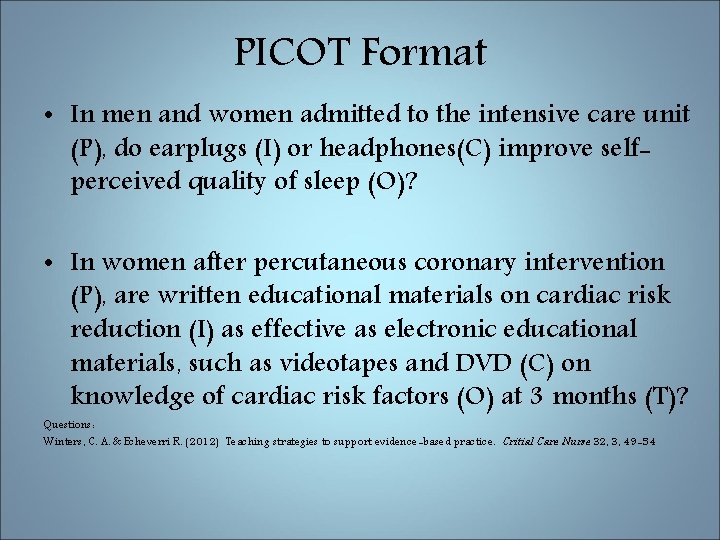
PICOT Format • In men and women admitted to the intensive care unit (P), do earplugs (I) or headphones(C) improve selfperceived quality of sleep (O)? • In women after percutaneous coronary intervention (P), are written educational materials on cardiac risk reduction (I) as effective as electronic educational materials, such as videotapes and DVD (C) on knowledge of cardiac risk factors (O) at 3 months (T)? Questions: Winters, C. A. & Echeverri R. (2012) Teaching strategies to support evidence-based practice. Critial Care Nurse 32, 3, 49 -54
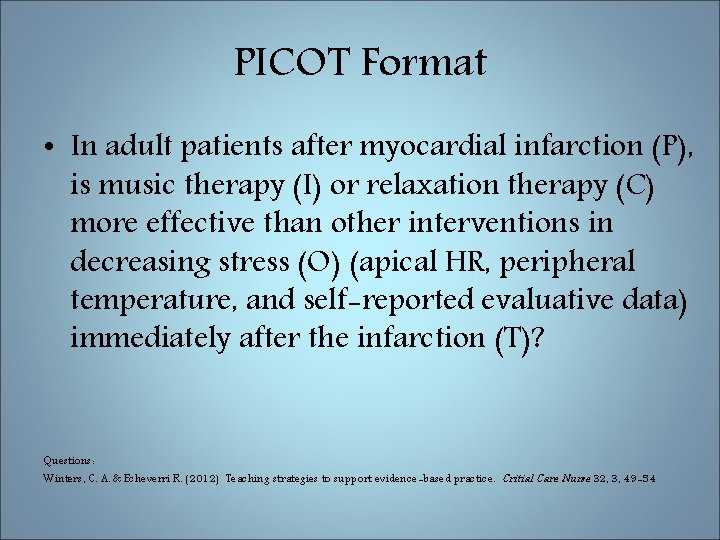
PICOT Format • In adult patients after myocardial infarction (P), is music therapy (I) or relaxation therapy (C) more effective than other interventions in decreasing stress (O) (apical HR, peripheral temperature, and self-reported evaluative data) immediately after the infarction (T)? Questions: Winters, C. A. & Echeverri R. (2012) Teaching strategies to support evidence-based practice. Critial Care Nurse 32, 3, 49 -54

Group Work
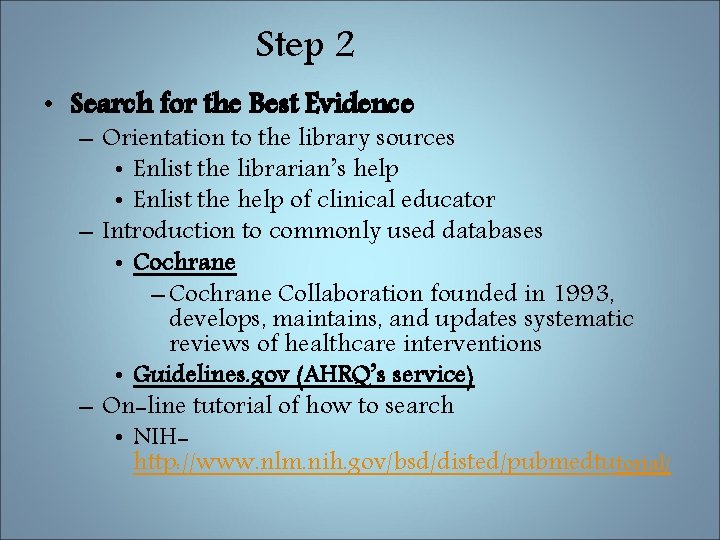
Step 2 • Search for the Best Evidence – Orientation to the library sources • Enlist the librarian’s help • Enlist the help of clinical educator – Introduction to commonly used databases • Cochrane – Cochrane Collaboration founded in 1993, develops, maintains, and updates systematic reviews of healthcare interventions • Guidelines. gov (AHRQ’s service) – On-line tutorial of how to search • NIHhttp: //www. nlm. nih. gov/bsd/disted/pubmedtutorial/
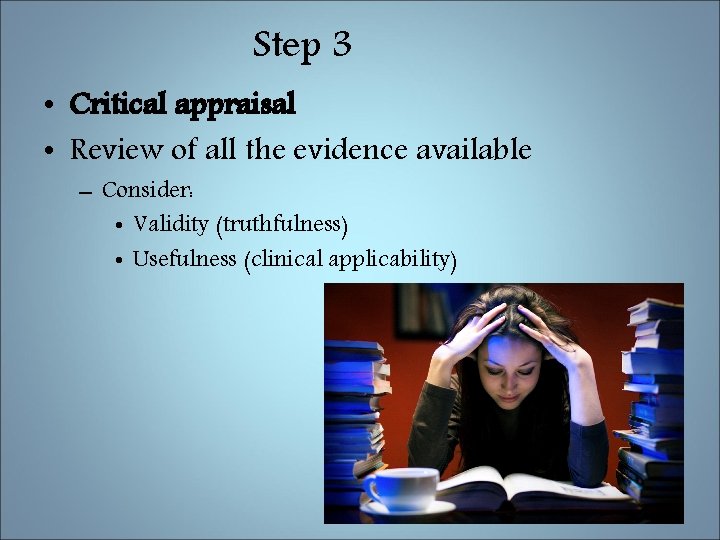
Step 3 • Critical appraisal • Review of all the evidence available – Consider: • Validity (truthfulness) • Usefulness (clinical applicability)
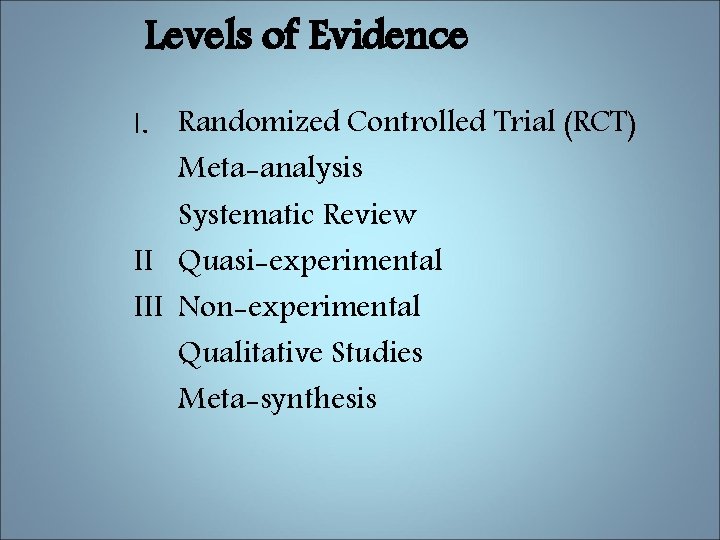
Levels of Evidence I. Randomized Controlled Trial (RCT) Meta-analysis Systematic Review II Quasi-experimental III Non-experimental Qualitative Studies Meta-synthesis
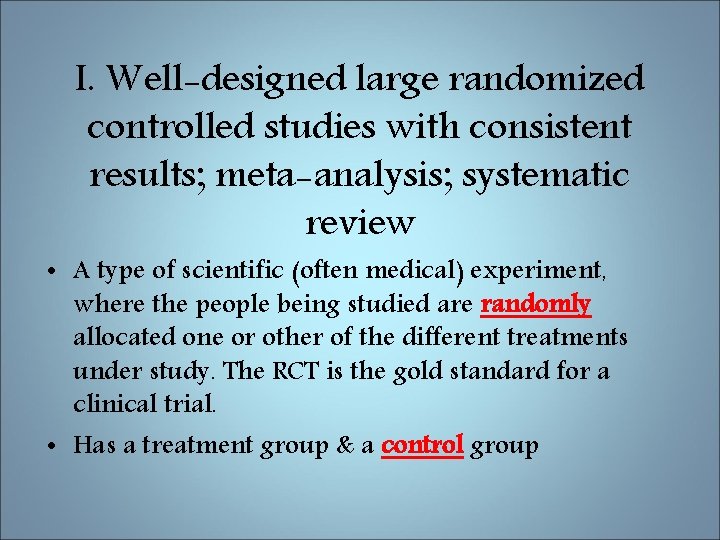
I. Well-designed large randomized controlled studies with consistent results; meta-analysis; systematic review • A type of scientific (often medical) experiment, where the people being studied are randomly allocated one or other of the different treatments under study. The RCT is the gold standard for a clinical trial. • Has a treatment group & a control group
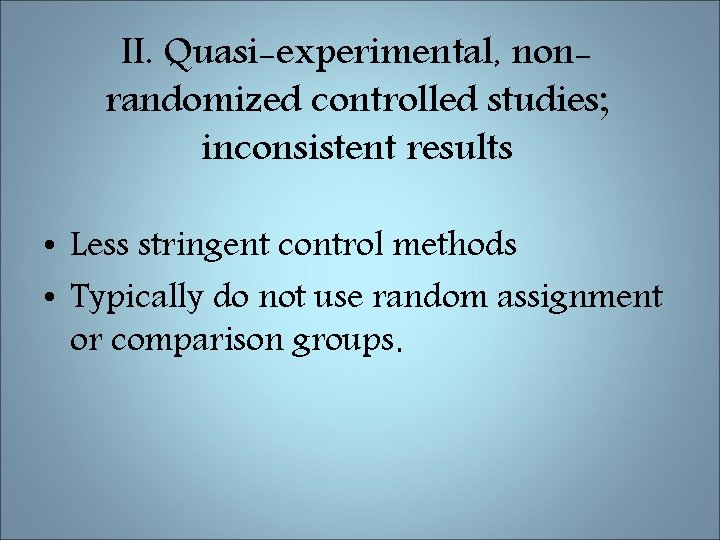
II. Quasi-experimental, nonrandomized controlled studies; inconsistent results • Less stringent control methods • Typically do not use random assignment or comparison groups.
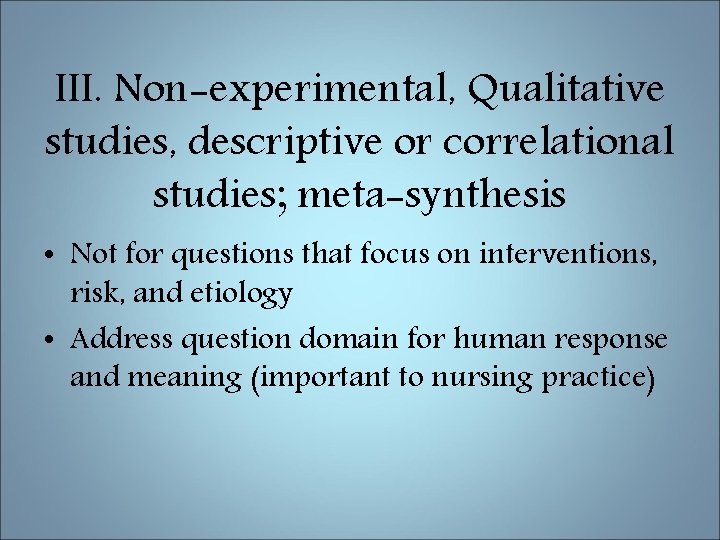
III. Non-experimental, Qualitative studies, descriptive or correlational studies; meta-synthesis • Not for questions that focus on interventions, risk, and etiology • Address question domain for human response and meaning (important to nursing practice)
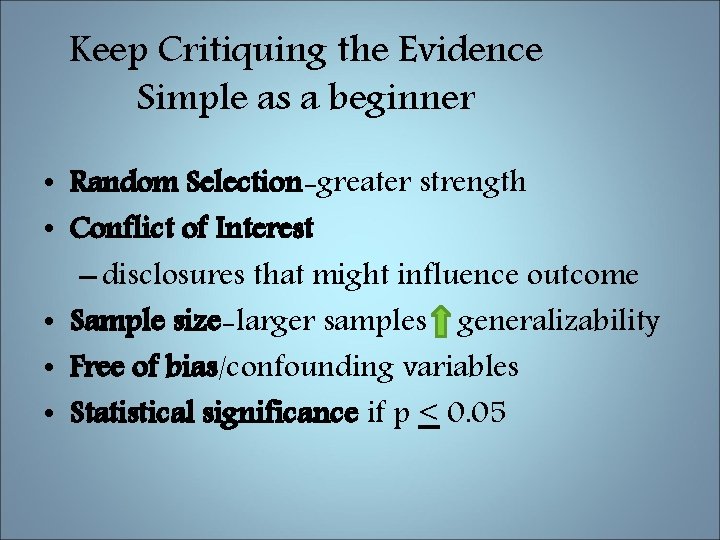
Keep Critiquing the Evidence Simple as a beginner • Random Selection-greater strength • Conflict of Interest – disclosures that might influence outcome • Sample size-larger samples generalizability • Free of bias/confounding variables • Statistical significance if p < 0. 05
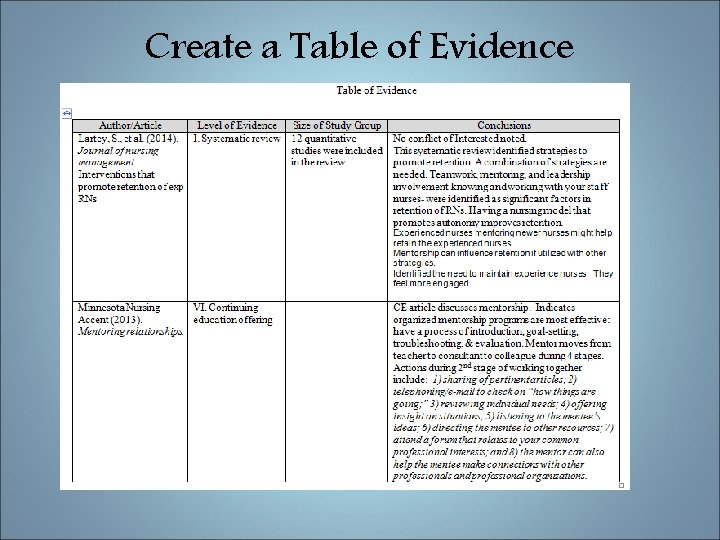
Create a Table of Evidence
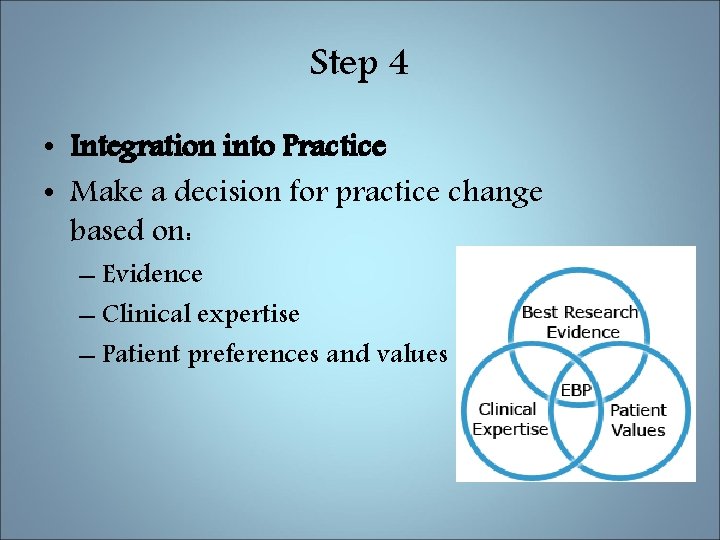
Step 4 • Integration into Practice • Make a decision for practice change based on: – Evidence – Clinical expertise – Patient preferences and values
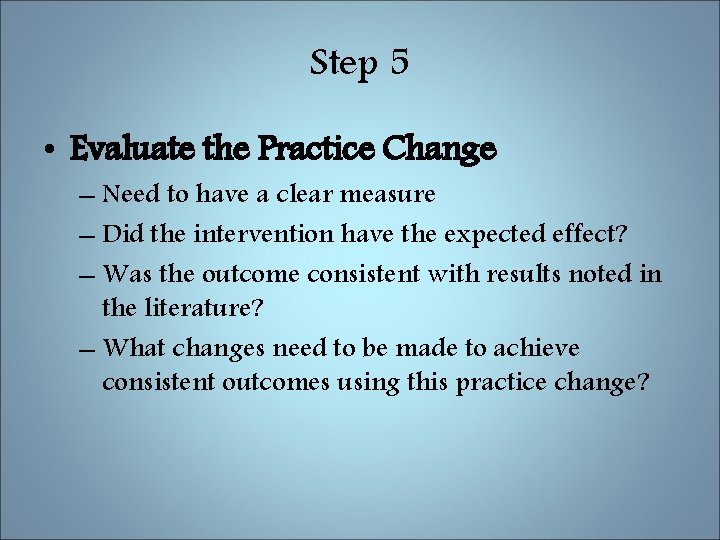
Step 5 • Evaluate the Practice Change – Need to have a clear measure – Did the intervention have the expected effect? – Was the outcome consistent with results noted in the literature? – What changes need to be made to achieve consistent outcomes using this practice change?
Examples of EBP in Action – Beta adrenergic receptor blockers post MI increase survival rates – Supine positioning for infants is safer as prone positioning leads to suffocation – Renal-dose Dopamine does not increase renal perfusion – No saline lavage with ETT suctioning because it increases the risk for infection

What Do We Do With What We Learn Through EBP and Research?
Barriers to Evidence-based Practice • I don’t have the authority to change patient care procedures • I don’t understand what EBP is. • I have trouble with the technology to access literature. • I don’t understand research articles. • I don’t know how to appraise evidence. • I don’t have time for this extra work
Overcoming Barriers • Read about evidence-based projects published in nursing journals • Discuss practice concerns with peers/colleagues • Join in on a clinical unit-based project • Find or be a champion • Seek administrative support

BARNGA

Keep work aligned with your values �If we become clear about our purpose, it sheds light on our values. �Our purpose is our personal aim statement
Continual Improvement in Our Work “Create constancy of purpose for continual improvement of products and services to society…. ” Deming 2000 Create constancy of purpose for continual improvement of ourselves….
Incorporating Values in Healthcare Professions • Appreciate all members’ contribution to the team • Think about what I really want to accomplish • Consider my communication-how am I perceived? • Reflection-the only way to grow/mature • Seek the feedback of others • Provide constructive feedback; build

Sometimes Our work feels like this…. .

With values (purpose) it feels like this………
Excerpt from a letter from Nelson Mandela in prison to a long-time advocate, Sheena Duncan, April 1, 1985: �The ideals we cherish, our fondest dreams, and fervent hopes may not be realized in our lifetime. That is beside the point. The knowledge that you did your duty is in itself, a rewarding experience and magnificent achievement.

Thank you! Altmillg@tcnj. edu The College of New Jersey
- Slides: 47