
TEAMING COLLABORATION PROBLEM SOLVING AND INCLUSION SUPPORT Chapter
TEAMING: COLLABORATION, PROBLEM SOLVING, AND INCLUSION SUPPORT Chapter 10
LEARNING OUTCOMES • Explain a variety of service-delivery models that are used to support children with disabilities in early childhood settings. • Explain why successful inclusion support requires establishing collaborative relationships. • Identify that successful collaboration and conflict resolution depend on skills in communication and problem solving. • Tell why paraprofessionals are critical to the effective support of children with disabilities in inclusive environments. • Identify the specific challenges involved if effective use of paraprofessionals as one-on-one assistants.

COLLABORATION, PROBLEM SOLVING, AND SHARED DECISION MAKING • Early childhood special educators (ECSE) must learn to engage in collaborative teaming with all key player’s in children’s lives. • Collaboration-a style of interaction that involves 2 or more co-equal partners voluntarily working side by side with mutual respect & cooperation to reach a common goal through shared decision making. • 1 st major component of skillful collaboration =effective communication. • One’s own communication style • reading the communication cues of others • Mastering the communication skills & styles necessary for collaborative consultation & teaming • 2 nd important component=problem solving • 3 rd important component=conflict resolution
COLLABORATION, PROBLEM SOLVING, AND SHARED DECISION MAKING…CONT’D • Communication Strategies: The Key to Successful Teaming • effective collaborators use their own verbal & nonverbal communication in ways that encourage team building nonverbal communication behaviors • can have a greater effect on (+ and -) than what the speaker actually says • be aware of body language; avoid sending certain negative messages • face the speaker, keep arms open/relaxed, mirror the speaker’s affect/movements, smile/nod verbal communication behaviors • negative-talking too much, interrupting, • focus on understanding & reflecting on the meaning of what the person is saying, use restatements/reflection, use “I” messages
COLLABORATION, PROBLEM SOLVING, AND SHARED DECISION MAKING…CONT’D • Problem solving & conflict resolution • Critical for effective teaming, a way to reduce conflict on an ongoing basis • Aspects of one problem-solving approach (Kurpius, 1978) • • • 1. identify the problem 2. generate potential solutions 3. discuss & select a solution to implement 4. implement the solution 5. evaluate the outcome • An important component of conflict is resistance. • attitudes (“If it ain’t broke, don’t fix it. ”) • fear (change, lack of training) • social resistance (lack of support, security or comfort) • Team members must be willing to let go of their own need for control, to be given credit for having the best ideas, or acknowledged to be “right. ”
COLLABORATION, PROBLEM SOLVING, AND SHARED DECISION MAKING…CONT’D • Conflict Resolution Strategies: • • • 1. pause & take a deep breath (don’t be impulsive) 2. try to state the issues or sides of the conflict in a neutral way 3. assess your won role honestly 4. attempt to move the group toward a problem solving approach 5. use your sense of humor (de-fuse & de-escalate a tense situation) • How to create a collaborative atmosphere: • • • clarify issues before a misunderstanding occurs encourage all players to express opinions focus on needs rather than too-quick solutions facilitate open discussions give feedback that values others’ opinions encourage members of the group to see others’ perspectives
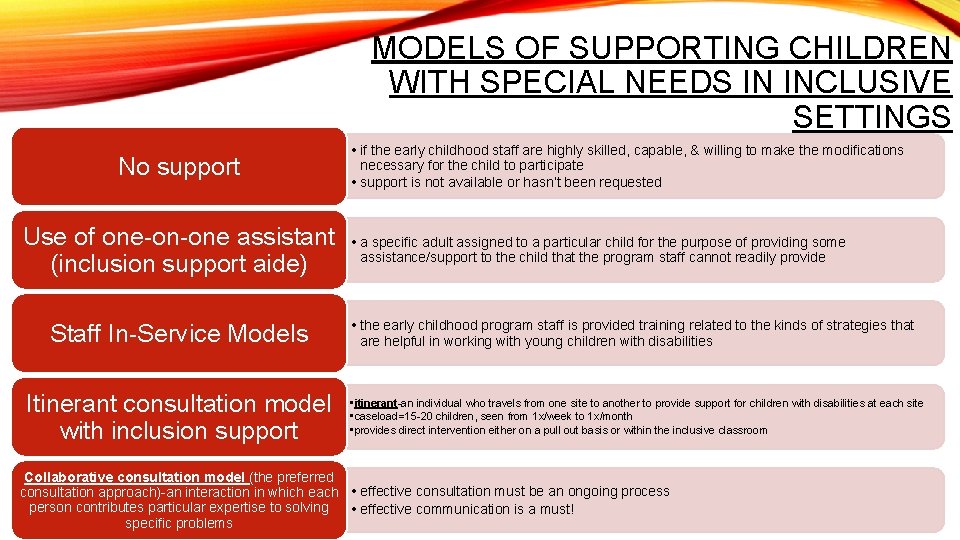
MODELS OF SUPPORTING CHILDREN WITH SPECIAL NEEDS IN INCLUSIVE SETTINGS No support Use of one-on-one assistant (inclusion support aide) Staff In-Service Models Itinerant consultation model with inclusion support • if the early childhood staff are highly skilled, capable, & willing to make the modifications necessary for the child to participate • support is not available or hasn’t been requested • a specific adult assigned to a particular child for the purpose of providing some assistance/support to the child that the program staff cannot readily provide • the early childhood program staff is provided training related to the kinds of strategies that are helpful in working with young children with disabilities • itinerant-an individual who travels from one site to another to provide support for children with disabilities at each site • caseload=15 -20 children, seen from 1 x/week to 1 x/month • provides direct intervention either on a pull out basis or within the inclusive classroom Collaborative consultation model (the preferred consultation approach)-an interaction in which each • effective consultation must be an ongoing process person contributes particular expertise to solving • effective communication is a must! specific problems
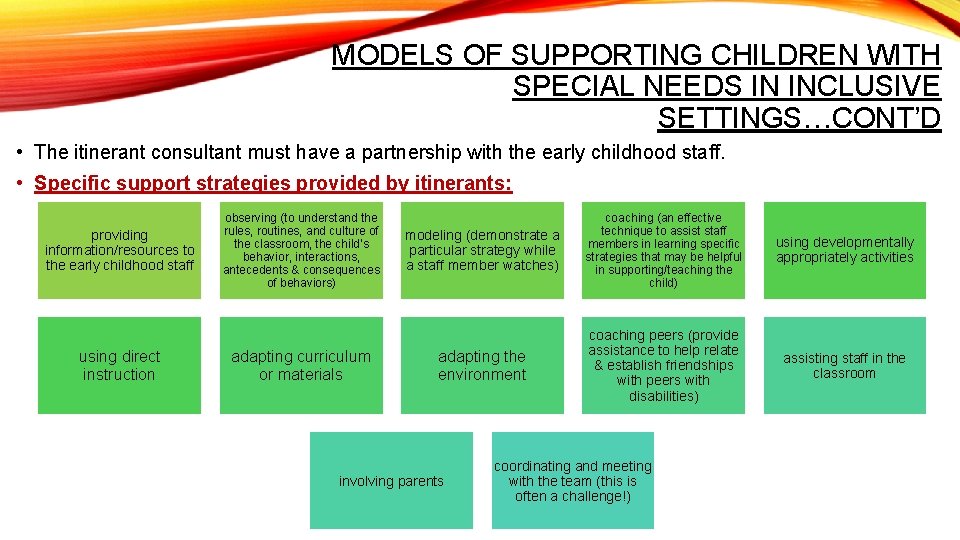
MODELS OF SUPPORTING CHILDREN WITH SPECIAL NEEDS IN INCLUSIVE SETTINGS…CONT’D • The itinerant consultant must have a partnership with the early childhood staff. • Specific support strategies provided by itinerants: providing information/resources to the early childhood staff using direct instruction observing (to understand the rules, routines, and culture of the classroom, the child’s behavior, interactions, antecedents & consequences of behaviors) adapting curriculum or materials modeling (demonstrate a particular strategy while a staff member watches) coaching (an effective technique to assist staff members in learning specific strategies that may be helpful in supporting/teaching the child) using developmentally appropriately activities adapting the environment coaching peers (provide assistance to help relate & establish friendships with peers with disabilities) assisting staff in the classroom involving parents coordinating and meeting with the team (this is often a challenge!)
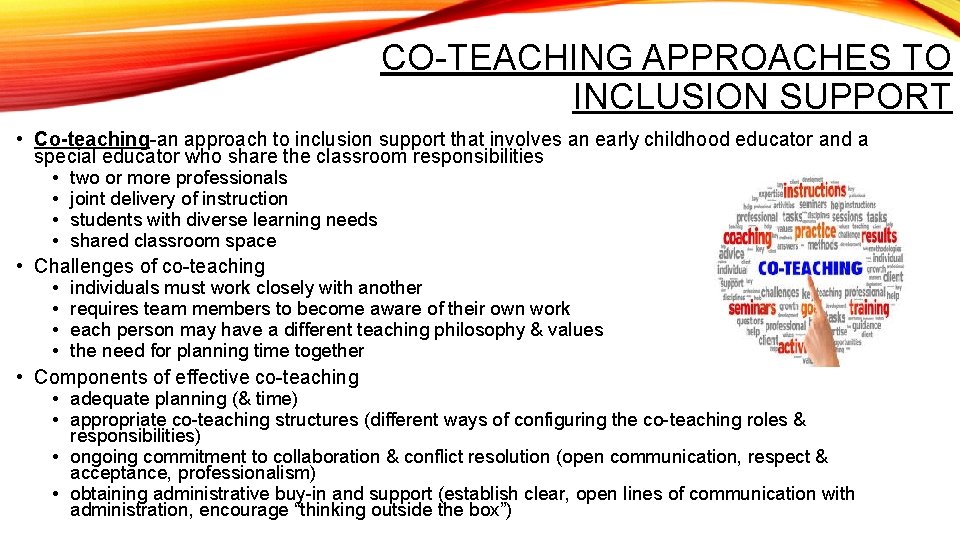
CO-TEACHING APPROACHES TO INCLUSION SUPPORT • Co-teaching-an approach to inclusion support that involves an early childhood educator and a special educator who share the classroom responsibilities • two or more professionals • joint delivery of instruction • students with diverse learning needs • shared classroom space • Challenges of co-teaching • individuals must work closely with another • requires team members to become aware of their own work • each person may have a different teaching philosophy & values • the need for planning time together • Components of effective co-teaching • adequate planning (& time) • appropriate co-teaching structures (different ways of configuring the co-teaching roles & responsibilities) • ongoing commitment to collaboration & conflict resolution (open communication, respect & acceptance, professionalism) • obtaining administrative buy-in and support (establish clear, open lines of communication with administration, encourage “thinking outside the box”)
EFFECTIVE TEAMING WITH INTERDISCIPLINARY SPECIALISTS • Children with unique and intensive needs also require input, support, & evaluation from a variety of specialists. • discipline-specific therapists-OT, PT, SLP • disability-specific specialists-vision impairment specialists, deaf or hard-of-hearing specialists • Specialists may provide services to children in inclusive settings in a variety of ways. • as an itinerant-may work directly with the child or in a consultation role (or a combo of both) • there is little evidence that working directly with a child for 1 hour each week can be effective if the specialist’s intervention strategies and goals for the child are not understood & incorporated into the daily routines • each specialist visits the center according to his/her own availability and schedule • Video: Occupational Therapy: OT in School (1: 23 min) https: //www. youtube. com/watch? v=k 76 ETm 50 s. CM • occupational therapy for teachers and parents that explores and demonstrates OT during a day in the classroom
TEAMING WITH PARAPROFESSIONALS • Paraprofessional-individuals who by their assistance extend the capacity and effectiveness of teachers & other interventionists. • play crucial roles in early childhood service delivery • typically do not have the training and expertise of professional teachers & receive less in monetary compensation • teacher aide, paraeducator, early intervention assistant, program aide • Possible paraprofessional tasks: • • prepare the room, centers, materials, daily supplies greet the children, assist with all routines (mealtime, toileting) direct & supervise activities in the classroom/on the playground nurture appropriate behavior, positive social integration facilitating the use of assistive technology, set up media equipment follow specialists’ instructions in helping to position or transport children help with end of day routines, clean up
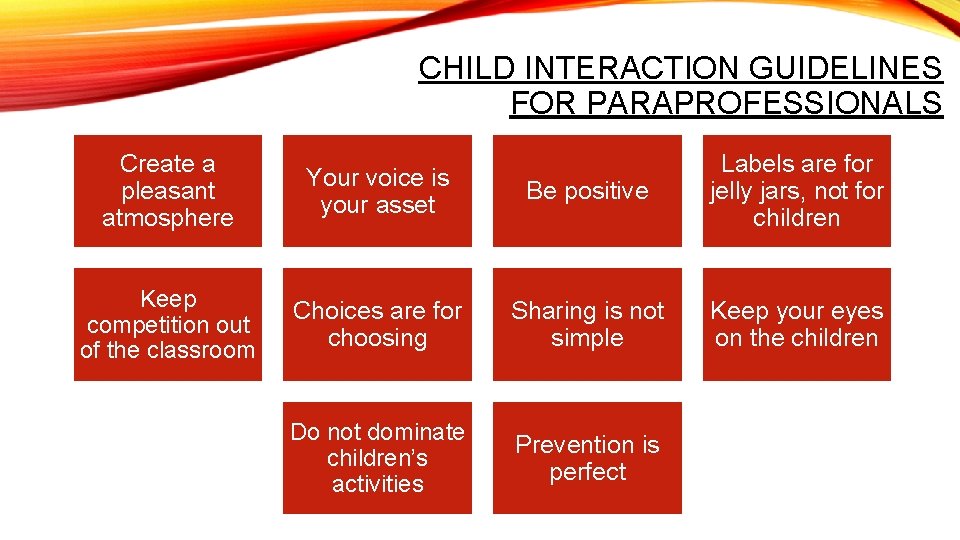
CHILD INTERACTION GUIDELINES FOR PARAPROFESSIONALS Create a pleasant atmosphere Your voice is your asset Be positive Labels are for jelly jars, not for children Keep competition out of the classroom Choices are for choosing Sharing is not simple Keep your eyes on the children Do not dominate children’s activities Prevention is perfect
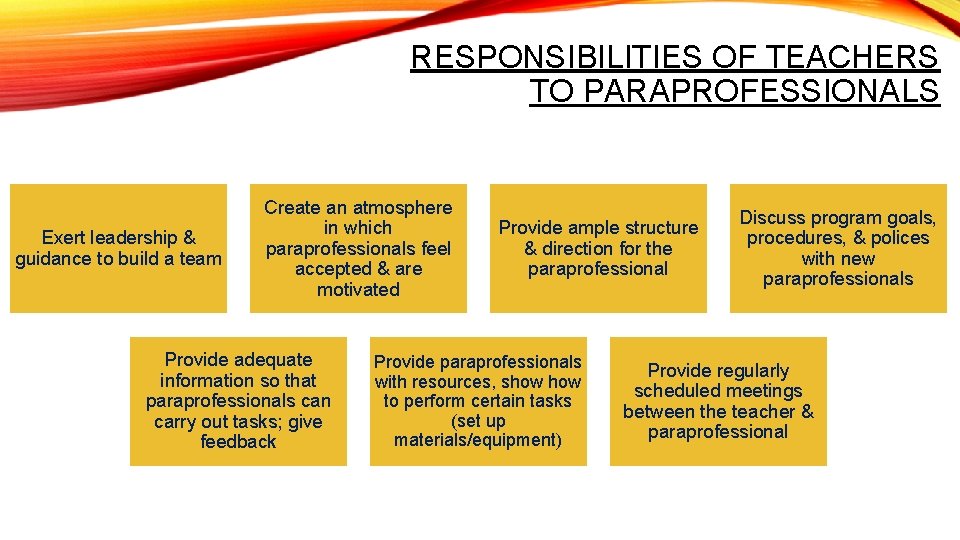
RESPONSIBILITIES OF TEACHERS TO PARAPROFESSIONALS Exert leadership & guidance to build a team Create an atmosphere in which paraprofessionals feel accepted & are motivated Provide adequate information so that paraprofessionals can carry out tasks; give feedback Provide ample structure & direction for the paraprofessional Provide paraprofessionals with resources, show to perform certain tasks (set up materials/equipment) Discuss program goals, procedures, & polices with new paraprofessionals Provide regularly scheduled meetings between the teacher & paraprofessional
PARAPROFESSIONALS AS ONE-TO-ONE ASSISTANTS • When paraprofessionals work one-on-one with a specific child, the child often becomes very attached because of the intensity and exclusivity of the relationship. • Research shows concerns related to the paraprofessionals potential ability to “hover: ” (Giangrecco and colleagues, 2005) • the general educators tended to avoid assuming responsibility for the education of the students who had one-on-one assistants • the assistance tended to separate the child from the group • the prolonged close proximity with assistants fostered dependency of the child • sometimes the paraprofessional unintentionally interfered with peers’ efforts to be friendly or helpful to the child with disabilities • unrealistic instructional expectations or a lack of training of the paraprofessionals led to inadequate academic instruction of the child • children who had difficulty speaking often found their paraprofessional did the speaking and making decisions for them
GUIDELINES FOR USE OF ONE-TOONE ASSISTANTS Define the purpose of the one-on-one assistant Make it clear that he/she should provide only the degree of intervention necessary The one-on-one assistant must not interfere with the child’s opportunity for interaction w/other children The use of a one-on-one assistant must not interfere with the child’s development of independence Avoid stigmatizing the child as the only child in the class who needs an “attached” adult Put specific daily responsibilities/activities of the assistant in writing Gradually include more & more children into the target child’s space Encourage the child’s attachment to other staff
EVALUATING PARAPROFESSIONAL SERVICES • Evaluating paraprofessional services is critical in developing improved & successful programs for young children. • Informal daily feedback helps create an atmosphere in which the paraprofessional feels secure, worthy, appreciated, and professional. • Evaluations • self-evaluations (evaluate your own contributions & feelings) • teacher-initiated evaluations of the paraprofessional (for personal & team improvement, focuses on specific behaviors, such as enriching & maintaining performance) • paraprofessionals evaluation of the teacher (improve role relationship & team performance) • Paraprofessional Burnout: • inadequate training, lack of training/professional development, poor organizational structure, poor salaries, lack of recognition, assignment of inappropriate responsibilities, lack of support from and time to communication with partner teachers
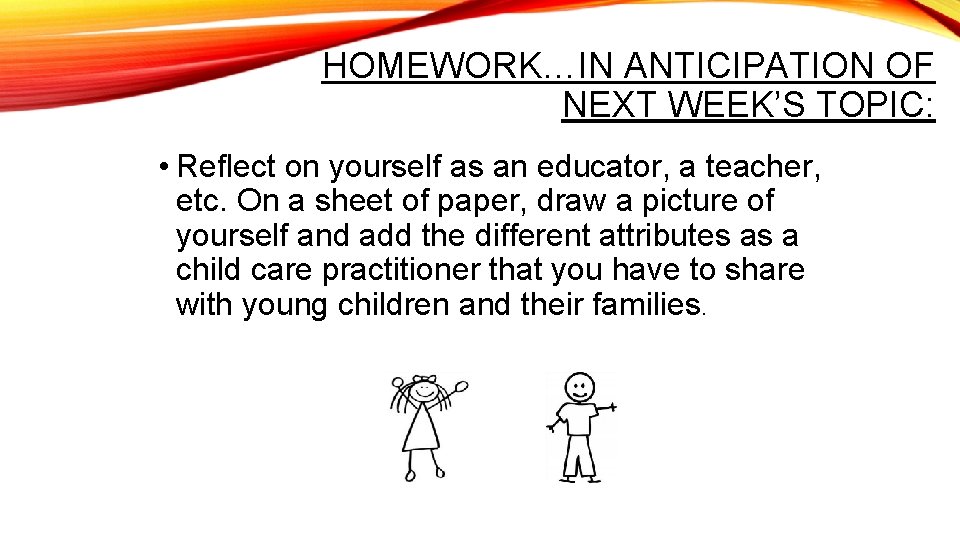
HOMEWORK…IN ANTICIPATION OF NEXT WEEK’S TOPIC: • Reflect on yourself as an educator, a teacher, etc. On a sheet of paper, draw a picture of yourself and add the different attributes as a child care practitioner that you have to share with young children and their families.
- Slides: 17