
Teambuilding the Workplace using LEGOSeriousPlay Presented by Pete
“Teambuilding @ the Workplace using LEGO®Serious®Play" Presented by Pete Smith
Agenda DAY 1 Day 2 9: 30 am – 10: 00 am: Ice Breaker: Feel the LEGO® 9: 30 am – 10: 45 am: The SCIENCE behind Successful LEGO® TEAMBUILDING 10: 00 – 10: 45 am: Introduction: What is Teambuilding? Teamgel’s Fundamental Premises 10: 45 am – 11: 00 am: Tea 11: 00 am – 13: 00 pm: The SECRETS of a Successful LEGO® TEAMBUILDING Workshop 10: 45 am – 11: 00 am: Tea 13: 00 pm – 14: 00 pm: Lunch 11: 00 am – 13: 00 pm: Creating a Shared Bond using LEGO® SERIOUS FUN - http: //www. teamgel. co. za/legoworkshops/lego-serious-fun/ 14: 00 pm – 15: 15 pm: Important Influences on the Success of LEGO® TEAMBUILDING 13: 00 pm – 14: 00 pm: Lunch 14: 00 pm – 15: 15 pm: Creating a Shared Point of View using LEGO® SERIOUS PLAY™ - Individual Build 15: 15 pm – 15: 30 pm: Tea 15: 30 – 17: 00 pm: Creating a Shared Point of View using LEGO® SERIOUS PLAY™ - Shared Build 15: 15 pm – 15: 30 pm: Tea 15: 30 – 16: 45 pm: Creating a Covenant 16: 45 pm – 17: 00 pm: Closure
What is Teambuilding? • A Team is a number of people working together to achieve the same objective(s). • Teambuilding is the process of making a team more efficient and effective. • Team spirit is the willingness on the part of the team members to act as an efficient and effective team. It arises at the individual level not the social level.
Teamgel’s Fundamental Premises • My own life is my laboratory • The purpose is ACTION, based on KNOWLEDGE, not knowledge alone • Design teambuilding workshops consistent with the Nature of Human Beings • Don’t build academic silos • We are all cut from the same cloth • Deal with people at the individual level before the social level • We are our own 1 st cause • See the world through the eyes of the delegate • Order, not chaos • A workshop is not a one-time event, it’s a step in a staircase • Shared Bond + Shared Point of View = Shared Action • LEGO® SERIOUS FUN + LEGO® SERIOUS PLAY™ = COVENANT • STAGE 1 → STAGE 2 → STAGE 3 • MAKE IT HAPPEN !!!!
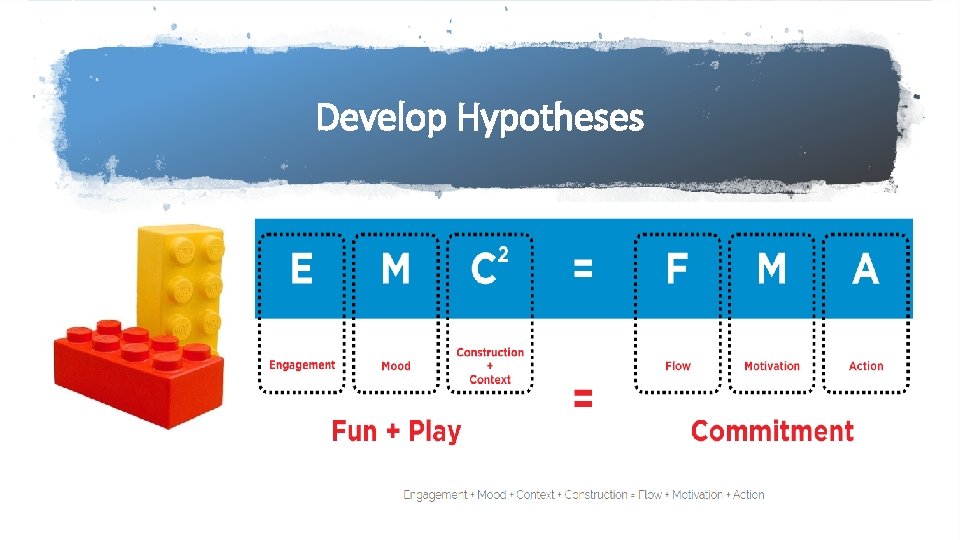
Develop Hypotheses
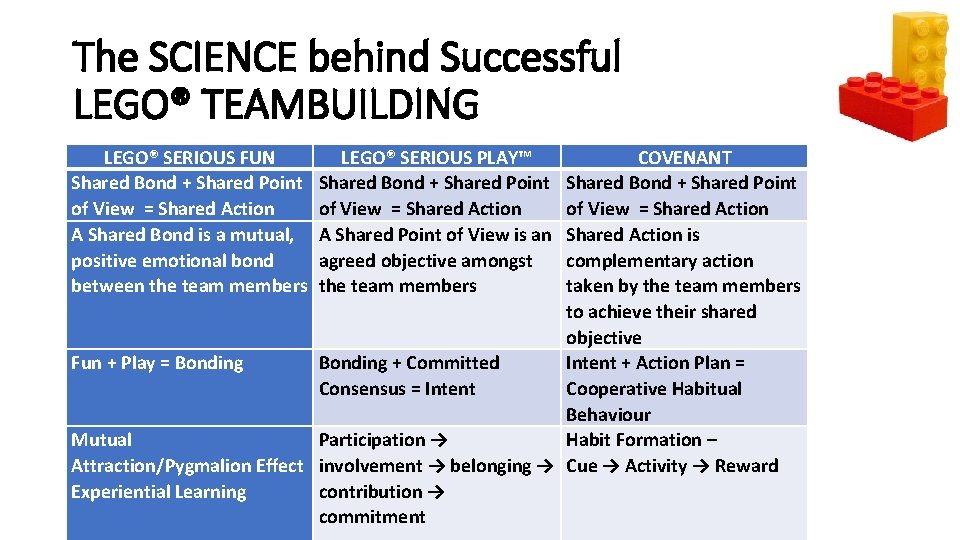
The SCIENCE behind Successful LEGO® TEAMBUILDING LEGO® SERIOUS FUN Shared Bond + Shared Point of View = Shared Action A Shared Bond is a mutual, positive emotional bond between the team members LEGO® SERIOUS PLAY™ Shared Bond + Shared Point of View = Shared Action A Shared Point of View is an agreed objective amongst the team members COVENANT Shared Bond + Shared Point of View = Shared Action is complementary action taken by the team members to achieve their shared objective Fun + Play = Bonding + Committed Intent + Action Plan = Consensus = Intent Cooperative Habitual Behaviour Mutual Participation → Habit Formation – Attraction/Pygmalion Effect involvement → belonging → Cue → Activity → Reward Experiential Learning contribution → commitment

The SCIENCE behind Successful LEGO® TEAMBUILDING LEGO® SERIOUS FUN Working at the Individual Human level more than the Social level Basic Human Nature Fun Remove demographics Competition Include emotions Realm of openness and honesty Mutual Attraction/Pygmalion effect Individual 1 st cause LEGO® SERIOUS PLAY™ Working at the Individual Human level more than the Social level COVENANT Working at the Individual Human level more than the Social level + + Wisdom rather than Facts Mental Association Metaphorical Thinking Storytelling Future Oriented Habitual Behaviour Mental Causation
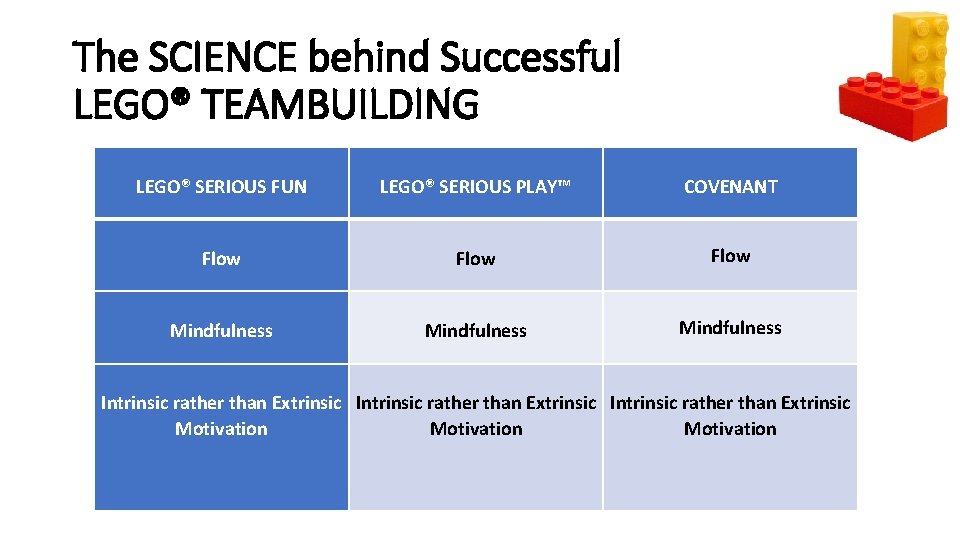
The SCIENCE behind Successful LEGO® TEAMBUILDING LEGO® SERIOUS FUN LEGO® SERIOUS PLAY™ COVENANT Flow Mindfulness Intrinsic rather than Extrinsic Motivation
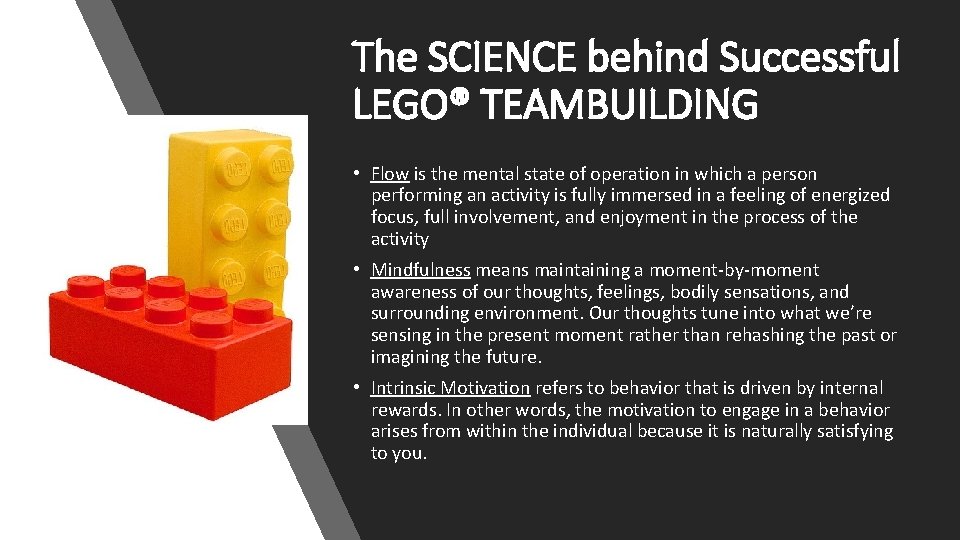
The SCIENCE behind Successful LEGO® TEAMBUILDING • Flow is the mental state of operation in which a person performing an activity is fully immersed in a feeling of energized focus, full involvement, and enjoyment in the process of the activity • Mindfulness means maintaining a moment-by-moment awareness of our thoughts, feelings, bodily sensations, and surrounding environment. Our thoughts tune into what we’re sensing in the present moment rather than rehashing the past or imagining the future. • Intrinsic Motivation refers to behavior that is driven by internal rewards. In other words, the motivation to engage in a behavior arises from within the individual because it is naturally satisfying to you.
The SECRETS of a Successful LEGO® TEAMBUILDING Workshop. • DO rather than TELL • Structure workshop according to Human Nature – fun, competitive, future oriented, 1 st cause, • Operate at individual level, the level of including emotions – participation, involvement, belonging, commitment, ownership; “This is my workshop” • Seek wisdom rather than facts LEGO® SERIOUS FUN Instil a Shared Bond LEGO® SERIOUS PLAY™ Reach Committed Consensus COVENANT Turn Action Plan into a Covenant
The SECRETS of a Successful LEGO® TEAMBUILDING Workshop. LEGO® SERIOUS FUN Instil a Shared Bond LEGO® SERIOUS PLAY™ Reach Committed Consensus COVENANT Turn Action Plan into a Covenant • Create Fun - process managed incrementally; don’t interrupt or stop • Create Flow – observe delegates to be aware of proceedings; levels of behaviour, emotion and cognition; “When we played with LEGO®” • Encourage Humour – the lubricant • Ensure Respect for others - allow and encourage others to participate and access their individuality beyond their social roles
The SECRETS of a Successful LEGO® TEAMBUILDING Workshop. LEGO® SERIOUS FUN Instil a Shared Bond LEGO® SERIOUS PLAY™ Reach Committed Consensus COVENANT Turn Action Plan into a Covenant • 100% participation • The role of the facilitator • • • Multi-level thinking – past, present, future Manage process, not in the process Follow structure Guide content Create ambiance • Physical dimensions – team size, light, distance, physical closeness, noise interference, atmosphere, • Time allocation – do 1 thing well rather than many things badly
The SECRETS of a Successful LEGO® TEAMBUILDING Workshop. LEGO® SERIOUS FUN Instil a Shared Bond LEGO® SERIOUS PLAY™ Reach Committed Consensus COVENANT Turn Action Plan into a Covenant • When using LEGO® SERIOUS PLAY™ • • • always facilitate a skills exercise 1 st probing to elicit story of individual build – 3 D LEGO®, represents, meaning, implication tell story of the model built record important proceedings – memory hook always end off with a commitment to action • Address Important Influences on the success of the teambuilding – action planning, intrinsic motivation, sustained motivation, procrastination, habit formation
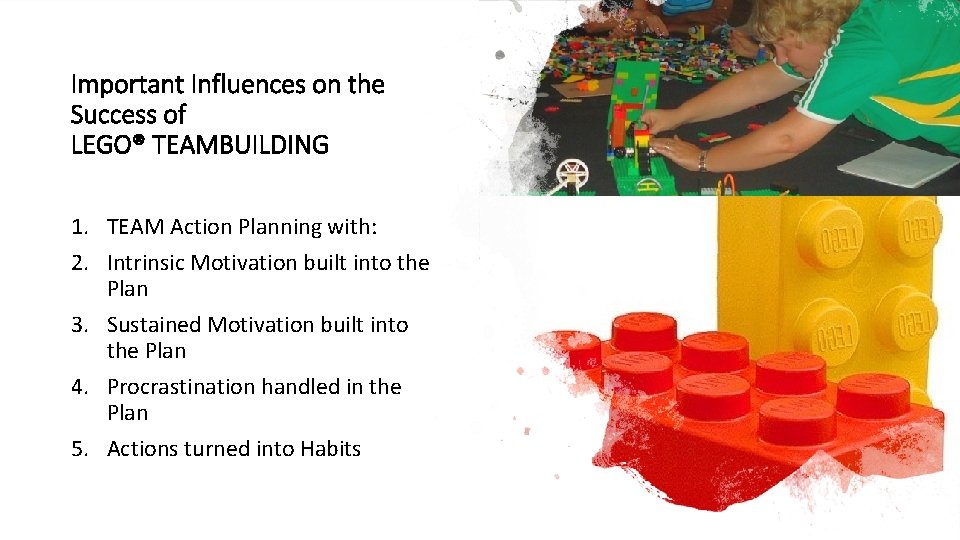
Important Influences on the Success of LEGO® TEAMBUILDING 1. TEAM Action Planning with: 2. Intrinsic Motivation built into the Plan 3. Sustained Motivation built into the Plan 4. Procrastination handled in the Plan 5. Actions turned into Habits
Making Action Planning Happen • GET GOING – everyone must take 1 st co-ordinated step • turn the action plan into a covenant • design plan and build steps into it to ensure intrinsic motivation accessed, procrastination managed, and action steps become habits • committed consensus – from objectives to action steps to reward • individual responsibility, intrinsic motivation, accountability, reward • incremental, achievable steps • success leads to success
How to Practice Better Intrinsic Motivation • Intrinsic motivation is behavior that is driven by internal rewards. In other words, the motivation to engage in a behavior arises from within the individual because it is naturally satisfying to you • Look for the fun in work and other activities or find ways to make tasks engaging for yourself. • Find meaning by focusing on your value, the purpose of a task, and how it helps others. • Keep challenging yourself by setting attainable goals that focus on mastering a skill, not on external gains. • Help someone in need, whether it’s a friend who could use a hand at home or lending a hand at a soup kitchen. • Create a list of things you genuinely love to do or have always wanted to do and choose something on the list to do whenever you have time or are feeling uninspired. • Participate in a competition and focus on the camaraderie and how well you perform instead of on winning. • Before starting a task, visualize a time that you felt proud and accomplished and focus on those feelings as you work to conquer the task.
How to Sustain Motivation • Hold back. If the goal is to run 3 miles a day start off with running 1 mile a day. Tell yourself you can run more. Then run 2 miles. Tell yourself you can run more. Then run 3 miles and do so thereafter • Just start. Take the first step • Stay accountable. Report progress continuously to nominated person(s) • Squash negative thoughts and replace them with positive ones. Practice daily. • Think about the benefits. Think about how positive you will feel when the task is completed. • Get excited again. Think about why you were excited in the first place.
How to Sustain Motivation • Read about it. Read about your goal. • Find like-minded friends. Find someone with similar goals. Encourage each other to succeed. • Read inspiring stories. Read success stories. • Build on your successes. Celebrate every little milestone. Take that successful feeling and build on it with another baby step. • Just get through the low points. Motivation comes and goes. Wait for it to return.
Overcoming Procrastination • Procrastination – we know what we want to do, but something gets in the way. An emotional problem that gets in the way. A conscious decision to delay. The instant gratification monkey. Procrastination is caused by tasks that evoke feelings of boredom, anxiety or stress. • The procrastination loop: Put off starting work because “I don’t feel like it” → feel guilty and stressed → not in a good mood to start working → delay again • Overcoming procrastination – shift your mindset from a logical time management problem to an emotion management one. • Step 1. You can’t change the past. Forgive yourself for procrastinating previously. • Step 2. Break your goals and tasks down into smaller chunks. Smaller goals are easier to achieve. Success leads to success. Ask yourself “what is the smallest step I can take to move this forward? ” • Step 3. Use the 5 -minute rule to cross the procrastination threshold. If you don’t want to do something make a deal with yourself to do at least 5 minutes of it. • Step 4. Track your progress to stay motivated and push through
What are Habits? • Cue – Action – Reward • When I see CUE, I will do ROUTINE in order to get a REWARD. A positive reward creates a positive feedback loop that tells your brain to do the same actions the next time the cue occurs. Once you go through this loop a few times, you’ll stop thinking about it and you’ll act automatically. • Habits are built on choice, but sustained through consistency • replace habits rather than stop them • buddy system • A Keystone Habit is an action or behaviour that sets off a chain reaction that encourages you to build other healthy habits without trying. Treat overall action plan as a keystone habit.
Tips to Create Habits • Schedule your Reminder. Eg. Every day at 7 am. • Create “if – then” statements. Eg. If it is lunch time • Make your Routine as easy to do as possible. Start small and over time build up to the required level. • Eliminate all other options. It’s still a choice until it becomes a habit. Make the Routine the best option and the only option • Stick to your schedule • Using reviews, feedback and tools to track your progress. • Feedback loops. • Weekly and monthly reviews. • Tools to track your actions.
Common Mistakes that can Break Good Habits • Focusing too much on the end goal. Rather think about the actions you’re taking than where you are going • Taking on too much at once. Taking on too much gives you an easy excuse to put off the behaviours you’re trying to make routine • Procrastinating before we even trigger our habit. • Creating a deadline, not a schedule. Don’t set deadlines for building habits, commit to a schedule. • Not being excited enough about the reward. To build a habit that lasts, your brain needs to start expecting and anticipating the reward.
How to get back on track • Find an accountability partner • Don’t fantasize about the end result. Rather visualize doing the work. • Create a supportive environment. • Write your habits down on the calendar. • If you can’t do your habit just do something.
LEGO® Teambuilding in a nutshell • Create a Shared Bond • Reach a Shared Point of View • Devise Shared Action Plan – a Covenant • DO IT AGAIN and AGAIN • HAVE FUN
Contact Pete Smith • • • pete@teamgel. co. za www. teamgel. co. za https: //www. linkedin. com/in/legopetesmith/ (South Africa) 833207623 (South Africa) 11 4632894
- Slides: 25