
Teambuilding For Prison Officers at HPSS 14 th
Teambuilding For Prison Officers at HPSS 14 th November 2013. Irene Mwinga Management & OD Consultant Trainworks Ltd. Mobile: 0721813867 1
TEAMBUILDING Made up of two words: Team- group/lineup Building- Construction YOU CAN EITHER Build a new team OR Develop an existing one 2
REASONS FOR TEAMBUILDING Improve communication Make work place more enjoyable Motivate the team Get to know each other Get everyone “onto the same page”, including goal setting Teaching the team self-regulation strategies 3
REASONS FOR TEAMBUILDING Cont. Helping participants learn more about themselves (strengths and weaknesses) Identify and utilize strengths of team members Improving team productivity Practice effective collaboration with team members 4
What is a team? A Team is a special type of group in which people work interpedently to accomplish a goal. ( Levi, D. , (2001), Group dynamics, Sage Publishers, USA) People working together towards achieving objectives which are for everyone in the team. 5
CHARACTERISTICS OF A TEAM Teams strength depends on commonality of purpose and interconnectivity between individual members Teams are difficult to form Formed due to their complementary skills Success depends on their functional interpersonal dynamics- success measured through processes of activities and results 6
Characteristics Of A Group As Opposed To A Team A group’s strength may come from sheer volume or willingness to carry out a single leader’s commands. It is easy to form, for example professionals grouped together i. e. accountants etc Low interdependence Group members may not be compatible Success measured by results 7
New Team Some Principles of building a new team: • Define purpose • Identify time frames • Get top management support • Select team members • Share overall purpose • Create mission statement and goals • Decide team name (Topchick) 8
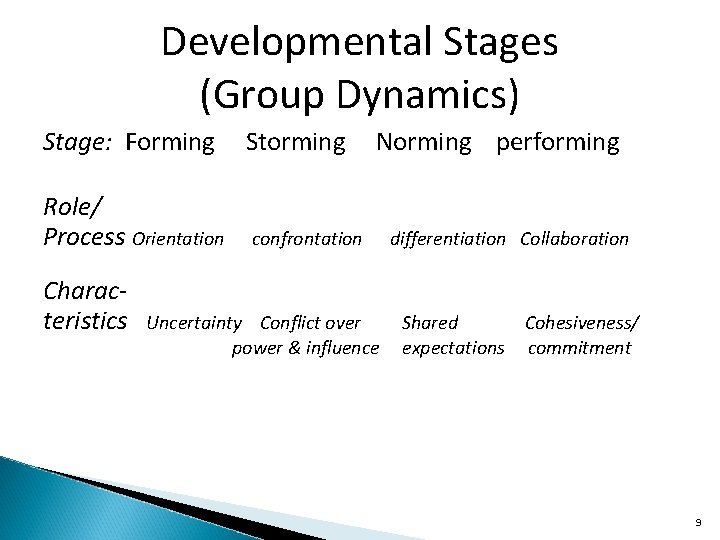
Developmental Stages (Group Dynamics) Stage: Forming Role/ Process Orientation Characteristics Storming Norming performing confrontation Uncertainty Conflict over power & influence differentiation Collaboration Shared Cohesiveness/ expectations commitment 9
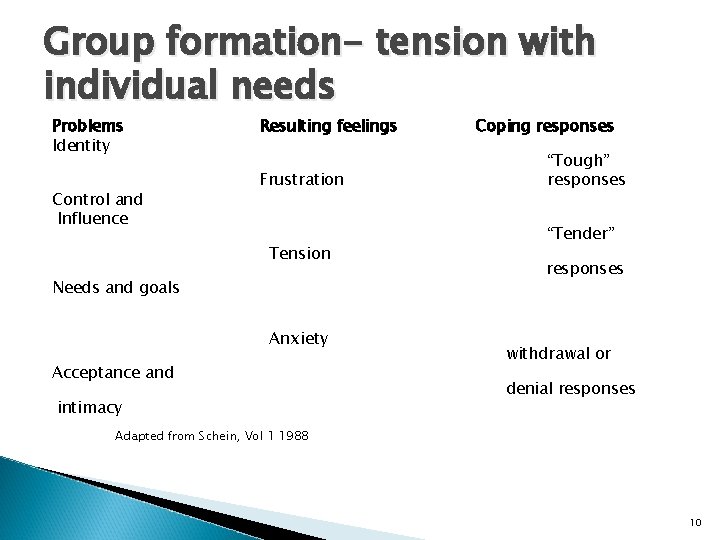
Group formation- tension with individual needs Problems Identity Control and Influence Resulting feelings Frustration Tension Needs and goals Anxiety Acceptance and intimacy Coping responses “Tough” responses “Tender” responses withdrawal or denial responses Adapted from Schein, Vol 1 1988 10

Group Structure and Roles • Group structure describes the pattern of relations i. e. status, roles, leadership, communication etc • Group structure is present in both formal and informal groups • Groups roles describe typical behaviours of individuals in groups based on Personality traits Buchanan & Huczynski, 1997 11
Group Culture • Norms and beliefs – Groups can develop their own culture e. g. power, role, task, person – Norms are often implicit – Norms can sustain the morale of the group but can also restrict the group • Interaction with the organization – Others in the organization affect working of the group – Inter-group relations affect productivity and morale 12
Group Maintenance functions • Task functions – Initiating – Information sharing • Group building and maintenance functions – standard setting – conflict resolution • Boundary maintenance functions – Boundary defining – Entry and exit management Schein, Vol 1 1988 13
Group effectiveness and teamworking • The aims of the group – Effective – Efficient – Happy? • Effectiveness is also influenced by: – Team size, structure, process, leadership, organizational context – The informal workings of the group 1976) (Handy, 14
Group decision-making Autocratic Democratic Consensus Unanimity Lack of response etc 15
HOW TO DEVELOP AN EXISTING TEAM Includes: Coaching Mentoring Train- team training and cross training Guided Team self-correction etc 16
Problems with groups • “Groupthink” • Group Polarization (Janis) – Inappropriate decisions through unconscious processes of conformity – Uncreative: dissident views are quashed or become un-discussable – Often happens in high risk or high status situations – The group will make more polarized decisions than each member would as an individual – More risky if the group is risk oriented – More cautious if the group is conservative 17
Problems with groups • • Abdication of responsibility Organizations are often structured around individuals – Need to structure organizations around work groups – Self managing teams should be the organizational building blocks – Japanese approaches support these ideas but Western approached rely on individualism • Diversity- in function, role, background, identity, experience – Problems with stereotypes and traditions – Supported by informal groups, linkages – A problem or an opportunity? 18
Suitable team Structures Range of skills ◦ A suitable team should bring together a range of skills ◦ The greater the diversity and skills range the better for an effective team 19
Roles that a team needs 1. ◦ ◦ The challenger -someone to bring the team down to earth (kills group think). I don’t think we should do this. Am not convinced! Why are we doing this? Is this really the best way? 20
Roles that a team needs 2. ◦ ◦ The ideas person On the other hand why don’t we …? What about trying …? Of course we could always … This might sound daft, but … 21
Roles that a team needs 3. The driving force –Focusing the team on what it’s trying to do in what time. – This is fascinating but we should be looking at … – Look we’ve only twenty minutes left and … – Lets get on with it –we’ve done that. – Lets get started! – We don’t have time for all this planning … (watch this weakness) 22
Roles that a team needs 4. ◦ ◦ The bottom-liner –the teams accountant We can’t afford it. Who’s going to do that? There must be a simpler way Having listened to all that it looks as if it will mean … (helpful brake on others) 23
Roles that a team needs 5. The Implementer ◦ Gets stuck into the details of making it work ◦ Ties up the loose ends and checks everyone knows who is doing what next 24
Roles that a team needs 6. The Calming influence ◦ Acts and helps people get along. ◦ A social animal, acts as mediator when things gets tough. ◦ Takes the sting out of things 25
Roles that a team needs 7. The Captain –the team leader – Give everyone a share of vision – Create a working atmosphere for everyone to work – Listens to comments – Keeps harmony – Brings balance on inputs – Monitors progress and keeps timing to ensure arrival at destination 26
“IMPERFECT PEOPLE MAKE PERFECT TEAMS” § § Role coverage- no gaps, excellence in key areas Minimum overlap- no duplication of dominant roles Synergy- playing to strengths, everyone has a role “Chairman” strength- effective management of discussion and decision-making process 27
“IMPERFECT PEOPLE MAKE PERFECT TEAMS” Cont. § § Shape- a mix of types, “fit for purpose” Openness- clarity about what members can depend on from each other 28
Benefits of Team Working • Benefits to the organization – Increased creativity and org synergy – Cross-functional and cross-organizational fertilization for products/services improvement – Co-ordination –for complex projects – Greater dissemination of organizational performance information – Ownership and empowerment – Improved decision making, less politics 29
Benefits of Team Working Benefits member to individual team ◦ Leader/manager development ◦ Greater learning/induction into org ◦ Improved morale and personal support ◦ Job enrichment and satisfaction ◦ Feeling of contribution 30
What Makes An Effective Team Leader Setting values: establishing standards of performance, Clarifying objectives: helping team members understand expectations. Provide a model: the leader's own behaviour as an appropriate model. Identifying members' strengths: ensuring optimum use of resources. Delegation: willingness to genuinely delegate. 31
Effective Team Leader Cont. • • • Getting help: being aware of realistic limits to Concern for people • existing team competences. Flexibility of approach. Different styles suit different task conditions. Represent the team: spokesman role Develops team members: Makes sure that team members experience opportunities for achievement through personal growth. Feedback: positive feedback. Available: leader is there 32
Types of Teambuilding Exercises • Communication exercises geared towards improving communication skills • Problem solving/decision making exercise focusing on groups ability to solve difficult problems together • Planning/Adaptability Exercise focusing on adaptability to change • Trust Exercise v. Draw a group picture representing current situation. No words to explain. 33
Exercises and Lessons To be Learnt Trust Walk- Enhancing trust between members Water Balloon Netball- Coordination, communication, teamwork, decision making Rope Knots- Conflict resolution, coordination, communication, teamwork etc 34
Conflict • • • Conflict arises from a play-out of power relations (often referred to as organizational politics). It generally sustains and reproduces dominant cultural meanings A strong culture, paradigm, provides greater consensus and fewer opportunities for conflict Conflict has functional and dysfunctional consequences » Is conflict inevitable? 35
Some Causal Factors In Conflict Personal issues- values, beliefs, interests, personalities, attitude (difficulty in managing emotions) Organizational structure- interdependence, shared resources, rewards, performance criteria Communications- Information under/overload, language, contradictory information Fighting over power and power sharing Cultural- Values, competition, sub-cultures 36
Approach To Conflict Resolution Cont. How to Resolve: • Bargain by building consensus • Retreat- only used when the issue does not have a serious effect on the team • Enforce team rules (should be used as a last resort as it brings ill feelings in the team or even worse division). Used only on extreme cases i. e. unwillingness of a member to be a team player. 37
Using power and influence to resolve conflict Domination Sabotage Subversion Accommodation Avoidance Compromise Collaboration Co-optation Reason problem-solving Friendliness, assertiveness Coalition formation bargaining wield Power Yield Power Share distribute power 38
FORM TEAMS 39
TEAM EFFECTIVENESS REVIEW • Do you consider the team successful? Why? What effectiveness indicators did the team display? • What are the strengths and weaknesses of the team? • How did the team handle and resolve conflicts? • How did the team make decisions? • What can you say about leadership in the team? What is the culture of the team? (H/O) 40
OBSTACLES TO TEAM EFFECTIVENESS Faulty Construction- Organization, Calibre, Deployment Leader behaviour- Personal Style, Personality etc Member behaviour- Ambition, Insularity (narrowmindedness), Cliques, Focus on ‘Me’ Process failures- Information, Communication, Decisionmaking, Control Physical factors- Isolation, Resources, Language Uncontrollable factors- Management Turnover, 41
- Slides: 41