
TEAM PRODUCT Sections A B DESCRIBE AREA SELECTED
TEAM PRODUCT – Sections A & B • DESCRIBE AREA SELECTED AND WHY – Political, economic, social-culture, technological, geographical, demographics, etc. as relates to your business • COMPANY NAME AND WHY – – – Descriptive, suggestive, or non-sensical Office Max, Home Depot, Florist Creations Perfection Solutions, Excel Landscaping Radio Shack or Nordstrom Why did you select that name 1
TEAM PRODUCT – Section C • LEGAL FORM – – Sole proprietorship Partnership Corporation Limited liability • WHY YOU SELECTED THAT FORM 2
TEAM PRODUCT – Section D • ORGANIZATIONAL FORM – – – Simple Functional Divisional Matrix Other • NUMBERS OF EMPLOYEES NEEDED • TYPES – SKILLED, UN-SKILLED, ETC 3
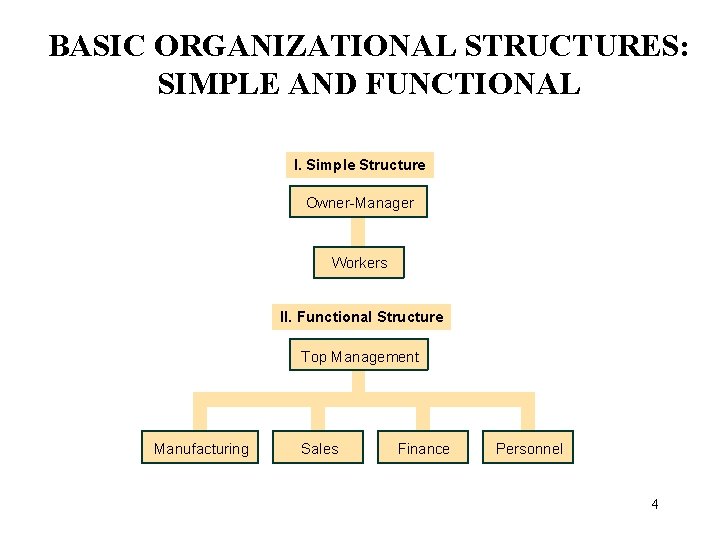
BASIC ORGANIZATIONAL STRUCTURES: SIMPLE AND FUNCTIONAL I. Simple Structure Owner-Manager Workers II. Functional Structure Top Management Manufacturing Sales Finance Personnel 4
TEAM PRODUCT – Section E • NAME OF PRODUCT AND VALUE (WHY SHOULD CONSUMERS PURCHASE IT – DOES IT SATISFY A NEED OR WANT THAT THEY HAVE) • NAME OF THE PRODUCT IS IMPORTANT 5
PRODUCT NAME CONSIDERATIONS • NAME SHOULD BE APPEALING • HELPS TO BE TRADEMARKED • GREAT CARE IN: – Creating/developing the name – Pre-testing the name – Managing the name 6
GOALS OF THE NAME • • FOUNDATION FOR COMMUNICATION HELPS IDENTIFY THE PRODUCT TAKES ON MEANING LENDS STREGTH TO THE PRODUCT 7
BRAND NAME STRATEGIES • • • GENERIC DESCRIPTIVE SUGGESTIVE ARBITRARY COINED OR FANCIFUL 8
TRADEMARK PROTECTION • GENERIC BRAND NAMES: – Difficult to obtain protection – Some examples: § Bakery, aspirin, flower, automobile, la boulangerie – Not conducive for your protection and promotion 9
PROTECTION 1 • DESCRIPTIVE BRAND NAMES – They describe the product – Some examples: § “Laser jet” printers § “Flu relief” cold/flu medicine § “Solid head” thumb tacks § “Invisible tape” § “Color brite” detergent § “Clean all” cleaners 10
PROTECTION 2 • SUGGESTIVE BRAND NAMES • EVOKES A PRODUCT’S BENEFITS • SOME EXAMPLES: § § “Ever-ready” batteries “Sleepeezy” cold/flu medicine “Sparkle” cleaner “Vanish” toilet bowl cleaner 11
PROTECTION 3 • ARBITRARY BRAND NAMES • COMMON WORD WITH NO APPARENT RELATION TO THE PRODUCT CATEGORY • SOME EXAMPLES: § § “Camels” cigarettes “Sequence” cold/flu medicine “Jump” detergent “Horizon” cleaner 12
PROTECTION 4 • COINED OR FANCIFUL NAMES • FICTIONAL WORDS UNRELATED TO THE PRODUCT AND PRODUCT CATEGORY • SOME EXAMPLES: § § “Exxon” gasoline “Sucrets” throat lozenges “Robitussin” cough medicine “Mylanta” for stomach 13
IMPLICATIONS • DESCRIPTIVE AND SUGGESTIVE NAMES A BETTER OVERALL CHOICE • SURVEY RESULTS SHOWED THAT RECALL AND LIKING WERE HIGHEST • HARDER TO REGISTER FOR PROTECTION 14
TEAM PRODUCT – Section F • VISION – A FIRM’S FUTURE BUSINESS PATH – WHERE WE ARE GOING • MISSION – FOCUSES ON CURRENT BUSINESS ACTIVITIES – WHO WE ARE AND WHAT WE DO 15
TEAM PRODUCT – Section G STRATEGIC & FINANCIAL OBJECTIVES • CONVERTS VISION AND MISSION TO PERFORMANCE TARGETS • CREATES A YARDSTICK TO TRACK PERFORMANCE • PUSHES FIRM TO BE INVENTIVE AND FOCUSED ON RESULTS – NOT ACITIVIES 16
TEAM PRODUCT – Section G • FINANCIAL OBJECTIVES – OUTCOMES FOCUSED ON IMPROVING FINANCIAL PERFORMANCE • STRATEGIC OBJECTIVES – OUTCOMES FOCUSED ON IMPROVING LONG-TERM, COMPETITIVE BUSINESS POSITION 17
TEAM PRODUCT – Section G 1 STRATEGIC OBJECTIVES – – Higher product quality than rivals Lower costs relative to key competitors Broader product line than rivals Better e-commerce and internet sales capabilities than rivals – Better customer service than rivals – Recognition as a leader in technology – Wider geographic coverage than rivals 18
TEAM PRODUCT – Section G 2 FINANCIAL OBJECTIVES – – – Achieve revenue growth of 10% per year Increase earnings by 15% annually Increase dividends per share by 5% per year Increase net profit margins from 2% to 4% A rising stock price (outperform the S&P 500) 19
EXAMPLE: GE CORPORATE OBJECTIVES – Become the most competitive enterprise in the world. – Be number one or number two in each business we are in. – Globalize every activity in the company. – Embrace the internet and become a global e- business. 20
EXAMPLE: MOTOROLA CORPORATE OBJECTIVES – Self-funding revenue growth of 15% annually. – An average return on assets of 13 to 15%. – An average return on shareholders’ equity investment of 16 to 18%. 21
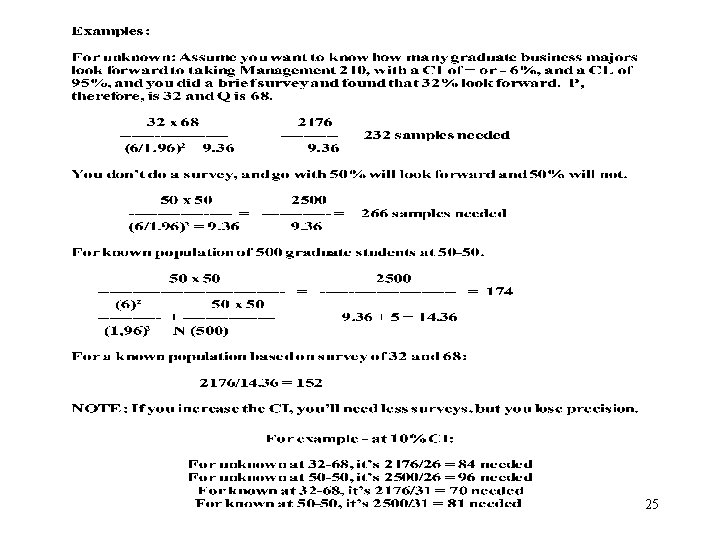
TEAM PRODUCT – Section H TARGET MARKET – DESCRIBE: • TOTAL POPULATION AND ITS CHARACTERISTICS: – Gender, income, etc. – Things relevant to your product • SAMPLE – WHO, WHEN, WHERE, HOW – Results from sampling – match population? 22
SURVEY INSTRUMENT • OBTAIN DEMOGRAPHICS OF YOUR SAMPLE • ASK TWO KEY QUESTIONS? – Would you buy this product § Definitely § Probably § Maybe § No – How much would you pay? • GIVE ME PRODUCT COST AND EXPECTED SALES 23
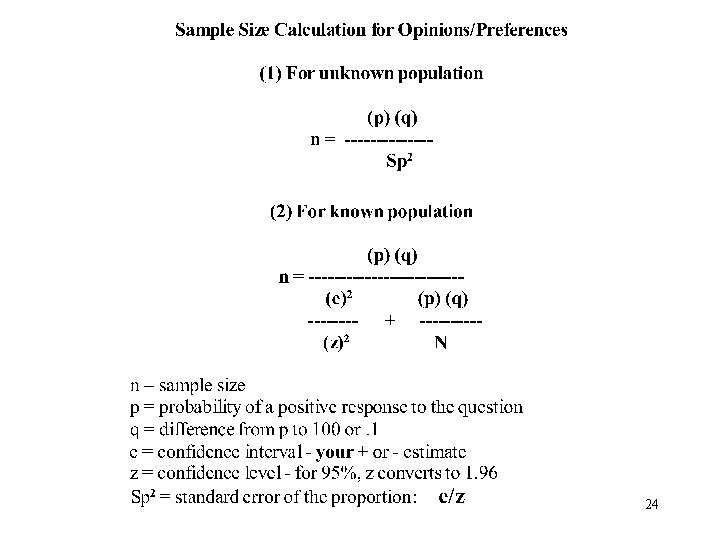
24
25
TEAM PRODUCT – Section I COMPETITORS (TOP FIVE) DIRECT OR IN-DIRECT • DESCRIBE THEIR SIMILAR PRODUCTS • THE PRICES THEY CHARGE • HOW THEY PROMOTE THEIR PRODUCTS • WHERE THEY SELL THEIR PRODUCTS 26
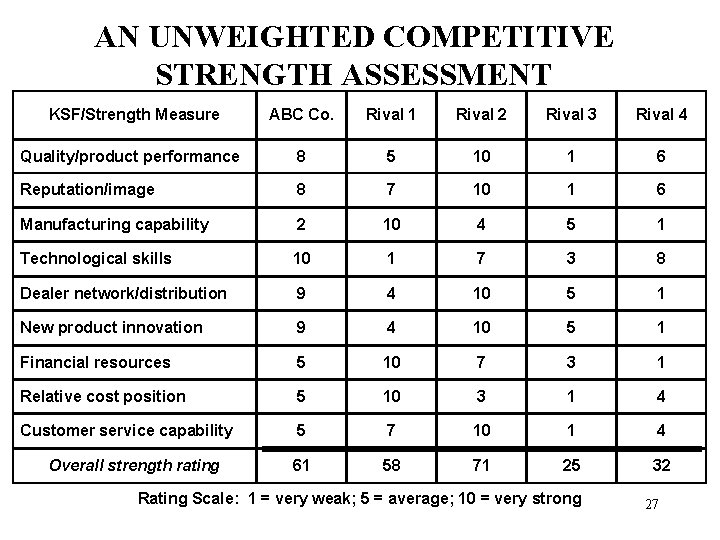
AN UNWEIGHTED COMPETITIVE STRENGTH ASSESSMENT KSF/Strength Measure ABC Co. Rival 1 Rival 2 Rival 3 Rival 4 Quality/product performance 8 5 10 1 6 Reputation/image 8 7 10 1 6 Manufacturing capability 2 10 4 5 1 Technological skills 10 1 7 3 8 Dealer network/distribution 9 4 10 5 1 New product innovation 9 4 10 5 1 Financial resources 5 10 7 3 1 Relative cost position 5 10 3 1 4 Customer service capability 5 7 10 1 4 61 58 71 25 32 Overall strength rating Rating Scale: 1 = very weak; 5 = average; 10 = very strong 27
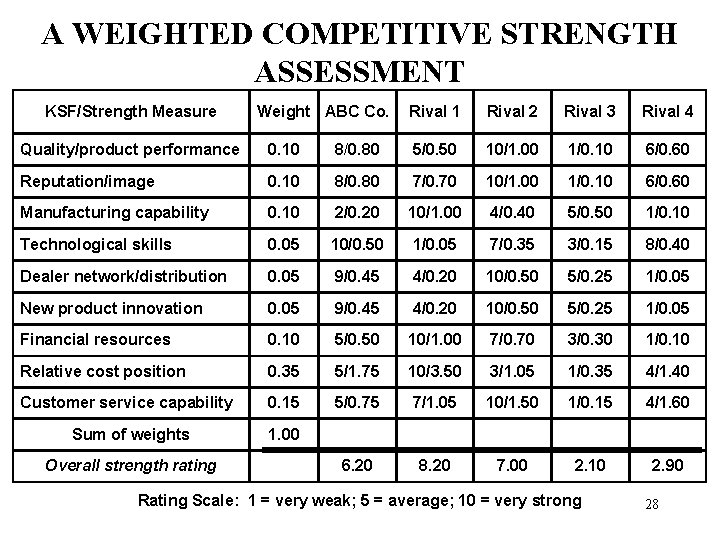
A WEIGHTED COMPETITIVE STRENGTH ASSESSMENT KSF/Strength Measure Weight ABC Co. Rival 1 Rival 2 Rival 3 Rival 4 Quality/product performance 0. 10 8/0. 80 5/0. 50 10/1. 00 1/0. 10 6/0. 60 Reputation/image 0. 10 8/0. 80 7/0. 70 10/1. 00 1/0. 10 6/0. 60 Manufacturing capability 0. 10 2/0. 20 10/1. 00 4/0. 40 5/0. 50 1/0. 10 Technological skills 0. 05 10/0. 50 1/0. 05 7/0. 35 3/0. 15 8/0. 40 Dealer network/distribution 0. 05 9/0. 45 4/0. 20 10/0. 50 5/0. 25 1/0. 05 New product innovation 0. 05 9/0. 45 4/0. 20 10/0. 50 5/0. 25 1/0. 05 Financial resources 0. 10 5/0. 50 10/1. 00 7/0. 70 3/0. 30 1/0. 10 Relative cost position 0. 35 5/1. 75 10/3. 50 3/1. 05 1/0. 35 4/1. 40 Customer service capability 0. 15 5/0. 75 7/1. 05 10/1. 50 1/0. 15 4/1. 60 Sum of weights 1. 00 6. 20 8. 20 7. 00 2. 10 2. 90 Overall strength rating Rating Scale: 1 = very weak; 5 = average; 10 = very strong 28
WHICH COMPANIES ARE IN STRONGEST / WEAKEST POSITIONS VERSUS YOUR COMPANY • ONE TECHNIQUE FOR REVEALING THE DIFFERENT COMPETITIVE POSITIONS OF INDUSTRY RIVALS IS STRATEGIC GROUP MAPPING • A STRATEGIC GROUP CONSISTS OF THOSE RIVALS WITH SIMILAR COMPETITIVE APPROACHES IN AN INDUSTRY 29
STRATEGIC GROUP MAPPING • FIRMS IN SAME STRATEGIC GROUP HAVE TWO OR MORE COMPETITIVE CHARACTERISTICS IN COMMON – – – – Sell in same price/quality range Cover same geographic areas Be vertically integrated to same degree Have comparable product line breadth Emphasize same types of distribution channels Offer buyers similar services Use identical technological approaches 30
CONSTRUCTING A GROUP MAP • Identify competitive characteristics that differentiate firms in an industry from one another • Plot firms on a two-variable map using pairs of these differentiating characteristics • Assign firms that fall in about the same strategy space to same strategic group • Draw circles around each group, making circles proportional to size of group’s respective share of total industry sales 31
TEAM PRODUCT – Section J • ACQUISITION SOURCES AND COSTS (IN TABLE FORM) – Name of supplier – Quantities – Costs 32
TEAM PRODUCT – Section K BUSINESS-LEVEL OR COMPETITIVE STRATEGIES • CONVINCE CUSTOMERS YOUR FIRM’S PRODUCT/SERVICES OFFERS SUPERIOR VALUE – Offer a good product at lower prices – Use differentiation to provide a better product buyers think is worth a premium price 33
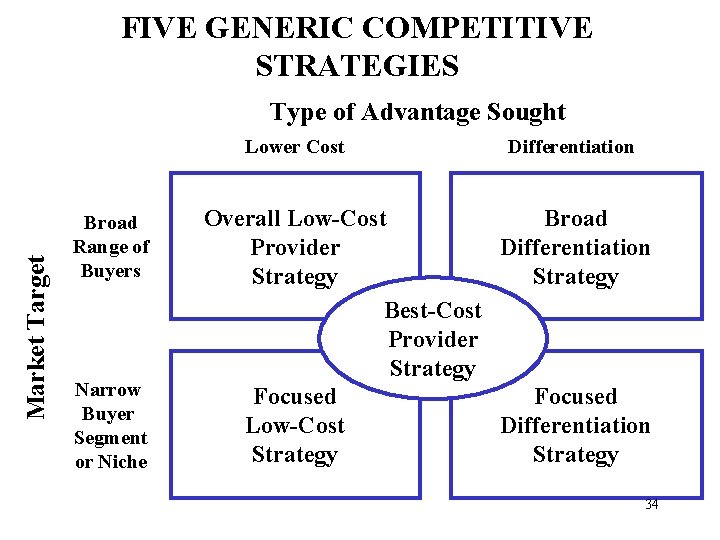
FIVE GENERIC COMPETITIVE STRATEGIES Type of Advantage Sought Market Target Lower Cost Broad Range of Buyers Narrow Buyer Segment or Niche Differentiation Overall Low-Cost Broad Provider Differentiation Strategy Best-Cost Provider Strategy Focused Low-Cost Differentiation Strategy 34
LOW-COST LEADERSHIP Keys to Success • Make achievement of low-cost relative to rivals theme of firm’s business strategy • Find ways to drive costs out of business year-afteryear Low-cost leadershipmeanslow OVERALL costs, not just low overall costs, not just low manufacturing or production costs! 35
WHEN DOES A LOW-COST STRATEGY WORK BEST? • Price competition is vigorous • Product is standardized or readily available from many suppliers • There are few ways to achieve differentiation that have value to buyers • Most buyers use product in same ways • Buyers incur low switching costs • Buyers are large and have significant bargaining power • Industry newcomers use introductory low prices to attract buyers and build customer base 36
DIFFERENTIATION STRATEGIES Objective • Incorporate differentiating features that cause buyers to prefer firm’s product or service over brands of rivals Keys to Success • Find ways to differentiate that create value for buyers and that are not easily matched or cheaply copied by rivals • Not spending more to achieve differentiation than the price premium that can be charged 37
APPEAL OF DIFFERENTIATION STRATEGIES • A powerful competitive approach when uniqueness can be achieved in ways that – Buyers perceive as valuable and are willing to pay for – Rivals find hard to match or copy – Can be incorporated at a cost well below the price premium that buyers will pay 38
TYPES OF DIFFERENTIATION THEMES • Unique taste -- Dr. Pepper • Multiple features -- Microsoft Windows and Office • Wide selection and one-stop shopping -- Home Depot and Amazon. com • Superior service -- Fed. Ex, Ritz-Carlton • Spare parts availability -- Caterpillar • More for your money -- Mc. Donald’s, Wal-Mart • Prestige -- Rolex • Quality manufacture -- Honda, Toyota • Technological leadership -- 3 M Corporation, Intel • Top-of-the-line image -- Ralph Lauren, Chanel 39
COMPETITIVE STRATEGY PRINCIPLE A low-cost producer strategy can defeat a differentiation strategy when buyers are satisfied with a standard product and do not see extra attributes as worth paying additional money to obtain! 40
BEST COST PROVIDER STRATEGIES • Combine a strategic emphasis on low-cost with a strategic emphasis on differentiation – Make an upscale product at a lower cost – Give customers more value for the money Objectives Deliver superior value by meeting or exceeding buyer expectations on product attributes and beating their price expectations • Be the low-cost provider of a product with good-toexcellent product attributes, then use cost advantage to under-price comparable brands • 41
FOCUS / NICHE STRATEGIES Objective • Concentrated attention on a narrow piece of the total market - Serve niche buyers better than rivals Keys to Success Choose a market niche where buyers have distinctive preferences, special requirements, or unique needs • Develop unique capabilities to serve needs of target buyer segment • 42
FOCUS / NICHE STRATEGIES AND COMPETITIVE ADVANTAGE Approach 1 Achieve lower costs than rivals in serving the segment -- A low-cost strategy Approach 2 Offer niche buyers something different from rivals -- A differentiation strategy 43
EXAMPLES OF FOCUS STRATEGIES • e. Bay – Online auctions • Porsche – Sports cars • Horizon and Comair (commuter airlines) – Link major airports with small cities • Jiffy Lube International – Maintenance for motor vehicles • Bandag – Specialist in truck tire recapping 44
TEAM PRODUCT – Section L FUNCTIONAL STRATEGIES – Production – Logistics – Marketing – Accounting – Research and development – Management information system – Finance 45
FUNCTIONAL STRATEGIES • PRODUCTION – What strategy – batch, assembly, etc. ? – Detailed step-by-step explanation of the manufacturing process – Include tools and equipment needed – Location of the production site 46
FUNCTIONAL STRATEGIES • LOGISTICS – Process to acquire raw materials – Channels of distribution of finished product § Direct, agent, wholesaler, retailer, etc. 47
FUNCTIONAL STRATEGIES • MARKETING (PRICE) – Pricing strategy (penetration or skimming) – Include the cost of the finished product – Wholesale or retail price 48
FUNCTIONAL STRATEGIES • MARKETING (PROMOTION) – Advertisement (media selected) – Personal selling – Coupons, discounts, contests, samples, etc. 49
FUNCTIONAL STRATEGIES • MARKETING (PLACE) – Where will you offer the product to the consumer? – Direct, retail store, on-line, etc. ? 50
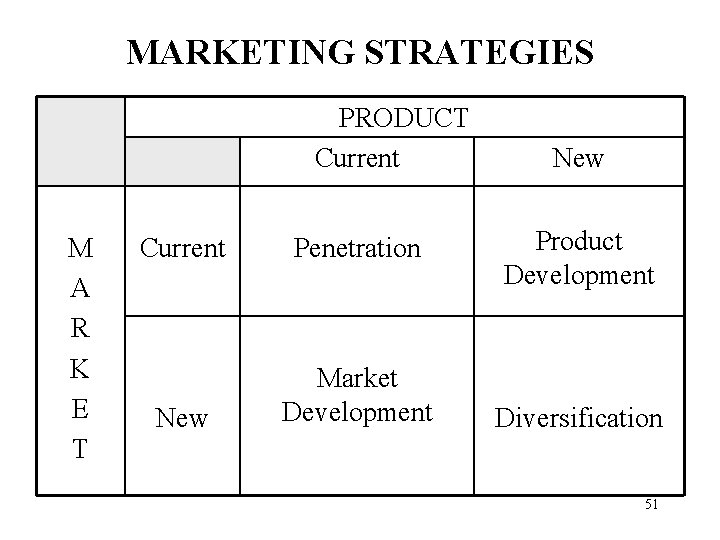
MARKETING STRATEGIES PRODUCT Current M A R K E T Current Penetration New Market Development New Product Development Diversification 51
FUNCTIONAL STRATEGIES • ACCOUNTING SYSTEM STRATEGY – Traditional? – Activity-base? – Outsource, in-house? – Software packages? 52
ACTIVITY-BASED COSTING: A KEY TOOL IN STRATEGIC COST ANALYSIS • Determining whether a company’s costs are in line with those of rivals requires measuring how a company’s costs compare with those of rivals activity-by-activity-from one end of the value chain to the other • Requires having accounting data that measures the cost of each value chain activity • Activity-based accounting systems provide the data for determining the costs for each relevant value chain activity 53
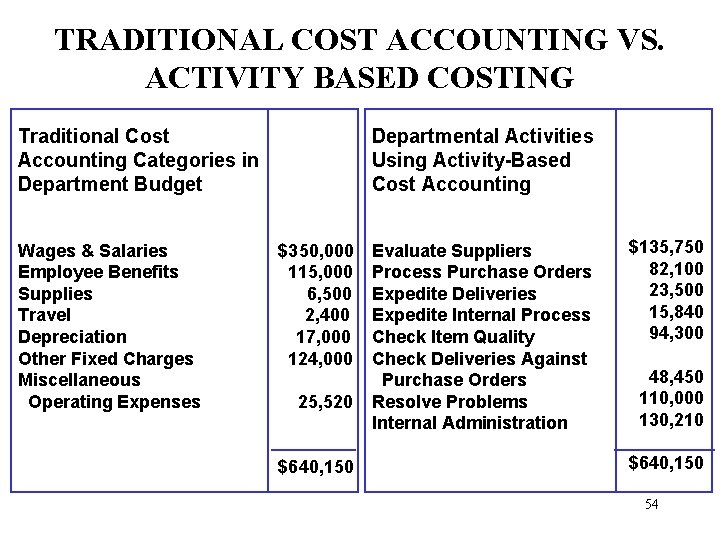
TRADITIONAL COST ACCOUNTING VS. ACTIVITY BASED COSTING Traditional Cost Accounting Categories in Department Budget Wages & Salaries Employee Benefits Supplies Travel Depreciation Other Fixed Charges Miscellaneous Operating Expenses Departmental Activities Using Activity-Based Cost Accounting $350, 000 115, 000 6, 500 2, 400 17, 000 124, 000 25, 520 $640, 150 Evaluate Suppliers Process Purchase Orders Expedite Deliveries Expedite Internal Process Check Item Quality Check Deliveries Against Purchase Orders Resolve Problems Internal Administration $135, 750 82, 100 23, 500 15, 840 94, 300 48, 450 110, 000 130, 210 $640, 150 54
FUNCTIONAL STRATEGIES • RESEARCH AND DEVELOPMENT – For the next production cycle, cite what: – Changes you can make to the product – Changes you can make to the process 55
FUNCTIONAL STRATEGIES • FINANCIAL STRATEGY – Detail expenses needed – Source of the funds (no make-believe) 56
FUNCTIONAL STRATEGIES • MANAGEMENT INFORMATION SYSTEM STRATEGY – Manually – Outsource – In-house – Off-the-shelf 57
TEAM PRODUCT – Section M • CHARTS REQUIRED: – Organizational chart – Value chain – Start-up categories and costs § Licenses, attorney, incorporation, phone installation (one-time expenses) § Other costs – see syllabus – Pro-forma (p/l) two years by quarters • COPY OF SURVEY AND RESULTS • BIBLIOGRAPHY 58
WHAT IS STRATEGIC COST ANALYSIS? • Focuses on a firm’s costs relative to its rivals • Compares a firm’s costs activity by activity against costs of key rivals – From raw materials purchase to – Price paid by ultimate customer • Pinpoints which internal activities are a source of cost advantage or disadvantage 59
THE CONCEPT OF A COMPANY VALUE CHAIN • A company’s value chain shows the linked set of activities, functions, and business processes that it performs in the course of designing, producing, marketing, delivering, and supporting its product / service. • A company’s value chain consists of two types of activities – Primary activities (where most of the value for customers is created) – Support activities that are undertaken to aid the individuals and groups engaged in doing the primary activities 60
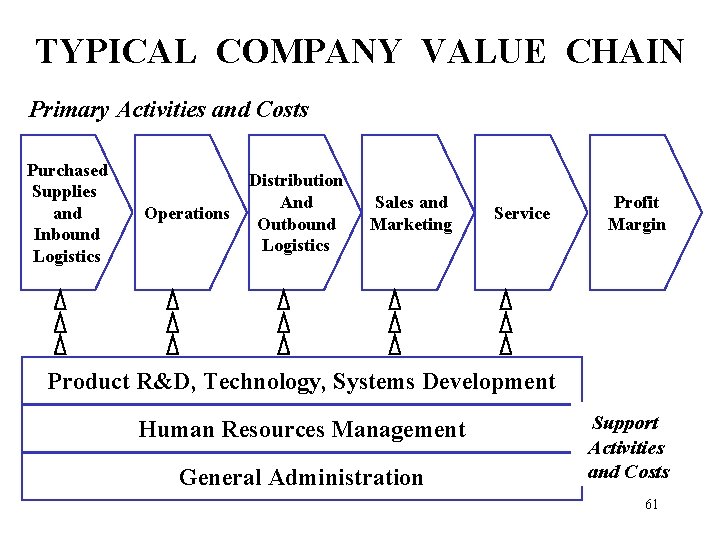
TYPICAL COMPANY VALUE CHAIN Primary Activities and Costs Purchased Supplies and Inbound Logistics Operations Distribution And Outbound Logistics Sales and Marketing Service Profit Margin Product R&D, Technology, Systems Development Human Resources Management General Administration Support Activities and Costs 61
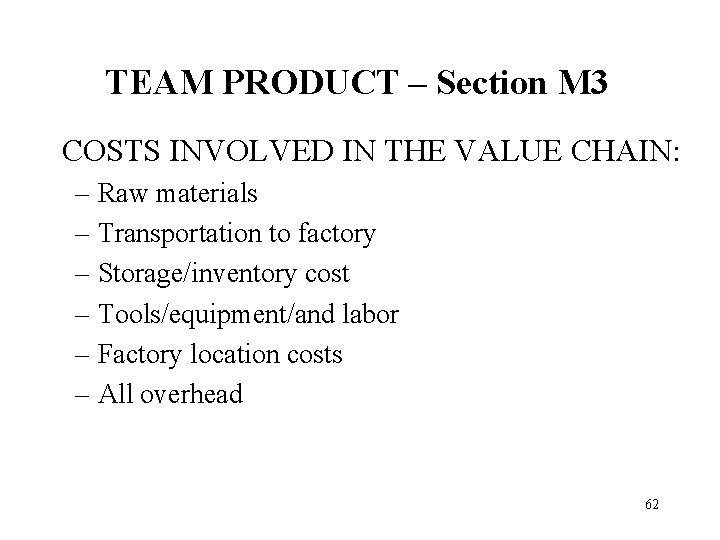
TEAM PRODUCT – Section M 3 COSTS INVOLVED IN THE VALUE CHAIN: – Raw materials – Transportation to factory – Storage/inventory cost – Tools/equipment/and labor – Factory location costs – All overhead 62
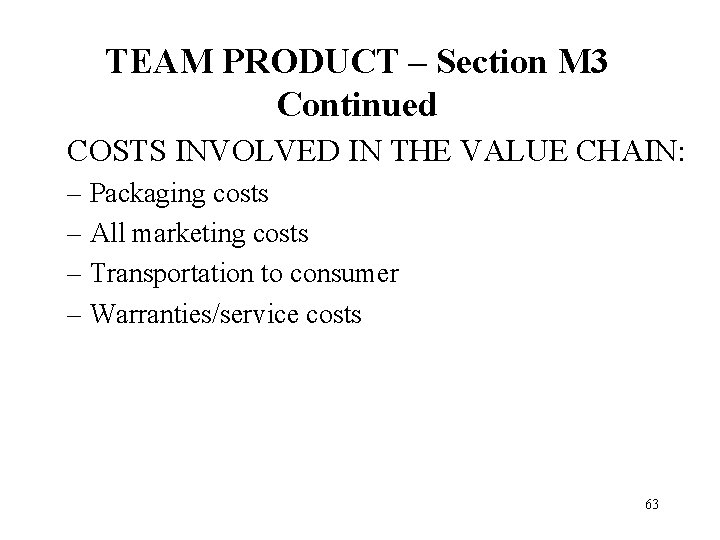
TEAM PRODUCT – Section M 3 Continued COSTS INVOLVED IN THE VALUE CHAIN: – Packaging costs – All marketing costs – Transportation to consumer – Warranties/service costs 63
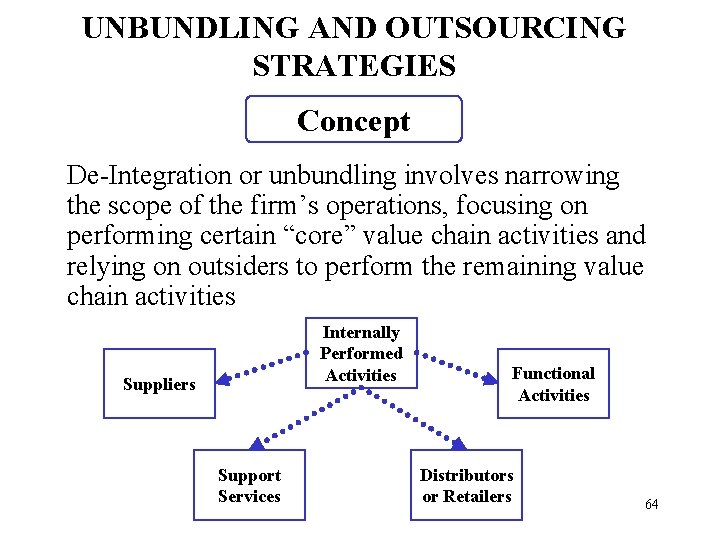
UNBUNDLING AND OUTSOURCING STRATEGIES Concept De-Integration or unbundling involves narrowing the scope of the firm’s operations, focusing on performing certain “core” value chain activities and relying on outsiders to perform the remaining value chain activities Internally Performed Activities Suppliers Support Services Functional Activities Distributors or Retailers 64
WHEN DOES OUTSOURCING MAKE STRATEGIC SENSE? • Activity can be performed better or more cheaply by outside specialists • Activity is not crucial to achieve a sustainable competitive advantage • Risk exposure to changing technology and/or changing buyer preferences is reduced • Operations are streamlined to – Cut cycle time – Speed decision-making – Reduce coordination costs • Firm can concentrate on doing those “core” value chain activities that best suit its resource strengths and capabilities 65
- Slides: 65