
Team Play Tactics Maximum Involvement Teaching a junior
- Slides: 24
Team Play / Tactics & Maximum Involvement ‘ Teaching a junior footballer the fundamentals of the game is the second most important job for you as a coach. The most important job is facilitating enjoyment and being responsible for a players continued participation. ’ Level 1 Youth/Junior Coaching Course Mark Smart
Youth Coaching Philosophy’s You MUST teach all your players the fundamentals of the GAME: 1. The ‘BASIC SKILLS’: • All the basics skills of the game (extension/advance them) 2. TEACH ‘HOW TO PLAY DIFFERENT POSITIONS’ • Give all players the opportunity to play BACK, MID, FWD. 3. TEAM THEM ‘HOW TO BE A TEAM PLAYER’ • This is where your team rules are important 4. YOU MUST ALLOW ALL PLAYERS TO ENJOY THEIR INVOLVEMENT • Develop a culture of ‘ENJOYMENT, LEARNING, DEVELOPING, UNDERSTANDING THE GAME – ‘NOT WINNING BASED’ Mark Smart
Why have “TEAM RULES & GAME PLANS” 1. It makes an “unpredictable game predictable” 2. It gives a coach a PLAN to work with at TRAINING and work to on GAME DAY 3. Allows players to read the game in ‘ADVANCE’ 4. Enhances players understanding of how to play POSITIONALLY and as part of a TEAM Mark Smart
GAME PLANS • ‘STYLE OF PLAY’ or ‘BRAND’ - Geelong v St. Kilda? - Team Strengths OR Coaches Philosophy? • TEAM RULES - Whole Team – Coach or Players? - Playing Zones (backs, mids, forwards) • TACTICS - Phases of the Game (us, them, in dispute) - Playing zones • SET PLAY’S - Plans to exploit opposition • PLAYER MATCH-UPS Mark Smart
‘Tactics’ Purpose: 1. Improve team/individual performance 2. Exploit opposition 3. Motivate and educate players Guidelines: 1. Must be practised frequently with all players 2. Must serve a clear purpose 3. Every player must understand the tactics, signals and roles 4. Must be shown and learnt a number of ways 5. Must be adaptable (ground, opposition, weather, timing etc) Offensive: eg. Forward set-ups, ball-ups/stoppages, running lines, kick-ins etc Defensive: eg. Hard tags, zones, man on man, flooding etc Mark Smart
Formulate your Game Strategy PLAYERS STRENGTHS OR COACHES PHILOSOPHY? • Know your players physical capabilities. eg. Height, skill level, strength, speed, endurance etc • You need to utilise the groups strengths in your style of play. eg. Good talls – utilise a long kicking game to key targets Quick mids – running possession game • Tactics need to evolve and good coaches tailor their strategy to meet the changing demands. eg. Rule changes, opposition, ground size, weather, state of the game etc • Sell it to your players. If they are convinced they are more likely to carry it out. eg. Show them video footage of it’s success Mark Smart
Implementation “You need to make sure you cater for the different ways players learn. ” • AUDIO (Hear-Tell them what, when, how) • VISUAL (See-Show them diagrams, videos, notes) • PHYSICAL (Demonstrate-Do on the track, mini oval mat’s) • PRACTICE, PRACTICE repeatedly at training, your drills must have purpose and define your pattern of play • Involve all players – every player in your group should know tactics for each area of the ground (backs, mids, forwards) • Ask players questions/do scenerios to check their understanding Mark Smart
How do you know it’s effective? 1. • • ANALYSIS Stats (only specific to your strategy) Video replay Observation Scoring breakdowns (quarters etc) 2. PLAYER FEEDBACK • Leadership group 3. SUPPORT TEAM • Assistant Coach • Runner Mark Smart
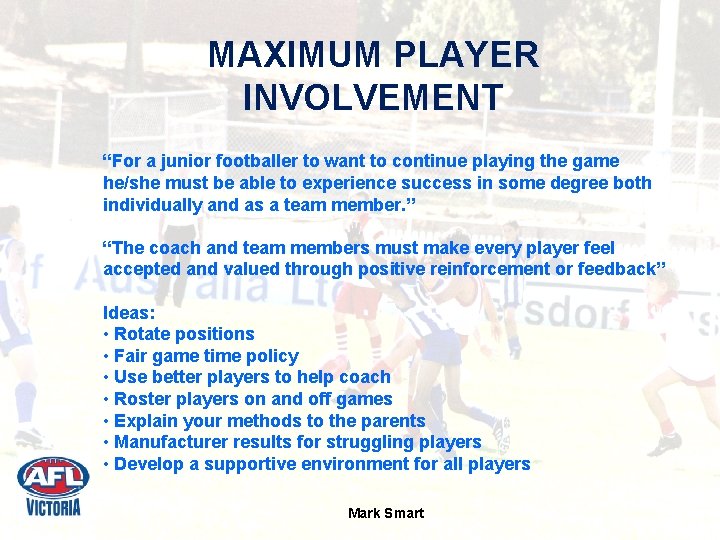
MAXIMUM PLAYER INVOLVEMENT “For a junior footballer to want to continue playing the game he/she must be able to experience success in some degree both individually and as a team member. ” “The coach and team members must make every player feel accepted and valued through positive reinforcement or feedback” Ideas: • Rotate positions • Fair game time policy • Use better players to help coach • Roster players on and off games • Explain your methods to the parents • Manufacturer results for struggling players • Develop a supportive environment for all players Mark Smart
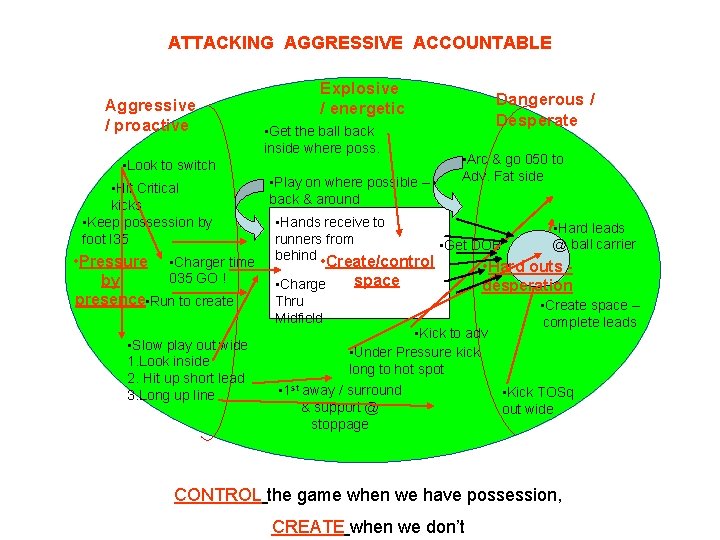
ATTACKING AGGRESSIVE ACCOUNTABLE Aggressive / proactive Explosive / energetic • Get the ball back inside where poss. • Look to switch • Hit Critical kicks • Keep possession by foot I 35 • Pressure • Charger time 035 GO ! by presence • Run to create • Slow play out wide 1. Look inside 2. Hit up short lead 3. Long up line • Play on where possible – back & around Dangerous / Desperate • Arc & go 050 to Adv. Fat side • Hands receive to runners from • Get DOB behind • Create/control • Charge Thru Midfield space • Hard leads @ ball carrier • Hard outs desperation • Create space – complete leads • Kick to adv • Under Pressure kick long to hot spot • 1 st away / surround • Kick TOSq & support @ out wide stoppage CONTROL the game when we have possession, CREATE when we don’t
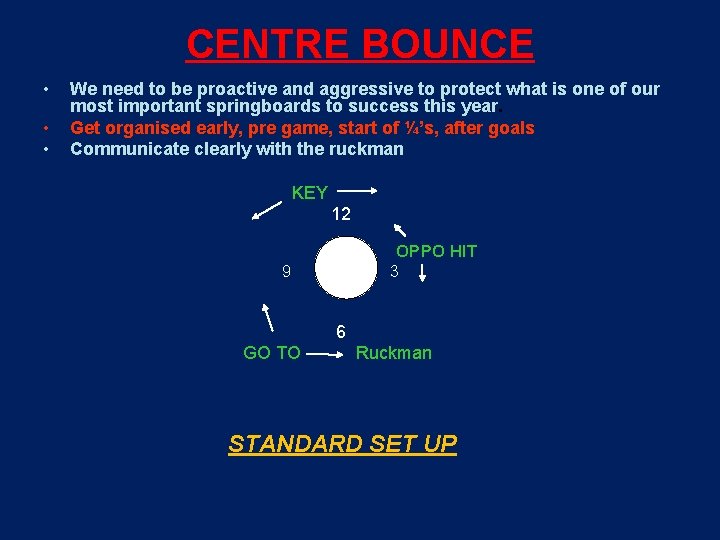
CENTRE BOUNCE • • • We need to be proactive and aggressive to protect what is one of our most important springboards to success this year. Get organised early, pre game, start of ¼’s, after goals Communicate clearly with the ruckman KEY 12 OPPO HIT 3 9 6 GO TO Ruckman STANDARD SET UP
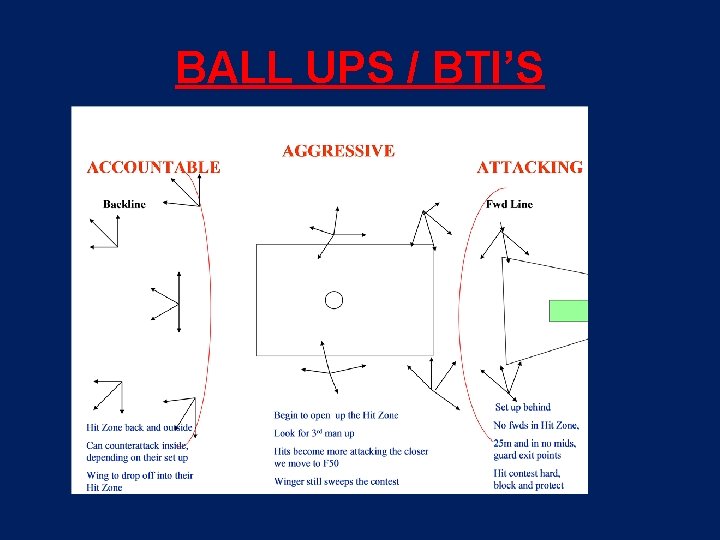
BALL UPS / BTI’S
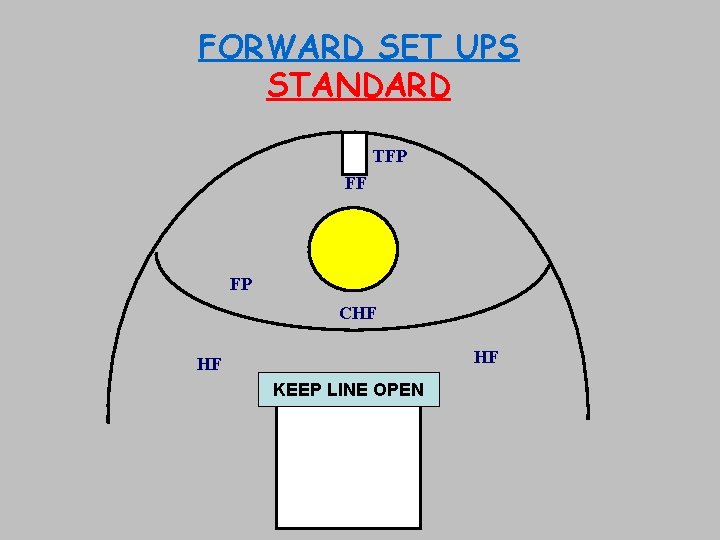
FORWARD SET UPS STANDARD TFP FF FP CHF HF HF KEEP LINE OPEN
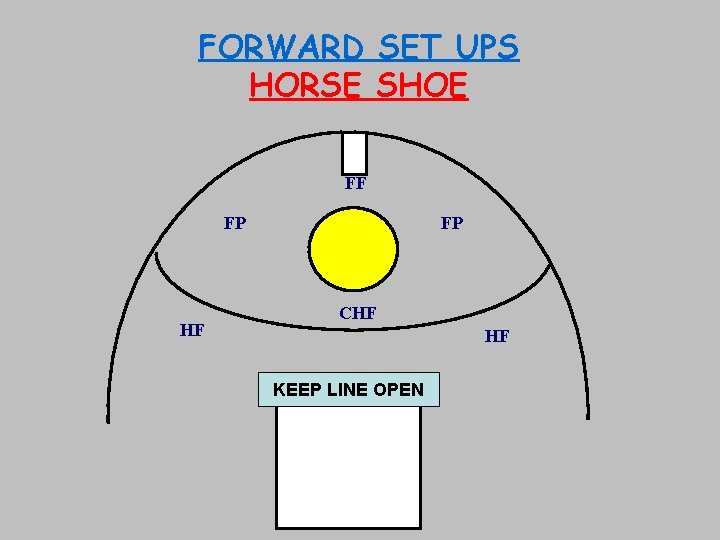
FORWARD SET UPS HORSE SHOE FF FP HF FP CHF HF KEEP LINE OPEN
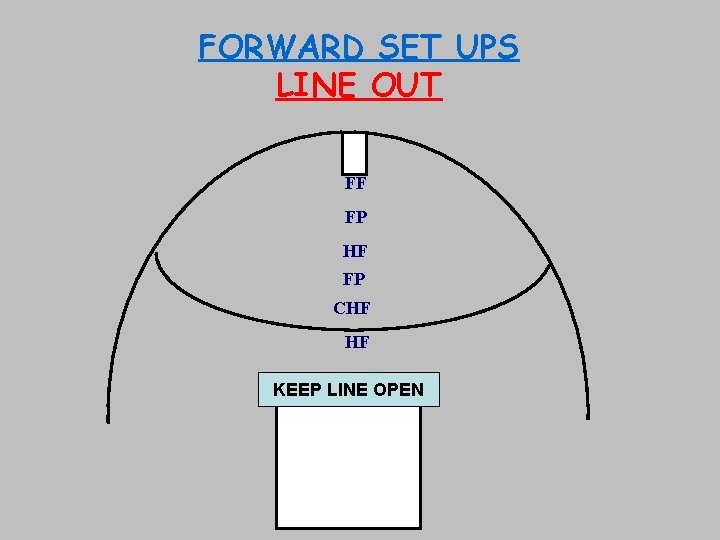
FORWARD SET UPS LINE OUT FF FP HF FP CHF HF KEEP LINE OPEN
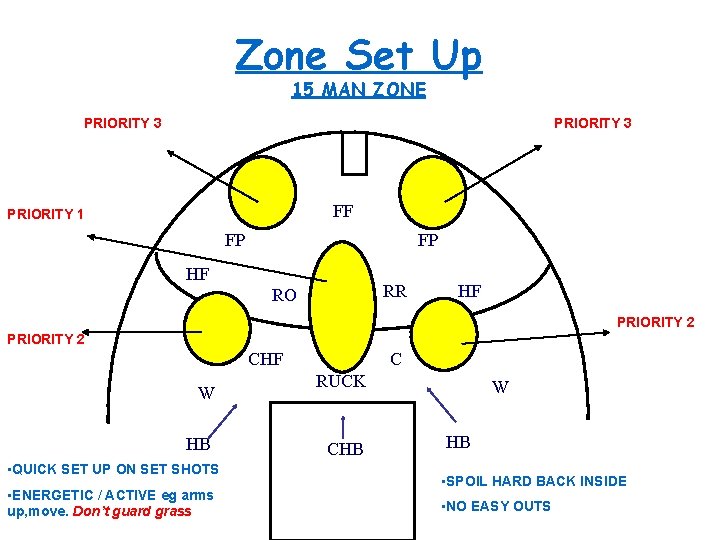
Zone Set Up 15 MAN ZONE PRIORITY 3 FF PRIORITY 1 FP FP HF RR RO HF PRIORITY 2 CHF W HB • QUICK SET UP ON SET SHOTS • ENERGETIC / ACTIVE eg arms up, move. Don’t guard grass C RUCK CHB W HB • SPOIL HARD BACK INSIDE • NO EASY OUTS
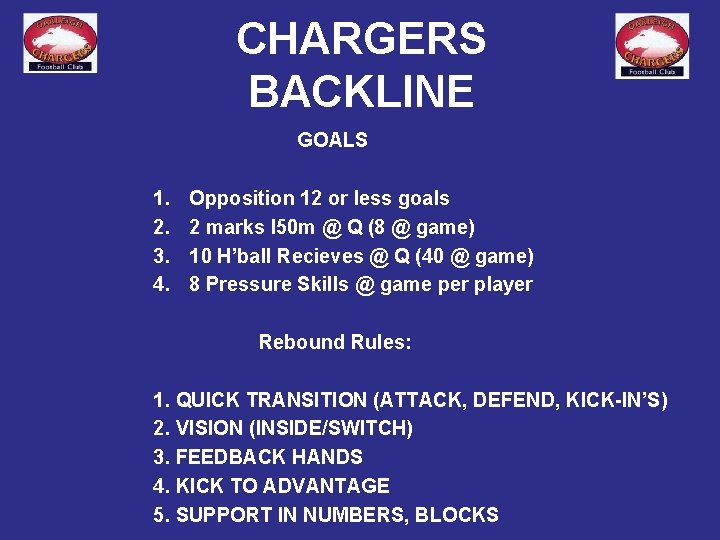
CHARGERS BACKLINE GOALS 1. 2. 3. 4. Opposition 12 or less goals 2 marks I 50 m @ Q (8 @ game) 10 H’ball Recieves @ Q (40 @ game) 8 Pressure Skills @ game per player Rebound Rules: 1. QUICK TRANSITION (ATTACK, DEFEND, KICK-IN’S) 2. VISION (INSIDE/SWITCH) 3. FEEDBACK HANDS 4. KICK TO ADVANTAGE 5. SUPPORT IN NUMBERS, BLOCKS
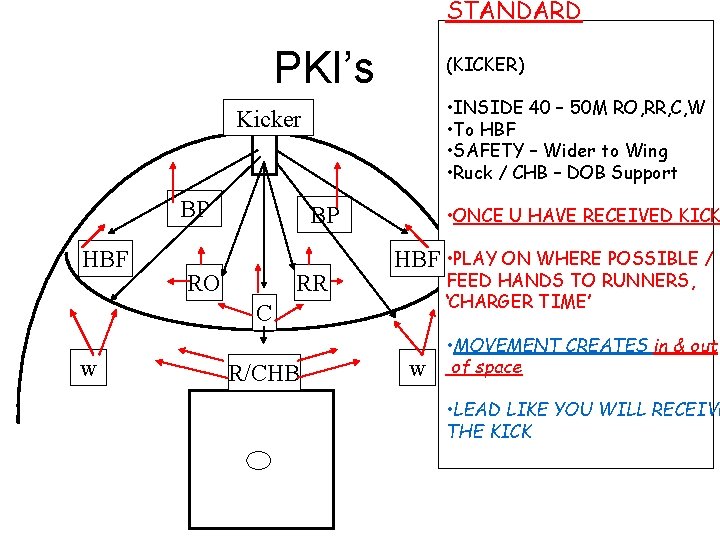
STANDARD PKI’s (KICKER) • INSIDE 40 – 50 M RO, RR, C, W • To HBF • SAFETY – Wider to Wing • Ruck / CHB – DOB Support Kicker BP HBF • ONCE U HAVE RECEIVED KICK BP RO RR HBF • PLAY ON WHERE POSSIBLE / FEED HANDS TO RUNNERS, ‘CHARGER TIME’ C w R/CHB w • MOVEMENT CREATES in & out of space • LEAD LIKE YOU WILL RECEIVE THE KICK
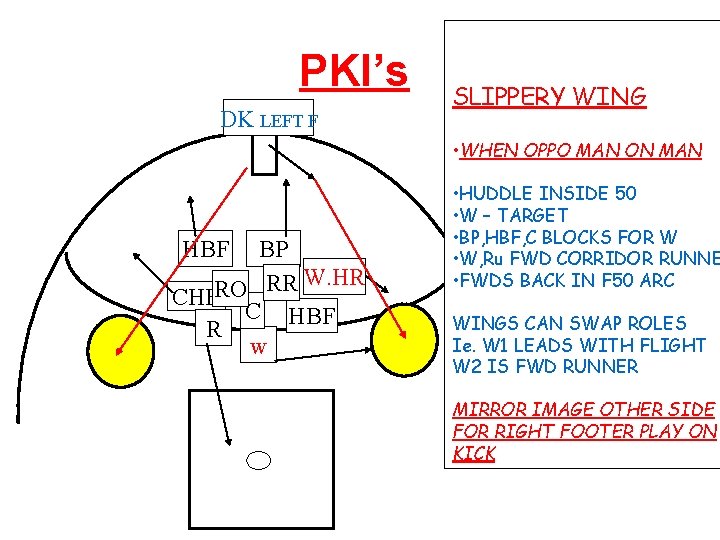
PKI’s DK LEFT F SLIPPERY WING • WHEN OPPO MAN ON MAN HBF BP RR W. HR RO CHB C HBF R w • HUDDLE INSIDE 50 • W – TARGET • BP, HBF, C BLOCKS FOR W • W, Ru FWD CORRIDOR RUNNE • FWDS BACK IN F 50 ARC WINGS CAN SWAP ROLES Ie. W 1 LEADS WITH FLIGHT W 2 IS FWD RUNNER MIRROR IMAGE OTHER SIDE FOR RIGHT FOOTER PLAY ON KICK
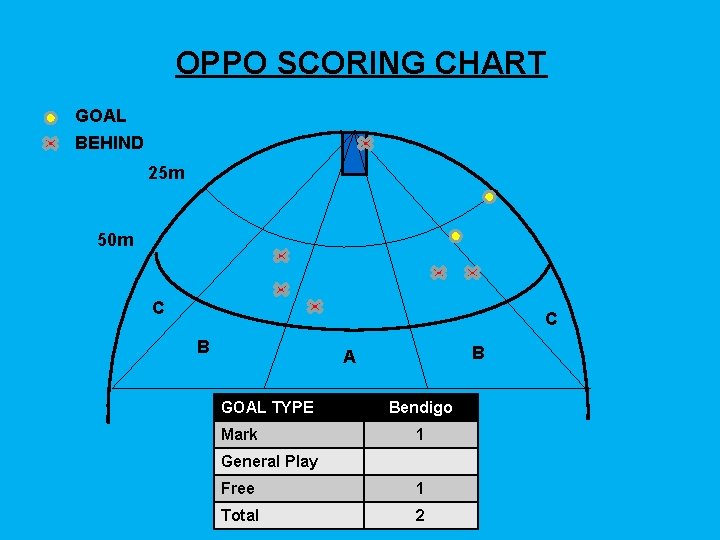
OPPO SCORING CHART GOAL BEHIND 25 m 50 m C C B B A GOAL TYPE Mark Bendigo 1 General Play Free 1 Total 2
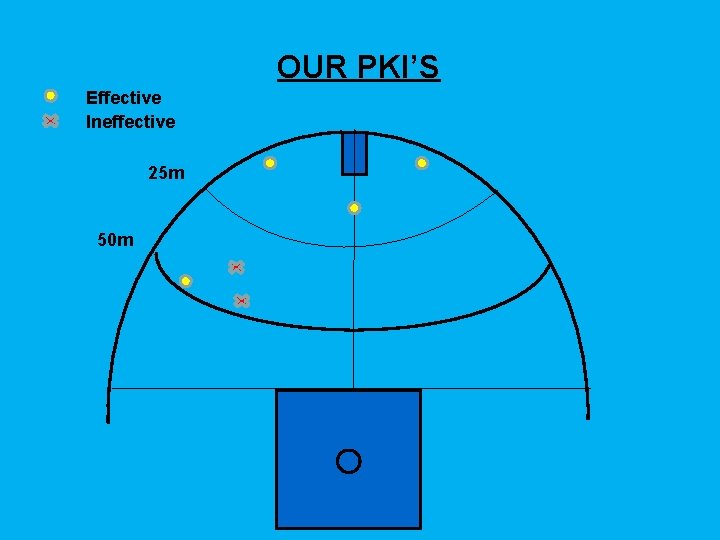
OUR PKI’S Effective Ineffective 25 m 50 m
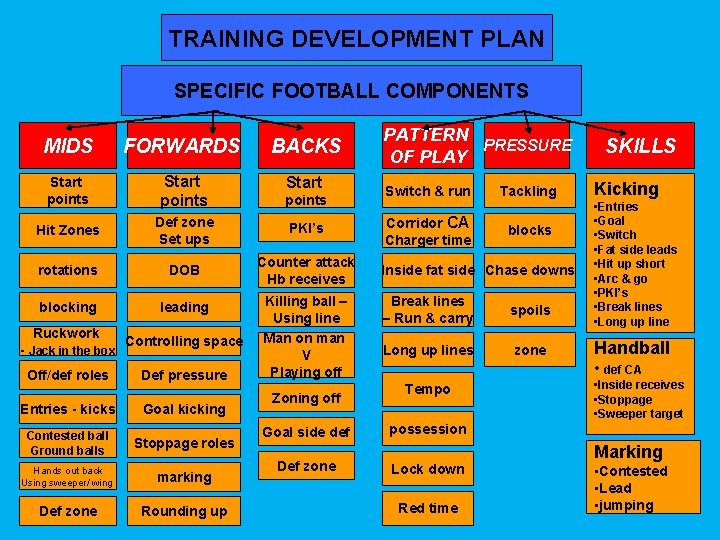
TRAINING DEVELOPMENT PLAN SPECIFIC FOOTBALL COMPONENTS MIDS FORWARDS BACKS Start points Start Hit Zones Def zone Set ups PKI’s rotations DOB Counter attack Hb receives blocking leading Ruckwork - Jack in the box Off/def roles Entries - kicks Contested ball Ground balls Controlling space Def pressure Goal kicking Stoppage roles Hands out back Using sweeper/ wing marking Def zone Rounding up points Killing ball – Using line Man on man V Playing off Zoning off Goal side def Def zone PATTERN PRESSURE OF PLAY Switch & run Corridor CA Charger time Tackling blocks Inside fat side Chase downs Break lines – Run & carry spoils Long up lines zone SKILLS Kicking • Entries • Goal • Switch • Fat side leads • Hit up short • Arc & go • PKI’s • Break lines • Long up line Handball • def CA Tempo • Inside receives • Stoppage • Sweeper target possession Lock down Red time Marking • Contested • Lead • jumping
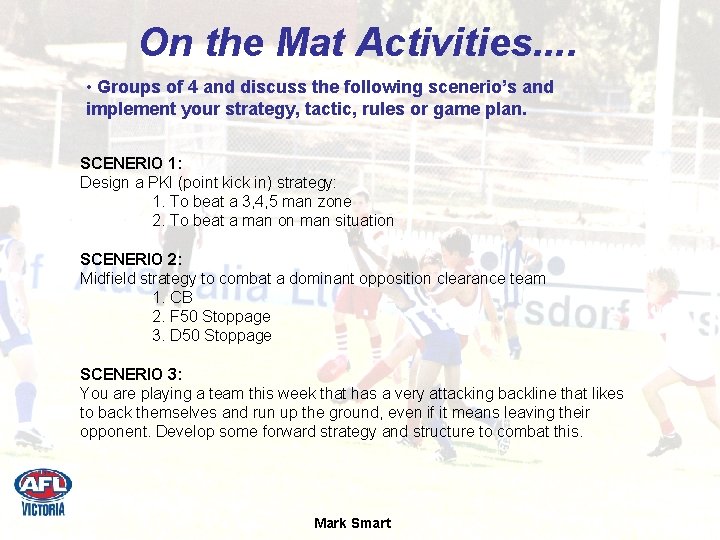
On the Mat Activities. . • Groups of 4 and discuss the following scenerio’s and implement your strategy, tactic, rules or game plan. SCENERIO 1: Design a PKI (point kick in) strategy: 1. To beat a 3, 4, 5 man zone 2. To beat a man on man situation SCENERIO 2: Midfield strategy to combat a dominant opposition clearance team 1. CB 2. F 50 Stoppage 3. D 50 Stoppage SCENERIO 3: You are playing a team this week that has a very attacking backline that likes to back themselves and run up the ground, even if it means leaving their opponent. Develop some forward strategy and structure to combat this. Mark Smart
Questions ? ? Mark Smart