
TEAM BUILDING BLOCKS TRAINING 2020 IN HALL TIME
TEAM BUILDING BLOCKS TRAINING 2020 IN HALL TIME
To develop a foundation for our team PURPOSE AND GOAL OF ACTIVITY To reflect on and apply our results from the selfawareness pre-training module to team dynamics To gain insight about other members on the team
SETTING GROUND RULES WHAT IS YOUR DEFINITION OF GROUND RULES?
OUR TEAM’S GROUND RULES • Consider the following in the creation of our ground rules: – Think about the best group discussions you have been a part of, and reflect on what made these discussions so satisfying. – Next, think about the worst group discussions in which you have participated and reflect on what made these discussions so unsatisfactory. – For each of the positive characteristics identified, suggest three things the group could do to ensure that these characteristics are present. – For each of the negative characteristics identified, suggest three things the group could do to ensure that these characteristics are not present.
TURMAN – HAMILTON GROUND RULES • • • Having one person speak at a time Make sure that everyone says at least one thing (People have the ability to step up or step down) People can set their own boundaries when approaching conversations Making a judgement-free zone, not talking bad about other's ideas or opinions Listening to listen, rather than to respond Having a discussion-facilitator Making sure that you are present and engaged (body language) Have peaceful resolution Maintaining a sense of self-awareness and how you might be affecting those around you – Listen to how loud you are talking

TEAM BUILDING BLOCKS
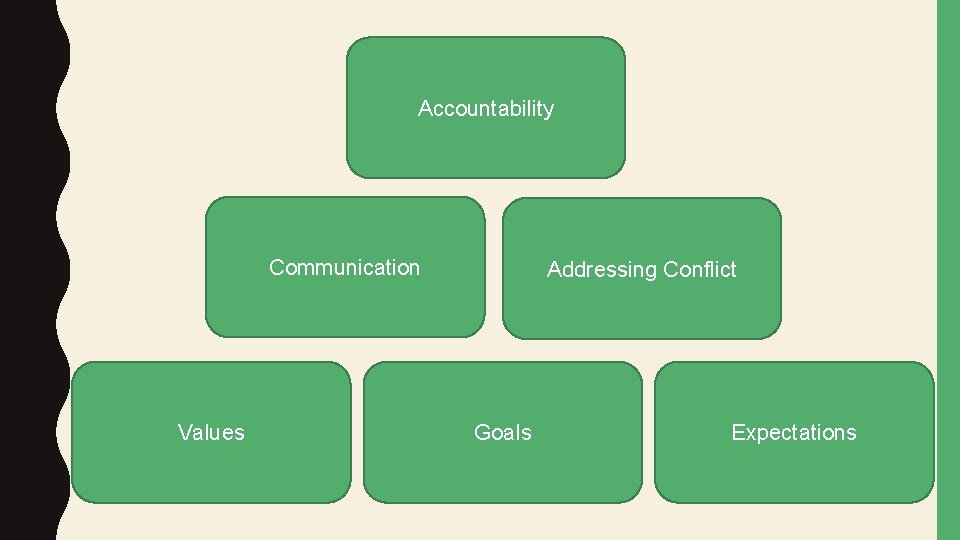
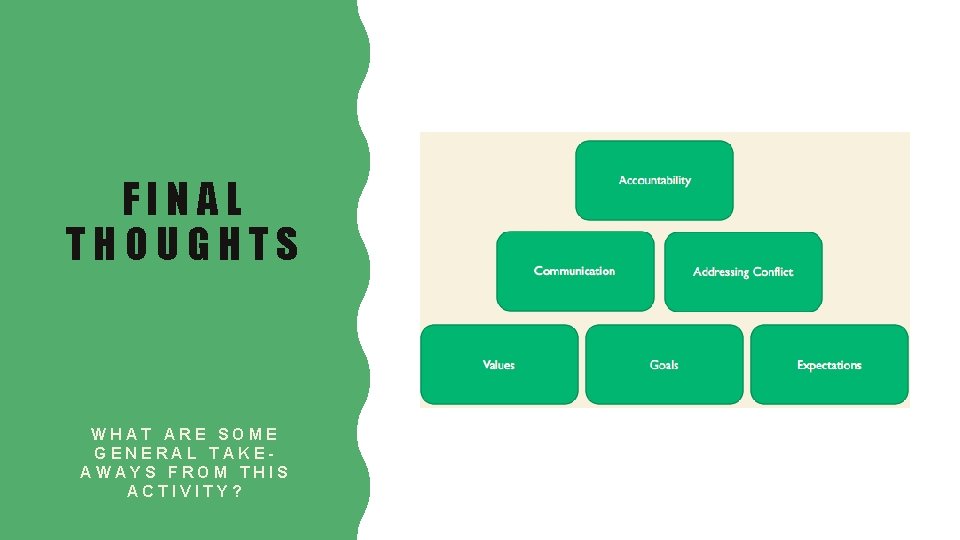
Accountability Communication Values Addressing Conflict Goals Expectations
GUIDING QUESTIONS: VALUES • Thinking about your 16 Personalities Assessment & our talk yesterday, what values guide you in your daily life and work? • Compare your initial answers with others in your small group. – In what ways are your values different or similar than others in this same role layer? • What do your values look like in action?
TURMAN – HAMILTON VALUES • Kindness • Courtesy • Authenticity • Fostering environment • Patience + empathy • Open-mindedness + Flexibility • Intentionality • Connectedness • Being passionate (remembering your why • Vulnerability • Honesty
GUIDING QUESTIONS: GOALS • Thinking about your Big 5 assessment, what are some initial goals that you have for yourself and team? – How is this similar or different than others in your small group? • What do you want to accomplish by the end of the semester? • What do you want to accomplish by the end of the academic year? • How will we know if we have accomplished our goals?
TURMAN – HAMILTON GOALS • Make it through without losing sight of what's important (make it through!) – Feel fulfilled, feel like you did something • • • Believe in yourself <3 Do as many in-person programs that could be allowed Make sure residents feel that they have a community by end of year Make sure residents are involved in other aspects Empower residents to set their own wellness goals Keep a positive mindset Becoming more self-driven Setting boundaries Reminding yourself why you're in the position To have residents rely on their staff if needed • Progress check: 1: 1, boundaries --> get enough sleep!, upkeep of self-care
GUIDING QUESTIONS: EXPECTATIONS • Thinking about your Four Tendencies Assessment, what did you learn about yourself and how you tend to respond to expectations? • What kind of expectations do you want to set for this year? – Team oriented expectations? Individualized expectations? – How is this similar or different than others in your small group? • What do expectations look like for your specific tendency?
TURMAN – HAMILTON EXPECTATIONS • Rebels: try not to set too many expectations, take things as they come, go with the flow, needs a connection to identity, don't set premature expectations (being uncertain of what we can deliver), don't give people expectations, doing lots of new things, EMPOWERMENT!! AFFIRM US!!! • Obligers: self-care <3, follow-up with staff and residents, accountability, being approachable • Questioners: will give push back, give logical reasoning, decides what's worth their time, need space to be allowed to ask questions, timeliness • Upholders: make expectations for staff and personal, meet expectations and job requirements, will get things done! • Everybody: clear communication, responsiveness, beautiful bulletin boards, community compact, checking-in with residents, motivate each other, transparency, being empathetic
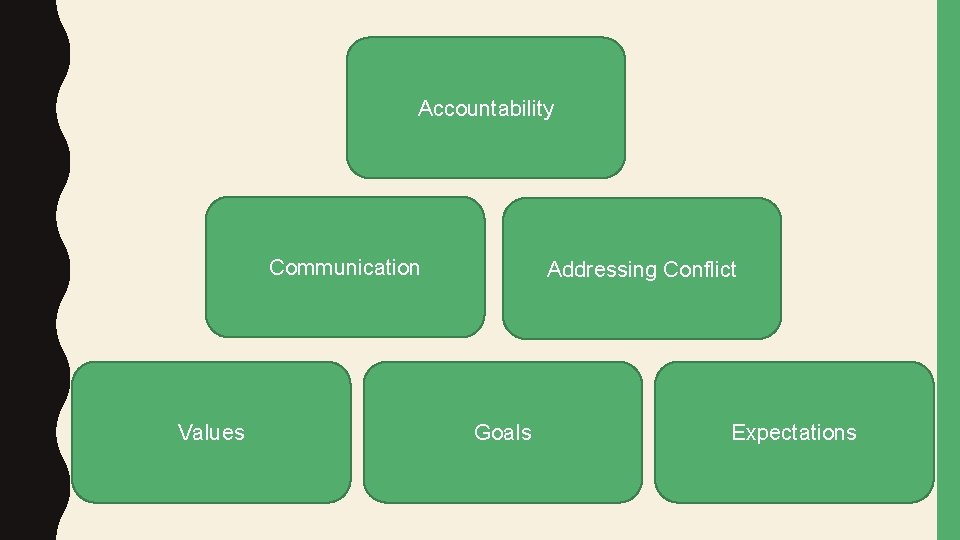
Accountability Communication Values Addressing Conflict Goals Expectations
GUIDING QUESTIONS: COMMUNICATION • Thinking about your Big 5 assessment, specifically the Openness score, what are some ways you like to communicate? • What does communication mean to you? – Is this similar or different than other people in your small group? • What do you need from others when communicating?
TURMAN – HAMILTON COMMUNICATION • Honesty and transparency • Compassion + empathy • Having space and time to express ideas • Equally opportunity for each party to communicate • Be productive with time, efficiency in communication • Making time to speak and making time to THINK before you respond • Listening to listen • Overcommunication is key (constant flow is great, keep it up Nichole!!) • Remaining accessible to your residents and staff – Check your groupme!
GUIDING QUESTIONS: ADDRESSING CONFLICT • Thinking about your preferred Conflict Management Style, what are some advantages and disadvantages to the manner in which you prefer to manage conflict? • Reflecting on that, what are some ways your conflict management style deals with conflict? • How do you think a conflict on staff should be handled?
TURMAN - HAMILTON ADDRESSING CONFLICT • Owls: making decisions based off what everyone believes, talking to all parties to understand where everyone is coming from; Cons: not everything is ideal, difficult at compromising, may take longer to come up with solutions • Teddy Bears: trying to acknowledge everyone's opinion, assume good until proven otherwise, end on a high note Cons: unawareness of bad intentions, doesn’t lead to solid resolution • Foxes: efficiency, meeting in the middle, get things done; cons: ruffles feathers, some people may be unhappy • Turtles: avoidance, put issue away for a while, easier to resolve through 3 rd party, overcome avoidance to get to efficient solution • Sharks? : Driven, motivated, not great for conflict resolution (my way or the highway), need to give, good at being a voice and advocate • Goals: 1) 48 hour rule, if you have a problem say it or let it go, 2) follow-up, 3) being direct, say it to each other rather than bringing in others, 4) privacy, share only with who needs to know, 5) assuming good intent, giving the benefit of the doubt
GUIDING QUESTIONS: ACCOUNTABILITY • Reflecting on your 16 Personalities Assessment, what does accountability mean to you and others in your small group? – Are there any similarities or differences arising in this conversation? • How do we hold staff members accountable throughout the year? – How could this differ based upon a person’s personality type? • What, if anything, is needed to assist each other in holding one another accountable?
TURMAN - HAMILTON ACCOUNTABILITY • Getting what needs to be done, done • Understanding the full scope of your job and making sure you keep up with responsibilities • Not being afraid to follow up after asking someone to do something • Maintaining Res. Life policies and community compact along with your staff • Make promises that you intend to keep • Check in with your staff (e. g. how are 1: 1's? ); reaching out and being proactive! • Having 1: 1 s with your floorstaff! (e. g. SA dates? RA/CC dates? ) • Staff development! (e. g. writing letters to yourself) • Group. Me's unmuted to maintain communication! (it will make everything easier, we promise <3) • Taking care of ourselves and setting time for self-care • Day-to-day goals! • <3
FINAL THOUGHTS WHAT ARE SOME GENERAL TAKEAWAYS FROM THIS ACTIVITY?
- Slides: 21