
Team Assignment OMGT 320 Managing Group Dynamics Gary

- Slides: 25
Team Assignment OMGT 320 Managing Group Dynamics Gary L. Brewer June 19, 2011 Team C Hernandez Daniel Olson Richardson
Types of Teams and Critical Considerations for Self Directed Work Teams
Types of Teams �Two main types of teams �Parallel teams �Self-directed work teams (self-managing teams)
Parallel Teams �Normally created for problem solving efforts �Do not control resources �Examples: �Functional, task force, specialized work groups, and project teams
Parallel Teams �Limitations of parallel teams: �Individual rewards over team reward �Management’s fear of teams holding power �Segmentalism (NIH syndrome) – teams don’t work with other teams in organization
Self-Directed Work Teams �Have control of resources �Can affect change �Responsibility lies with team
Self-Directed Work Teams �Benefits: �Team reward system over individual �Responsibility at team level vs. a manager �Reduced segmentalism �Harris and Sherblom (2011) cite seven benefits and costs of SDWTs: improvement in work methods and procedures, improved employee retention, staffing flexibility, increased quality, improved output, better decision making, reduced need for supervision and staff support. (pg. 137)
Self-Directed Work Teams �Hurdles to self-directed team implementation �Increased training �Lofty expectations by management �Limit testing �Conflict between includedexcluded employees �Increased time to make decisions �Corporate culture that does not understand selfdirected work teams
Maximizing the Creativity of a Team
Four types of techniques �Idea needlers �Manipulative verbs �Utilizing metaphors �Positive climate
Idea Needlers �Asking questions in ways that inspire ideas �Who else can do it? �Why it must be done that way? �What else can be done?
Use of Manipulative Verbs �Examples of manipulative verbs �Magnify �Alter �Soften �Thicken �Stretch �Invert
Utilizing Metaphors �Metaphors for a better understanding �The heart and a pump �Fast as lightning �Slow as a turtle
Positive Climate �The climate of the group �Openness �Sharing Information, Resources, Responsibilities, and Ownership �Demonstrating Empathy �Empowering Others �Asking for Input �Creation of Environment by Group leader � Positive, Open, Cohesiveness
Benefits and Challenges Presented by Team Member Diversity
What is diversity? �Includes gender �Race �Ethnic heritage �Differences in social and economic class �Access to education �Physical attractiveness and ability �Sexual orientation
Benefits of Diversity �Diverse team membership results in a wider range of approaches being used. �Diverse teams have a wider range of skills, abilities and experiences
Challenges of Diversity �Reduced understanding of the goals and processes �Similarities increase group cohesion; diversity does the opposite. �Misunderstanding the non-verbal communication
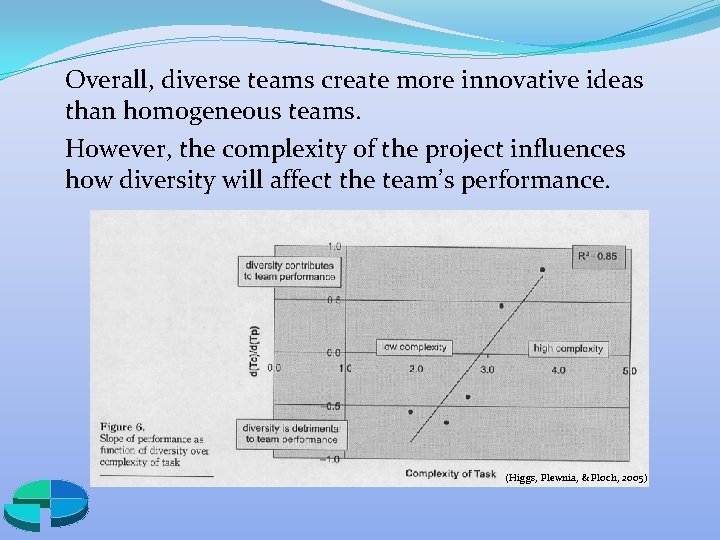
Overall, diverse teams create more innovative ideas than homogeneous teams. However, the complexity of the project influences how diversity will affect the team’s performance. (Higgs, Plewnia, & Ploch, 2005)
How Leadership Style Can Impact Team Effectiveness
Leadership Styles �Leader-as-Technician �Leader-as-Conductor �Leader-as-Coach
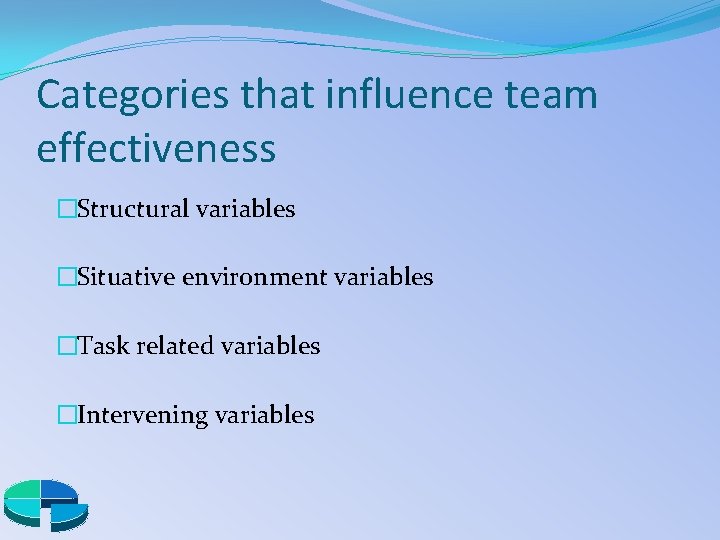
Categories that influence team effectiveness �Structural variables �Situative environment variables �Task related variables �Intervening variables
Team Experience �Ryan Hernandez: �Selected as team leader during the compilation of the team’s first assignment. Ryan exhibited an ability to bring the team’s ideas together, combining each member’s ideas and input to create a project with uniformity in writing style and voice. �John Olson: �John was the driving force behind the efforts to complete the initial assignment. Without his stepping forward to perform much of the leg-work of getting the assignment put together, the end product would not have been as cohesive.
Team Experience (cont…) �Richardson: �Richard turned out to be the one of the team’s initiators. Richard stayed on top of the due dates, posting questions to ensure the group was aware of the coming dead-lines and ensured our team met its obligations. �Samuel Daniel: �Samuel also initiated much of the team’s activities. Samuel was the first of the group to post each of the requirements providing a baseline template for the rest of the team to follow.
References � Harris, T. E. & Sherblom, J. C. (2010). Small Group and Team Communication, 5 th edition. Boston, Ma. Allyn and Bacon. � Higgs, M. , Plewnia, U. , & Ploch, J. (2005). Influence of team composition and task complexity on team performance. Team Performance Management, 11(7), 227 -250. Retrieved from http: //ezproxy. sckans. edu/login? url=http: //search. proquest. com/docview/2171 07639? accountid=13979 � Liu, W. , & Farris, J. A. (2010). Developing a comprehensive model of project team Performance: Results from a systematic literature review. IIE Annual Conference. Proceedings, , 1 -8. Retrieved from http: //ezproxy. sckans. edu/login? url=http: //search. proquest. com/docview/733 014298? accountid=13979