
TEAM A 3 PRESENTS Copyright PERFORMANCE APPRAISAL FEATURING



- Slides: 15
TEAM A 3
PRESENTS: ©Copyright
PERFORMANCE APPRAISAL FEATURING: JUAN CARLOS OTALORA SUPRATEEK ROY
AGENDA: • DEFINITION • POSITIVE & NEGATIVE ASPECTS Ø BEHAVIOURS Ø MOTIVATION Ø TEAMWORK • TEAM SUGGESTIONS (PA) • CONCLUSIONS
DEFINITION: • Part of Performance management. • Method of performance evaluation. • Is an analysis of employees successes and Failures. • Comparison between goals and Achievements. • Systematic Review of a person work on A determined period of time.
KEY ASPECTS OF PA The five key elements of the performance appraisal are: Measurement Feedback Positive reinforcement Exchange of views Agreement
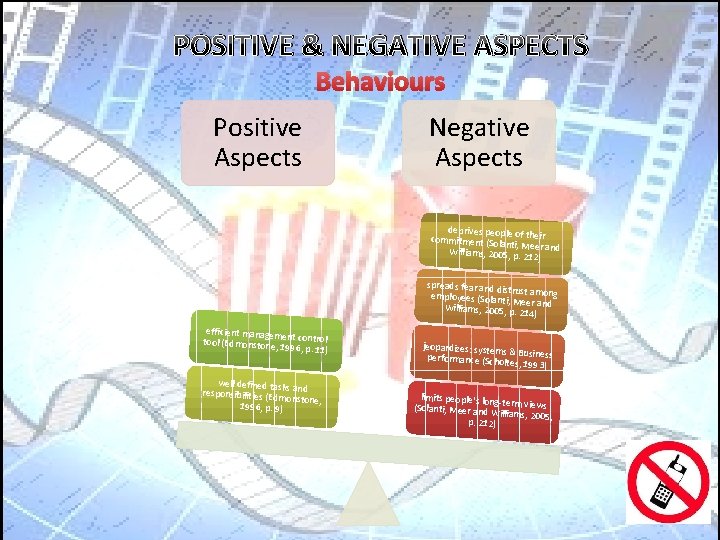
POSITIVE & NEGATIVE ASPECTS Behaviours Positive Aspects Negative Aspects deprives people commitment (Solan of their ti, Meer and Williams, 2005, p. 212) spreads fear and di stru employees (Solanti, st among Mee Williams, 2005, p. r and 214) efficient managem en tool (Edmonstone, t control 1996, p. 11) well defined task responsibilities (Edms and onstone, 1996, p. 9) jeopardizes: system s & Business performance (Sch oltes, 1993) limits people’s long (Solanti, Meer and -term views Williams, 2005, p. 212)
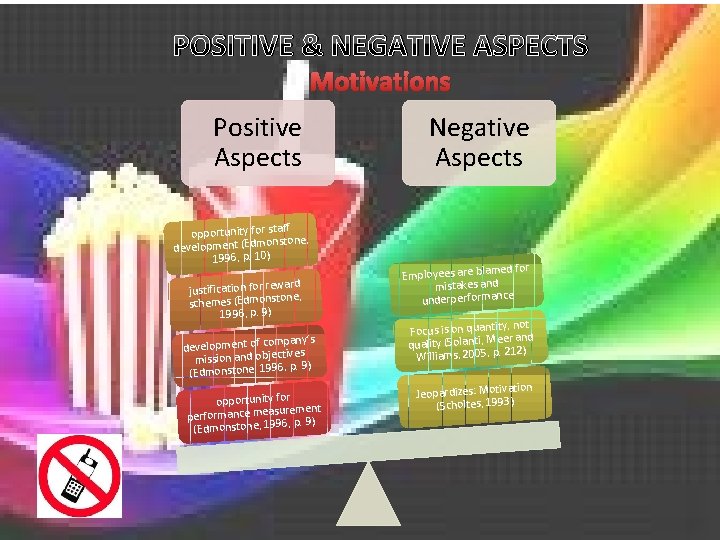
POSITIVE & NEGATIVE ASPECTS Motivations Positive Aspects aff opportunity for st onstone, development (Edm 1996, p. 10) ward justification for re e, on schemes (Edmonst 9) 1996, p. mpany’s development of co ives mission and object 9) , p. (Edmonstone, 1996 opportunity for surement performance mea , p. 9) (Edmonstone, 1996 Negative Aspects ed for Employees are blam mistakes and underperformance y, not Focus is on quantit and eer quality (Solanti, M 212) p. Williams, 2005, ation Jeopardizes: Motiv (Scholtes, 1993)
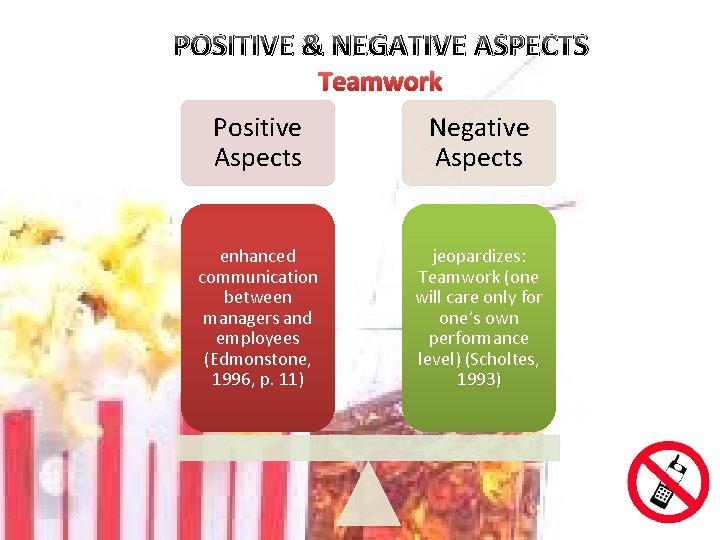
POSITIVE & NEGATIVE ASPECTS Teamwork Positive Aspects Negative Aspects enhanced communication between managers and employees (Edmonstone, 1996, p. 11) jeopardizes: Teamwork (one will care only for one’s own performance level) (Scholtes, 1993)
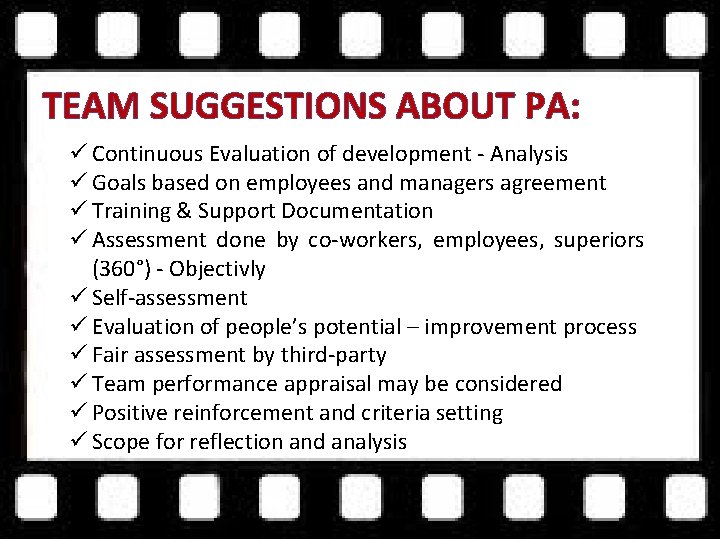
TEAM SUGGESTIONS ABOUT PA: ü Continuous Evaluation of development - Analysis ü Goals based on employees and managers agreement ü Training & Support Documentation ü Assessment done by co-workers, employees, superiors (360°) - Objectivly ü Self-assessment ü Evaluation of people’s potential – improvement process ü Fair assessment by third-party ü Team performance appraisal may be considered ü Positive reinforcement and criteria setting ü Scope for reflection and analysis
CONCLUSIONS ü Performance appraisal is present in every context ü Many advantages when the system is designed and used properly § Employees decisions and careers § Commitment and Satisfaction § Performance management ü Administrative purposes ü Between person, within person, systems maintenance and documentation ü Managing not measuring (un-measurable)
TEAM A 3 Juan Otalora Rey Awal Takkar Ting Zhao Ayham Fattoum Suprateek Roy Marcin Czajkowski Contributions Criticism Punctuality Speak Up Control
QUESTIONS? ?
References • • • Danielle S. Wiese and M. Ronald Buckley (1998). The evolution of the performance appraisal process. Journal of Management History, 4 (3), pp. 233 -249. © MCB University Press. Deborah F. Boice and Brian H. Kleiner (1997). Designing effective performance appraisal systems. Work Study, 46 (6), pp. 197– 201, MCB University Press. Edmonstone, J. (1996). Appraising the state of performance appraisal. Health Manpower Management, 22, 6, 9 -13. FLETCHER CLIVE. (1985). Performance appraisal for career development. [S. l. ], Pub By Bu. Halachmi, A. (2005). Performance measurement is only one way of managing performance. International Journal of Productivity and Performance Management, 54, 7, 502 -516. HEATH, G. (1989). Staff development, supervision and performance appraisal. Harlow, Longman. http: //www. cipd. co. uk (The Chartered Institute of Personnel and Development) http: //www 2. warwick. ac. uk/fac/sci/wmg/ftmsc/modules/modulelist/le/sessions/ (Module Notes) Scholtes, P. R. (1993). ‘Total quality or performance appraisal: choose one’, National Productivity Review, 12(3), pp. 349– 363. Solanti, E. , & Meer, R. , & Williams, T. (2005). A Contrast of HMR and TQM Approaches to Performance Management: Some Evidence. British Journal of Management, 16, 211 -230. WILLIAMS, M. R. (1972). Performance appraisal in management. London, Heinemann.