
Teachings for Exercise 7 D Algebraic Methods A

Teachings for Exercise 7 D
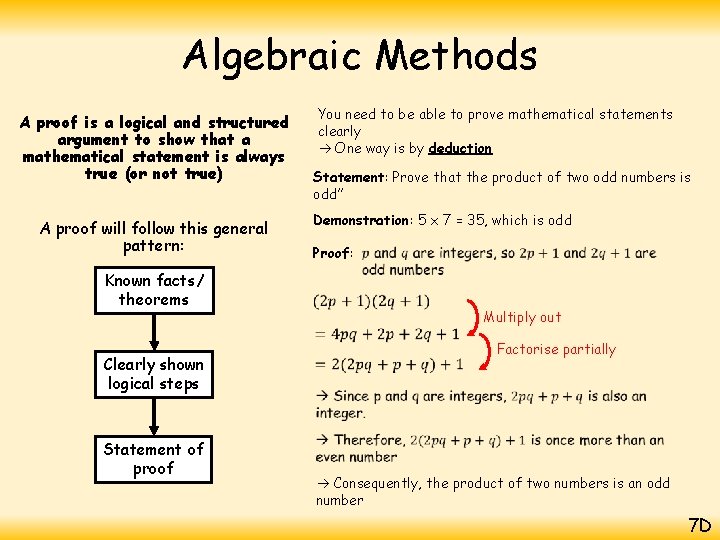
Algebraic Methods A proof is a logical and structured argument to show that a mathematical statement is always true (or not true) A proof will follow this general pattern: Known facts/ theorems Clearly shown logical steps Statement of proof You need to be able to prove mathematical statements clearly One way is by deduction Statement: Prove that the product of two odd numbers is odd” Demonstration: 5 x 7 = 35, which is odd Proof: Multiply out Factorise partially Consequently, the product of two numbers is an odd number 7 D
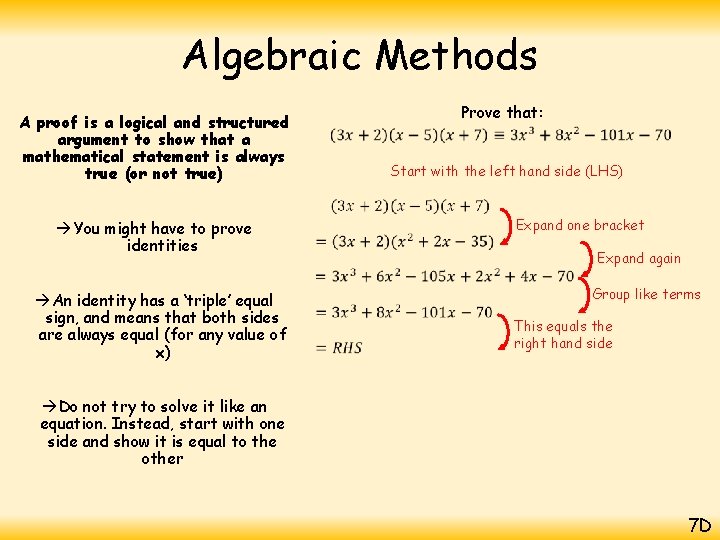
Algebraic Methods A proof is a logical and structured argument to show that a mathematical statement is always true (or not true) You might have to prove identities An identity has a ‘triple’ equal sign, and means that both sides are always equal (for any value of x) Prove that: Start with the left hand side (LHS) Expand one bracket Expand again Group like terms This equals the right hand side Do not try to solve it like an equation. Instead, start with one side and show it is equal to the other 7 D
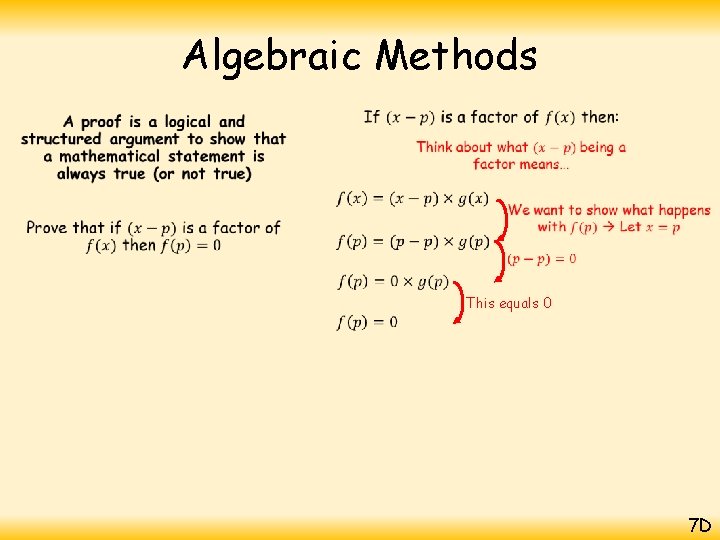
Algebraic Methods • This equals 0 7 D
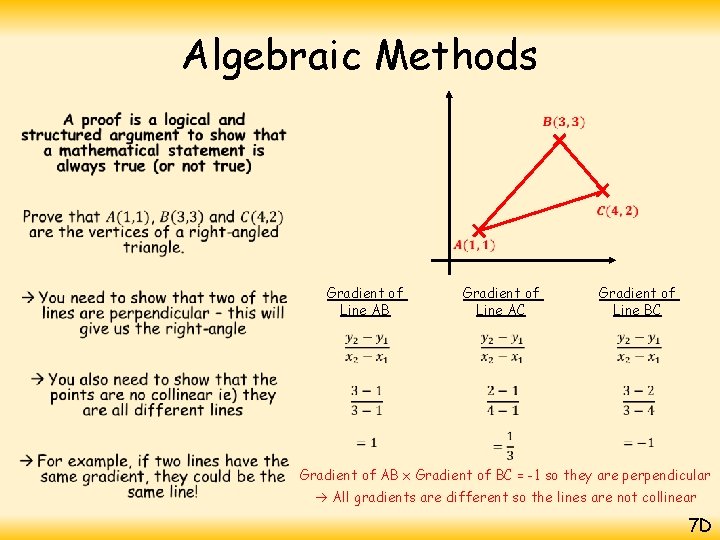
Algebraic Methods • Gradient of Line AB Gradient of Line AC Gradient of Line BC Gradient of AB x Gradient of BC = -1 so they are perpendicular All gradients are different so the lines are not collinear 7 D
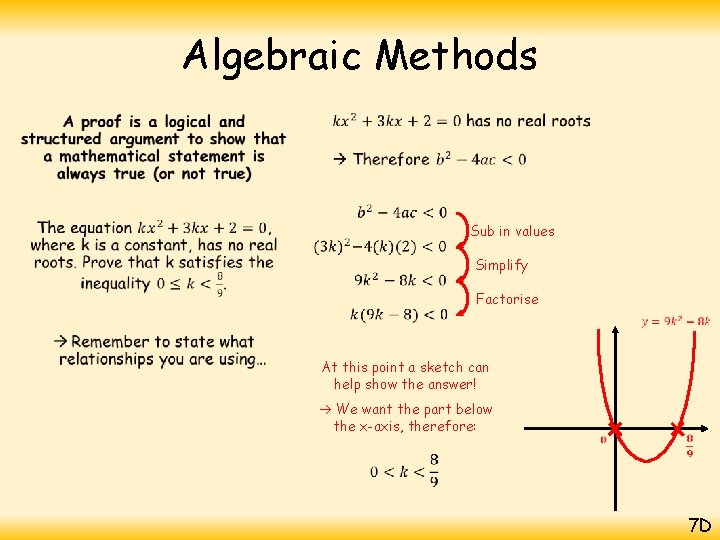
Algebraic Methods • Sub in values Simplify Factorise At this point a sketch can help show the answer! We want the part below the x-axis, therefore: 7 D
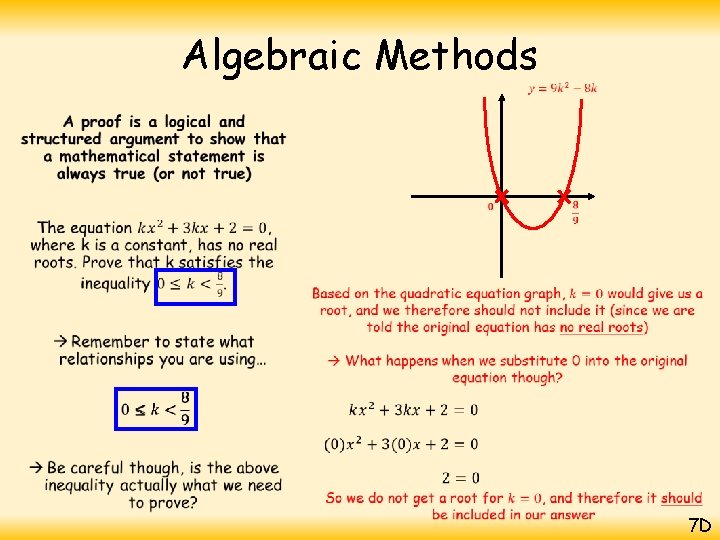
Algebraic Methods • 7 D
Teachings for Exercise 7 E
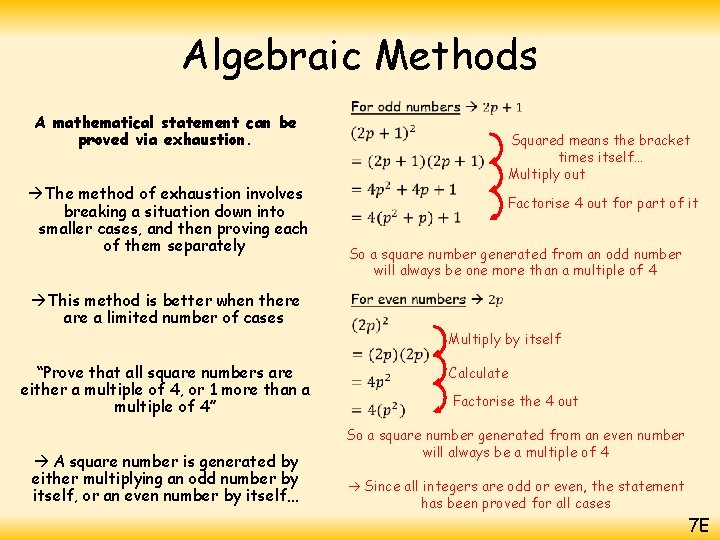
Algebraic Methods A mathematical statement can be proved via exhaustion. The method of exhaustion involves breaking a situation down into smaller cases, and then proving each of them separately Squared means the bracket times itself… Multiply out Factorise 4 out for part of it So a square number generated from an odd number will always be one more than a multiple of 4 This method is better when there a limited number of cases Multiply by itself “Prove that all square numbers are either a multiple of 4, or 1 more than a multiple of 4” A square number is generated by either multiplying an odd number by itself, or an even number by itself… Calculate Factorise the 4 out So a square number generated from an even number will always be a multiple of 4 Since all integers are odd or even, the statement has been proved for all cases 7 E
Algebraic Methods A mathematical statement can be proved via exhaustion. Prove that the following statement is not true: “The sum of two consecutive prime numbers is always even” You can prove a statement is not true by ‘counter-example’. In that case, you find a single example where the statement does not work 2 + 3 = 5 would be a counter-example here… 7 E
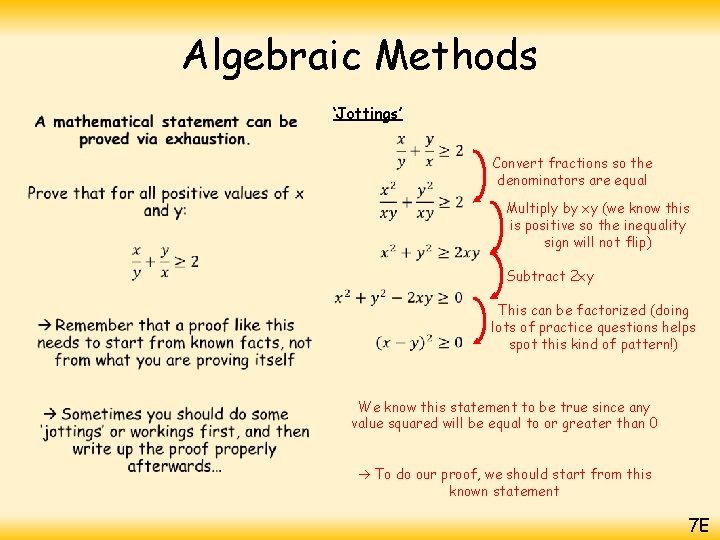
Algebraic Methods • ‘Jottings’ Convert fractions so the denominators are equal Multiply by xy (we know this is positive so the inequality sign will not flip) Subtract 2 xy This can be factorized (doing lots of practice questions helps spot this kind of pattern!) We know this statement to be true since any value squared will be equal to or greater than 0 To do our proof, we should start from this known statement 7 E
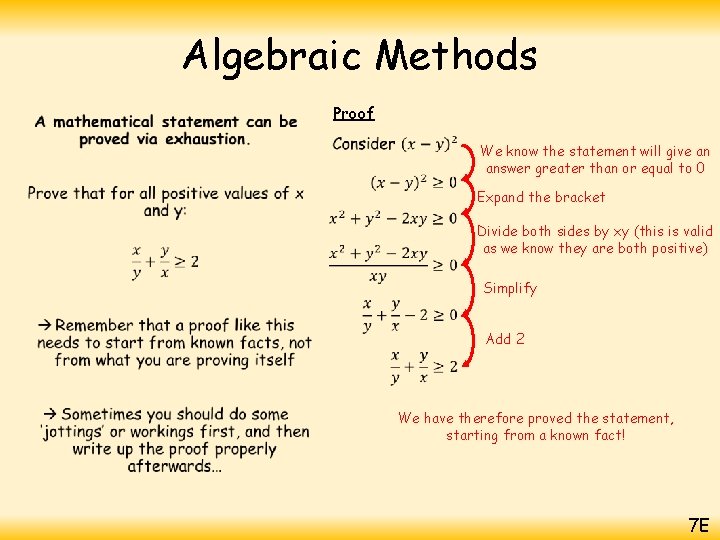
Algebraic Methods • Proof We know the statement will give an answer greater than or equal to 0 Expand the bracket Divide both sides by xy (this is valid as we know they are both positive) Simplify Add 2 We have therefore proved the statement, starting from a known fact! 7 E
- Slides: 12