
Teachings for Exercise 5 C Forces and Friction

- Slides: 10
Teachings for Exercise 5 C
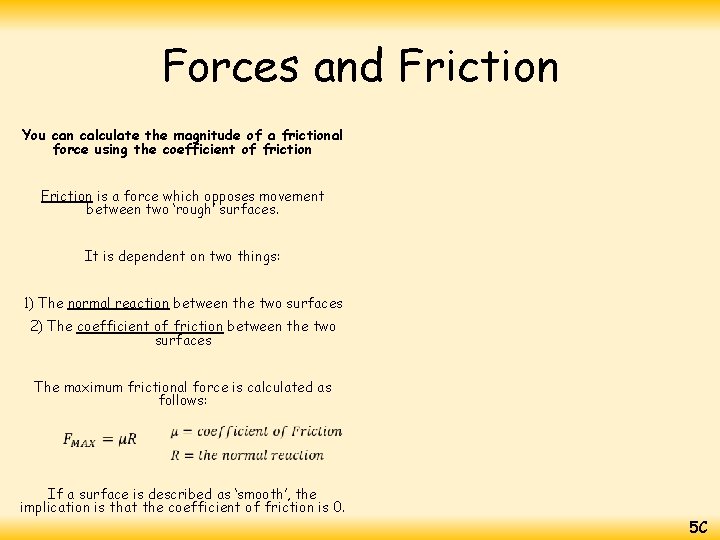
Forces and Friction You can calculate the magnitude of a frictional force using the coefficient of friction Friction is a force which opposes movement between two ‘rough’ surfaces. It is dependent on two things: 1) The normal reaction between the two surfaces 2) The coefficient of friction between the two surfaces The maximum frictional force is calculated as follows: If a surface is described as ‘smooth’, the implication is that the coefficient of friction is 0. 5 C
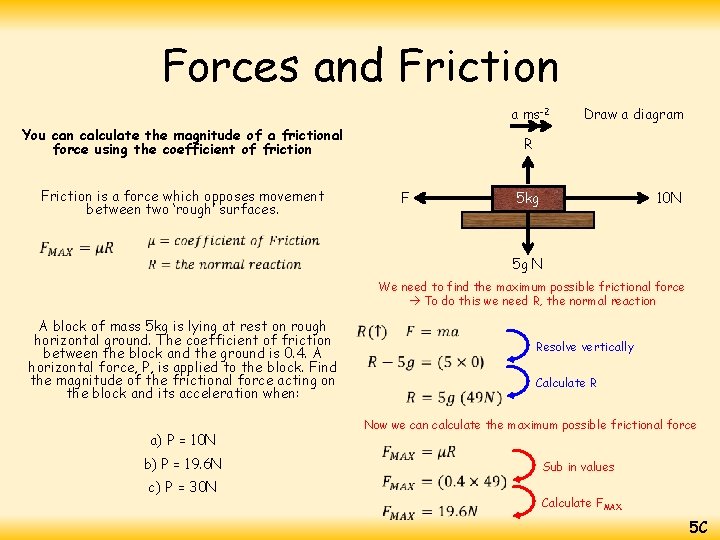
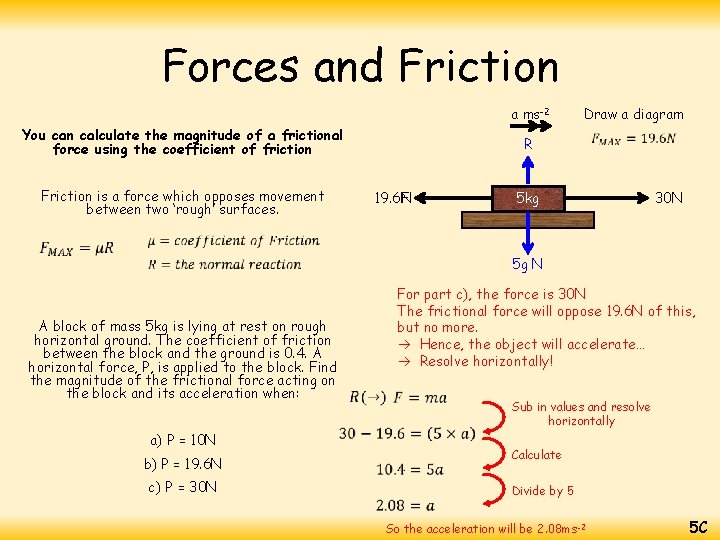
Forces and Friction a ms-2 You can calculate the magnitude of a frictional force using the coefficient of friction Friction is a force which opposes movement between two ‘rough’ surfaces. Draw a diagram R F 5 kg 10 N 5 g N We need to find the maximum possible frictional force To do this we need R, the normal reaction A block of mass 5 kg is lying at rest on rough horizontal ground. The coefficient of friction between the block and the ground is 0. 4. A horizontal force, P, is applied to the block. Find the magnitude of the frictional force acting on the block and its acceleration when: a) P = 10 N b) P = 19. 6 N c) P = 30 N Resolve vertically Calculate R Now we can calculate the maximum possible frictional force Sub in values Calculate FMAX 5 C
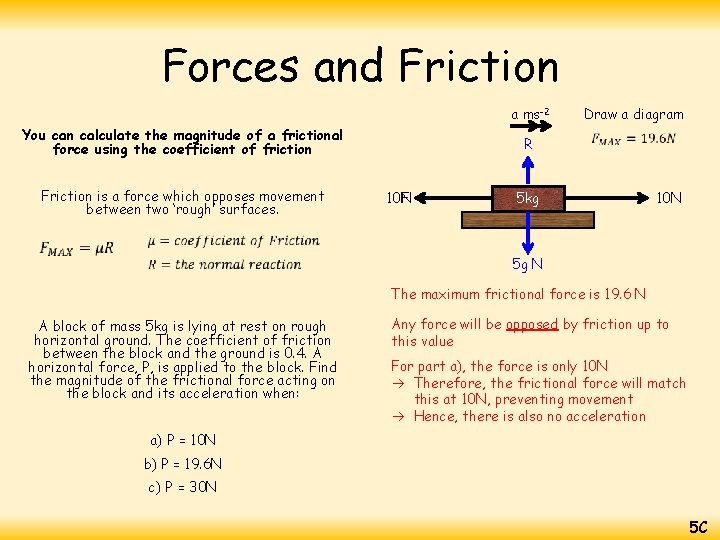
Forces and Friction a ms-2 You can calculate the magnitude of a frictional force using the coefficient of friction Friction is a force which opposes movement between two ‘rough’ surfaces. Draw a diagram R 10 N F 5 kg 10 N 5 g N The maximum frictional force is 19. 6 N A block of mass 5 kg is lying at rest on rough horizontal ground. The coefficient of friction between the block and the ground is 0. 4. A horizontal force, P, is applied to the block. Find the magnitude of the frictional force acting on the block and its acceleration when: Any force will be opposed by friction up to this value For part a), the force is only 10 N Therefore, the frictional force will match this at 10 N, preventing movement Hence, there is also no acceleration a) P = 10 N b) P = 19. 6 N c) P = 30 N 5 C
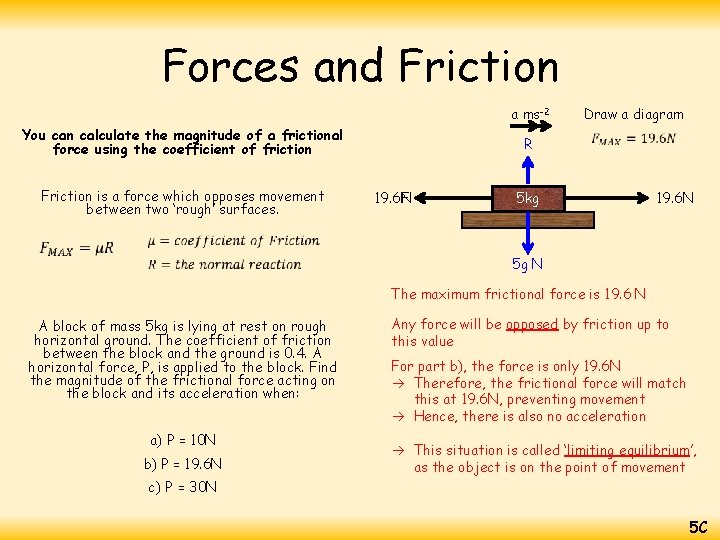
Forces and Friction a ms-2 You can calculate the magnitude of a frictional force using the coefficient of friction Friction is a force which opposes movement between two ‘rough’ surfaces. Draw a diagram R 19. 6 N F 5 kg 19. 6 N 5 g N The maximum frictional force is 19. 6 N A block of mass 5 kg is lying at rest on rough horizontal ground. The coefficient of friction between the block and the ground is 0. 4. A horizontal force, P, is applied to the block. Find the magnitude of the frictional force acting on the block and its acceleration when: a) P = 10 N b) P = 19. 6 N Any force will be opposed by friction up to this value For part b), the force is only 19. 6 N Therefore, the frictional force will match this at 19. 6 N, preventing movement Hence, there is also no acceleration This situation is called ‘limiting equilibrium’, as the object is on the point of movement c) P = 30 N 5 C
Forces and Friction a ms-2 You can calculate the magnitude of a frictional force using the coefficient of friction Friction is a force which opposes movement between two ‘rough’ surfaces. Draw a diagram R 19. 6 N F 5 kg 30 N 5 g N A block of mass 5 kg is lying at rest on rough horizontal ground. The coefficient of friction between the block and the ground is 0. 4. A horizontal force, P, is applied to the block. Find the magnitude of the frictional force acting on the block and its acceleration when: a) P = 10 N b) P = 19. 6 N c) P = 30 N For part c), the force is 30 N The frictional force will oppose 19. 6 N of this, but no more. Hence, the object will accelerate… Resolve horizontally! Sub in values and resolve horizontally Calculate Divide by 5 So the acceleration will be 2. 08 ms -2 5 C
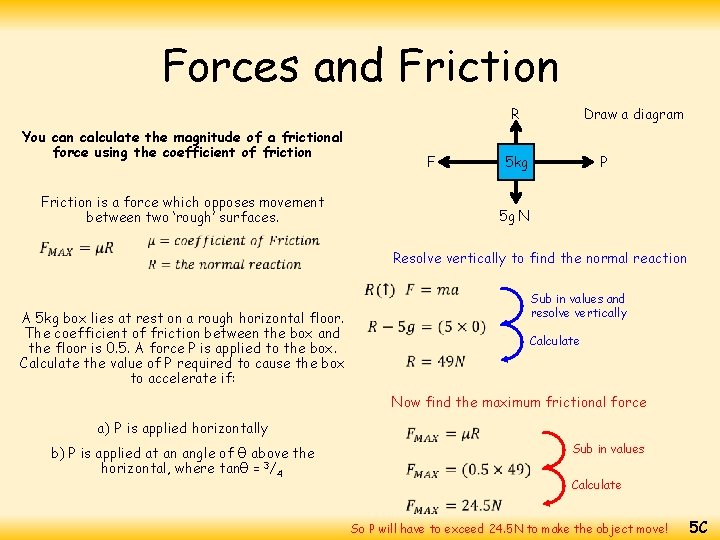
Forces and Friction R You can calculate the magnitude of a frictional force using the coefficient of friction Friction is a force which opposes movement between two ‘rough’ surfaces. F Draw a diagram 5 kg P 5 g N Resolve vertically to find the normal reaction A 5 kg box lies at rest on a rough horizontal floor. The coefficient of friction between the box and the floor is 0. 5. A force P is applied to the box. Calculate the value of P required to cause the box to accelerate if: Sub in values and resolve vertically Calculate Now find the maximum frictional force a) P is applied horizontally b) P is applied at an angle of θ above the horizontal, where tanθ = 3/4 Sub in values Calculate So P will have to exceed 24. 5 N to make the object move! 5 C
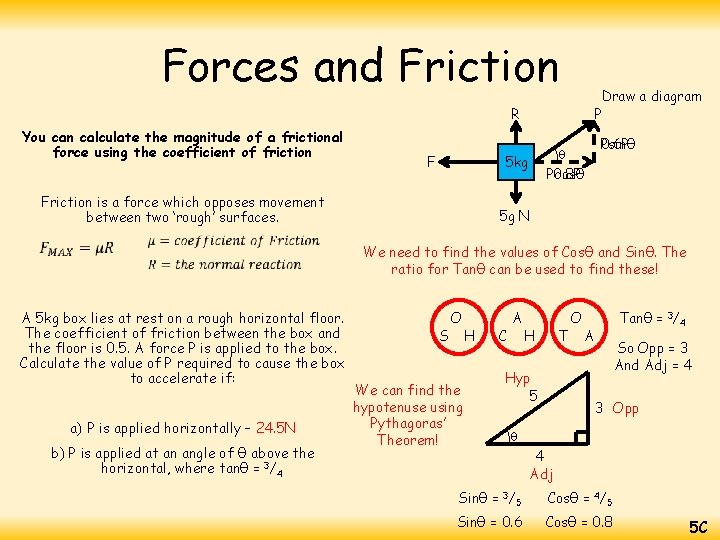
Forces and Friction Draw a diagram P R You can calculate the magnitude of a frictional force using the coefficient of friction F 5 kg Friction is a force which opposes movement between two ‘rough’ surfaces. Psinθ 0. 6 P θ Pcosθ 0. 8 P 5 g N We need to find the values of Cosθ and Sinθ. The ratio for Tanθ can be used to find these! A 5 kg box lies at rest on a rough horizontal floor. The coefficient of friction between the box and the floor is 0. 5. A force P is applied to the box. Calculate the value of P required to cause the box to accelerate if: a) P is applied horizontally – 24. 5 N b) P is applied at an angle of θ above the horizontal, where tanθ = 3/4 S O We can find the hypotenuse using Pythagoras’ Theorem! H C A H T Hyp 5 O Tanθ = 3/4 A So Opp = 3 And Adj = 4 3 Opp θ 4 Adj Sinθ = 3/5 Cosθ = 4/5 Sinθ = 0. 6 Cosθ = 0. 8 5 C
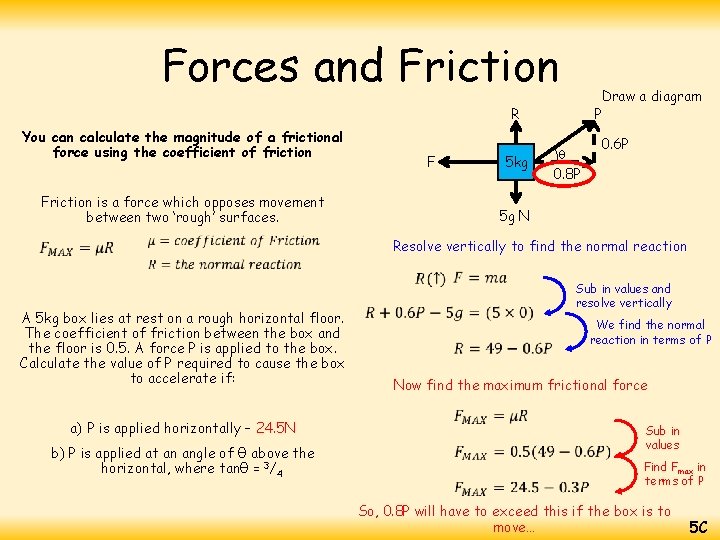
Forces and Friction Draw a diagram P R You can calculate the magnitude of a frictional force using the coefficient of friction Friction is a force which opposes movement between two ‘rough’ surfaces. F 5 kg 0. 6 P θ 0. 8 P 5 g N Resolve vertically to find the normal reaction A 5 kg box lies at rest on a rough horizontal floor. The coefficient of friction between the box and the floor is 0. 5. A force P is applied to the box. Calculate the value of P required to cause the box to accelerate if: a) P is applied horizontally – 24. 5 N b) P is applied at an angle of θ above the horizontal, where tanθ = 3/4 Sub in values and resolve vertically We find the normal reaction in terms of P Now find the maximum frictional force Sub in values Find Fmax in terms of P So, 0. 8 P will have to exceed this if the box is to move… 5 C
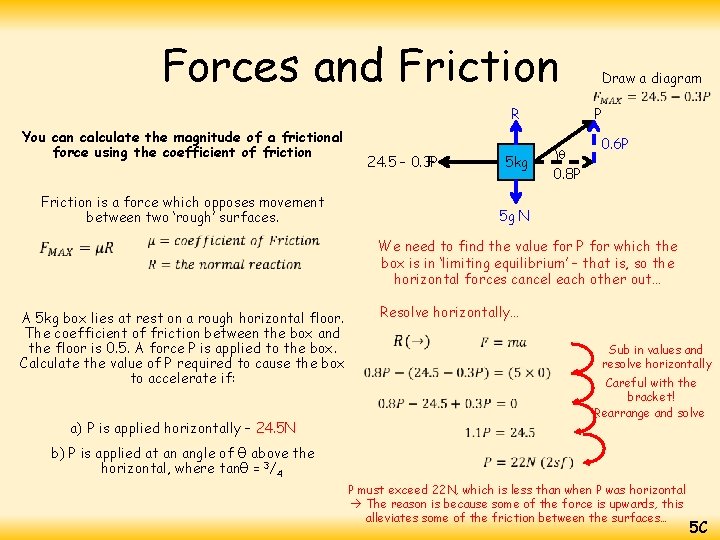
Forces and Friction Draw a diagram R You can calculate the magnitude of a frictional force using the coefficient of friction Friction is a force which opposes movement between two ‘rough’ surfaces. 24. 5 – 0. 3 P F 5 kg P θ 0. 6 P 0. 8 P 5 g N We need to find the value for P for which the box is in ‘limiting equilibrium’ – that is, so the horizontal forces cancel each other out… A 5 kg box lies at rest on a rough horizontal floor. The coefficient of friction between the box and the floor is 0. 5. A force P is applied to the box. Calculate the value of P required to cause the box to accelerate if: a) P is applied horizontally – 24. 5 N Resolve horizontally… Sub in values and resolve horizontally Careful with the bracket! Rearrange and solve b) P is applied at an angle of θ above the horizontal, where tanθ = 3/4 P must exceed 22 N, which is less than when P was horizontal The reason is because some of the force is upwards, this alleviates some of the friction between the surfaces… 5 C