
Teachings for Exercise 3 F The normal distribution
Teachings for Exercise 3 F

The normal distribution You need to be able to approximate a binomial distribution Let’s compare the two quickly… Normal distribution Continuous data Binomial distribution Discrete data No. heads when flipping a coin 7 times Height of the flipped coin 3 F

Using normal distribution to approximate a binomial distribution The normal distribution • Finding a relationship for the standard deviation is much more difficult to understand… We will need to clarify some statements first… 3 F
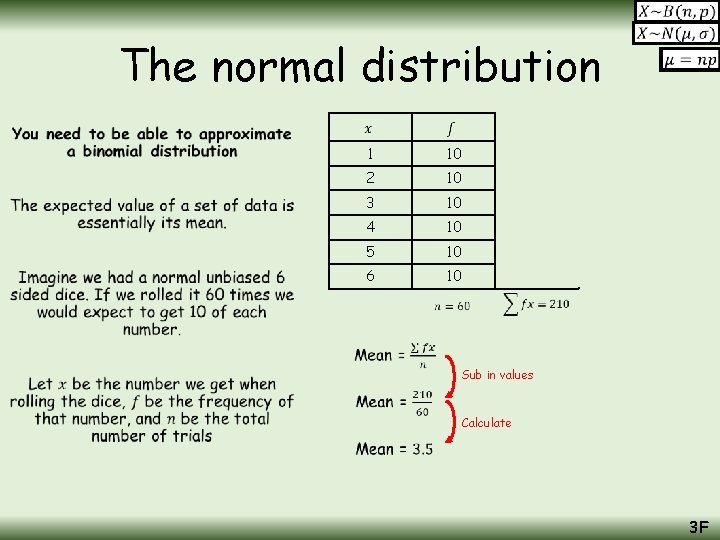
The normal distribution • 1 10 10 20 3 10 30 4 10 40 5 10 50 6 10 60 Sub in values Calculate 3 F
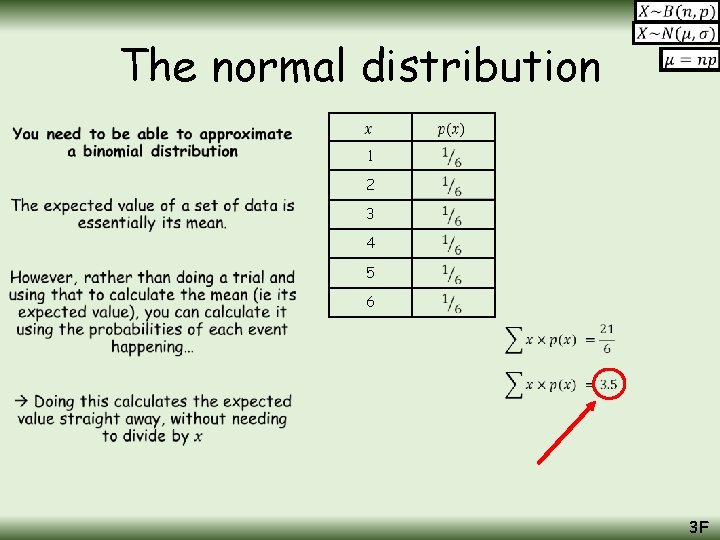
The normal distribution • 1 2 3 4 5 6 3 F
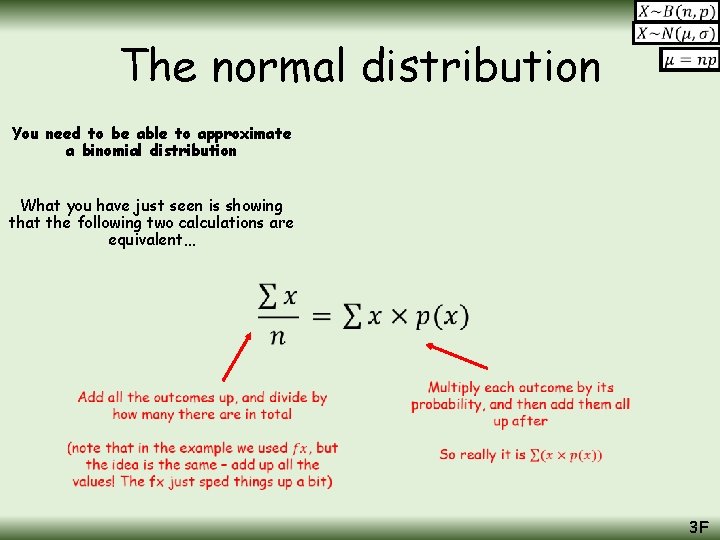
The normal distribution You need to be able to approximate a binomial distribution What you have just seen is showing that the following two calculations are equivalent… 3 F
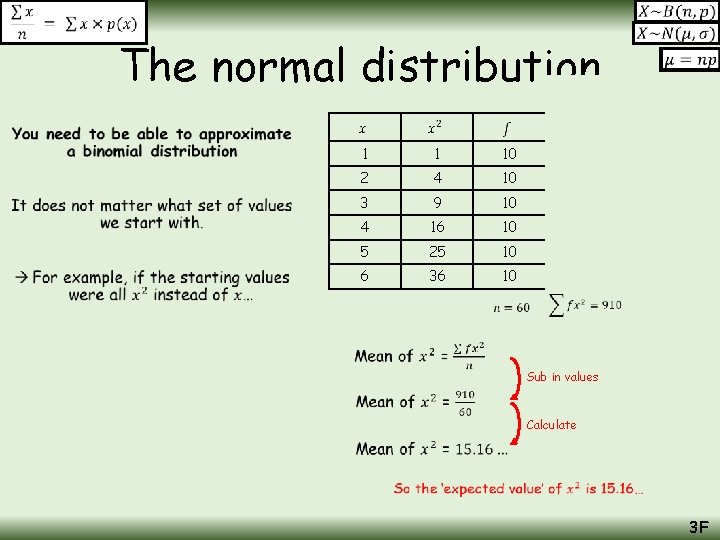
The normal distribution • 1 1 10 10 2 4 10 40 3 9 10 90 4 16 10 160 5 25 10 250 6 36 10 360 Sub in values Calculate 3 F
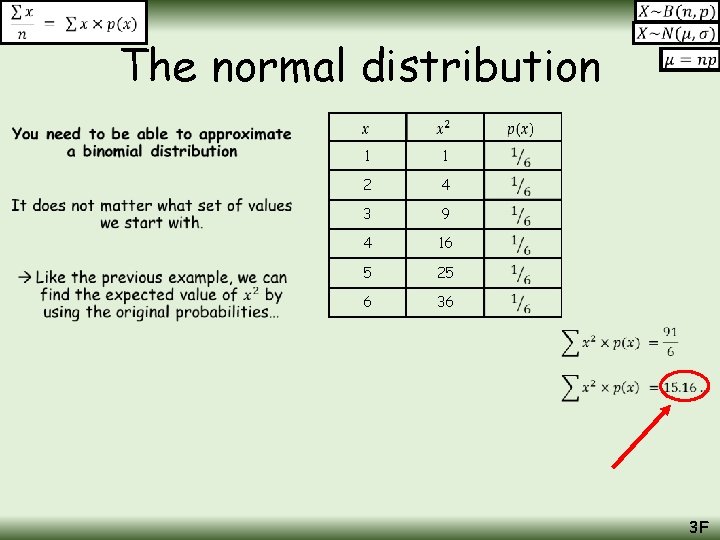
The normal distribution • 1 1 2 4 3 9 4 16 5 25 6 36 3 F
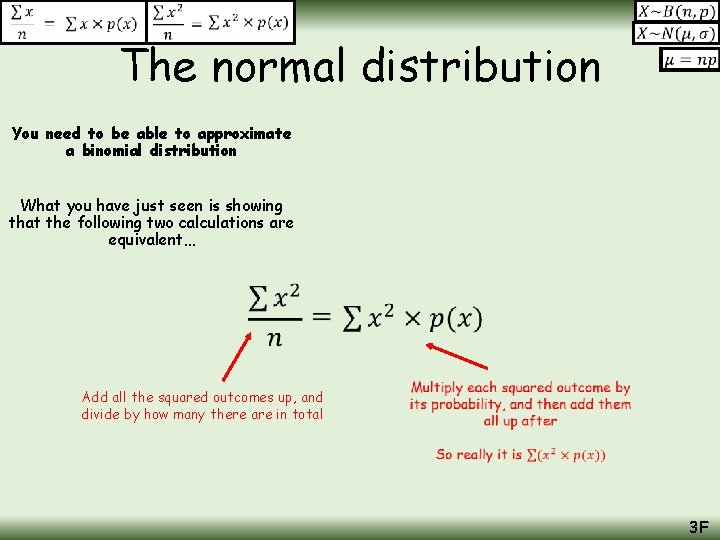
The normal distribution You need to be able to approximate a binomial distribution What you have just seen is showing that the following two calculations are equivalent… Add all the squared outcomes up, and divide by how many there are in total 3 F
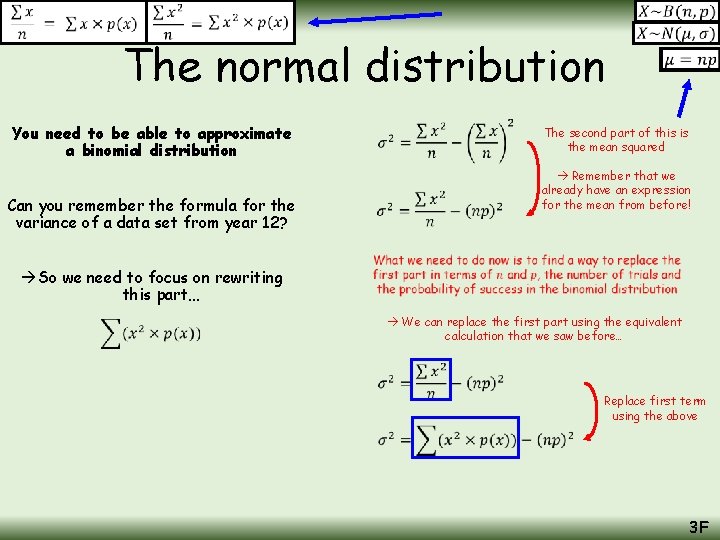
The normal distribution You need to be able to approximate a binomial distribution Can you remember the formula for the variance of a data set from year 12? The second part of this is the mean squared Remember that we already have an expression for the mean from before! So we need to focus on rewriting this part… We can replace the first part using the equivalent calculation that we saw before… Replace first term using the above 3 F

The normal distribution You need to be able to approximate a binomial distribution Can you remember the formula for the variance of a data set from year 12? So we need to focus on rewriting this part… Remember how to find the calculation for a an event that is binomially distributed? 3 F
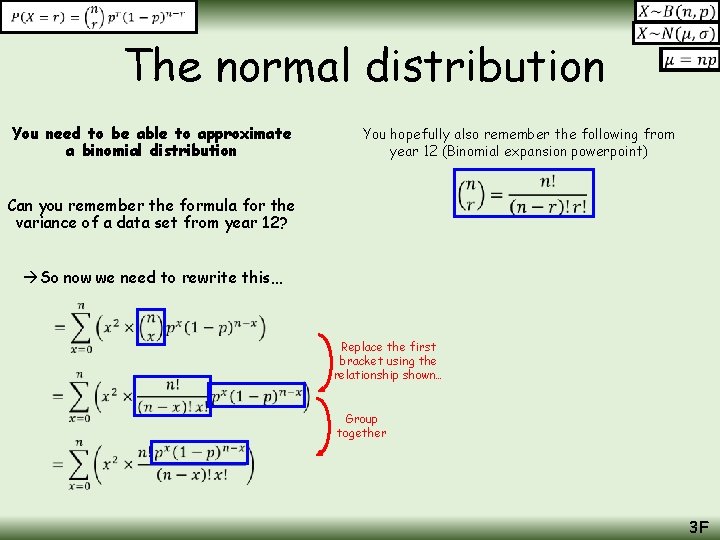
The normal distribution You need to be able to approximate a binomial distribution You hopefully also remember the following from year 12 (Binomial expansion powerpoint) Can you remember the formula for the variance of a data set from year 12? So now we need to rewrite this… Replace the first bracket using the relationship shown… Group together 3 F
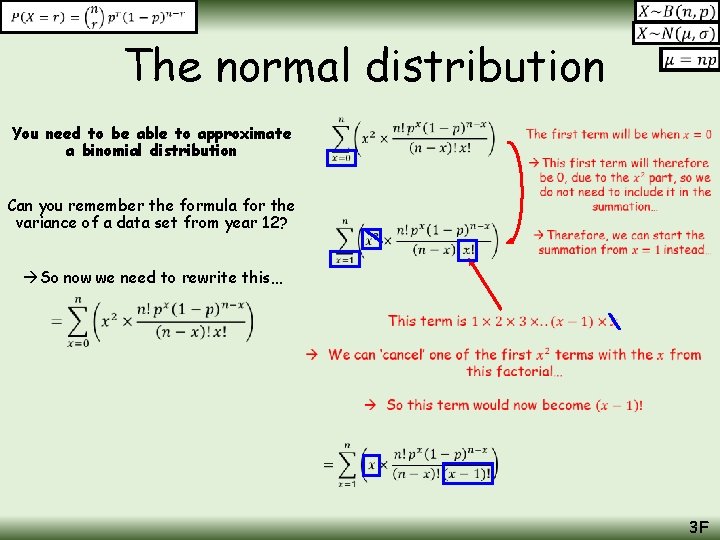
The normal distribution You need to be able to approximate a binomial distribution Can you remember the formula for the variance of a data set from year 12? So now we need to rewrite this… 3 F
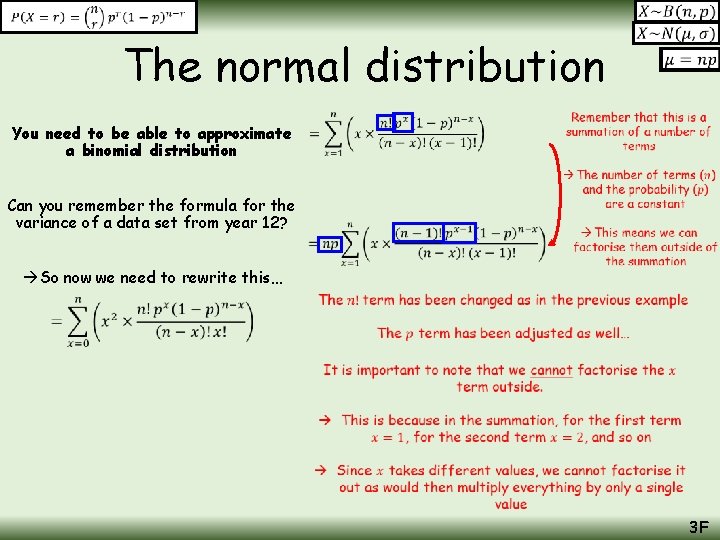
The normal distribution You need to be able to approximate a binomial distribution Can you remember the formula for the variance of a data set from year 12? So now we need to rewrite this… 3 F
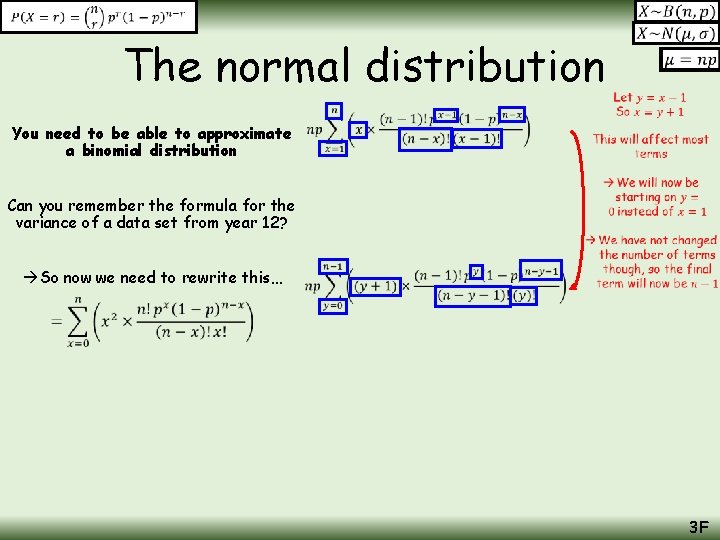
The normal distribution You need to be able to approximate a binomial distribution Can you remember the formula for the variance of a data set from year 12? So now we need to rewrite this… 3 F
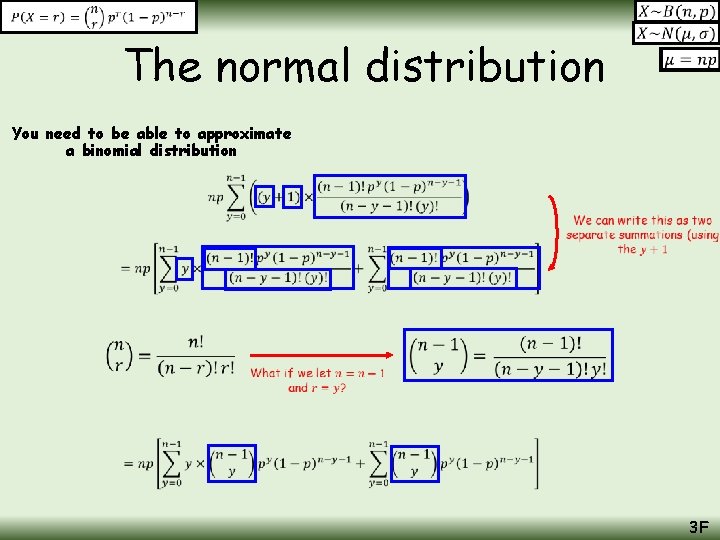
The normal distribution You need to be able to approximate a binomial distribution 3 F
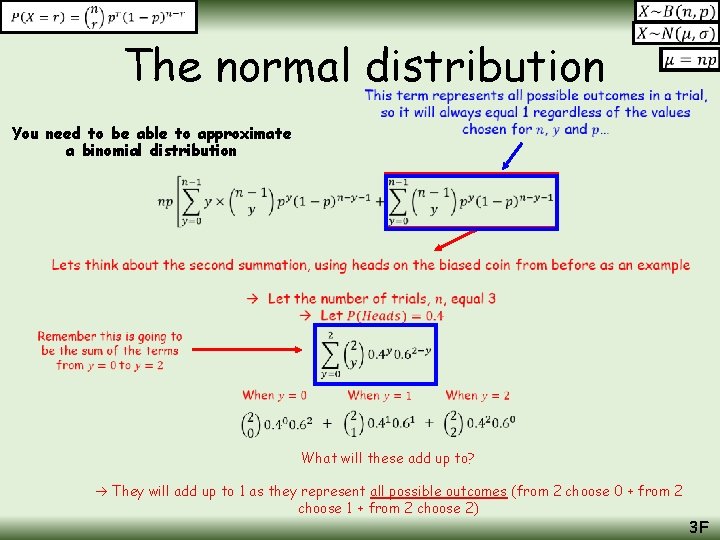
The normal distribution You need to be able to approximate a binomial distribution What will these add up to? They will add up to 1 as they represent all possible outcomes (from 2 choose 0 + from 2 choose 1 + from 2 choose 2) 3 F
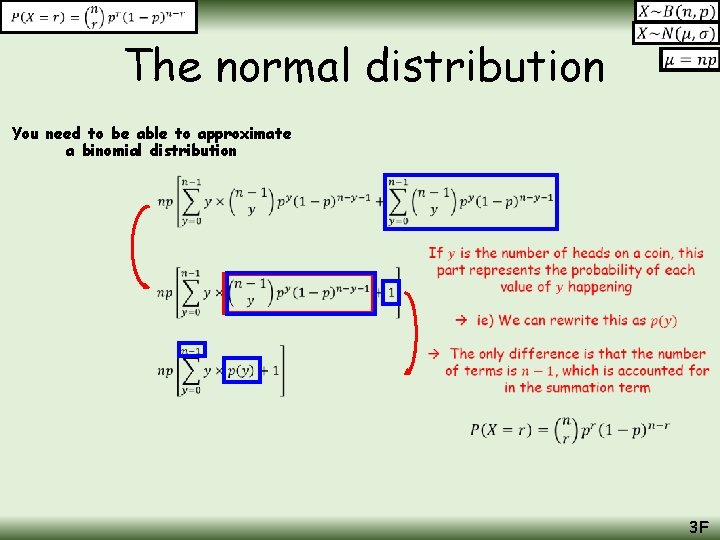
The normal distribution You need to be able to approximate a binomial distribution 3 F
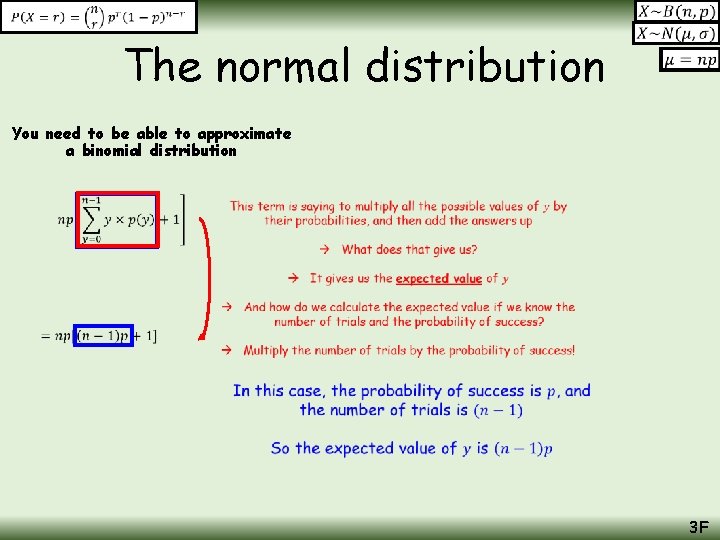
The normal distribution You need to be able to approximate a binomial distribution 3 F
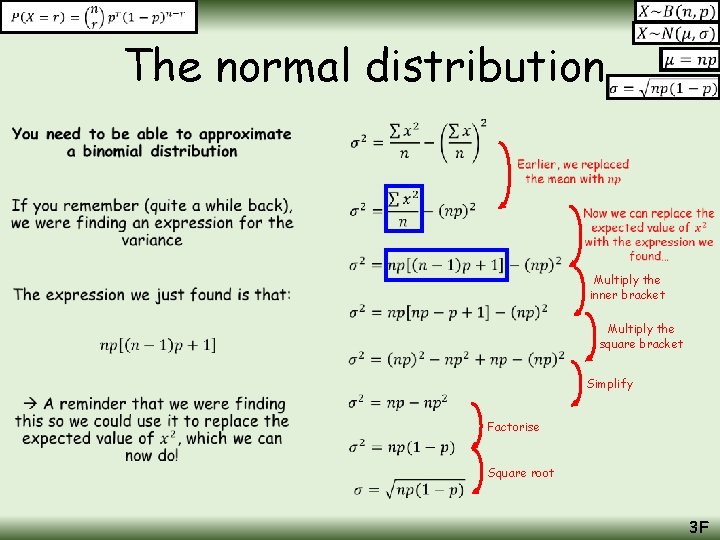
The normal distribution • Multiply the inner bracket Multiply the square bracket Simplify Factorise Square root 3 F
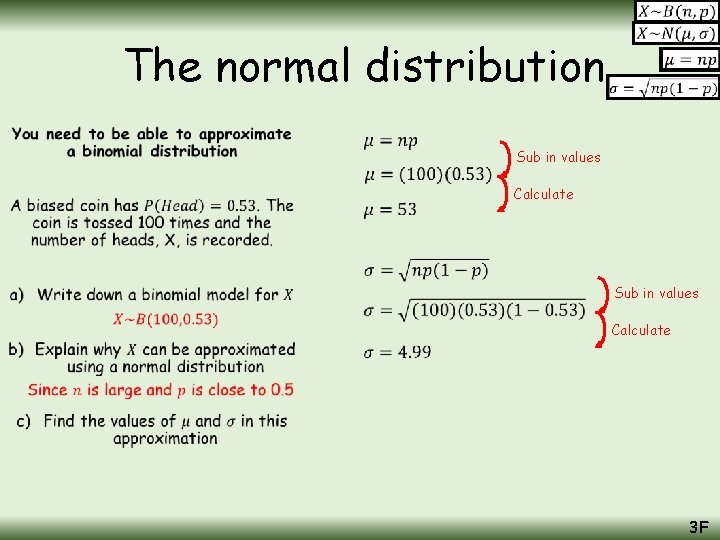
The normal distribution • Sub in values Calculate 3 F
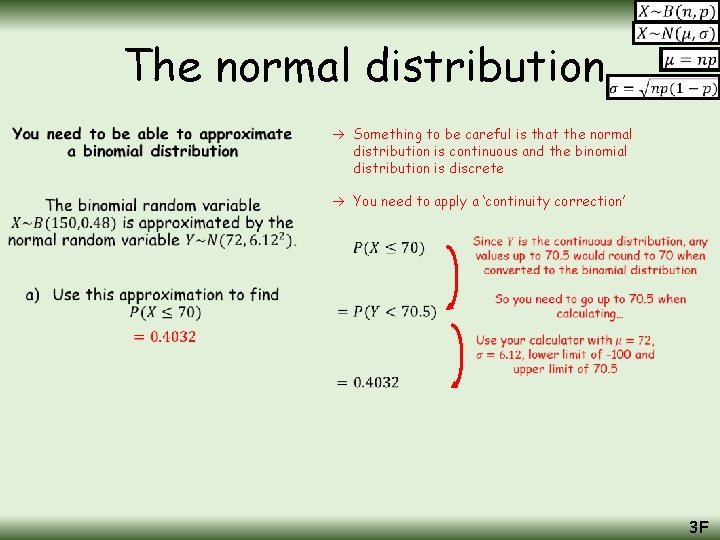
The normal distribution • Something to be careful is that the normal distribution is continuous and the binomial distribution is discrete You need to apply a ‘continuity correction’ 3 F
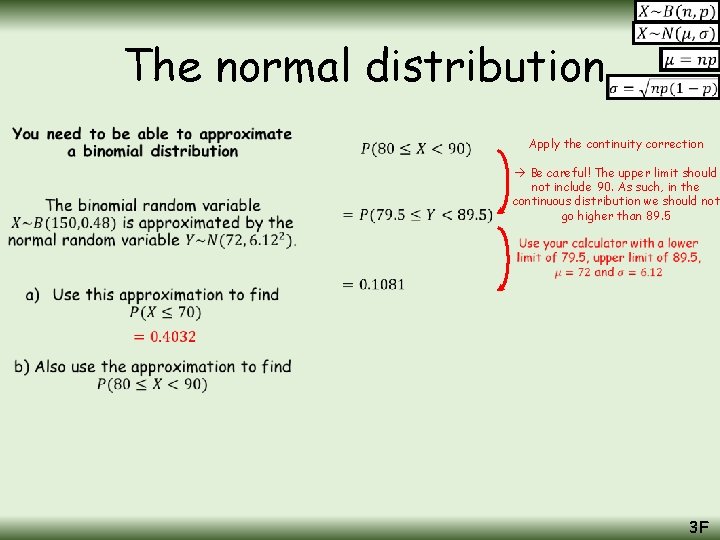
The normal distribution • Apply the continuity correction Be careful! The upper limit should not include 90. As such, in the continuous distribution we should not go higher than 89. 5 3 F
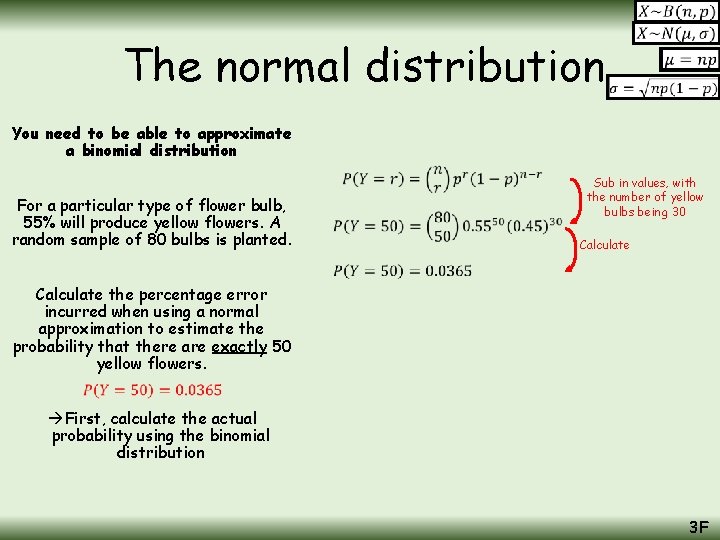
The normal distribution You need to be able to approximate a binomial distribution For a particular type of flower bulb, 55% will produce yellow flowers. A random sample of 80 bulbs is planted. Sub in values, with the number of yellow bulbs being 30 Calculate the percentage error incurred when using a normal approximation to estimate the probability that there are exactly 50 yellow flowers. First, calculate the actual probability using the binomial distribution 3 F
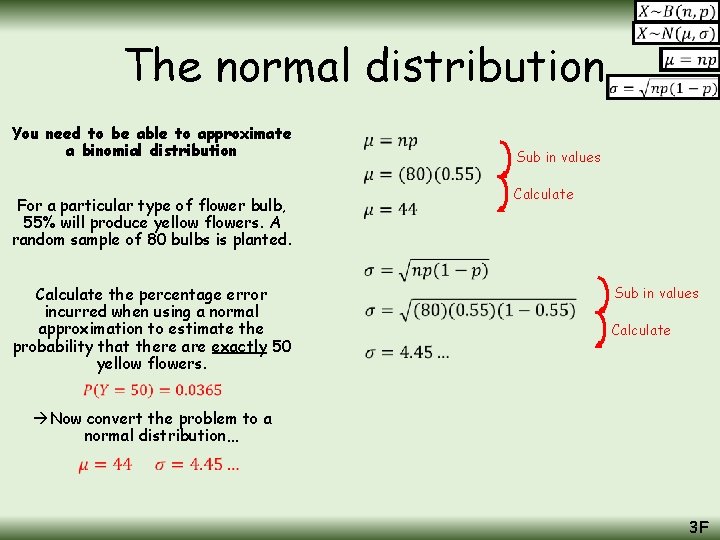
The normal distribution You need to be able to approximate a binomial distribution For a particular type of flower bulb, 55% will produce yellow flowers. A random sample of 80 bulbs is planted. Calculate the percentage error incurred when using a normal approximation to estimate the probability that there are exactly 50 yellow flowers. Sub in values Calculate Now convert the problem to a normal distribution… 3 F
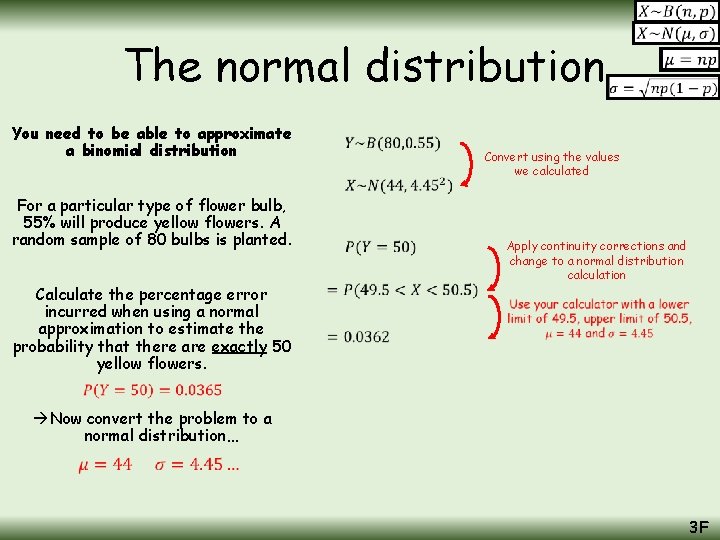
The normal distribution You need to be able to approximate a binomial distribution For a particular type of flower bulb, 55% will produce yellow flowers. A random sample of 80 bulbs is planted. Calculate the percentage error incurred when using a normal approximation to estimate the probability that there are exactly 50 yellow flowers. Convert using the values we calculated Apply continuity corrections and change to a normal distribution calculation Now convert the problem to a normal distribution… 3 F
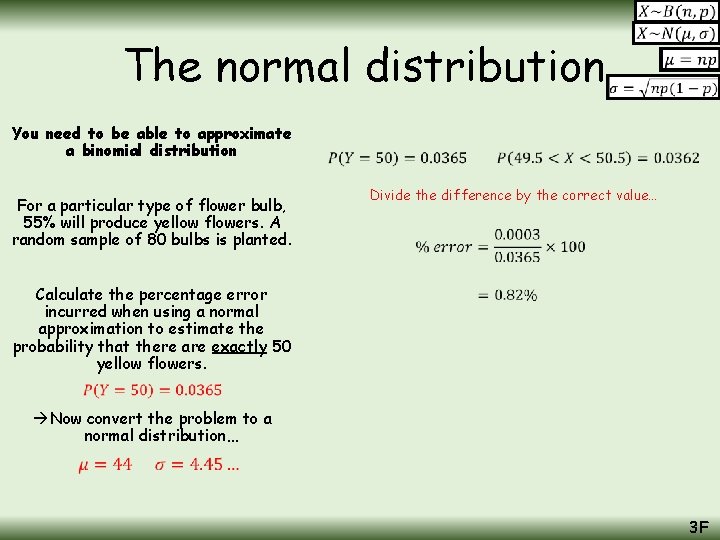
The normal distribution You need to be able to approximate a binomial distribution For a particular type of flower bulb, 55% will produce yellow flowers. A random sample of 80 bulbs is planted. Divide the difference by the correct value… Calculate the percentage error incurred when using a normal approximation to estimate the probability that there are exactly 50 yellow flowers. Now convert the problem to a normal distribution… 3 F
- Slides: 27