
TEACHINGLEARNING The Nurse as Teacher Teaching Planned method



- Slides: 69
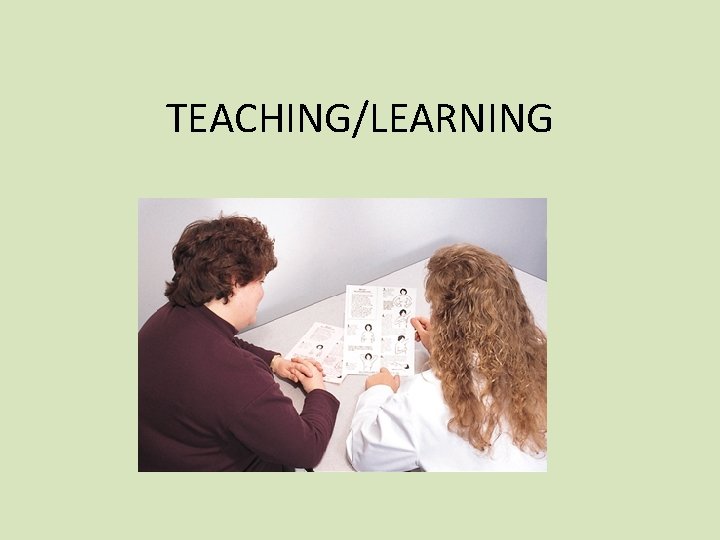
TEACHING/LEARNING
The Nurse as Teacher • Teaching: – Planned method or series of methods – Used to help someone learn – The person using these methods teacher • Learning – Process by which a person acquires or increases knowledge or – Changes behavior in an obvious way as a result of experience
• The nurse is the teacher • The patient is the learner • This relationship enhanced by the helping relationship – Mutual trust – Mutual respect • Both patient and nurse have identified this learning need as important
Focus of patient education: • Three critical areas: – Prepare patient for receiving care – Prepare patient/family for discharge from hospital – Document patient education activity • V. I. P. for insurance reimbursement
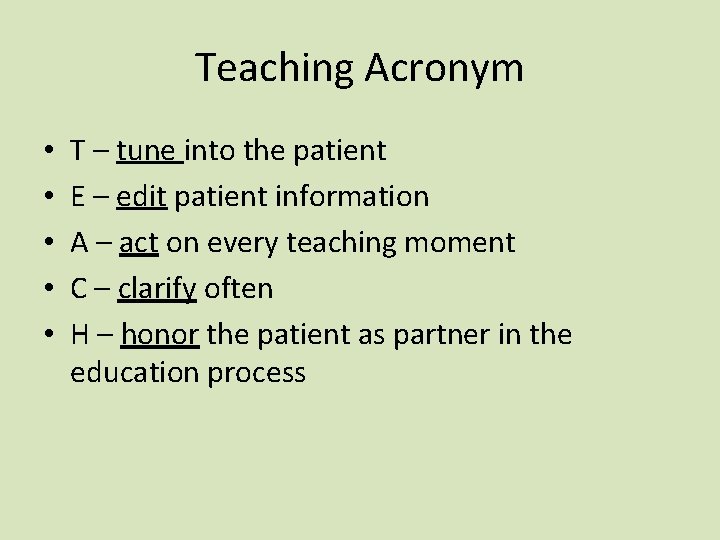
Teaching Acronym • • • T – tune into the patient E – edit patient information A – act on every teaching moment C – clarify often H – honor the patient as partner in the education process
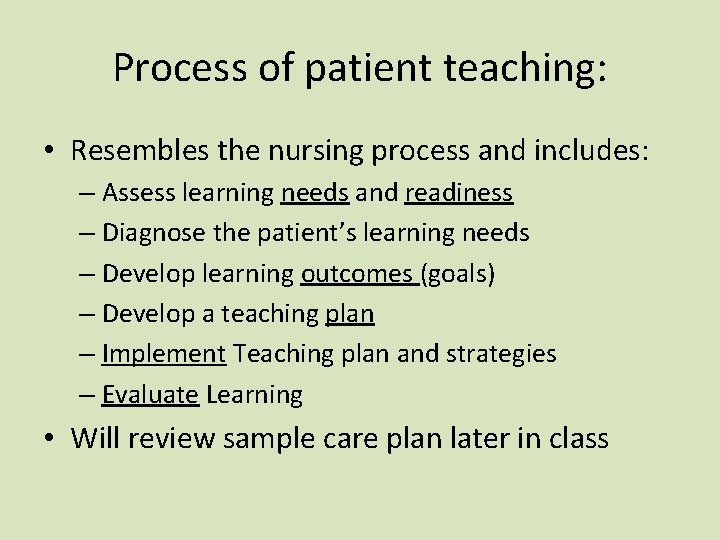
Process of patient teaching: • Resembles the nursing process and includes: – Assess learning needs and readiness – Diagnose the patient’s learning needs – Develop learning outcomes (goals) – Develop a teaching plan – Implement Teaching plan and strategies – Evaluate Learning • Will review sample care plan later in class
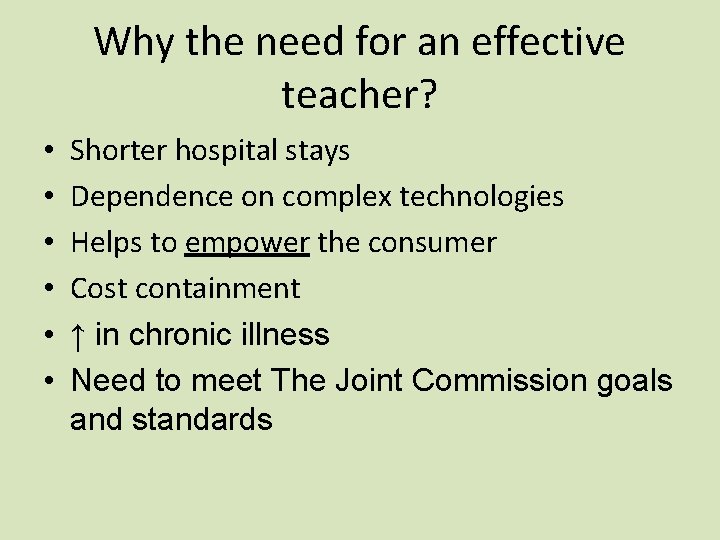
Why the need for an effective teacher? • • • Shorter hospital stays Dependence on complex technologies Helps to empower the consumer Cost containment ↑ in chronic illness Need to meet The Joint Commission goals and standards
Our challenges? • Lots to teach! • ↓ time • ↓ resources • Getting patients to want to learn
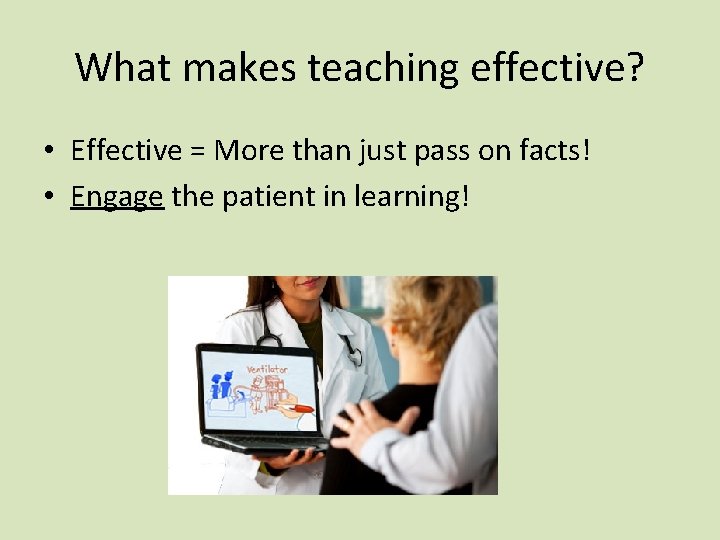
What makes teaching effective? • Effective = More than just pass on facts! • Engage the patient in learning!
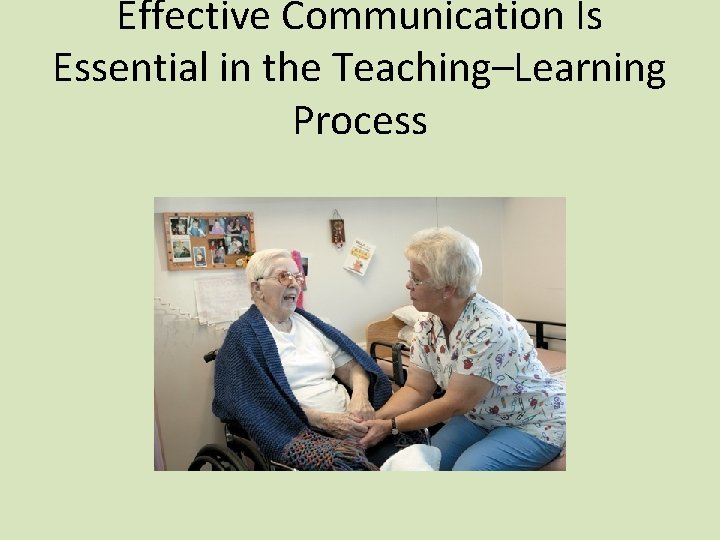
Effective Communication Is Essential in the Teaching–Learning Process
LEARNING
PROCESS OF LEARNING • Life-long process • Involves acquiring: – New information – Skills – Attitudes – Understanding – Values
DOMAINS OF LEARNING • Patients learn in three domains: – Cognitive – Affective – Psychomotor
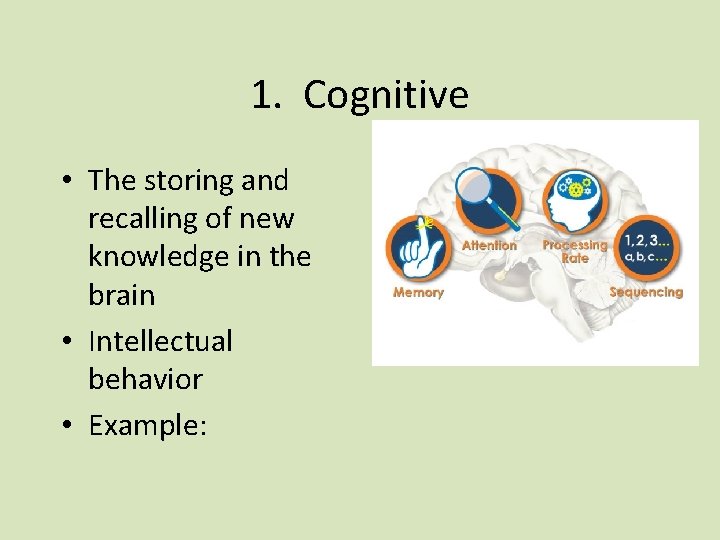
1. Cognitive • The storing and recalling of new knowledge in the brain • Intellectual behavior • Example:
2. Affective • • • Includes: Changes in attitudes Values Feelings Example: patient expresses renewed selfconfidence after physical therapy
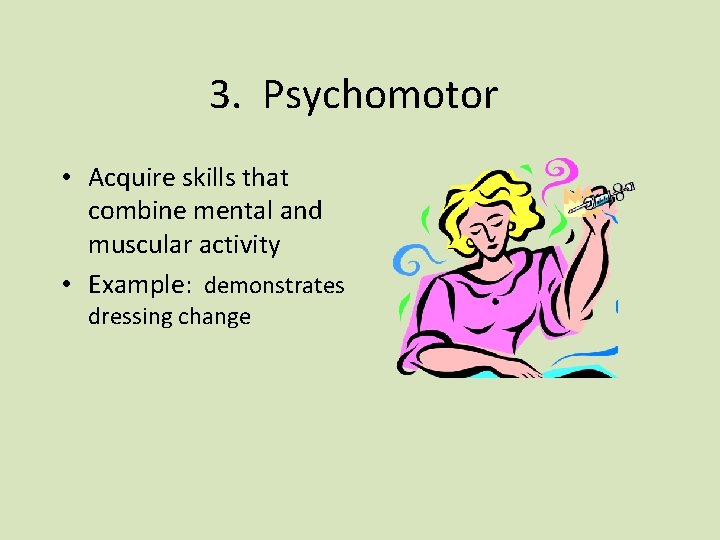
3. Psychomotor • Acquire skills that combine mental and muscular activity • Example: demonstrates dressing change
Summary • Any topic you teach may involve one or more of these domains.
FACTORS AFFECTING PATIENT LEARNING • Age and developmental level – Patient’s physical maturation and abilities – Psychosocial development – Cognitive capacity – Emotional maturity – Spiritual development
FACTORS AFFECTING PATIENT LEARNING • Adult learners: – Must believe they need to learn before they are willing to learn – May need to be shown the importance of learning new information – Identify any learning barriers. Older adults may experience: • Sensory loss (vision, hearing) • Limited physical mobility • Inability to comply with regimen
FACTORS AFFECTING PATIENT LEARNING • Family support Networks and Financial resources – Try to get family involved with teaching/learning • Cultural influences and language issues
Providing Culturally Competent Patient Education • Develop an understanding of the patient’s culture. • Work with multicultural team. • Be aware of personal assumptions, biases, and prejudices. • Understand the core cultural values of the patient or group. • Develop written material in native language of the patient.
• Health literacy – Average American reads at the 8 th or 9 th grade level – Most health-care literature written at the 10 th grade level!
SOME LEARNING PRINCIPLES
1. Readiness How ready is the person to learn? Assess the following: – How alert is this person? Need to consider: • • Physical discomfort Primary disease Imbalance of fluid/electrolyte Nutritional status Mental changes due to medications Physical mobility Level of endurance
• Anxiety level - mild motivates, high prevents learning • Environmental factors - unplanned interruptions; uncomfortable environment
• Ask yourself: – “Is there anything that is keeping my patient from learning? – Control those factors.
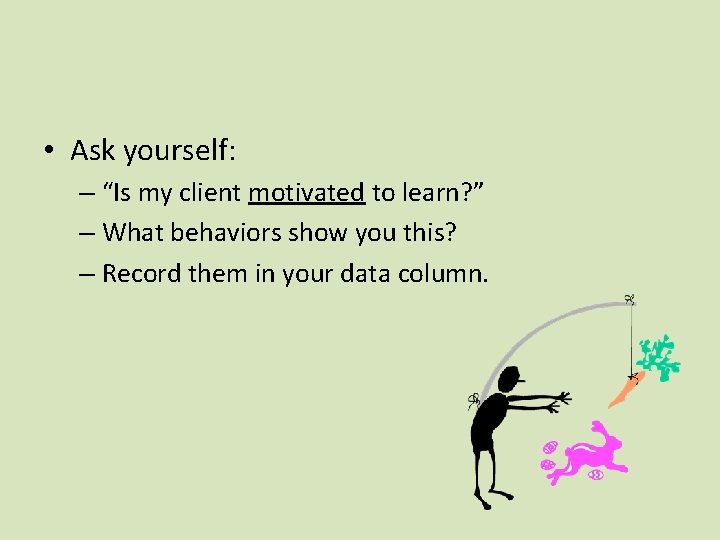
2. Motivation · How motivated is my patient? · Internal desire · Causes a person to act · If someone does not want to learn, will he/she learn?
· Some motivating forces: · easy to learn · necessary for survival · ex - insulin for the diabetic
• Ask yourself: – “Is my client motivated to learn? ” – What behaviors show you this? – Record them in your data column.
3. Psychosocial Status • Loss of health --> grieving • Stages of grieving • Ex. - anger, denial - not good for learning
• Ask yourself, – “Is my patient showing any of the signs of grieving? – If so, will it effect his learning? ” – Record this in the data column.
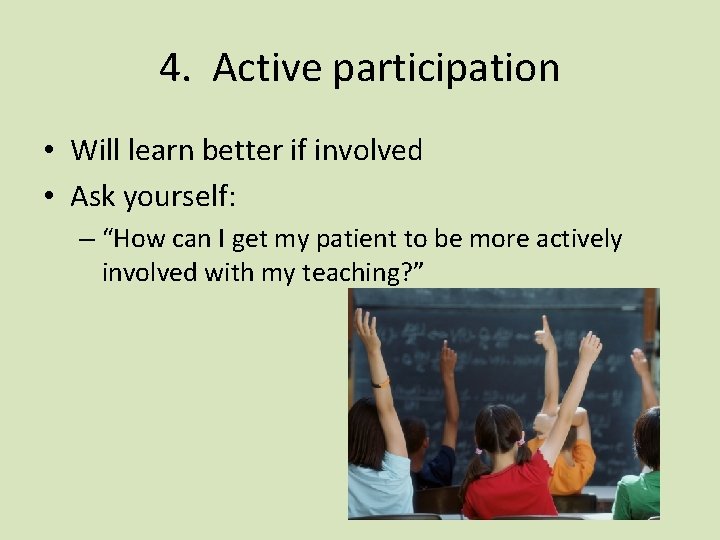
4. Active participation • Will learn better if involved • Ask yourself: – “How can I get my patient to be more actively involved with my teaching? ”
5. Compliance • Patients who follow the treatment plan • Patients more likely to be compliant when they: – Understand their diagnosis; – Treatment rationale; – Medication regimen; and – Benefits of compliance. • Increased patient compliance is a direct outcome of effective patient teaching!
Ways to improve compliance: • Make sure instructions are understandable • Include patient and family as partners in the teaching/learning process • Use interactive teaching strategies • Remember that teaching and learning are processes that rely on strong interpersonal relationships with patients and their families.
6. Ability to learn • • • Developmental stage Education level Physical ability Able to perform ADL’s Able to read prescriptions, see colors, etc.
7. Learning Environment • Factors: – – – – room temperature need for privacy lighting noise ventilation furniture Do changes need to be made in any of the above?
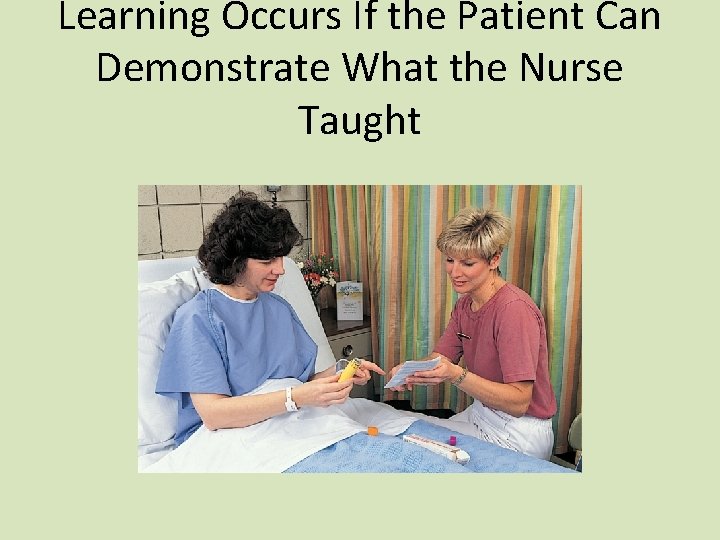
Learning Occurs If the Patient Can Demonstrate What the Nurse Taught
TEACHING • Interactive process • Promotes learning • Aimed at changing the way persons can and/or will behave
TEACHING PRINCIPLES • Techniques for supporting the principles of learning – Get-and keep-your patient’s attention • • Clearly state your point Vary your tone of voice Use variety of teaching techniques Use examples to get your point across
TEACHING PRINCIPLES • Stick to the basics – Keep it short, specific and simple – Use simple, everyday language • Make the most of your time – What are some good times to teach? • •
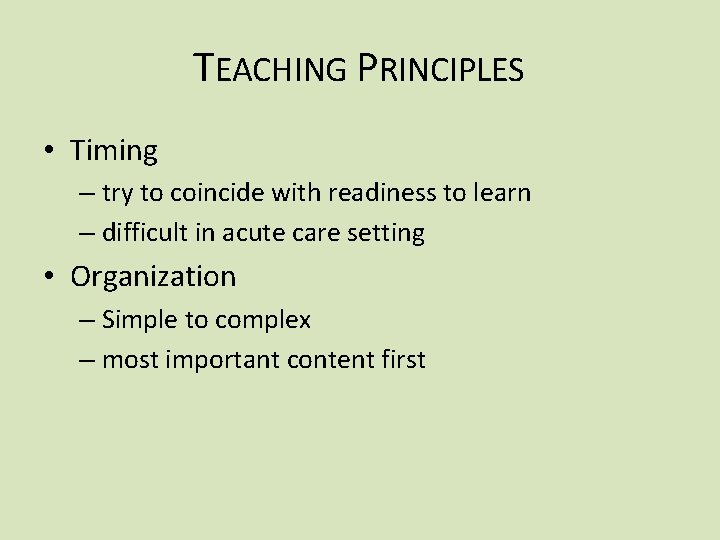
TEACHING PRINCIPLES • Timing – try to coincide with readiness to learn – difficult in acute care setting • Organization – Simple to complex – most important content first
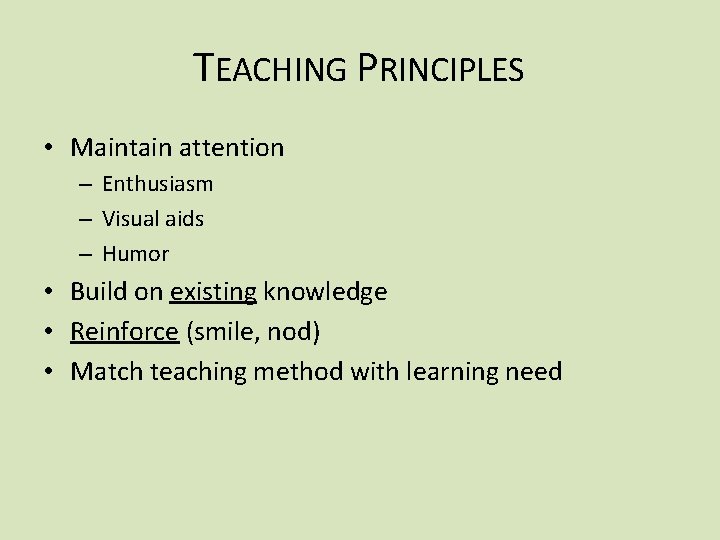
TEACHING PRINCIPLES • Maintain attention – Enthusiasm – Visual aids – Humor • Build on existing knowledge • Reinforce (smile, nod) • Match teaching method with learning need
• • • Reinforce content Reinforce what?
SUGGESTED TEACHING STRATEGIES FOR THE THREE LEARNING DOMAINS:
Cognitive • • • Panel discussion Printed materials DVD’s, Laptops, I-Pads, etc. Question and answer Lecture or discussion
• Lecture/explanation in sequence – use simple terms – know the subject well – give feedback – record patient’s response – allow time to discuss feelings, concerns, questions – correct any misunderstandings
Affective Domain • • • Role play Discussion Panel discussion Multi-media Printed materials
Psychomotor Domain • Demonstrate and practice – Nurse demonstrates – Patient returns demonstration – Simple to complex - repetition – Use same equipment as at home – Ensure success for patient • Multi-media • Printed materials
Applying the Nursing Process to Teaching
Assessment: • Assess patient’s: – Readiness to learn – Ability to learn – The learning environment • Assess the learning environment
Nursing Diagnosis 1. Deficient Knowledge R/T: – Cognitive limitation – Lack of exposure – Lack of interest in learning – Lack of recall – Not familiar with information resources
• As evidenced by: (the data that shows the lack) – Asks questions – Unable to answer questions asked to him/her – Not following the regimen – Etc.
2. Ineffective self Health Management • Definition: – Pattern of not incorporating care for an illness to meet goal of meeting health needs • R/T: – Economic difficulties – Knowledge deficit – Etc. • A. E. B. – specific data
Plan Teaching • Create appropriate learning environment • Avoid interruptions • Keep patient’s limitations in mind
Implement the Teaching Plan • • • Keep sessions short Avoid too much detail Teach the “need to know” content Teach in small amounts Use examples the patient can relate to Ask for questions Involve the patient Use a variety of media Avoid lecturing
• • • Be sincere and honest. Be a cheerleader for the patient. Use simple vocabulary. Vary the tone of voice. Keep content clear. Listen and do not interrupt.
• • • Teaching Strategies Lecture Discussion Panel discussion Demonstration Discovery Role playing Audiovisual materials – DVD’s, I-Pads, Lap-tops Printed materials/pamphlets Programmed instruction Web-based instruction
Multi-media, Printed Aids National Group samples (Cancer Society, Heart Assn. , etc. ) Pictures/posters Drug and Medical supply companies Dieticians, patient educators Anatomical models
Evaluate effectiveness of teaching • Most effective – return demo • Restating information • Have patient list parts of the teaching Difficulty learning? Usually requires more than one session “I understand” is not reliable!
Documentation • Document on appropriate forms
Teaching Plans for Older Adults • • • Identify learning barriers. Allow extra time. Plan short teaching sessions. Accommodate for sensory deficits. Reduce environmental distractions.
The Teaching Care Plan • One care plan due this module • Review example • Review grading sheet
Question Which of the following is an example of cognitive learning? A. A patient demonstrates how to change his wound dressing B. A new mother follows instructions for caring for the umbilical cord C. A patient describes how to portion food to maintain within a prescribed calorie range D. A patient expresses renewed confidence following a teaching session on caring for her
Answer: C. A patient describes how to portion food to maintain within a prescribed calorie range Rationale: Cognitive learning involves the storing and recalling of new knowledge in the brain, such as learning food portions to maintain a calorie count. Demonstrating how to change a wound dressing
Question Which of the following would be the best teaching strategy to teach a patient how to care for an indwelling catheter? A. Lecture B. Role modeling C. Discovery D. Demonstration
Answer: D. Demonstration Rationale: Demonstration of techniques, procedures, exercises, and the use of special equipment, combined with a lecture and discussion, is an effective strategy to facilitate psychomotor learning, such as caring for a catheter.
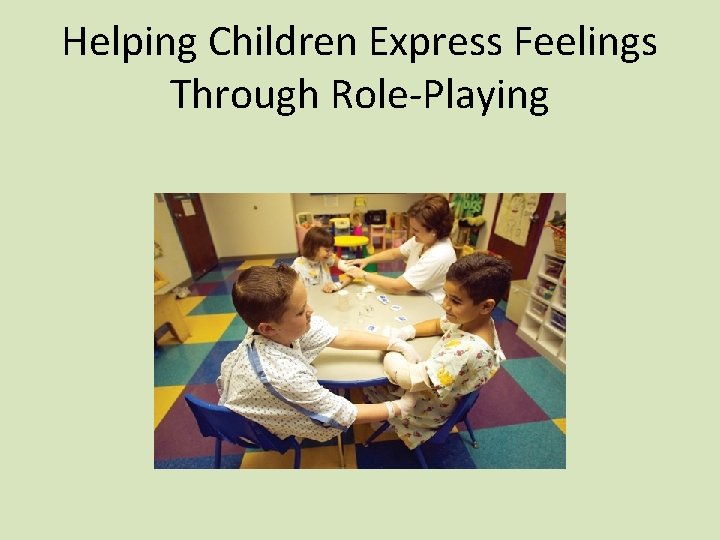
Helping Children Express Feelings Through Role-Playing