
Teaching Young Children OBJECTIVE 3 02 Understand selection
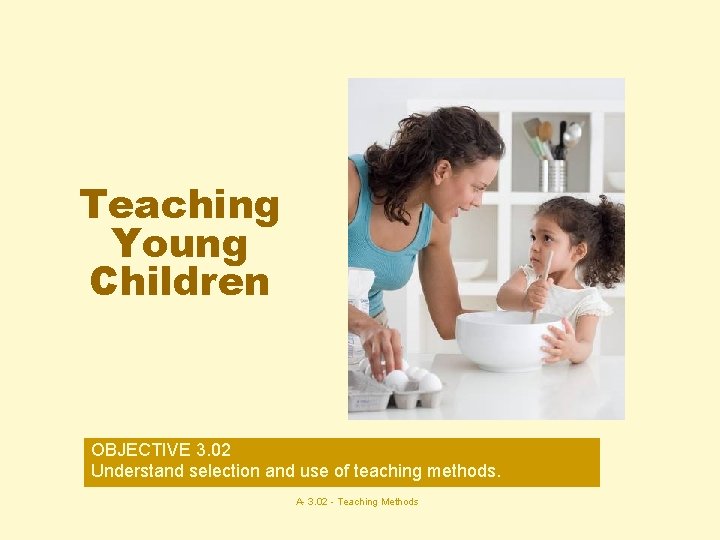
Teaching Young Children OBJECTIVE 3. 02 Understand selection and use of teaching methods. A- 3. 02 - Teaching Methods
Teaching Young Children Part 1: Selecting Teaching Methods ØWays Children Learn ØThe Role of Play Materials A- 3. 02 - Teaching Methods 2
Selecting Teaching Methods • In order to select appropriate teaching methods, you need to know about – The ways children learn – The role of play materials – Factors to consider when selecting toys and play materials A- 3. 02 - Teaching Methods 3
How do children learn? • From the environment • From a teacher • From their experiences A- 3. 02 - Teaching Methods 4
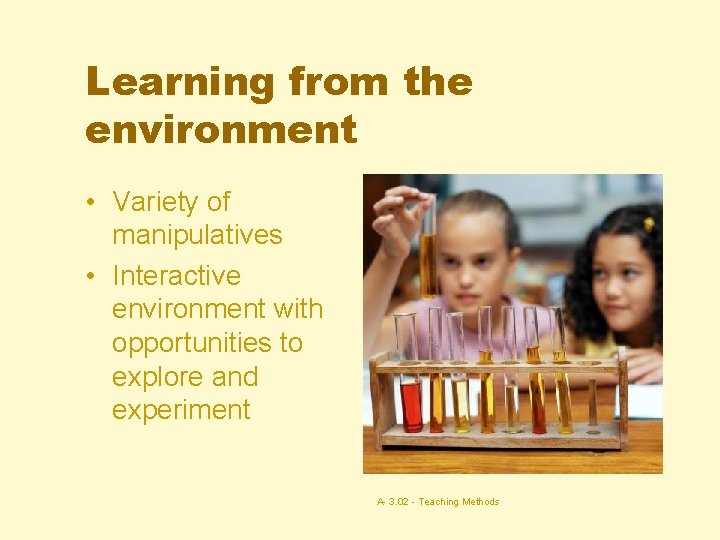
Learning from the environment • Variety of manipulatives • Interactive environment with opportunities to explore and experiment A- 3. 02 - Teaching Methods 5

Learning from a teacher • Provides positive reinforcement • Is a good role model for children to imitate When a person shows someone else how to do something, this is called modeling. A- 3. 02 - Teaching Methods 6
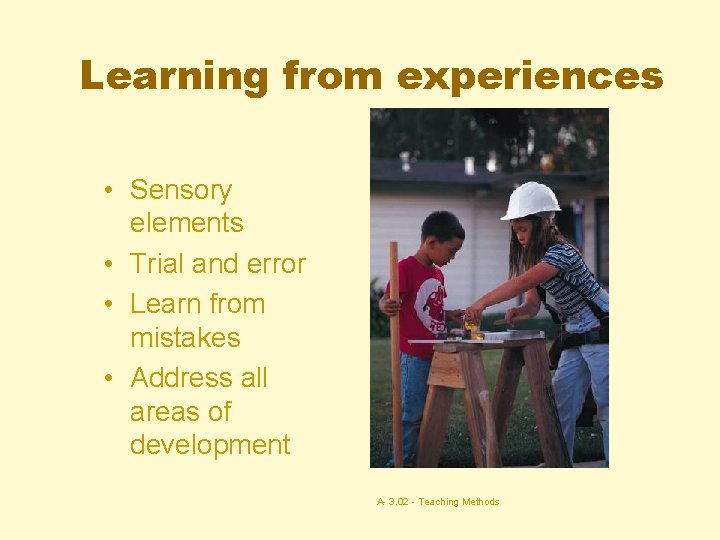
Learning from experiences • Sensory elements • Trial and error • Learn from mistakes • Address all areas of development A- 3. 02 - Teaching Methods 7
The Role of Play Materials A- 3. 02 - Teaching Methods
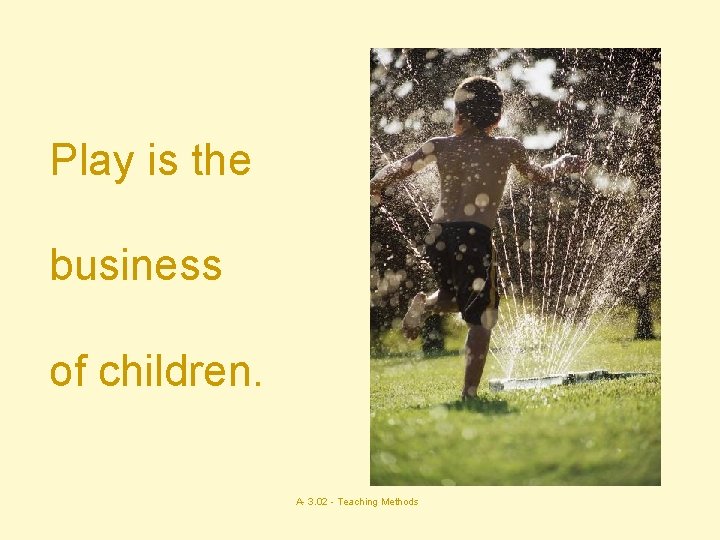
Play is the business of children. A- 3. 02 - Teaching Methods
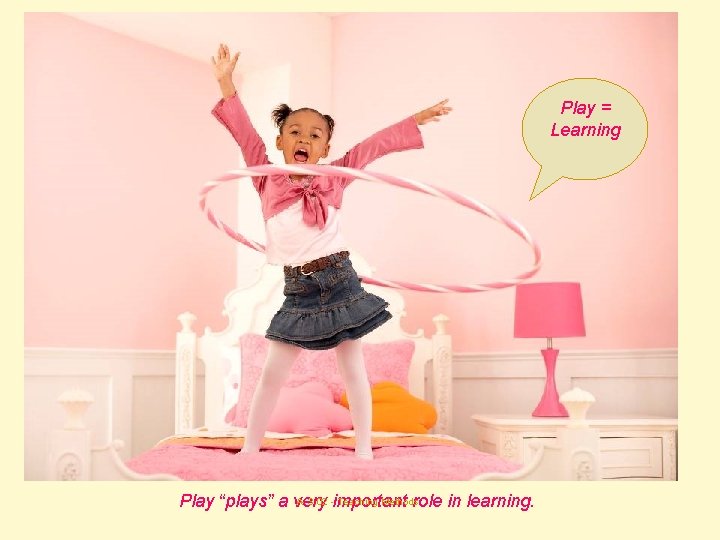
Play = Learning A- 3. 02 -important Teaching Methods Play “plays” a very role in learning.
2 Types of Play Materials 1. Open-ended --- can be used in a variety of ways, with no one correct way to play with them 2. Closed-ended --- structured materials meant to be used in one way, with one intended outcome A- 3. 02 - Teaching Methods 11
Can you think of examples of each? • Open-ended • Closed-ended Both types offer benefits for children. A- 3. 02 - Teaching Methods 12
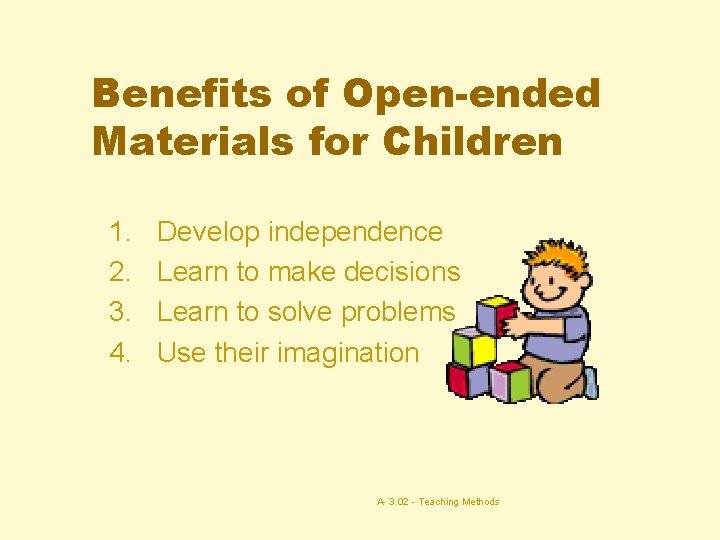
Benefits of Open-ended Materials for Children 1. 2. 3. 4. Develop independence Learn to make decisions Learn to solve problems Use their imagination A- 3. 02 - Teaching Methods 13
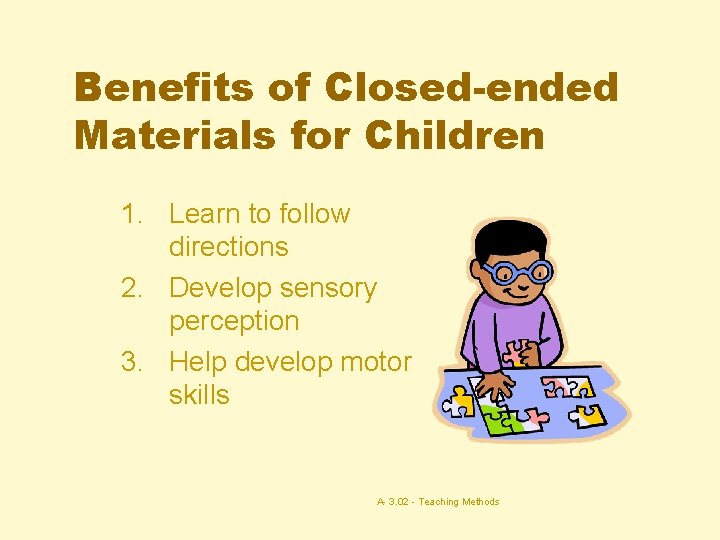
Benefits of Closed-ended Materials for Children 1. Learn to follow directions 2. Develop sensory perception 3. Help develop motor skills A- 3. 02 - Teaching Methods 14
Factors to Consider When Selecting Toys & Play Materials • Safety – Rounded, smooth edges – Nontoxic A- 3. 02 - Teaching Methods 15
Factors to Consider When Selecting Toys & Play Materials • Durability • Easy to clean • Appropriate for different ages • Encourages cooperative play, not aggressive play A- 3. 02 - Teaching Methods 16
Factors to Consider When Selecting Toys & Play Materials • Number of children who can use at one time • Storage space available A- 3. 02 - Teaching Methods 17
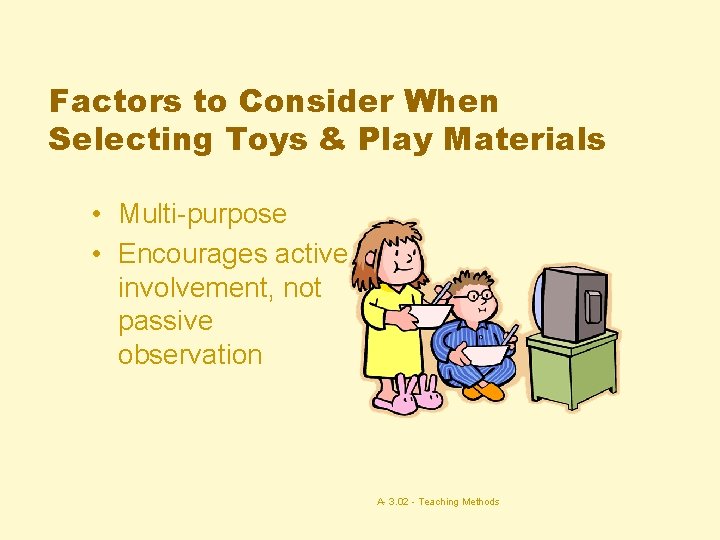
Factors to Consider When Selecting Toys & Play Materials • Multi-purpose • Encourages active involvement, not passive observation A- 3. 02 - Teaching Methods 18
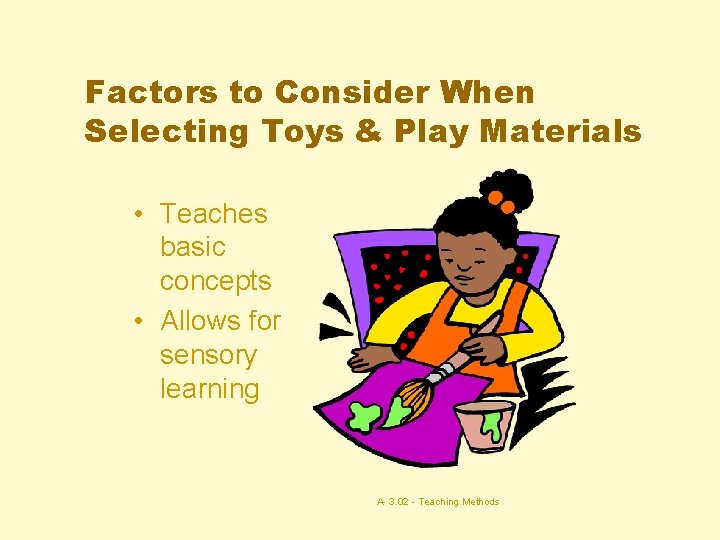
Factors to Consider When Selecting Toys & Play Materials • Teaches basic concepts • Allows for sensory learning A- 3. 02 - Teaching Methods 19
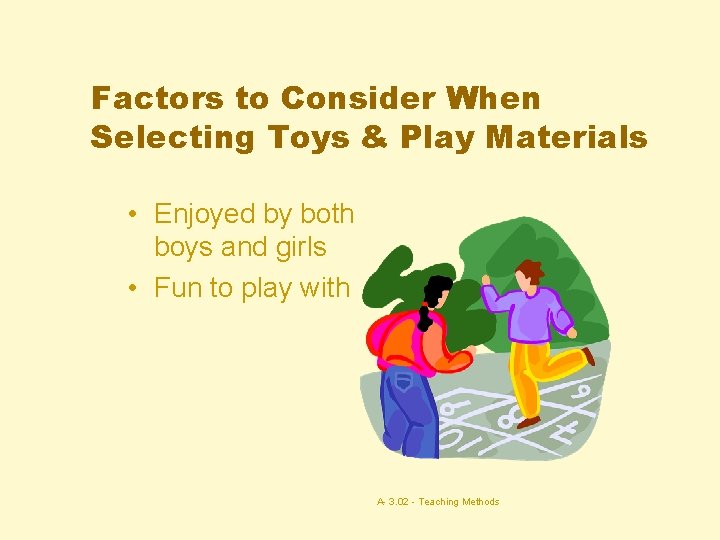
Factors to Consider When Selecting Toys & Play Materials • Enjoyed by both boys and girls • Fun to play with A- 3. 02 - Teaching Methods 20
Teaching Young Children Part 2: Using Teaching Methods ØPlanning Lessons A- 3. 02 - Teaching Methods 21
Using Teaching Methods • In order to use teaching methods effectively, you need to know about – Planning lessons – Teaching styles – Teaching techniques A- 3. 02 - Teaching Methods 22
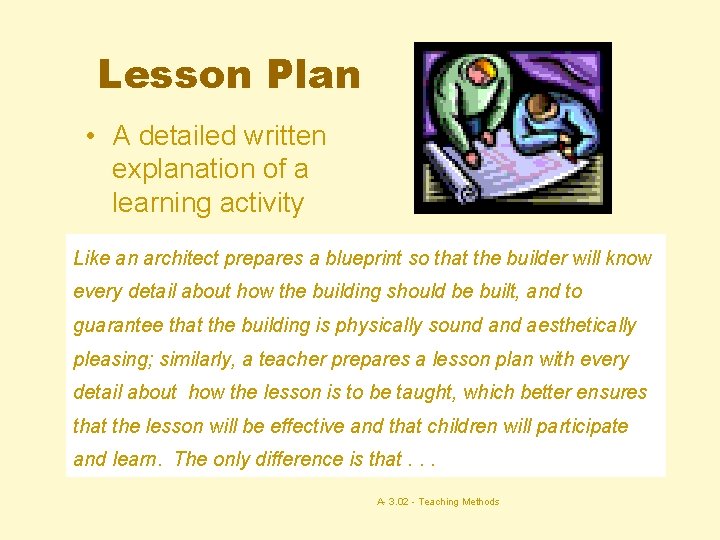
Lesson Plan • A detailed written explanation of a learning activity Like an architect prepares a blueprint so that the builder will know every detail about how the building should be built, and to guarantee that the building is physically sound aesthetically pleasing; similarly, a teacher prepares a lesson plan with every detail about how the lesson is to be taught, which better ensures that the lesson will be effective and that children will participate and learn. The only difference is that. . . A- 3. 02 - Teaching Methods 23
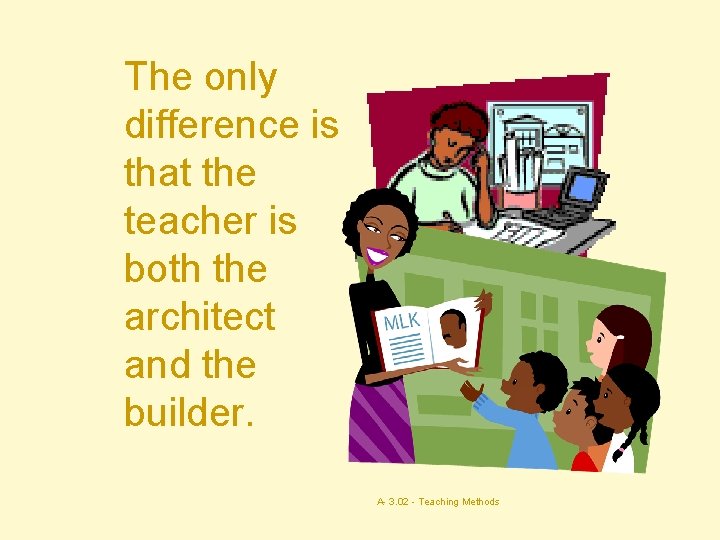
The only difference is that the teacher is both the architect and the builder. A- 3. 02 - Teaching Methods 24
Purposes of Lesson Plans • Serves as an organizational tool • Forces teachers to think ahead • Enables teachers to think through what they want to do • Provides time to gather needed materials • Can be saved for future reference A- 3. 02 - Teaching Methods 25
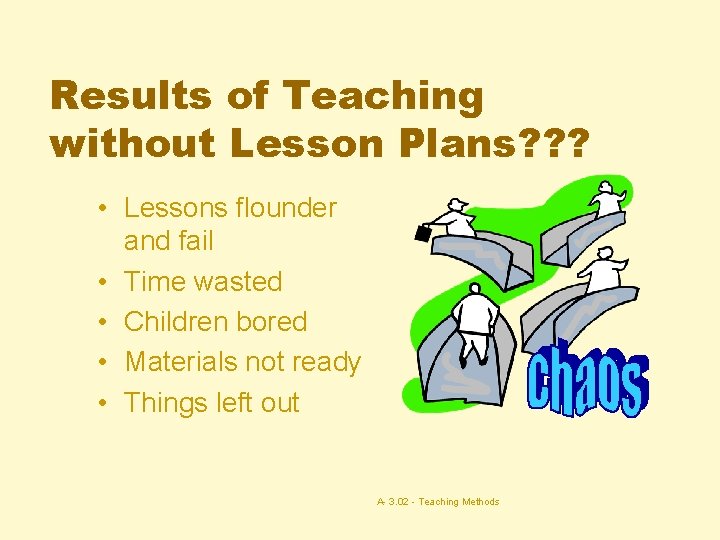
Results of Teaching without Lesson Plans? ? ? • Lessons flounder and fail • Time wasted • Children bored • Materials not ready • Things left out A- 3. 02 - Teaching Methods 26
Components of Lesson Plans Let’s look at • • • Target age group Topic or theme Purpose Concepts to be learned Skills to be developed Materials needed Procedures Questions Follow-up activities Evaluation each of these more closely. . . A- 3. 02 - Teaching Methods 27
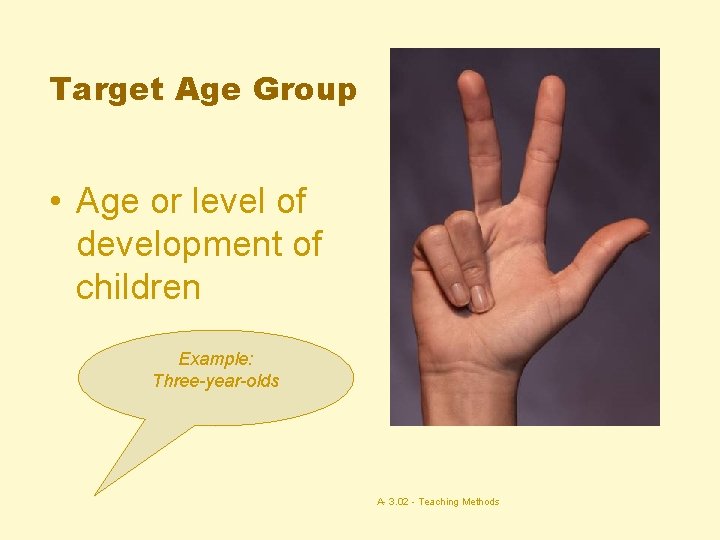
Target Age Group • Age or level of development of children Example: Three-year-olds A- 3. 02 - Teaching Methods 28
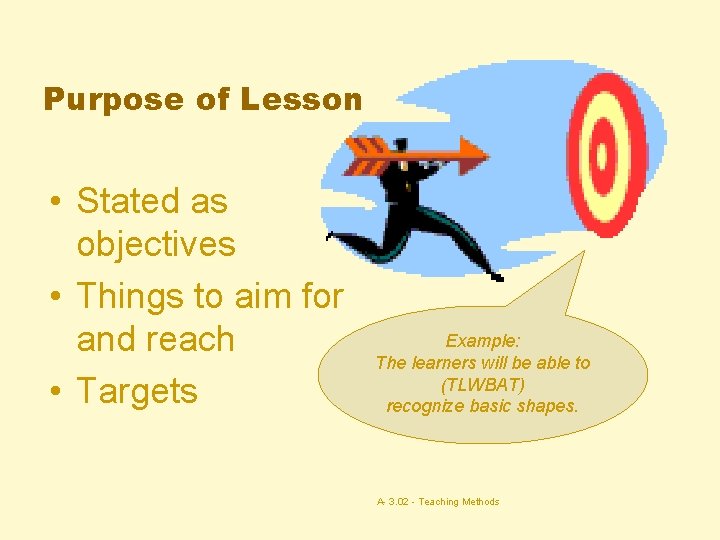
Purpose of Lesson • Stated as objectives • Things to aim for and reach • Targets Example: The learners will be able to (TLWBAT) recognize basic shapes. A- 3. 02 - Teaching Methods 29
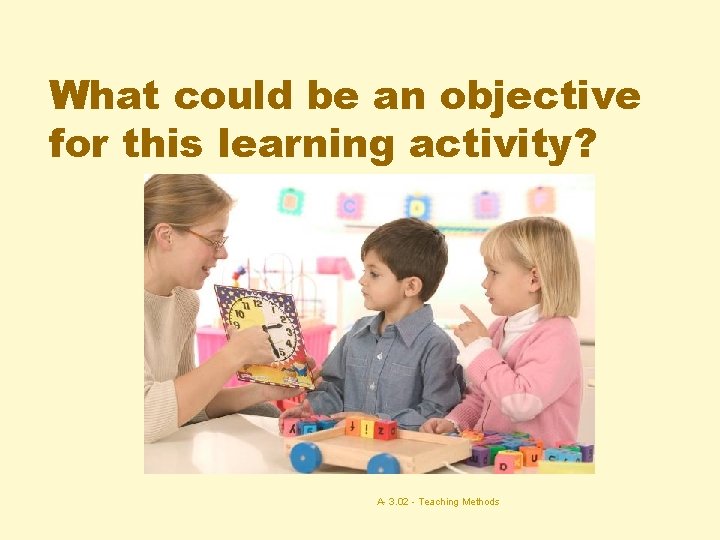
What could be an objective for this learning activity? A- 3. 02 - Teaching Methods 30
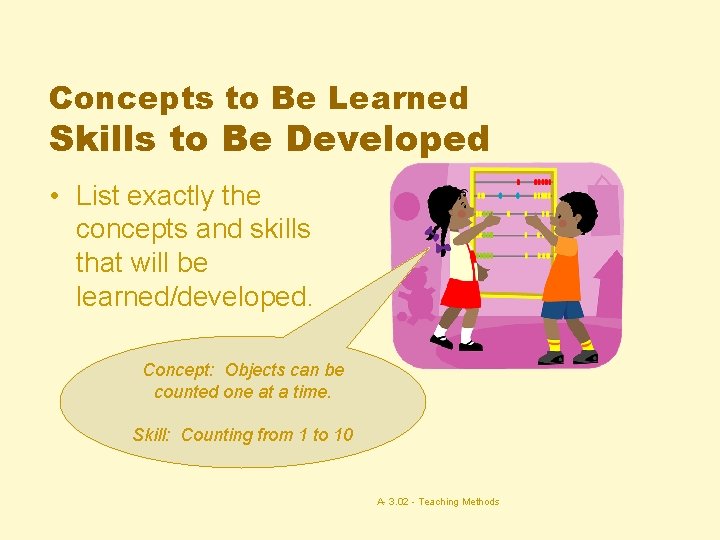
Concepts to Be Learned Skills to Be Developed • List exactly the concepts and skills that will be learned/developed. Concept: Objects can be counted one at a time. Skill: Counting from 1 to 10 A- 3. 02 - Teaching Methods 31
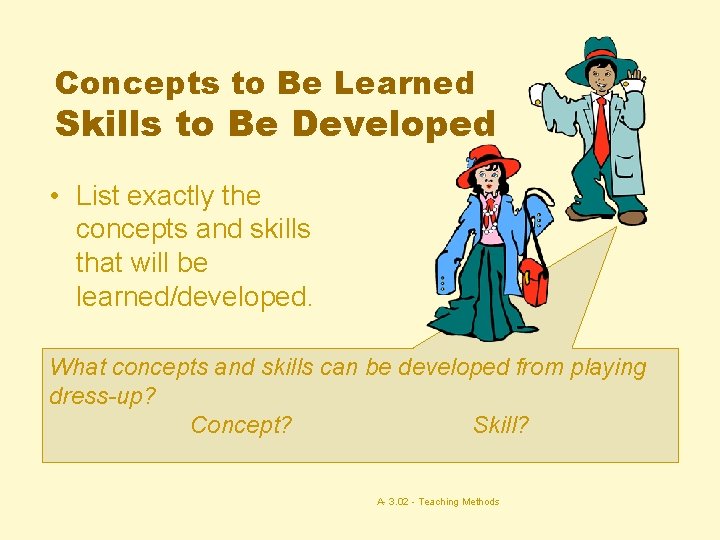
Concepts to Be Learned Skills to Be Developed • List exactly the concepts and skills that will be learned/developed. What concepts and skills can be developed from playing dress-up? Concept? Skill? A- 3. 02 - Teaching Methods 32
Materials Needed • List all materials needed • State quantities • This serves as the teacher’s checklist for getting prepared. (Example) Materials Needed 6 sets crayons 1 4 -in. paper square per child 6 bottles white glue Yarn, assorted lengths, colors A- 3. 02 - Teaching Methods 33
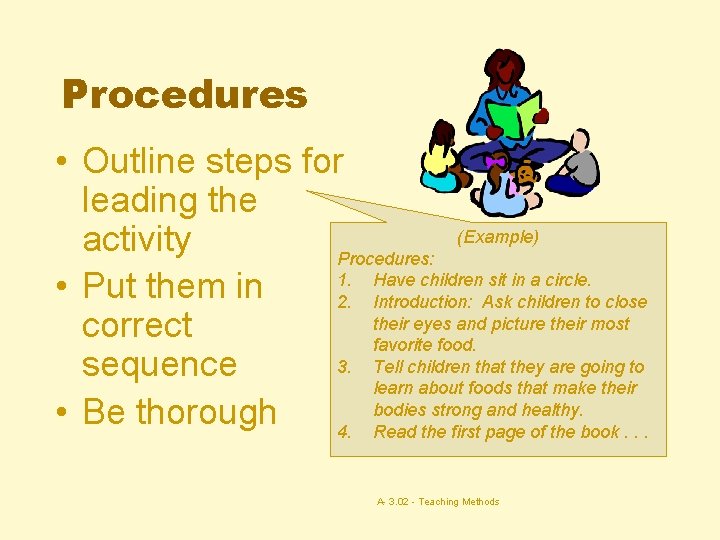
Procedures • Outline steps for leading the (Example) activity Procedures: 1. Have children sit in a circle. • Put them in 2. Introduction: Ask children to close their eyes and picture their most correct favorite food. 3. Tell children that they are going to sequence learn about foods that make their bodies strong and healthy. • Be thorough 4. Read the first page of the book. . . A- 3. 02 - Teaching Methods 34
Lessons usually include these lesson functions: • Focus and review - an introduction to capture attention, focus on the topic, review • Statement of objective – to state what children will learn • Teacher input – to introduce new information • Student guided practice – to give children a chance to use the new information • Independent practice –to see how well children can do things on their own • Closure - to summarize, bring the activity to an end A- 3. 02 - Teaching Methods 35
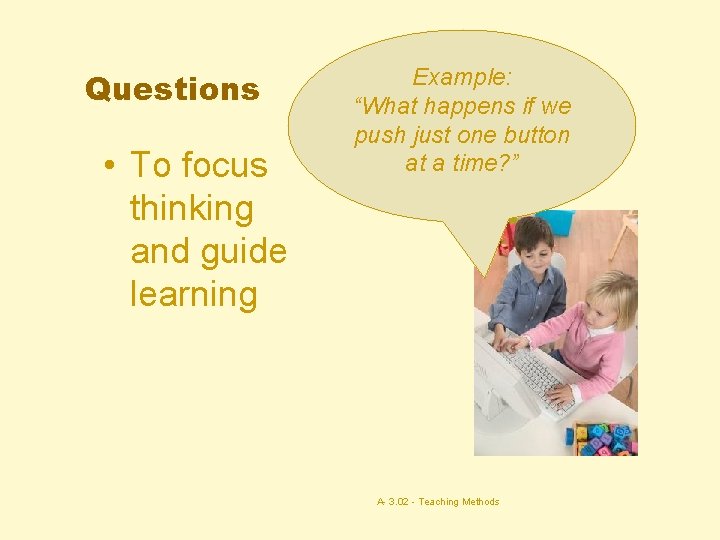
Questions • To focus thinking and guide learning Example: “What happens if we push just one button at a time? ” A- 3. 02 - Teaching Methods 36
Follow-up Activities • To reinforce what was learned • To provide additional help for children who need it A- 3. 02 - Teaching Methods 37
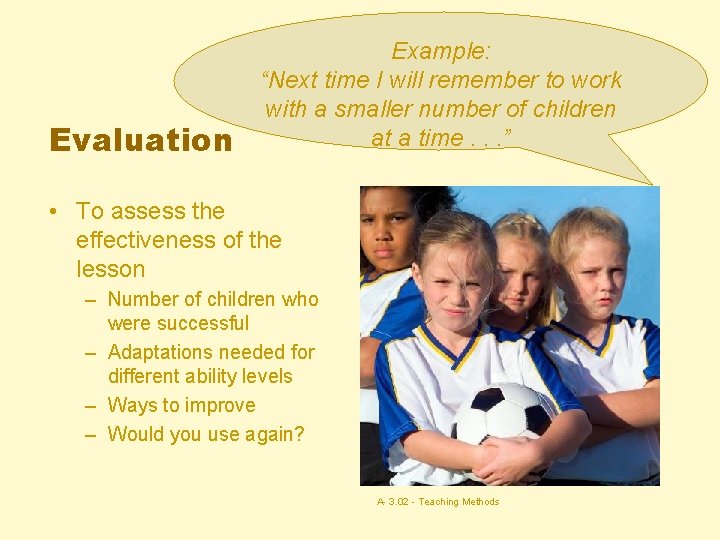
Evaluation Example: “Next time I will remember to work with a smaller number of children at a time. . . ” • To assess the effectiveness of the lesson – Number of children who were successful – Adaptations needed for different ability levels – Ways to improve – Would you use again? A- 3. 02 - Teaching Methods 38
Transitions • Short activities that guide children smoothly from one activity to another A- 3. 02 - Teaching Methods 39
Transition signals may be A- 3. 02 - Teaching Methods 40
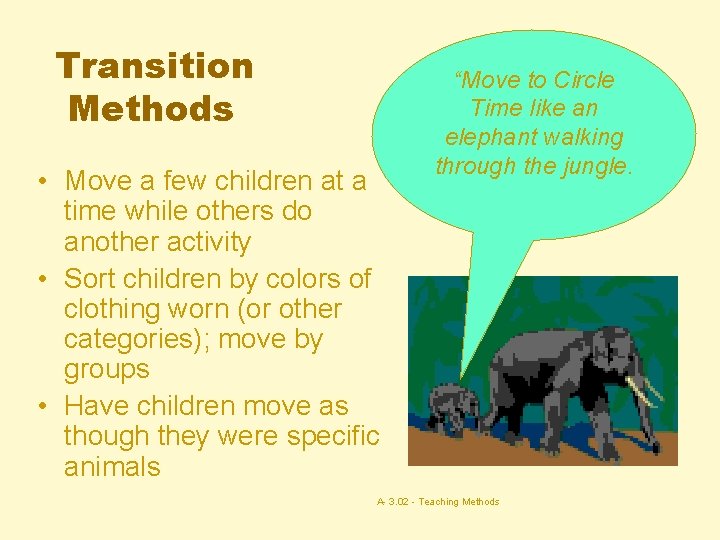
Transition Methods • Move a few children at a time while others do another activity • Sort children by colors of clothing worn (or other categories); move by groups • Have children move as though they were specific animals “Move to Circle Time like an elephant walking through the jungle. A- 3. 02 - Teaching Methods 41
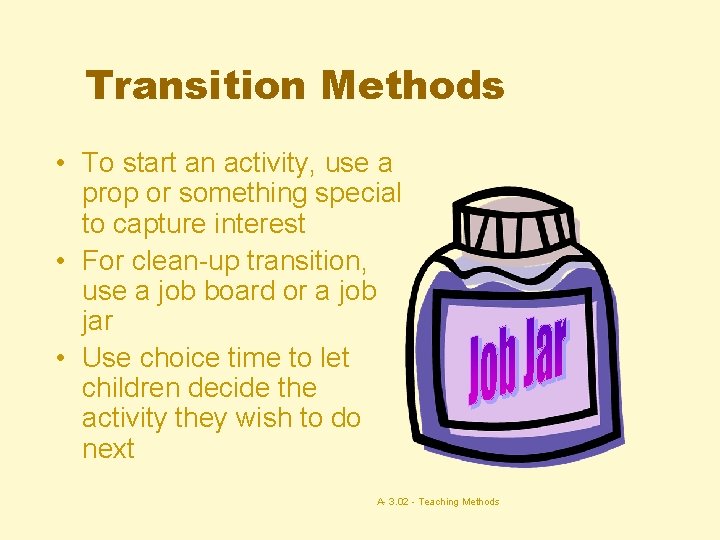
Transition Methods • To start an activity, use a prop or something special to capture interest • For clean-up transition, use a job board or a job jar • Use choice time to let children decide the activity they wish to do next A- 3. 02 - Teaching Methods 42
Teaching Young Children Part 3: Using Teaching Methods ØTeaching Styles ØTeaching Techniques A- 3. 02 - Teaching Methods 43
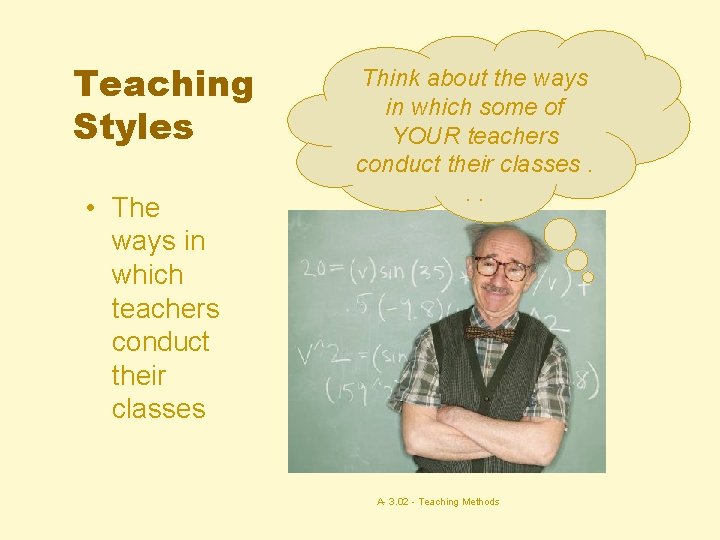
Teaching Styles • The ways in which teachers conduct their classes Think about the ways in which some of YOUR teachers conduct their classes. . . A- 3. 02 - Teaching Methods 44
Teaching style includes • The teacher’s expectations about behavior • The degree of structure in lessons • The degree of spontaneity in lessons What’s spontaneity ? You know, spontaneous! Spontaneity is when the teacher follows her impulses, lets things happen naturally. A- 3. 02 - Teaching Methods 45
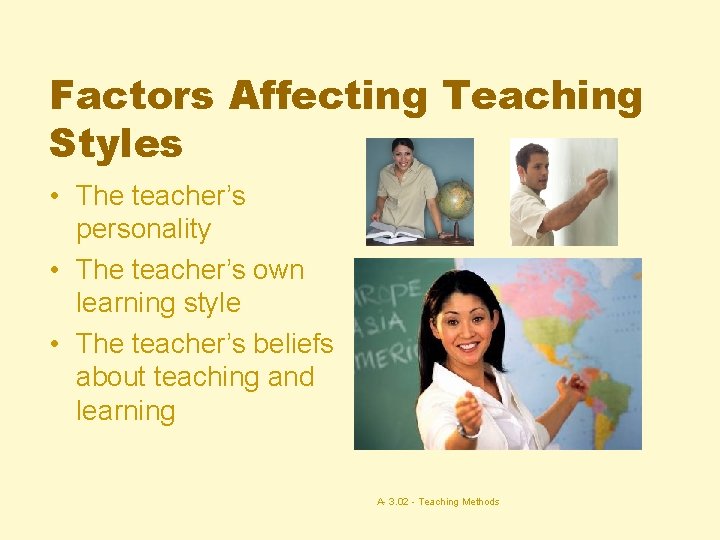
Factors Affecting Teaching Styles • The teacher’s personality • The teacher’s own learning style • The teacher’s beliefs about teaching and learning A- 3. 02 - Teaching Methods 46
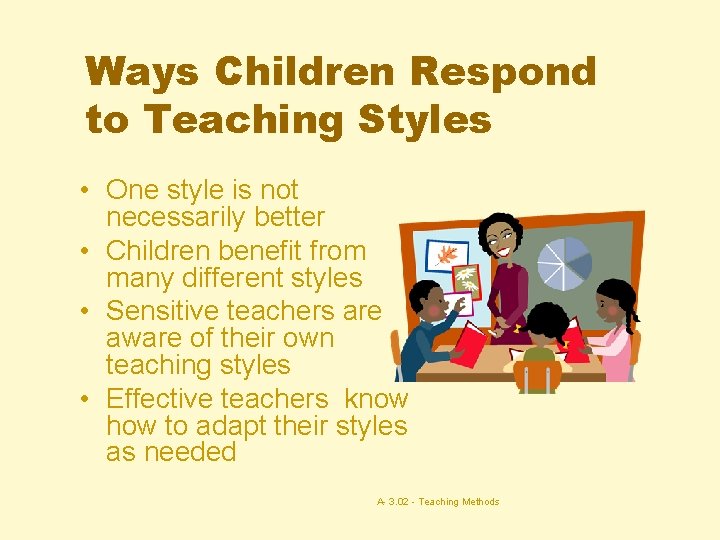
Ways Children Respond to Teaching Styles • One style is not necessarily better • Children benefit from many different styles • Sensitive teachers are aware of their own teaching styles • Effective teachers know how to adapt their styles as needed A- 3. 02 - Teaching Methods 47
ØTeaching Techniques A- 3. 02 - Teaching Methods 48
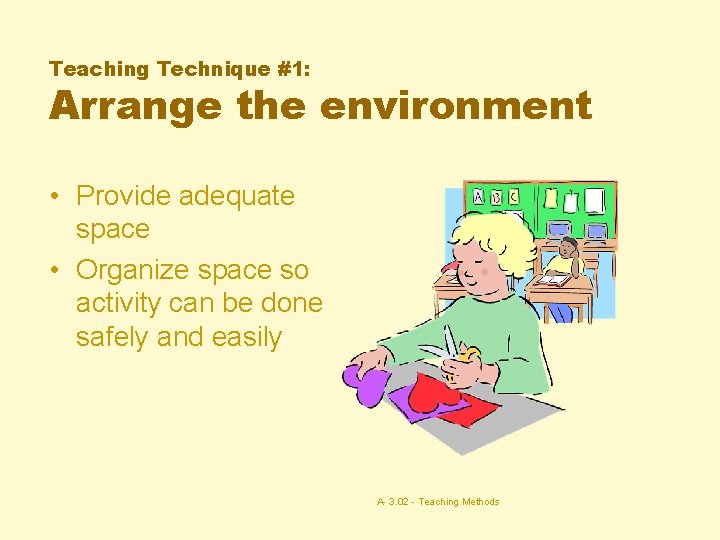
Teaching Technique #1: Arrange the environment • Provide adequate space • Organize space so activity can be done safely and easily A- 3. 02 - Teaching Methods 49
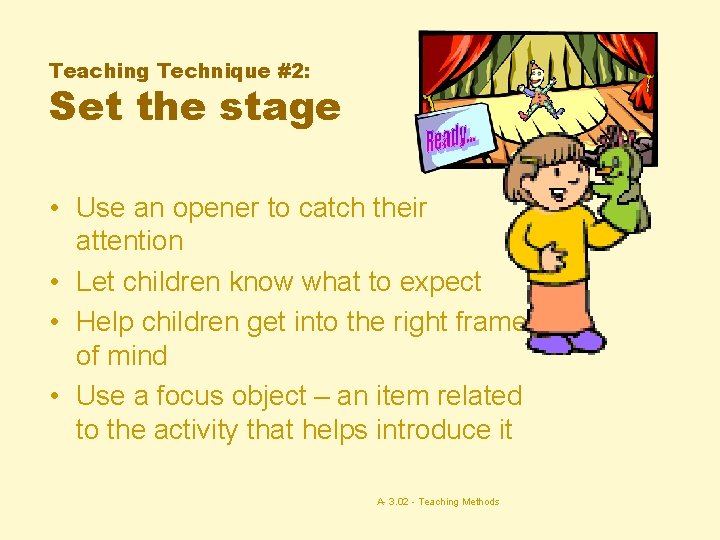
Teaching Technique #2: Set the stage • Use an opener to catch their attention • Let children know what to expect • Help children get into the right frame of mind • Use a focus object – an item related to the activity that helps introduce it A- 3. 02 - Teaching Methods 50
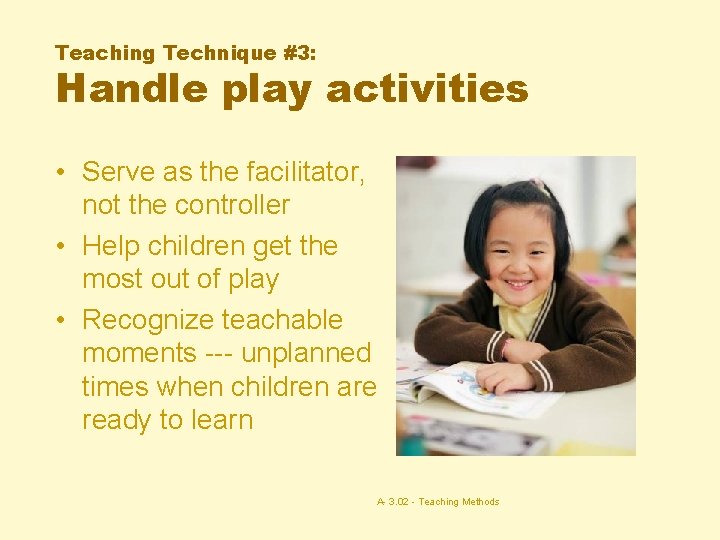
Teaching Technique #3: Handle play activities • Serve as the facilitator, not the controller • Help children get the most out of play • Recognize teachable moments --- unplanned times when children are ready to learn A- 3. 02 - Teaching Methods 51
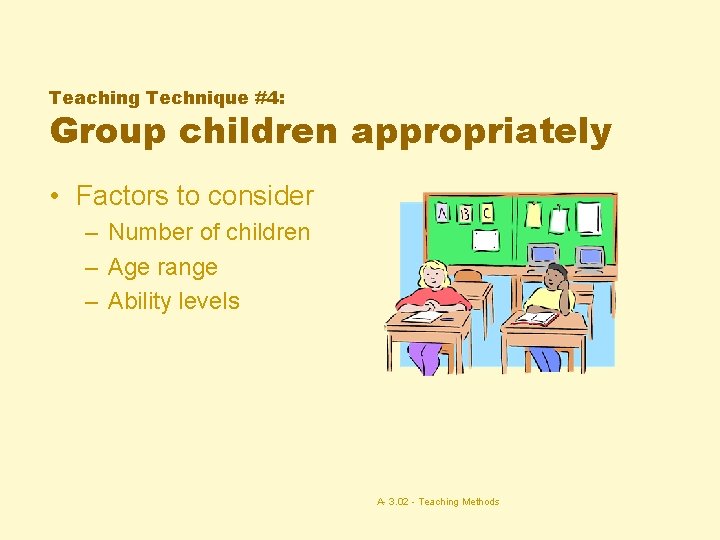
Teaching Technique #4: Group children appropriately • Factors to consider – Number of children – Age range – Ability levels A- 3. 02 - Teaching Methods 52
Methods of Grouping • Chronological grouping – same age together • Developmental grouping – same ability levels together • Family grouping – same age range together • Random grouping – grouping with no pattern in mind; each child has an equal chance to be in any group A- 3. 02 - Teaching Methods 53
Advantages/Disadvantages of Grouping by Age or Ability • Advantage: Easier to plan lessons • Disadvantage: Children miss the opportunity to relate to children of other ages/abilities • Can you think of other advantages or disadvantages? A- 3. 02 - Teaching Methods 54
Advantages/Disadvantages of Family Grouping • Advantage: Individual children have a greater chance of learning • Advantage: Children have more opportunity to learn to relate with children of other ages • Disadvantage: The range of developmental needs is challenging for teachers • Can you think of other advantages or disadvantages? A- 3. 02 - Teaching Methods 55
Conditions under which smaller groups are needed: 1. When much personal attention is required 2. When learning new skills 3. When the activity is complex 4. With younger children 5. When children are prone to misbehave A- 3. 02 - Teaching Methods 56
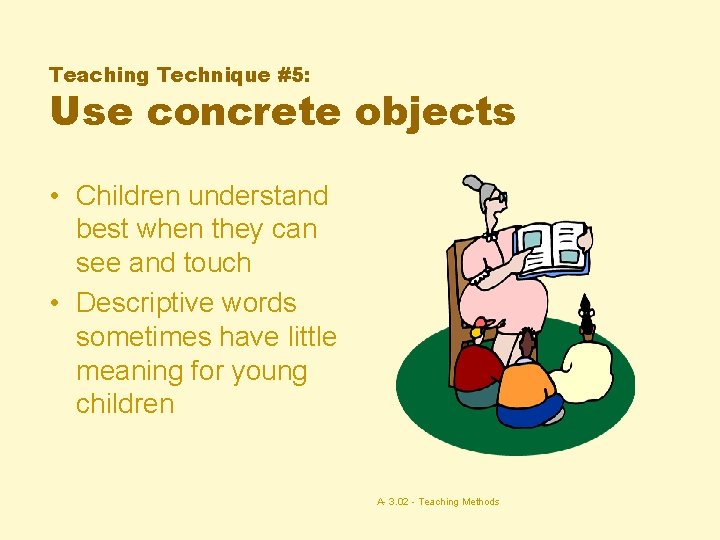
Teaching Technique #5: Use concrete objects • Children understand best when they can see and touch • Descriptive words sometimes have little meaning for young children A- 3. 02 - Teaching Methods 57
Teaching Technique #6: Use open-ended questions • Require more than a “yes” or “no” answer • There is no right or wrong response • Encourage children to express themselves • Stimulate creativity and language development A- 3. 02 - Teaching Methods 58
Teaching Technique #7: Use other techniques effectively. • Visuals can reinforce learning • Props can capture attention and add variety A- 3. 02 - Teaching Methods 59

That’s all for now! A- 3. 02 - Teaching Methods 60
- Slides: 60