
Teaching Writing to Second Language Learners Focusing on


- Slides: 26
Teaching Writing to Second. Language Learners: Focusing on Vocabulary over Grammar Michael Goeller and Agnieszka Goeller Rutgers University
Over 1 Million International Students
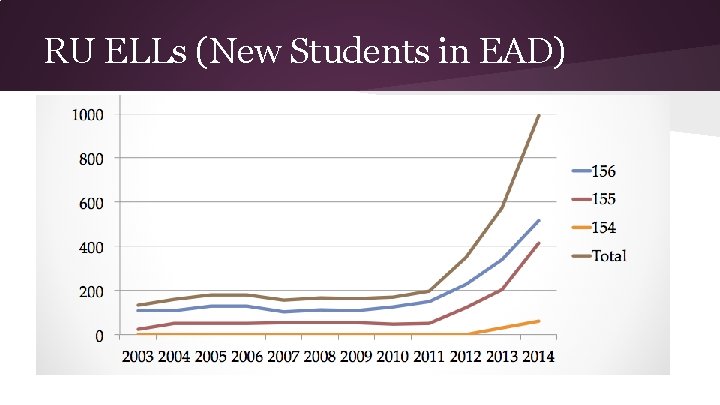
RU ELLs (New Students in EAD)
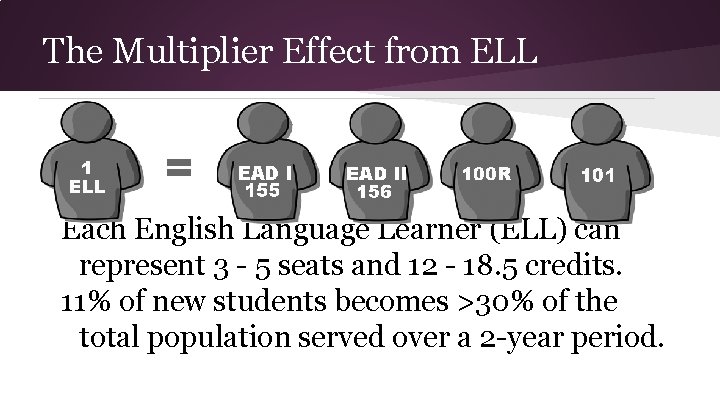
The Multiplier Effect from ELL Each English Language Learner (ELL) can represent 3 - 5 seats and 12 - 18. 5 credits. 11% of new students becomes >30% of the total population served over a 2 -year period.
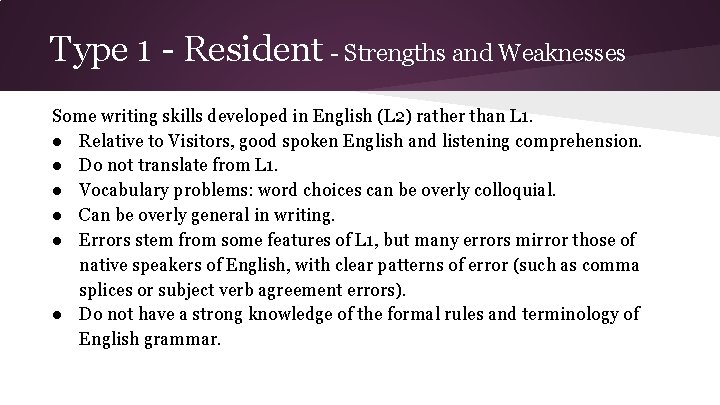
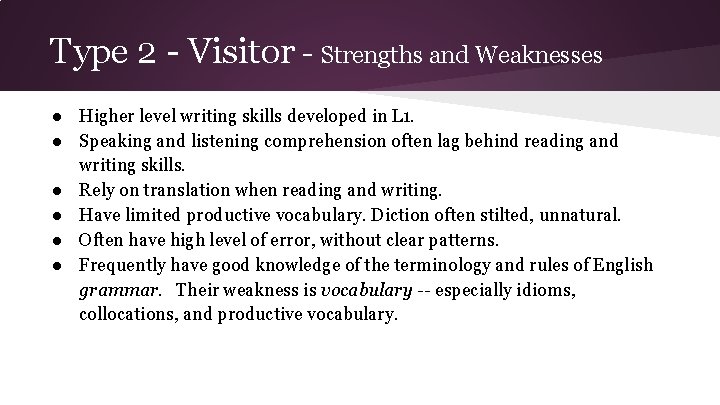
Changes in ELL population at Rutgers Type 1 - Resident: Typical of 4 years ago or more Immigrated early in life or a child of immigrants. The native language (L 1) continues to be spoken at home. A significant portion of schooling in the U. S. (at least some high school) in English-language environments. Most had lived in the US for 2 years or more. Type 2 - Visitor: Typical of the past 4 years Arrived in the U. S. less than a month before the first day of class.
Type 1 - Resident - Strengths and Weaknesses Some writing skills developed in English (L 2) rather than L 1. ● Relative to Visitors, good spoken English and listening comprehension. ● Do not translate from L 1. ● Vocabulary problems: word choices can be overly colloquial. ● Can be overly general in writing. ● Errors stem from some features of L 1, but many errors mirror those of native speakers of English, with clear patterns of error (such as comma splices or subject verb agreement errors). ● Do not have a strong knowledge of the formal rules and terminology of English grammar.
Type 2 - Visitor - Strengths and Weaknesses ● Higher level writing skills developed in L 1. ● Speaking and listening comprehension often lag behind reading and writing skills. ● Rely on translation when reading and writing. ● Have limited productive vocabulary. Diction often stilted, unnatural. ● Often have high level of error, without clear patterns. ● Frequently have good knowledge of the terminology and rules of English grammar. Their weakness is vocabulary -- especially idioms, collocations, and productive vocabulary.
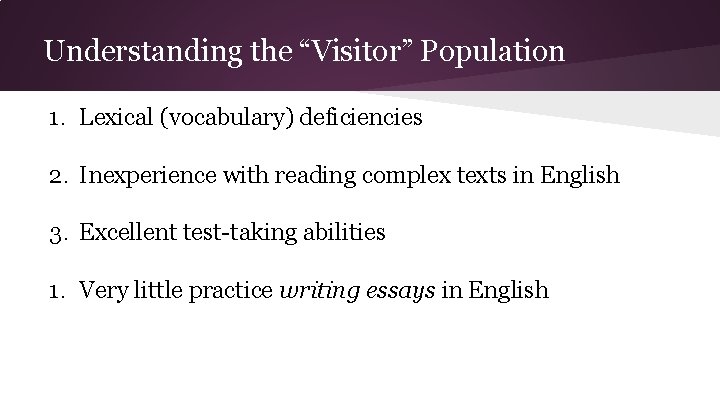
Understanding the “Visitor” Population 1. Lexical (vocabulary) deficiencies 2. Inexperience with reading complex texts in English 3. Excellent test-taking abilities 1. Very little practice writing essays in English
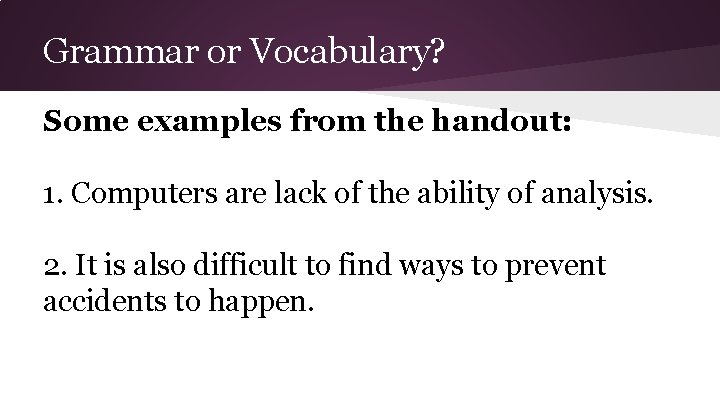
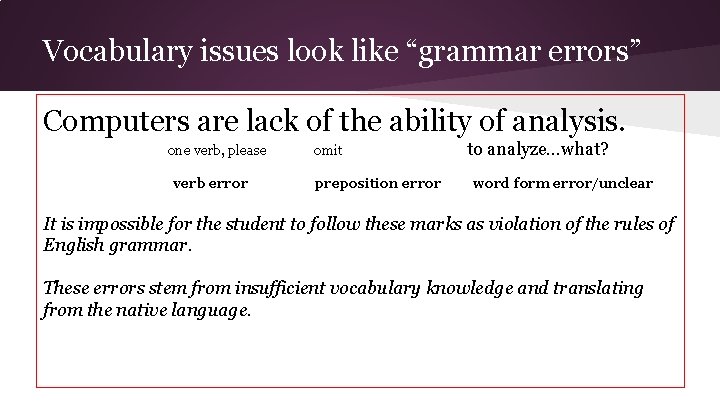
Grammar or Vocabulary? Some examples from the handout: 1. Computers are lack of the ability of analysis. 2. It is also difficult to find ways to prevent accidents to happen.
Vocabulary issues look like “grammar errors” Computers are lack of the ability of analysis. one verb, please verb error omit preposition error to analyze. . . what? word form error/unclear It is impossible for the student to follow these marks as violation of the rules of English grammar. These errors stem from insufficient vocabulary knowledge and translating from the native language.
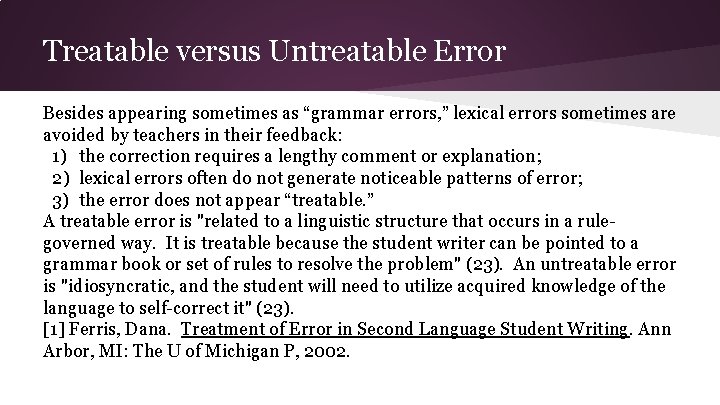
Treatable versus Untreatable Error Besides appearing sometimes as “grammar errors, ” lexical errors sometimes are avoided by teachers in their feedback: 1) the correction requires a lengthy comment or explanation; 2) lexical errors often do not generate noticeable patterns of error; 3) the error does not appear “treatable. ” A treatable error is "related to a linguistic structure that occurs in a rulegoverned way. It is treatable because the student writer can be pointed to a grammar book or set of rules to resolve the problem" (23). An untreatable error is "idiosyncratic, and the student will need to utilize acquired knowledge of the language to self-correct it" (23). [1] Ferris, Dana. Treatment of Error in Second Language Student Writing. Ann Arbor, MI: The U of Michigan P, 2002.
Reading and vocabulary learning are “synergistic” Research shows reading comprehension is poor if: 1. The vocabulary is insufficient; 2. Deceptively transparent words are misinterpreted; 3. Unknown words are guessed incorrectly. What percentage of the text should one know to make correct guesses of unknown words from context? Coady, J. and Huckin, T. Second Language Vocabulary Acquisition (1997), Cambridge.
Strategies for teaching vocabulary 1. During reading and discussion; 2. By orienting feedback on papers toward “noticing” lexical errors and praising lexical range and precision; 3. By making students respond to our sensitivity toward word choice and word form in vocabulary journals or logs.
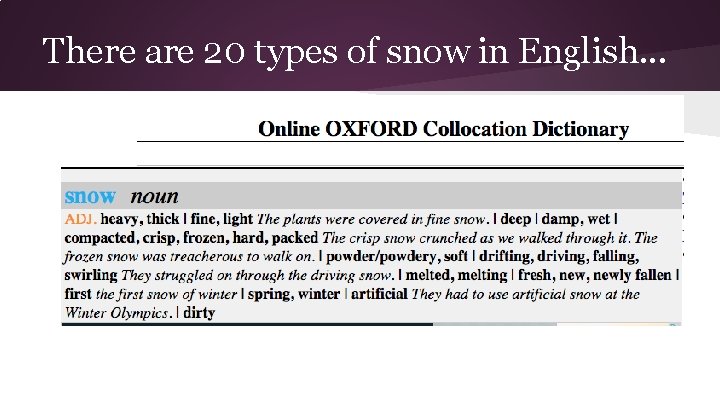
There are 20 types of snow in English. . .
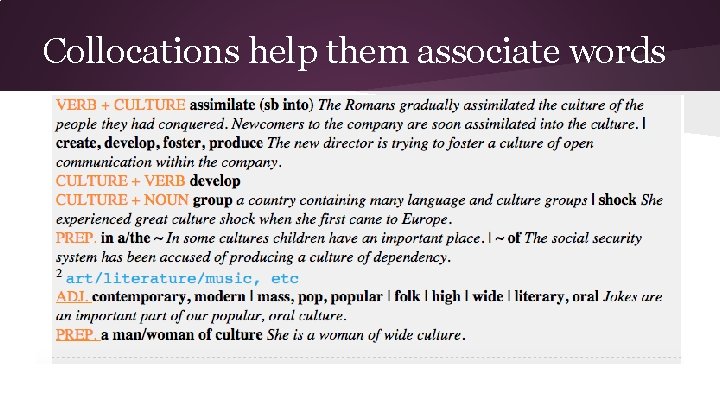
Teach them collocations
Collocations help them associate words
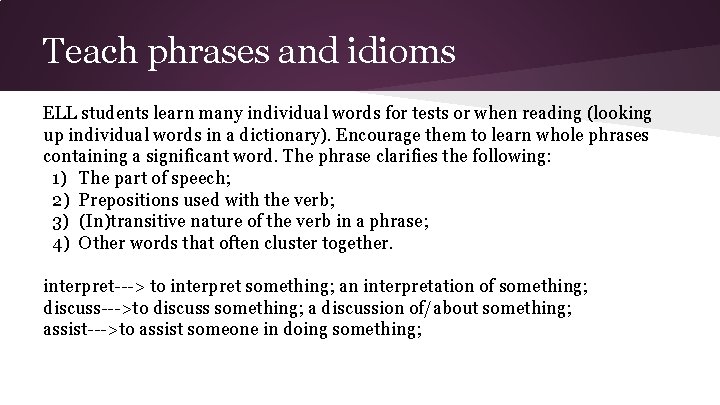
Teach phrases and idioms ELL students learn many individual words for tests or when reading (looking up individual words in a dictionary). Encourage them to learn whole phrases containing a significant word. The phrase clarifies the following: 1) The part of speech; 2) Prepositions used with the verb; 3) (In)transitive nature of the verb in a phrase; 4) Other words that often cluster together. interpret---> to interpret something; an interpretation of something; discuss--->to discuss something; a discussion of/about something; assist--->to assist someone in doing something;
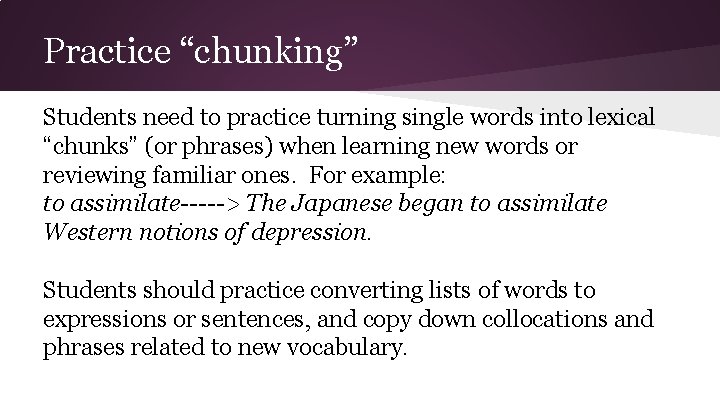
Practice “chunking” Students need to practice turning single words into lexical “chunks” (or phrases) when learning new words or reviewing familiar ones. For example: to assimilate-----> The Japanese began to assimilate Western notions of depression. Students should practice converting lists of words to expressions or sentences, and copy down collocations and phrases related to new vocabulary.
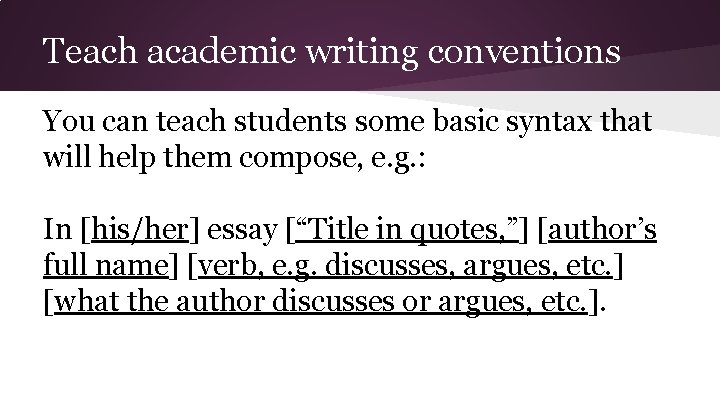
Teach academic writing conventions You can teach students some basic syntax that will help them compose, e. g. : In [his/her] essay [“Title in quotes, ”] [author’s full name] [verb, e. g. discusses, argues, etc. ] [what the author discusses or argues, etc. ].
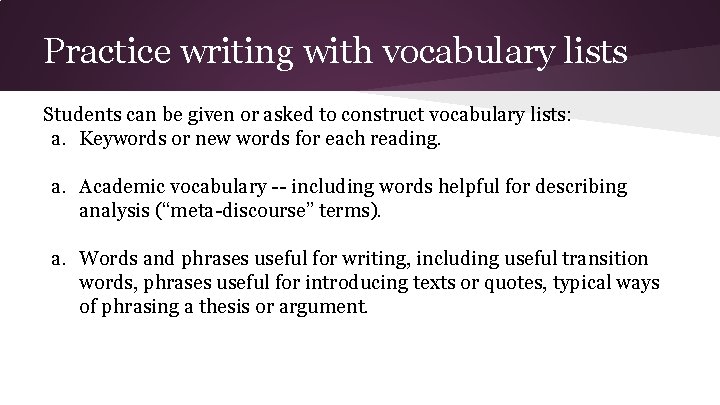
Practice writing with vocabulary lists Students can be given or asked to construct vocabulary lists: a. Keywords or new words for each reading. a. Academic vocabulary -- including words helpful for describing analysis (“meta-discourse” terms). a. Words and phrases useful for writing, including useful transition words, phrases useful for introducing texts or quotes, typical ways of phrasing a thesis or argument.
Get students to use a practice journal Journals can be used for short writing exercises and independent learning. Help students by identifying the words that should go into their journals based on their errors. International students can be confused by marks and feedback.
Get students to use basic tools Tell them to bring a dictionary if they don’t already do so. Practice using it. Point them to online resources, such as the Oxford Collocation Dictionary. Make sure they have the grammar book and get them to use it.
Give ELLs short writing exercises Individual exercises (as discussed). Practice defining terms in their own words or using them in a sentence. Practice describing events or people from the reading. Practice summarizing the author’s argument.
Original EAD design Extended drafting sequence (2 rough drafts followed by a final draft); Rapid progression from the texts into the writing of the paper; Revision/editing/proofreading tasks often focused attention on language correctness
New course design in EAD more readings and focus on reading skills; more time for structured discussion; short writing assignments to assist in assimilating new concepts and vocabulary from the texts as a way of priming the productive vocabulary for the main writing tasks (4 papers).
EAD Courses at Rutgers Main Courses: English as Academic Discourse Fundamentals New design English as an Academic Discourse I (EAD I) New design English as an Academic Discourse II (EAD II) New design Support Courses: Discussion and Presentation Skills - New course (Fall 2014) Grammar Workshop - New course (Fall 2014) Writing Centers offer drop-in grammar tutoring - (Fall 2011) Reading Workshops - New course (Fall 2016)