
Teaching with mathematical modeling providing multiple entry points

- Slides: 22
Teaching with mathematical modeling: providing multiple entry points and connections Mary Beth Searcy Appalachian State University Boone, North Carolina USA Seminario Internacional sobre Modelamiento Matemático: Santiago, Chile 10 January 2013
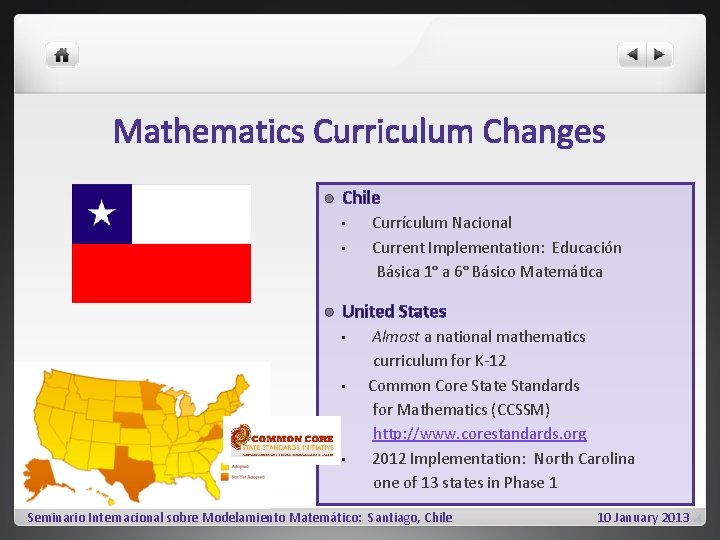
Mathematics Curriculum Changes l Chile Currículum Nacional • Current Implementation: Educación Básica 1° a 6° Básico Matemática • l United States Almost a national mathematics curriculum for K-12 • Common Core State Standards for Mathematics (CCSSM) http: //www. corestandards. org • 2012 Implementation: North Carolina one of 13 states in Phase 1 • Seminario Internacional sobre Modelamiento Matemático: Santiago, Chile 10 January 2013
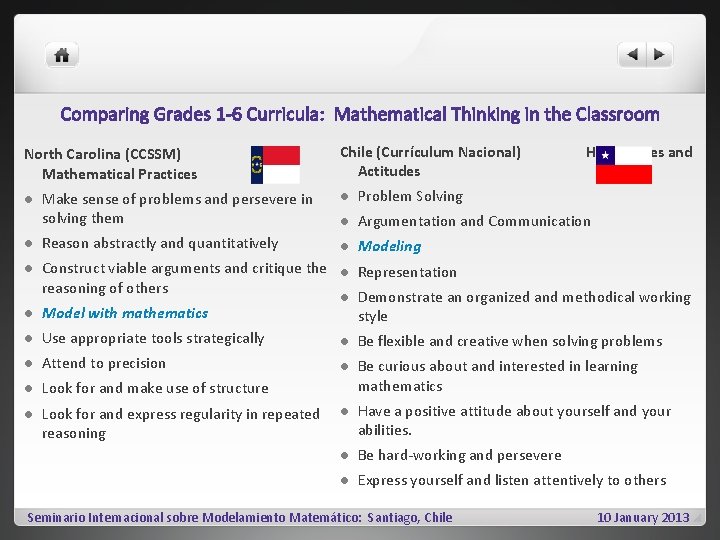
Comparing Grades 1 -6 Curricula: Mathematical Thinking in the Classroom North Carolina (CCSSM) Mathematical Practices l Make sense of problems and persevere in solving them Chile (Currículum Nacional) Actitudes Habilidades and l Problem Solving l Argumentation and Communication l Reason abstractly and quantitatively l Modeling l Construct viable arguments and critique the reasoning of others l Representation l Demonstrate an organized and methodical working style l Model with mathematics l Use appropriate tools strategically l Be flexible and creative when solving problems l Attend to precision l l Look for and make use of structure Be curious about and interested in learning mathematics l Look for and express regularity in repeated reasoning l Have a positive attitude about yourself and your abilities. l Be hard-working and persevere l Express yourself and listen attentively to others Seminario Internacional sobre Modelamiento Matemático: Santiago, Chile 10 January 2013
Teaching with Mathematical Modeling -- My journey started with questions l Why do I want to use modeling in my classroom? l How can I include modeling in the curriculum? l How can I make sure that my students make the mathematical connections within modeling? l What is teaching with modeling anyway? Seminario Internacional sobre Modelamiento Matemático: Santiago, Chile 10 January 2013
Why Teach with Mathematical Modeling? Reason #1: The Experience of Modeling l Students discover something new l Generates excitement about answering a question when “THE answer” is not known l Students see modeling as a complex process l Promotes creativity and communication Seminario Internacional sobre Modelamiento Matemático: Santiago, Chile 10 January 2013
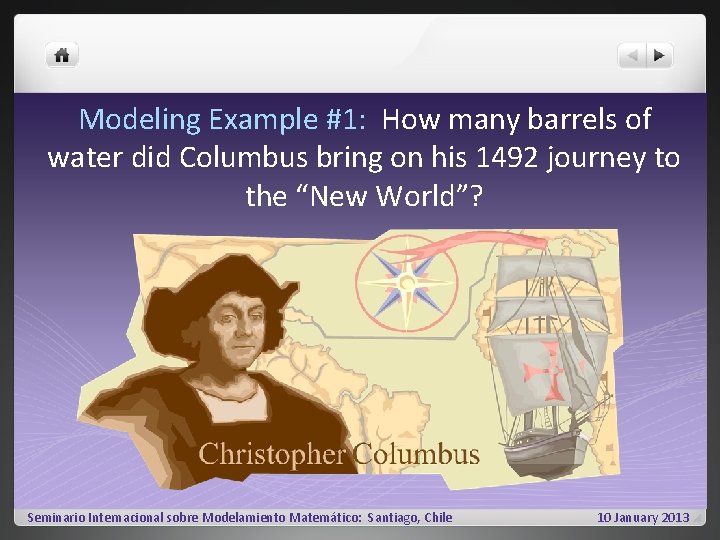
Modeling Example #1: How many barrels of water did Columbus bring on his 1492 journey to the “New World”? Seminario Internacional sobre Modelamiento Matemático: Santiago, Chile 10 January 2013
Modeling: Columbus’ Journey and Water l Voyage manifests were lost – we do not know the answer l Can be modeled by different levels of students l Students l Ask questions – what impacts the need for water? l Learn more about Columbus’ journey and the world in the late 1400’s l Justify their choice of mathematical tools l Communicate their solution processes Seminario Internacional sobre Modelamiento Matemático: Santiago, Chile 10 January 2013
Why Teach with Mathematical Modeling? Reason #2: Reinforce Mathematical Concepts l Allows more opportunities to use mathematic concepts students have learned. l Helps draw connections to other mathematics concepts l Allows student to see how mathematical concepts are interpreted in terms of real world situations. l Promotes curiosity l Helps build foundation for more complex mathematical ideas. Seminario Internacional sobre Modelamiento Matemático: Santiago, Chile 10 January 2013
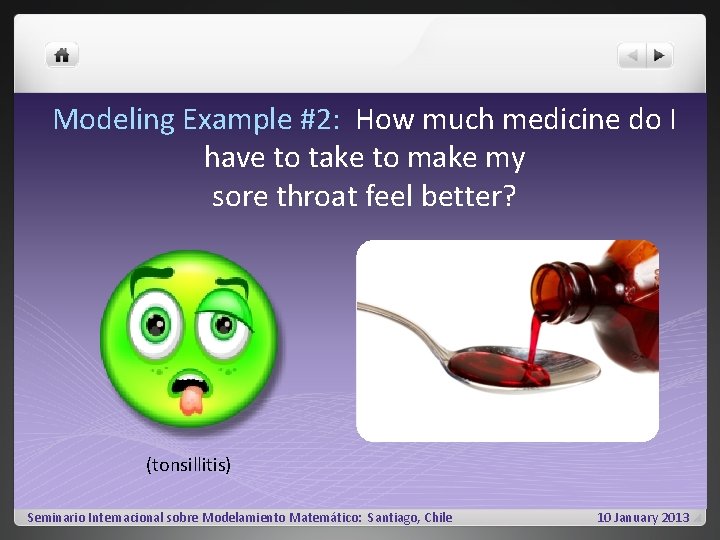
Modeling Example #2: How much medicine do I have to take to make my sore throat feel better? (tonsillitis) Seminario Internacional sobre Modelamiento Matemático: Santiago, Chile 10 January 2013
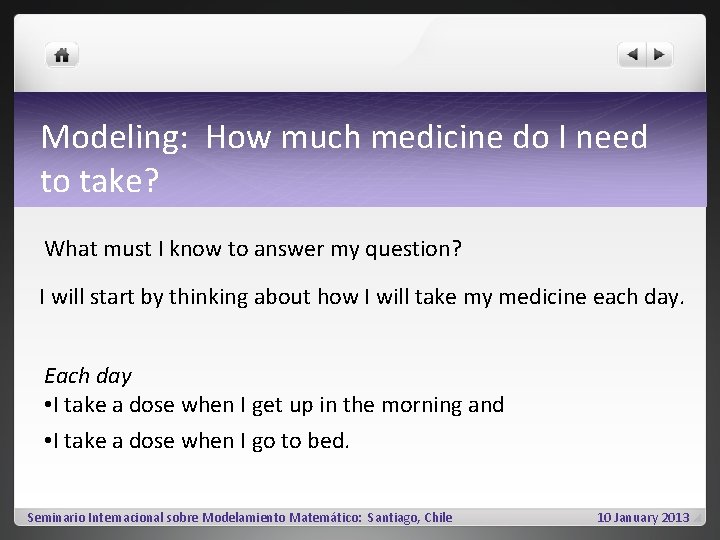
Modeling: How much medicine do I need to take? What must I know to answer my question? I will start by thinking about how I will take my medicine each day. Each day • I take a dose when I get up in the morning and • I take a dose when I go to bed. Seminario Internacional sobre Modelamiento Matemático: Santiago, Chile 10 January 2013
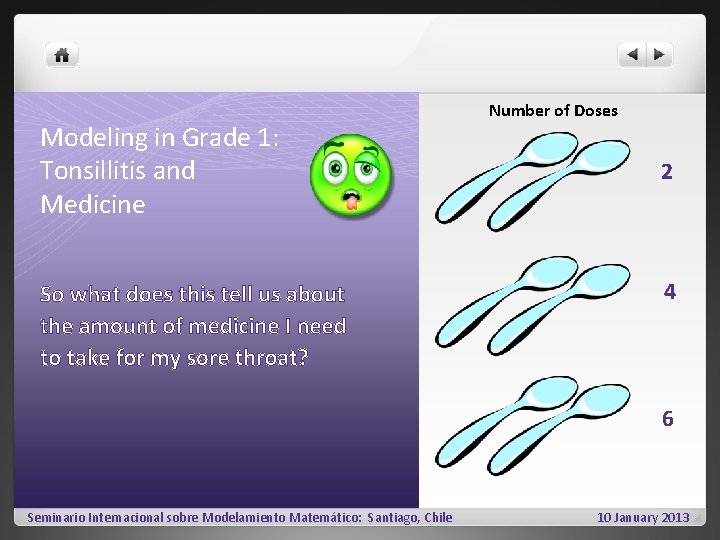
Modeling in Grade 1: Tonsillitis and Medicine So what does this tell us about the amount of medicine I need to take for my sore throat? Number of Doses 2 4 6 Seminario Internacional sobre Modelamiento Matemático: Santiago, Chile 10 January 2013
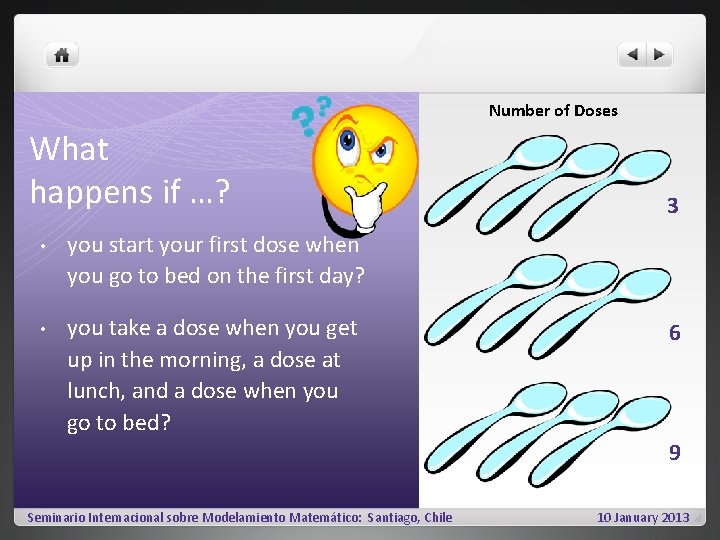
Number of Doses What happens if …? • you start your first dose when you go to bed on the first day? • you take a dose when you get up in the morning, a dose at lunch, and a dose when you go to bed? 3 6 9 Seminario Internacional sobre Modelamiento Matemático: Santiago, Chile 10 January 2013
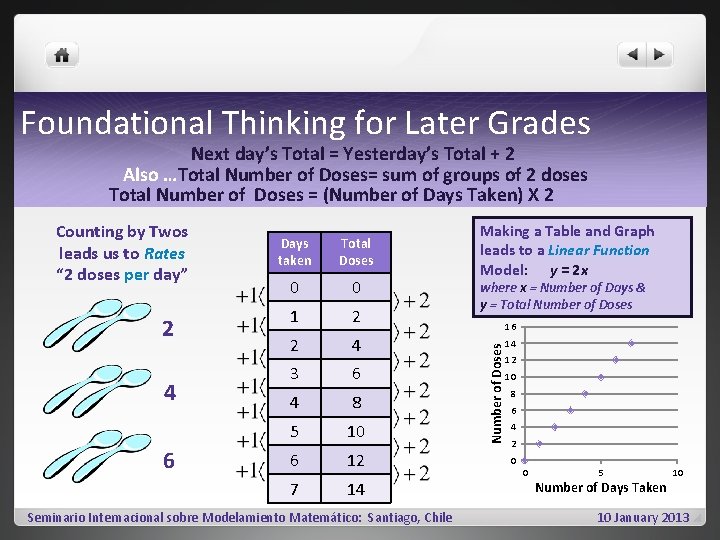
Foundational Thinking for Later Grades Next day’s Total = Yesterday’s Total + 2 Also …Total Number of Doses= sum of groups of 2 doses Total Number of Doses = (Number of Days Taken) X 2 2 4 6 Days taken Total Doses 0 0 1 2 2 4 3 6 4 8 5 10 6 12 7 14 Seminario Internacional sobre Modelamiento Matemático: Santiago, Chile Making a Table and Graph leads to a Linear Function Model: y = 2 x where x = Number of Days & y = Total Number of Doses 16 Number of Doses Counting by Twos leads us to Rates “ 2 doses per day” 14 12 10 8 6 4 2 0 0 5 Number of Days Taken 10 10 January 2013
Why Teach with Mathematical Modeling? Reason #3: Introduce New Concepts l Explore a familiar situation with mathematics l Analyze situation and uncover the need for a new mathematical concept l Promotes further research on the situation Seminario Internacional sobre Modelamiento Matemático: Santiago, Chile 10 January 2013
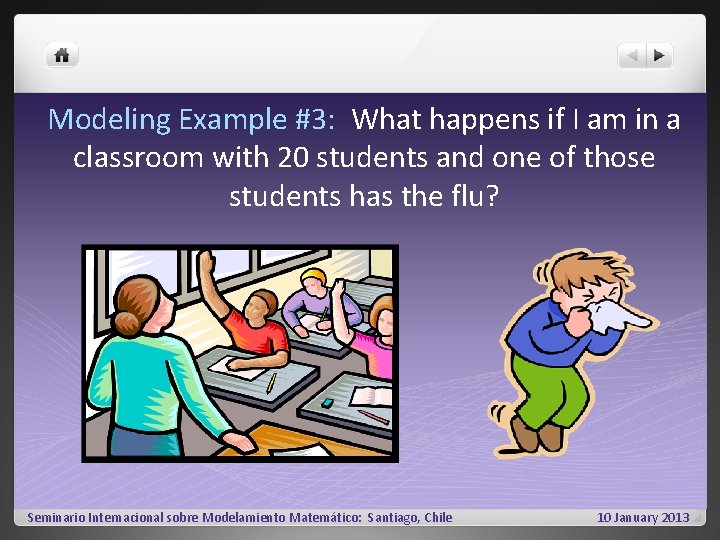
Modeling Example #3: What happens if I am in a classroom with 20 students and one of those students has the flu? Seminario Internacional sobre Modelamiento Matemático: Santiago, Chile 10 January 2013
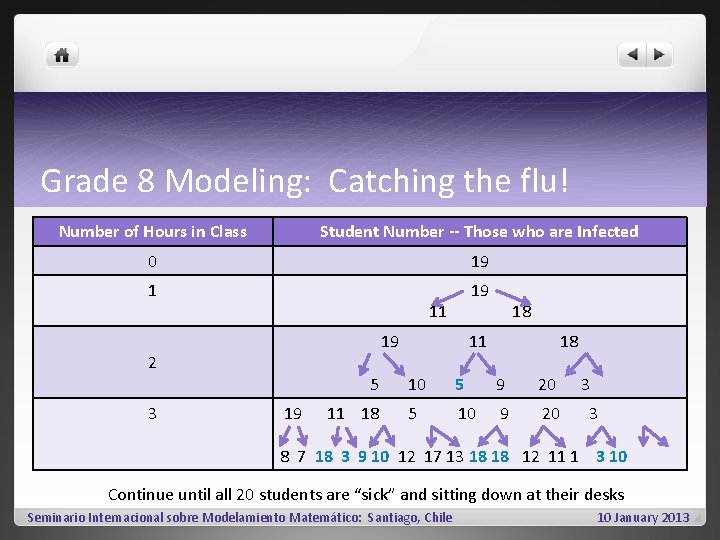
Modeling: What will happen to the class when one person has the flu? What do I know about the spread of germs? Let us start with a simple idea … Each hour, an infected person will come in contact with two people and thus spread the flu germ to two people. Seminario Internacional sobre Modelamiento Matemático: Santiago, Chile 10 January 2013
Grade 8 Modeling: Catching the flu! Let us explore this situation with an activity. Give each of the twenty students a natural number, starting with 1 up to 20. Now you have Student No. 1, Student No. 2, Student No. 3, Student No. 4, … , Student No. 20. Using a random number generator from natural numbers 1 to 20, we will select which student comes into class with the flu. Continue to use random number generator to see who comes in contact with “sick” students. Seminario Internacional sobre Modelamiento Matemático: Santiago, Chile 10 January 2013
Grade 8 Modeling: Catching the flu! Number of Hours in Class Student Number -- Those who are Infected 0 19 11 18 2 3 19 11 18 5 10 5 9 20 3 19 11 18 5 10 9 20 3 8 7 18 3 9 10 12 17 13 18 18 12 11 1 3 10 Continue until all 20 students are “sick” and sitting down at their desks Seminario Internacional sobre Modelamiento Matemático: Santiago, Chile 10 January 2013
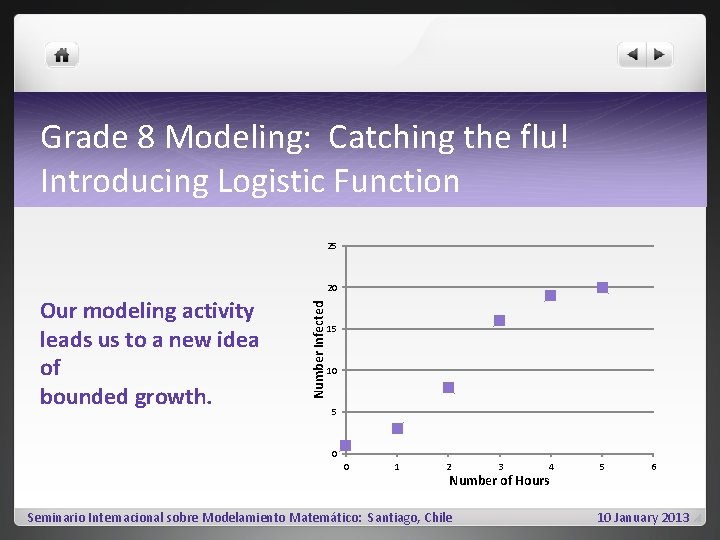
Grade 8 Modeling: Catching the flu! Introducing Logistic Function 25 Our modeling activity leads us to a new idea of bounded growth. Number Infected 20 15 10 5 0 0 1 2 3 4 Number of Hours Seminario Internacional sobre Modelamiento Matemático: Santiago, Chile 5 6 10 January 2013
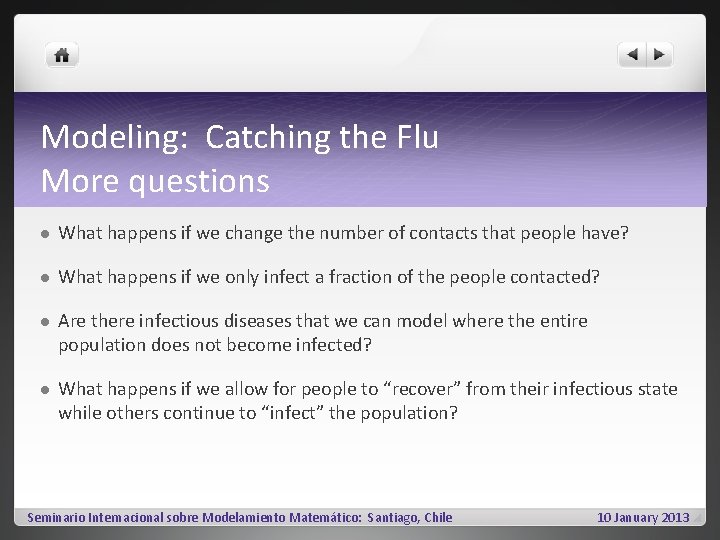
Modeling: Catching the Flu More questions l What happens if we change the number of contacts that people have? l What happens if we only infect a fraction of the people contacted? l Are there infectious diseases that we can model where the entire population does not become infected? l What happens if we allow for people to “recover” from their infectious state while others continue to “infect” the population? Seminario Internacional sobre Modelamiento Matemático: Santiago, Chile 10 January 2013
And so my journey with teaching with modeling continues. And it always leaves me with more questions to ask. Seminario Internacional sobre Modelamiento Matemático: Santiago, Chile 10 January 2013
Muchas Gracias l Dr. Roberto Araya de Universidad de Chile l Ministerio de Educación de Chile l Dr. Eric Marland Seminario Internacional sobre Modelamiento Matemático: Santiago, Chile 10 January 2013