
TEACHING TRANSLATION AT ILR LEVEL 3 SOME THOUGHTS
- Slides: 29
TEACHING TRANSLATION AT ILR LEVEL 3 SOME THOUGHTS AND IDEAS Claus Mathiesen Head of Language Training Section Institute for Languages and Culture Royal Danish Defence College
THE INTUITIVE APPROACH…. . Student to me: ”Translation? But, Claus, isn’t that just to…? ”
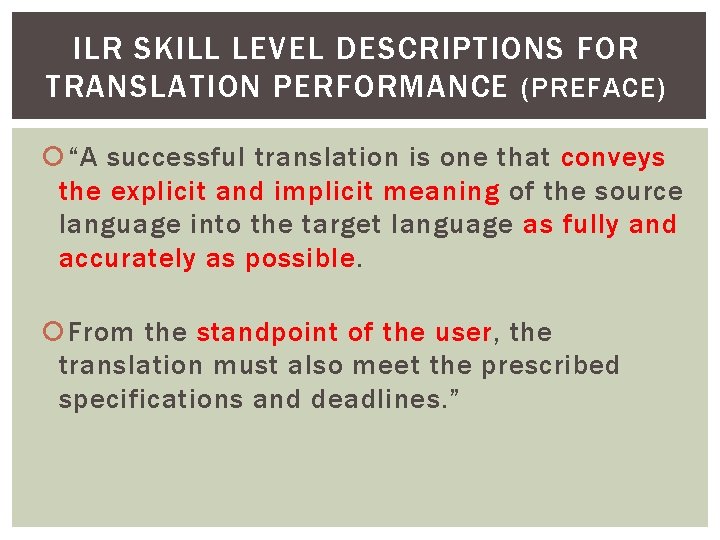
ILR SKILL LEVEL DESCRIPTIONS FOR TRANSLATION PERFORMANCE (PREFACE) “A successful translation is one that conveys the explicit and implicit meaning of the source language into the target language as fully and accurately as possible. From the standpoint of the user, the translation must also meet the prescribed specifications and deadlines. ”
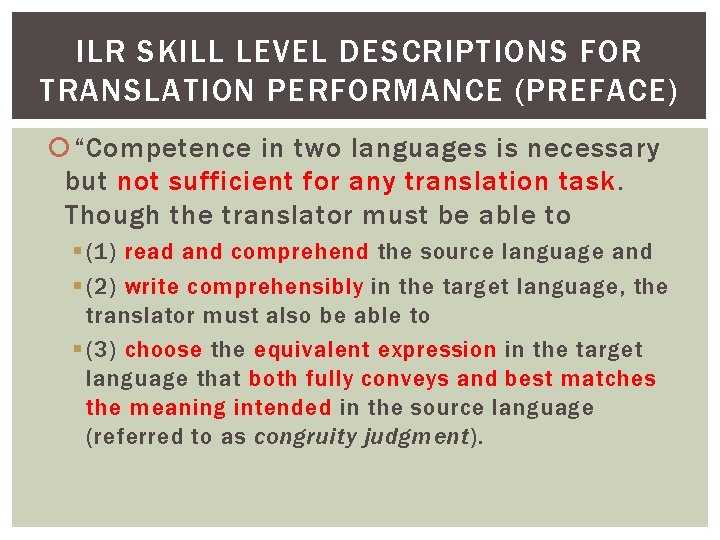
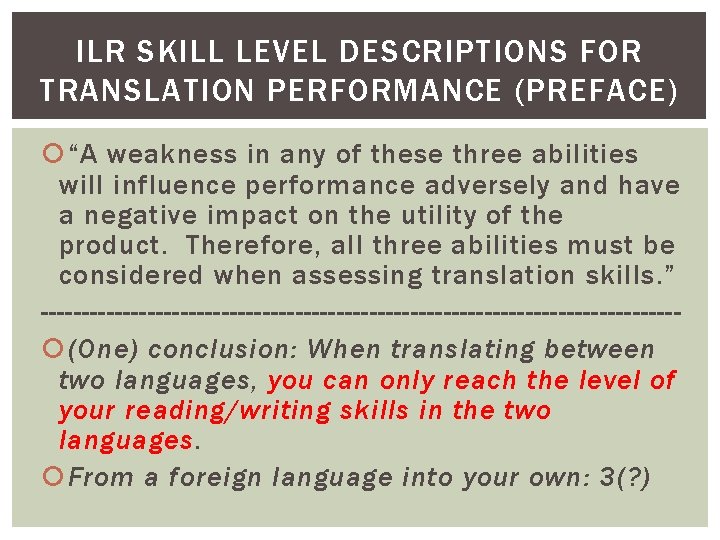
ILR SKILL LEVEL DESCRIPTIONS FOR TRANSLATION PERFORMANCE (PREFACE) “Competence in two languages is necessary but not sufficient for any translation task. Though the translator must be able to § (1) read and comprehend the source language and § (2) write comprehensibly in the target language, the translator must also be able to § (3) choose the equivalent expression in the target language that both fully conveys and best matches the meaning intended in the source language (referred to as congruity judgment).
ILR SKILL LEVEL DESCRIPTIONS FOR TRANSLATION PERFORMANCE (PREFACE) “A weakness in any of these three abilities will influence performance adversely and have a negative impact on the utility of the product. Therefore, all three abilities must be considered when assessing translation skills. ” --------------------------------------- (One) conclusion: When translating between two languages, you can only reach the level of your reading/writing skills in the two languages. From a foreign language into your own: 3(? )
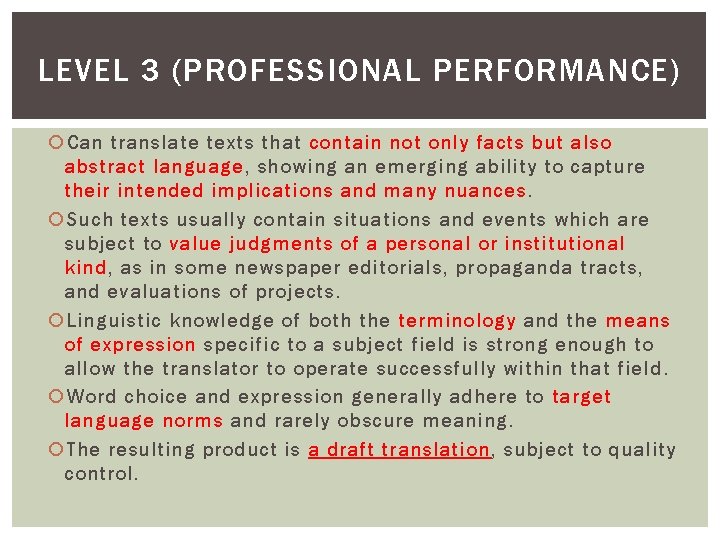
LEVEL 3 (PROFESSIONAL PERFORMANCE) Can translate texts that contain not only facts but also abstract language, showing an emerging ability to capture their intended implications and many nuances. Such texts usually contain situations and events which are subject to value judgments of a personal or institutional kind, as in some newspaper editorials, propaganda tracts, and evaluations of projects. Linguistic knowledge of both the terminology and the means of expression specific to a subject field is strong enough to allow the translator to operate successfully within that field. Word choice and expression generally adhere to target language norms and rarely obscure meaning. The resulting product is a draft translation, subject to quality control.
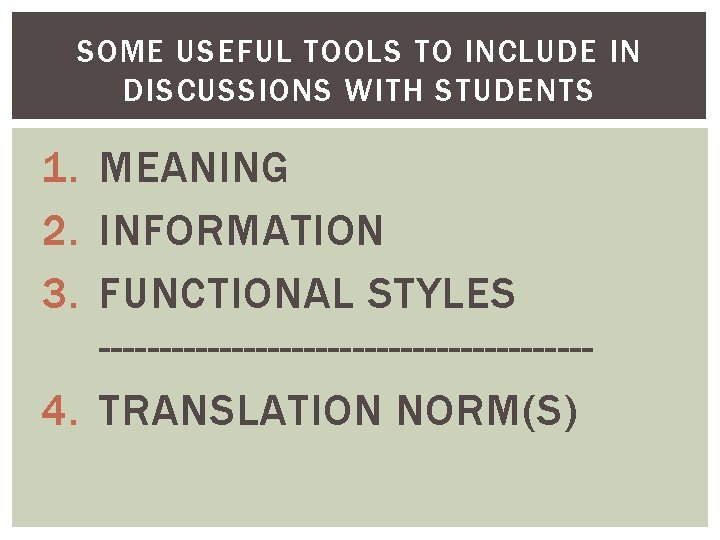
SOME USEFUL TOOLS TO INCLUDE IN DISCUSSIONS WITH STUDENTS 1. MEANING 2. INFORMATION 3. FUNCTIONAL STYLES --------------------4. TRANSLATION NORM(S)
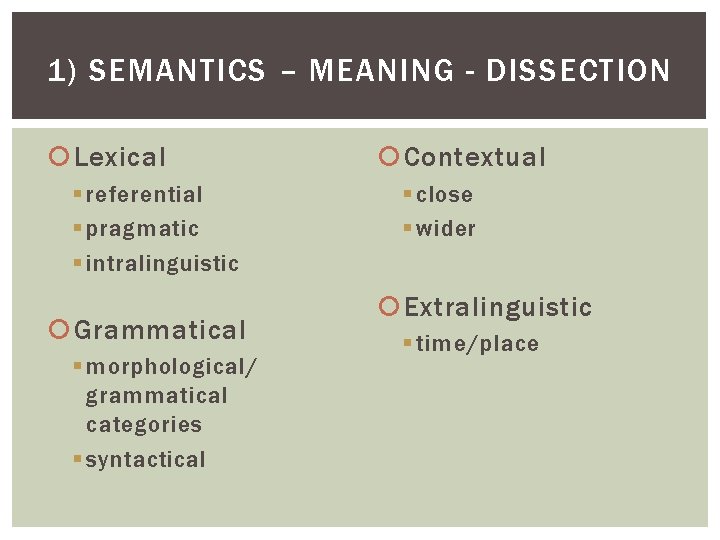
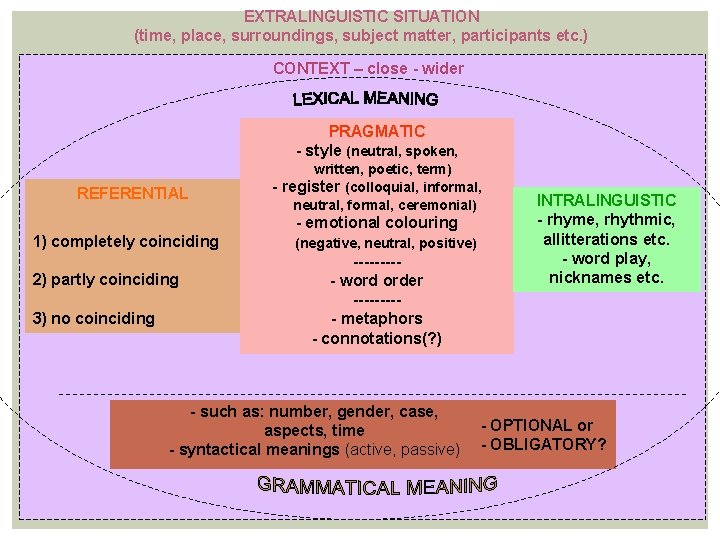
1) SEMANTICS – MEANING - DISSECTION Lexical § referential § pragmatic § intralinguistic Grammatical § morphological/ grammatical categories § syntactical Contextual § close § wider Extralinguistic § time/place
EXTRALINGUISTIC SITUATION (time, place, surroundings, subject matter, participants etc. ) CONTEXT – close - wider PRAGMATIC - style (neutral, spoken, REFERENTIAL written, poetic, term) - register (colloquial, informal, neutral, formal, ceremonial) - emotional colouring 1) completely coinciding 2) partly coinciding 3) no coinciding (negative, neutral, positive) ----- word order ----- metaphors - connotations(? ) - such as: number, gender, case, aspects, time - syntactical meanings (active, passive) INTRALINGUISTIC - rhyme, rhythmic, allitterations etc. - word play, nicknames etc. - OPTIONAL or - OBLIGATORY?
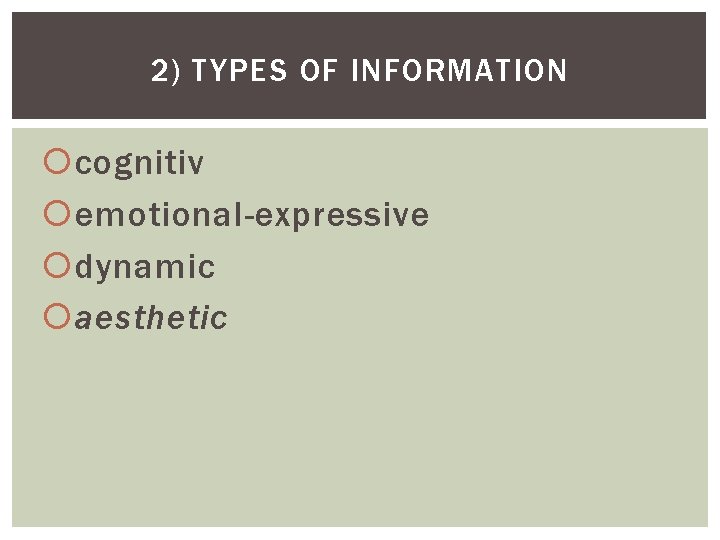
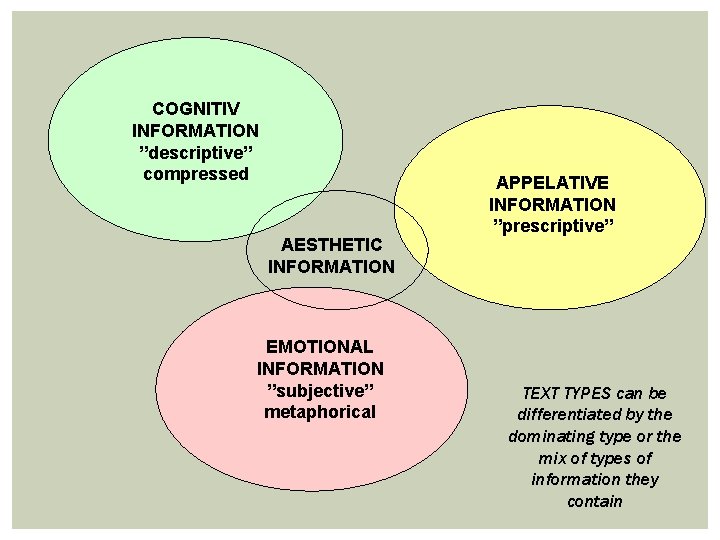
2) TYPES OF INFORMATION cognitiv emotional-expressive dynamic aesthetic
COGNITIV INFORMATION ”descriptive” compressed AESTHETIC INFORMATION EMOTIONAL INFORMATION ”subjective” metaphorical APPELATIVE INFORMATION ”prescriptive” TEXT TYPES can be differentiated by the dominating type or the mix of types of information they contain
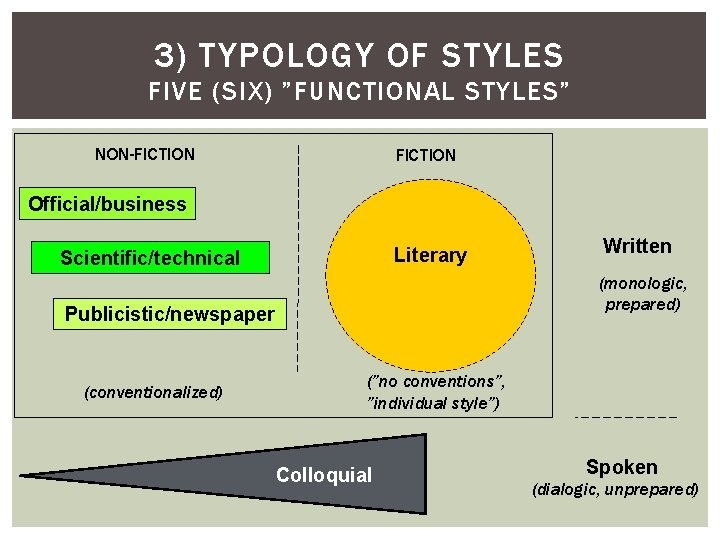
3) TYPOLOGY OF STYLES FIVE (SIX) ”FUNCTIONAL STYLES” NON-FICTION Official/business Literary Scientific/technical (monologic, prepared) Publicistic/newspaper (conventionalized) Written (”no conventions”, ”individual style”) Colloquial Spoken (dialogic, unprepared)
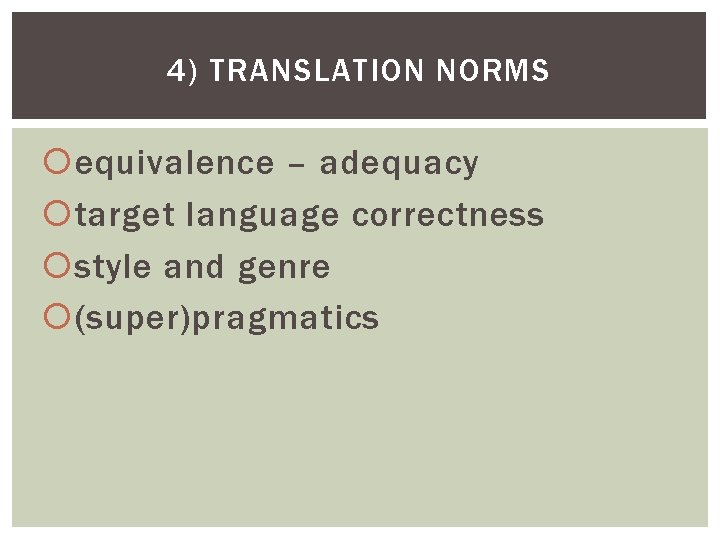
4) TRANSLATION NORMS equivalence – adequacy target language correctness style and genre (super)pragmatics
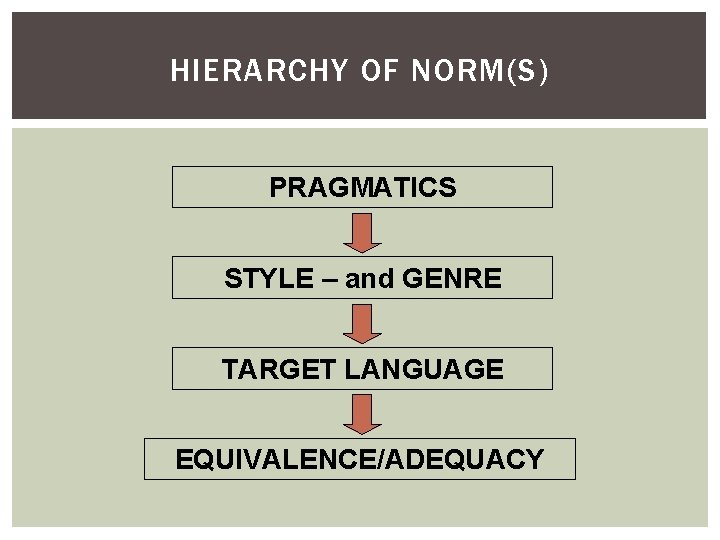
HIERARCHY OF NORM(S) PRAGMATICS STYLE – and GENRE TARGET LANGUAGE EQUIVALENCE/ADEQUACY
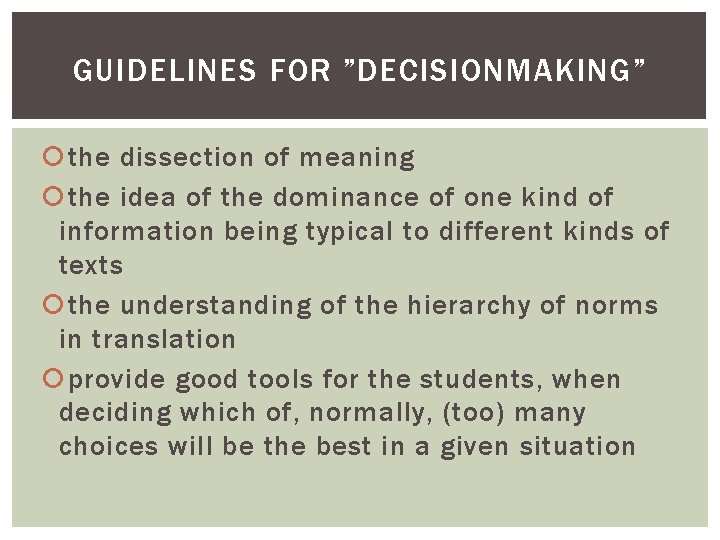
GUIDELINES FOR ”DECISIONMAKING” the dissection of meaning the idea of the dominance of one kind of information being typical to different kinds of texts the understanding of the hierarchy of norms in translation provide good tools for the students, when deciding which of, normally, (too) many choices will be the best in a given situation
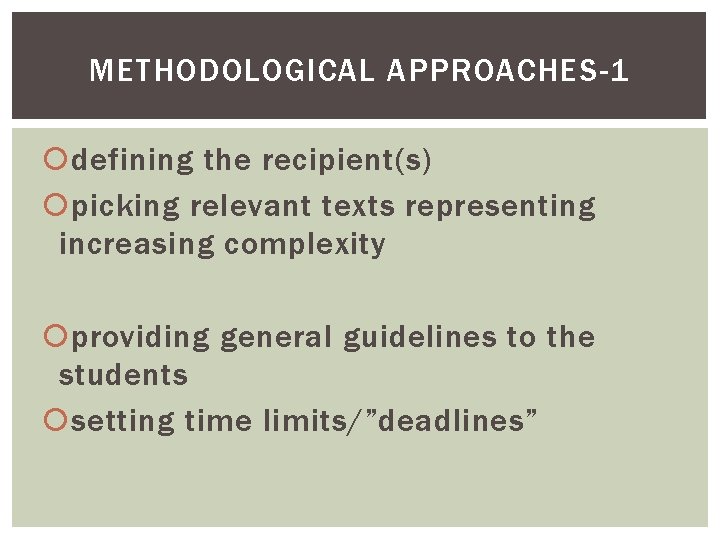
METHODOLOGICAL APPROACHES-1 defining the recipient(s) picking relevant texts representing increasing complexity providing general guidelines to the students setting time limits/”deadlines”
DEFINING THE RECIPIENT(S) individual/group/collective? ”persons, who are interested in the country and what is going on there, but who do not possess any specialised knowledge of the country’s background or reality” • of utmost importance when deciding to which extent it will be necessary to make implicit meaning explicit • ”State Duma” – ”Ptasie Mleczko”
PICKING THE RIGHT TEXTS-1 PUBLICISTIC/NEWSPAPER STYLE shares features with the scientific style: coherent and logical syntactical structure, careful paragraphing, expanded system of connectives shares features with the style of belleslettres: words with emotive meaning, imagery Publicistic vs. newspaper style the goal of the publicistic style: ‘views’, i. e. to shape the audience, to influence public opinion, to make the audience accept the speaker’s point of view the goal of the newspaper style: ‘news’, i. e. to inform the audience
PICKING THE RIGHT TEXTS-2 PUBLICISTIC/NEWSPAPER STYLE Syntactical Features coherent and logical syntactical structure careful paragraphing simple rather than complex sentences expanded system of connectives brevity of expression abundant use of modifiers (adjectives, adverbs) Lexical Features emphasis on accessibility and easy understanding > paraphrasing rather than special terms only established and generally understood terms (e. g. Cold War) evaluating adjectives (e. g. the strongest pressure, growing menace, elementary blunder) traditional, unoriginal metaphors and similes newspaper clichés numerals, abbreviations, symbols
PICKING THE RIGHT TEXTS-3 PUBLICISTIC/NEWSPAPER STYLE short news items (preferably complete texts) start with reports on events that could happen almost anywhere § car accidents, fires, official visits continue with texts with a more ”local” flavour § anniversaries, social matters, etc. move on to texts with a highly ”local” flavour including references, comments, elements of criticism, irony, humor, even poetry, etc. 15 -20 texts for translation totally
STUDENT GUIDELINES-1 The purpose of reading the text before starting to translate § general idea, intention of the author, ”tone” etc. § ”pre-translation analysis” The first part of the translation is the most time-consuming Main difficulties/challenges § Standardized expressions § situational, unseparable, clichees § Metaphors § Terminology § References to source-language reality § § geography, institutions, history, culture ethnography (dress, food, tools etc. ) intertextuality (in the broadest sense) note: references can be ”historical” or contemporary § Poetic language
STUDENT GUIDELINES-2 What to avoid? ”argot” or ”semitranslations” ”translator’s remarks” formulations influenced by the source language punctuation influenced by the source language(!)
STUDENT GUIDELINES-3 on translitteration on titles, names on using dictionaries on using the internet on using web-based resources
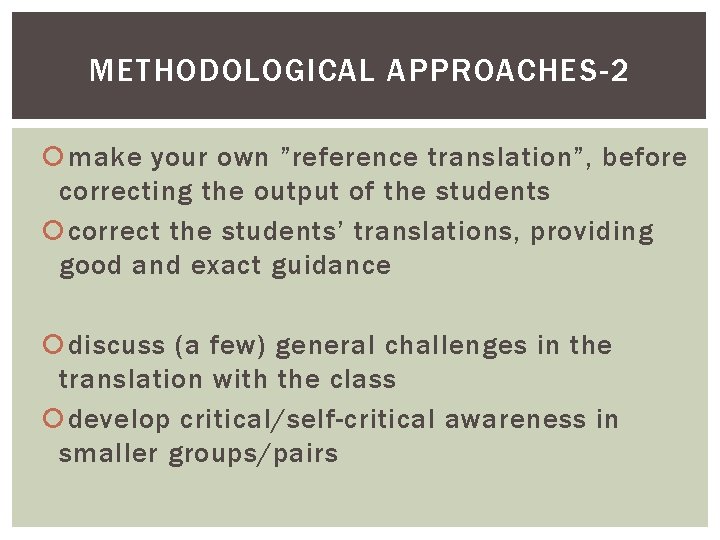
METHODOLOGICAL APPROACHES-2 make your own ”reference translation”, before correcting the output of the students correct the students’ translations, providing good and exact guidance discuss (a few) general challenges in the translation with the class develop critical/self-critical awareness in smaller groups/pairs
APPROACHES TO BE DEVELOPED IN THE WORKING PROCESS taking full responsibility for the translation thoroughnes (first language competence etc. ) handling time pressure language awareness in general translation awareness ”the discussions during the process are more important than the result” the possibilities of the internet have raised the bar regarding the quality of translation significantly! if you search, you will find (almost anything)!! § ”hunting instinct”
TRANSLATABILITY Is it possible to translate everything? Yes, § but not always without loss of meaning, § which might even be significant.
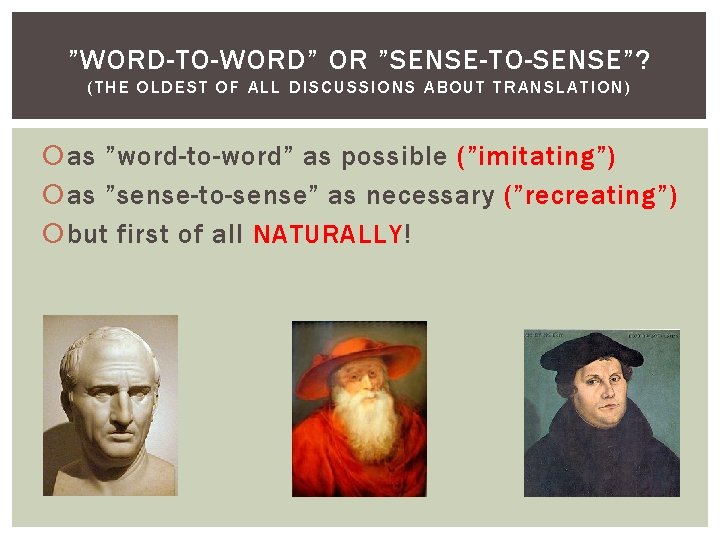
”WORD-TO-WORD” OR ”SENSE-TO-SENSE”? (THE OLDEST OF ALL DISCUSSIONS ABOUT TRANSLATION) as ”word-to-word” as possible (”imitating”) as ”sense-to-sense” as necessary (”recreating”) but first of all NATURALLY!
MISSION ACCOMPLISHED… ”Claus, now I really understand, WHY translation is NOT just to…” (Yeah, and you be glad, it’s only a DRAFT, too, you little i…. !)
FURTHER STEPS the described way of working with translation has proved to be a good ”stepping stone” for training: § translation to a foreign language § translation of military texts § although they mainly belong to the scientific-technical functional style § interpretation in general