
Teaching the Holocaust and Genocide The Case for
- Slides: 19
Teaching the Holocaust and Genocide The Case for Sound Rationale Bob Lehmann and Brian Kahn
Purpose of Rationale Statements • To assist teachers in creating and implementing a more solid and pedagogically sound set of learning experiences – • Think about the WHYS rather than only the WHATS when addressing issues of the Holocaust as well as more contemporary genocide. • Have these discussions with your students, too – Why even study the Holocaust? What are the primary purposes in studying this and related topics?
First…Ask Yourself: • Why is the Holocaust important to study? • What are the most important topics to address in teaching the Holocaust…and why? • What do I want my students to walk away with following this unit fo study?
Statements of Rationale • “To explore the concepts of prejudice, discrimination, stereotyping, racism, anti-Semitism, justice” – • “To show that the Holocaust was not inevitable but the result of many historical events and deeds occurring in progression” – • “To make students more aware of and sensitive to religious hatred” – Remember, create your own rationale statements as they apply to your setting and students’ overall level of learning.
Precise Language is Key • Avoid use of terms such as “unimaginable” or “unbelievable” as the Holocaust was systematically planned and carried out by other human beings – • Avoid use of clichés such as Never Forget or Always Remember as replacement for student discussion on specific topics – • Avoid comparisons of pain – all genocides are horrific -
Factors Influencing Focus of Rationale Statements • Your aims in teaching the history of the Holocaust – • Your own personal knowledge of the history – • Content area of course – • Student factors such as level of abilities – • Time factors: How much time can I spend on this unit? • Available and reliable instructional resource -
Rationale Directs the Content • Be selective when choosing instructional materials – • Address the BIG question: What lessons have we learned? • It’s not just about WHAT happened – also the WHY! • Antisemitism must be examined so as to not skew history –
Consider the Context of the Holocaust It is “…essential to place the study of the Holocaust within a historical context that will allow students to see the relationship of political, social, and economic factors that impacted the times and events that resulted in that history. ” (Totten and Feinberg, 1995)
Pitfalls to Avoid • Find multiple opportunities to make the study more personal by using primary source accounts – • Tell the whole story using hard facts – Jews were victims of ghastly crimes – without the facts, the complete story can be miseducative • The themes of hiding and rescue are essential in telling story – • Make every effort to portray Jews during the Holocaust as being more than one-dimensional victims – Jew also led resistance movements • Make connections to contemporary life, examining moral, ethical, and legal issues – but avoid comparisons of pain -
Pitfalls (continued) • Don’t assault students with dozens of horrific images – there are other ways to share the reality of what happened – • Consider the uniqueness of the Holocaust as state sponsored policy intended to annihilate an entire people – “The Nazis’ aim was to make the Jewish world shrink – from town to neighborhood, from neighborhood to street, from street to house, from house to room, from room to garret, from garret to cattle car, from cattle car to gas chamber. And they did the same to the individual – separated from his or her community, then from his or her family, then from his or her identity, eventually becoming a work permit, until the number itself was turned into ashes. ” (Eli Wiesel, 1984)
Establishing a Foundation of Study/Assessing the Student’s Knowledge Base Identify or design ”opening activities” with the purpose of identifying and discovering: Student’s • Current knowledge base • Depth of knowledge • Crucial questions and concerns about the Holocaust/Genocide
Opening Activity Examples • Developing a Cluster/Mind-Map • Student Questions About the Holocaust • Questionnaire • Chronological Approach
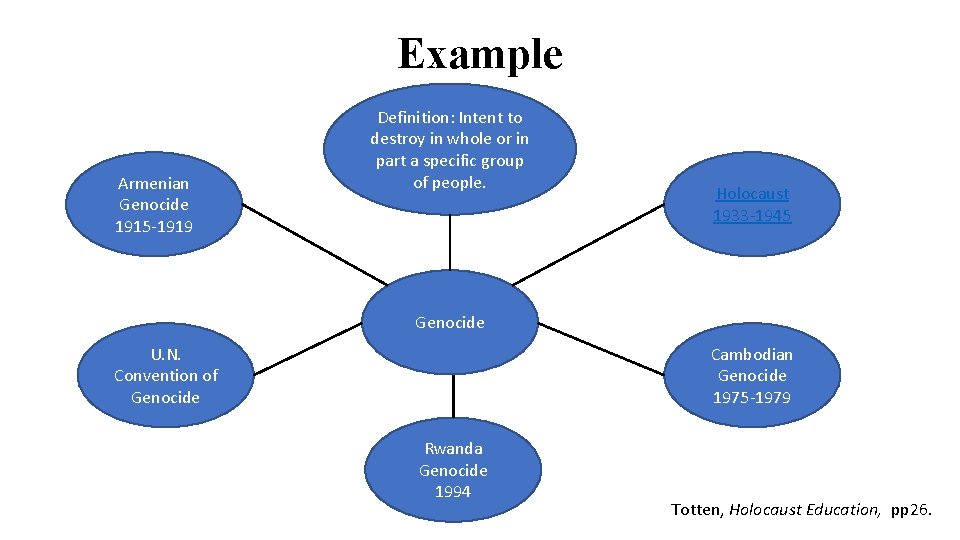
Cluster/Mind-Map • A non-linear brainstorming process to graphically portray ideas, images, and feelings around a central stimulus. • Students are encouraged to create the most detailed and comprehensive cluser and connections between the key items/concepts/events/ideas. • Clustering serves a number of key purposes: • Assist students in recognizing what they do not know about the subject. • The teacher gains a vivid illustration of the depth of the student’s knowledge • The teacher is able to identify specific student inaccuracies, misconceptions and myths they hold about the subject - a preassessment exercise.
Example Armenian Genocide 1915 -1919 Definition: Intent to destroy in whole or in part a specific group of people. Holocaust 1933 -1945 Genocide U. N. Convention of Genocide Cambodian Genocide 1975 -1979 Rwanda Genocide 1994 Totten, Holocaust Education, pp 26.
Student Questions • Students questions assist in making their study more focused and personal. • Encourages students become active researchers as opposed to passive participants. • Method: • Students are asked to write down 3 -5 questions they have about the Holocaust/Genocide (can be either anonymous or identified by name) • Questions can be about anything related to the Holocaust/Genocide • Explain to the students that some of their questions may never be answered • Post student questions on the board or chart paper, have them displayed in the classroom and updated as they are answered or addressed throughout the unit.
Questionnaire • A quick and simple preassessment aimed at establishing the student’s basic knowledge. • 36 Questions About the Holocaust (https: //www. jewishvirtuallibrary. org/36 -questions-and-answersabout-the-holocaust) • Sample questions: • • • What does the word “holocaust” mean? What was the Holocaust? During what time period did the Holocaust take place? What were the Nuremburg Laws? True or False: Jews constitute a race.
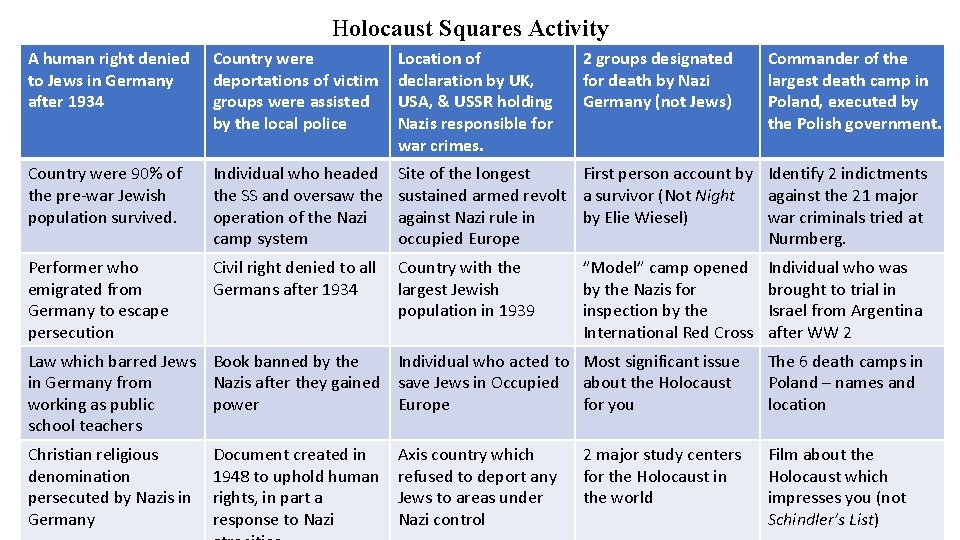
Holocaust Squares Activity A human right denied to Jews in Germany after 1934 Country were deportations of victim groups were assisted by the local police Location of declaration by UK, USA, & USSR holding Nazis responsible for war crimes. 2 groups designated for death by Nazi Germany (not Jews) Country were 90% of the pre-war Jewish population survived. Individual who headed the SS and oversaw the operation of the Nazi camp system Site of the longest First person account by sustained armed revolt a survivor (Not Night against Nazi rule in by Elie Wiesel) occupied Europe Identify 2 indictments against the 21 major war criminals tried at Nurmberg. Performer who emigrated from Germany to escape persecution Civil right denied to all Germans after 1934 Country with the largest Jewish population in 1939 Individual who was brought to trial in Israel from Argentina after WW 2 ”Model” camp opened by the Nazis for inspection by the International Red Cross Commander of the largest death camp in Poland, executed by the Polish government. Law which barred Jews Book banned by the Individual who acted to Most significant issue in Germany from Nazis after they gained save Jews in Occupied about the Holocaust working as public power Europe for you school teachers The 6 death camps in Poland – names and location Christian religious denomination persecuted by Nazis in Germany Film about the Holocaust which impresses you (not Schindler’s List) Document created in 1948 to uphold human rights, in part a response to Nazi Axis country which refused to deport any Jews to areas under Nazi control 2 major study centers for the Holocaust in the world
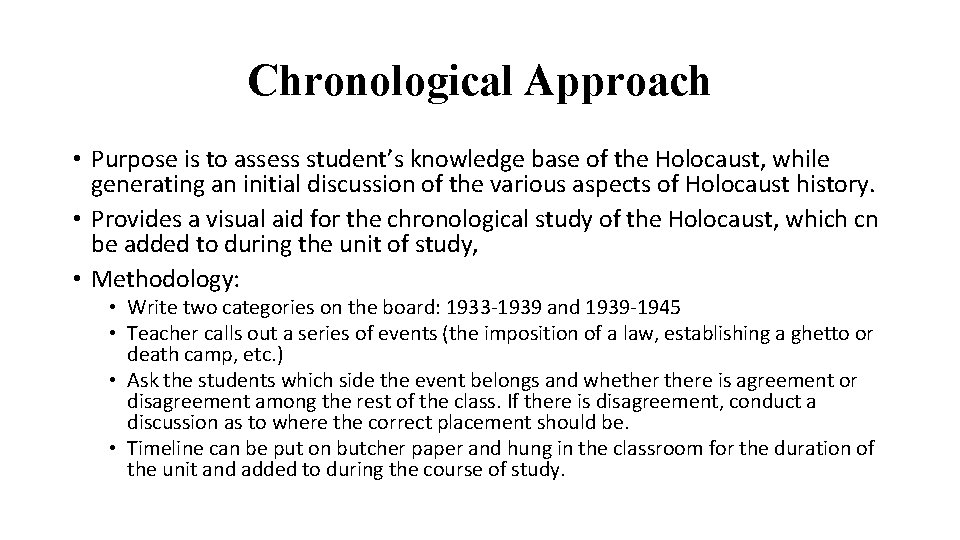
Chronological Approach • Purpose is to assess student’s knowledge base of the Holocaust, while generating an initial discussion of the various aspects of Holocaust history. • Provides a visual aid for the chronological study of the Holocaust, which cn be added to during the unit of study, • Methodology: • Write two categories on the board: 1933 -1939 and 1939 -1945 • Teacher calls out a series of events (the imposition of a law, establishing a ghetto or death camp, etc. ) • Ask the students which side the event belongs and whethere is agreement or disagreement among the rest of the class. If there is disagreement, conduct a discussion as to where the correct placement should be. • Timeline can be put on butcher paper and hung in the classroom for the duration of the unit and added to during the course of study.
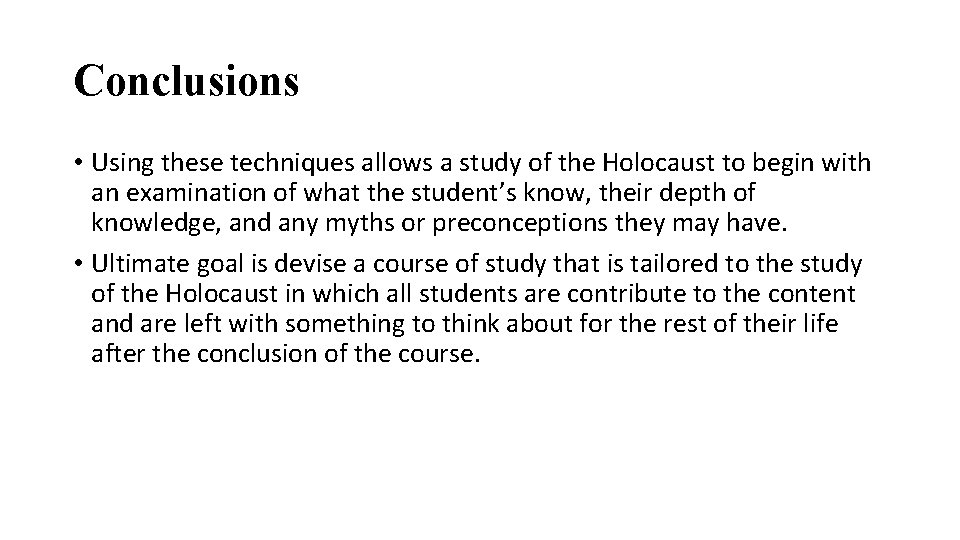
Conclusions • Using these techniques allows a study of the Holocaust to begin with an examination of what the student’s know, their depth of knowledge, and any myths or preconceptions they may have. • Ultimate goal is devise a course of study that is tailored to the study of the Holocaust in which all students are contribute to the content and are left with something to think about for the rest of their life after the conclusion of the course.