
Teaching the Ethics of Information and Information Technology
- Slides: 27
Teaching the Ethics of Information and Information Technology Emily Miller-Francisco Southern Oregon University Online Northwest January 21, 2005
Introduction • Goals for this presentation • 3 Scenarios • 1 Caveat
Introduction ACRL Information Literacy Standards • • • Standard One: Determine the extent of information needed Standard Two: Access the needed information effectively and efficiently Standard Three: Evaluate information and its sources critically Standard Four: Incorporate selected information into one’s knowledge base Standard Five: Use information effectively to accomplish a specific purpose • Standard Six: Understand the economic, legal, and social issues surrounding the use of information, and access and use information ethically and legally
Introduction Goals for the Course • Demonstrate an understanding of major issues in information ethics such as free speech, copyright, and privacy. • Demonstrate an understanding of how technology impacts each of these issues. • Demonstrate an understanding of a variety of ethical approaches and how they can be utilized to discuss information ethics issues. • Demonstrate an understanding of the legal context within which debate about information issues takes place.
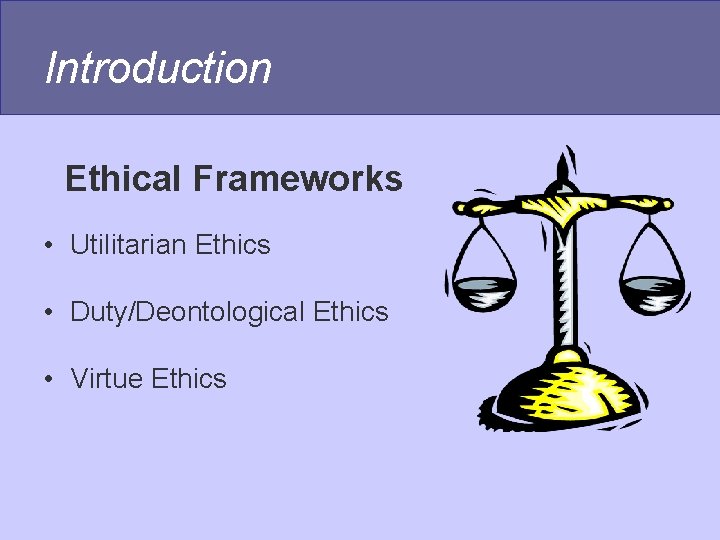
Introduction Ethical Frameworks • Utilitarian Ethics • Duty/Deontological Ethics • Virtue Ethics
Free Speech and Censorship First Amendment: Congress shall make no law respecting an establishment of religion, or prohibiting the free exercise thereof; or abridging the freedom of speech, or of the press; or the right of the people peaceably to assemble, and to petition the government for a redress of grievances.
Free Speech and Censorship Types of censorship: • Sexual • Religious • Political • Social • Violence • Etc.
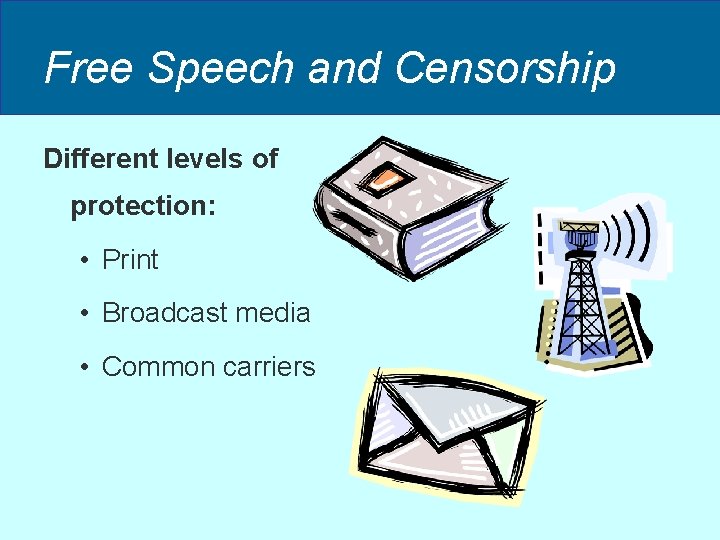
Free Speech and Censorship Different levels of protection: • Print • Broadcast media • Common carriers
Free Speech and Censorship Legal limits to free speech: • Defamation • Obscenity • Fighting Words • Gag rules • Security Issues • Etc.
Free Speech and Censorship Legal History of Internet Filtering: • Communications Decency Act (1996) (struck down in 1997) • Child Online Protection Act (1998) (remanded twice by the Supreme Court) • Children’s Internet Protection Act (2000) (upheld in 2003)
Free Speech and Censorship Is there such a thing as free speech? And is it a good thing?
Intellectual Property Types of Protection: • Copyright: Fixed expression • Patents: Inventions & processes • Trademarks: Logos, designs, etc. that point to a company • Trade secrets, publicity, etc.
Intellectual Property Copyright History: • Printing Press (1400 s) • Statute of Anne (1710) • U. S. Constitution • Copyright Acts of 1790, 1909, and 1976 • Sonny Bono Extension Act (1998)
Intellectual Property Balancing copyright: • Fair Use – Purpose/character of the use – Nature of the original work – Amount borrowed in relation to the whole – Effect on market value • Public Domain – Waited 14 years (+14 years renewable) in 1790 – Now wait for the life of the author + 70 years
Intellectual Property Impact of Technology: • Boundary confusion (e. g. software: patent or copyright? ) • New kinds of copyright (e. g. Tasini v. New York Times) • New ability to control (e. g. digital rights management and licensing) • New participants (e. g. Napster) • New attempts to respond: Digital Millennium Copyright Act (1998)
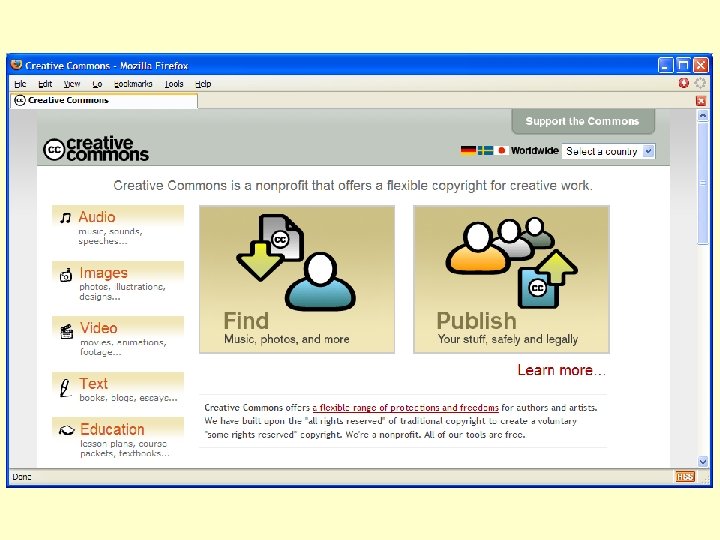
Intellectual Property Impact of Technology & the Quest for Balance: • Open Source movement o Copyleft and the GNU Project (Richard Stallman) o “The Cathedral and the Bazaar” by Eric Raymond o Linux • Other responses to copyright o The Future of Ideas by Lawrence Lessig o “The Economy of Ideas” by John Perry Barlow • Creative Commons at http: //creativecommons. org
Intellectual Property Plagiarism: • Ideas versus their Expression • Ethics versus law • Our little incident(s)
Privacy Defining: • Freedom from intrusion • Control of information about yourself • Freedom from surveillance Definition from Sara Baase
Privacy History: • “Right to Privacy” (1890) by Warren & Brandeis • Watkins v. U. S. (1957): government can’t expose private affairs without justification
Privacy History: • Griswold v. Connecticut (1965): Right to use contraceptives • Justice Douglas: Privacy is a right that can be derived from the “penumbras and emanations” of the Bill of Rights: – – – free speech no soldiers in the house no unreasonable searches & seizures right against self-incrimination the rights listed in the Constitution aren’t the only rights • Led to other cases like Roe v. Wade (1973) & Lawrence v. Texas (2003)
Privacy History: • Katz v. U. S. (1967): – requires government to have a warrant to perform wiretapping – people can have a “reasonable expectation of privacy” even in public places • Now: USA Patriot Act (2001) – expands the Foreign Intelligence Surveillance Act of 1978 and allows wiretapping for domestic crimes as long as the information is relevant to the investigation
Privacy Also statutory law: e. g. Privacy Act (1974): Gives a citizen the right to review & amend their government records and to sue for violations of that right
Privacy Impact of technology: • Marketing: Consumer online privacy, datamining, spam, etc. • Surveillance issues (online and off) • Health/Genetic privacy
Privacy & Security Impact of technology: • Hackers and viruses • Cyberstalking • Cyberterrorism
Conclusion
Teaching the Ethics of Information and Information Technology http: //campus. sou. edu/~millere/ietalk/ Emily Miller-Francisco Southern Oregon University Online Northwest January 21, 2005