
TEACHING THE COMMUNICATION USING PROBLEMBASED LEARNING METHOD A
TEACHING THE COMMUNICATION USING PROBLEM-BASED LEARNING METHOD: A WAY TO IMPROVE THE COMMUNICATION BETWEEN HEALTH CARE STAFF IN PAEDIATRICS. Project Number: 2016 -1 -RO 01 -KA 203024630
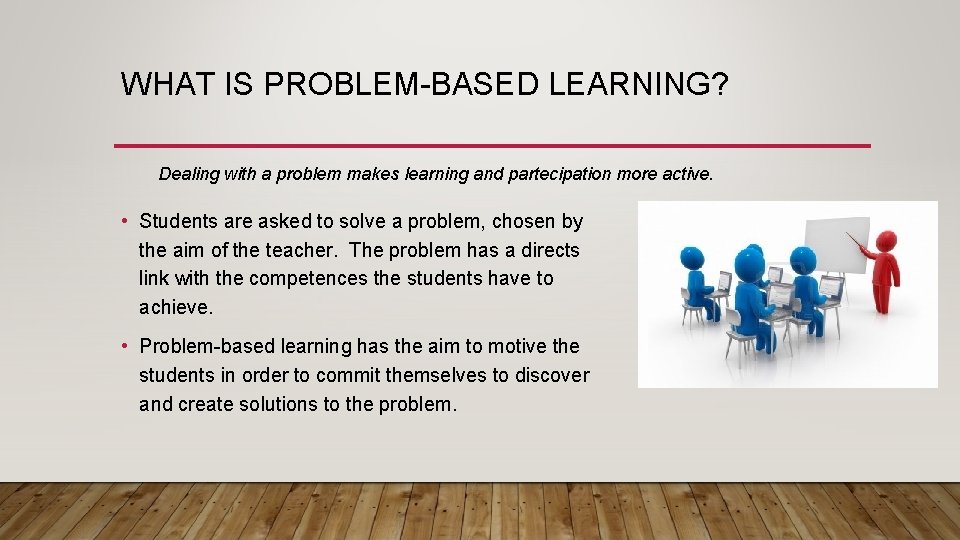
WHAT IS PROBLEM-BASED LEARNING? Dealing with a problem makes learning and partecipation more active. • Students are asked to solve a problem, chosen by the aim of the teacher. The problem has a directs link with the competences the students have to achieve. • Problem-based learning has the aim to motive the students in order to commit themselves to discover and create solutions to the problem.
DEFINING CHARACTERISTICS OF PBL • Learning is driven by challenging, open-ended problems with no one “right” answer • Problems/cases are context-specific: student will talk about communication with other health care staff • Students work as self-directed, active investigators and problem-solvers in small collaborative groups • A key problem is identified and a solution is agreed upon and implemented • Teachers adopt the role as facilitators of learning, guiding the learning process and promoting an environment of inquiry

TEACHING WITH PROBLEM-BASED LEARNING • The main stress of this approach is to have an inter-disciplinary integrated development of deliverables, in order to improve the overall competency and skills of the students.
BEFORE STARTING: BUILDING THE PROBLEM • Students will be motivated if the problem is a part of their professional experience. The problem has to be built in order to be interesting for the students: it must be a part of their expertise. • Teachers might build a problem wich is not too easy and not too difficult as well. Teachers will focus on the argument that he want the students to talk about: communication within the staff. This is why it is important to know which are the students’ competences related to communication with other health care staff.
PRESENTATION OF THE PROBLEM • The aim and the effectiveness of this teaching technique must be declared to the partecipants • Teacher presents the problem to a group of 6 -8 students. Here comes the role definition: within the students, two of them will be the moderator and the secretary of the group. • SECRETARY: summarizes the collected information on a board • MODERATOR: asks the partecipants to give their opinion in order to involve all the students
OPENING PHASE Reading the case study and the problem (4 minutes) • STEP 1: defining and clarifying unclear terms • STEP 2: brainstorming – define the problem and its consequences, also relating to the health care ouctomes • STEP 3: dividing the questions in uniform areas • STEP 4: searching for explanation hypothesis • STEP 5: defining studying objectives
INDIVIDUAL DETAILED STUDY • STEP 6: after the definition of studying objectives, students will search for further information individually. They may have 24 – 48 hours in order to make researches on their own. This kind of research do not provide for teachers’ help or advice.
CLOSING PHASE • STEP 7: summarizing and assessing the collected information • STEP 8: formulating research questions • STEP 9: assessing individual study • STEP 10: assessing the results of the group work
REFERENCES • https: //www. learning-theories. com/problem-based-learning-pbl. html • https: //en. wikipedia. org/wiki/Problem-based_learning • https: //www. flinders. edu. au/teaching/quality/teaching-methods/problem-basedlearning. cfm • http: //web. stanford. edu/dept/CTL/cgibin/docs/newsletter/problem_based_learning. pdf
- Slides: 10