
Teaching the 21 st Century Learner Robbin Clark
Teaching the 21 st Century Learner Robbin Clark, MA
Expanded Core + 21 st century skills= today’s student Expanded Core areas focus on providing opportunities for a thriving, successful life. These components bridge the gaps for students. 21 st century skills prepare students for today’s world. As educators, we must consider the conditions for today’s and tomorrow world. ● Consider this: ○ ○ ○ What are the skills of high school graduates in the 21 st century? How has your teaching evolved over the past few years? How can you be effective with Expanded Core for meaningful instruction?
Foreword to the original edition of The National Agenda “As we move toward the 21 st century, our society is changing and growing at an ever-increasing rate. We must ensure that our children can change and grow with it so that they are not left behind, but instead fully participate in every aspect of mainstream societal life. If the children of today and tomorrow are to succeed in this way, then we must set high standards for them, for ourselves, and for our programs. We must expect children to learn to a high level of competency, so they can compete successfully and confidently in the global 21 st century society that is fast approaching. ” -Foreword to the original edition of The National Agenda
A focus on learning 21 st century teaching isn’t just about teaching technology. It’s a shift from a focus on teaching to a focus on learning. “Twenty-first-century learning embodies an approach to teaching that marries content to skill. Without skills, students are left to memorize facts, recall details for worksheets, and relegate their educational experience to passivity. Without content, students may engage in problem-solving or team-working experiences that fall into triviality, into relevance without rigor. Instead, the 21 stcentury learning paradigm offers an opportunity to synergize the margins of the content vs. skills debate and bring it into a framework that dispels these dichotomies. Twenty-first-century learning means hearkening to cornerstones of the past to help us navigate our future. Embracing a 21 stcentury learning model requires consideration of those elements that could comprise such a shift: creating learners who take intellectual risks, fostering learning dispositions, and nurturing school communities where everyone is a learner. ” Sarah Brown Wessling, 2010 National Teacher of the Year Consider: How do we create conditions for learning for our students?
Replace not Integrate Dr. Heidi Hayes Jacobs advises us to replace not integrate when considering how we upgrade. We need something concrete to offer as a replacement (Jacobs, 2010). Consider our approach to the Expanded Core instruction. ● How effective has our current approaches been for enduring understandings of concepts? ● If it hasn’t been as effective as you would like, what wasn’t working? That’s your starting point for where to replace.
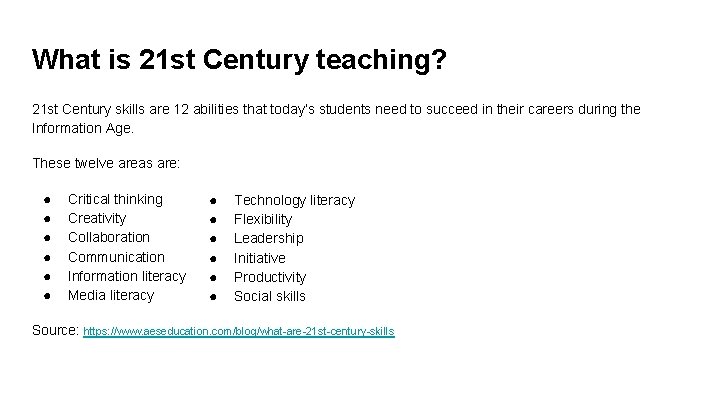
What is 21 st Century teaching? 21 st Century skills are 12 abilities that today’s students need to succeed in their careers during the Information Age. These twelve areas are: ● ● ● Critical thinking Creativity Collaboration Communication Information literacy Media literacy ● ● ● Technology literacy Flexibility Leadership Initiative Productivity Social skills Source: https: //www. aeseducation. com/blog/what-are-21 st-century-skills
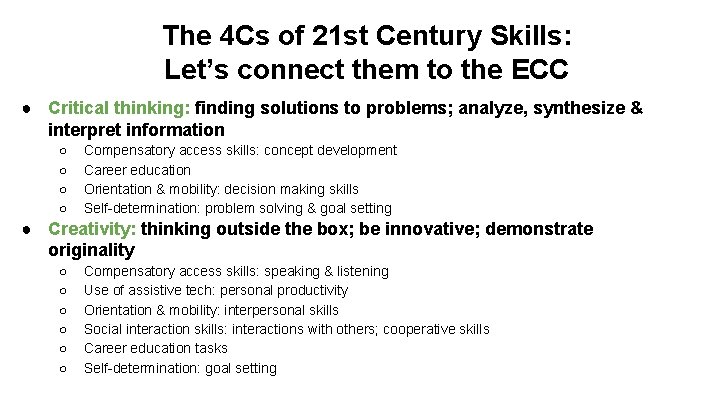
The 4 Cs of 21 st Century Skills: Let’s connect them to the ECC ● Critical thinking: finding solutions to problems; analyze, synthesize & interpret information ○ ○ Compensatory access skills: concept development Career education Orientation & mobility: decision making skills Self-determination: problem solving & goal setting ● Creativity: thinking outside the box; be innovative; demonstrate originality ○ ○ ○ Compensatory access skills: speaking & listening Use of assistive tech: personal productivity Orientation & mobility: interpersonal skills Social interaction skills: interactions with others; cooperative skills Career education tasks Self-determination: goal setting
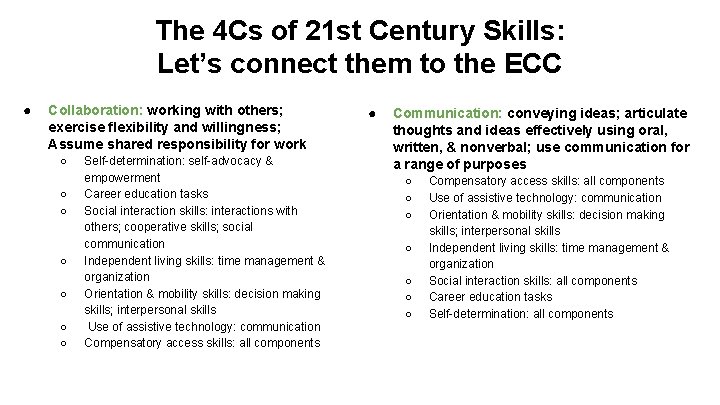
The 4 Cs of 21 st Century Skills: Let’s connect them to the ECC ● Collaboration: working with others; exercise flexibility and willingness; Assume shared responsibility for work ○ ○ ○ ○ Self-determination: self-advocacy & empowerment Career education tasks Social interaction skills: interactions with others; cooperative skills; social communication Independent living skills: time management & organization Orientation & mobility skills: decision making skills; interpersonal skills Use of assistive technology: communication Compensatory access skills: all components ● Communication: conveying ideas; articulate thoughts and ideas effectively using oral, written, & nonverbal; use communication for a range of purposes ○ ○ ○ ○ Compensatory access skills: all components Use of assistive technology: communication Orientation & mobility skills: decision making skills; interpersonal skills Independent living skills: time management & organization Social interaction skills: all components Career education tasks Self-determination: all components
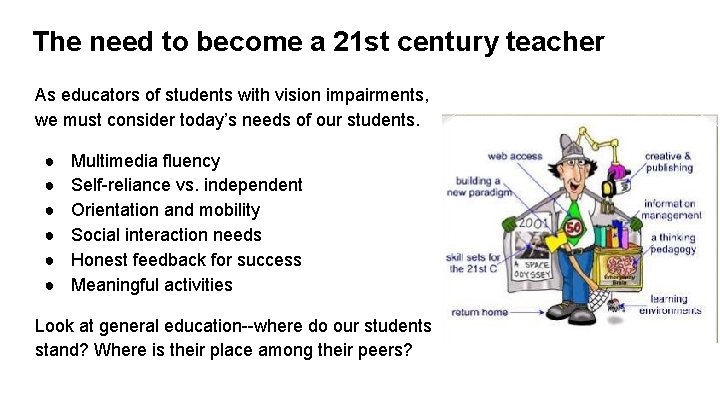
The need to become a 21 st century teacher As educators of students with vision impairments, we must consider today’s needs of our students. ● ● ● Multimedia fluency Self-reliance vs. independent Orientation and mobility Social interaction needs Honest feedback for success Meaningful activities Look at general education--where do our students stand? Where is their place among their peers?
The need to become a 21 st century teacher But where do I start? How do I start? Ahhhhhhh! Start here: ● Expanded Core evaluations: ○ ○ EVALS: ■ Exit Assessments versions 1 & 2 (start at 12 years if possible; great transition resource) ■ Basic Infused Skills Assessments (for students with multiple impairments) ■ Independent Living Skills Assessment (ILSA): great for lesson planning ECC Screenings should be part of your essential assessments with your FVA, LMA ● Know your Expanded Core components ○ A great definition is found in ECC Essentials from AFB ● Identify clearning objectives & lesson planning ● Shift from a focus on teaching to a focus on learning
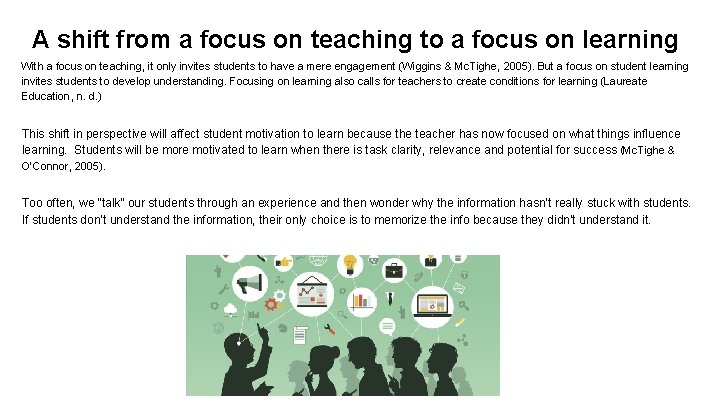
A shift from a focus on teaching to a focus on learning With a focus on teaching, it only invites students to have a mere engagement (Wiggins & Mc. Tighe, 2005). But a focus on student learning invites students to develop understanding. Focusing on learning also calls for teachers to create conditions for learning (Laureate Education, n. d. ) This shift in perspective will affect student motivation to learn because the teacher has now focused on what things influence learning. Students will be more motivated to learn when there is task clarity, relevance and potential for success (Mc. Tighe & O’Connor, 2005). Too often, we “talk” our students through an experience and then wonder why the information hasn’t really stuck with students. If students don’t understand the information, their only choice is to memorize the info because they didn't understand it.
21 st century teaching starter strategies ● ● Lesson plan components: ○ Clearning goal or objective (what is the focus of this lesson? ) ○ Background knowledge (what do students need to know coming into this lesson? ) ○ Procedure (how are you going to teach this? ) ○ Assessment (what will students do to demonstrate understanding of the topic) Infuse your Expanded Core & 21 st century skills ○ You can’t teach these skills in silos. Multiple areas have to be integrated for success. Use assessment! ○ Consider a variety of formative assessments to help you determine your student’s skills Apply technology in meaningful ways ○ Multiple devices for one skill--for example, try it on an i. Pad, laptop or Braille. Note Touch ○ Replace traditional with upgraded ed tech--for example, provide a Google form or use a podcast
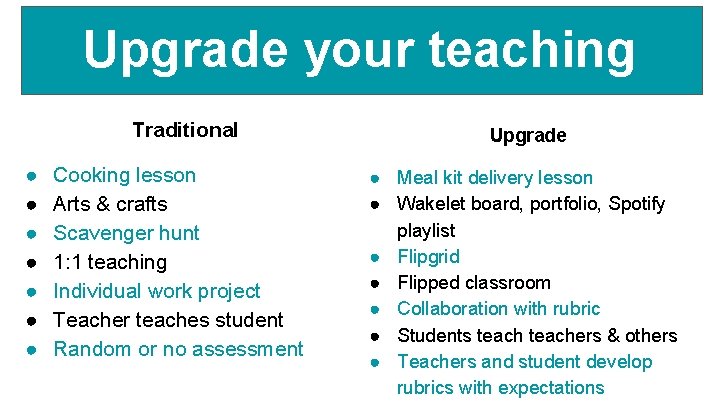
Upgrade your teaching Traditional ● ● ● ● Cooking lesson Arts & crafts Scavenger hunt 1: 1 teaching Individual work project Teacher teaches student Random or no assessment Upgrade ● Meal kit delivery lesson ● Wakelet board, portfolio, Spotify playlist ● Flipgrid ● Flipped classroom ● Collaboration with rubric ● Students teachers & others ● Teachers and student develop rubrics with expectations
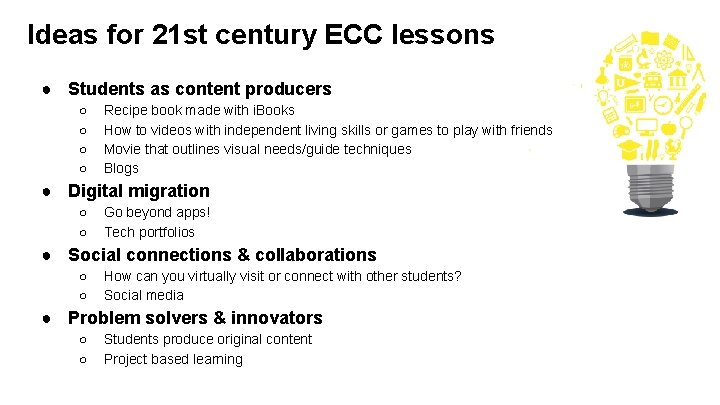
Ideas for 21 st century ECC lessons ● Students as content producers ○ ○ Recipe book made with i. Books How to videos with independent living skills or games to play with friends Movie that outlines visual needs/guide techniques Blogs ● Digital migration ○ ○ Go beyond apps! Tech portfolios ● Social connections & collaborations ○ ○ How can you virtually visit or connect with other students? Social media ● Problem solvers & innovators ○ ○ Students produce original content Project based learning
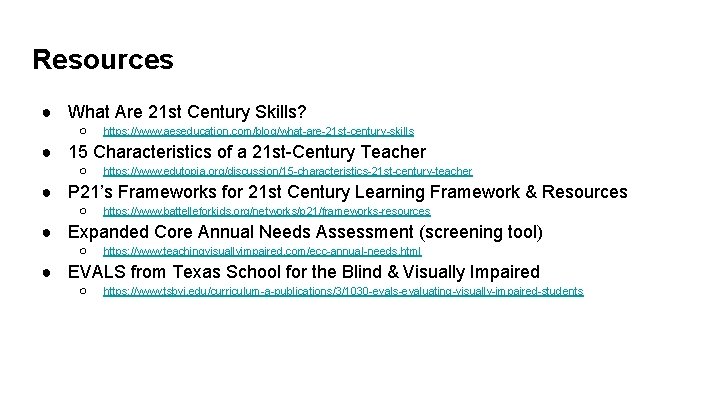
Resources ● What Are 21 st Century Skills? ○ https: //www. aeseducation. com/blog/what-are-21 st-century-skills ● 15 Characteristics of a 21 st-Century Teacher ○ https: //www. edutopia. org/discussion/15 -characteristics-21 st-century-teacher ● P 21’s Frameworks for 21 st Century Learning Framework & Resources ○ https: //www. battelleforkids. org/networks/p 21/frameworks-resources ● Expanded Core Annual Needs Assessment (screening tool) ○ https: //www. teachingvisuallyimpaired. com/ecc-annual-needs. html ● EVALS from Texas School for the Blind & Visually Impaired ○ https: //www. tsbvi. edu/curriculum-a-publications/3/1030 -evals-evaluating-visually-impaired-students
- Slides: 15