
Teaching Teaming Writing and Speaking ASEE Workshop June
- Slides: 28
Teaching Teaming, Writing, and Speaking ASEE Workshop, June 22, 2003 Nashville, TN Drs. Chris Anson, Lisa Bullard, Steven Peretti North Carolina State University Paula Berardinelli, Deanna Dannels, Chris Daubert, Amanda Granrud, Naomi Kleid, David Kmiec
Workshop Objectives Identify issues, choices, and challenges associated with emphasizing teaming, writing, and speaking (TWS) in engineering curricula Explore methods and models for integrating TWS into engineering courses Facilitate strategic choices and implementation plans Share materials and resources based on instructional needs and parameters
Workshop Agenda 12: 30 Introduction(s), agenda, contextsetting, exploration of issues 1: 30 Explanation of TWS models and methods 2: 30 Break 2: 45 Application of models 3: 45 Discussion and questions 4: 00 Adjourn
Your turn… Please form small groups. Read the case and, playing the role of committee members, read and discuss the emailed response. Formulate a response to the email’s author. Assign a spokesperson and be prepared to share your group’s
Models and Methods: Lab Junior level Chemical engineering unit operations lab Course: one hour lecture plus three hour lab TWS module: 4 times/semester during lab off-weeks as a class 4 times/semester with TWS consultant as teams
Models and Methods: Lab Focus of in-class activities Teaming Collaborative writing Collaborative speaking Focus of consultations Proper citations Report organization Graphics and layout Rehearse oral presentation
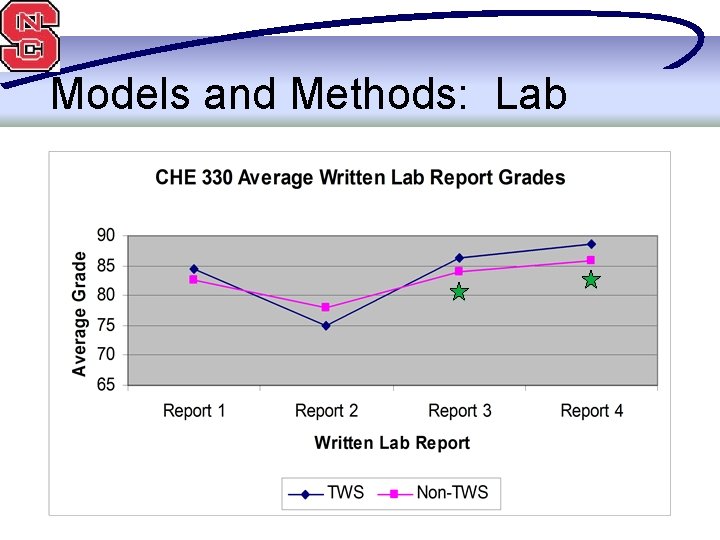
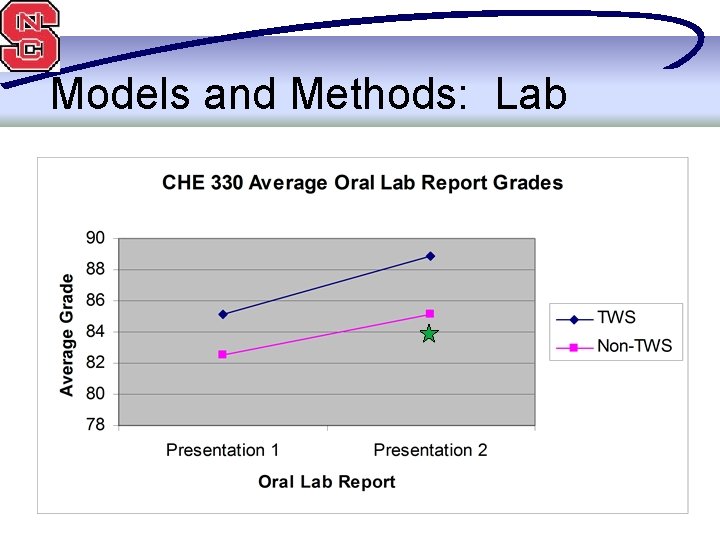
Models and Methods: Lab Preliminary Results Statistically significant difference in 3 rd and 4 th written reports: TWS outperformed non-TWS Statistically significant difference in final oral presentation: TWS outperformed non-TWS
Models and Methods: Lab
Models and Methods: Lab
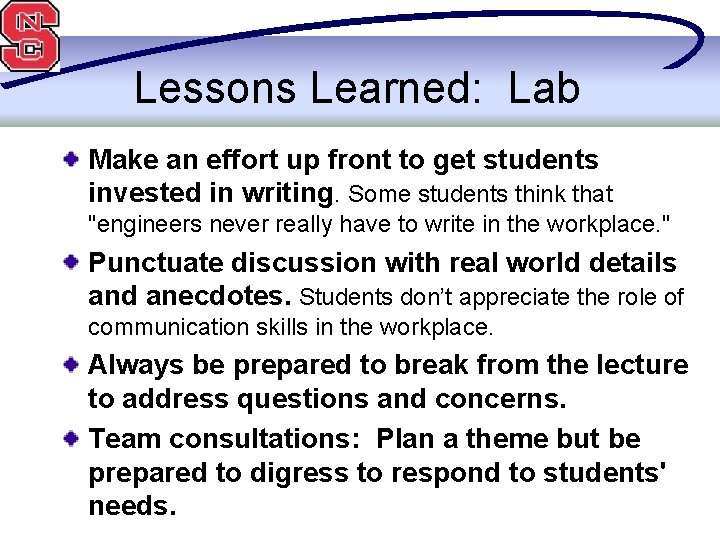
Lessons Learned: Lab Make an effort up front to get students invested in writing. Some students think that "engineers never really have to write in the workplace. " Punctuate discussion with real world details and anecdotes. Students don’t appreciate the role of communication skills in the workplace. Always be prepared to break from the lecture to address questions and concerns. Team consultations: Plan a theme but be prepared to digress to respond to students' needs.
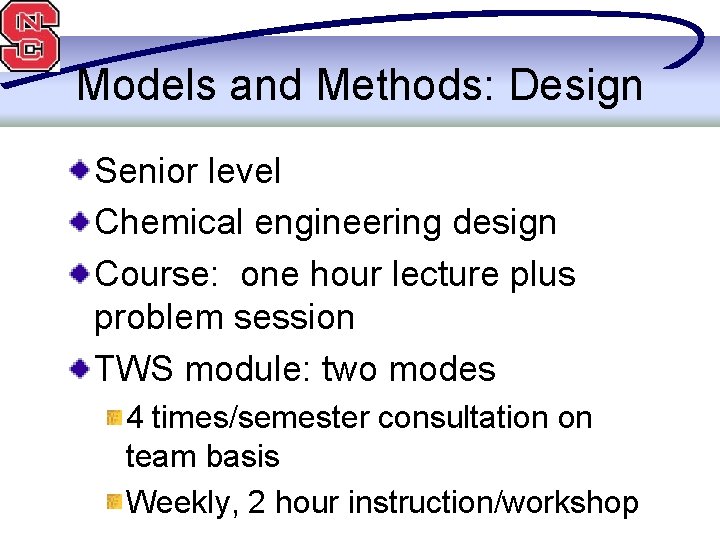
Models and Methods: Design Senior level Chemical engineering design Course: one hour lecture plus problem session TWS module: two modes 4 times/semester consultation on team basis Weekly, 2 hour instruction/workshop
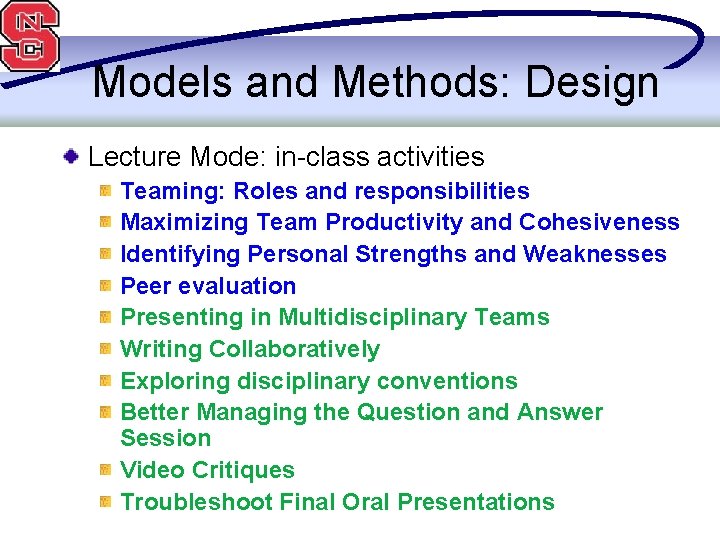
Models and Methods: Design Lecture Mode: in-class activities Teaming: Roles and responsibilities Maximizing Team Productivity and Cohesiveness Identifying Personal Strengths and Weaknesses Peer evaluation Presenting in Multidisciplinary Teams Writing Collaboratively Exploring disciplinary conventions Better Managing the Question and Answer Session Video Critiques Troubleshoot Final Oral Presentations
Models and Methods: Design Lecture advantages Importance transparent Significant contact time Depth and variety Accountability Lecture disadvantages Workload
Results: Design Lecture 23 design teams from Spring ‘ 02 semester 3 groupings: no TWS instruction, CHE students only (NTWS/SD) TWS instruction, CHE students only (TWS/SD) TWS instruction, multidisciplinary teams (TWS/MD) 3 progress reports, final report, final
Results: Design Lecture No statistically-significant difference in performance between groups on progress reports Differences appear for final report - analysis ongoing Oral final presentation TWS/SD outperformed TWS/MD and NTWS/SD TWS/MD equivalent to NTWS/SD
Results: Design Lecture Intellectual background of group members is a potential confounding variable Average GPA of TWS/MD groups = 3. 5; TWS/SD groups = 3. 5; NTWS/SD group = 3. 3 Student reflections indicate 4 challenges integrating multidisciplinary information managing diverse feedback and audiences aligning content material with communication task addressing interpersonal team issues ÊMultidisciplinary groups face a larger challenge than single discipline groups
Lessons Learned: Design Lecture Treat as practical lab scheduling of joint instructional time generated conflict specific to multidisciplinary teams. Combine with individual team consultations Teach the MD teams to address multiple audiences in written and oral communication. Teach teams how to assimilate members with varying degrees of expertise in both technical content and writing and speaking.
Models and Methods: Design Consultation Mode Teamwork Collaborative writing Written feedback Appropriate acknowledgements Report structure/organization Rehearse oral presentation Feedback from oral presentation
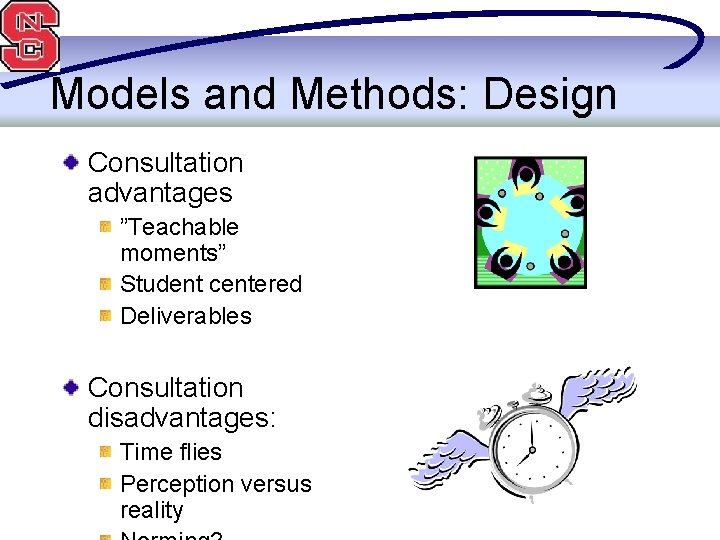
Models and Methods: Design Consultation advantages ”Teachable moments” Student centered Deliverables Consultation disadvantages: Time flies Perception versus reality
Results: Design Consultation 23 design teams from Spring ‘ 03 semester 3 groupings: No TWS instruction, (NTWS) TWS instruction, (TWS) Multidisciplinary teams (MD) Single-discipline teams (SD) 3 progress reports, final report, midsemester and final presentations GPA equivalence between TWS and
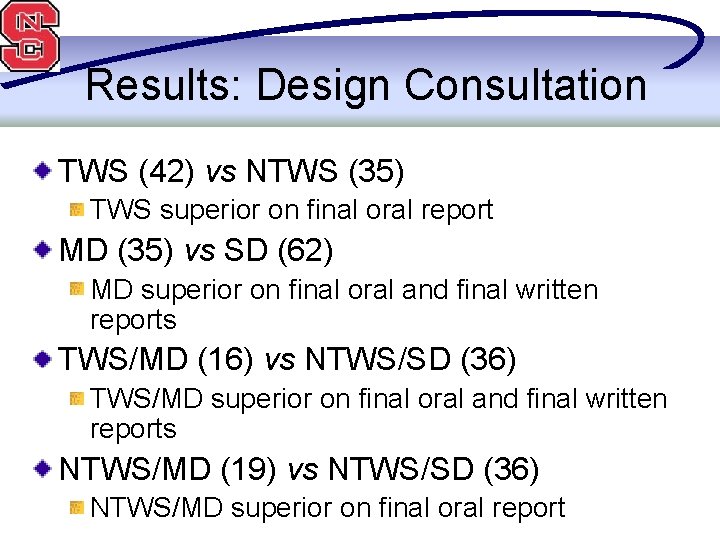
Results: Design Consultation TWS (42) vs NTWS (35) TWS superior on final oral report MD (35) vs SD (62) MD superior on final oral and final written reports TWS/MD (16) vs NTWS/SD (36) TWS/MD superior on final oral and final written reports NTWS/MD (19) vs NTWS/SD (36) NTWS/MD superior on final oral report
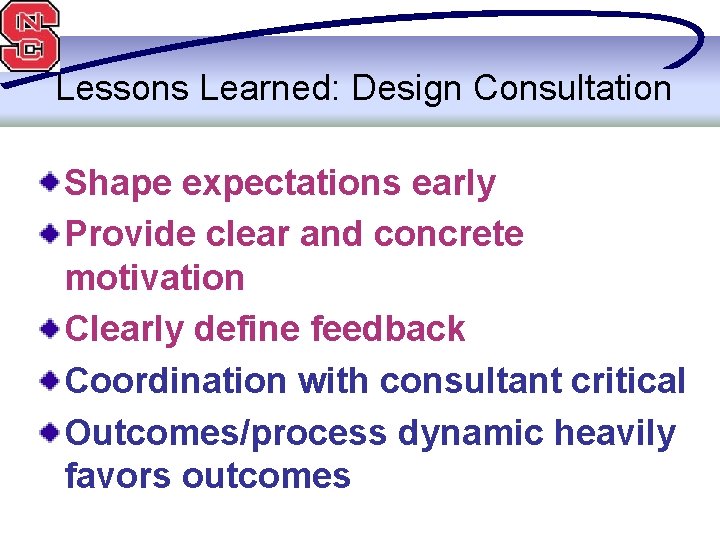
Lessons Learned: Design Consultation Shape expectations early Provide clear and concrete motivation Clearly define feedback Coordination with consultant critical Outcomes/process dynamic heavily favors outcomes
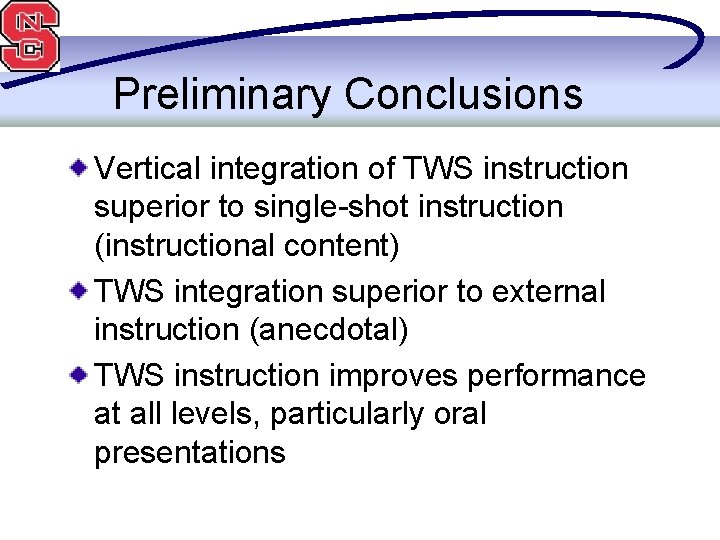
Preliminary Conclusions Vertical integration of TWS instruction superior to single-shot instruction (instructional content) TWS integration superior to external instruction (anecdotal) TWS instruction improves performance at all levels, particularly oral presentations
Break 2: 30 -2: 45
Your turn… Form small groups according to institutional types. Identify which, if any, of the models presented are most useful or appropriate to implement on your campus, based on your general objectives. With your group members, work through the implementation issues identified on the handout. Now collectively identify and try to solve both general challenges and those unique to your own situation. Selected participants will report on their discussions.
Resources www. che. ncsu. edu/action agenda Contains all of the information from this workshop, and complete set of project information from this 3 yr effort www. ncsu. edu/labwrite/ Contains extensive instructional materials that help students understand the genre of the lab report and guide them in the process of writing effective reports. www 2. chass. ncsu. edu/CWSP/fac_seminar/sem _archives. html archives of how faculty have incorporated writing and speaking in various courses, including engineering.
Resources www. engl. iastate. edu/ISUComm/s 2 proceedings/ISUCo mm 2. html A communication across the curriculum program at Iowa State; started in Agriculture and is spreading out to the entire university www. udel. edu/pbl/ Extensive problem-based learning site (not directly TWS but problem -based learning always implies TWS skills) www. engrng. pitt. edu/~ec 2000/ec 2000_project_descripti on. html Assessment methods for a variety of learning outcomes associated with EC 2000. www. chemistrycoach. com/linkstoa. htm#Links%20 to%2 0 a%20 Better%20 Education A collection of links to handouts for students on writing in general
Good luck!