
Teaching Students with Lower Incidence Disabilities Chapter 4
Teaching Students with Lower -Incidence Disabilities Chapter 4 Professor Abbott The Inclusive Classroom: Strategies for Effective Differentiated Instruction , 4 th Edition 0 -13 -500140 -4 © 2010 Pearson Education, Inc. All rights reserved.
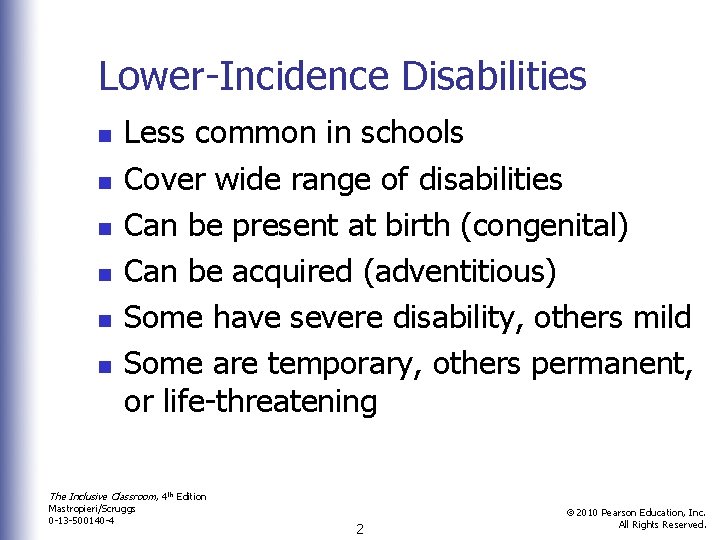
Lower-Incidence Disabilities n n n Less common in schools Cover wide range of disabilities Can be present at birth (congenital) Can be acquired (adventitious) Some have severe disability, others mild Some are temporary, others permanent, or life-threatening The Inclusive Classroom, 4 th Edition Mastropieri/Scruggs 0 -13 -500140 -4 2 © 2010 Pearson Education, Inc. All Rights Reserved.
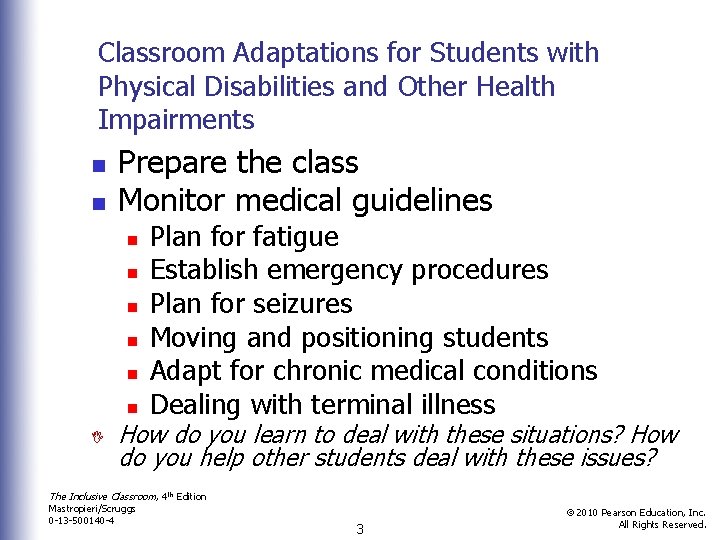
Classroom Adaptations for Students with Physical Disabilities and Other Health Impairments n n Prepare the class Monitor medical guidelines n n n I Plan for fatigue Establish emergency procedures Plan for seizures Moving and positioning students Adapt for chronic medical conditions Dealing with terminal illness How do you learn to deal with these situations? How do you help other students deal with these issues? The Inclusive Classroom, 4 th Edition Mastropieri/Scruggs 0 -13 -500140 -4 3 © 2010 Pearson Education, Inc. All Rights Reserved.
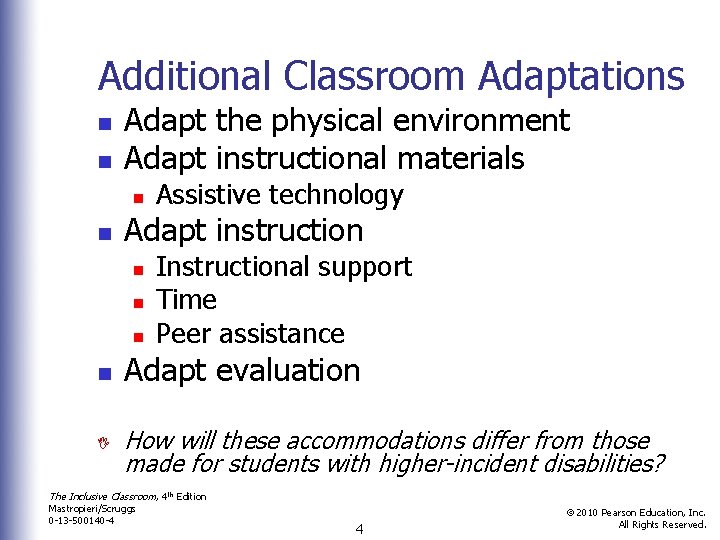
Additional Classroom Adaptations n n Adapt the physical environment Adapt instructional materials n n Assistive technology Adapt instruction n Instructional support Time Peer assistance n Adapt evaluation I How will these accommodations differ from those made for students with higher-incident disabilities? The Inclusive Classroom, 4 th Edition Mastropieri/Scruggs 0 -13 -500140 -4 4 © 2010 Pearson Education, Inc. All Rights Reserved.
Communication Strategies for Students with Autism n Establish effective communication n n Augmentative or Alternative Communication is important PECS- Picture exchange communication system teaches students to use pictures and symbols to communicate Sign language Writing with Symbols or Board. Maker The Inclusive Classroom, 4 th Edition Mastropieri/Scruggs 0 -13 -500140 -4 5 © 2010 Pearson Education, Inc. All Rights Reserved.
Strategies for Students with Autism n Direct Instruction n n Applied Behavior Analysis n n Small group or one-to-one structured, teacher directed lessons, with direct questioning and response Use of reinforcement for appropriate behaviors and careful documentation of behaviors Develop Social Competence n Social stories n Simple sentences and pictures to demonstrate the desired social behavior The Inclusive Classroom, 4 th Edition Mastropieri/Scruggs 0 -13 -500140 -4 6 © 2010 Pearson Education, Inc. All Rights Reserved.
Strategies for Students with Visual Impairments n n n n n I Adapt the physical environment Enlarge and enhance printed materials Use assistive technology Increase visibility of materials Convert print to Braille formats Use oral output devices Use Descriptive Video Service Use tactile and three-dimensional models Be explicit giving oral presentations How has the use of assistive technology changed the way we teach students who have visual impairments? The Inclusive Classroom, 4 th Edition Mastropieri/Scruggs 0 -13 -500140 -4 7 © 2010 Pearson Education, Inc. All Rights Reserved.
Strategies for Students with Visual Impairments (continued) n n n Adapt the physical environment Use technology including FM systems Use visuals Use language cards Reiterate major points Use hand signals or devise a signaling system Alert students as to when to look or listen Use a “listen, then look, then listen” sequence of instruction Repeat information Plan for interpreters Adapt evaluation The Inclusive Classroom, 4 th Edition Mastropieri/Scruggs 0 -13 -500140 -4 8 © 2010 Pearson Education, Inc. All Rights Reserved.
Questions The Inclusive Classroom, 4 th Edition Mastropieri/Scruggs 0 -13 -500140 -4 9 © 2010 Pearson Education, Inc. All Rights Reserved.
- Slides: 9