
Teaching students to think like a paramedic Improving
- Slides: 1
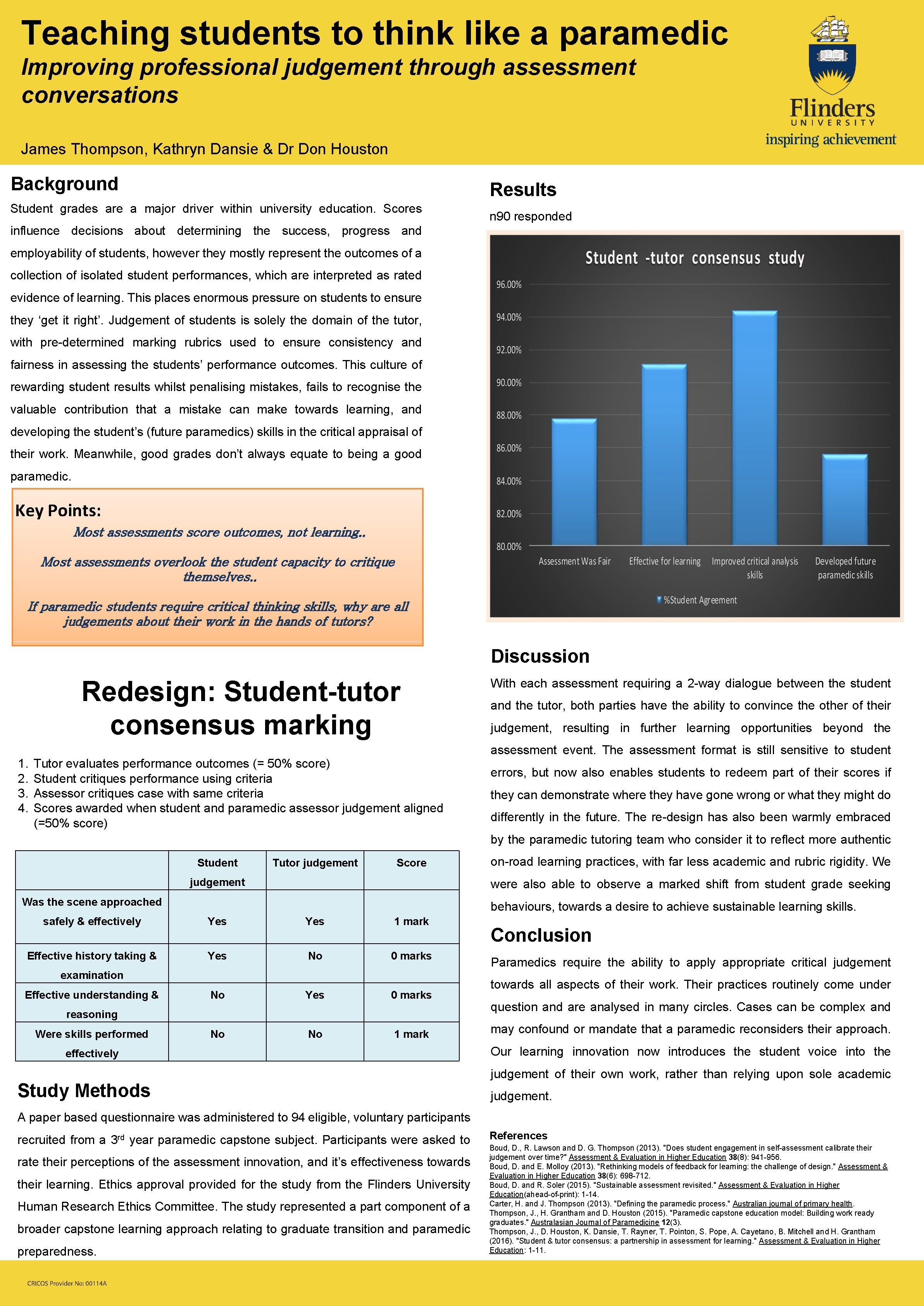
Teaching students to think like a paramedic Improving professional judgement through assessment conversations James Thompson, Kathryn Dansie & Dr Don Houston Background Results Student grades are a major driver within university education. Scores n 90 responded influence decisions about determining the success, progress and employability of students, however they mostly represent the outcomes of a collection of isolated student performances, which are interpreted as rated evidence of learning. This places enormous pressure on students to ensure they ‘get it right’. Judgement of students is solely the domain of the tutor, with pre-determined marking rubrics used to ensure consistency and fairness in assessing the students’ performance outcomes. This culture of rewarding student results whilst penalising mistakes, fails to recognise the valuable contribution that a mistake can make towards learning, and developing the student’s (future paramedics) skills in the critical appraisal of their work. Meanwhile, good grades don’t always equate to being a good paramedic. Key Points: Most assessments score outcomes, not learning. . Most assessments overlook the student capacity to critique themselves. . If paramedic students require critical thinking skills, why are all judgements about their work in the hands of tutors? Discussion Redesign: Student-tutor consensus marking 1. 2. 3. 4. Tutor evaluates performance outcomes (= 50% score) Student critiques performance using criteria Assessor critiques case with same criteria Scores awarded when student and paramedic assessor judgement aligned (=50% score) With each assessment requiring a 2 -way dialogue between the student and the tutor, both parties have the ability to convince the other of their judgement, resulting in further learning opportunities beyond the assessment event. The assessment format is still sensitive to student errors, but now also enables students to redeem part of their scores if they can demonstrate where they have gone wrong or what they might do differently in the future. The re-design has also been warmly embraced by the paramedic tutoring team who consider it to reflect more authentic Student Tutor judgement Score judgement were also able to observe a marked shift from student grade seeking Was the scene approached behaviours, towards a desire to achieve sustainable learning skills. safely & effectively Yes 1 mark Effective history taking & Yes No 0 marks examination Effective understanding & No Yes 0 marks No No 1 mark reasoning Were skills performed on-road learning practices, with far less academic and rubric rigidity. We effectively Study Methods Conclusion Paramedics require the ability to apply appropriate critical judgement towards all aspects of their work. Their practices routinely come under question and are analysed in many circles. Cases can be complex and may confound or mandate that a paramedic reconsiders their approach. Our learning innovation now introduces the student voice into the judgement of their own work, rather than relying upon sole academic judgement. A paper based questionnaire was administered to 94 eligible, voluntary participants recruited from a 3 rd year paramedic capstone subject. Participants were asked to rate their perceptions of the assessment innovation, and it’s effectiveness towards their learning. Ethics approval provided for the study from the Flinders University Human Research Ethics Committee. The study represented a part component of a broader capstone learning approach relating to graduate transition and paramedic preparedness. References Boud, D. , R. Lawson and D. G. Thompson (2013). "Does student engagement in self-assessment calibrate their judgement over time? " Assessment & Evaluation in Higher Education 38(8): 941 -956. Boud, D. and E. Molloy (2013). "Rethinking models of feedback for learning: the challenge of design. " Assessment & Evaluation in Higher Education 38(6): 698 -712. Boud, D. and R. Soler (2015). "Sustainable assessment revisited. " Assessment & Evaluation in Higher Education(ahead-of-print): 1 -14. Carter, H. and J. Thompson (2013). "Defining the paramedic process. " Australian journal of primary health. Thompson, J. , H. Grantham and D. Houston (2015). "Paramedic capstone education model: Building work ready graduates. " Australasian Journal of Paramedicine 12(3). Thompson, J. , D. Houston, K. Dansie, T. Rayner, T. Pointon, S. Pope, A. Cayetano, B. Mitchell and H. Grantham (2016). "Student & tutor consensus: a partnership in assessment for learning. " Assessment & Evaluation in Higher Education: 1 -11.