
Teaching Students to Read Complex Text Timothy Shanahan






- Slides: 150
Teaching Students to Read Complex Text Timothy Shanahan University of Illinois at Chicago www. shanahanonliteracy. com
Standards shift attention towards text and away from skills • Since 2010, most states embraced the idea of teaching students to read “complex text” • They set levels of text students are to learn to read in grades 2 -12) • This is in stark contrast to past standards that emphasized the learning of reading skills alone without attention to text
Reasons for the shift to an emphasis on text complexity • Studies showing that students can’t read the required texts when they leave high school (Achieve, 2015; Military Officers Association of America, 2018; Nale, et al. , 1998; Williamson, 2006; Workforce Readiness Project, 2006) • Schools teach kids with below grade level texts (Shanahan, 2013; Griffith & Duffett, 2018)
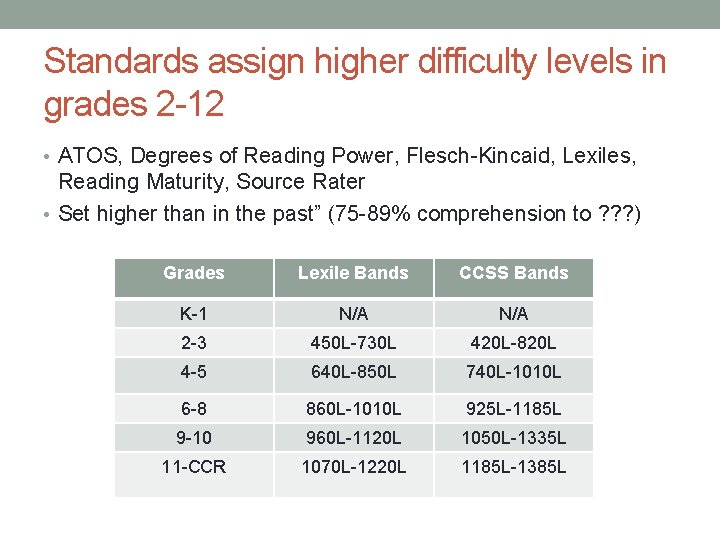
Standards assign higher difficulty levels in grades 2 -12 • ATOS, Degrees of Reading Power, Flesch-Kincaid, Lexiles, Reading Maturity, Source Rater • Set higher than in the past” (75 -89% comprehension to ? ? ? ) Grades Lexile Bands CCSS Bands K-1 N/A 2 -3 450 L-730 L 420 L-820 L 4 -5 640 L-850 L 740 L-1010 L 6 -8 860 L-1010 L 925 L-1185 L 9 -10 960 L-1120 L 1050 L-1335 L 11 -CCR 1070 L-1220 L 1185 L-1385 L
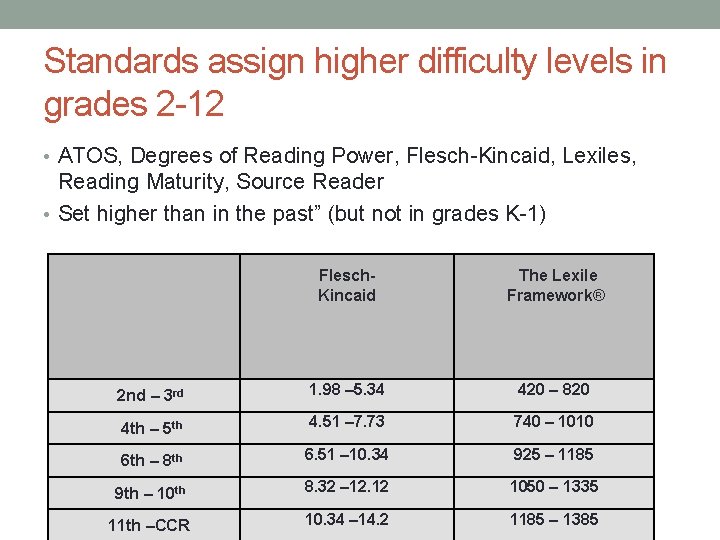
Standards assign higher difficulty levels in grades 2 -12 • ATOS, Degrees of Reading Power, Flesch-Kincaid, Lexiles, Reading Maturity, Source Reader • Set higher than in the past” (but not in grades K-1) Flesch. Kincaid The Lexile Framework® 2 nd – 3 rd 1. 98 – 5. 34 420 – 820 4 th – 5 th 4. 51 – 7. 73 740 – 1010 6 th – 8 th 6. 51 – 10. 34 925 – 1185 9 th – 10 th 8. 32 – 12. 12 1050 – 1335 11 th –CCR 10. 34 – 14. 2 1185 – 1385
Clarification: “Text complexity” carries two meanings in standards • Content/thematic sophistication • Language complexity • Both have to be honored
Results of complex texts mandates • RAND conducted nationwide survey of elementary and secondary teachers in 2016 • 77% of elementary teachers thought that teaching students with texts at their reading levels was aligned with the standards • 45% of secondary teachers believed this • Only about one-third of elementary teachers and ½ secondary teachers thought that they should assign a grade level text for a class to read • Teachers who knew the standards were less likely to used leveled readers to teach reading
Results of complex texts mandates (cont. ) • Thomas Fordham Foundation conducted national survey of teachers in 2018 and found that teachers were less likely to have students read grade level texts for reading than was true in 2010 when they previously surveyed • What these studies tell us is that teachers often lack understanding of their state’s educational standards and that students are less likely to be taught to read complex texts than before so many states mandated it
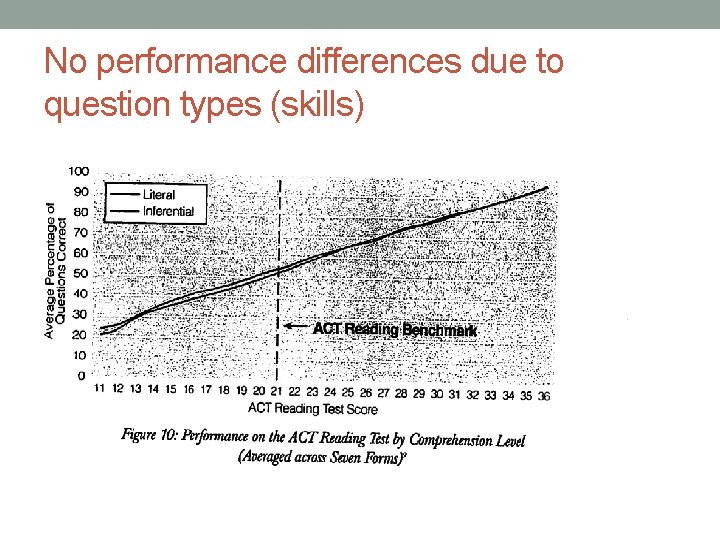
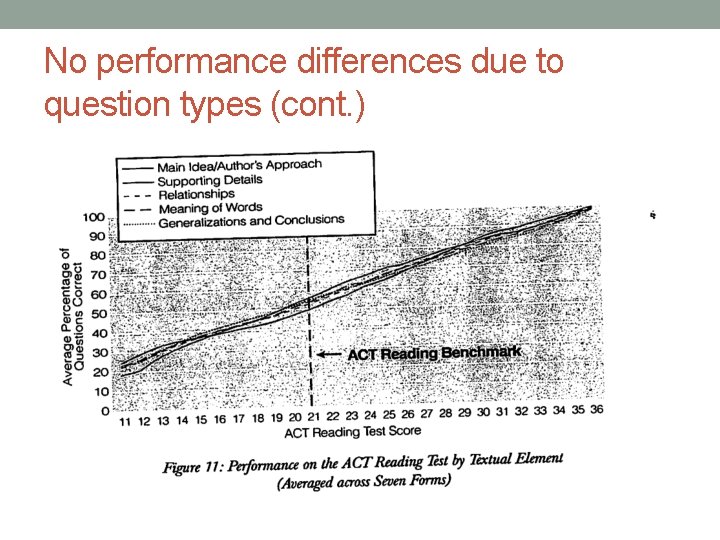
No performance differences due to question types (skills) •
No performance differences due to question types (cont. )
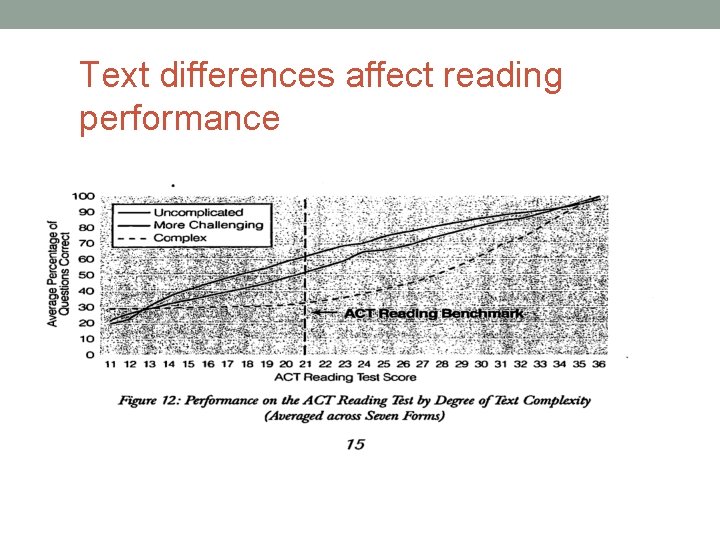
Text differences affect reading performance
Reconceptualization of reading • Reading comprehension is not the ability to answer certain kinds of text questions • Reading is the ability to make sense of ideas expressed in text—the ability to negotiate the linguistic and conceptual barriers or affordances of a text
Four Common Classroom Responses to Text Complexity • Move students to easier text • Read text to students (communicates the information, but doesn’t increase student reading ability) • Tell students what texts say (same as reading to kids in its impact) • Ignore the problem (more drawbacks than the previous approaches)
Reading experts have long championed the idea of instructional level • • • William S. Gray Edward Thorndike Arthur I. Gates Edward Dolch Albert J. Harris Marion Monroe Paul Witty Ruth Strang George Spache Donald Durrell Guy Bond Miles Tinker • • • Richard Allington Irene Fountas Gay Su Pinnell John J. Pikulski Richard Vacca Morton Botel Jerry Johns Roger Farr Jack Cassidy
Many programs and approaches depend on this idea, too • • • Guided Reading Recovery Book Bands Success for All Accelerated Reader Lexiles Corrective Reading Mastery Learning Academy of Reading Core Reading Programs (HHM, MH, SF, etc. ) • Etc.
As do other fields of education • Special Education • English Language Learners (ELL)
Teaching students with easier text • Theory has been that students learn best when taught with relatively easy text (Betts, 1946) • Independent (fluency 99 -100%; comprehension 90 -100%) • Instructional (fluency 95 -98%; comprehension 75 -89%) • Frustration (fluency 0 -92%; comprehension 0 -50%)
Matching texts to student levels doesn’t improve achievement • Killgallon (1942): only looked at relationship of oral reading fluency and reading comprehension—not learning • Powell (1968): same methodology as Killgallon, but more grade levels and different results • Dunkeld (1981): students taught at frustration level made greatest learning gains • Jorgensen, et al. (1977): no relation between placement and achievement gains • Mc. Namara, et al. (1996): middle school students learned more content from texts that were hard for them • Morgan, et al. (2000): frustration level placements led to greater learning gains in reading
Matching texts to student levels doesn’t improve achievement • Brown et al. (2017): replicates this result with third grade • O’Connor et al (2002, 2010): only benefit was for students reading at grade 1 level, but this benefit went away if scaffolding was equated • Kuhn et al (2006): frustration level placement led to greater learning gains • Homan, et al. , (2010): teaching 6 th graders with instructional level text gave no advantage over teaching with text one year above instructional level • Lupo , et al. (2019): grade level text led to as much learning as easier texts with 9 th graders (content and reading) as long as there was instructional support
Learning from complex text • Having students reading challenging text with accountability increases opportunity to learn • But students--if they are to be successful with this --require scaffolding, guidance, and teaching • A basic idea of instructional level teaching is to minimize teaching • The basic idea of teaching with complex text is to maximize achievement
But can we just throw students into difficult text? • No real evidence based on learning that shows instructional level works • However, the idea has burgeoned because just placing students in demanding texts that they cannot read well was not working well • Where does that leave us?
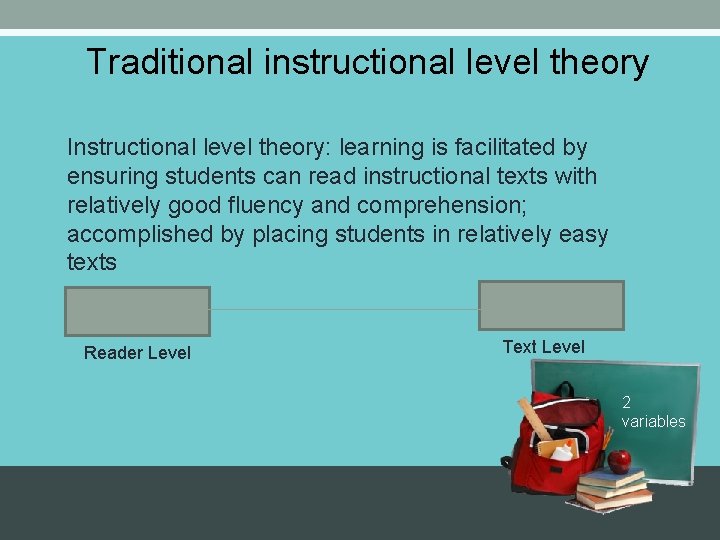
Traditional instructional level theory Instructional level theory: learning is facilitated by ensuring students can read instructional texts with relatively good fluency and comprehension; accomplished by placing students in relatively easy texts Reader Level Text Level 2 variables
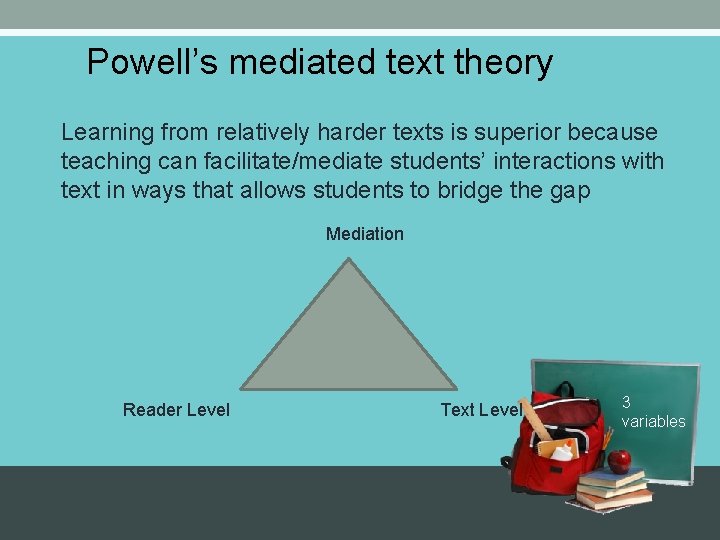
Powell’s mediated text theory Learning from relatively harder texts is superior because teaching can facilitate/mediate students’ interactions with text in ways that allows students to bridge the gap Mediation Reader Level Text Level 3 variables
An important exception • The standards do not require teaching beginning readers with more complex text • It is a good idea to read complex text to them, but text complexity for beginning readers is mainly tied up in decoding • Young children need to learn to decode, and more complex text may interfere with this • Use relatively easy texts initially—with plenty of repetition of words and spelling patterns
Scaffolding an Instructional Level Bonfiglio, Daly, Persampieri, & Andersen, 2006 Burns, 2007 Burns, Dean, & Foley, 2004 Carney, Anderson, Blackburn, & Blessings, 1984 Daly & Martens, 1994 Eckert, Ardoin, Daisey, & Scarola, 2000 Faulkner & Levy, 1999 Gickling & Armstrong, 1978 Hall, Sabey, & Mc. Clellan, 2005 Levy, Nicholls, & Kohen, 1993 Mc. Comas, Wacker, & Cooper, 1996 Neill, 1979
Scaffolding an Instructional Level O’Shea, Sindelar, & O’Shea, 1985 Pany & Mc. Coy, 1988 Rasinski, 1990 Reitsma, 1988 Rose & Beattie, 1986 Sanford & Horner, 2013 Sindelar, Monda, & O’Shea, 1990 Smith, 1979 Stoddard, Valcante, Sindelar, O’Shea, et al. , 1993 Taylor, Wade, & Yekovich, 1985 Turpie & Paratore, 1995 Van. Wagenen, Williams, & Mc. Laughlin, 1994 Weinstein & Cooke, 1992 Wixson, 1986
Scaffolding Challenging Text Scaffolding Text Features • Complexity of ideas/content • Match of text and reader prior knowledge • Complexity of vocabulary • Complexity of syntax • Complexity of coherence • Familiarity of genre demands • Complexity of text organization • Subtlety of author’s tone • Sophistication of literary devices or data-presentation devices Other Approaches • Provide sufficient fluency • Use stair-steps or apprentice texts • Teach comprehension strategies • Motivation
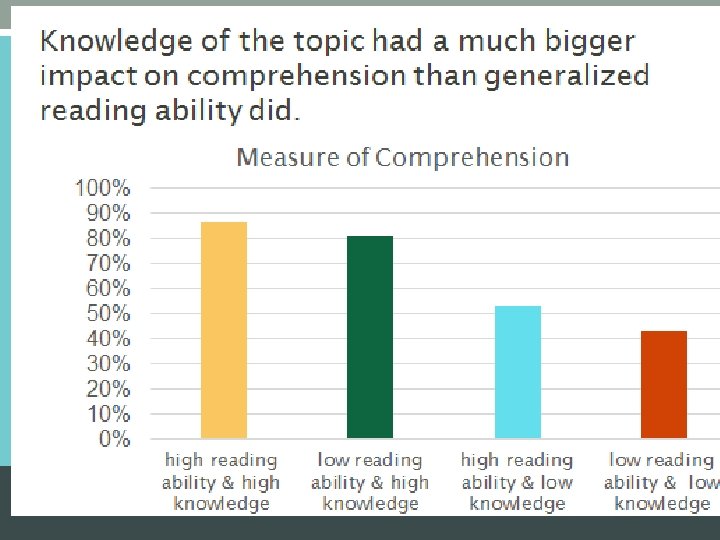
Build/Access Prior Knowledge • Prior knowledge plays an important role in reading • Prior knowledge refers to the information a reader brings to a text (in other words, knowledge) • Reading comprehension requires a combination of information from the text and information from the reader’s mind • Reading comprehension as building bridges between the new and the known
Build/Access Prior Knowledge (cont. ) • Reading usually requires inferencing—inferences are instigated by information in the text, but they are made on the basis of what the reader already knows • Thus, if a character is handling diapers, has spit up on her blouse, and is warming a bottle—it may be inferred that the character has a baby
Build/Access Prior Knowledge (cont. ) • Reading sometimes requires the untangling of ambiguity • Sarah gave a bath to her dog wearing a pink t-shirt.
Build/Access Prior Knowledge (cont. ) • Cognitive psychologists have described three types of memory: long-term, short-term, and working memory • Working memory is a place where new information is processed for comprehension (it is a temporary storage place) • Working memory has limited capacity (Craik & Lockhart, 1975) • One way around the limits of working memory is to access information from long-term memory • Thus, a person with relevant prior knowledge will be able to process new information more completely
Build/Access Prior Knowledge (cont. ) • There are downsides to prior knowledge as well • Studies show that when prior knowledge contradicts text information, students tend to reject or ignore the text information • Students stay with preconceptions—even when they are wrong —rather than correctly weighing the text information • Neither of these approaches make sense • Prior knowledge often overwhelms text (students stay with preconceptions) • Placing a great emphasis on prior knowledge discourages learning • Prior knowledge preparation should be kept brief
Build/Access Prior Knowledge (cont. ) • Various approaches to prior knowledge • One approach is to simply avoid topics that students know little about • This ignores the fact that even with relatively low knowledge it is possible to learn new things (harder, but still workable) • Withholding information that is outside of students’ experience has serious social justice implications as well • Or, teachers will tell the students the new information instead of having them read it, but this doesn’t change the capacity of working memory or enable inferences either
Build/Access Prior Knowledge (cont. ) • Various approaches to prior knowledge • Another approach is to help the reader to take advantage of relevant prior knowledge • You’ll see authors who do this by trying to use metaphors or analogies that they believe will signal relevant connections to a reader • Teachers too can help students to access appropriate memory by telling them the topic and the genre (this kind of introduction should be brief--remember we don’t want prior knowledge to overwhelm the text)
"The procedure is actually quite simple. First you arrange items into different groups. Of course one pile may be sufficient depending on how much there is do. If you need to go somewhere else due to a lack of facilities, then this is the next step; otherwise, you are pretty well set. It is important not to overdo things. That is, it is better to do too few things at once than too many. In the short run, this may not seem important, but complications can easily arise. A mistake can be expensive as well. At first, the whole procedure will seem complicated. Soon, however, it will become just another facet of life. It is difficult to foresee any end to the necessity for this task in the future, but then, one can never tell. After the procedure is completed, one arranges the materials into different piles again. Eventually they will be used one more and the whole cycle will then have to be repeated. However, that is part of life. "
Washing Clothes "The procedure is actually quite simple. First you arrange items into different groups. Of course one pile may be sufficient depending on how much there is do. If you need to go somewhere else due to a lack of facilities, then this is the next step; otherwise, you are pretty well set. It is important not to overdo things. That is, it is better to do too few things at once than too many. In the short run, this may not seem important, but complications can easily arise. A mistake can be expensive as well. At first, the whole procedure will seem complicated. Soon, however, it will become just another facet of life. It is difficult to foresee any end to the necessity for this task in the future, but then, one can never tell. After the procedure is completed, one arranges the materials into different piles again. Eventually they will be used one more and the whole cycle will then have to be repeated. However, that is part of life. "
Build/Access Prior Knowledge (cont. ) • Teachers, in efforts to support reading comprehension, may tell too much—revealing what the text says rather than reminding students or informing students about separate but helpful information • Sometime the prior knowledge preparation ignores what it is that students have trouble with
Prior Knowledge Example Three men came to get their haircut, but Stanley barked at them. The barber looked at William. “Boy, ” he said, “isn’t that your dog? ” “No, ” he said. “He just followed me. He lives next door. ” “Well, ” the barber said, “that dog is keeping people out of my shop. There are people here ahead of you, but I’ll cut your hair now. ”
Prior Knowledge Had high school students bring prior knowledge to bear on texts, not by previewing the content, but by associating the content with what they know through reasoning (Hattan, 2019) • Analogy (similarities—a cell is like a factory…) • Anomaly (discrepancies—in statistics, looking at outliers) • Antinomy (exclusivity—ruling out cases based on rules/whale is a mammal) • Antithesis (opposition—global warming)
Prior Knowledge • Don’t worry too much about whether the student knows about this text or content, but is there knowledge that the author assumes that the reader will have? • Does interpreting text depend on knowledge the student doesn’t have due to lack of experience or cultural differences? • What can you tell the student that will make interpretation of the text easier—without telling things that the text itself presents? • Are there things that a student might know that could help in interpretation but that they might not think to use? (cricket, baseball, games)
Tell Vocabulary • Texts can be hard because of unfamiliar vocabulary (difference between academic vocabulary and key vocabulary in a text) • We teach vocabulary, but there are two major issues in vocabulary teaching: (1) building a lexicon; (2) enabling immediate understanding of text • We need to identify relatively high frequency (usefulness) words that kids won’t learn on their own from oral language to build lexicon (no matter what their immediate impact) • We need to identify words that students are not likely to know or that can’t be figured out easily that have high impact on reading comprehension (no matter their importance).
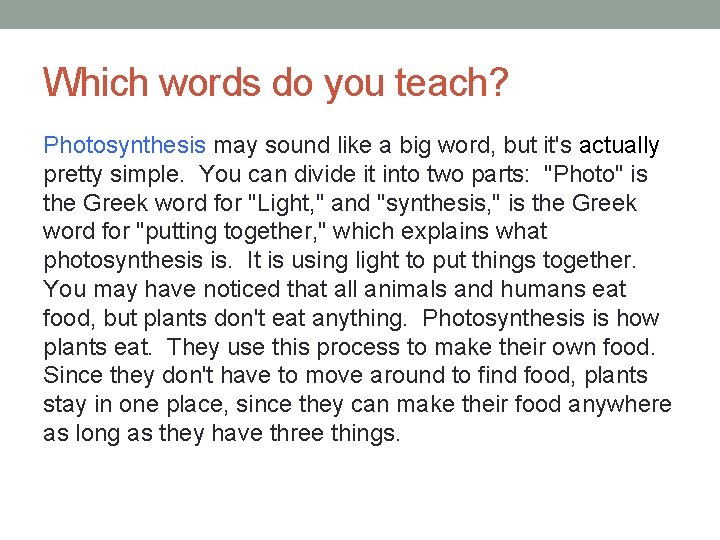
Which words do you teach? Photosynthesis may sound like a big word, but it's actually pretty simple. You can divide it into two parts: "Photo" is the Greek word for "Light, " and "synthesis, " is the Greek word for "putting together, " which explains what photosynthesis is. It is using light to put things together. You may have noticed that all animals and humans eat food, but plants don't eat anything. Photosynthesis is how plants eat. They use this process to make their own food. Since they don't have to move around to find food, plants stay in one place, since they can make their food anywhere as long as they have three things.
Which words do you teach? Photosynthesis may sound like a big word, but it's actually pretty simple. You can divide it into two parts: "Photo" is the Greek word for "Light, " and "synthesis, " is the Greek word for "putting together, " which explains what photosynthesis is. It is using light to put things together. You may have noticed that all animals and humans eat food, but plants don't eat anything. Photosynthesis is how plants eat. They use this process to make their own food. Since they don't have to move around to find food, plants stay in one place, since they can make their food anywhere as long as they have three things.
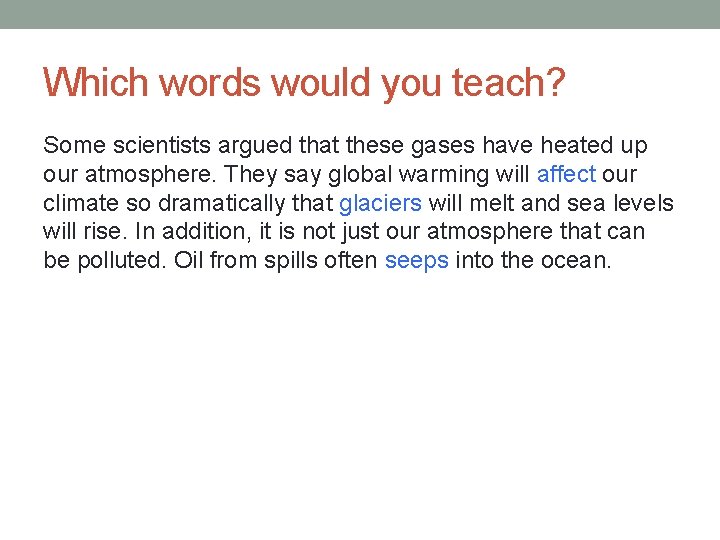
Which words would you teach? Some scientists argued that these gases have heated up our atmosphere. They say global warming will affect our climate so dramatically that glaciers will melt and sea levels will rise. In addition, it is not just our atmosphere that can be polluted. Oil from spills often seeps into the ocean.
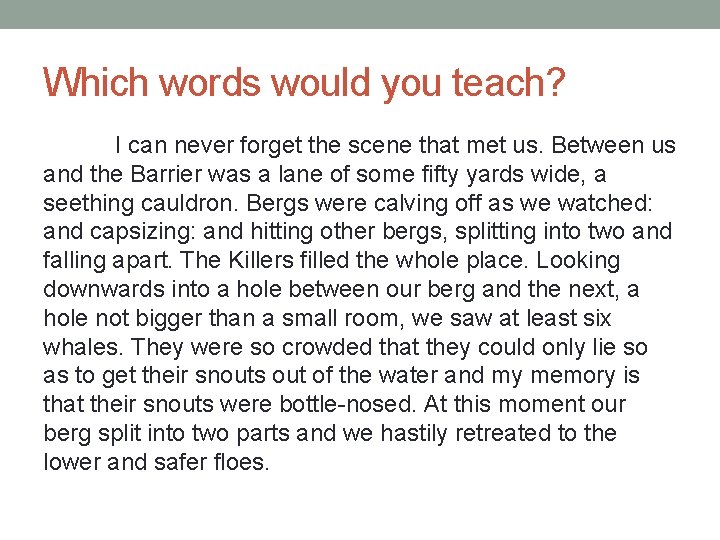
Which words would you teach? I can never forget the scene that met us. Between us and the Barrier was a lane of some fifty yards wide, a seething cauldron. Bergs were calving off as we watched: and capsizing: and hitting other bergs, splitting into two and falling apart. The Killers filled the whole place. Looking downwards into a hole between our berg and the next, a hole not bigger than a small room, we saw at least six whales. They were so crowded that they could only lie so as to get their snouts out of the water and my memory is that their snouts were bottle-nosed. At this moment our berg split into two parts and we hastily retreated to the lower and safer floes.
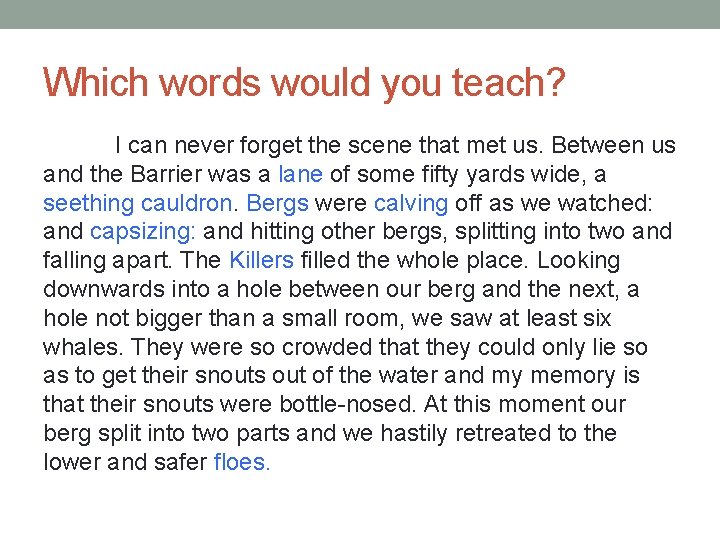
Which words would you teach? I can never forget the scene that met us. Between us and the Barrier was a lane of some fifty yards wide, a seething cauldron. Bergs were calving off as we watched: and capsizing: and hitting other bergs, splitting into two and falling apart. The Killers filled the whole place. Looking downwards into a hole between our berg and the next, a hole not bigger than a small room, we saw at least six whales. They were so crowded that they could only lie so as to get their snouts out of the water and my memory is that their snouts were bottle-nosed. At this moment our berg split into two parts and we hastily retreated to the lower and safer floes.
Vocabulary: Building the Lexicon • Research shows that vocabulary knowledge increases in importance as students advance through school • By high school, vocabulary knowledge predicts a large amount of the variation in reading comprehension • Studies show that vocabulary instruction (and incidental learning of vocabulary) are related to growth in reading comprehension ability • Vocabulary is both an index of language knowledge and of domain or world knowledge (prior knowledge)
Vocabulary: Building the Lexicon Successful vocabulary instruction has been found to include the following features: 1. Rich definition 2. Consideration of relationships among words 3. Use in reading, writing, speaking, listening, visual representations 4. Connecting to real life 5. Frequent review
Vocabulary: Building the Lexicon • Rich vocabulary/Multiple definitions • Explanation/Encyclopedia more than Definition/Dictionary 1. Dictionary definition 2. Synonyms 3. Antonyms 4. Part of speech 5. Other forms/spellings 6. Category 7. Example 8. Picture 9. Act it out
Vocabulary: Morphology Analyzing words (cont. ) • Morphology refers to the study of how words are formed by analyzing the structure of words and word parts such as stems, root words, prefixes, and suffixes. • Words meanings can sometimes be figured out from morphology (breaking words into their meaningful parts) • This kind of work is best done with words that students are confronting in their reading
Vocabulary: Building the Lexicon Epitomize 1. Dictionary definition: 2. Synonyms: 3. Antonyms 4. Part of speech 5. Other forms/spellings 6. Category 7. Example 8. Picture 9. Act it out
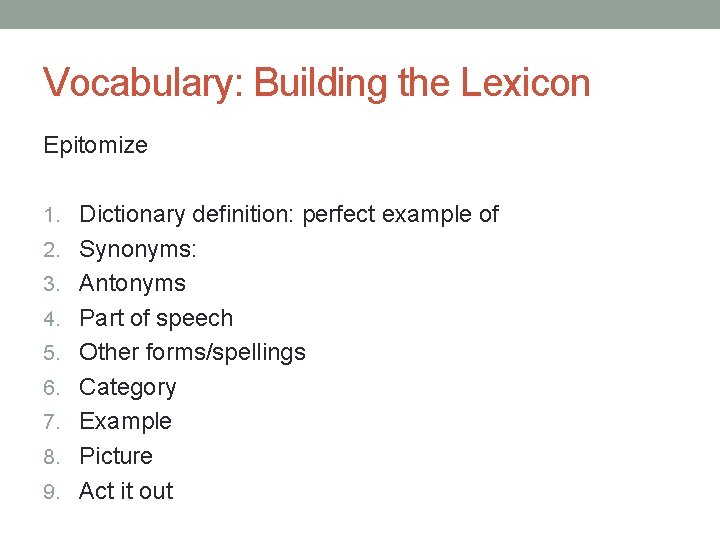
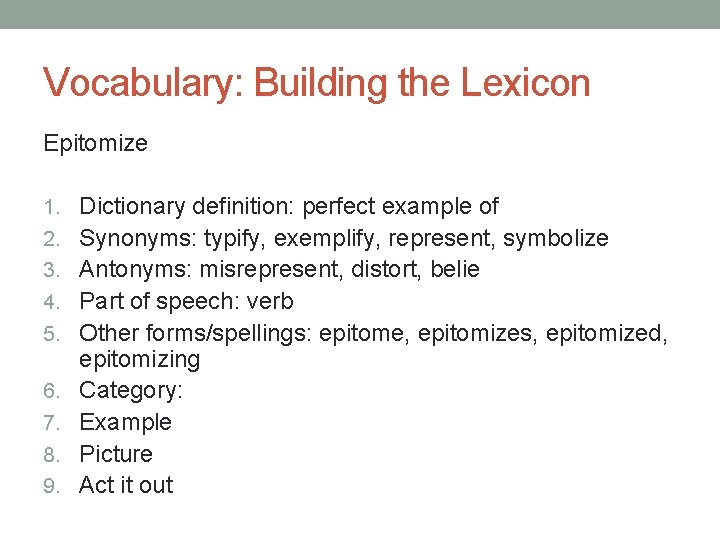
Vocabulary: Building the Lexicon Epitomize 1. Dictionary definition: perfect example of 2. Synonyms: 3. Antonyms 4. Part of speech 5. Other forms/spellings 6. Category 7. Example 8. Picture 9. Act it out
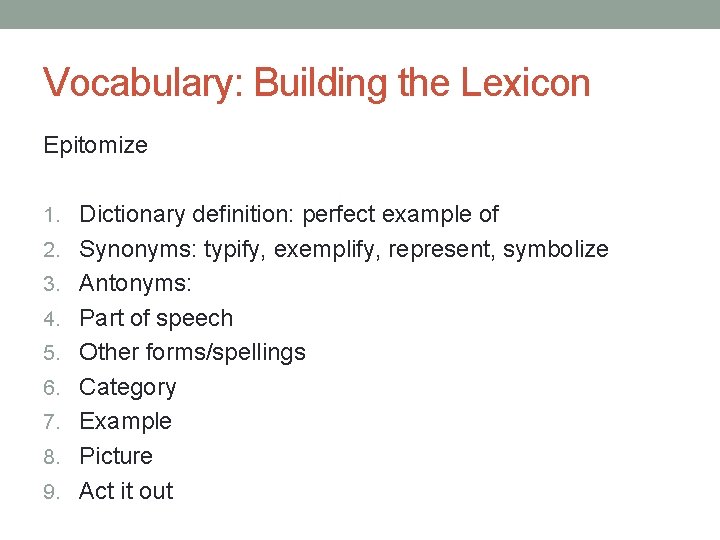
Vocabulary: Building the Lexicon Epitomize 1. Dictionary definition: perfect example of 2. Synonyms: typify, exemplify, represent, symbolize 3. Antonyms: 4. Part of speech 5. Other forms/spellings 6. Category 7. Example 8. Picture 9. Act it out
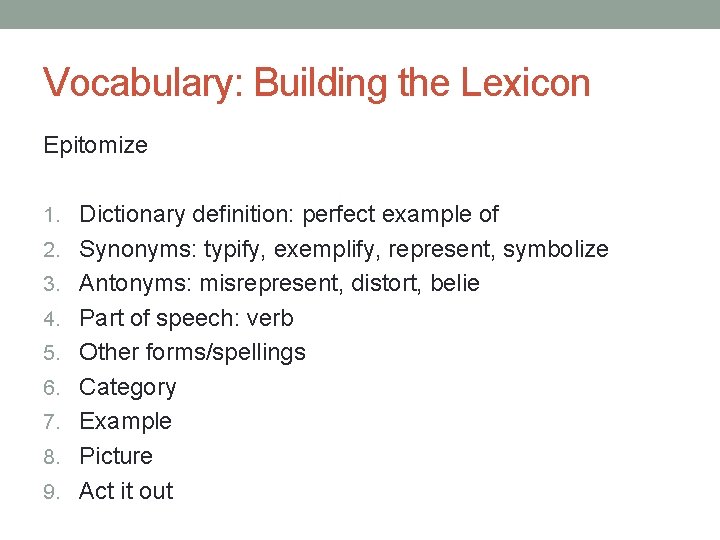
Vocabulary: Building the Lexicon Epitomize 1. Dictionary definition: perfect example of 2. Synonyms: typify, exemplify, represent, symbolize 3. Antonyms: misrepresent, distort, belie 4. Part of speech: verb 5. Other forms/spellings 6. Category 7. Example 8. Picture 9. Act it out
Vocabulary: Building the Lexicon Epitomize 1. Dictionary definition: perfect example of 2. Synonyms: typify, exemplify, represent, symbolize 3. Antonyms: misrepresent, distort, belie 4. Part of speech: verb 5. Other forms/spellings: epitome, epitomizes, epitomized, 6. 7. 8. 9. epitomizing Category: Example Picture Act it out
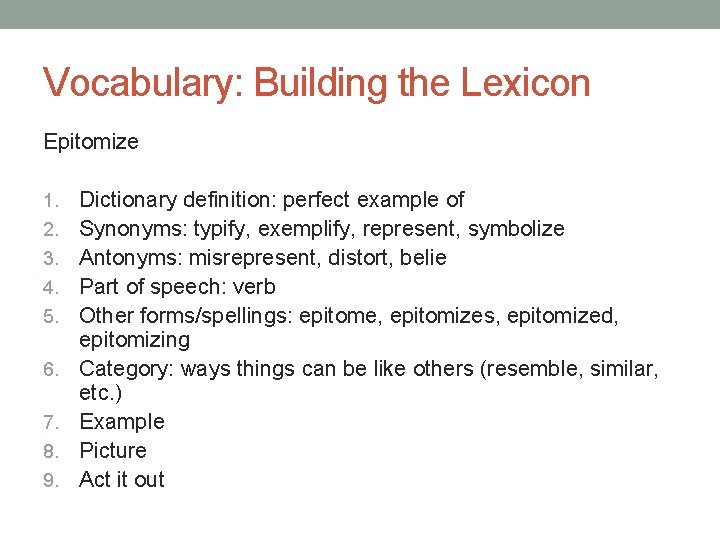
Vocabulary: Building the Lexicon Epitomize 1. 2. 3. 4. 5. 6. 7. 8. 9. Dictionary definition: perfect example of Synonyms: typify, exemplify, represent, symbolize Antonyms: misrepresent, distort, belie Part of speech: verb Other forms/spellings: epitome, epitomizes, epitomized, epitomizing Category: ways things can be like others (resemble, similar, etc. ) Example Picture Act it out
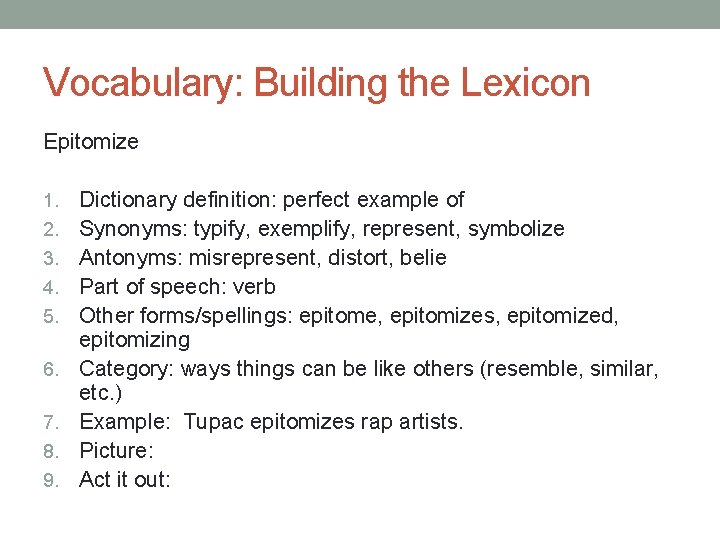
Vocabulary: Building the Lexicon Epitomize 1. 2. 3. 4. 5. 6. 7. 8. 9. Dictionary definition: perfect example of Synonyms: typify, exemplify, represent, symbolize Antonyms: misrepresent, distort, belie Part of speech: verb Other forms/spellings: epitome, epitomizes, epitomized, epitomizing Category: ways things can be like others (resemble, similar, etc. ) Example: Tupac epitomizes rap artists. Picture: Act it out:
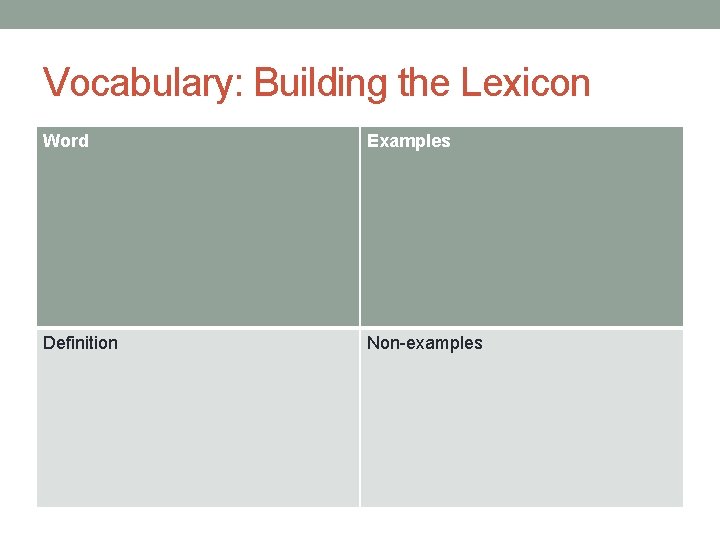
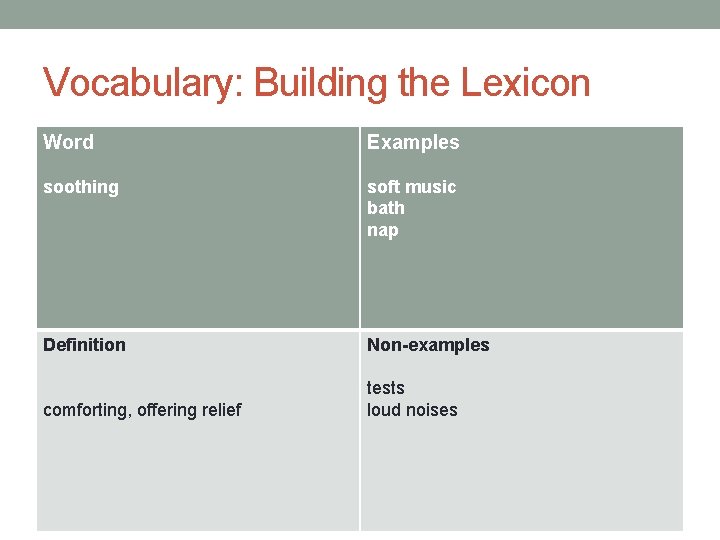
Vocabulary: Building the Lexicon Word Examples Definition Non-examples
Vocabulary: Building the Lexicon Word Examples soothing soft music bath nap Definition Non-examples comforting, offering relief tests loud noises
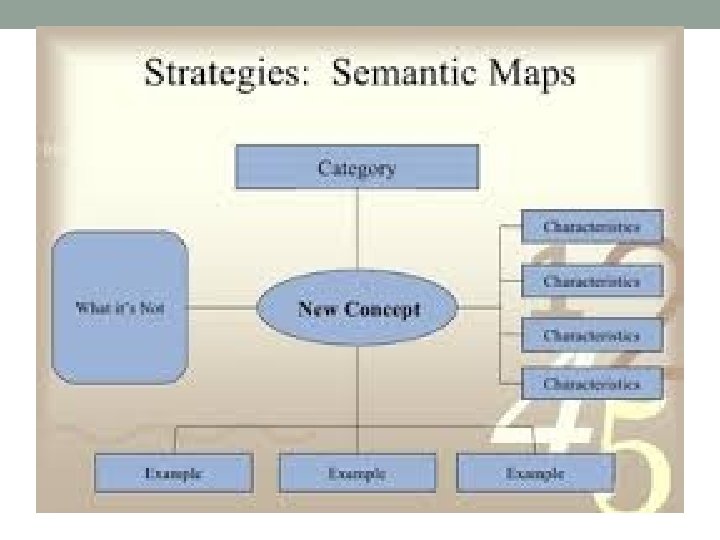
Vocabulary: Building the Lexicon • Words are remembered best when they are connected to other words/ideas • Various approaches connect words (synonyms, antonyms, categories, and comparisons of previous examples connect words) • Another way is semantic mapping
Vocabulary: Building the Lexicon • Repeated and varied use (12 repetitions) • All modes of language (reading, writing, speaking, listening, graphic/pictographic, kinesthetic) • Personal connections (personal vocabulary lists, word wizards) • Frequent review
Vocabulary: Sensitivity to meaning Metacognitive awareness • It is essential that students have metacognitive awareness during reading • They need to be sensitive to their lack of understanding of words • It is important to be able to proceed in trying to make sense of text even when you don’t know all the words, but it is also essential that you be aware of when you don’t know the meaning of words
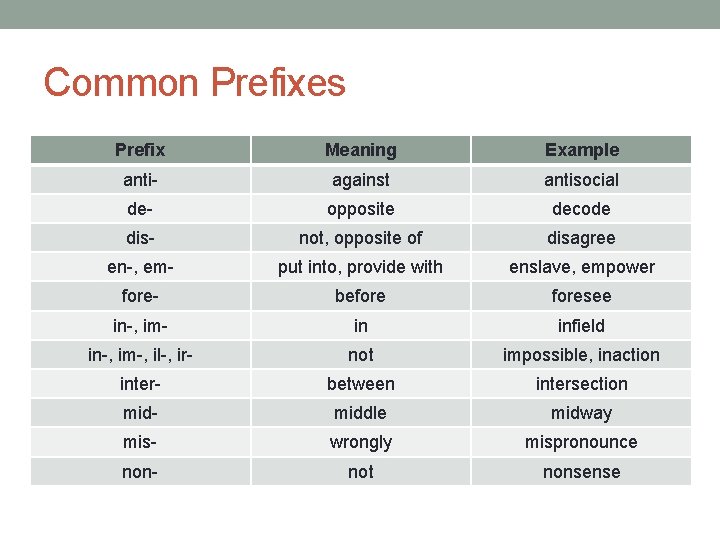
Common Prefixes Prefix Meaning Example anti- against antisocial de- opposite decode dis- not, opposite of disagree en-, em- put into, provide with enslave, empower fore- beforesee in-, im- in infield in-, im-, il-, ir- not impossible, inaction inter- between intersection mid- middle midway mis- wrongly mispronounce non- not nonsense
Vocabulary: Morphology Analyzing words (cont. ) • Morphology refers to the study of how words are formed by analyzing the structure of words and word parts such as stems, root words, prefixes, and suffixes. • Words meanings can sometimes be figured out from morphology (breaking words into their meaningful parts) • This kind of work is best done with words that students are confronting in their reading
Common Prefixes Prefix Meaning Example anti- against antisocial de- opposite decode dis- not, opposite of disagree en-, em- put into, provide with enslave, empower fore- beforesee in-, im- in infield in-, im-, il-, ir- not impossible, inaction inter- between intersection mid- middle midway mis- wrongly mispronounce non- not nonsense
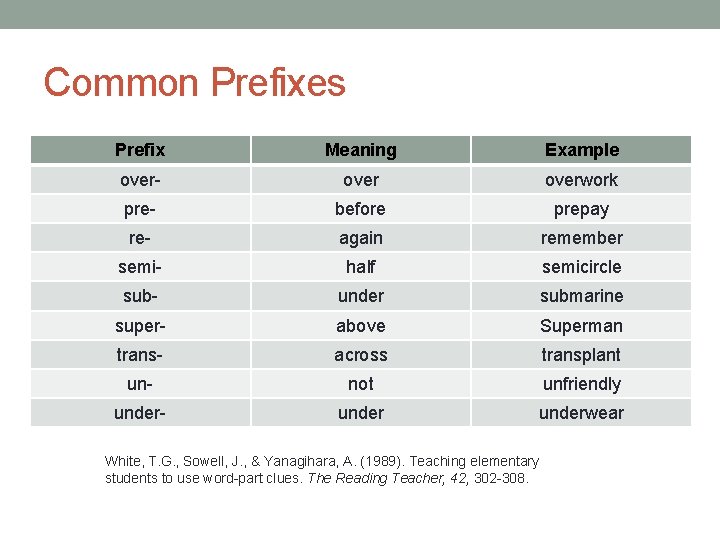
Common Prefixes Prefix Meaning Example over- overwork pre- before prepay re- again remember semi- half semicircle sub- under submarine super- above Superman trans- across transplant un- not unfriendly under- underwear White, T. G. , Sowell, J. , & Yanagihara, A. (1989). Teaching elementary students to use word-part clues. The Reading Teacher, 42, 302 -308.
Common suffixes Suffix Meaning Example -able, ible can be done comfortable -al, ial having characteristics of partial -ed past-test verbs helped -en made of golden -er one who player -er comparative faster -est comparative fastest -ful full of careful -ic having characteristics of romantic -ing present-tense verbs running -ion, -tion, -ation, -ition act, process action
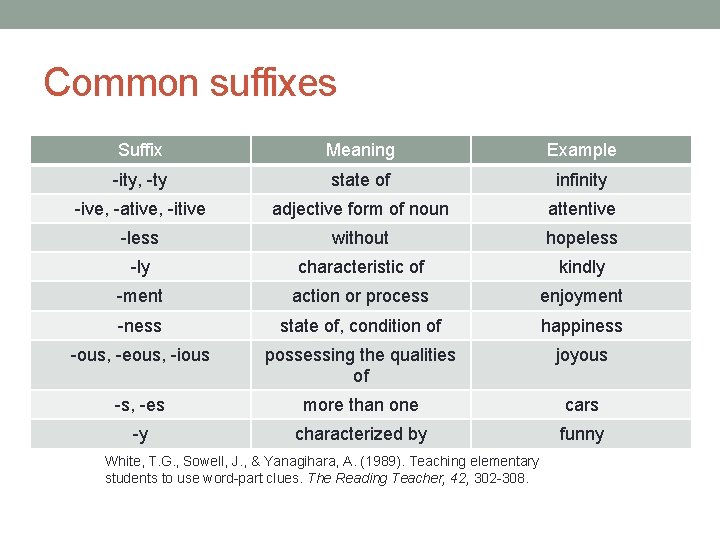
Common suffixes Suffix Meaning Example -ity, -ty state of infinity -ive, -ative, -itive adjective form of noun attentive -less without hopeless -ly characteristic of kindly -ment action or process enjoyment -ness state of, condition of happiness -ous, -eous, -ious possessing the qualities of joyous -s, -es more than one cars -y characterized by funny White, T. G. , Sowell, J. , & Yanagihara, A. (1989). Teaching elementary students to use word-part clues. The Reading Teacher, 42, 302 -308.
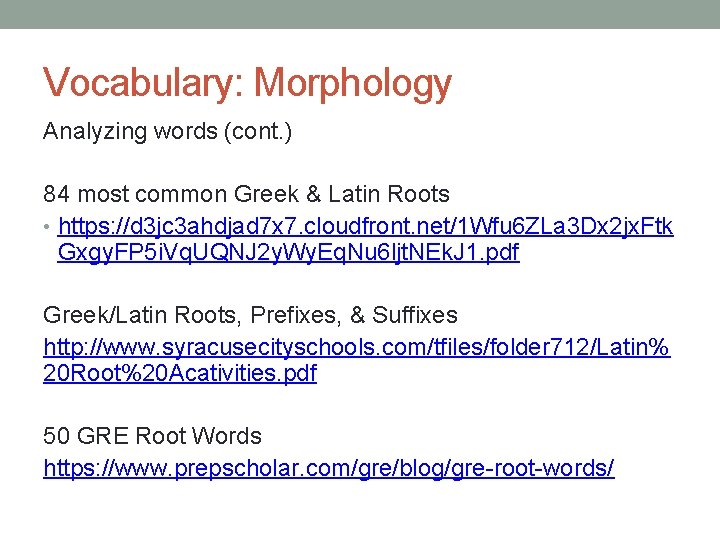
Vocabulary: Morphology Analyzing words (cont. ) 84 most common Greek & Latin Roots • https: //d 3 jc 3 ahdjad 7 x 7. cloudfront. net/1 Wfu 6 ZLa 3 Dx 2 jx. Ftk Gxgy. FP 5 i. Vq. UQNJ 2 y. Wy. Eq. Nu 6 ljt. NEk. J 1. pdf Greek/Latin Roots, Prefixes, & Suffixes http: //www. syracusecityschools. com/tfiles/folder 712/Latin% 20 Root%20 Acativities. pdf 50 GRE Root Words https: //www. prepscholar. com/gre/blog/gre-root-words/
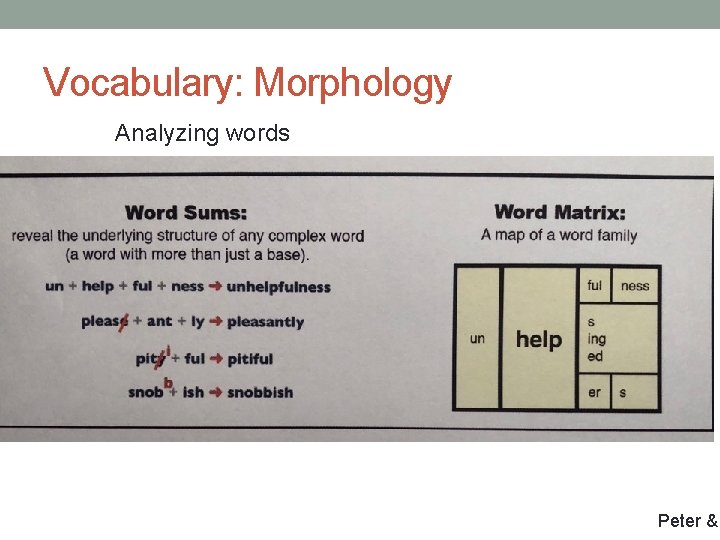
Vocabulary: Morphology Analyzing words Peter &
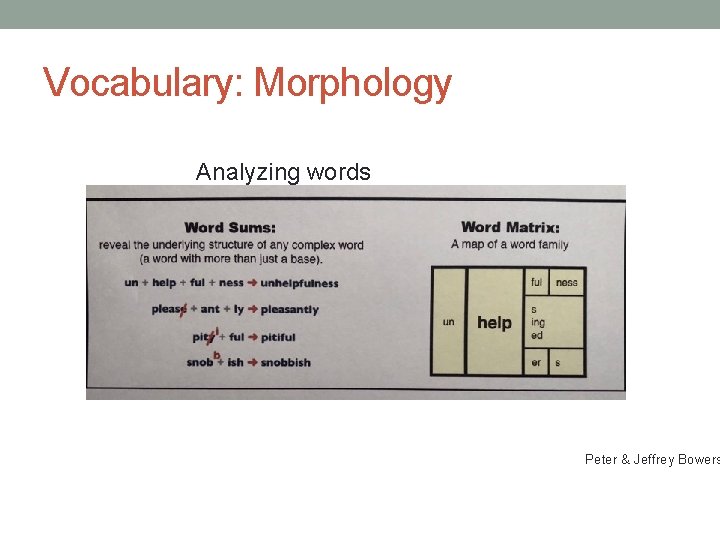
Vocabulary: Morphology Analyzing words Peter & Jeffrey Bowers
Comprehending Sentences • Reading requires more than an ability to make sense of word meanings • Comprehension also depends on one’s ability to make sense of syntax, too
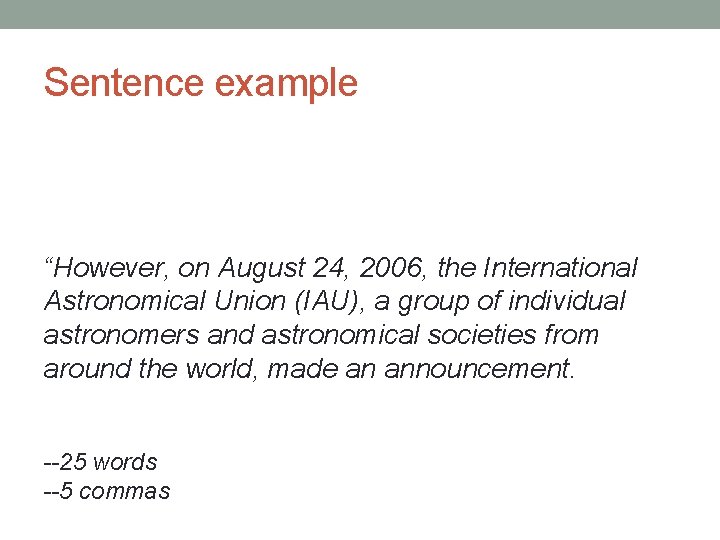
Sentence example “However, on August 24, 2006, the International Astronomical Union (IAU), a group of individual astronomers and astronomical societies from around the world, made an announcement. --25 words --5 commas
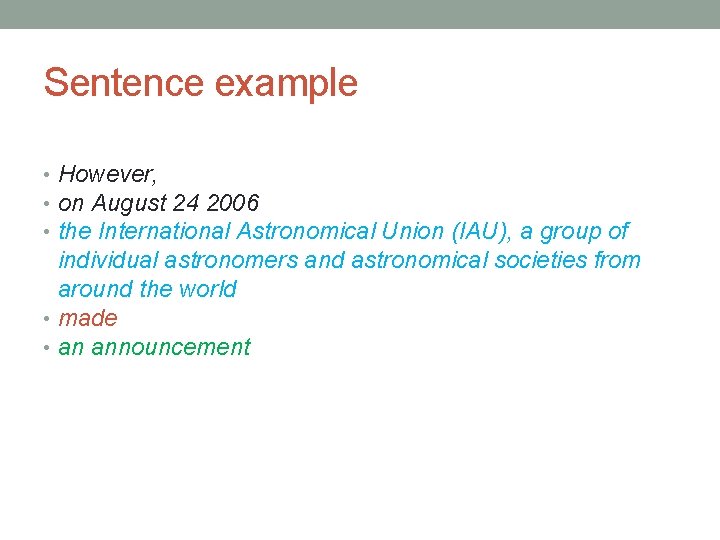
Sentence example • However, • on August 24 2006 • the International Astronomical Union (IAU), a group of individual astronomers and astronomical societies from around the world • made • an announcement
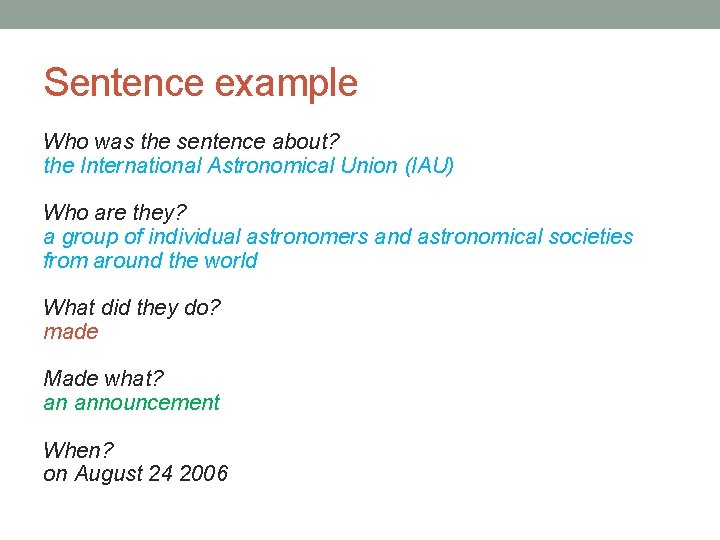
Sentence example Who was the sentence about? the International Astronomical Union (IAU) Who are they? a group of individual astronomers and astronomical societies from around the world What did they do? made Made what? an announcement When? on August 24 2006
Another example “The women of Montgomery, both young and older, would come in with their fancy holiday dresses that needed adjustments or their Sunday suits and blouses that needed just a touch—a flower or some velvet trimming or something to make the ladies look festive. ” --Nikki Giovanni (Rosa) • 44 words • 2 commas, 1 em-dash
“The women of Montgomery , both young and older, would come in with their fancy holiday dresses that needed adjustments or their Sunday suits and blouses that needed just a touch—a flower or some velvet trimming or something to make the ladies look festive. ”
“The women of Montgomery would come in with their fancy holiday dresses that needed adjustments or their Sunday suits and blouses that needed just a touch—a flower or some velvet trimming or something to make the ladies look festive. ”
“The women of Montgomery would come in with their fancy holiday dresses that needed adjustments or their Sunday suits and blouses that needed just a touch—a flower or some velvet trimming or something to make the ladies look festive. ”
Another example “The women of Montgomery would come in with their fancy holiday dresses that needed adjustments or their Sunday suits and blouses that needed just a touch —a flower or some velvet trimming or something to make the ladies look festive. ”
Another example “The women of Montgomery would come in with their fancy holiday dresses that needed adjustments or their Sunday suits and blouses that needed just a touch —a flower or some velvet trimming or something to make the ladies look festive. ”
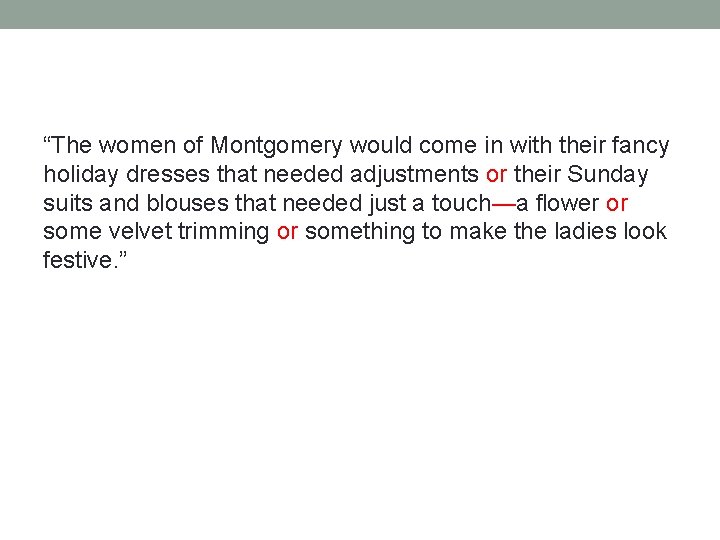
Another example “The women of Montgomery would come in with their fancy holiday dresses that needed adjustments or The women of Montgomery would come in with their Sunday suits and blouses that needed just a touch —a flower or some velvet trimming or something to make the ladies look festive. ”
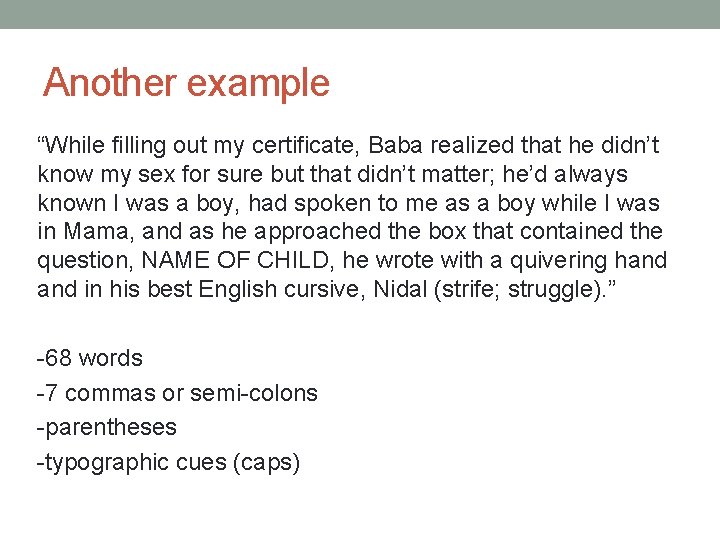
Another example “While filling out my certificate, Baba realized that he didn’t know my sex for sure but that didn’t matter; he’d always known I was a boy, had spoken to me as a boy while I was in Mama, and as he approached the box that contained the question, NAME OF CHILD, he wrote with a quivering hand in his best English cursive, Nidal (strife; struggle). ”
Another example “While filling out my certificate, Baba realized that he didn’t know my sex for sure but that didn’t matter; he’d always known I was a boy, had spoken to me as a boy while I was in Mama, and as he approached the box that contained the question, NAME OF CHILD, he wrote with a quivering hand in his best English cursive, Nidal (strife; struggle). ” -68 words -7 commas or semi-colons -parentheses -typographic cues (caps)
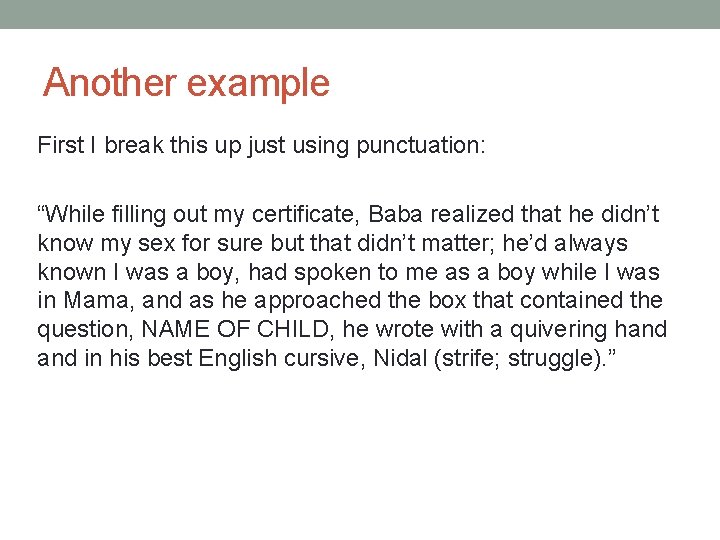
Another example First I break this up just using punctuation: “While filling out my certificate, Baba realized that he didn’t know my sex for sure but that didn’t matter; he’d always known I was a boy, had spoken to me as a boy while I was in Mama, and as he approached the box that contained the question, NAME OF CHILD, he wrote with a quivering hand in his best English cursive, Nidal (strife; struggle). ”
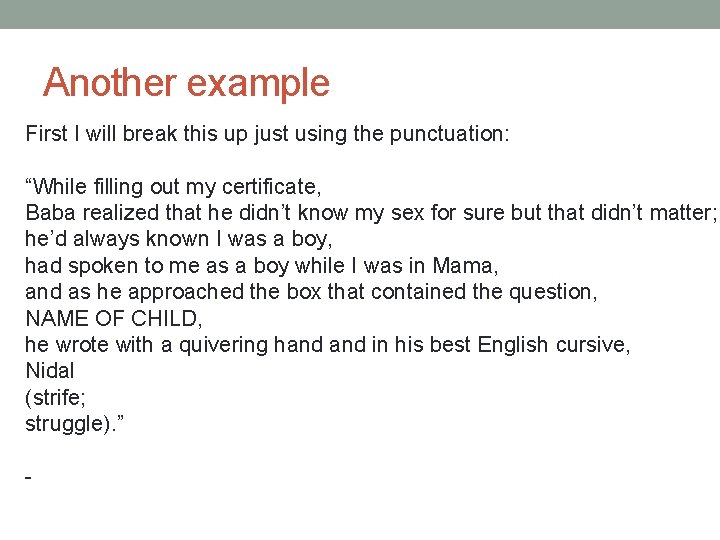
Another example First I will break this up just using the punctuation: “While filling out my certificate, Baba realized that he didn’t know my sex for sure but that didn’t matter; he’d always known I was a boy, had spoken to me as a boy while I was in Mama, and as he approached the box that contained the question, NAME OF CHILD, he wrote with a quivering hand in his best English cursive, Nidal (strife; struggle). ” -
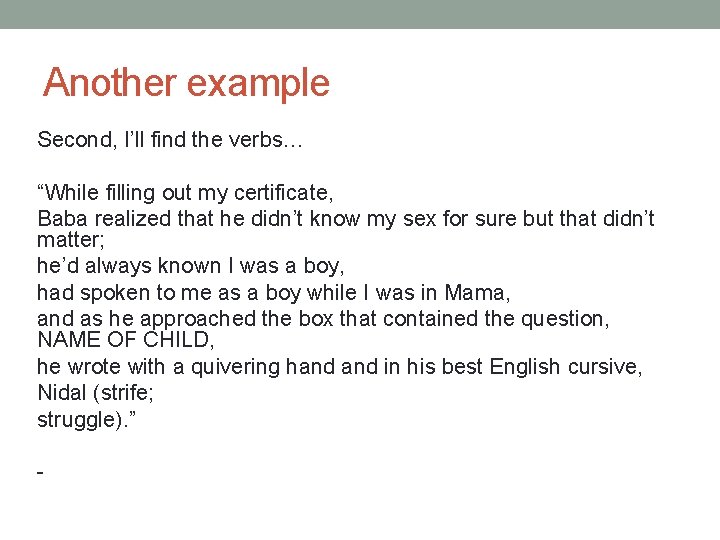
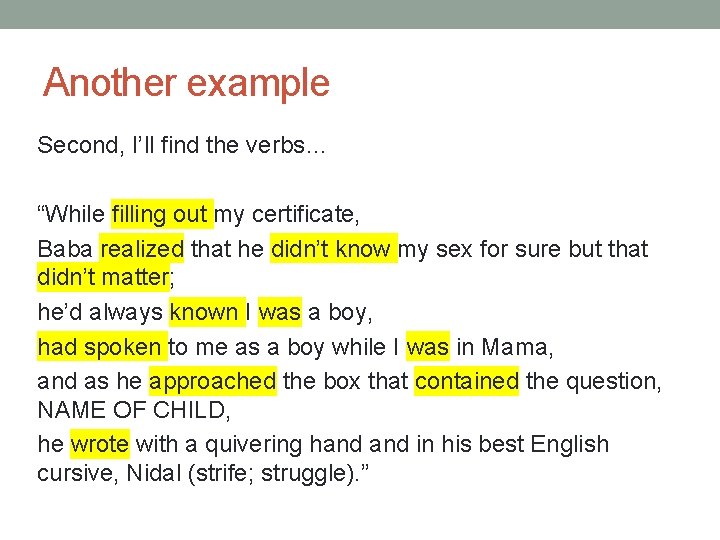
Another example Second, I’ll find the verbs… “While filling out my certificate, Baba realized that he didn’t know my sex for sure but that didn’t matter; he’d always known I was a boy, had spoken to me as a boy while I was in Mama, and as he approached the box that contained the question, NAME OF CHILD, he wrote with a quivering hand in his best English cursive, Nidal (strife; struggle). ” -
Another example Second, I’ll find the verbs… “While filling out my certificate, Baba realized that he didn’t know my sex for sure but that didn’t matter; he’d always known I was a boy, had spoken to me as a boy while I was in Mama, and as he approached the box that contained the question, NAME OF CHILD, he wrote with a quivering hand in his best English cursive, Nidal (strife; struggle). ”
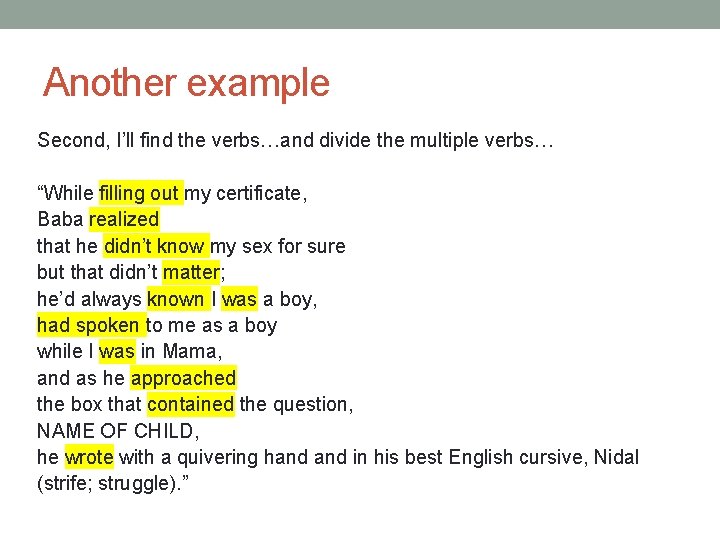
Another example Second, I’ll find the verbs…and divide the multiple verbs… “While filling out my certificate, Baba realized that he didn’t know my sex for sure but that didn’t matter; he’d always known I was a boy, had spoken to me as a boy while I was in Mama, and as he approached the box that contained the question, NAME OF CHILD, he wrote with a quivering hand in his best English cursive, Nidal (strife; struggle). ”
Another example Second, I’ll find the verbs…and divide the multiple verbs… “While filling out my certificate, Baba realized that he didn’t know my sex for sure but that didn’t matter; he’d always known I was a boy, had spoken to me as a boy while I was in Mama, and as he approached the box that contained the question, NAME OF CHILD, he wrote with a quivering hand in his best English cursive, Nidal (strife; struggle). ”
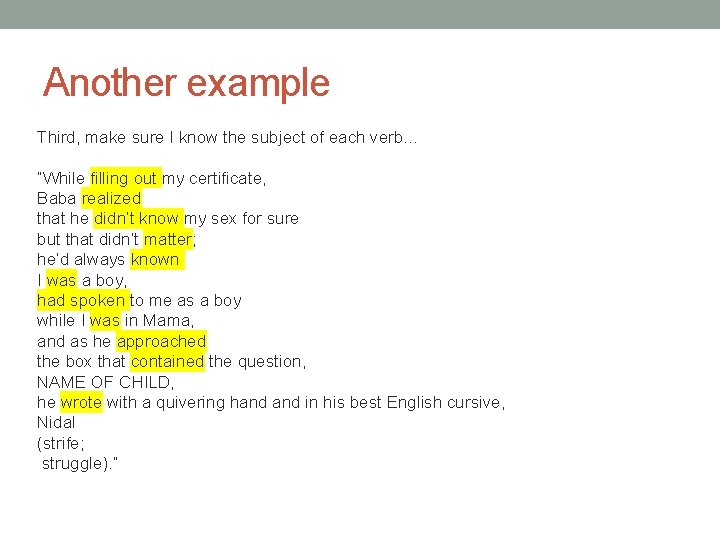
Another example Third, make sure I know the subject of each verb… “While filling out my certificate, Baba realized that he didn’t know my sex for sure but that didn’t matter; he’d always known I was a boy, had spoken to me as a boy while I was in Mama, and as he approached the box that contained the question, NAME OF CHILD, he wrote with a quivering hand in his best English cursive, Nidal (strife; struggle). ”
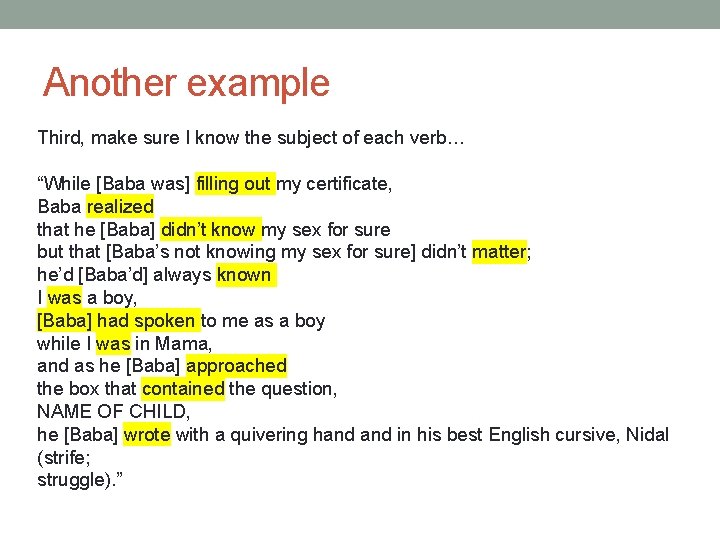
Another example Third, make sure I know the subject of each verb… “While [Baba was] filling out my certificate, Baba realized that he [Baba] didn’t know my sex for sure but that [Baba’s not knowing my sex for sure] didn’t matter; he’d [Baba’d] always known I was a boy, [Baba] had spoken to me as a boy while I was in Mama, and as he [Baba] approached the box that contained the question, NAME OF CHILD, he [Baba] wrote with a quivering hand in his best English cursive, Nidal (strife; struggle). ”
Identify challenging sentences? • Particularly long sentences • Internal punctuation • Dependent clauses • Multiple phrases • Parentheticals • Passive voice • Etc. • Write a question for the sentences • Break the sentences down (punctuation, conjunctions, demonstrative pronouns, prepositions, etc. )
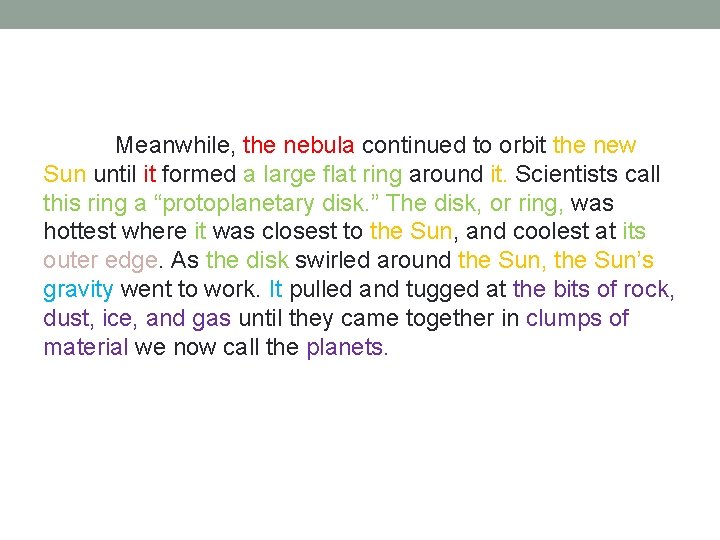
Help with Cohesion • Texts can be hard because the relationships and connections may be unclear to readers • The killer whale tosses the penguin into the air and generally torments its prey before it eats it • The killer whale tosses the penguin into the air and generally torments the penguin before eating it.
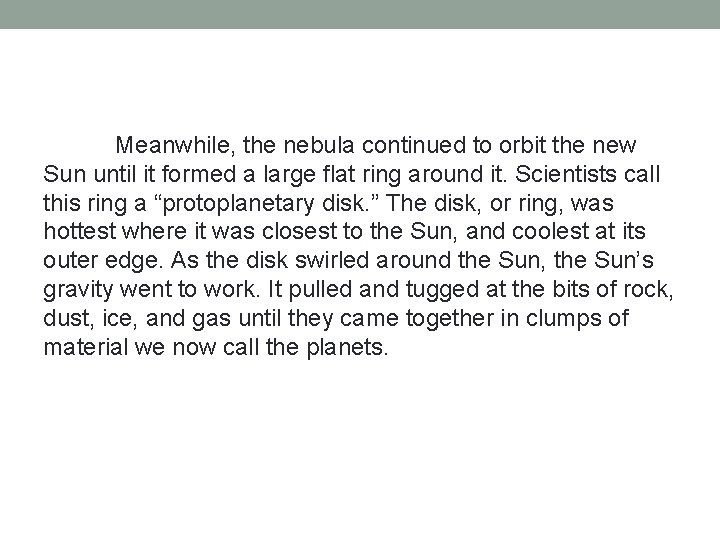
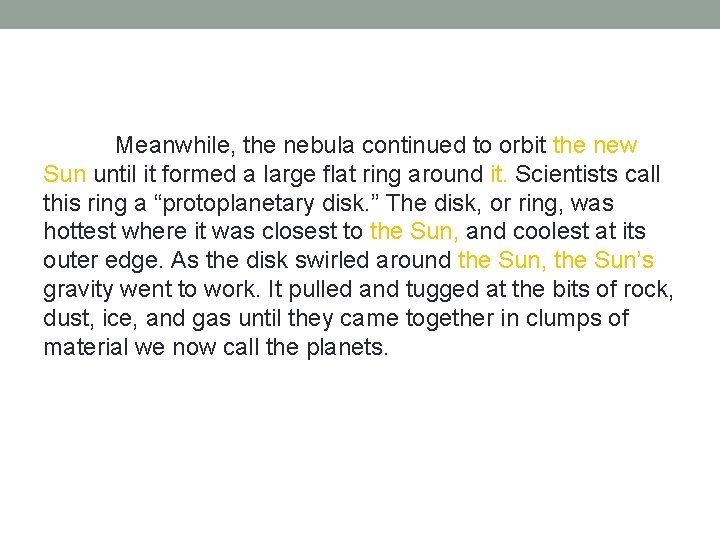
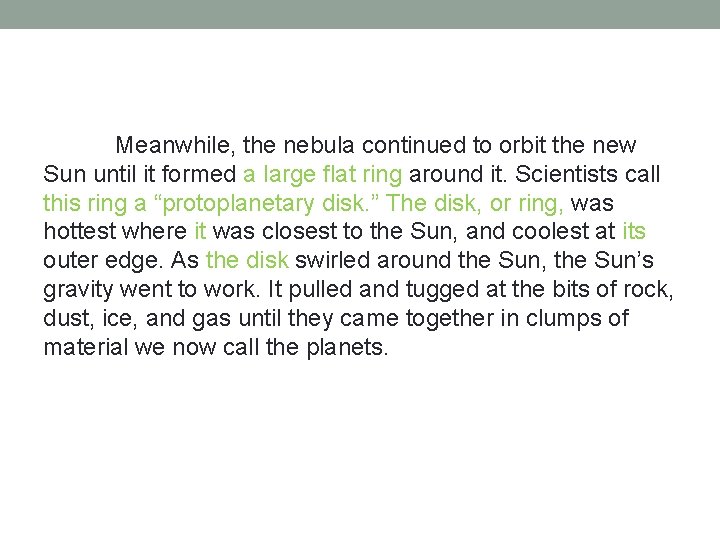
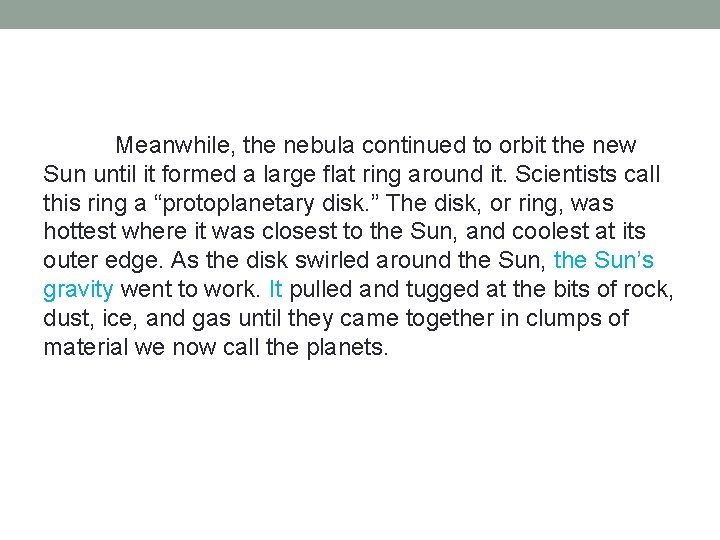
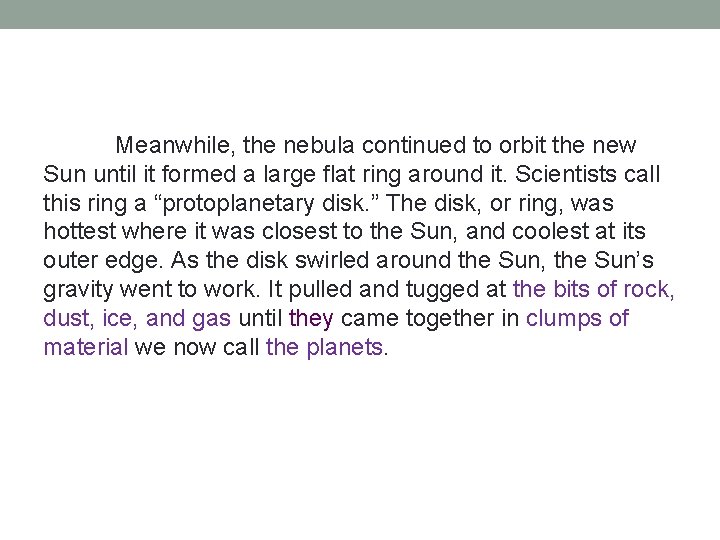
Meanwhile, the nebula continued to orbit the new Sun until it formed a large flat ring around it. Scientists call this ring a “protoplanetary disk. ” The disk, or ring, was hottest where it was closest to the Sun, and coolest at its outer edge. As the disk swirled around the Sun, the Sun’s gravity went to work. It pulled and tugged at the bits of rock, dust, ice, and gas until they came together in clumps of material we now call the planets.
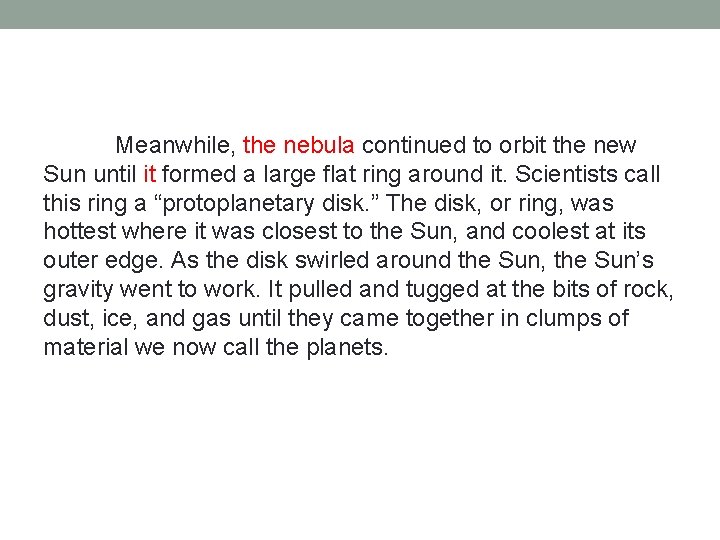
Meanwhile, the nebula continued to orbit the new Sun until it formed a large flat ring around it. Scientists call this ring a “protoplanetary disk. ” The disk, or ring, was hottest where it was closest to the Sun, and coolest at its outer edge. As the disk swirled around the Sun, the Sun’s gravity went to work. It pulled and tugged at the bits of rock, dust, ice, and gas until they came together in clumps of material we now call the planets.
Meanwhile, the nebula continued to orbit the new Sun until it formed a large flat ring around it. Scientists call this ring a “protoplanetary disk. ” The disk, or ring, was hottest where it was closest to the Sun, and coolest at its outer edge. As the disk swirled around the Sun, the Sun’s gravity went to work. It pulled and tugged at the bits of rock, dust, ice, and gas until they came together in clumps of material we now call the planets.
Meanwhile, the nebula continued to orbit the new Sun until it formed a large flat ring around it. Scientists call this ring a “protoplanetary disk. ” The disk, or ring, was hottest where it was closest to the Sun, and coolest at its outer edge. As the disk swirled around the Sun, the Sun’s gravity went to work. It pulled and tugged at the bits of rock, dust, ice, and gas until they came together in clumps of material we now call the planets.
Meanwhile, the nebula continued to orbit the new Sun until it formed a large flat ring around it. Scientists call this ring a “protoplanetary disk. ” The disk, or ring, was hottest where it was closest to the Sun, and coolest at its outer edge. As the disk swirled around the Sun, the Sun’s gravity went to work. It pulled and tugged at the bits of rock, dust, ice, and gas until they came together in clumps of material we now call the planets.
Meanwhile, the nebula continued to orbit the new Sun until it formed a large flat ring around it. Scientists call this ring a “protoplanetary disk. ” The disk, or ring, was hottest where it was closest to the Sun, and coolest at its outer edge. As the disk swirled around the Sun, the Sun’s gravity went to work. It pulled and tugged at the bits of rock, dust, ice, and gas until they came together in clumps of material we now call the planets.
Meanwhile, the nebula continued to orbit the new Sun until it formed a large flat ring around it. Scientists call this ring a “protoplanetary disk. ” The disk, or ring, was hottest where it was closest to the Sun, and coolest at its outer edge. As the disk swirled around the Sun, the Sun’s gravity went to work. It pulled and tugged at the bits of rock, dust, ice, and gas until they came together in clumps of material we now call the planets.
Another cohesion example • There were several roads near by, but it did not take her long to find the one paved with yellow bricks.
Another cohesion example • There were several roads near by, but it did not take her long to find the one paved with yellow bricks.
Another cohesion example • There were several roads near by, but it did not take her long to find the one paved with yellow bricks.
Another cohesion example “Surely, ” said John, like one who had lost faith in his memory, “he used not to sleep in the kennel? ” “John, ” Wendy said falteringly, “perhaps we don’t remember the old life as well as we thought we did. ”
Another cohesion example “Surely, ” said John, like one who had lost faith in his memory, “he used not to sleep in the kennel? ” “John, ” Wendy said falteringly, “perhaps we don’t remember the old life as well as we thought we did. ”
Another cohesion example “Surely, ” said John, like one who had lost faith in his memory, “he used not to sleep in the kennel? ” “John, ” Wendy said falteringly, “perhaps we don’t remember the old life as well as we thought we did. ”
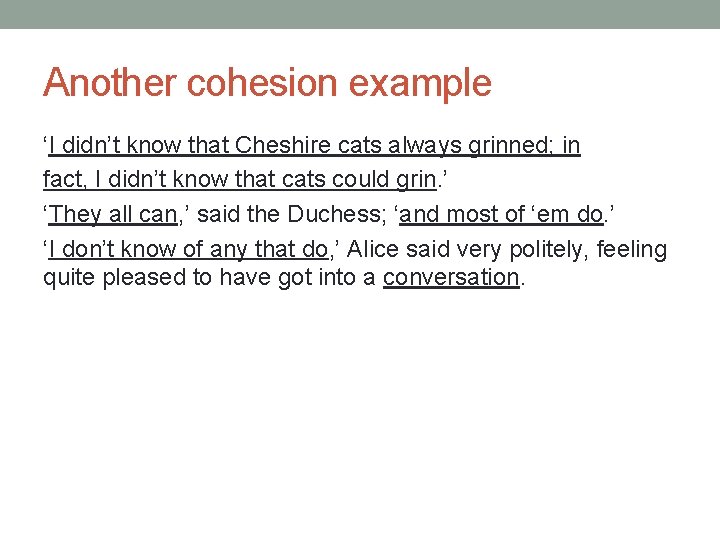
Another cohesion example ‘I didn’t know that Cheshire cats always grinned; in fact, I didn’t know that cats could grin. ’ ‘They all can, ’ said the Duchess; ‘and most of ‘em do. ’ ‘I don’t know of any that do, ’ Alice said very politely, feeling quite pleased to have got into a conversation.
Another cohesion example ‘I didn’t know that Cheshire cats always grinned; in fact, I didn’t know that cats could grin. ’ ‘They all can, ’ said the Duchess; ‘and most of ‘em do. ’ ‘I don’t know of any that do, ’ Alice said very politely, feeling quite pleased to have got into a conversation.
Another cohesion example ‘I didn’t know that Cheshire cats always grinned; in fact, I didn’t know that cats could grin. ’ ‘They all can, ’ said the Duchess; ‘and most of ‘em do. ’ ‘I don’t know of any that do, ’ Alice said very politely, feeling quite pleased to have got into a conversation.
Another cohesion example ‘I didn’t know that Cheshire cats always grinned; in fact, I didn’t know that cats could grin. ’ ‘They all can, ’ said the Duchess; ‘and most of ‘em do. ’ ‘I don’t know of any that do, ’ Alice said very politely, feeling quite pleased to have got into a conversation.
Another cohesion example ‘I didn’t know that Cheshire cats always grinned; in fact, I didn’t know that cats could grin. ’ ‘They all can, ’ said the Duchess; ‘and most of ‘em do. ’ ‘I don’t know of any that do, ’ Alice said very politely, feeling quite pleased to have got into a conversation.
Another cohesion example ‘I didn’t know that Cheshire cats always grinned; in fact, I didn’t know that cats could grin. ’ ‘They all can, ’ said the Duchess; ‘and most of ‘em do. ’ ‘I don’t know of any that do, ’ Alice said very politely, feeling quite pleased to have got into a conversation.
Guidelines for cohesion scaffolding • Identify the repetitions, synonyms, pronouns (mark the text to show the connections) • Identify the conjunctions (and, moreover, however, but, consequently, etc. ) • Identify antithesis
Guide Use of Text Structure • Texts can be hard because they are organized in complex ways • The structure of what is read can help students determine importance. • Need to make sure that students know common text organization schemes (description; compare/contrast; problem-solution; sequence; enumeration) • Need to guide students to use headings and subheadings can help students learn the scope and sequence of information • Need to examine particular texts to see if organization holds a special key to the meaning (like in a comparison text or problem-solution text) and to guide students to attend to this structure
Text Structure • Authors organize their ideas • Some structures are used by many authors • Widely used structures: q q q Description/enumeration Sequence/chronological order Comparison/contrast Problem/solution Cause/effect Argument
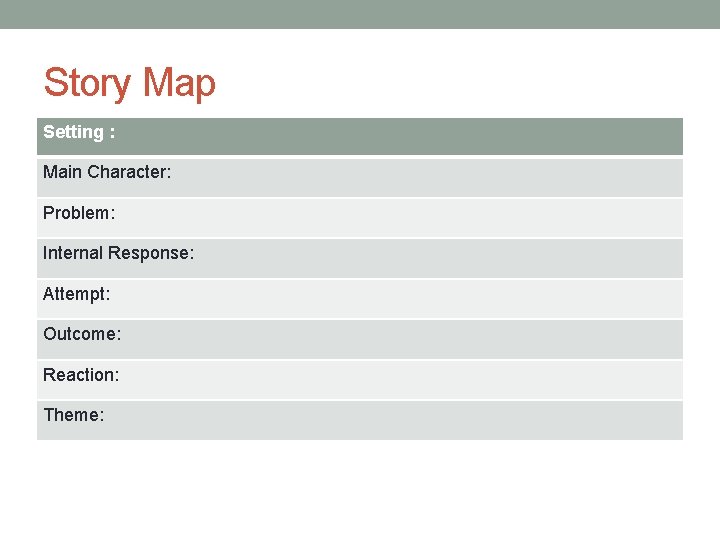
Story Map Setting : Main Character: Problem: Internal Response: Attempt: Outcome: Reaction: Theme:
Text Structure (cont. ) • Readers use the authors structure to guide their understanding and recall • If the reader is able to recognize the organizational plan, then this can be used to remember the text • If the reader does not recognize a common organizational plan, it helps to impose one • This often can be done by briefly identifying the main point of each paragraph or section
Text Structure (cont. ) • Readers use the authors structure to guide their understanding and recall • If the reader is able to recognize the organizational plan, then this can be used to remember the text • If the reader does not recognize a common organizational plan, it helps to impose one • This often can be done by briefly identifying the main point of each paragraph or section
Text structure example “The horseless carriage was just arriving in San Francisco, and its debut was turning into one of those colorfully unmitigated disasters that bring misery to everyone but historians. Consumers were staying away from the “devilish contraptions” in droves. In San Francisco in 1903, the horse and buggy was not going the way of the horse and buggy. ”
Text structure example What is the purpose of this paragraph or what is it about? “The horseless carriage was just arriving in San Francisco, and its debut was turning into one of those colorfully unmitigated disasters that bring misery to everyone but historians. Consumers were staying away from the “devilish contraptions” in droves. In San Francisco in 1903, the horse and buggy was not going the way of the horse and buggy. ”
Text structure example What is the purpose of this paragraph or what is it about? “The horseless carriage was just arriving in San Francisco, and its debut was turning into one of those colorfully unmitigated disasters that bring misery to everyone but historians. Consumers were staying away from the “devilish contraptions” in droves. In San Francisco in 1903, the horse and buggy was not going the way of the horse and buggy. ” The “horseless carriage” was unpopular in San Francisco.
Text structure example: What is the purpose of this paragraph or what is it about? For good reason. The automobile, so sleekly efficient on paper, was in practice a civic menace, belching out exhaust, kicking up storms of dust, becoming hopelessly mired in the most innocuous-looking puddles, and tying up horse traffic. Incensed local lawmakers responded with monuments to legislative creativity. The laws of at least one town required automobile drivers to stop, get out, and fire off Roman candles every time horse-drawn vehicles came into view. Massachusetts tried and, fortunately, failed to mandate that cars be equipped with bells that would ring with each revolution of the wheels. In some towns police were authorized to disable passing cars with ropes, chains, and wires. San Francisco didn’t escape the legislative wave. Bitter local officials pushed through an ordinance banning automobiles from all tourist areas, effectively exiling them from the city.
Text structure example: What is the purpose of this paragraph or what is it about? For good reason. The automobile, so sleekly efficient on paper, was in practice a civic menace, belching out exhaust, kicking up storms of dust, becoming hopelessly mired in the most innocuous-looking puddles, and tying up horse traffic. Incensed local lawmakers responded with monuments to legislative creativity. The laws of at least one town required automobile drivers to stop, get out, and fire off Roman candles every time horse-drawn vehicles came into view. Massachusetts tried and, fortunately, failed to mandate that cars be equipped with bells that would ring with each revolution of the wheels. In some towns police were authorized to disable passing cars with ropes, chains, and wires. San Francisco didn’t escape the legislative wave. Bitter local officials pushed through an ordinance banning automobiles from all tourist areas, effectively exiling them from the city. Laws across the country were passed against horseless carriages.
Text structure example: What is the purpose of this paragraph or what is it about? Nor were these the only obstacles. The asking price for the cheapest automobile amounted to twice the $500 annual salary of the average citizen— some cost three times that much—and all that bought you was four wheels, a body, and an engine. “Accessories” like bumpers, carburetors, and headlights had to be purchased separately. Navigation was a nightmare. The first of San Francisco’s road signs were only just being erected, hammered up by an enterprising insurance underwriter who hoped to win clients by posting directions into the countryside, where drivers retreated for automobile “picnic parties” held out of the view of angry townsfolk.
Text structure example: What is the purpose of this paragraph or what is it about? Nor were these the only obstacles. The asking price for the cheapest automobile amounted to twice the $500 annual salary of the average citizen— some cost three times that much—and all that bought you was four wheels, a body, and an engine. “Accessories” like bumpers, carburetors, and headlights had to be purchased separately. Navigation was a nightmare. The first of San Francisco’s road signs were only just being erected, hammered up by an enterprising insurance underwriter who hoped to win clients by posting directions into the countryside, where drivers retreated for automobile “picnic parties” held out of the view of angry townsfolk. Horseless carriages were expensive.
Text structure example: What is the purpose of this paragraph or what is it about? The first automobiles imported to San Francisco had so little power that they rarely made it up the hills. The grade of Nineteenth Avenue was so daunting for the engines of the day that watching automobiles straining for the top to become a local pastime.
Text structure example: What is the purpose of this paragraph or what is it about? The first automobiles imported to San Francisco had so little power that they rarely made it up the hills. The grade of Nineteenth Avenue was so daunting for the engines of the day that watching automobiles straining for the top to become a local pastime. Horseless carriages were not powerful enough to climb San Francisco’s hills.
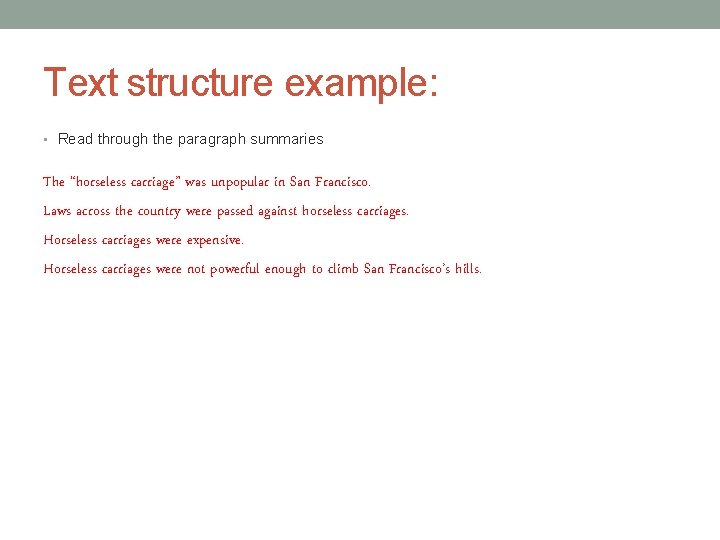
Text structure example: • Read through the paragraph summaries The “horseless carriage” was unpopular in San Francisco. Laws across the country were passed against horseless carriages. Horseless carriages were expensive. Horseless carriages were not powerful enough to climb San Francisco’s hills.
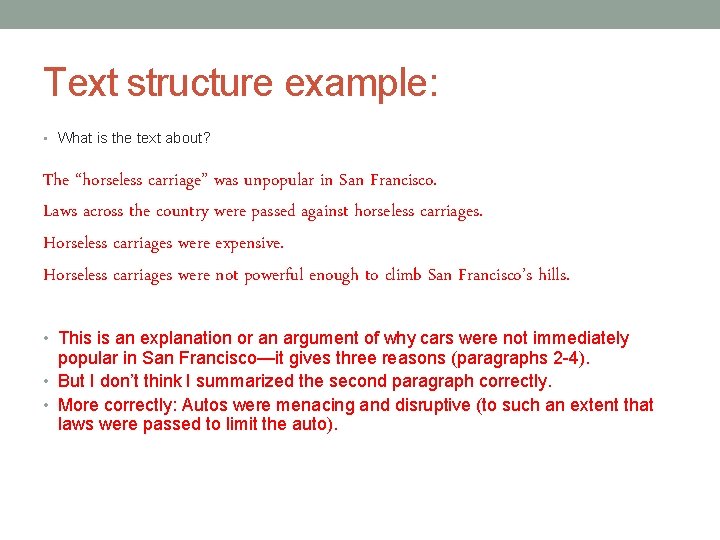
Text structure example: • What is the text about? The “horseless carriage” was unpopular in San Francisco. Laws across the country were passed against horseless carriages. Horseless carriages were expensive. Horseless carriages were not powerful enough to climb San Francisco’s hills. • This is an explanation or an argument of why cars were not immediately popular in San Francisco—it gives three reasons (paragraphs 2 -4). • But I don’t think I summarized the second paragraph correctly. • More correctly: Autos were menacing and disruptive (to such an extent that laws were passed to limit the auto).
Text structure instruction: http: //literacy. io/#
Guide Tone Awareness • Author’s tone expresses their attitude towards subject or audience • Text can be hard because the author’s tone might be subtle (it matters if a student expects the text to be literally correct, when the author intends to be satirical) • Young children always expect a positive tone • Help students to recognize the tone of the text (e. g. , formal, intimate, solemn, playful, serious, ironic)
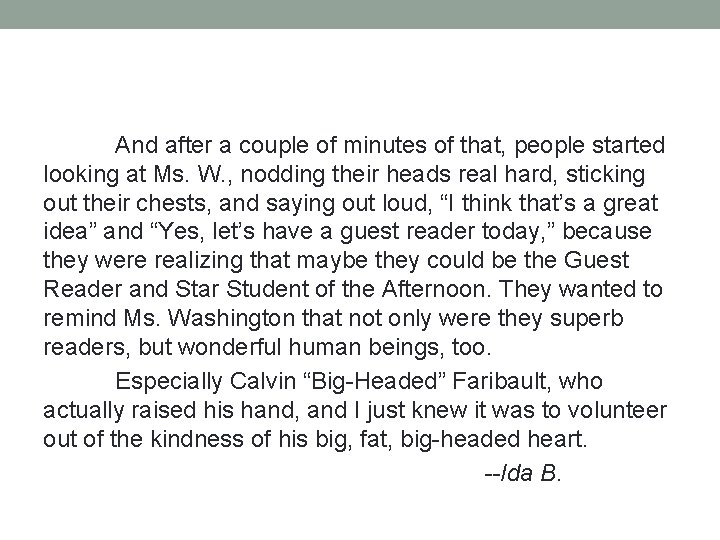
And after a couple of minutes of that, people started looking at Ms. W. , nodding their heads real hard, sticking out their chests, and saying out loud, “I think that’s a great idea” and “Yes, let’s have a guest reader today, ” because they were realizing that maybe they could be the Guest Reader and Star Student of the Afternoon. They wanted to remind Ms. Washington that not only were they superb readers, but wonderful human beings, too. Especially Calvin “Big-Headed” Faribault, who actually raised his hand, and I just knew it was to volunteer out of the kindness of his big, fat, big-headed heart. --Ida B.
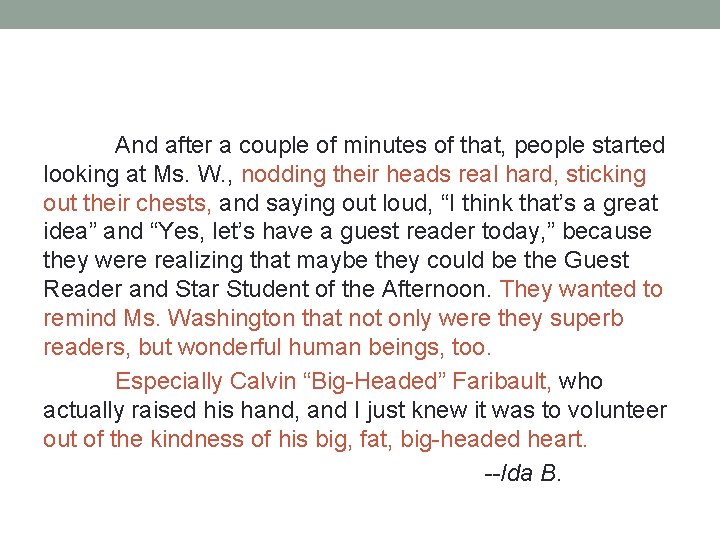
And after a couple of minutes of that, people started looking at Ms. W. , nodding their heads real hard, sticking out their chests, and saying out loud, “I think that’s a great idea” and “Yes, let’s have a guest reader today, ” because they were realizing that maybe they could be the Guest Reader and Star Student of the Afternoon. They wanted to remind Ms. Washington that not only were they superb readers, but wonderful human beings, too. Especially Calvin “Big-Headed” Faribault, who actually raised his hand, and I just knew it was to volunteer out of the kindness of his big, fat, big-headed heart. --Ida B.
Resources Shanahan, T. , Fisher, D. , & Frey, N. (2012), March. The challenge of challenging text. Educational Leadership. Shanahan, T. (2013). Letting text take center stage. American Educator.
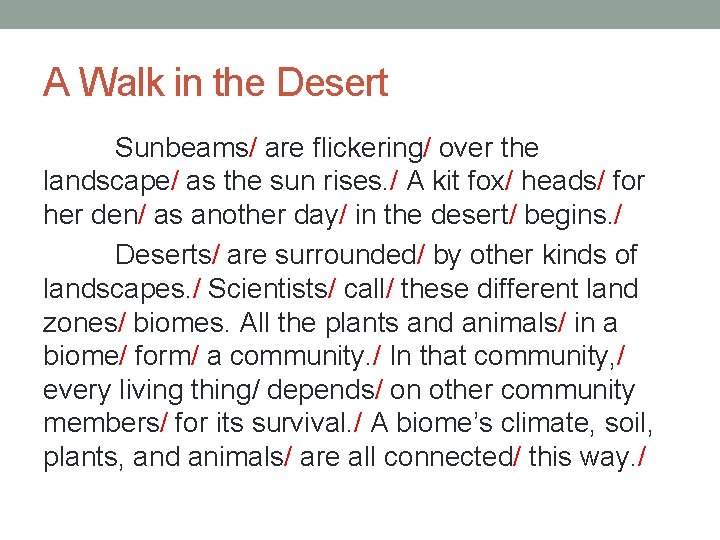
Build Text Reading Fluency • Texts can be hard because they demand more advanced • • reading skills than the students have Students need practice reading (orally) with accuracy, appropriate speed, and prosody Not round-robin reading (use these instead: repeated reading, echo reading, paired reading, reading while listening, etc. ) Putting fluency first might make sense Parsing texts can be helpful
A Walk in the Desert Sunbeams are flickering over the landscape as the sun rises. A kit fox heads for her den as another day in the desert begins. Deserts are surrounded by other kinds of landscapes. Scientists call these different land zones biomes. All the plants and animals in a biome form a community. In that community, every living thing depends on other community members for its survival. A biome’s climate, soil, plants, and animals are all connected this way.
A Walk in the Desert Sunbeams are flickering over the landscape as the sun rises. A kit fox heads for her den as another day in the desert begins. Deserts are surrounded by other kinds of landscapes. Scientists call these different land zones biomes. All the plants and animals/ in a biome form a community. In that community, every living thing/ depends on other community members for its survival. A biome’s climate, soil, plants, and animals are all connected this way.
A Walk in the Desert Sunbeams are flickering over the landscape as the sun rises. A kit fox heads for her den as another day in the desert begins. Deserts are surrounded by other kinds of landscapes. Scientists call these different land zones biomes. All the plants and animals in a biome form a community. In that community, every living thing depends on other community members for its survival. A biome’s climate, soil, plants, and animals are all connected this way.
A Walk in the Desert Sunbeams/ are flickering/ over the landscape/ as the sun rises. / A kit fox/ heads/ for her den/ as another day/ in the desert/ begins. / Deserts/ are surrounded/ by other kinds of landscapes. / Scientists/ call/ these different land zones/ biomes. All the plants and animals/ in a biome/ form/ a community. / In that community, / every living thing/ depends/ on other community members/ for its survival. / A biome’s climate, soil, plants, and animals/ are all connected/ this way. /
Provide Stair-step Texts • Texts can be hard because students lack sufficient background knowledge • If students have multiple texts on the same topic that are at different difficulty levels, • easier “apprentice” texts can help students build background knowledge for the more difficult ones. • The overlap in important information should increase the likelihood that students will pay attention to it. • Should increase a student’s ability to independently deal with the information in the hard text
Repetition • One of the most powerful scaffolds is also one of the most obvious—reading a text more than once makes it more accessible • In the past, we tended to have students read a text a single time, but as the text challenge increases it is essential that we encourage students to read texts (and parts of texts) more than once to make sense of it • This is an effective strategy, but it is expensive too (the idea is to become successful with these texts—which should make it possible to succeed with other texts later with less work) • Explain this to students
Comprehension strategies • Research shows that when students are active readers—that is, when they are actively trying to understand a text—they comprehend and remember more • Comprehension strategies are a proven way to get students to think about the ideas in a text • Summarization, questioning, monitoring, seeking particular kinds of information have all been found to stimulate learning
Motivation • The instructional level is based on the idea that students seek • • easy work--that if the work is challenging they will stop trying But research shows that students seek challenge and are motivated by it Challenge only works if it is not overwhelming and if students see the possibility of getting better/stronger, et. Don’t make challenging text a secret—tell kids what is happening and show them how you will make them effective Research also shows that students are interested in more challenging content (and on their own, they’ll fight through more challenging text to get to this content)—using challenging text opens up content possibilities
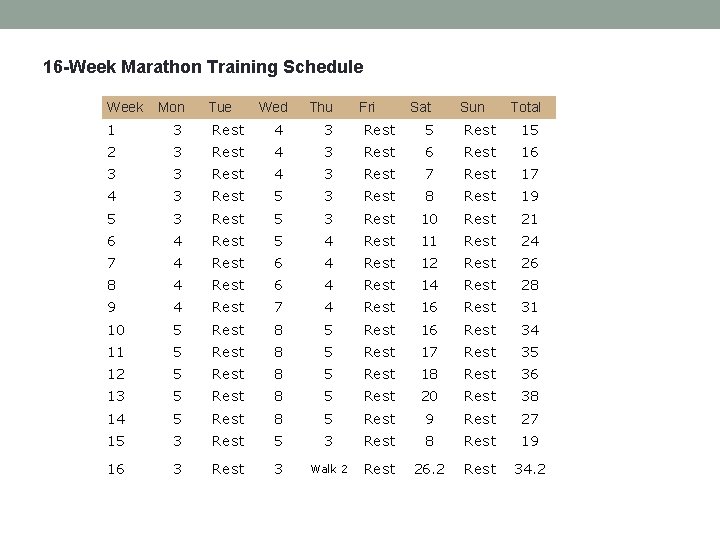
The physical fitness metaphor • If reading and physical exercise are similar, then text complexity is akin to weight or distance • Students need to practice reading with multiple levels of difficulty and for varied amounts (these variations can even occur within a single exercise session) • Guiding students to read text with support is like spotting for someone during weight lifting (you have to be careful not to do the exercise for them and you have to avoid dependence) • Do not always head off the challenges, but always be ready to respond and support
16 -Week Marathon Training Schedule Week Mon Tue Wed Thu Fri Sat Sun Total 1 3 Rest 4 3 Rest 5 Rest 15 2 3 Rest 4 3 Rest 6 Rest 16 3 3 Rest 4 3 Rest 7 Rest 17 4 3 Rest 5 3 Rest 8 Rest 19 5 3 Rest 10 Rest 21 6 4 Rest 5 4 Rest 11 Rest 24 7 4 Rest 6 4 Rest 12 Rest 26 8 4 Rest 6 4 Rest 14 Rest 28 9 4 Rest 7 4 Rest 16 Rest 31 10 5 Rest 8 5 Rest 16 Rest 34 11 5 Rest 8 5 Rest 17 Rest 35 12 5 Rest 8 5 Rest 18 Rest 36 13 5 Rest 8 5 Rest 20 Rest 38 14 5 Rest 8 5 Rest 9 Rest 27 15 3 Rest 8 Rest 19 16 3 Rest 3 Walk 2 Rest 26. 2 Rest 34. 2
Differentiation? • Not different books, but different scaffolding • Students should read multiple texts across a range of challenge levels (including “frustration” level), but the degree of scaffolding should be higher the harder the text • Large group text vs. small group texts? • Pull-out instruction?
Conclusions • I can’t learn from a text that I can’t figure out. • But I can learn from one that I may not easily understand but that I can make sense of • Persistence depends upon my awareness that I can successfully take control in such situations • A steady diet of instructional level text restricts/limits the text barriers that I can gain experience with • But providing students with complex text alone – without scaffolding, guidance, and teaching – will provide opportunity without ensuring learning • Make students powerful, teach them to read complex texts