
TEACHING STUDENTS HOW TO TRANSFORM POWER AND PRIVILEGE
- Slides: 23
TEACHING STUDENTS HOW TO TRANSFORM POWER AND PRIVILEGE INTO A RESOURCE TO ASSIST THOSE WHO LACK THE SAME PRIVILEGE VIRTUALLY Dr. Ebonnie Vazquez, MSW Dr. Brie Radis, LCSW, MSS, MLSP
Who are we? Ebonnie has extensive experience in macro social work practice. She has worked in both the public in private sectors advocating for, creating, and implementing policies that enhance the quality of life for Pennsylvania’s most vulnerable citizens. Brie has extensive clinical and supervisory experience working with individuals experiencing trauma in the mental health, substance use, and homelessness fields. She has focused on trauma informed educational practice in her teaching and scholarship. She is currently codirector of the Anti-Racism Working Group, which is an action-oriented collaborative group of staff, students, and faculty across West Chester University. COMMONALITIES • Social work professors • Committed to anti-racism trauma informed educational practice • Teach at both the Philadelphia and West Chester campuses
Goal 1: Learn how to identify your individual power to better advocate for those who are lacking similar power and privilege. Goal 2: Goals Learn how to transform your power and privilege into a resource that can be used to empower those who lack similar power Goal 3: Learn how to utilize your power of privilege as a tool to advance social justice causes in your agency and community and empower future social workers
When you think about Power and Privilege, reflect on these statements: ◦ When thinking of my power and privilege, I think_____ ◦ But then I learned _____ ◦ So now I think of my power and privilege as_____ Dr. Beverly Daniel Tatum *We are going to revisit these questions at the end*
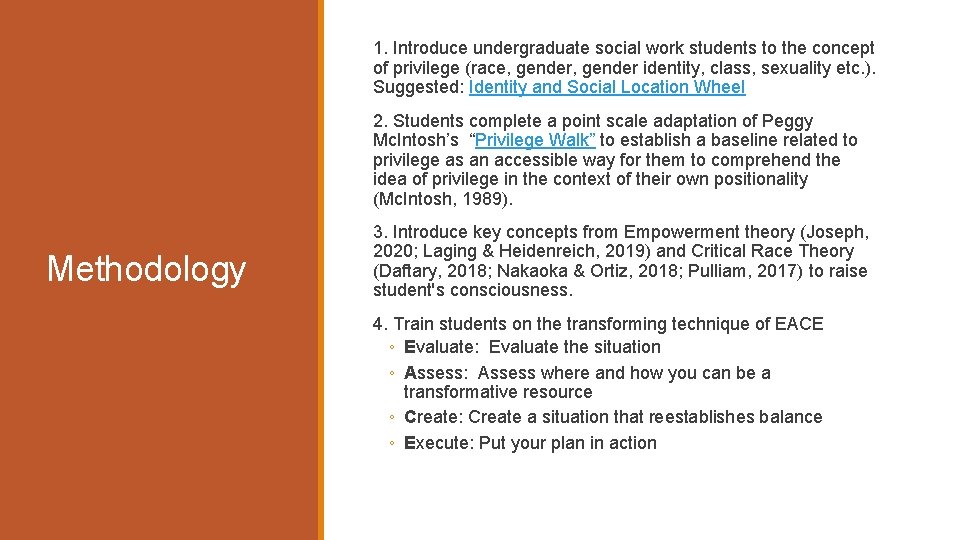
1. Introduce undergraduate social work students to the concept of privilege (race, gender identity, class, sexuality etc. ). Suggested: Identity and Social Location Wheel 2. Students complete a point scale adaptation of Peggy Mc. Intosh’s “Privilege Walk” to establish a baseline related to privilege as an accessible way for them to comprehend the idea of privilege in the context of their own positionality (Mc. Intosh, 1989). Methodology 3. Introduce key concepts from Empowerment theory (Joseph, 2020; Laging & Heidenreich, 2019) and Critical Race Theory (Daftary, 2018; Nakaoka & Ortiz, 2018; Pulliam, 2017) to raise student's consciousness. 4. Train students on the transforming technique of EACE ◦ Evaluate: Evaluate the situation ◦ Assess: Assess where and how you can be a transformative resource ◦ Create: Create a situation that reestablishes balance ◦ Execute: Put your plan in action
Webster defines Privilege as: “a special right, advantage, or immunity granted or available only to a particular person or group. ” Privilege manifests itself in a multitude of different ways…instinctively, when we think of power, we think of wealth, status, and prestige. . What is Privilege? Privilege manifests itself in: ◦ ◦ ◦ ◦ ◦ Gender Identity Race Age Education Language Class Sexuality Ethnicity Age
Often a deficit-based narrative How we learn about privilege? Privilege is taught as something which puts others at a disadvantage, but has not been taught as something with corollary aspects, which puts some at an advantage. (Mc. Intosh, 1989) We often vilify power or privilege. We want to transform power and privilege into a resource. We want to embrace the beneficial qualities that come with power and privilege.
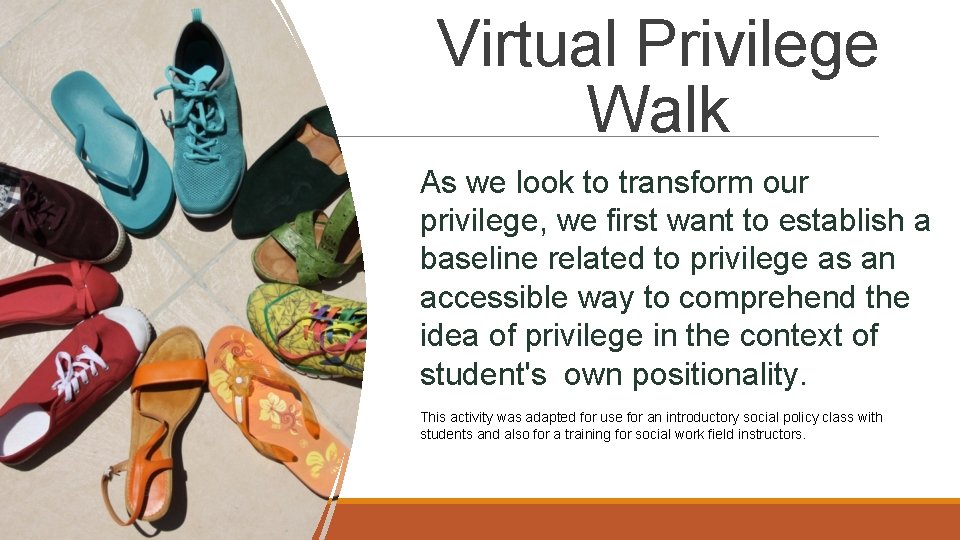
Virtual Privilege Walk As we look to transform our privilege, we first want to establish a baseline related to privilege as an accessible way to comprehend the idea of privilege in the context of student's own positionality. This activity was adapted for use for an introductory social policy class with students and also for a training for social work field instructors.
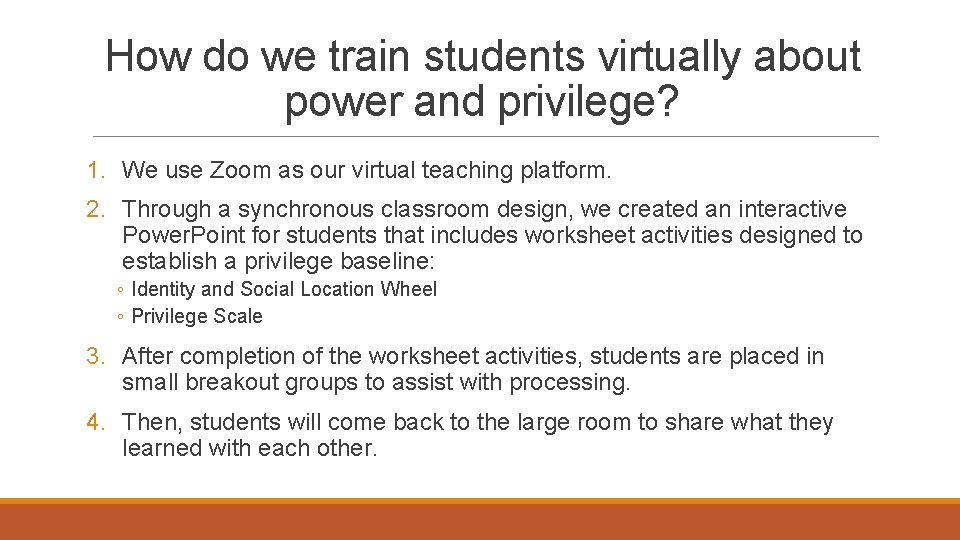
How do we train students virtually about power and privilege? 1. We use Zoom as our virtual teaching platform. 2. Through a synchronous classroom design, we created an interactive Power. Point for students that includes worksheet activities designed to establish a privilege baseline: ◦ Identity and Social Location Wheel ◦ Privilege Scale 3. After completion of the worksheet activities, students are placed in small breakout groups to assist with processing. 4. Then, students will come back to the large room to share what they learned with each other.
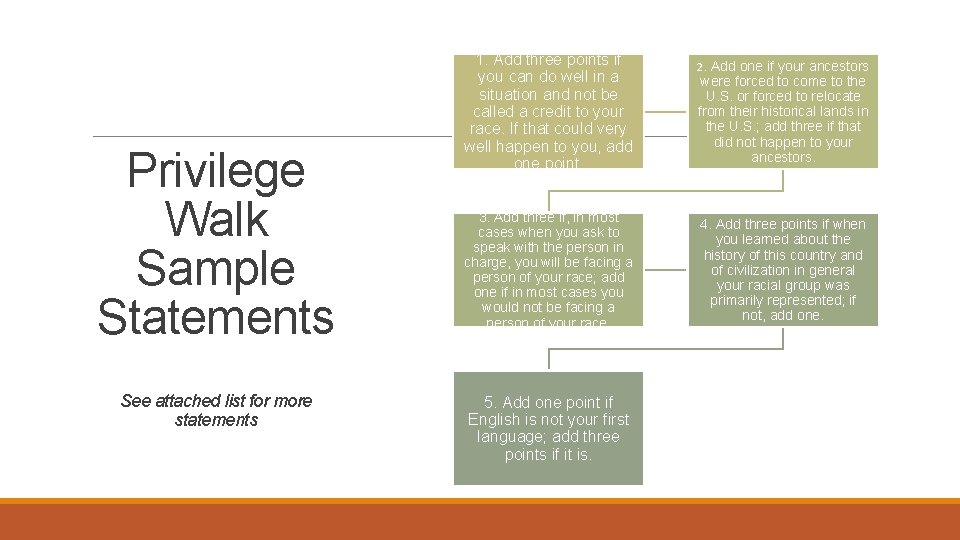
Privilege Walk Sample Statements See attached list for more statements 1. Add three points if you can do well in a situation and not be called a credit to your race. If that could very well happen to you, add one point. 3. Add three if, in most cases when you ask to speak with the person in charge, you will be facing a person of your race; add one if in most cases you would not be facing a person of your race. 5. Add one point if English is not your first language; add three points if it is. 2. Add one if your ancestors were forced to come to the U. S. or forced to relocate from their historical lands in the U. S. ; add three if that did not happen to your ancestors. 4. Add three points if when you learned about the history of this country and of civilization in general your racial group was primarily represented; if not, add one.
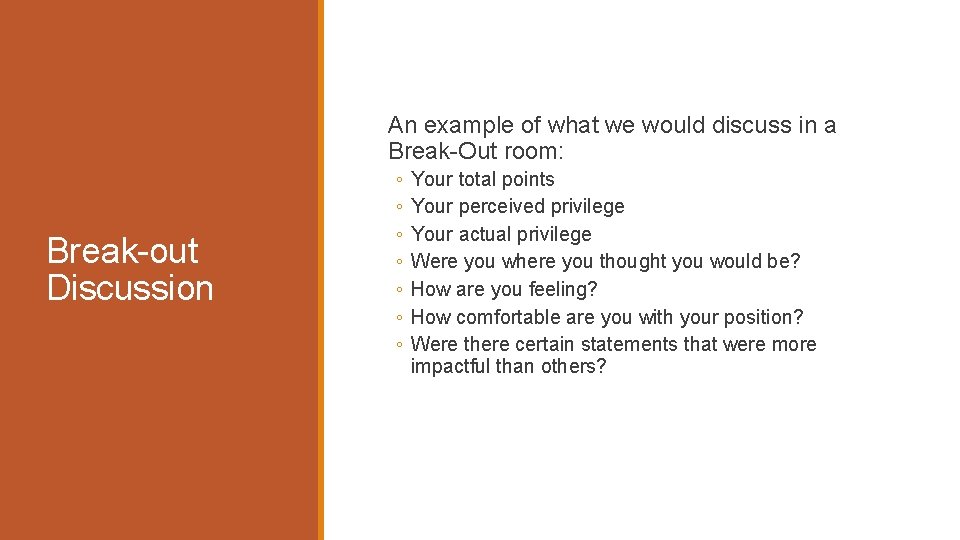
An example of what we would discuss in a Break-Out room: Break-out Discussion ◦ ◦ ◦ ◦ Your total points Your perceived privilege Your actual privilege Were you where you thought you would be? How are you feeling? How comfortable are you with your position? Were there certain statements that were more impactful than others?
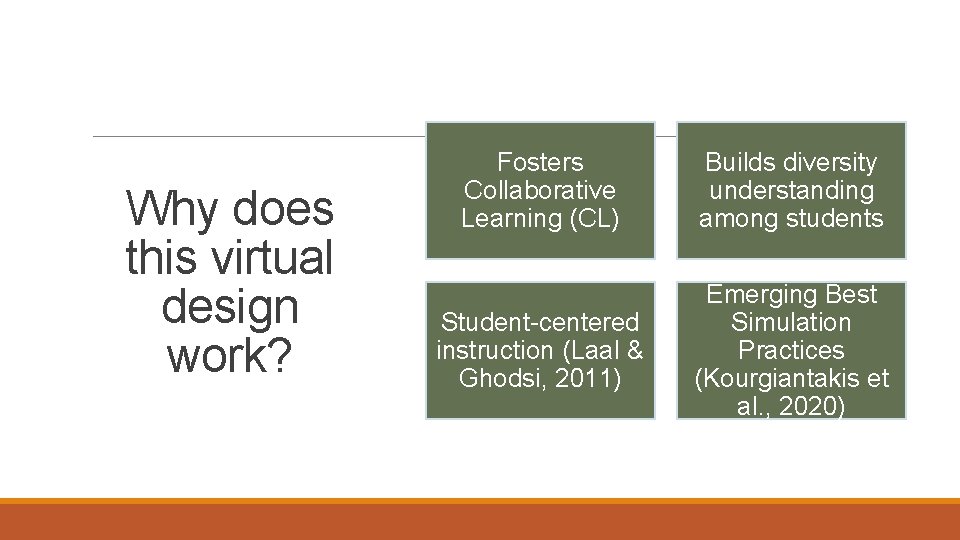
Why does this virtual design work? Fosters Collaborative Learning (CL) Builds diversity understanding among students Student-centered instruction (Laal & Ghodsi, 2011) Emerging Best Simulation Practices (Kourgiantakis et al. , 2020)
Strengths and Challenges Strengths ◦ Interactive design ◦ Putting theory to practice ◦ Introspective analysis of both power and privilege ◦ Virtually, students can have a more TIEP individualized experience and share only as much as they feel comfortable sharing Challenges/Lessons Learned ◦ Virtually, it is difficult to gage student reactions to a charged topic. ◦ A modified scale that includes various dimensions of intersectional privilege including education, sexuality, and age would enhance the experience ◦ Privilege walks often center privilege and has the potential to generate internalized shame
Purpose of the Activity This activity has been designed to provide participants (BSW students or field instructors) with an opportunity to understand the intricacies of privilege and to explore the ways that we enjoy privileges based on being members of social identity groups in the United States. Please note that this exercise is not meant to make anyone feel guilty or ashamed of their privilege or lack of privilege related to any social identity categories. Rather, the exercise seeks to highlight the fact that everyone has SOME privilege, even as some people have more privilege than others. By illuminating our various privileges as individuals, we can recognize ways that we can use our privileges individually and collectively to work for social justice. The purpose is not to blame anyone for having more power or privilege or for receiving more help in achieving goals, but to have an opportunity to identify both obstacles and benefits experienced in our life.
Privilege Walk Directions for Participants As we look to transform our privilege, we first want to establish a baseline related to privilege as an accessible way to comprehend the idea of privilege in the context of their own positionality. This exercise that can create certain emotions such as discomfort and vulnerability. Check in with yourself. To do this virtually, please use a blank piece of paper to score yourself based on the points (points represent steps) gains or losses. Let’s prepare to walk (in the virtual sense). Envision everyone starting at one end of a soccer field or a large room together.
1) Review the purpose, then provide a content warning that some statements may cause discomfort and/or vulnerability. Thus, this activity should be introduced after students/participants have developed some level of trust and safety with one another. Participation should be encouraged, but optional. Virtual Privilege Walk Instructions for Instructors 2) State the following: Listen to the following statements, and follow the instructions given. I will read each statement out loud that is also shown on the Power. Point. For example, if I read, “If you have blue eyes, add two points, and if you have another eye color, add zero points, ” only people with blue eyes will add points to their scoresheet. Each point represents a step. 3) This activity should be done in silence, and if anyone feels uncomfortable taking points on any statement I read, then you do not need to use this statement, but remember the statement read. This is an introspective exercise and it’s important for you to understand how privilege affects your life, but it is not designed to make you share things which you don’t wish to share.
10 -15: In U. S. society, many obstacles will be put in place that will interfere with you getting the things required to have what the society considers a good life, simply because of your identity. Privilege Walk Scoring 16 -20: In U. S. society, some obstacles will be put in place that will interfere with you getting the things required to have what the society considers a good life, simply because of your identity. 21 -25: In U. S. society, some resources will be offered to you that support you to get the things required to have what the society considers a good life, simply because of your identity. 26 -30: In U. S. society, many resources will be offered to you, whether or not you want them or ask for them, that will support you to get the things required to have what the society considers a good life, simply because of your identity.
Let’s take 10 minutes to discuss and process our thoughts on: Individual Reflection ◦ ◦ ◦ Your total points Your perceived privilege Your actual privilege Were you where you thought you would be? How comfortable are you with your position?
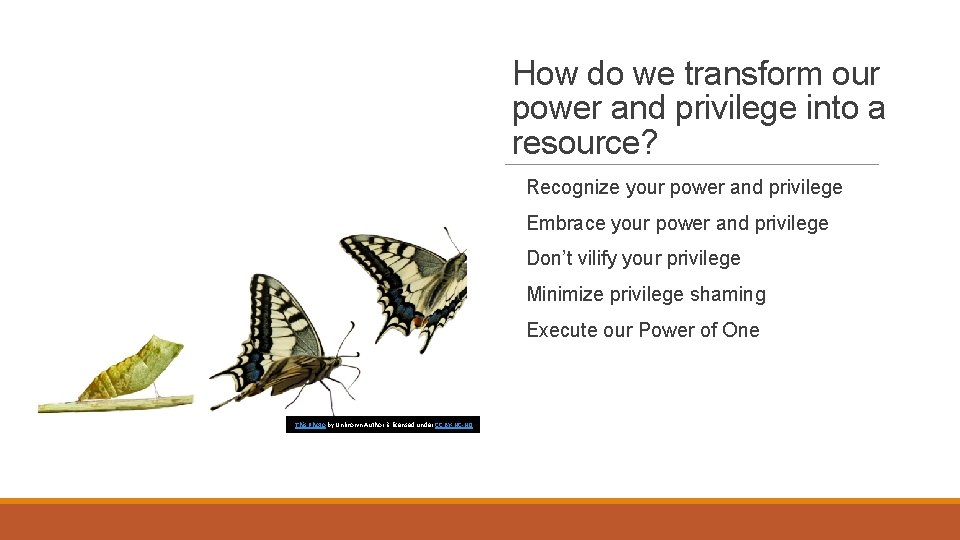
How do we transform our power and privilege into a resource? Recognize your power and privilege Embrace your power and privilege Don’t vilify your privilege Minimize privilege shaming Execute our Power of One This Photo by Unknown Author is licensed under CC BY-NC-ND
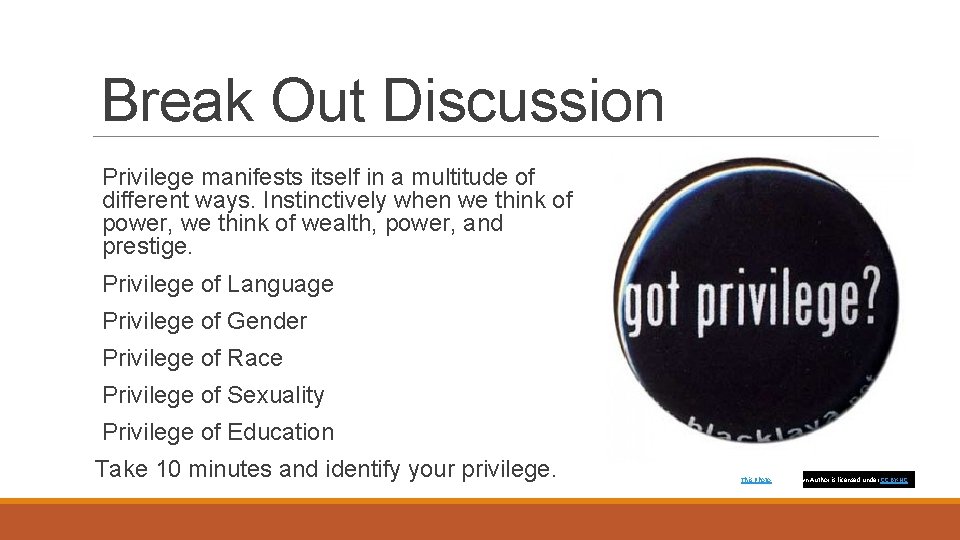
Break Out Discussion Privilege manifests itself in a multitude of different ways. Instinctively when we think of power, we think of wealth, power, and prestige. Privilege of Language Privilege of Gender Privilege of Race Privilege of Sexuality Privilege of Education Take 10 minutes and identify your privilege. This Photo by Unknown Author is licensed under CC BY-NC
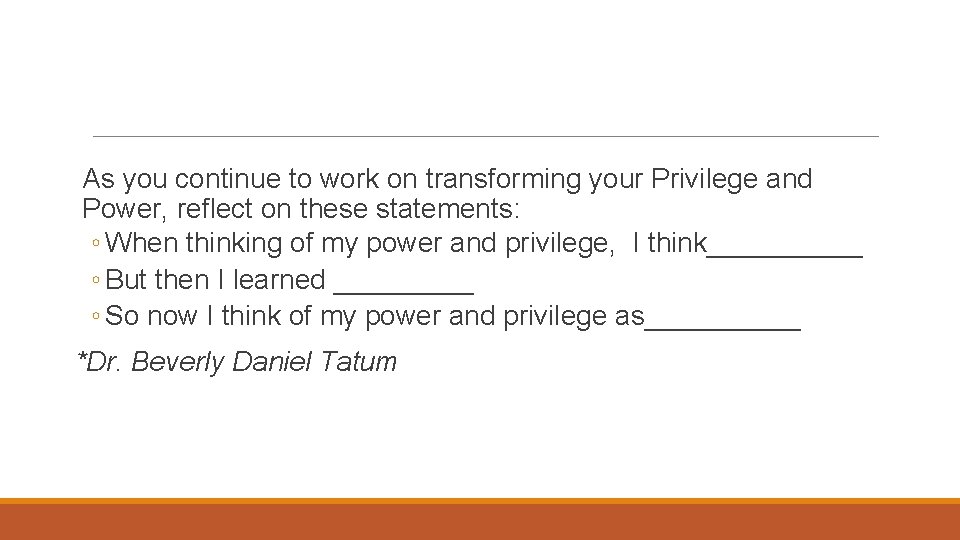
As you continue to work on transforming your Privilege and Power, reflect on these statements: ◦ When thinking of my power and privilege, I think_____ ◦ But then I learned _____ ◦ So now I think of my power and privilege as_____ *Dr. Beverly Daniel Tatum Wrap Up
REFERENCES Abrams, L. S. , & Gibson, P. (2007). Teaching notes: Reframing multicultural education: Teaching white privilege in the social work curriculum. Journal of Social Work Education, 43(1), 147 -160. Daftary, A. M. H. (2018). Critical race theory: An effective framework for social work research. Journal of Ethnic & Cultural Diversity in Social Work, 1 -16. Davis, A. , & Gentlewarrior, S. (2015). White privilege and clinical social work practice: Reflections and recommendations. Journal of Progressive Human Services, 26(3), 191 -208. Joseph, R. (2020). The theory of empowerment: A critical analysis with theory evaluation scale. Journal of Human Behavior in the Social Environment, 30(2), 138 -157. Kourgiantakis, T. , Sewell, K. M. , Hu, R. , Logan, J. , & Bogo, M. (2020). Simulation in social work education: A scoping review. Research on Social Work Practice, 30(4), 433 -450. Laal, M. . , & Ghodsi, S. M. (2011). Benefits of Collaborative Learning. Procedia - Social and Behavioral Sciences 31(2012), 486 – 430. Laging, M. , & Heidenreich, T. (2019). Towards a Conceptual Framework of Service User Involvement in Social Work Education: Empowerment and Educational Perspectives. Journal of Social Work Education, 55(1), 11 -22. Mc. Intosh, P. (2016). Privilege Walk Lesson Plan. Peace Learner. White Privilege Unpacking the Invisible Knapsack Mc. Intosh, P. (2007). White privilege: Unpacking the invisible knapsack. Race, class, and gender in the United States: An integrated study, 177 -182. Nakaoka, S. , & Ortiz, L. (2018). Examining racial microaggressions as a tool for transforming social work education: The case for critical race pedagogy. Journal of Ethnic & Cultural Diversity in Social Work, 27(1), 72 -85. Pulliam, R. M. (2017). Practical application of critical race theory: A social justice course design. Journal of Social Work Education, 53(3), 414 -423. Tatum, B. D. (2000). The complexity of identity: “ Who am I? ”. Readings for diversity and social justice, 2, 5 -8. Vazquez, E. , Radis, B. , (2020, October). Teaching Students how to Transform Power and Privilege Into a Resource to Assist Those who Lack the Same Privilege Virtually, New York State Social Work Education Association Symposia
CONTACT INFORMATION: Ebonnie L. Vazquez, Ph. D. , MSW Assistant Professor, Undergraduate Social Work Department evazquez@wcupa. edu Brie Radis, DSW, LCSW, MSS, MLSP Assistant Professor, Undergraduate Social Work Department bradis@wcupa. edu