
Teaching Strategy Toolbox Bethany Rudolph Latonya Ruiz Lynlee
+ Teaching Strategy Toolbox Bethany Rudolph Latonya Ruiz Lynlee Gayle Melissa Jones Tiffany Mc. Clendon

+ Spotlight: Team-Based Learning
+ Team-Based Learning n Special method of shared learning using a combination of individual and group work paired with feedback creating a learning environment where each learner is held accountable and responsible for being knowledgeable and prepared to contribute to learning discussions n Can be used in academic, corporate, and hospital settings n Beneficial in budding skills in working, learning, and collaborating as a team as so often is required in any profession or career. n Studies have shown that the use of this strategy in the classroom educational setting leads to “greater long-term knowledge retention compared to a traditional passive lecture curriculum”
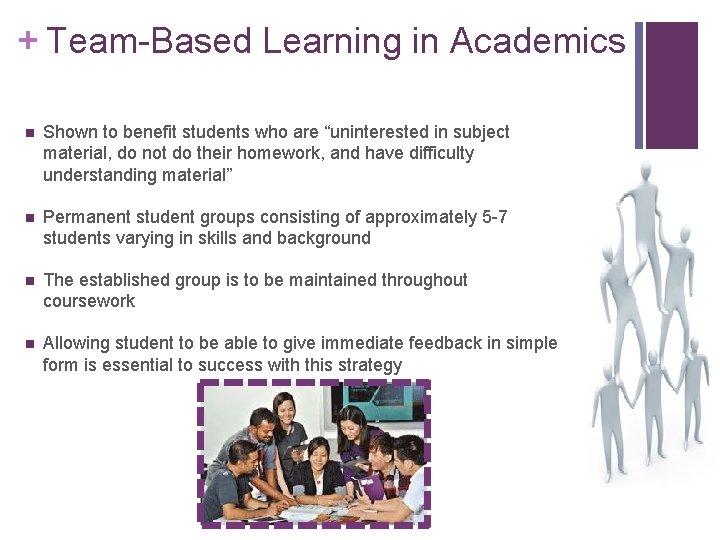
+ Team-Based Learning in Academics n Shown to benefit students who are “uninterested in subject material, do not do their homework, and have difficulty understanding material” n Permanent student groups consisting of approximately 5 -7 students varying in skills and background n The established group is to be maintained throughout coursework n Allowing student to be able to give immediate feedback in simple form is essential to success with this strategy
+ Spotlight: Flipped Classroom
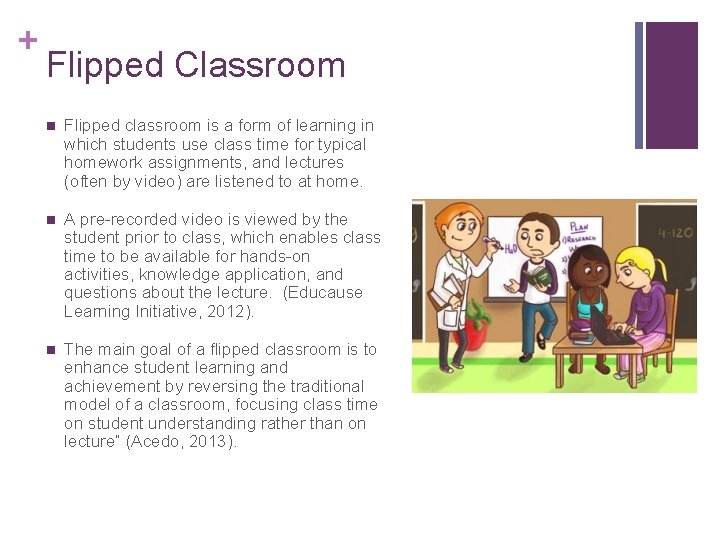
+ Flipped Classroom n Flipped classroom is a form of learning in which students use class time for typical homework assignments, and lectures (often by video) are listened to at home. n A pre-recorded video is viewed by the student prior to class, which enables class time to be available for hands-on activities, knowledge application, and questions about the lecture. (Educause Learning Initiative, 2012). n The main goal of a flipped classroom is to enhance student learning and achievement by reversing the traditional model of a classroom, focusing class time on student understanding rather than on lecture” (Acedo, 2013).
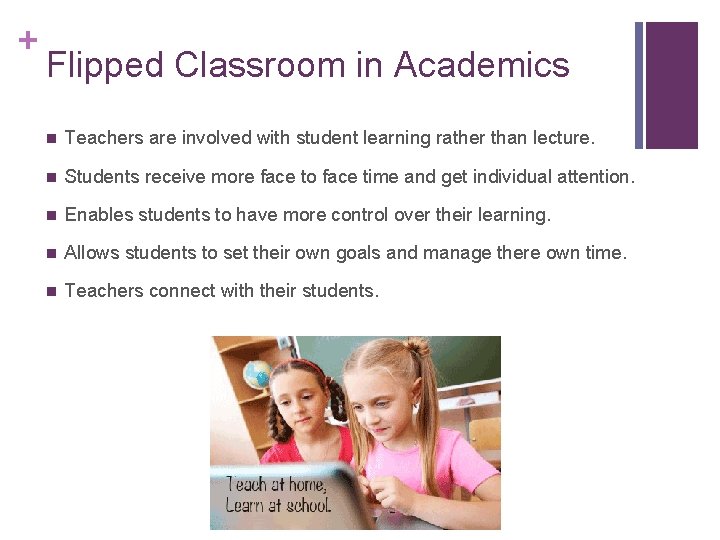
+ Flipped Classroom in Academics n Teachers are involved with student learning rather than lecture. n Students receive more face to face time and get individual attention. n Enables students to have more control over their learning. n Allows students to set their own goals and manage there own time. n Teachers connect with their students.

+ Spotlight: Teaching Naked
+ Teaching Naked n Based upon the assertion that technology should be integrated into the learning process rather than replace it n Emphasis is placed on face-to-face (naked) interaction between students and faculty n The greatest asset of a classroom is the interaction of students and professors n Technology is used outside of class to prepare students so valuable class time is not used learning information but learning ways to apply knowledge
+ Teaching Naked in Academics n Entry points – Connect with students on their level. Utilize technology that they are familiar with n First exposure to content – do personal online searches prior to class to determine what information is available n Online quizzes – students complete quizzes or study questions prior to class to be familiar with content before class n Effective use of class time – use strategies such as discussion, application, active learning and role playing to allow students to better comprehend and integrate knowledge n Cognitive wrappers – after work is completed, ask students to reflect on their learning and how their actions affect their progress/grades n How did I prepare? n Where did I lose points? n How might I prepare better next time?
+ Spotlight: Active Learning
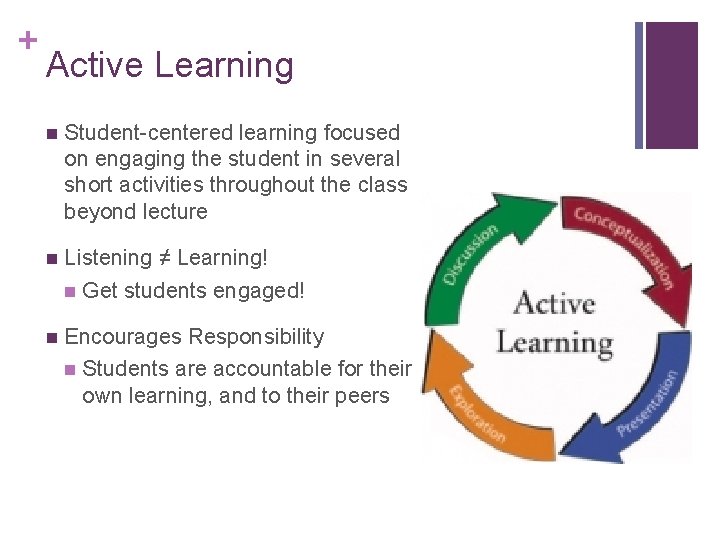
+ Active Learning n Student-centered learning focused on engaging the student in several short activities throughout the class beyond lecture n Listening ≠ Learning! n Get students engaged! n Encourages Responsibility n Students are accountable for their own learning, and to their peers
+ Active Learning in Academics n Group discussion n n Group projects n n Students are more accountable to each other Idea that the group is more important than the individual Encourages teamwork and discipline Practice n n n Encourages critical thinking Simulation, clinical Activities Minute Papers Self-assessment Case studies Feedback n n n Given from the instructor to students Should be given often Encourages open communication and higher quality communication
+ Spotlight: Formative Assessment
+ Formative Assessment n The use of CAT (classroom assessment techniques), “is a type of formative assessment, which yields direct evidence of students’ learning” (Mansson, 344). n This is beneficial for instructors and learners because student learning can be monitored in an ongoing fashion versus at the end of a semester. n Helps to demonstrate what learning goals have achieved and teaching can be curtailed to achieve unmet goals to benefit the learners.
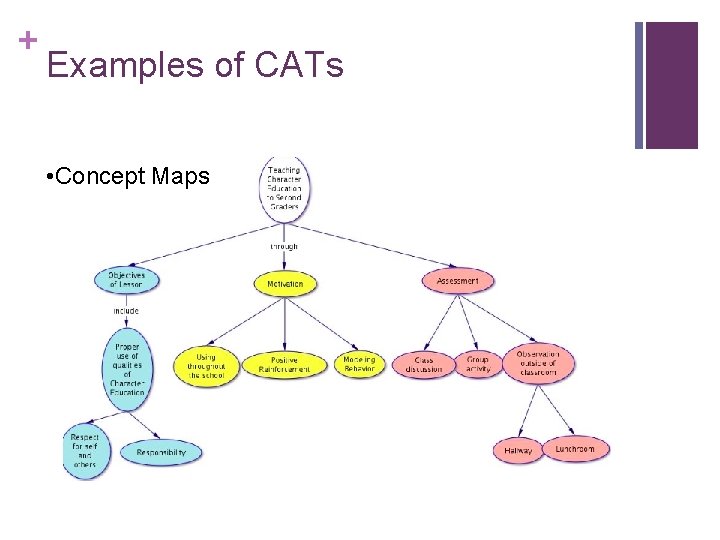
+ Examples of CATs • Concept Maps
+ Examples of CATs n ‘The Minute Paper’. This method involves have students write about what they have learned about a particular subject, topic or discussion to see how much they have retained. n ‘Misconception/Perception Check’. This method assists in evaluating misconceptions or perceptions from the learner about a topic. The instructor can then help to clarify these prior to progressing to the next topic. n ‘Muddies Point’. Have you ever heard the saying, “It was as clear as mud”? In this case, the instructor will ask the students to elaborate on what they did not understand clearly in efforts to clarify understanding.
+ References Acedo, M. (2013). 10 pros and cons Of A flipped classroom. Retrieved from http: //www. teachthought. com/trends/10 -pros-cons-flipped-classroom/ Baepler, P. , & Walker, J. D. . (2014). Active learning classrooms and educational alliances: Changing relationships to improve learning. New Directions for Teaching & Learning, 2014(137), 27– 40. http: //doi. org/10. 1002/tl. 20083 Bowen, J. (January, 2014). The teaching naked cycle: Technology is a tool, but psychology is the new pedagogy. Speech presented at Association of American Colleges and Universities. Washington, D. C. Creţu, D. (2014). Integrating active learning methods during university lectures. Journal Plus Education / Educatia Plus, 10(1), 166– 172. Retrieved from: http: //www. uav. ro/jour/index. php/jpe Educause Learning Initiative. (2012). 7 things you should know about flipped classrooms. 7 Things you should know about, 1 -2. Retrieved from https: //net. educause. edu/ir/library/pdf/eli 7081. pdf
+ References, cont. Lumpkin, A. L. , Achen, R. M. , & Dodd, R. K. (2015). Student perceptions of active learning. College Student Journal, 49(1), 121– 133. Retrieved from: http: //www. projectinnovation. com/college-student-journal. html Mansson, D. (n. d). Assessing student learning in intercultural communication: Implementation of three classroom assessment techniques. College Student Journal, 343 -349. Retrieved from https: //blackboard. uttyler. edu/bbcswebdav/pid-756240 -dtcontent-rid-2619177_1/courses/2015 -SPRING-NURS 5327. 060/Article%20 formative%20 assess_1_. pdf Sibley, J. , Spiridonaff, S. (n. d). Team based learning handout. Retrieved fromhttp: //www. teambasedlearning. org/Resources/Documents/TBL+Handout+Aug+16 print+ready+no+branding. pdf Strayer, J. (2007). The effects of the classroom flip on the learning environment: a comparison of learning activity in a traditional classroom and a flip classroom that used an intelligent tutoring system. (Electronic Thesis or Dissertation). Retrieved from https: //etd. ohiolink. edu/ Wikipedia. (2014). Team-Based Learning. Retrieved from http: //en. wikipedia. org/wiki/Teambased_learning
- Slides: 19