
Teaching Spanish as a Second Language Focusing on

![Importance of Phonetic Articulation v “Your chocie of which one [phoneme] to pronounce is](https://slidetodoc.com/presentation_image_h2/eae222a3d4545ebb890594568e8cac1e/image-9.jpg "Importance of Phonetic Articulation v “Your chocie of which one [phoneme] to pronounce is")

- Slides: 18
Teaching Spanish as a Second Language: Focusing on a Phonetic Articulatory Praxis Jessica Brightman Advisor Dr. Arrizabalaga 16 May, 2013 Spanish Capstone Project Language & Linguistics
Index v Significance of Study + Abstract v Spanish in a globalizing world v Language and it’s customs v Traditional and modern teaching methods v The articulatory praxis v Phonetic praxis v Language Interference v Future Spanish Instructors
Significance of Study v Who do we study first, the student or the instructor? v What are the best methods to teach and learn Spanish as a second language? v Is it possible to have a teaching model that reduces the possibility of language interference? v What is the ideal method for teaching Spanish through phonetic practices? http: //youtu. be/Jx. QUb. Uy. Qlxs
Abstract v It is impossible to confirm that there is one single way to teach Spanish to non-native speakers, there is however a speaking praxis that comes out of an imagined, yet real, standard model. There is something missing for Spanish learning students, native to English, who produce interference upon pronouncing Spanish as a second language because they are non-native speakers. It is possible to recognize the allophonic variation that students produce upon speaking Spanish through phonetics. For English speakers professors teaching a second language have an important job, they must represent the language orthographically and more pertinent in this work, through a phonetically based idealized spoken standard.
Abstract Continued v As soon as the professor recognizes the need for a standard model of pronunciation for them selves, he/she can then move forward with an idealized teaching model. The professor should be a guide that ideally speaks both languages; both English and Spanish, paying close attention to his own articulation and production of the language. As bilinguals, the definitive goal will be to teach a standardized model with praxis of articulation based in phonetics. Native English speakers (L 1) that learn Spanish as a second language (L 2) will only pronounce vowels and consonants correctly with a minimized foreign accent when the professor realizes the similarities and differences between both languages. This study has been done to recognize the “in-between” or the interference between English speaking students learning Spanish as a second language from their professor. The teaching of Spanish as a second language is to extend communicative abilities of a set of speakers with different identities of native languages in a globalizing world.
Spanish in a globalizing world v In 2009, there were an estimated 329 million Spanish speakers. Spanish is recognized in more than 20 countries as a national language. v The objective of learning a second language is to extend communicative abilities to speakers with different language identities.
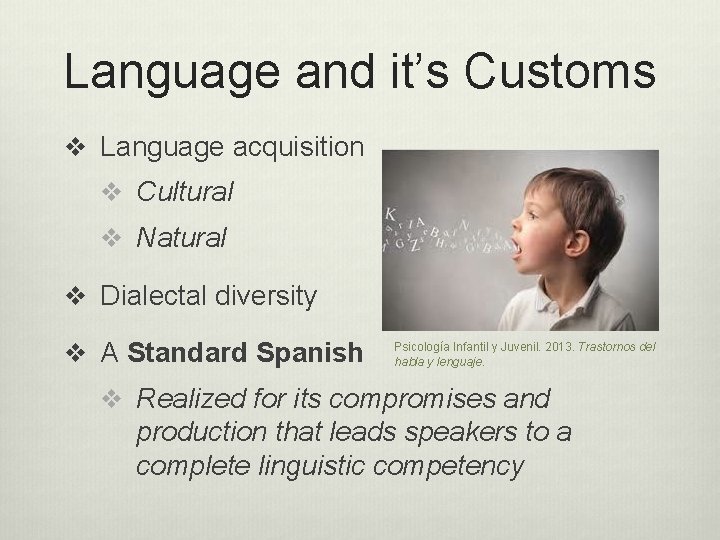
Language and it’s Customs v Language acquisition v Cultural v Natural v Dialectal diversity v A Standard Spanish Psicología Infantil y Juvenil. 2013. Trastornos del habla y lenguaje. v Realized for its compromises and production that leads speakers to a complete linguistic competency
Traditional & Modern Teaching Models v Traditional educational pedagogies v Models that encourage an advanced level of understanding and require language proficiency v Audio-oral method v Modern Pedagogies v Online Programs v Studying abroad v Hands on Experience or Teaching in a Classroom v Reflexive model
Importance of Phonetic Articulation v “Your chocie of which one [phoneme] to pronounce is virtually obligatory, involuntary, automatic, and below the level of your awareness” (Dalbor 15). v Articulation Points v Bilabial v Labio-dental v Dental v Alveolar v Palatal v Velar v Uvular
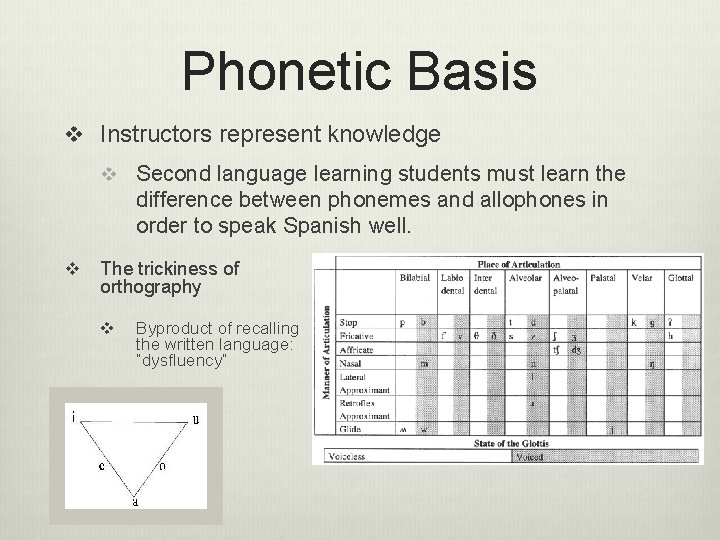
Phonetic Basis v Instructors represent knowledge v Second language learning students must learn the difference between phonemes and allophones in order to speak Spanish well. v The trickiness of orthography v Byproduct of recalling the written language: “dysfluency”
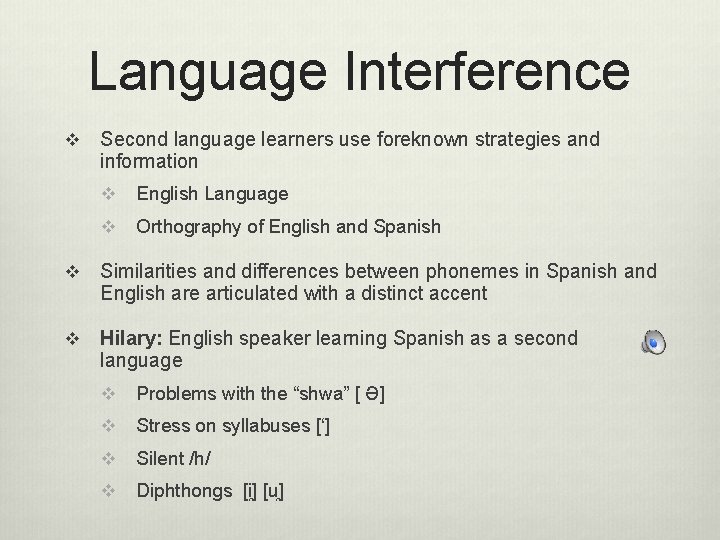
Language Interference v Second language learners use foreknown strategies and information v English Language v Orthography of English and Spanish v Similarities and differences between phonemes in Spanish and English are articulated with a distinct accent v Hilary: English speaker learning Spanish as a second language v Problems with the “shwa” [ Ə] v Stress on syllabuses [‘] v Silent /h/ v Diphthongs [i ] [u ]
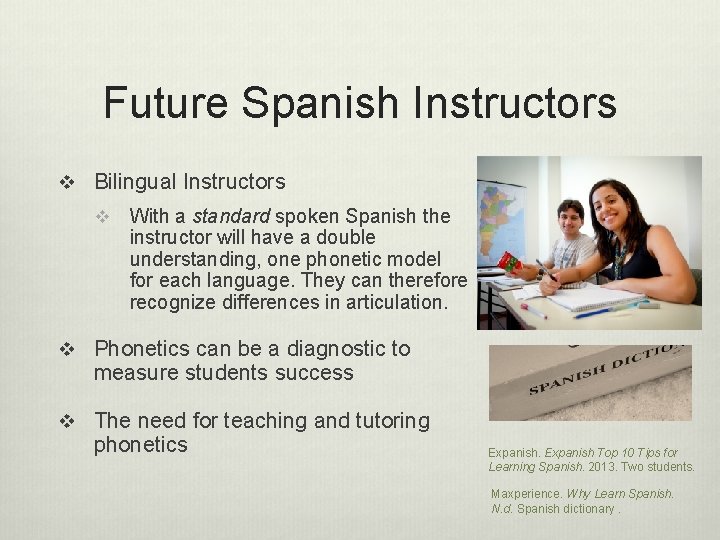
Future Spanish Instructors v Bilingual Instructors v With a standard spoken Spanish the instructor will have a double understanding, one phonetic model for each language. They can therefore recognize differences in articulation. v Phonetics can be a diagnostic to measure students success v The need for teaching and tutoring phonetics Expanish Top 10 Tips for Learning Spanish. 2013. Two students. Maxperience. Why Learn Spanish. N. d. Spanish dictionary.
Thank you!
Works Cited v Andión Herrero, M. , Antonieta. “Modelo, Estándar y norma…, Conceptos Imprescindibles en el Español L 2/LE. ” Universidad Nacional de Educación a Distancia (Madrid). 2008. 9 -26. Print. v Appel, Rene, & Muysken, Pieter. Language Contact And Bilingualism. Amsterdam: Amsterdam University Press. 2005. Web. v Blake, Robert & Ann Marie Delforge. “Online Language Learning. ” Eds. Salaberry, Rafael & Barabara A. Lafford. The Art of Teaching Spanish Second Language Acquisition from Research to Praxis. Washington, D. C. : Georgetown University Press: 2006. 127 -147. Print. v Bradlow. “The Adquisition of Spanish Vowels by Native English-Speaking students in Spanish Immersion Programs. ” Eds. Menke, Mandy, R. University of Minnesota: 2010. Web. v Cazden, Courtney, B. Classroom Discourse. The language of Teaching and Learning. Portsmouth: Heinemann, 2001. Print.
v Dalbor, B. , John. Spanish Pronunciation: theory and practice. Orlando: Harcourt College Publishers, 1997. Print. v Donaldson, Rebekah, M. Teaching Foreign Language Conversation: A conversation Norms Approach. MA Thesis. California State University, Chico, Spring 2011. Print. v Conzález Barrera, María del Carmen. “Predicción y solución de dificultades que un alumno de habla inglesa puede tener al aprender fonetica española. ” Memoria MEELE Curso Académico. MA Thesis. Universidad Antonio de Nebrija, 1999. Web. v Lafford, A. , Barbara & Salaberry Rafael. “The State of the Art of Teaching Spanish From Research to Praxis. ” Eds. Salaberry, Rafael & Barabara A. Lafford. The Art of Teaching Spanish Second Language Acquisition from Research to Praxis. Washington, D. C. : Georgetown University Press: 2006. 1 -22. Print.
v Lafford, Barbara & Joseph Collentine. “The Effects of Study Abroad and Classroom Contexts on the Acquisition of Spanish as a Second Language From Research to Application. ” Eds. Salaberry, Rafael & Barabara A. Lafford. The Art of Teaching Spanish Second Language Acquisition from Research to Praxis. Washington, D. C. : Georgetown University Press: 2006. 103 -126. Print. v Lipski, M. , John. “Spanish Lingüistics: The Past 100 Years Retrospective and Bibliography. Hispania, Vol. 81, No. 2. American Association of Teachers of Spanish and Portuguese: May 1998. 248 -260. Web. 09/03/2013. v Marrero, Victoria. “Fonética Perceptiva-Addenda”. Dpt. Lengua Española y Lingüística General Facultad de Filología, 2001. 1 -55. Print. v Martín Sanchez, Miguel. “Historia de la metodología de enseñanza de lenguas extranjeras. ” Tejuelo, No. 5. Extremadura: Universidad de Extremadura. 20 marzo, 2009. 54 -70. Web. 28 abril, 2013. v Menke, Mandy, R. “The Adquisition of Spanish Vowels by Native English-Speaking students in Spanish Immersion Programs. ” University of Minnesota: 2010. Web.
v Nash, Rose. Comparing Spanish and English: Patterns in Phonology and Orthography. San Juan: Parallexicon Publishing Company, 2000. Print. v Negueruela, Eduardo & James P. Lantolf. “Concept-Based Instruction and the Acquisition of L 2 Spanish. ” Eds. Salaberry, Rafael & Barabara A. Lafford. The Art of Teaching Spanish Second Language Acquisition from Research to Praxis. . Washington D. C. : Georgetown University Press, 2006. 79 -102. Print. v One world Nations Online. Languages of the World. N. p. , 2009. Web. 04 Apr. 2013. v Otheguy, Ricardo. Funcional Adaptation and Conceptual Convergence in the Analysis of Contact in the Spanish of Bilingual Communities in New York. Web. 07 April, 2013. v Pérez de Obanos Romero, Gregorio. “La competencia docente y el desarrollo professional: hacia un enfoque reflexivo de la enseñanza de ELE. ” Brasil: Instituto Cervantes de Belo Horizonte. 2009. Web. 28 April, 2013. v Pilotti, Maura, Martin Chodorow, & Olga Vlasova. “Interference Effects and the Consequences of Recognition Failures and Successes. ” The American Journal of Psychology, Vol. 121, No. 4. Champaign: University of Illinois Press, 2008. 523 -549. Web.
v Quilis, Antonio. “Fonética articulatoría. ” Tratado de fonologíaa y fonética españolas. Madrid: Biblioteca Románica Hispánica, 1993. 57 -84. Print. v Quilis, Antonio. “Fonología y fonética españoles. ” Tratado de fonología y fonética españolas. Madrid: Biblioteca Románica Hispánica, 1993, 11 -56. Print. v Schwegler, Armin, Juergen, Kempff, & Ana Ameal-Guerra. Fonética y Fonología Españolas. Hoboken: John Wiley & Sons, Inc. , 2010. Print. v Username: Assaultivebear. “The Ideas of Chomsky-BBC interview. ” Interview. Youtube. com. Youtube, May 16, 20011. Web. 23 April, 2013. v Username: Valendiana. “El conductismo. ” Buenas. Tareas. com. June 2012. http: //www. buenastareas. com/ensayos/El-Condctismo/4608813 v Van. Patten, Bill & Michael Leeser. “Theoretical and Research Considerations Underlying Classroom Practice The Fundamental Role of Input. ” Eds. Salaberry, Rafael & Barabara A. Lafford. The Art of Teaching Spanish Second Language Acquisition from Research to Praxis. Washington D. C. : Georgetown University Press, 2006. 55 -77. Print.