
TEACHING SONG AND DANCE IN ENGLISH Father William



- Slides: 52
TEACHING SONG AND DANCE IN ENGLISH
Father William (Traditional) Father William had seven sons. Seven sons had Father William. And they ate a lot. And they drank a lot. And they all had lots of fun! Right hand. Right foot. Left hand. Nod your head.
Important things to remember � Tell them if you are a mirror or if they must do the opposite. � You can change to present tense (have, eat, drink). � Don’t expect them to sing when they are nodding their head!
Hokey Pokey � Instructions: right, left, turn around, clap your hands, sit down, stand up, sing a song, be quiet, take a bow. � Link to the hokey pokey: http: //www. youtube. com/watch? v=_j. W 3 L 1 dy. Ef. Y The people who made this video have also made other good one: Super Simple Songs https: //www. youtube. com/watch? v=HGgskl. Wmtg&NR=1&feature=endscreen �
The Walls of Limerick � � � Use stretching to revise parts of the body. 1, 2, 3 s up and down the room. 7 s in a circle. Change places (doing the steps to warm up). Give each child in a pair a different name e. g. oranges on the right and apples on the left. Vocabulary needed: partner, pair, take hands, in, out, drop hands, change places, face to face, go to the side, swing.
The Walls of Limerick � Link to the song: http: //www. youtube. com/watch? v=o. Ni 1 Mt 1 y 4 K 8 � Link to the dance: http: //www. youtube. com/watch? v=NOr. UEPZf. As. U The dance is not exactly the same but it will help you remember.
Useful tools for teaching songs � Pictures and games to pre-teach vocabulary. � Elicit lyrics as you go. � Actions – they could invent them which also checks they understand the concepts. � Have a focal point or activity. � You could make up songs to tunes they already know. � Use your classroom assistant or a strong pupil to do rounds (canons). � If the song is difficult split it into chunks. � Get them to invent the lyrics. � Give them an incentive like you are going to record or video them performing the song.
What stops teachers singing in the classroom? � I can´t sing! � I can’t read music! � It’s a waste of class time. � The grammar of the lyrics are too complicated for them to understand eg. we haven’t done the past tense yet.
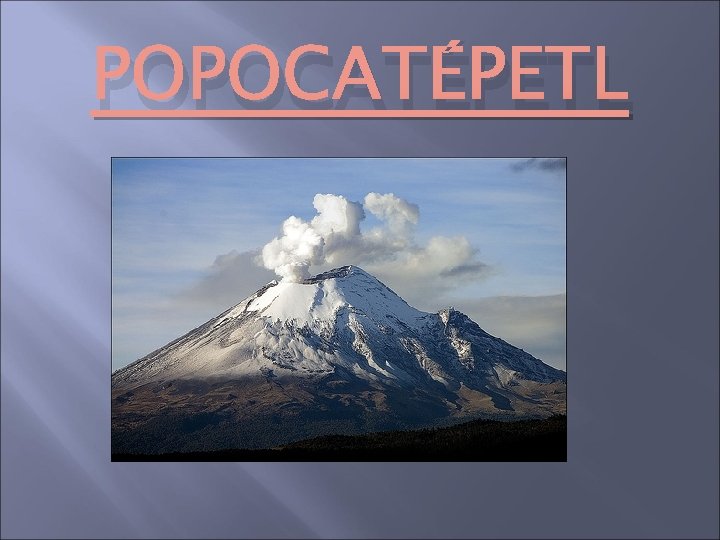
POPOCATÉPETL
Warming up � What is it? A volcano (pronunciation of the ‘v’ with the two front teeth on the bottom lip). � Is it big or small? Big. � Where is Popocatépetl? In Mexico. � Is Mexico close like Fene or far away like America? Far away. � What noise does a volcano make? BANG, sizzle, BANG. � What can you see coming out of the volcano? Smoke. What colour is it? � What other things can come out of volcanoes? Rocks, lava, ash and gas. What colour are they?
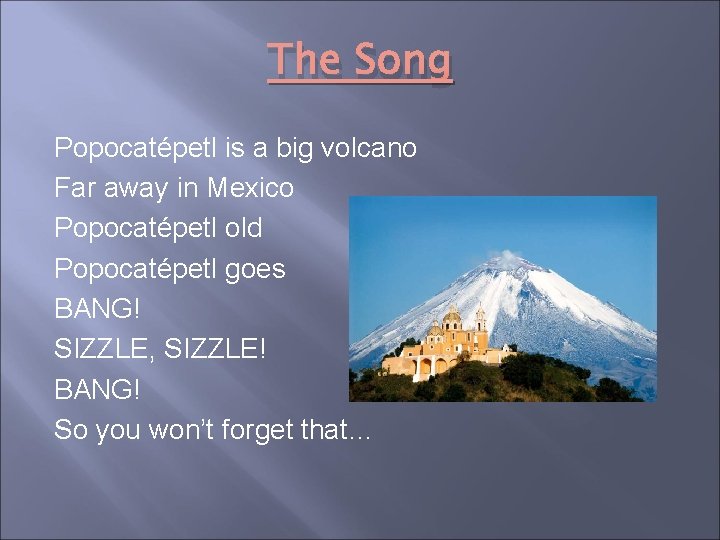
The Song Popocatépetl is a big volcano Far away in Mexico Popocatépetl old Popocatépetl goes BANG! SIZZLE, SIZZLE! BANG! So you won’t forget that…
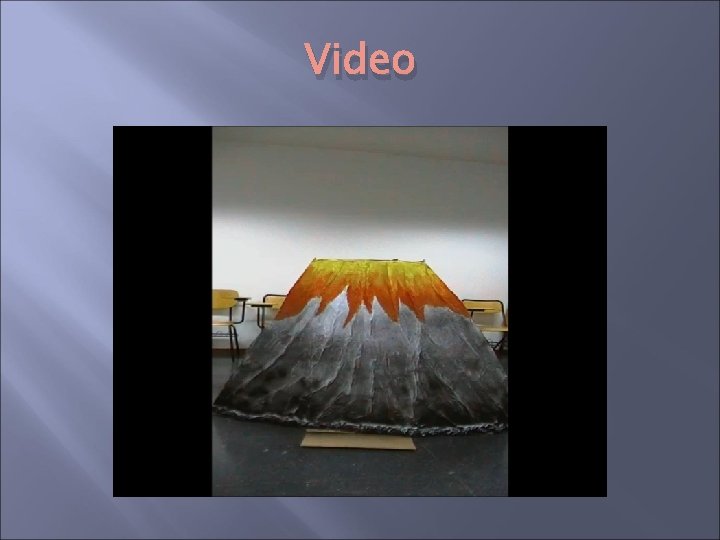
Video
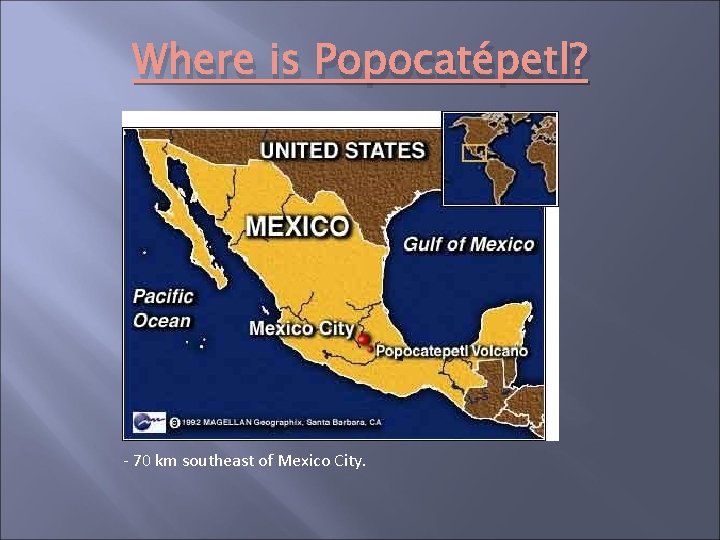
Where is Popocatépetl? - 70 km southeast of Mexico City.
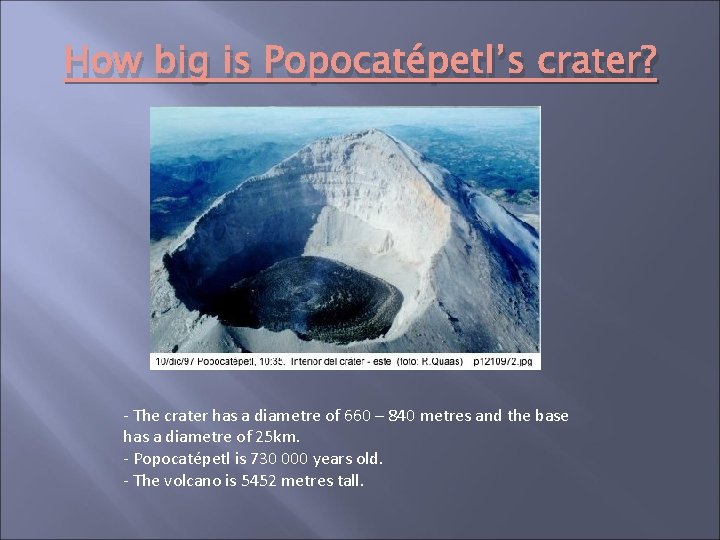
How big is Popocatépetl’s crater? - The crater has a diametre of 660 – 840 metres and the base has a diametre of 25 km. - Popocatépetl is 730 000 years old. - The volcano is 5452 metres tall.
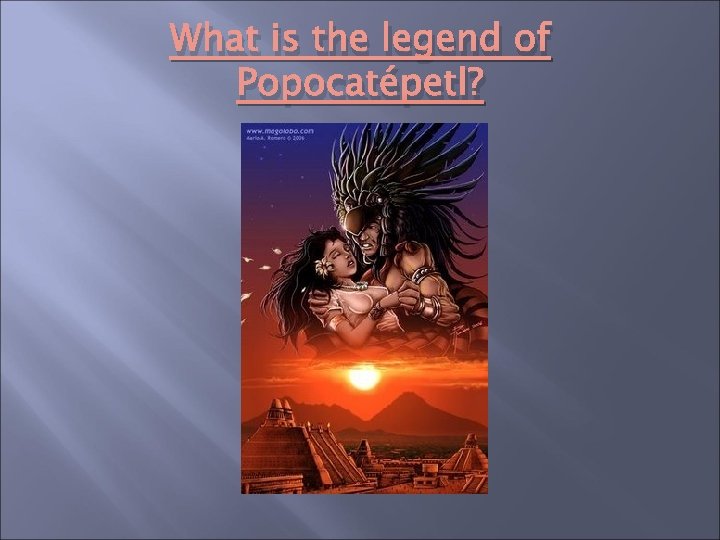
What is the legend of Popocatépetl?
The Legend? � The great emperor of the Aztecs was very powerful, all the tribes of the valley of Mexico and neighbouring areas had to pay taxes, but not all the tribes were happy with this. . . They were tired of their oppressors. � The Chief of Tlaxcala decided one day that it was time to deliver his people from Aztec domination and start a terrible war between the Aztecs and Tlaxcaltecas. � Ixtaccíhuatl was the young and beautiful Princess, the daughter of the chief of Tlaxcala. Popocatépetl was one of the leading warriors of his people, he told the Princess he loved her in secret. Before the war, Popocatépetl asked Ixtaccíhuatl’s father if he could marry his daughter, if he won the war. The Chief of Tlaxcala said yes. � Popocatépetl won every battle, and on his triumphant return to Tlaxcala, the Chief comes to him and tells him that Ixtaccíhuatl had died. � Popocatépetl was very sad angry. He took Ixtaccíhuatl in his arms and started climbing the mountain. � When he got to the highest point of the mountain, close to the sky, he put her down and kneeled beside her with a burning lantern in his hand. Snow covered their bodies, forming the giant volcanoes that are in Mexico valley. � An animated version of the story with no words only music is available on youtube, which is great for getting the children to explain what is happening: http: //www. youtube. com/watch? v=r 15 ZCCr. X 5 y 0
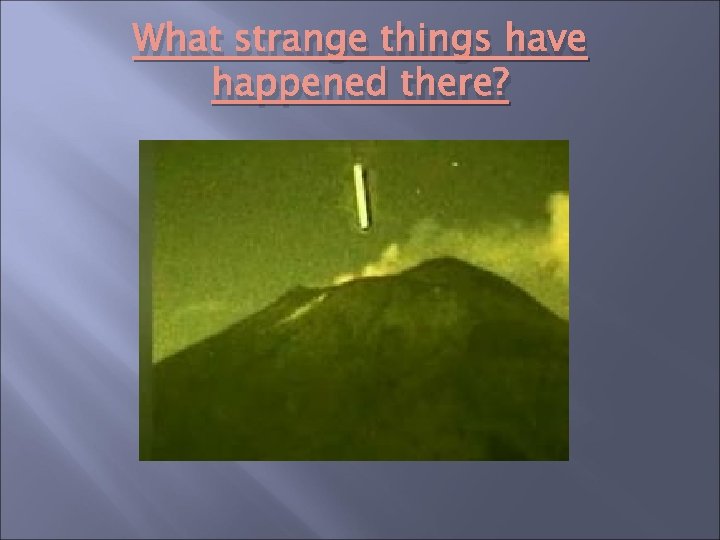
What strange things have happened there?
Could the U. F. O be a spaceship? Watch the news in Mexico and find out what they think. http: //www. youtube. com/watch? v=c 0 HNFvu. LF 0 Q
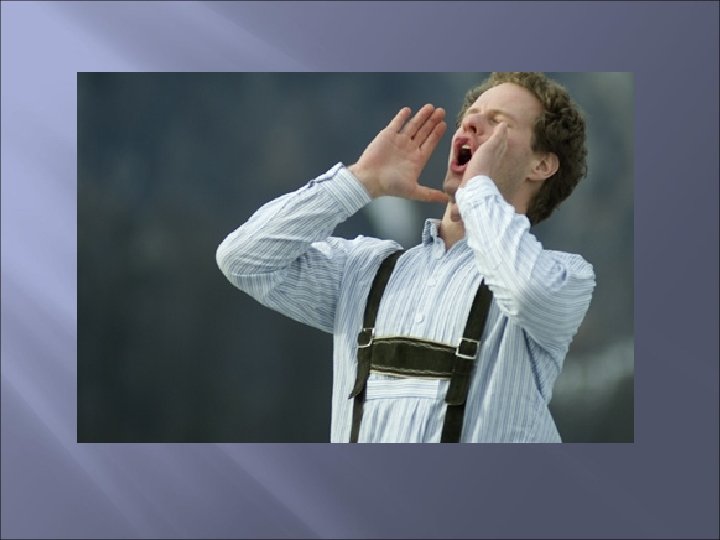
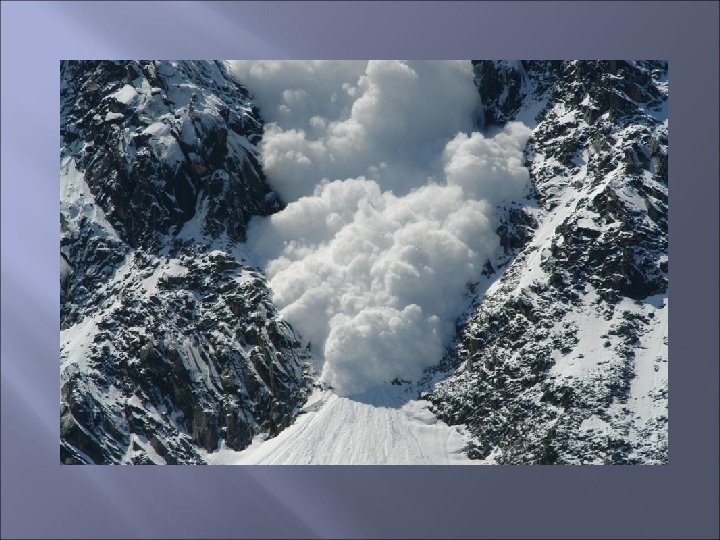
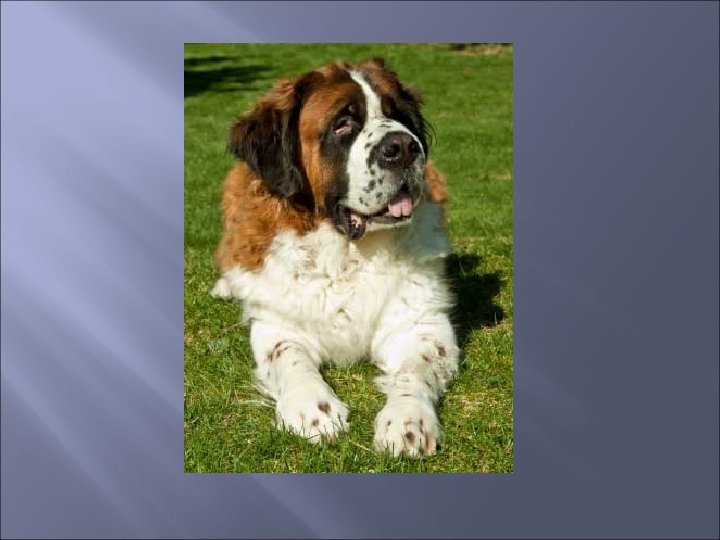
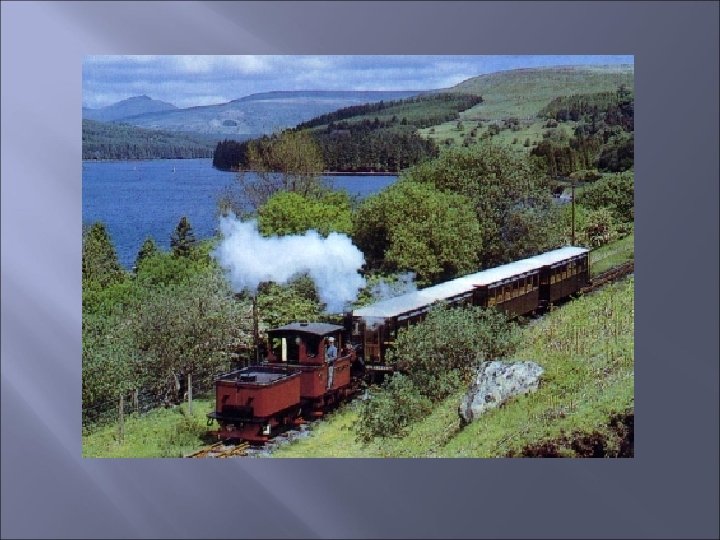
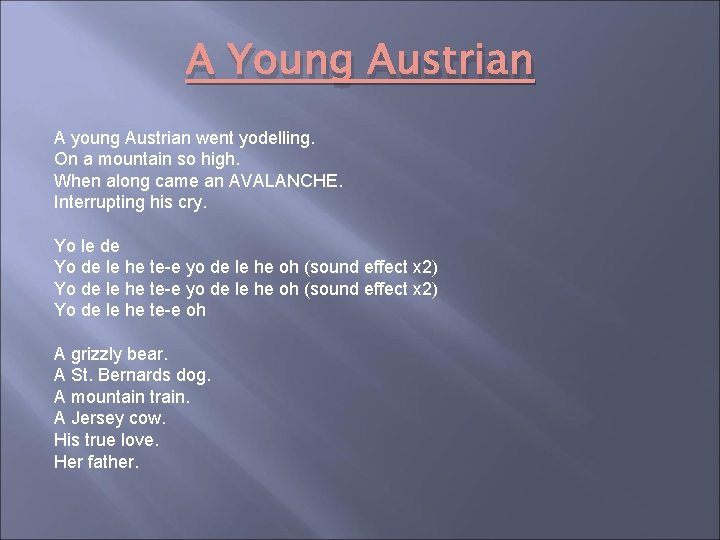
A Young Austrian A young Austrian went yodelling. On a mountain so high. When along came an AVALANCHE. Interrupting his cry. Yo le de Yo de le he te-e yo de le he oh (sound effect x 2) Yo de le he te-e oh A grizzly bear. A St. Bernards dog. A mountain train. A Jersey cow. His true love. Her father.
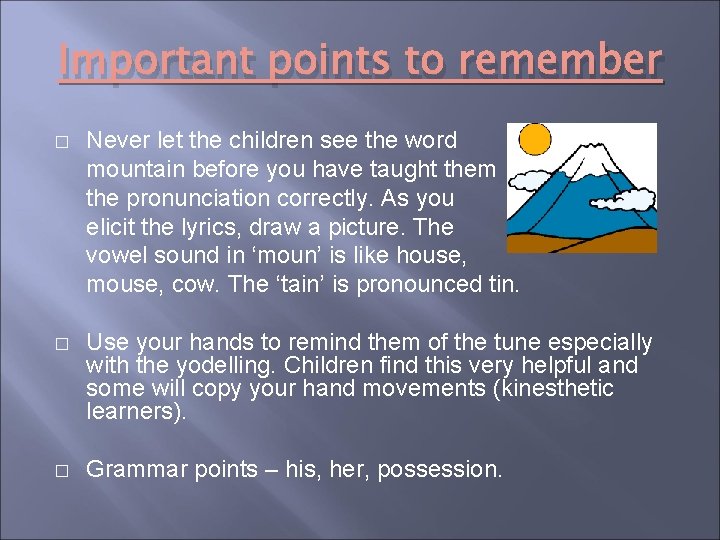
Important points to remember � Never let the children see the word mountain before you have taught them the pronunciation correctly. As you elicit the lyrics, draw a picture. The vowel sound in ‘moun’ is like house, mouse, cow. The ‘tain’ is pronounced tin. � Use your hands to remind them of the tune especially with the yodelling. Children find this very helpful and some will copy your hand movements (kinesthetic learners). � Grammar points – his, her, possession.
Singing in a round (canon) A Pizza Hut Kentucky Fried Chicken And a Pizza Hut Mac. Donalds Kentucky Fried Chicken And a Pizza Hut If you have a classroom assistant they will be very helpful for leading one group. Repeat each part twice with actions (square, chicken and M). Group A sing part 1, group B sing part 1 Group A sing part 2, group B sing part 2 Group B sing part 2. As group B are finishing their second part 2, group A could begin again and the song repeats.
The Circassian Circle � In, out, in, out. Men in and clap. Ladies in, clap and turn around. Swing. Walk. � Ladies could move on to the next man when they turn around. � For older students there are different swings: Swing 1: Hold the right hand of your partner with your right then hold the right elbow of your partner with your left hand. Swing 2: Hold the left hand of your partner with your left like you are saying, ‘how do you do’. Insert your right hand between their arm and body and hold their waist. � Link to the dance: http: //www. youtube. com/watch? v=MKROo. Yw. Br 6 c � Link to some music but actually any ‘jig’ will be fine: https: //www. youtube. com/watch? v=8 IRWVKh. Dzx. A
Hand clapping rhymes � Chocolate, chocolate, ice. Chocolate, cream, cream. Chocolate, ice, chocolate, cream. Chocolate, chocolate, ice-cream. � A sailor went to sea, sea. To see what he could see, see. And all that he could see, see. Was the bottom of the deep blue sea, sea.
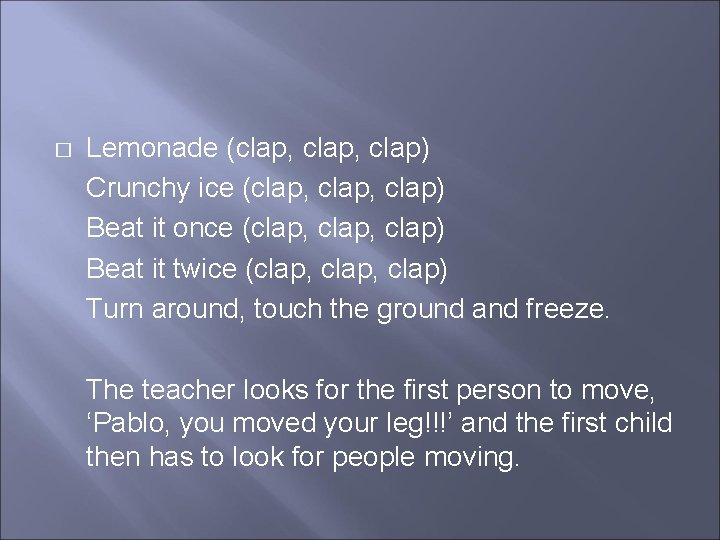
� Lemonade (clap, clap) Crunchy ice (clap, clap) Beat it once (clap, clap) Beat it twice (clap, clap) Turn around, touch the ground and freeze. The teacher looks for the first person to move, ‘Pablo, you moved your leg!!!’ and the first child then has to look for people moving.
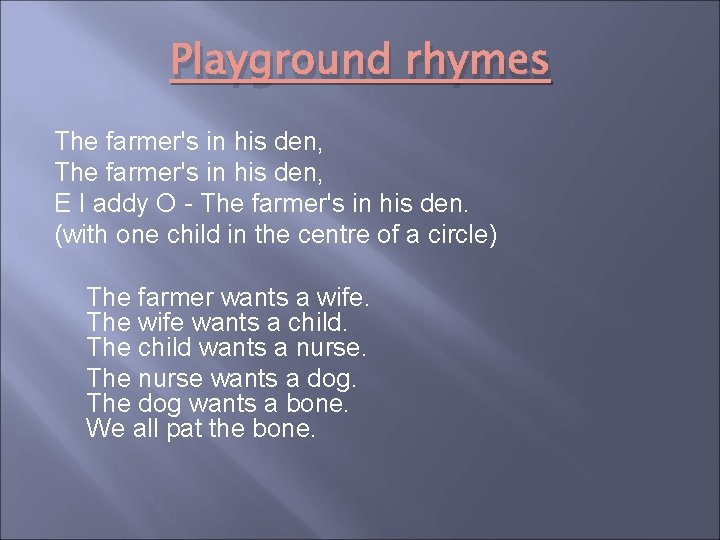
Playground rhymes The farmer's in his den, E I addy O - The farmer's in his den. (with one child in the centre of a circle) The farmer wants a wife. The wife wants a child. The child wants a nurse. The nurse wants a dog. The dog wants a bone. We all pat the bone.
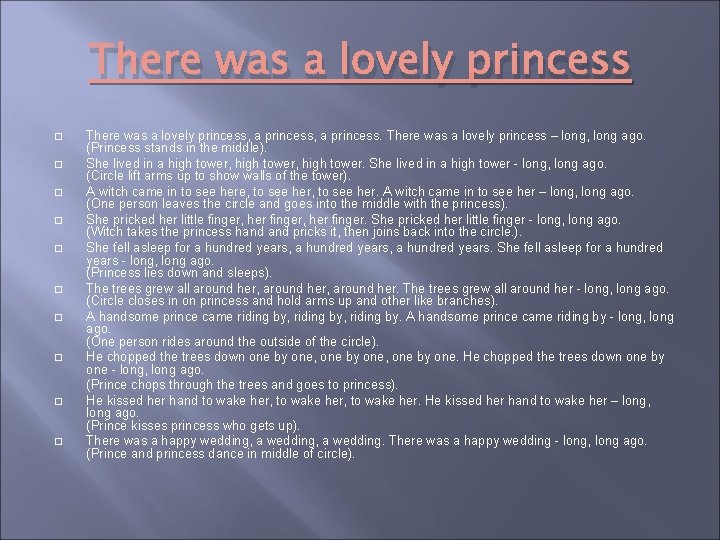
There was a lovely princess � � � � � There was a lovely princess, a princess. There was a lovely princess – long, long ago. (Princess stands in the middle). She lived in a high tower, high tower. She lived in a high tower - long, long ago. (Circle lift arms up to show walls of the tower). A witch came in to see here, to see her. A witch came in to see her – long, long ago. (One person leaves the circle and goes into the middle with the princess). She pricked her little finger, her finger. She pricked her little finger - long, long ago. (Witch takes the princess hand pricks it, then joins back into the circle. ). She fell asleep for a hundred years, a hundred years. She fell asleep for a hundred years - long, long ago. (Princess lies down and sleeps). The trees grew all around her, around her. The trees grew all around her - long, long ago. (Circle closes in on princess and hold arms up and other like branches). A handsome prince came riding by, riding by. A handsome prince came riding by - long, long ago. (One person rides around the outside of the circle). He chopped the trees down one by one, one by one. He chopped the trees down one by one - long, long ago. (Prince chops through the trees and goes to princess). He kissed her hand to wake her, to wake her. He kissed her hand to wake her – long, long ago. (Prince kisses princess who gets up). There was a happy wedding, a wedding. There was a happy wedding - long, long ago. (Prince and princess dance in middle of circle).
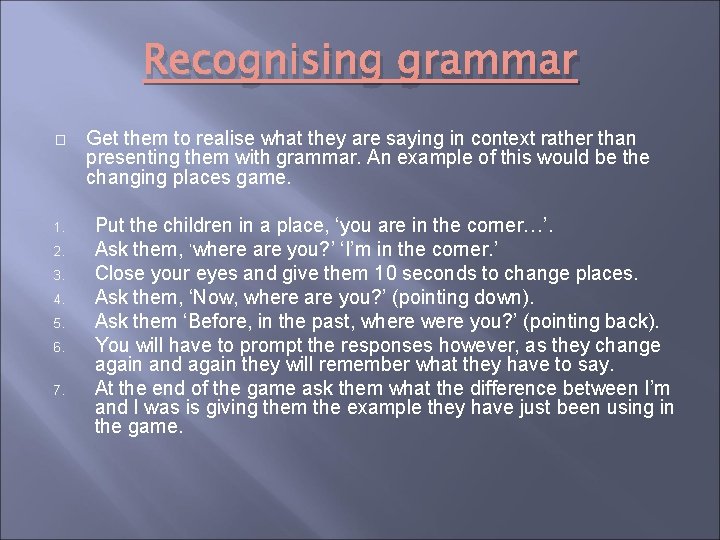
Recognising grammar � 1. 2. 3. 4. 5. 6. 7. Get them to realise what they are saying in context rather than presenting them with grammar. An example of this would be the changing places game. Put the children in a place, ‘you are in the corner…’. Ask them, ‘where are you? ’ ‘I’m in the corner. ’ Close your eyes and give them 10 seconds to change places. Ask them, ‘Now, where are you? ’ (pointing down). Ask them ‘Before, in the past, where were you? ’ (pointing back). You will have to prompt the responses however, as they change again and again they will remember what they have to say. At the end of the game ask them what the difference between I’m and I was is giving them the example they have just been using in the game.
It’s Midnight in the Kitchen � Show them some kitchen tools and tell or elicit from the children that they work hard all day preparing the food and at night they come out to play and have fun. They try not to wake anyone in the house. � Mark the beat with any tool as children use two fingers to walk on their hands or use the other kitchen tools.
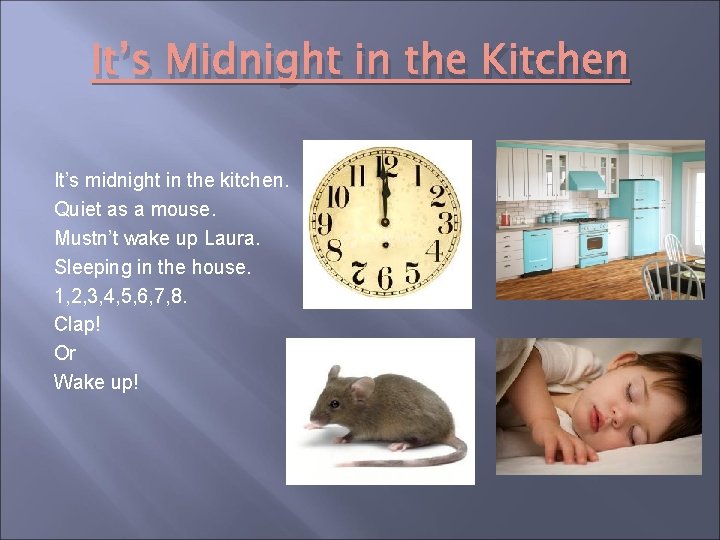
It’s Midnight in the Kitchen It’s midnight in the kitchen. Quiet as a mouse. Mustn’t wake up Laura. Sleeping in the house. 1, 2, 3, 4, 5, 6, 7, 8. Clap! Or Wake up!
Extras � The child will love pretending to be surprised, then you ask ‘Laura, who is sleeping in the house? ’ and they can choose the next person. Ana is sleeping in the house using present continuous. � The number that you clap or shout wake up on is changed each time to practise loud and quiet (dynamics). You could invent a hand signal for loud and quiet and then have one of the children be the conductor. This also helps them count together. � The time can be changed to practise time vocabulary. � The room can be changed to practise house vocabulary. � You could think of other quiet animals to check their understanding of the word quiet. � The child that is asleep has to guess what number the other children decided to clap/shout wake up on.
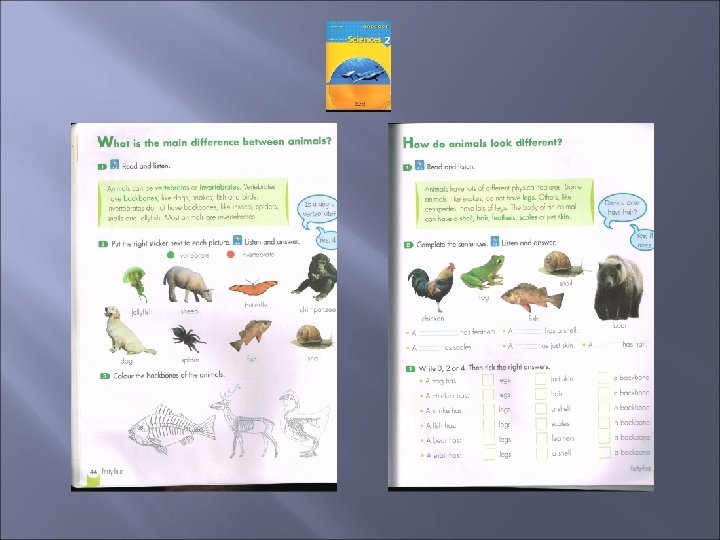
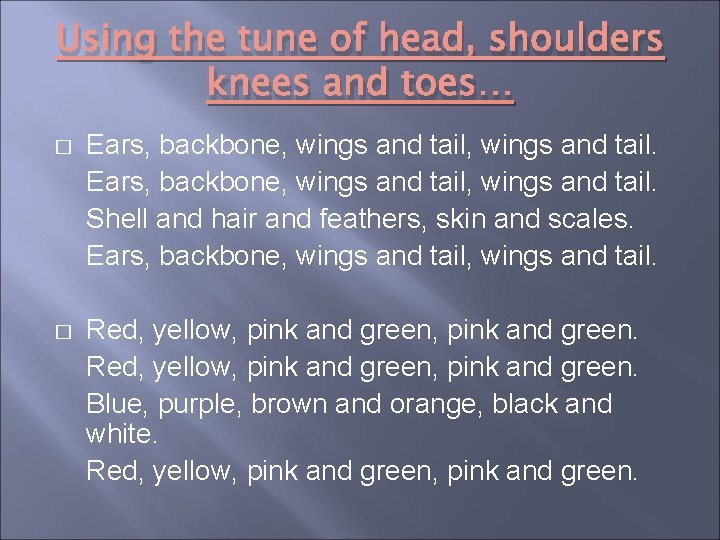
Using the tune of head, shoulders knees and toes… � Ears, backbone, wings and tail, wings and tail. Shell and hair and feathers, skin and scales. Ears, backbone, wings and tail. � Red, yellow, pink and green, pink and green. Blue, purple, brown and orange, black and white. Red, yellow, pink and green.
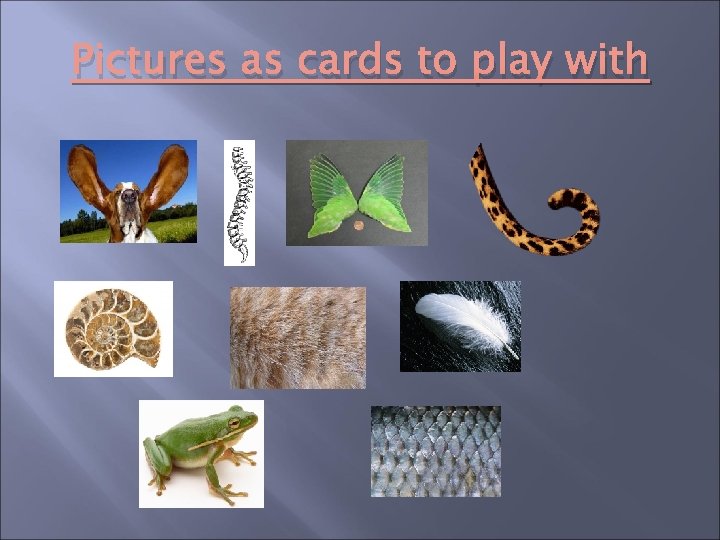
Pictures as cards to play with
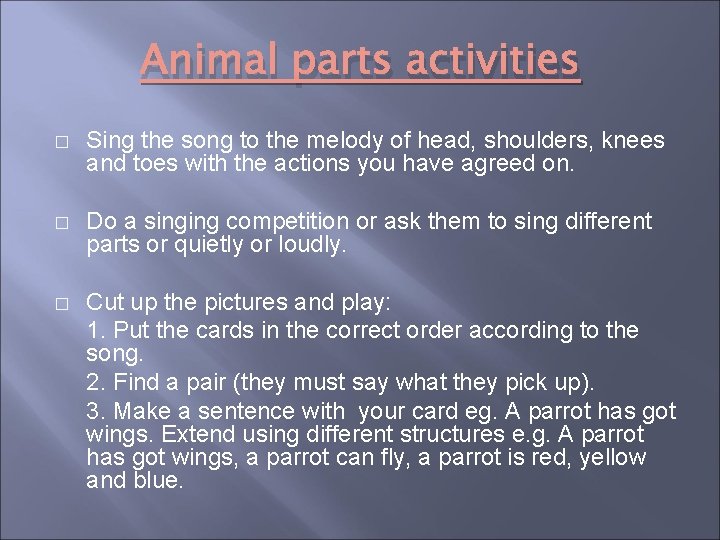
Animal parts activities � Sing the song to the melody of head, shoulders, knees and toes with the actions you have agreed on. � Do a singing competition or ask them to sing different parts or quietly or loudly. � Cut up the pictures and play: 1. Put the cards in the correct order according to the song. 2. Find a pair (they must say what they pick up). 3. Make a sentence with your card eg. A parrot has got wings. Extend using different structures e. g. A parrot has got wings, a parrot can fly, a parrot is red, yellow and blue.
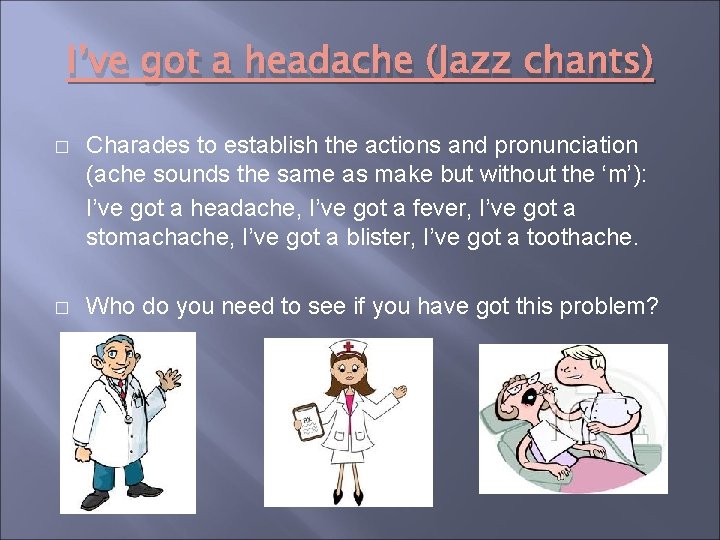
I’ve got a headache (Jazz chants) � Charades to establish the actions and pronunciation (ache sounds the same as make but without the ‘m’): I’ve got a headache, I’ve got a fever, I’ve got a stomachache, I’ve got a blister, I’ve got a toothache. � Who do you need to see if you have got this problem?
I’ve got a headache (Jazz chants) The tune is the same as ‘La Cucaracha’. I’ve got a headache. I don’t want to go to bed. I’ve got a fever. I don’t want to do my homework. I’ve got a stomachache. I don’t want to eat my lunch. I’ve got a blister. I don’t want to see my sister. Everytime I get a headache, Mama takes me to the doctor. Everytime I get a fever, Mama takes me to the nurse. Everytime I get a toothache, Mama takes me to the dentist. Everytime I see the dentist, I always come home feeling worse. Repeat: I´ve got a headache…
Yellow Umbrella � Play the cd and read the book asking them questions ‘how many…? ’, ‘where…? ’, ‘what’s the weather like? ’ or ‘what colour…? ’, to introduce and get them interested. � Ask them to guess what country the story is from then play the song and ask them to guess what language they are speaking. � Ask them what instruments are playing and what do they sound like. � Tell them we are going to sing the song in English. Give out the sheets and focus on the pictures and ask questions to elicit vocabulary and ideas from the song lyrics. � Sing the first verse with them repeating and then ask them what ‘hold up your umbrella’ means. Invite children to demonstrate the action with real umbrellas. Do the same for the other verses. � The accompaniment is very simple so you could introduce a musical instrument to imitate the sound of rain. � Perform the song with the cd until each child has had a chance to use an umbrella or an instrument.
� The object is not to learn the words, more to recognise vocabulary in context with the help of sound and pictures. It can be used to introduce or reinforce vocabulary they already know. � You need to invent an activity for the children to manipulate. � A fold-up. � Arm bands. � Colouring.
The Sweets of May � � � What do they need to know before you start teaching them the dance? Skip Double skip (1, 2, 3) Double skip backwards (back, 2, 3) Sevens for moving sideways (1, 2, 3, 4, 5, 6, 7). If you are moving to the right foot is in front and if you are moving to the left your left foot is in front. Take hands and drop hands. Partners – who are cats and who are dogs?
� Link to the song: http: //www. youtube. com/watch? v=vw. PKCm. Ew 8 M � Link to the dance: http: //www. youtube. com/watch? v=i. R 1 O 3 A 6 hy. Y w
Recommended books, publications and resources. � � � � Sing for pleasure Junior Song Books http: //www. singforpleasure. org. uk/catalog/index. ph p? c. Path=21 Jazz chants Music Express Traditional songs and dances are all on http: //www. youtube. com but may vary slightly. Barefoot books The Yellow Umbrella Sing Up http: //www. singup. org/