
Teaching resources for Speleology and Karst 2009 CAVING

- Slides: 36
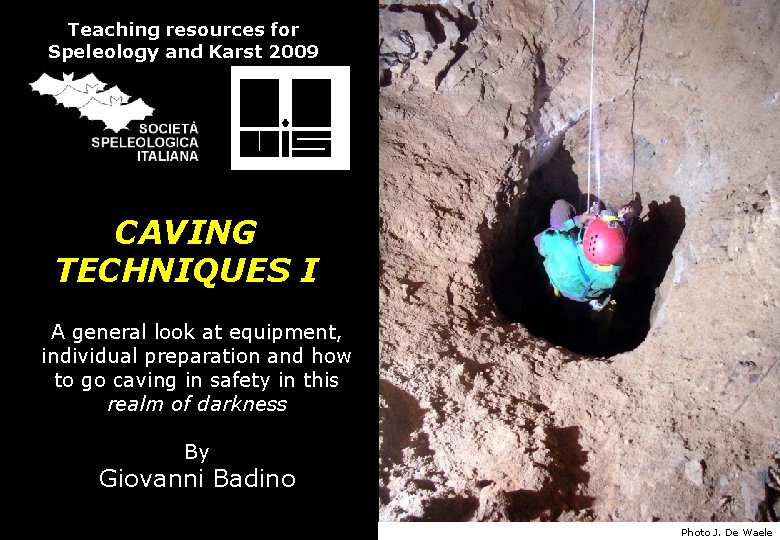
Teaching resources for Speleology and Karst 2009 CAVING TECHNIQUES I A general look at equipment, individual preparation and how to go caving in safety in this realm of darkness By Giovanni Badino Photo J. De Waele
INTRODUCTION This lecture is not meant to teach how to explore caves, because caving expertise is something that can only be acquired through experience, by visiting many caves. It also does not have the scope to teach techniques, since these are best learned through some studying and a lot of practice. This lecture has the following aims: 1) Give some basic information on caving; 2) Give some examples of things and situations to pay attention to; 3) But especially give suggestions on the general way in which one should get in contact with the subterranean environment. This is what we call “caving techniques” Caving techniques I – Società Speleologica Italiana 2009
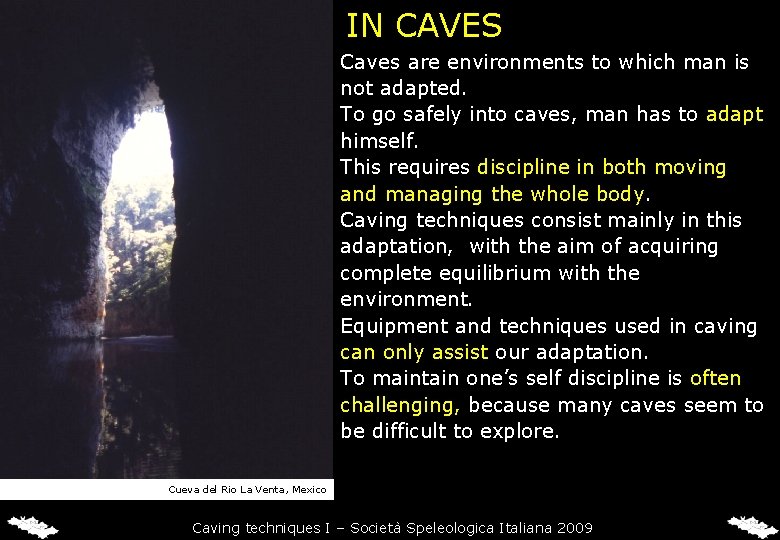
IN CAVES Caves are environments to which man is not adapted. To go safely into caves, man has to adapt himself. This requires discipline in both moving and managing the whole body. Caving techniques consist mainly in this adaptation, with the aim of acquiring complete equilibrium with the environment. Equipment and techniques used in caving can only assist our adaptation. To maintain one’s self discipline is often challenging, because many caves seem to be difficult to explore. Cueva del Rio La Venta, Mexico Caving techniques I – Società Speleologica Italiana 2009
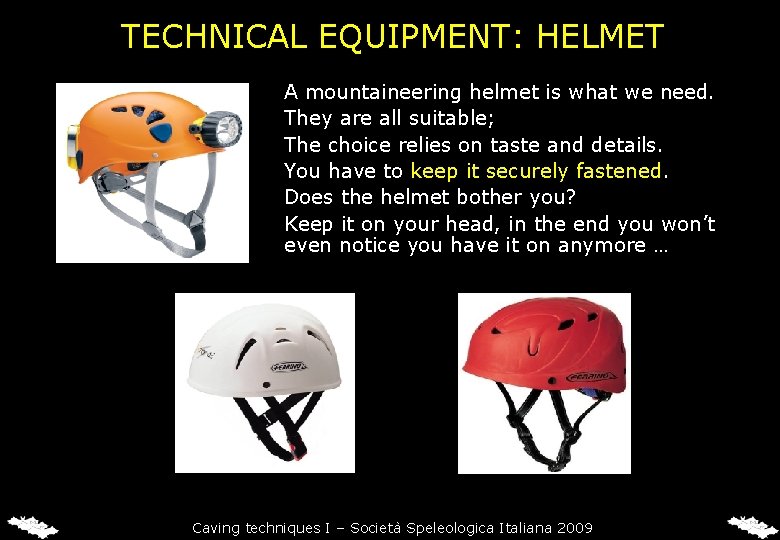
TECHNICAL EQUIPMENT: HELMET A mountaineering helmet is what we need. They are all suitable; The choice relies on taste and details. You have to keep it securely fastened. Does the helmet bother you? Keep it on your head, in the end you won’t even notice you have it on anymore … Caving techniques I – Società Speleologica Italiana 2009
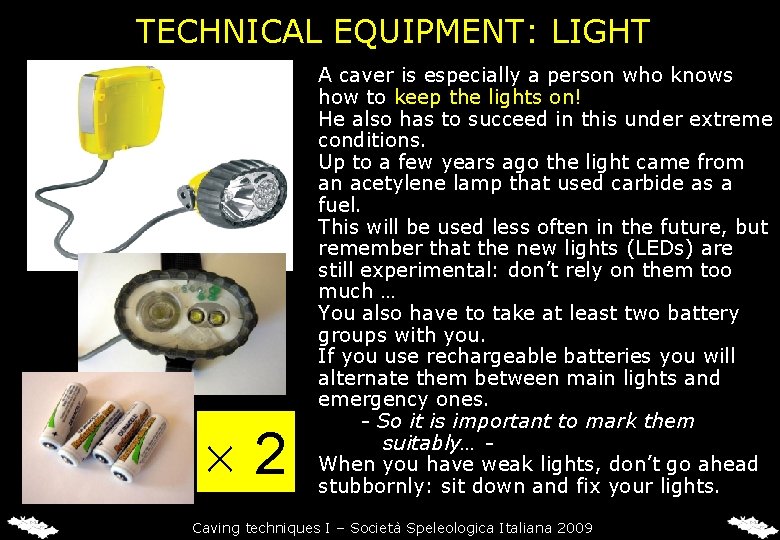
TECHNICAL EQUIPMENT: LIGHT 2 A caver is especially a person who knows how to keep the lights on! He also has to succeed in this under extreme conditions. Up to a few years ago the light came from an acetylene lamp that used carbide as a fuel. This will be used less often in the future, but remember that the new lights (LEDs) are still experimental: don’t rely on them too much … You also have to take at least two battery groups with you. If you use rechargeable batteries you will alternate them between main lights and emergency ones. - So it is important to mark them suitably… When you have weak lights, don’t go ahead stubbornly: sit down and fix your lights. Caving techniques I – Società Speleologica Italiana 2009
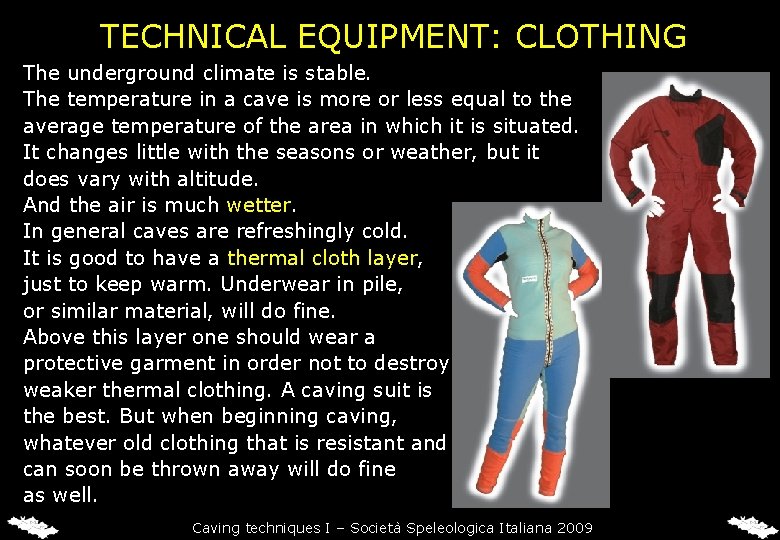
TECHNICAL EQUIPMENT: CLOTHING The underground climate is stable. The temperature in a cave is more or less equal to the average temperature of the area in which it is situated. It changes little with the seasons or weather, but it does vary with altitude. And the air is much wetter. In general caves are refreshingly cold. It is good to have a thermal cloth layer, just to keep warm. Underwear in pile, or similar material, will do fine. Above this layer one should wear a protective garment in order not to destroy this weaker thermal clothing. A caving suit is the best. But when beginning caving, whatever old clothing that is resistant and can soon be thrown away will do fine as well. Caving techniques I – Società Speleologica Italiana 2009
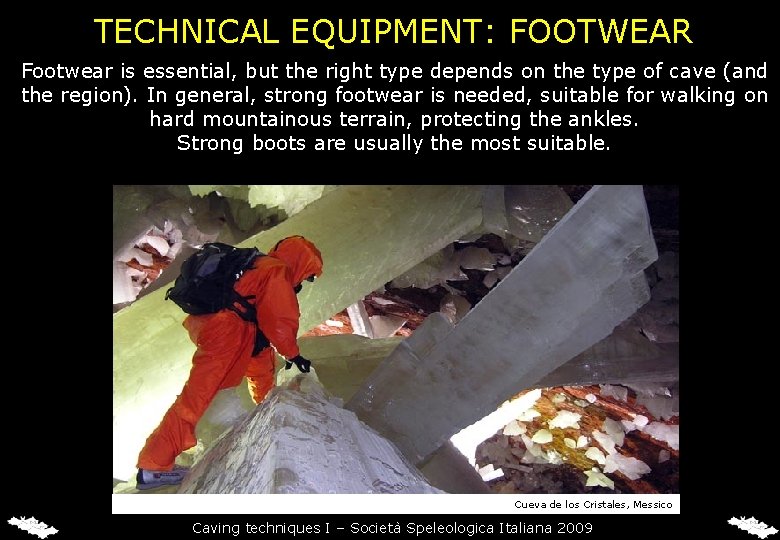
TECHNICAL EQUIPMENT: FOOTWEAR Footwear is essential, but the right type depends on the type of cave (and the region). In general, strong footwear is needed, suitable for walking on hard mountainous terrain, protecting the ankles. Strong boots are usually the most suitable. Cueva de los Cristales, Messico Caving techniques I – Società Speleologica Italiana 2009
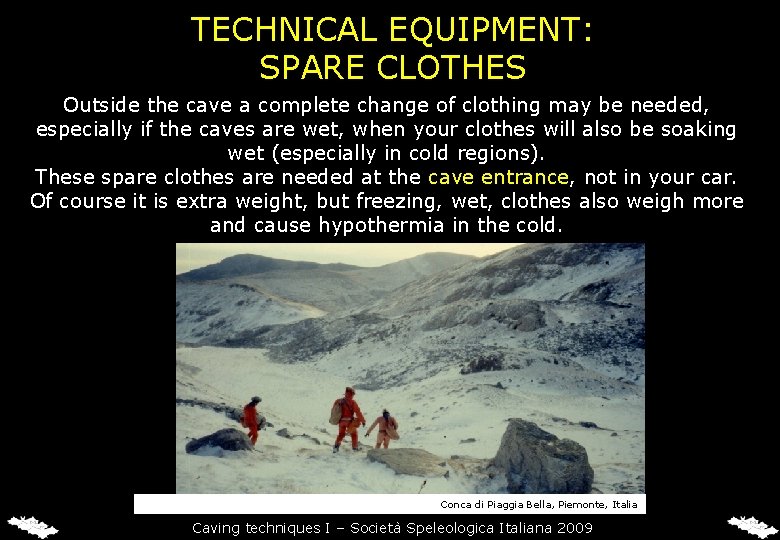
TECHNICAL EQUIPMENT: SPARE CLOTHES Outside the cave a complete change of clothing may be needed, especially if the caves are wet, when your clothes will also be soaking wet (especially in cold regions). These spare clothes are needed at the cave entrance, not in your car. Of course it is extra weight, but freezing, wet, clothes also weigh more and cause hypothermia in the cold. Conca di Piaggia Bella, Piemonte, Italia Caving techniques I – Società Speleologica Italiana 2009
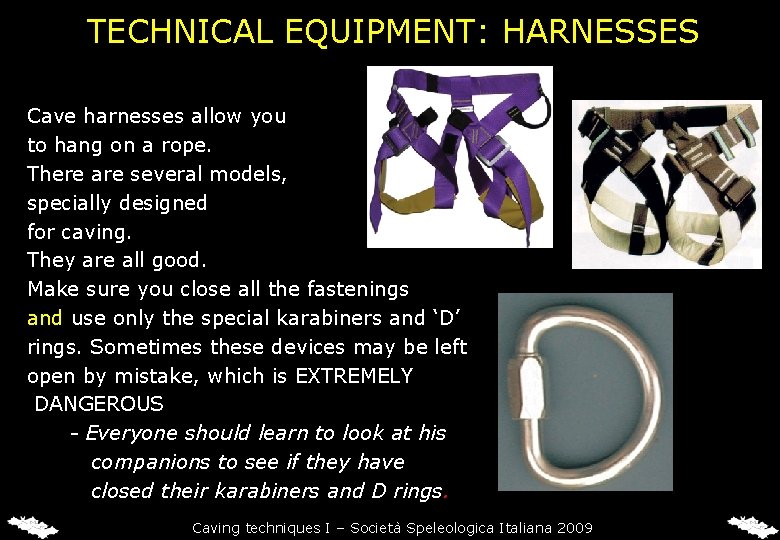
TECHNICAL EQUIPMENT: HARNESSES Cave harnesses allow you to hang on a rope. There are several models, specially designed for caving. They are all good. Make sure you close all the fastenings and use only the special karabiners and ‘D’ rings. Sometimes these devices may be left open by mistake, which is EXTREMELY DANGEROUS - Everyone should learn to look at his companions to see if they have closed their karabiners and D rings. Caving techniques I – Società Speleologica Italiana 2009
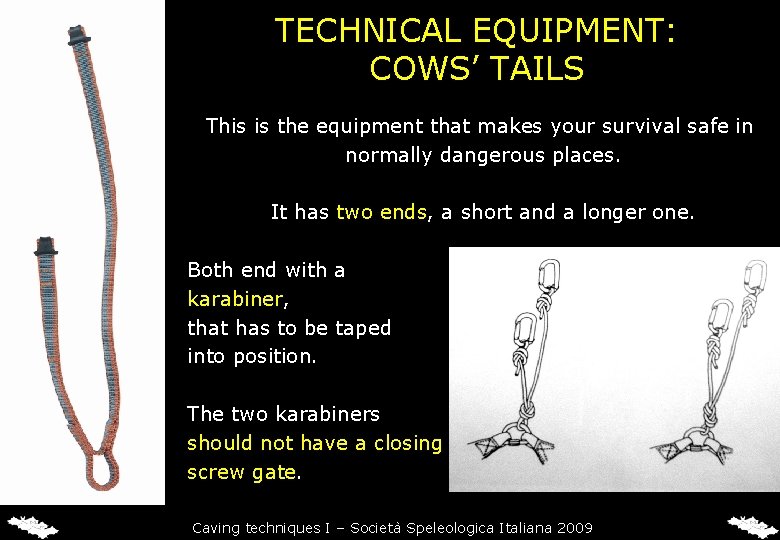
TECHNICAL EQUIPMENT: COWS’ TAILS This is the equipment that makes your survival safe in normally dangerous places. It has two ends, a short and a longer one. Both end with a karabiner, that has to be taped into position. The two karabiners should not have a closing screw gate. Caving techniques I – Società Speleologica Italiana 2009
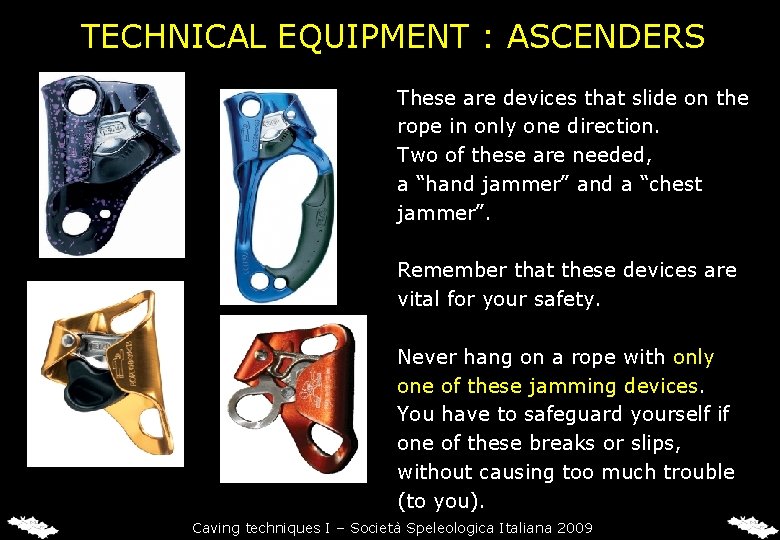
TECHNICAL EQUIPMENT : ASCENDERS These are devices that slide on the rope in only one direction. Two of these are needed, a “hand jammer” and a “chest jammer”. Remember that these devices are vital for your safety. Never hang on a rope with only one of these jamming devices. You have to safeguard yourself if one of these breaks or slips, without causing too much trouble (to you). Caving techniques I – Società Speleologica Italiana 2009
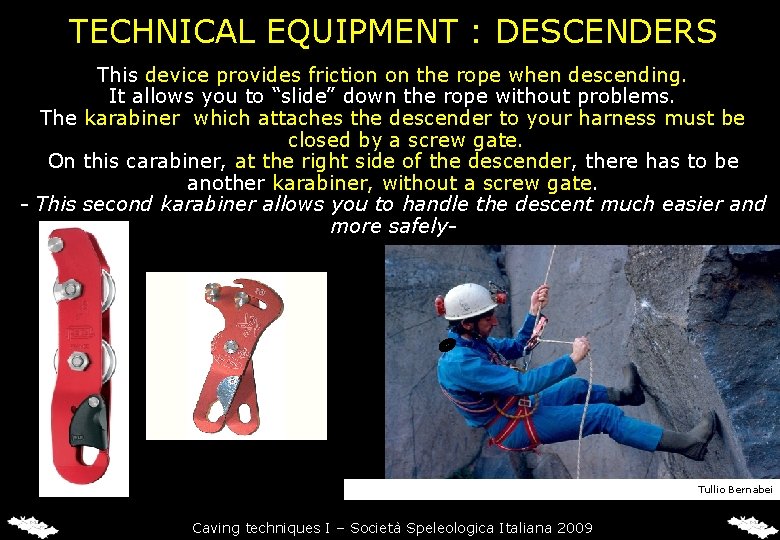
TECHNICAL EQUIPMENT : DESCENDERS This device provides friction on the rope when descending. It allows you to “slide” down the rope without problems. The karabiner which attaches the descender to your harness must be closed by a screw gate. On this carabiner, at the right side of the descender, there has to be another karabiner, without a screw gate. - This second karabiner allows you to handle the descent much easier and more safely- Tullio Bernabei Caving techniques I – Società Speleologica Italiana 2009
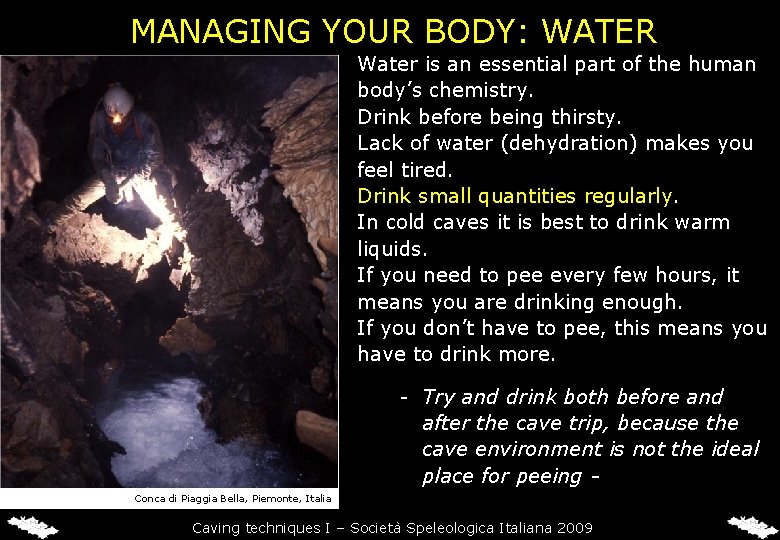
MANAGING YOUR BODY: WATER Water is an essential part of the human body’s chemistry. Drink before being thirsty. Lack of water (dehydration) makes you feel tired. Drink small quantities regularly. In cold caves it is best to drink warm liquids. If you need to pee every few hours, it means you are drinking enough. If you don’t have to pee, this means you have to drink more. - Try and drink both before and after the cave trip, because the cave environment is not the ideal place for peeing Conca di Piaggia Bella, Piemonte, Italia Caving techniques I – Società Speleologica Italiana 2009
DY MANAGING YOUR BODY: FOOD Food means fuel. Its digestion is a rather hard task, because it interferes with your movement. It is best is to eat food that is easy to digest. Do you want food full of energy? Why? Eat food slowly, similar to your movement in the cave, and eat small quantities, divided into several snacks. After each food stop, don’t move on immediately, give your body the time to digest it. Caving techniques I – Società Speleologica Italiana 2009
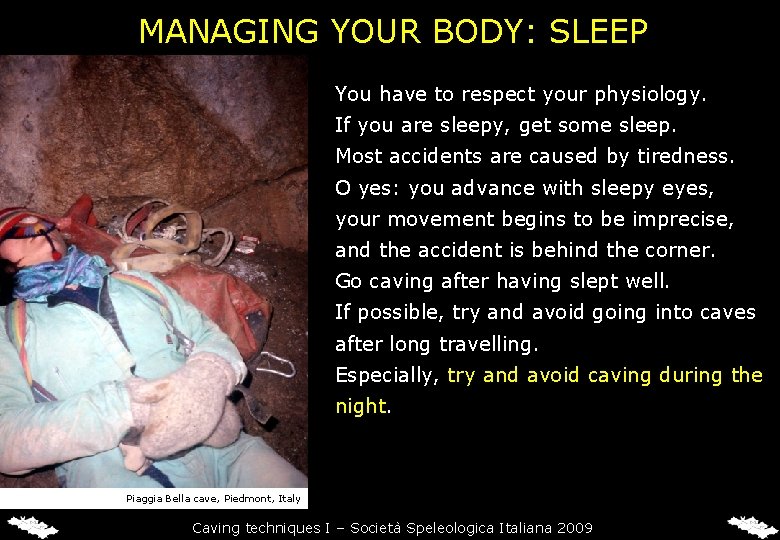
MANAGING YOUR BODY: SLEEP You have to respect your physiology. If you are sleepy, get some sleep. Most accidents are caused by tiredness. O yes: you advance with sleepy eyes, your movement begins to be imprecise, and the accident is behind the corner. Go caving after having slept well. If possible, try and avoid going into caves after long travelling. Especially, try and avoid caving during the night. Piaggia Bella cave, Piedmont, Italy Caving techniques I – Società Speleologica Italiana 2009
MANAGING YOUR BODY: STIMULANTS Going caving requires a certain dose of lucidity. Caves can harm you, and harm you badly. Try and avoid alterations of consciousness. Try and enter caves without being “high”. Underground your body will undergo a series of difficult moments, try and avoid creating other problems. You can drink after your caving trip, celebrating your new cave experiences. Caving techniques I – Società Speleologica Italiana 2009
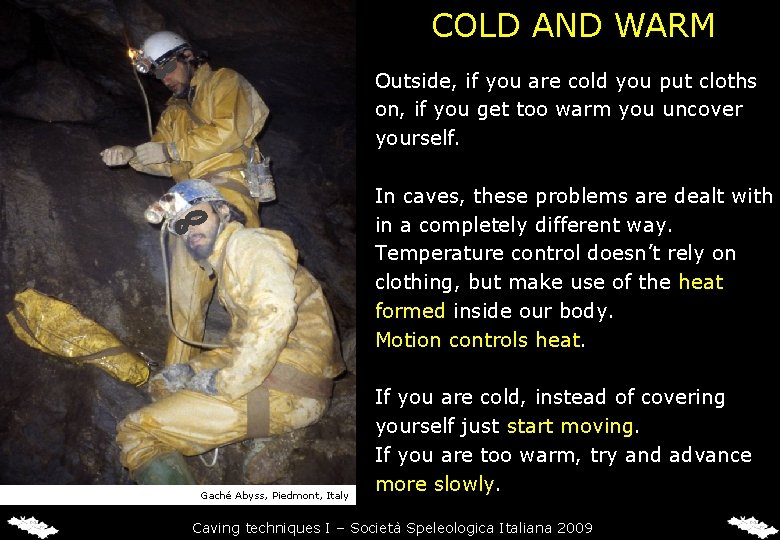
COLD AND WARM Outside, if you are cold you put cloths on, if you get too warm you uncover yourself. In caves, these problems are dealt with in a completely different way. Temperature control doesn’t rely on clothing, but make use of the heat formed inside our body. Motion controls heat. Gaché Abyss, Piedmont, Italy If you are cold, instead of covering yourself just start moving. If you are too warm, try and advance more slowly. Caving techniques I – Società Speleologica Italiana 2009
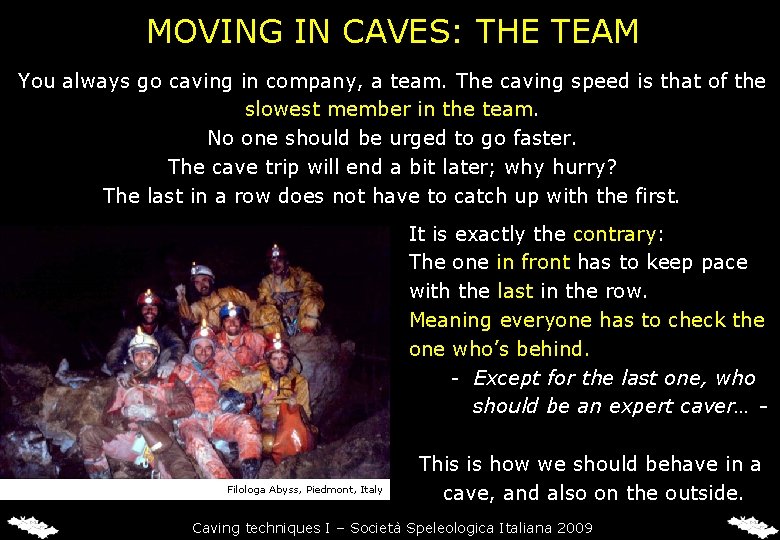
MOVING IN CAVES: THE TEAM You always go caving in company, a team. The caving speed is that of the slowest member in the team. No one should be urged to go faster. The cave trip will end a bit later; why hurry? The last in a row does not have to catch up with the first. It is exactly the contrary: The one in front has to keep pace with the last in the row. Meaning everyone has to check the one who’s behind. - Except for the last one, who should be an expert caver… - Filologa Abyss, Piedmont, Italy This is how we should behave in a cave, and also on the outside. Caving techniques I – Società Speleologica Italiana 2009
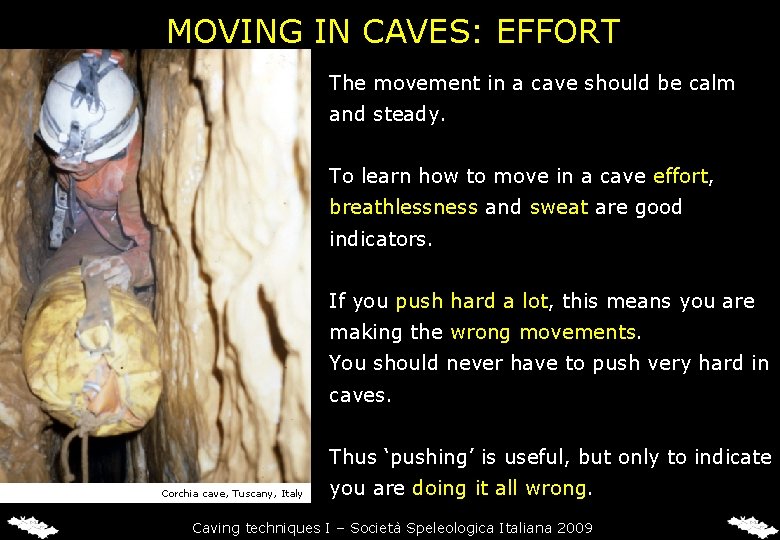
MOVING IN CAVES: EFFORT The movement in a cave should be calm and steady. To learn how to move in a cave effort, breathlessness and sweat are good indicators. If you push hard a lot, this means you are making the wrong movements. You should never have to push very hard in caves. Thus ‘pushing’ is useful, but only to indicate Corchia cave, Tuscany, Italy you are doing it all wrong. Caving techniques I – Società Speleologica Italiana 2009
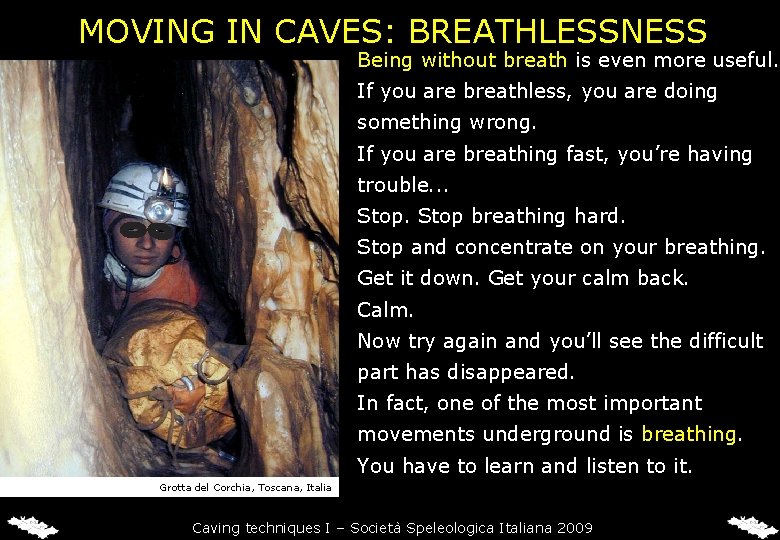
MOVING IN CAVES: BREATHLESSNESS Being without breath is even more useful. If you are breathless, you are doing something wrong. If you are breathing fast, you’re having trouble. . . Stop breathing hard. Stop and concentrate on your breathing. Get it down. Get your calm back. Calm. Now try again and you’ll see the difficult part has disappeared. In fact, one of the most important movements underground is breathing. You have to learn and listen to it. Grotta del Corchia, Toscana, Italia Caving techniques I – Società Speleologica Italiana 2009
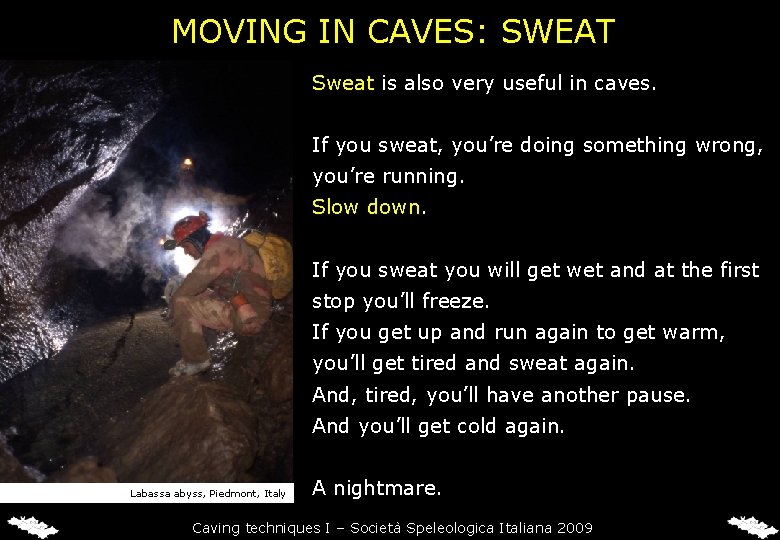
MOVING IN CAVES: SWEAT Sweat is also very useful in caves. If you sweat, you’re doing something wrong, you’re running. Slow down. If you sweat you will get wet and at the first stop you’ll freeze. If you get up and run again to get warm, you’ll get tired and sweat again. And, tired, you’ll have another pause. And you’ll get cold again. Labassa abyss, Piedmont, Italy A nightmare. Caving techniques I – Società Speleologica Italiana 2009
MOVING IN CAVES: SUPPORTS Touch the rock only with hands and feet. - The rock often is very cold, and friction makes you waste a lot of energy especially. Using the four points, the body advances, winding through the void in the rock. Every limb advances in search of a new support while the other three remain on their own supports. Once your hand or foot is placed and you feel the support will bear the weight, you can move another limb. And do this operation over and over again, thousands of times. Remember that the forward push has to come from the legs. The arms are used only to keep the body in the correct position. Caving techniques I – Società Speleologica Italiana 2009
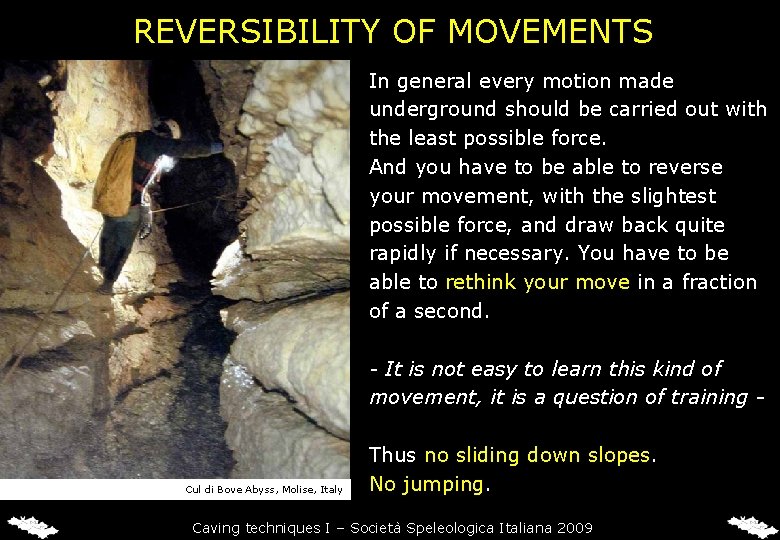
REVERSIBILITY OF MOVEMENTS In general every motion made underground should be carried out with the least possible force. And you have to be able to reverse your movement, with the slightest possible force, and draw back quite rapidly if necessary. You have to be able to rethink your move in a fraction of a second. - It is not easy to learn this kind of movement, it is a question of training - Cul di Bove Abyss, Molise, Italy Thus no sliding down slopes. No jumping. Caving techniques I – Società Speleologica Italiana 2009
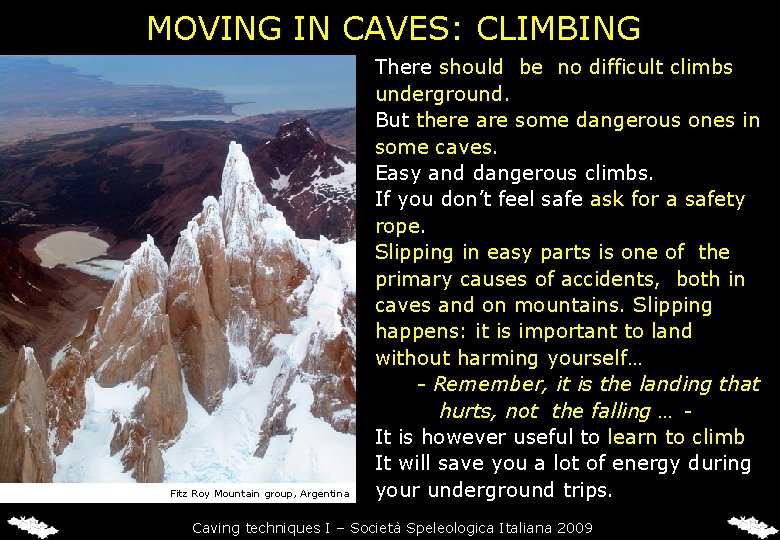
MOVING IN CAVES: CLIMBING Fitz Roy Mountain group, Argentina There should be no difficult climbs underground. But there are some dangerous ones in some caves. Easy and dangerous climbs. If you don’t feel safe ask for a safety rope. Slipping in easy parts is one of the primary causes of accidents, both in caves and on mountains. Slipping happens: it is important to land without harming yourself… - Remember, it is the landing that hurts, not the falling … It is however useful to learn to climb It will save you a lot of energy during your underground trips. Caving techniques I – Società Speleologica Italiana 2009
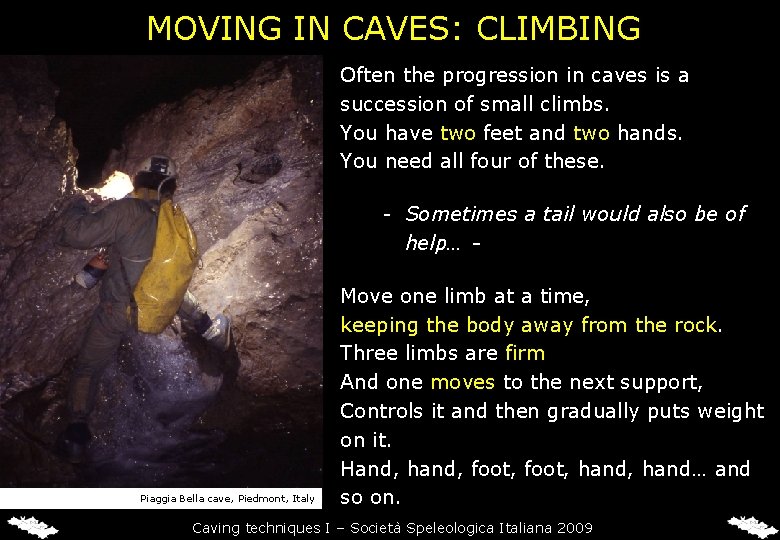
MOVING IN CAVES: CLIMBING Often the progression in caves is a succession of small climbs. You have two feet and two hands. You need all four of these. - Sometimes a tail would also be of help… - Piaggia Bella cave, Piedmont, Italy Move one limb at a time, keeping the body away from the rock. Three limbs are firm And one moves to the next support, Controls it and then gradually puts weight on it. Hand, hand, foot, hand… and so on. Caving techniques I – Società Speleologica Italiana 2009
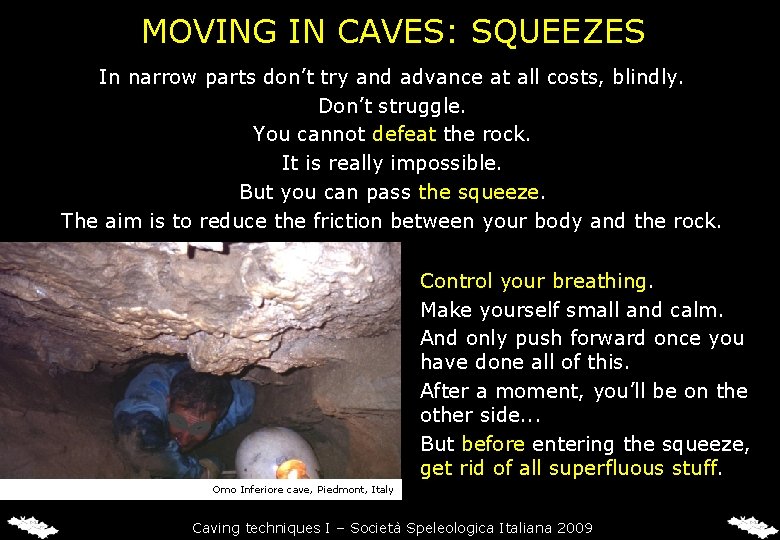
MOVING IN CAVES: SQUEEZES In narrow parts don’t try and advance at all costs, blindly. Don’t struggle. You cannot defeat the rock. It is really impossible. But you can pass the squeeze. The aim is to reduce the friction between your body and the rock. Control your breathing. Make yourself small and calm. And only push forward once you have done all of this. After a moment, you’ll be on the other side. . . But before entering the squeeze, get rid of all superfluous stuff. Omo Inferiore cave, Piedmont, Italy Caving techniques I – Società Speleologica Italiana 2009
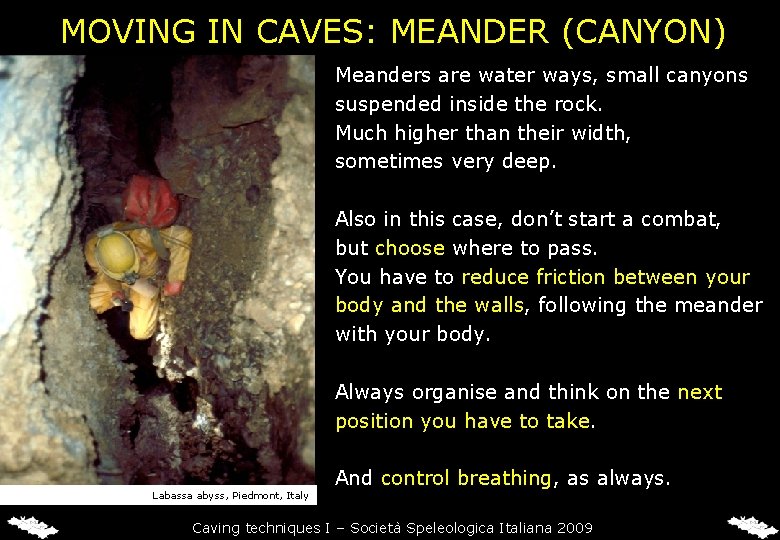
MOVING IN CAVES: MEANDER (CANYON) Meanders are water ways, small canyons suspended inside the rock. Much higher than their width, sometimes very deep. Also in this case, don’t start a combat, but choose where to pass. You have to reduce friction between your body and the walls, following the meander with your body. Always organise and think on the next position you have to take. Labassa abyss, Piedmont, Italy And control breathing, as always. Caving techniques I – Società Speleologica Italiana 2009
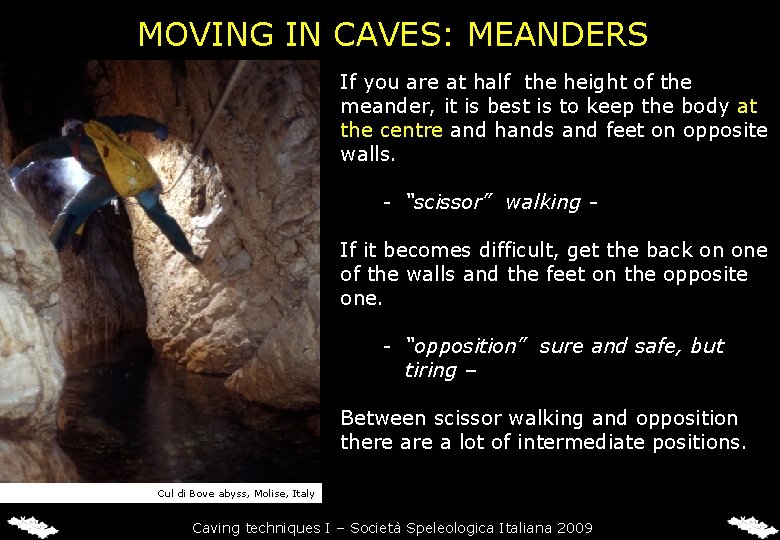
MOVING IN CAVES: MEANDERS If you are at half the height of the meander, it is best is to keep the body at the centre and hands and feet on opposite walls. - “scissor” walking If it becomes difficult, get the back on one of the walls and the feet on the opposite one. - “opposition” sure and safe, but tiring – Between scissor walking and opposition there a lot of intermediate positions. Cul di Bove abyss, Molise, Italy Caving techniques I – Società Speleologica Italiana 2009
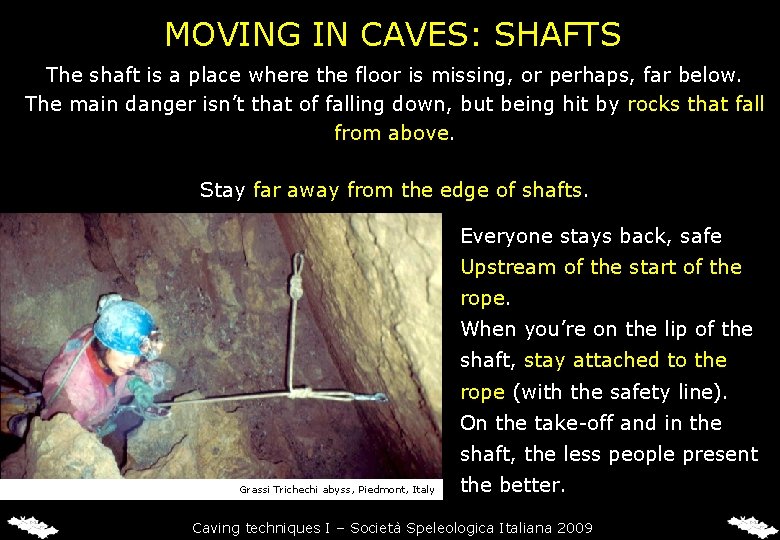
MOVING IN CAVES: SHAFTS The shaft is a place where the floor is missing, or perhaps, far below. The main danger isn’t that of falling down, but being hit by rocks that fall from above. Stay far away from the edge of shafts. Everyone stays back, safe Upstream of the start of the rope. When you’re on the lip of the shaft, stay attached to the rope (with the safety line). On the take-off and in the shaft, the less people present Grassi Trichechi abyss, Piedmont, Italy the better. Caving techniques I – Società Speleologica Italiana 2009
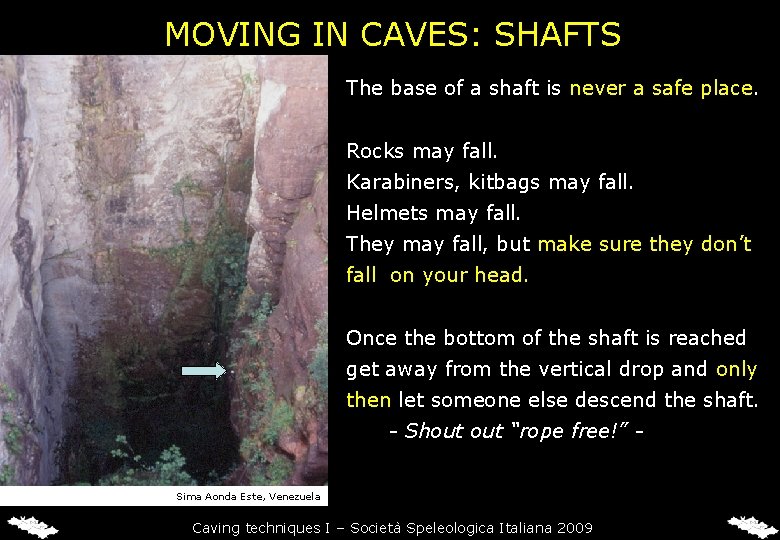
MOVING IN CAVES: SHAFTS The base of a shaft is never a safe place. Rocks may fall. Karabiners, kitbags may fall. Helmets may fall. They may fall, but make sure they don’t fall on your head. Once the bottom of the shaft is reached get away from the vertical drop and only then let someone else descend the shaft. - Shout “rope free!” Sima Aonda Este, Venezuela Caving techniques I – Società Speleologica Italiana 2009
MOVING IN CAVES: GENERAL Caves are often big and with an environment that is not suitable to us. It’s good to learn to go through them efficiently. This means, in general, without wasting time. Wasting time doesn’t mean wanting to do everything scrupulously, but don’t decide to be scrupulous at the wrong moment, letting everyone wait. Wasting time does not mean walking slowly and steadily, but don’t walk fast for short times and then make long pauses to gain back your energy. Wasting time does not mean rest, but never rest and then collapse. It does not mean talking with your companions, but don’t decide to talk when it is time to move. Caving techniques I – Società Speleologica Italiana 2009
MOVING IN CAVES: GENERAL Every time you are doing something, ask yourself if this will cause delay to the entire team. If it does not cause delay, do it calmly: it’s the best situation to do things, together with other activities. If it causes delay, keep calm the same, but try and do it quickly. «Festina lente» , said Svetonio. Hurry up slowly. The forced pauses are very frequent, learn to make use of them. Observe details of the cave, clean your equipment, learn to sing, listen to stories, learn knots, ask for explanations, reorder material, Prepare a tea, eat something… You’ll see that in caves most of the time goes by waiting; It is stupid to waste this time, this is time of your life that will never be given back. Waiting, you can learn. Caving techniques I – Società Speleologica Italiana 2009
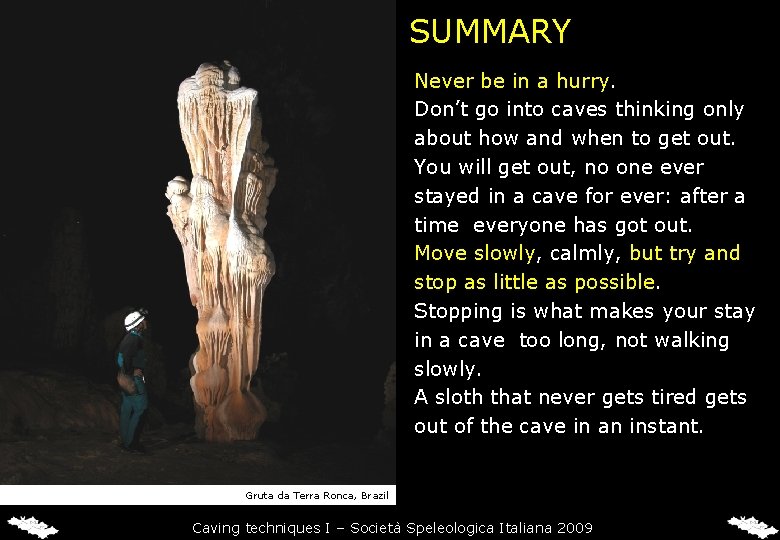
SUMMARY Never be in a hurry. Don’t go into caves thinking only about how and when to get out. You will get out, no one ever stayed in a cave for ever: after a time everyone has got out. Move slowly, calmly, but try and stop as little as possible. Stopping is what makes your stay in a cave too long, not walking slowly. A sloth that never gets tired gets out of the cave in an instant. Gruta da Terra Ronca, Brazil Caving techniques I – Società Speleologica Italiana 2009
INSIDE AND OUTSIDE Caves are dangerous? Certainly yes, they are savage and inhuman, and this can create a lot of difficulty. But if you look around, you’ll see that many of the things that you ought too learn to go caving are also useful outside, under the sunlight. Control oneself, breath correctly, move calmly, pace oneself, choose the right time to do things, study seriously. Caves are dangerous, true, but if you learn how to deal with them the outside world will become much safer for you. And with time passing you will realise that both worlds are strictly related to each other, much more than you thought earlier. A voyage of 1000 miles starts with a first step. Caving techniques I – Società Speleologica Italiana 2009
TO KNOW MORE AA. VV. (2004), Vita da Speleo, Segnavia Edizioni, Sassari, pp. 120; AA. VV. (2005), Schegge di Luce, AGSP, pp. 192; ARDITO F. (1999), Di Pietra e Acqua, Vivalda, Torino, pp. 166; BADINO G. (2006), Un Color Bruno, Segnavia Edizioni, Sassari, pp. 127; BADINO G. (1999), Il Fondo di Piaggia Bella, Erga Edizioni, Genova, pp. 303; BADINO G. (1996), Tecniche di Grotta, Erga Edizioni, pp. 207; GOBETTI A. (2001), Una Frontiera da Immaginare, CDA Vivalda, Torino, pp. 206; LAMBERT F. (1970), La Guerre des gouffres, Bompiani, Robert Laffont, Paris, pp. 276; SAURO F. (2007), L’Abisso, CDA Vivalda, Torino, pp. 262. Caving techniques I – Società Speleologica Italiana 2009
CREDITS This lecture has been prepared by Giovanni Badino. Translation to English by Jo De Waele and Trevor Faulkner. Photographs were provided by Giovanni Badino, Tullio Bernabei, Jo De Waele, Repetto. Sport e Ferrino Sp. A. © Società Speleologica Italiana Any part of this presentation may be reproduced at your own responsibility, as long as the contents remain unaltered. If reproducing the presentation (or parts of it) you should acknowledge this project as the source of the information. Caving techniques I – Società Speleologica Italiana 2009