
Teaching Research Skills Using the Internet Presented to
- Slides: 27
Teaching Research Skills Using the Internet Presented to the Illinois School Library Media Association Annual Conference October 2005 1/7/2022 © 2005 Illinois Mathematics and Science Academy 1
Agenda • What’s New • What’s Coming • Overview (For Newbies) 1/7/2022 © 2005 Illinois Mathematics and Science Academy 2
Try Googling Information Fluency 1/7/2022 © 2005 Illinois Mathematics and Science Academy 3
What’s New? (Since Last Year) • Chris Balsano’s Building Digital Information Fluency Skills into School Workshop • We can now come to your school and conduct workshops for your staff • Digital Information Fluency Core Concepts • Website Redesign • Updated Wizard Search Tool • Search Challenges 1/7/2022 © 2005 Illinois Mathematics and Science Academy 4
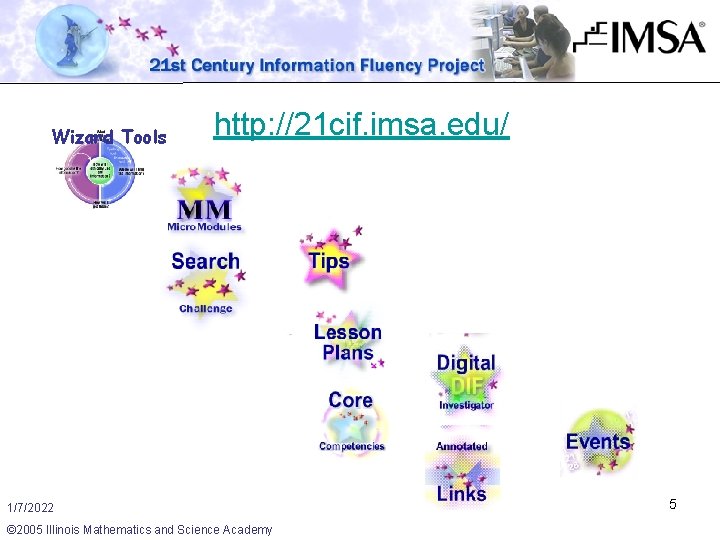
Wizard Tools http: //21 cif. imsa. edu/ 1/7/2022 © 2005 Illinois Mathematics and Science Academy 5
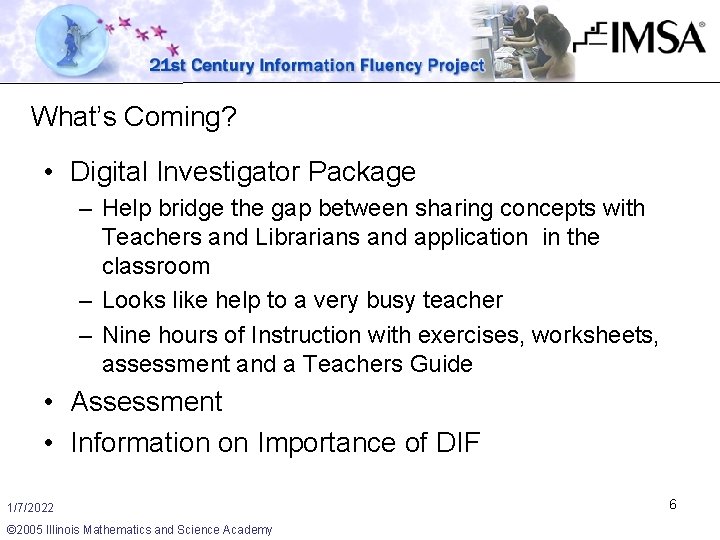
What’s Coming? • Digital Investigator Package – Help bridge the gap between sharing concepts with Teachers and Librarians and application in the classroom – Looks like help to a very busy teacher – Nine hours of Instruction with exercises, worksheets, assessment and a Teachers Guide • Assessment • Information on Importance of DIF 1/7/2022 © 2005 Illinois Mathematics and Science Academy 6
Assessment • Upgrades to the Micro Modules • Internet Basic Assessment • DIF Assessment Questions 1/7/2022 © 2005 Illinois Mathematics and Science Academy 7
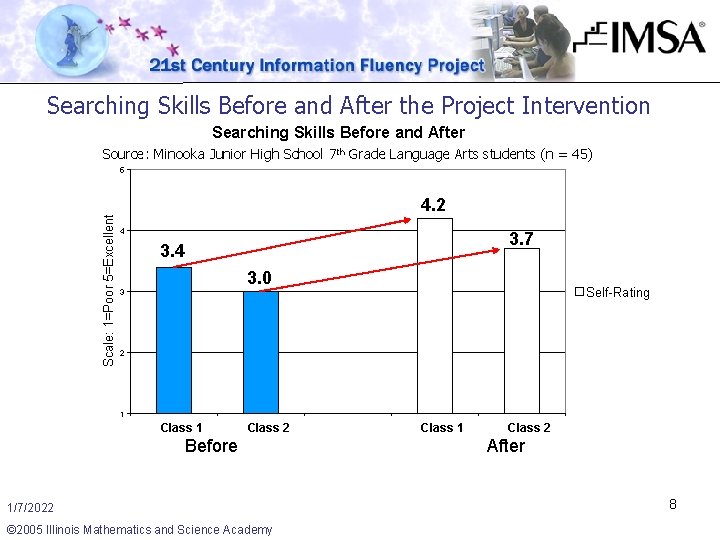
Searching Skills Before and After the Project Intervention Searching Skills Before and After Source: Minooka Junior High School 7 th Grade Language Arts students (n = 45) Scale: 1=Poor 5=Excellent 5 4. 2 4 3. 7 3. 4 3. 0 3 Self-Rating 2 1 Class 2 Before Class 1 Class 2 After 19% average improvement for both classes 1/7/2022 © 2005 Illinois Mathematics and Science Academy 8
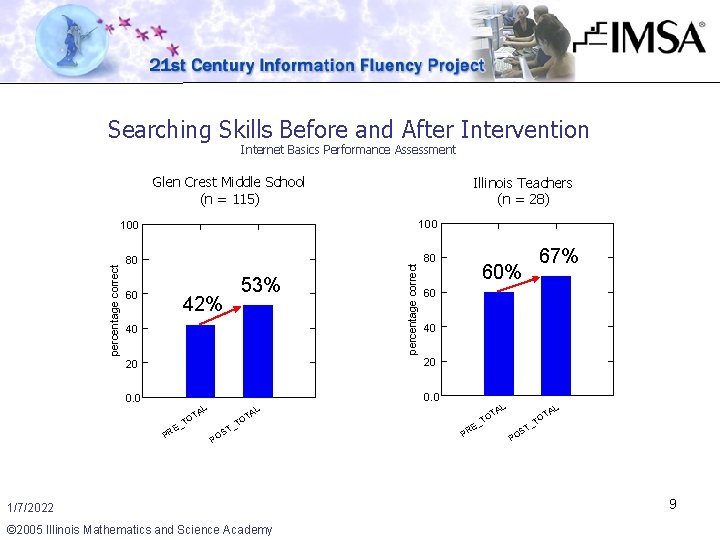
Searching Skills Before and After Intervention Internet Basics Performance Assessment Illinois Teachers (n = 28) 100 80 80 60 53% 42% 40 percentage correct Glen Crest Middle School (n = 115) 67% 60 40 20 20 0. 0 AL AL TO E_ PR L TA T TO _ ST PO AL OT _T E PR T TO _ ST PO 20% average student 11% average teacher improvement 1/7/2022 © 2005 Illinois Mathematics and Science Academy 9
Importance of Digital Information Fluency • Research Materials to underscore the need to invest in DIF • These charts were shared in Dr Carl Heine’s presentation at the Illinois Principal’s Conference October 17 1/7/2022 © 2005 Illinois Mathematics and Science Academy 10
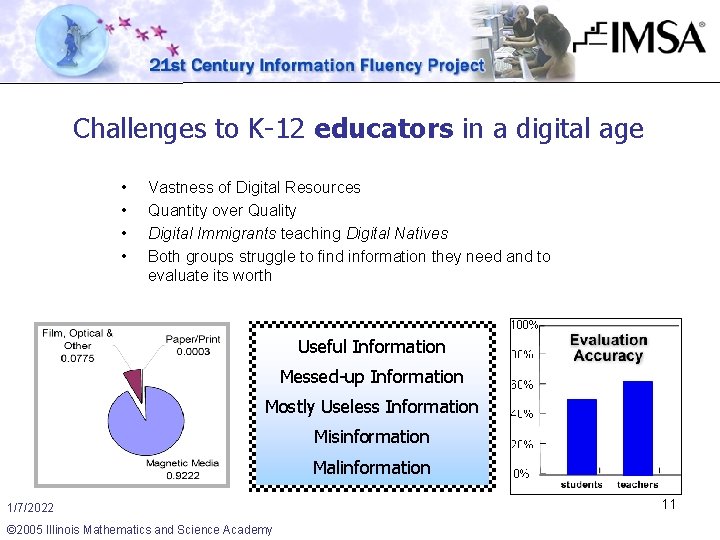
Challenges to K-12 educators in a digital age • • Vastness of Digital Resources Quantity over Quality Digital Immigrants teaching Digital Natives Both groups struggle to find information they need and to evaluate its worth Useful Information Messed-up Information Mostly Useless Information Misinformation Malinformation 1/7/2022 © 2005 Illinois Mathematics and Science Academy 11
“The traditional role of the teacher as the ‘fountain of knowledge’ must be reconsidered as massive amounts of information are readily accessible over the Internet…. With the continued emergence of new technologies, learning will be less about knowledge residing in the head and more about learning the pathways to knowledge in a digital age 1/7/2022 © 2005 Illinois Mathematics and Science Academy 12
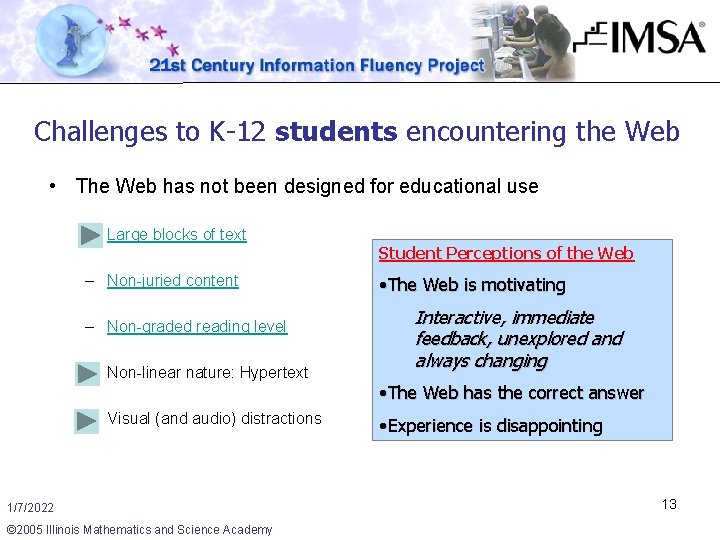
Challenges to K-12 students encountering the Web • The Web has not been designed for educational use – Large blocks of text – Non-juried content – Non-graded reading level – Non-linear nature: Hypertext – Visual (and audio) distractions 1/7/2022 © 2005 Illinois Mathematics and Science Academy Student Perceptions of the Web • The Web is motivating Interactive, immediate feedback, unexplored and always changing • The Web has the correct answer • Experience is disappointing 13
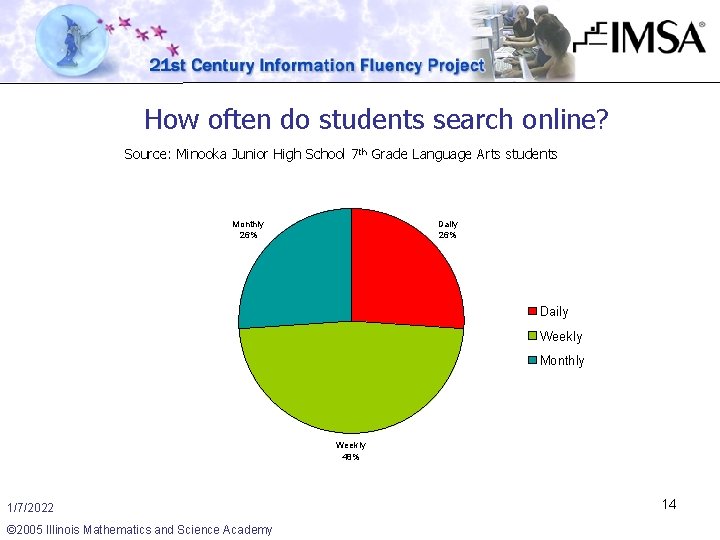
How often do students search online? Source: Minooka Junior High School 7 th Grade Language Arts students Monthly 26% Daily Weekly Monthly Weekly 48% 1/7/2022 © 2005 Illinois Mathematics and Science Academy 14
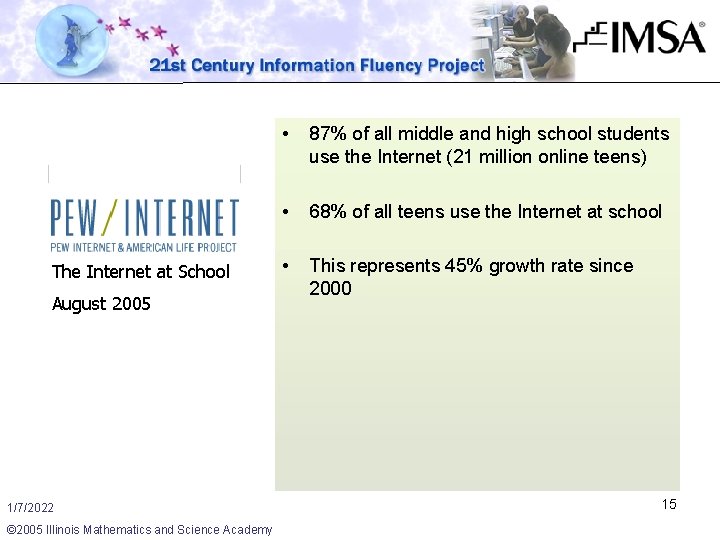
The Internet at School August 2005 1/7/2022 © 2005 Illinois Mathematics and Science Academy • 87% of all middle and high school students use the Internet (21 million online teens) • 68% of all teens use the Internet at school • This represents 45% growth rate since 2000 15
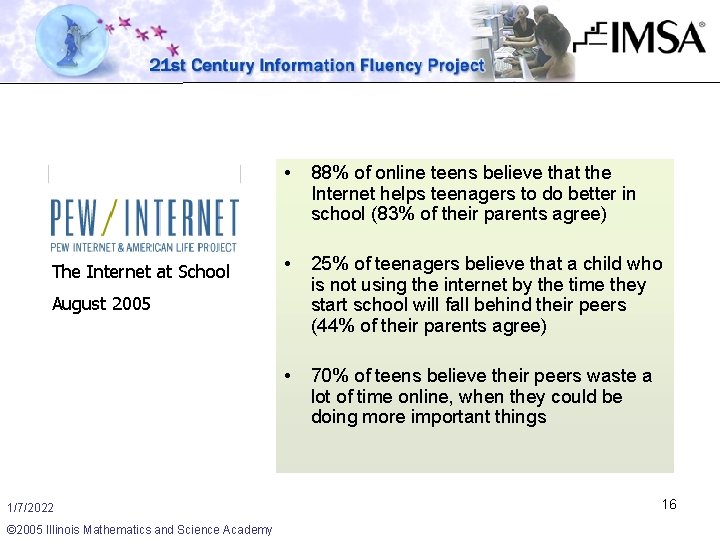
The Internet at School • 88% of online teens believe that the Internet helps teenagers to do better in school (83% of their parents agree) • 25% of teenagers believe that a child who is not using the internet by the time they start school will fall behind their peers (44% of their parents agree) • 70% of teens believe their peers waste a lot of time online, when they could be doing more important things August 2005 1/7/2022 © 2005 Illinois Mathematics and Science Academy 16
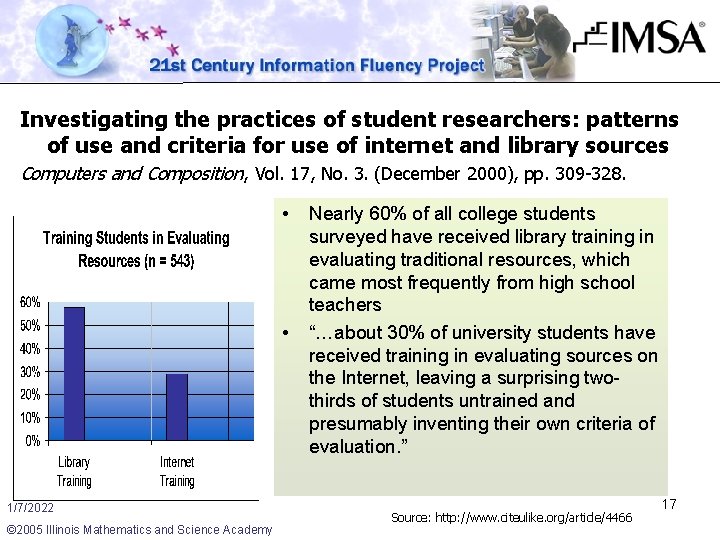
Investigating the practices of student researchers: patterns of use and criteria for use of internet and library sources Computers and Composition, Vol. 17, No. 3. (December 2000), pp. 309 -328. • Evaluating information on the Web: • How have college students learned to evaluate Internet information? 1/7/2022 © 2005 Illinois Mathematics and Science Academy Nearly 60% of all college students surveyed have received library training in evaluating traditional resources, which came most frequently from high school teachers “…about 30% of university students have received training in evaluating sources on the Internet, leaving a surprising twothirds of students untrained and presumably inventing their own criteria of evaluation. ” Source: http: //www. citeulike. org/article/4466 17
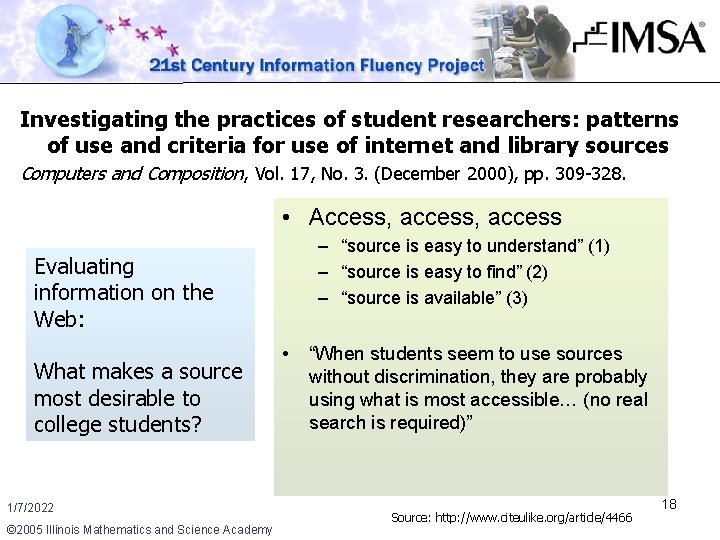
Investigating the practices of student researchers: patterns of use and criteria for use of internet and library sources Computers and Composition, Vol. 17, No. 3. (December 2000), pp. 309 -328. • Access, access – “source is easy to understand” (1) – “source is easy to find” (2) – “source is available” (3) Evaluating information on the Web: What makes a source most desirable to college students? 1/7/2022 © 2005 Illinois Mathematics and Science Academy • “When students seem to use sources without discrimination, they are probably using what is most accessible… (no real search is required)” Source: http: //www. citeulike. org/article/4466 18
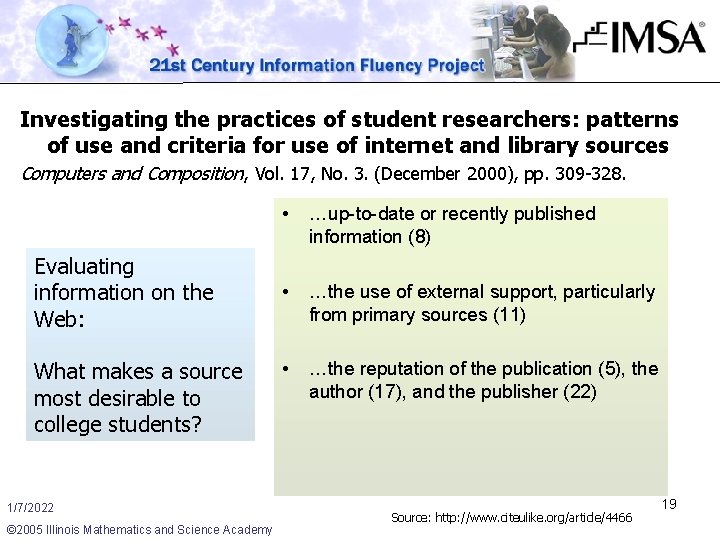
Investigating the practices of student researchers: patterns of use and criteria for use of internet and library sources Computers and Composition, Vol. 17, No. 3. (December 2000), pp. 309 -328. Evaluating information on the Web: What makes a source most desirable to college students? 1/7/2022 © 2005 Illinois Mathematics and Science Academy • …up-to-date or recently published information (8) • …the use of external support, particularly from primary sources (11) • …the reputation of the publication (5), the author (17), and the publisher (22) Source: http: //www. citeulike. org/article/4466 19
Numerous opportunities to help K-12 digital natives • • The level of technical skills says nothing about the ability to process information into meaningful knowledge Students prefer to browse intuitively rather than search systematically using keywords – Vague or ill-defined tasks are more suitable for browsing – Ill-defined tasks have more potential answers and are easier to answer Students search for the “right answer” rather than deduce an answer for themselves from several information sources (i. e. , they don’t use the Web for inquiry) Without help, students lack skills and patience to search for precise concrete information; they tend to accept information uncritically 1/7/2022 © 2005 Illinois Mathematics and Science Academy 20
“In the five years that I have worked in this district, I have noticed each year that students are more and more familiar with the Internet and completely at-ease in searching. Despite this, they are not savvy when it comes to actually finding what they are searching for. They often search aimlessly or give up and just print pages and pages hoping that somewhere in all that information, they will find what they are seeking. Too often, teachers assume that their students know how to find just the right information, even though the teacher has not spent time instructing the students in appropriately using the internet. I have realized that many times the teachers themselves do not really know how to be an effective searcher. The teachers need someone who can either give them the skills or give them a tool to give their students the skills. ” 1/7/2022 © 2005 Illinois Mathematics and Science Academy 21
“I’ve noticed that middle school students tend to believe just about anything they read or hear. They don’t know how to evaluate the credibility of any source, and instruction is necessary to make them not only better writers but also better citizens and consumers. ” 1/7/2022 © 2005 Illinois Mathematics and Science Academy 22
“I worked with all my (8 th grade) classes the past three years doing projects requiring the use of information on the Internet. I found that most of them enjoyed accessing information on the Internet. Since our class periods were only 40 minutes long each day and we had limited access to the computers, I had to use hot-lists of sources that I found to be appropriate, reliable and directly related to the problem. There were some students who were quite Internet savvy, and were capable of searching at home and finding additional resources which I could then evaluate and add to the list. I think that all students need guided access to the Internet and training on how to be more effective searchers, evaluators and documenters of the resources on the internet. ” 1/7/2022 © 2005 Illinois Mathematics and Science Academy 23
“At the freshmen level students are introduced to the library in a 30 minute orientation. As sophomores they are shown the various databases that are available to them through the Library Resources page located on [our school’s] website. Junior level simply builds on those skills. By the time that I have them in class as seniors, they have become complacent and rely heavily on the Galenet subscription databases that are provided for them. Although these are wonderful sources, it is a concern that when students leave [our school] they will not know how to find and evaluate reliable sources. ” 1/7/2022 © 2005 Illinois Mathematics and Science Academy 24
“The traditional role of the teacher as the ‘fountain of knowledge’ must be reconsidered as massive amounts of information are readily accessible over the Internet…. With the continued emergence of new technologies, learning will be less about knowledge residing in the head and more about learning the pathways to knowledge. ” J. D. Frechette (2002) Developing media literacy in cyberspace: Pedagogy and critical learning for the twenty-first-century classroom. p. xvii 1/7/2022 © 2005 Illinois Mathematics and Science Academy 25
How we can help: Free Workshops and Webinars • Building Digital Information Fluency Skills into Schools (full day) • Power Searching (one hour, half day, full day) Free Courses • 6 week Survey Course • 12 week Lab Course (3 graduate credits) Free Curriculum and Tools • DIF Investigator, Micro. Modules, Search Challenges • Assessment • Lesson Plan Repository • Tools: Search Wizard, Evaluation Wizard, Citation Wizard 1/7/2022 © 2005 Illinois Mathematics and Science Academy 26
Contact Us! URL http: //21 cif. imsa. edu General info 21 cif@imsa. edu Dan Balzer dbalzer@imsa. edu Carl Heine heine@imsa. edu Bob Houston rhouston@imsa. edu Dennis O’Connor doconnor@imsa. edu Gautam Saha gsaha@imsa. edu It’s all free – your tax dollars at work for you! 1/7/2022 © 2005 Illinois Mathematics and Science Academy 27