
Teaching Research Methods How to make it meaningful

- Slides: 29
Teaching Research Methods: How to make it meaningful for social work students Mary E. Rauktis, Ph. D. & Catherine G. Greeno Ph. D. ; EASSW Conference 2019 June 4 th to June 7 th 2019, Madrid University of Pittsburgh School of Social Work
Social Work Education in the United States • BSW; MSW; Ph. D. ; and DSW • BSW is a 4 year program; MSW is a 2 year program • Schools of social work are in Universities • MSW education is considered a “professional degree”, usually without a thesis • Field placement • Individuals with MSW work in a variety of settings doing different types of practice (therapy; community organizing; administration of NGOs and research).
Social Work Education in the United States A Social Work program is designed to prepare students for competent social work practice as defined by the Council on Social Work Education’s Educational Policy Accreditation Standards (EPAS). Educational Policy 2. 1. 6—Engage in research- informed practice and practice-informed research. Social workers use practice experience to inform research, employ evidence-based interventions, evaluate their own practice, and use research findings to improve practice, policy, and social service delivery. Social workers comprehend quantitative and qualitative research and understand scientific and ethical approaches to building knowledge.
Social Work Education in the United States • Social work practice should be based upon evidence • In order to make decisions about the evidence, social workers should understand the basics of research 5. 02 Evaluation and Research NASW Code of Ethics (a) Social workers should monitor and evaluate policies, the implementation of programs, and practice interventions. (b) Social workers should promote and facilitate evaluation and research to contribute to the development of knowledge. (c) Social workers should critically examine and keep current with emerging knowledge relevant to social work and fully use evaluation and research evidence in their professional practice. (d) Social workers engaged in evaluation or research should carefully consider possible consequences and should follow guidelines developed for the protection of evaluation and research participants. Appropriate institutional review boards should be consulted.
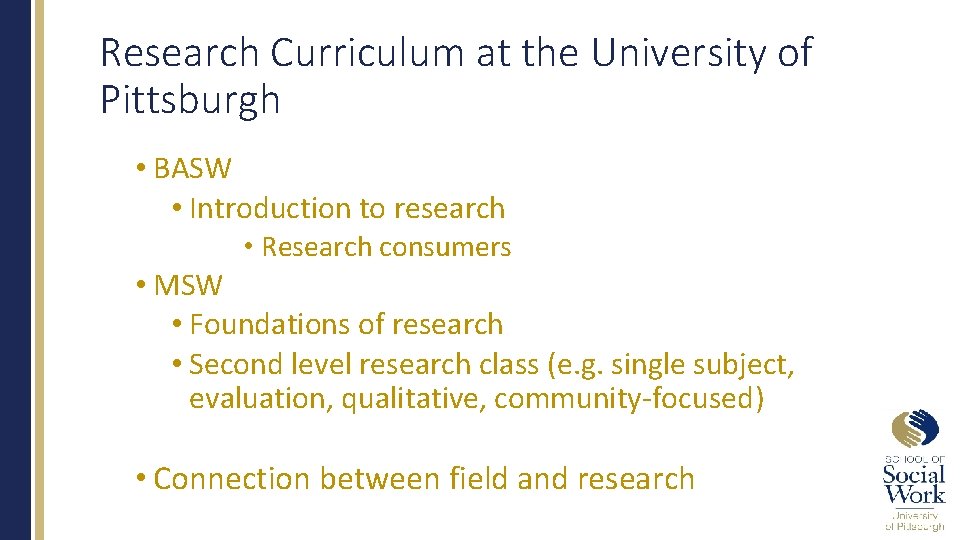
Research Curriculum at the University of Pittsburgh • BASW • Introduction to research • Research consumers • MSW • Foundations of research • Second level research class (e. g. single subject, evaluation, qualitative, community-focused) • Connection between field and research
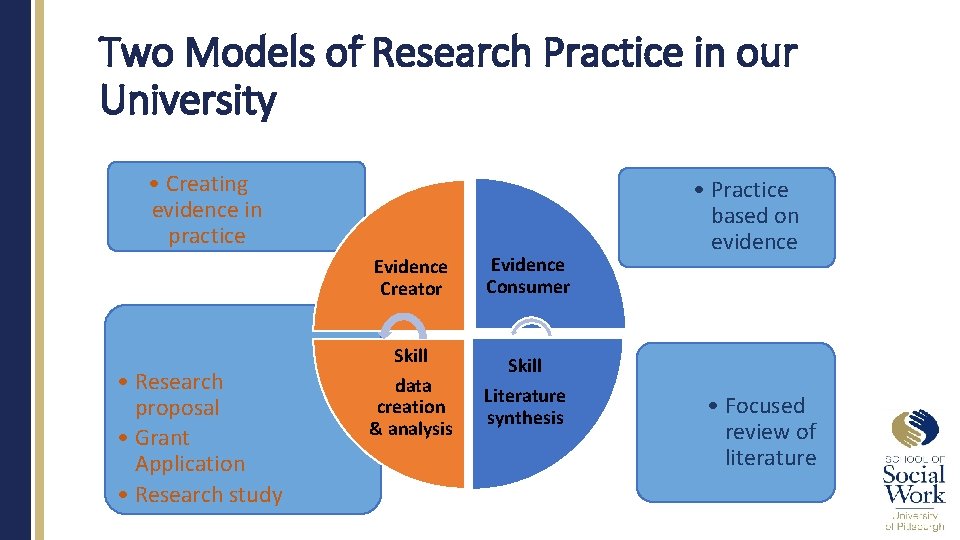
Two Models of Research Practice in our University • Creating evidence in practice Evidence Creator • Research proposal • Grant Application • Research study Skill data creation & analysis Evidence Consumer • Practice based on evidence Skill Literature synthesis • Focused review of literature
Discussion Question • What about your university?
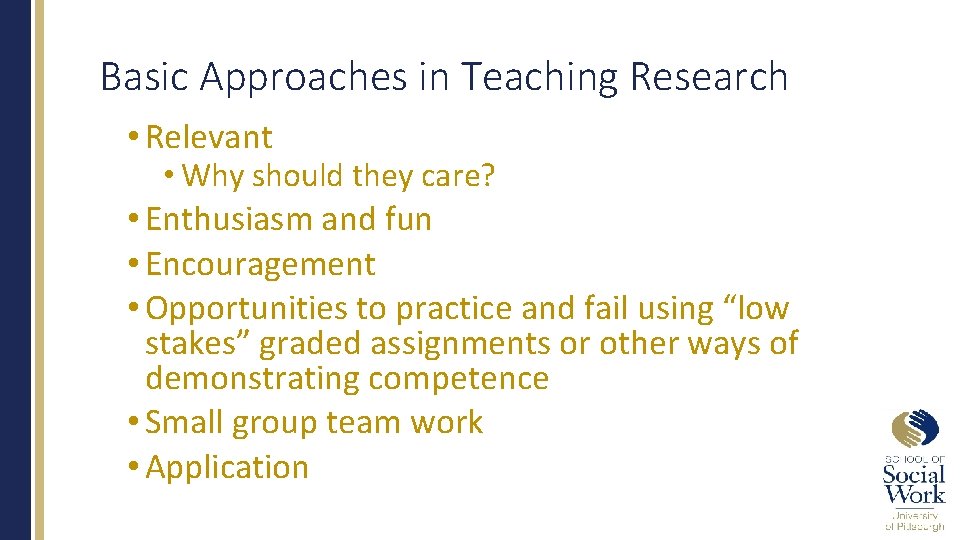
Basic Approaches in Teaching Research • Relevant • Why should they care? • Enthusiasm and fun • Encouragement • Opportunities to practice and fail using “low stakes” graded assignments or other ways of demonstrating competence • Small group team work • Application
Discussion Question • What are your challenges in teaching research?
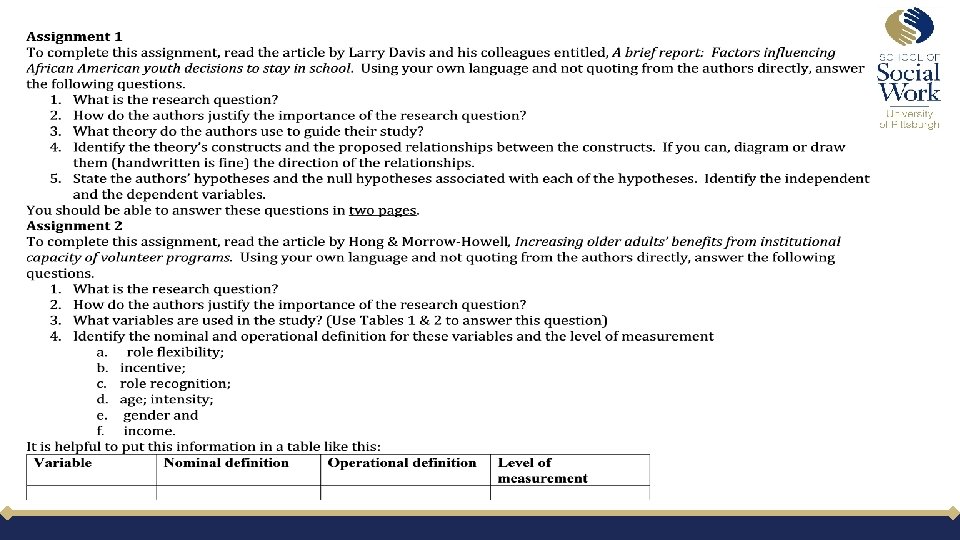
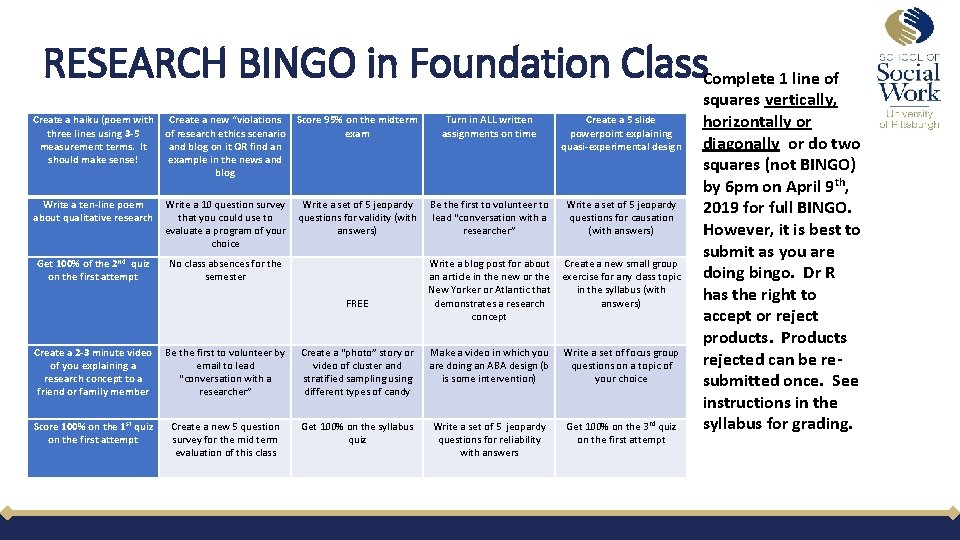
Written assignments • Five scaffolded assignments (Relevant + Encouragement + Low Stakes) and • a final paper which builds on knowledge and feedback on the five assignments • Research BINGO ( demonstrating other ways of competence) as extra credit
RESEARCH BINGO in Foundation Class. Complete 1 line of Create a haiku (poem with Create a new “violations Score 95% on the midterm three lines using 3 -5 of research ethics scenario exam measurement terms. It and blog on it OR find an should make sense! example in the news and blog Write a ten-line poem about qualitative research Write a 10 question survey that you could use to evaluate a program of your choice Get 100% of the 2 nd quiz on the first attempt No class absences for the semester Write a set of 5 jeopardy questions for validity (with answers) FREE Turn in ALL written assignments on time Create a 5 slide powerpoint explaining quasi-experimental design Be the first to volunteer to lead “conversation with a researcher” Write a set of 5 jeopardy questions for causation (with answers) Write a blog post for about an article in the new or the New Yorker or Atlantic that demonstrates a research concept Create a new small group exercise for any class topic in the syllabus (with answers) Create a 2 -3 minute video of you explaining a research concept to a friend or family member Be the first to volunteer by email to lead “conversation with a researcher” Create a “photo” story or video of cluster and stratified sampling using different types of candy Make a video in which you are doing an ABA design (b is some intervention) Write a set of focus group questions on a topic of your choice Score 100% on the 1 st quiz on the first attempt Create a new 5 question survey for the mid term evaluation of this class Get 100% on the syllabus quiz Write a set of 5 jeopardy questions for reliability with answers Get 100% on the 3 rd quiz on the first attempt squares vertically, horizontally or diagonally or do two squares (not BINGO) by 6 pm on April 9 th, 2019 for full BINGO. However, it is best to submit as you are doing bingo. Dr R has the right to accept or reject products. Products rejected can be resubmitted once. See instructions in the syllabus for grading.
Experiential Learning (Fun + Team building) • Design-a-Rama • Research ethics violations
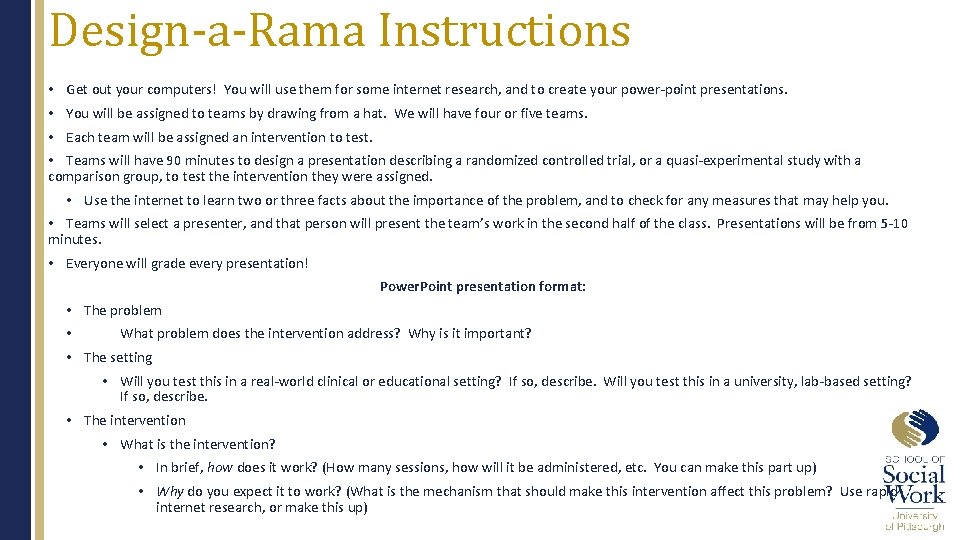
Design-a-Rama Instructions • Get out your computers! You will use them for some internet research, and to create your power-point presentations. • You will be assigned to teams by drawing from a hat. We will have four or five teams. • Each team will be assigned an intervention to test. • Teams will have 90 minutes to design a presentation describing a randomized controlled trial, or a quasi-experimental study with a comparison group, to test the intervention they were assigned. • Use the internet to learn two or three facts about the importance of the problem, and to check for any measures that may help you. • Teams will select a presenter, and that person will present the team’s work in the second half of the class. Presentations will be from 5 -10 minutes. • Everyone will grade every presentation! Power. Point presentation format: • The problem • What problem does the intervention address? Why is it important? • The setting • Will you test this in a real-world clinical or educational setting? If so, describe. Will you test this in a university, lab-based setting? If so, describe. • The intervention • What is the intervention? • In brief, how does it work? (How many sessions, how will it be administered, etc. You can make this part up) • Why do you expect it to work? (What is the mechanism that should make this intervention affect this problem? Use rapid internet research, or make this up)
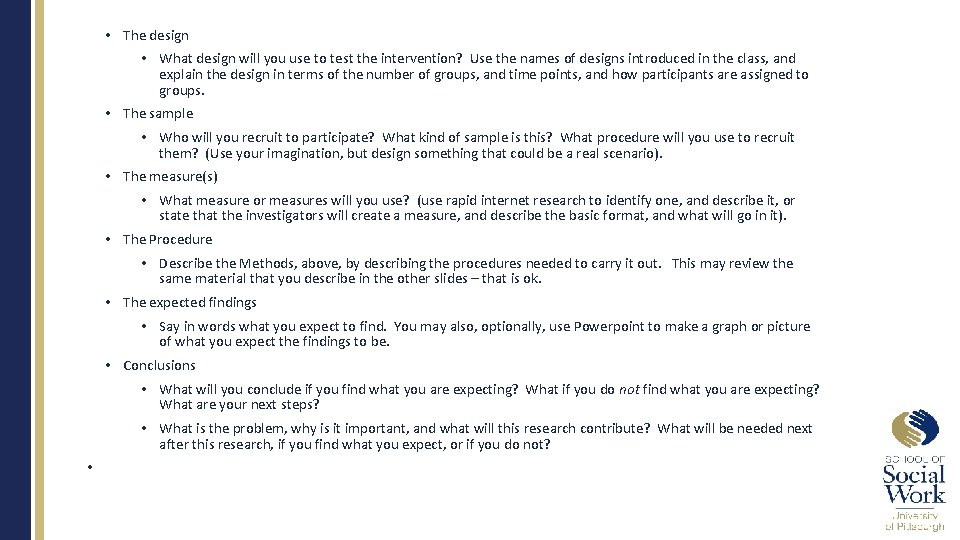
• The design • What design will you use to test the intervention? Use the names of designs introduced in the class, and explain the design in terms of the number of groups, and time points, and how participants are assigned to groups. • The sample • Who will you recruit to participate? What kind of sample is this? What procedure will you use to recruit them? (Use your imagination, but design something that could be a real scenario). • The measure(s) • What measure or measures will you use? (use rapid internet research to identify one, and describe it, or state that the investigators will create a measure, and describe the basic format, and what will go in it). • The Procedure • Describe the Methods, above, by describing the procedures needed to carry it out. This may review the same material that you describe in the other slides – that is ok. • The expected findings • Say in words what you expect to find. You may also, optionally, use Powerpoint to make a graph or picture of what you expect the findings to be. • Conclusions • What will you conclude if you find what you are expecting? What if you do not find what you are expecting? What are your next steps? • What is the problem, why is it important, and what will this research contribute? What will be needed next after this research, if you find what you expect, or if you do not? •
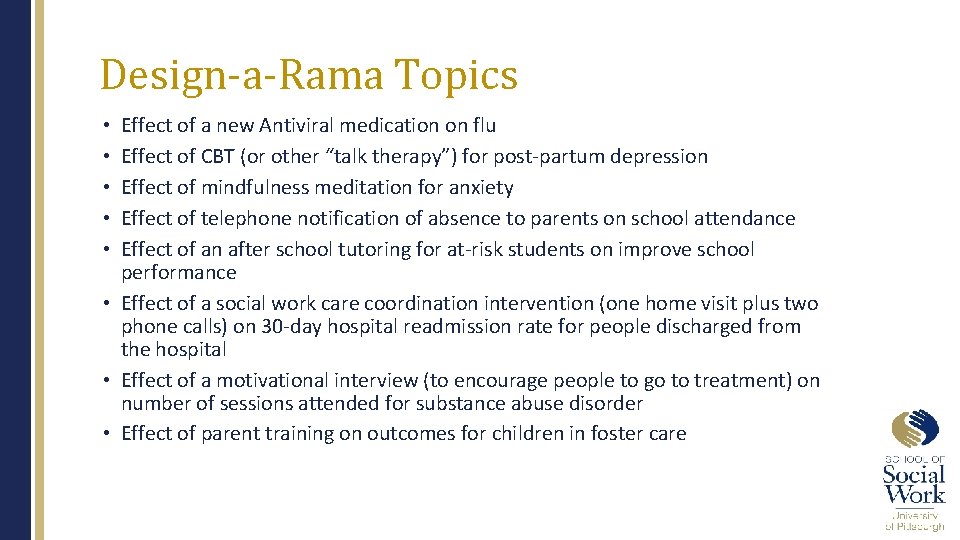
Design-a-Rama Topics Effect of a new Antiviral medication on flu Effect of CBT (or other “talk therapy”) for post-partum depression Effect of mindfulness meditation for anxiety Effect of telephone notification of absence to parents on school attendance Effect of an after school tutoring for at-risk students on improve school performance • Effect of a social work care coordination intervention (one home visit plus two phone calls) on 30 -day hospital readmission rate for people discharged from the hospital • Effect of a motivational interview (to encourage people to go to treatment) on number of sessions attended for substance abuse disorder • Effect of parent training on outcomes for children in foster care • • •
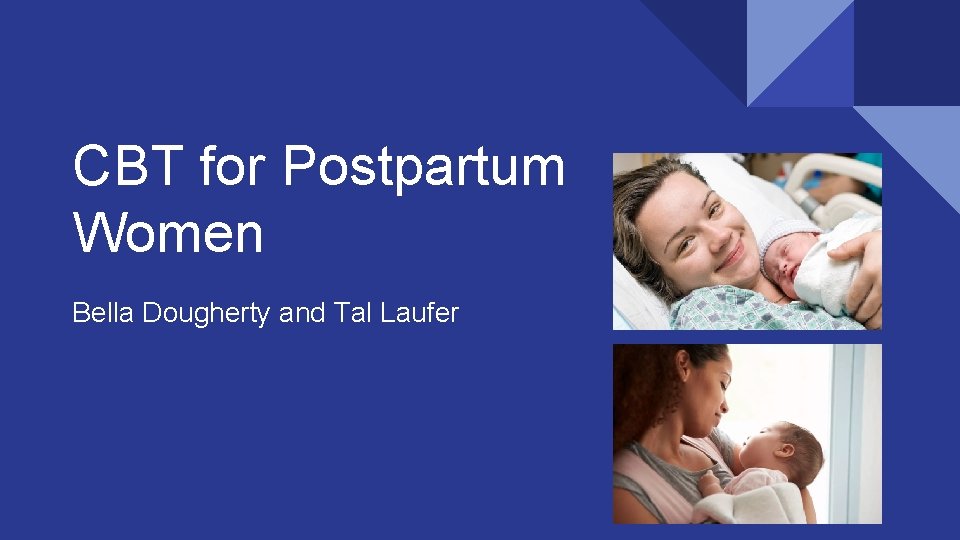
CBT for Postpartum Women Bella Dougherty and Tal Laufer
The Problem ● ● Women who experience postpartum depression Postpartum depression ranges from mild depression to severe psychosis occurring in the months following childbirth ○ Mild depression affects about 50% of new mothers ○ 50 -1000 mothers experience psychosis every year ■ http: //www. idph. state. il. us/about/womenshealth/factsheets/pdpress. htm
The Setting ● We will test CBT in a clinical setting through a university based hospital ○ Women will receive 10 weeks of CBT treatment at a mental health clinic
The Intervention ● ● Women will receive weekly sessions of CBT for 10 weeks by a LCSW specialized in mental health and CBT interventions ○ All sessions will be held in the same setting We are confident CBT will reduce postpartum intervention because studies have shown that it is effective in reducing depression
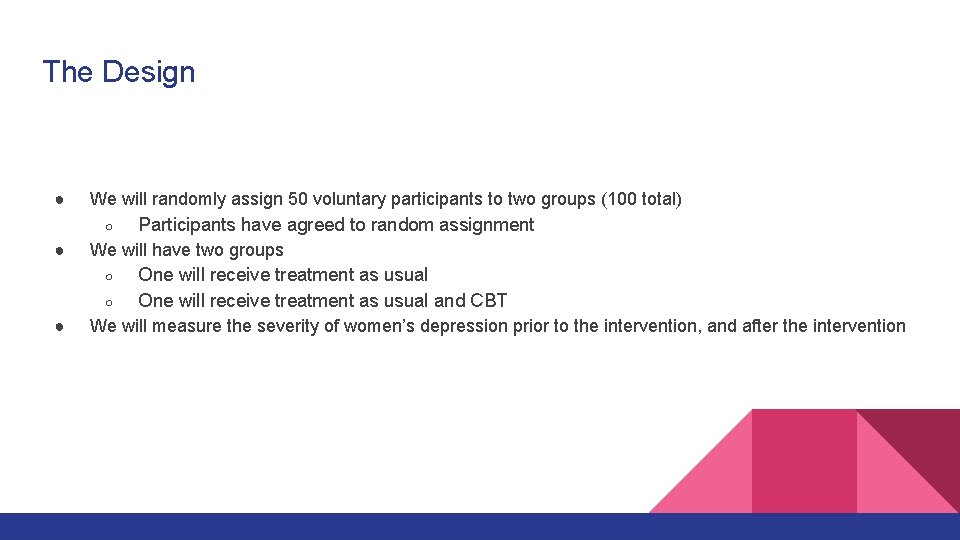
The Design ● ● ● We will randomly assign 50 voluntary participants to two groups (100 total) ○ Participants have agreed to random assignment We will have two groups ○ One will receive treatment as usual and CBT We will measure the severity of women’s depression prior to the intervention, and after the intervention
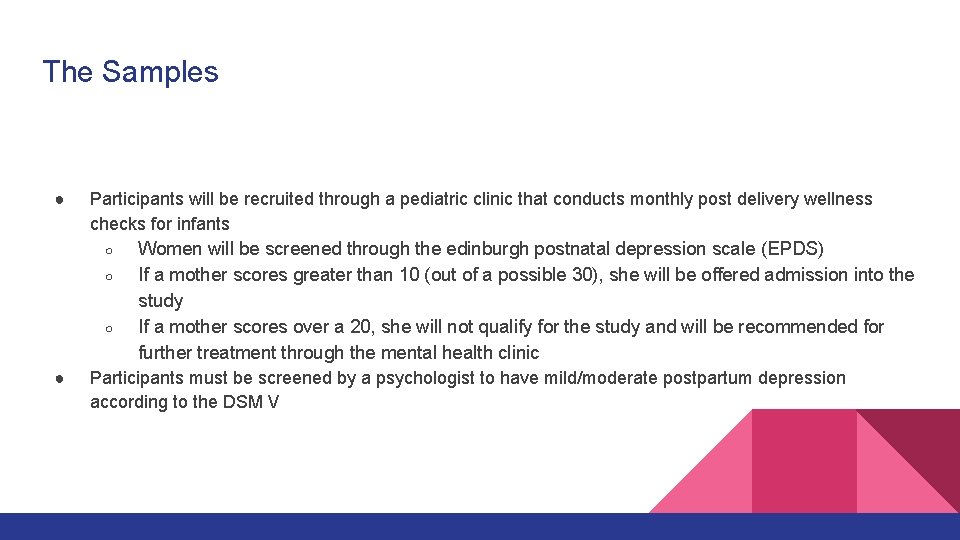
The Samples ● ● Participants will be recruited through a pediatric clinic that conducts monthly post delivery wellness checks for infants ○ Women will be screened through the edinburgh postnatal depression scale (EPDS) ○ If a mother scores greater than 10 (out of a possible 30), she will be offered admission into the study ○ If a mother scores over a 20, she will not qualify for the study and will be recommended for further treatment through the mental health clinic Participants must be screened by a psychologist to have mild/moderate postpartum depression according to the DSM V
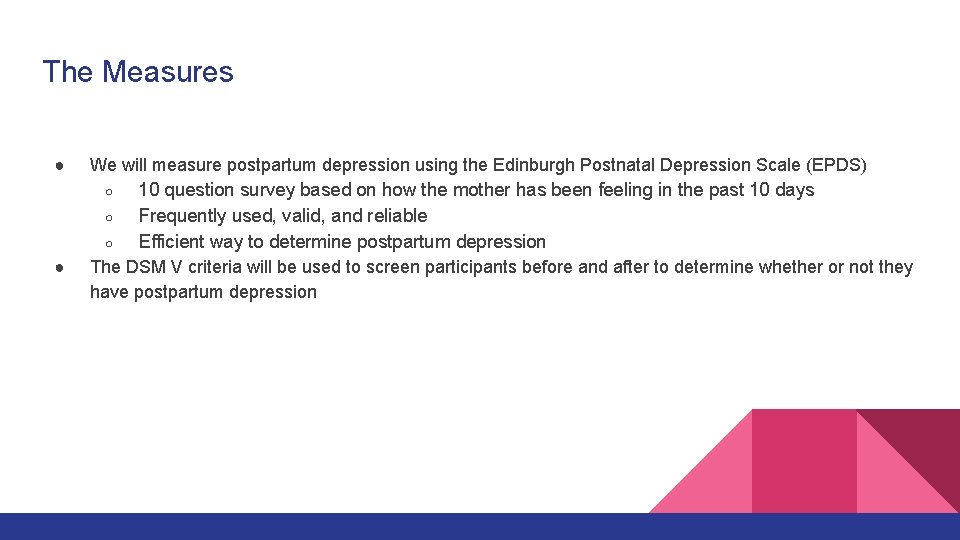
The Measures ● ● We will measure postpartum depression using the Edinburgh Postnatal Depression Scale (EPDS) ○ 10 question survey based on how the mother has been feeling in the past 10 days ○ Frequently used, valid, and reliable ○ Efficient way to determine postpartum depression The DSM V criteria will be used to screen participants before and after to determine whether or not they have postpartum depression
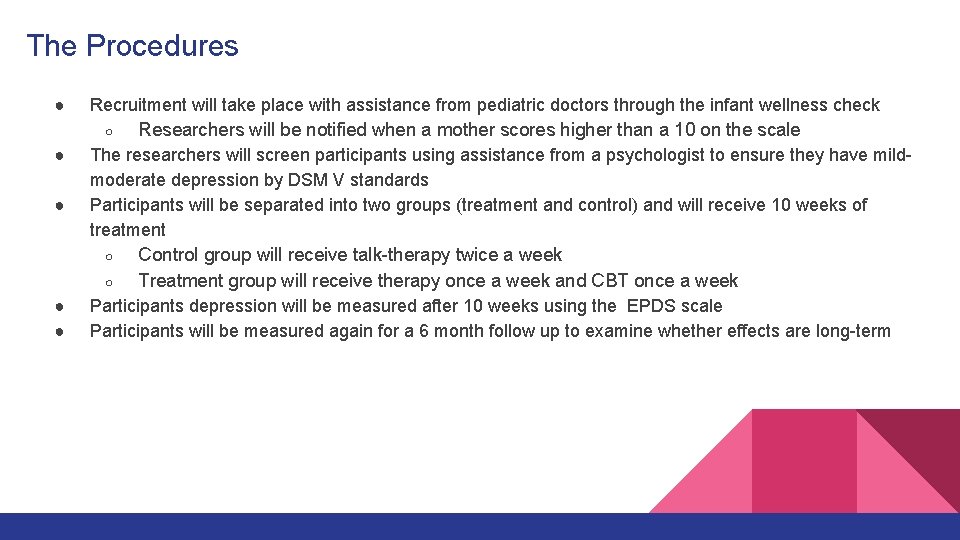
The Procedures ● ● ● Recruitment will take place with assistance from pediatric doctors through the infant wellness check ○ Researchers will be notified when a mother scores higher than a 10 on the scale The researchers will screen participants using assistance from a psychologist to ensure they have mildmoderate depression by DSM V standards Participants will be separated into two groups (treatment and control) and will receive 10 weeks of treatment ○ Control group will receive talk-therapy twice a week ○ Treatment group will receive therapy once a week and CBT once a week Participants depression will be measured after 10 weeks using the EPDS scale Participants will be measured again for a 6 month follow up to examine whether effects are long-term
The Expected Findings ● ● ● We expect that the level of depression in the treatment group will improve at a greater rate than the control group We think that CBT will help participants develop long term coping skills to reduce the severity of their depression We think the short term and long term effects of CBT will be better than the effects of talk therapy alone
Conclusions ● ● ● Assuming we find the results we intended, we will assume that CBT is more effective than talk therapy alone for a vast majority of participants ○ The next step would be to examine whether CBT alone is effective by conducting a study in which the treatment group receives CBT alone ○ This will confirm that CBT is effective without the presence of talk therapy If the study was not effective, we would re-examine the methods ○ Ex. changing the length of time to greater than 10 weeks, changing the number of times a week that it occured, sample of women The study and problem continues to be important because postpartum depression remains common and has pervasive effects for women’s mental health ○ Can lead CYF involvement, harm of child or hospitalization of mothers
Research ethics violations role play • article • Small groups of students randomly select one of ethical norms discussed in the course textbook • Each group role-plays the violation of their assigned ethic to the class. • The class guesses the ethical norm that was being violated.
• Research Context NOT Clinical • Confidentiality • • • • Voluntary Participation Informed Consent Anonymity Absence of deception No harm to participants Honesty and openness in conducting and reporting Risks and benefits are equally distributed
Thank you for your participation! Mary E Rauktis Mar 104@pitt. edu Katie Greeno kgreeno@pitt. edu