
TEACHING Reading Comprehension A Beautiful and Neglected Mess
TEACHING Reading Comprehension: A Beautiful and Neglected Mess!
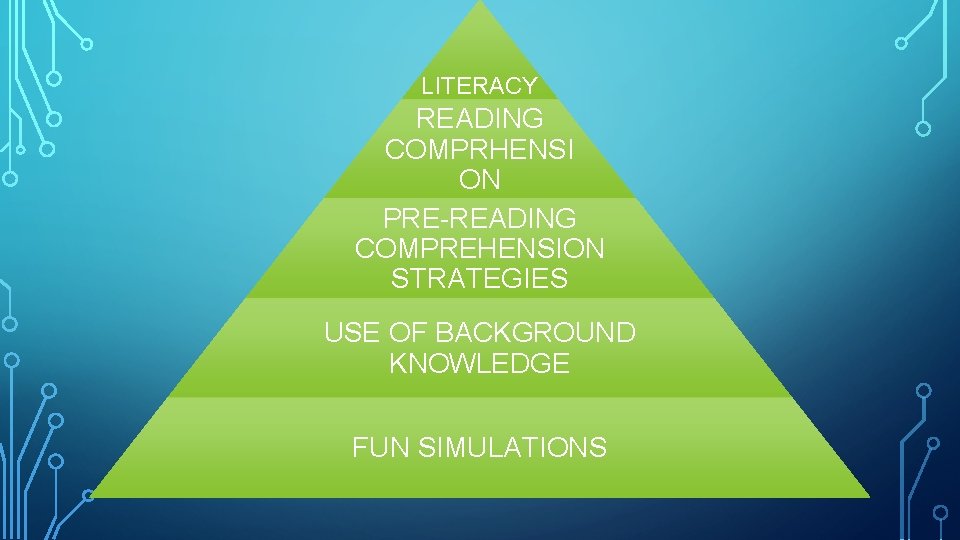
LITERACY READING COMPRHENSI ON PRE-READING COMPREHENSION STRATEGIES USE OF BACKGROUND KNOWLEDGE FUN SIMULATIONS

LITERACY: AN UNCONVENTIONAL DEFINITION Taking comprehensible linguistic input and making it sharable
LITERACY AIN’T JUST FOR GRADE SCHOOLERS • Remedial instruction now extends into the college level. • Demands for “ 21 st Century Skills” complicate the working definition of literacy and distract educators from the universals of effective teaching. • Standardized testing pushes the “messy” processes and strategies aside and replaces them with ”Comprehension Assessment” and not Literacy Instruction. • An example: EDU 104
• 1. • 2. LITERACY LEARNING AND INSTRUCTION: STANDARD CURRICULUM PRE-LITERATE learners and instructors EMERGENT literate learners and instructors • 3. Middle Grades learners and instructors • 4. HIGH SCHOOL COLLEGE-LEVEL STUDENTS AND TEACHERS
PREACHIN’ TO THE CHOIR? : ANY COMMENTS?
1 COMMENT: _What kinds of thoughts and feelings come to mind when you discover your place in the field of literacy LISTEN TO EACH TABLE MEMBER’S COMMENT. education? _____________ As a group generate a statement that incorporates most of the ideas in the form of ONE bullet point to educators K-16, including teacher educators and administrators! What do you have to say to educators? __________________________________________________________________________ _________ _____________________________________
1 COMMENT: ✍��I would love to see what my students could do if their upper level teachers continued to LISTEN TO EACH TABLE MEMBER’S promote literacy in COMMENT. the content areas. As a group generate a statement that incorporates most of the ideas in the form of ONE bullet point to educators K-16, including teacher educators and administrators! (Secretary? ) ✍��We would like to know if the tried and true strategies for teaching literacy at the lower levels are really carried on through the upper levels. This would include being validated for teaching our students literate, academic thinking. What does it look like?

ACADEMIC READING COMPREHENSION: A DEFINITION Reconstructing the author’s INTENDED message in a way that enables the READER to COMMUNICATE that message UNDERSTANDABLY and ACCEPTABLY in the context of a specific (academic) community
BEAUTIFUL AND NEGLECTED MESS? OLD HAT UNIVERSALS OF TEACHING • Literacy, Content Instruction and Critical Thinking go hand in hand. • As we pursue excellence in teaching, it looks more and more like an expanding EQUILATERAL triangle! • Focusing on (or neglecting) one of the vertices more than the other two creates an imbalanced learner. • Literacy usually is the neglected vertex as abstraction in content and demand for thinking increase. It is usually assumed that literacy will magically happen.
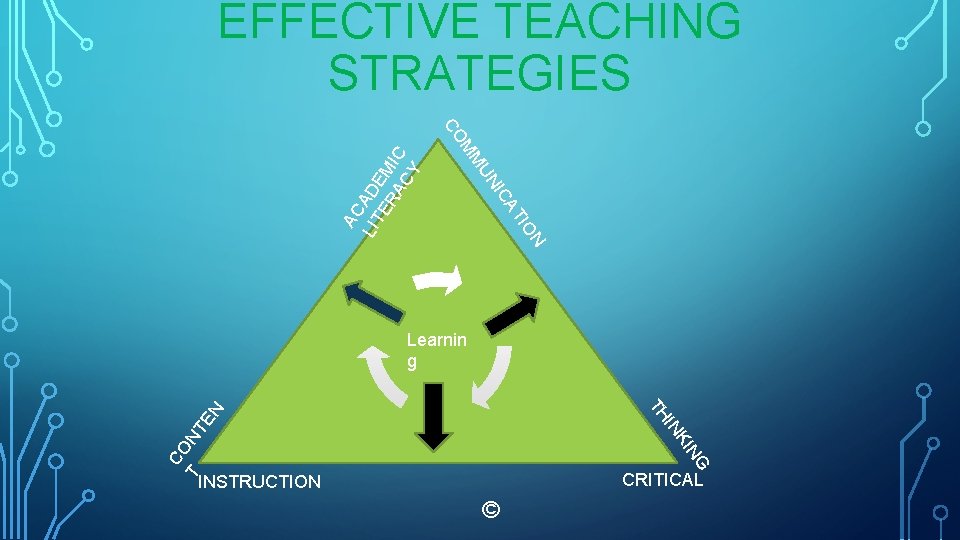
EFFECTIVE TEACHING STRATEGIES AC LIT AD ER EM AC IC Y N IO AT IC UN MM CO Learnin g T G IN CO K IN NT E N TH CRITICAL INSTRUCTION ©
BUT THE BIGGEST ELEPHANT IN THE CLASSROOOM? THERE IS A BIG DIFFERENCE BETWEEN ASSESSING LITERACY (READING COMPREHENSION AND WRITING PROFICIENCY) AND TEACHING
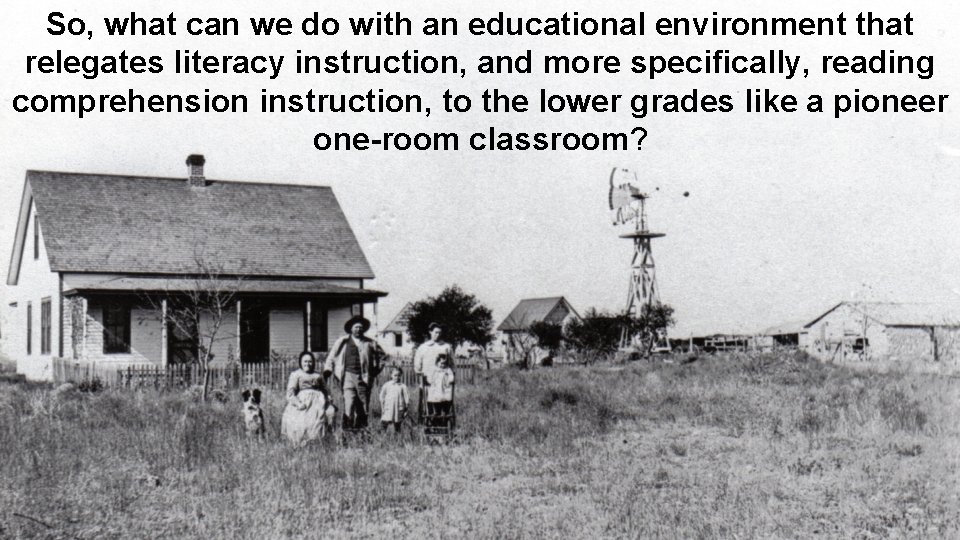
So, what can we do with an educational environment that relegates literacy instruction, and more specifically, reading comprehension instruction, to the lower grades like a pioneer one-room classroom?
PIONEERING: THE ONLY WAY TO EDUCATIONAL REFORM With the LONG-TERM best interest of our students in mind, we try our best to pioneer in some or all of the following ways:
A. Keep doing what we are doing: teaching literacy across ALL the disciplines. B. If you do not feel confident doing this, learn how! It’s a teachable skill. C. Take risks. Like “Making Thinking Visible” D. Become an advocate for building background knowledge, skills in academic reading comprehension and literacy in relevant and meaningful ways. E. Become the leader in educational reform, helping parents and teachers alike to understand the need for this sort of “messy” instruction instead of the typical information dump, teach-test-hope for
THE ROAD TO METACOGNITION UNIQUE AND UNIVERSAL QUALITY OF EVERY “LITERATE” PERSON IN EVERY CONTEXT
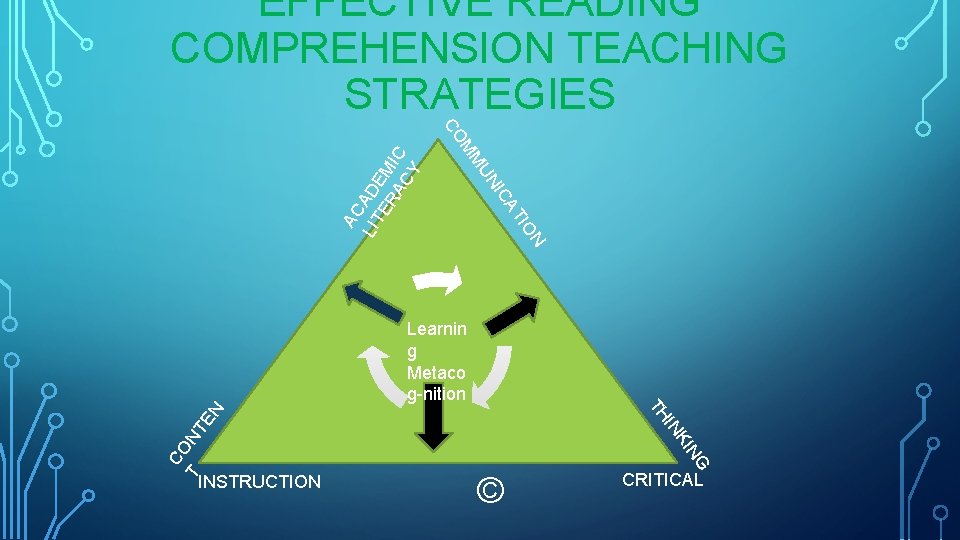
EFFECTIVE READING COMPREHENSION TEACHING STRATEGIES AC LIT AD ER EM AC IC Y N IO AT IC UN MM CO Learnin g Metaco g-nition T © G IN CO K IN NT E N TH INSTRUCTION CRITICAL
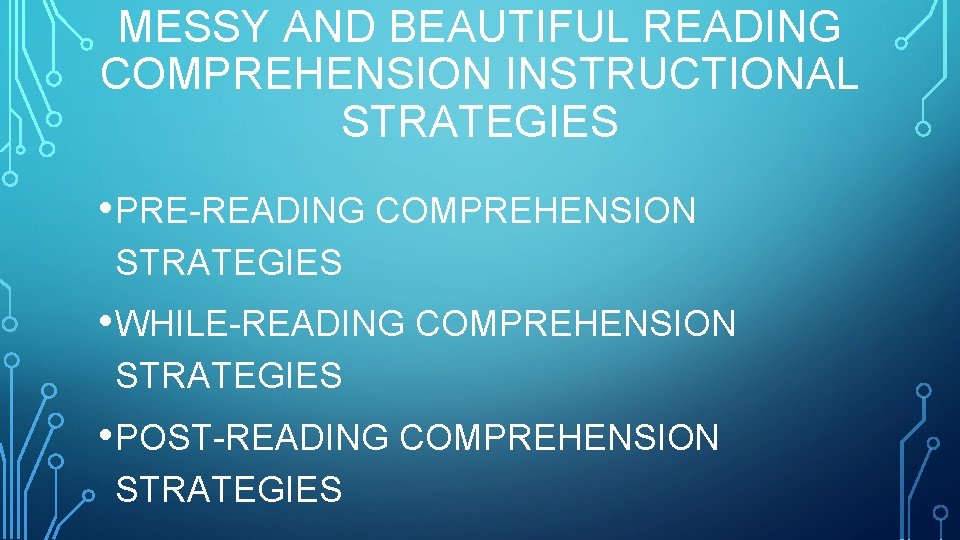
MESSY AND BEAUTIFUL READING COMPREHENSION INSTRUCTIONAL STRATEGIES • PRE-READING COMPREHENSION STRATEGIES • WHILE-READING COMPREHENSION STRATEGIES • POST-READING COMPREHENSION STRATEGIES
PRE- WHILE- POST- COMPREHENSION STRATEGIES • Close Reading • Cloze Reading • Mapping transition/signal words • “Look at the questions BEFORE” • Read/Think Aloud • Making Thinking Visible • Contextualized Vocabulary Instruction • Predict based on skimming and scanning • Using unknown vocabulary • Stop and Summarize • ___________________?
TODAY’S FOCUS: PRE-READING COMPREHENSION STRATEGIES QUESTIONS FOR REFLECTION: 1. In helping our students progress in their pre-reading comprehension strategies, what role does metacognition play and how can we help students succeed in their reconstructing the meaning of any kind of text? 2. What are the universal teaching principles in teaching prereading comprehension strategies?
3 UNIVERSAL METACOGNITIVE PRINCIPLES OF TEACHING PRE-READING STRATEGIES 1. SKIM/SCAN the material to be reconstructed to determine the depth and relevance of your own background knowledge. 2. PREDICT a main idea that does the following: STATES the suggested topic in the context of a FULL SENTENCE that suggests the relationship of ALL the information they have gained having skimmed and scanned. (“The passage will be about love” vs. “The outward expression and inward feeling of love are different for different cultures. ”) 3. STATE an objective for reading the material they are pre-reading, whether the teacher has provided one or not. The objective must be ACTIVE (not passive like “absorb the material” or “know everything”), ACADEMIC (self-assessing whether their objective fits into a larger community and/or curriculum), and ANCILLARY (where students can “pull it out” when they stumble on obstacles in reconstructing the
THE NUMBER ONE PREDICTOR OF READING COMPREHENSION LEVEL (FRUSTRATION, INSTRUCTIONAL AND INDEPENDENT) IS APPROPRIATE USE OF BACKGROUND KNOWLEDGE.
FUN WITH BACKGROUND KNOWLEDGE
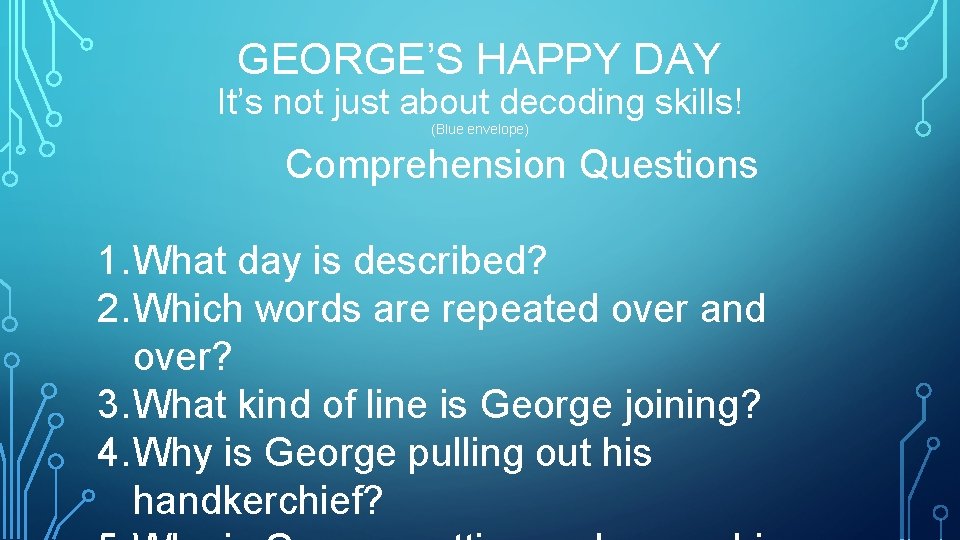
GEORGE’S HAPPY DAY It’s not just about decoding skills! (Blue envelope) Comprehension Questions 1. What day is described? 2. Which words are repeated over and over? 3. What kind of line is George joining? 4. Why is George pulling out his handkerchief?
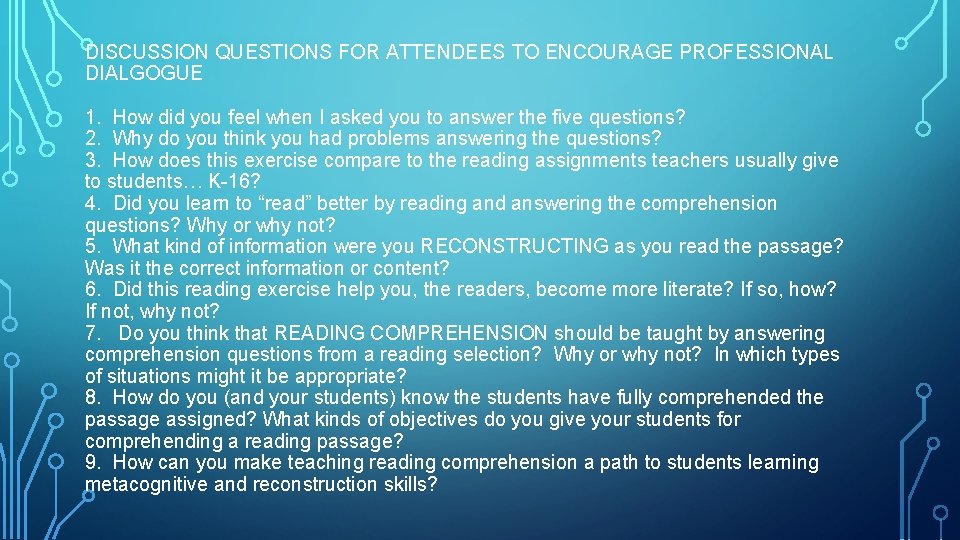
DISCUSSION QUESTIONS FOR ATTENDEES TO ENCOURAGE PROFESSIONAL DIALGOGUE 1. How did you feel when I asked you to answer the five questions? 2. Why do you think you had problems answering the questions? 3. How does this exercise compare to the reading assignments teachers usually give to students… K-16? 4. Did you learn to “read” better by reading and answering the comprehension questions? Why or why not? 5. What kind of information were you RECONSTRUCTING as you read the passage? Was it the correct information or content? 6. Did this reading exercise help you, the readers, become more literate? If so, how? If not, why not? 7. Do you think that READING COMPREHENSION should be taught by answering comprehension questions from a reading selection? Why or why not? In which types of situations might it be appropriate? 8. How do you (and your students) know the students have fully comprehended the passage assigned? What kinds of objectives do you give your students for comprehending a reading passage? 9. How can you make teaching reading comprehension a path to students learning metacognitive and reconstruction skills?
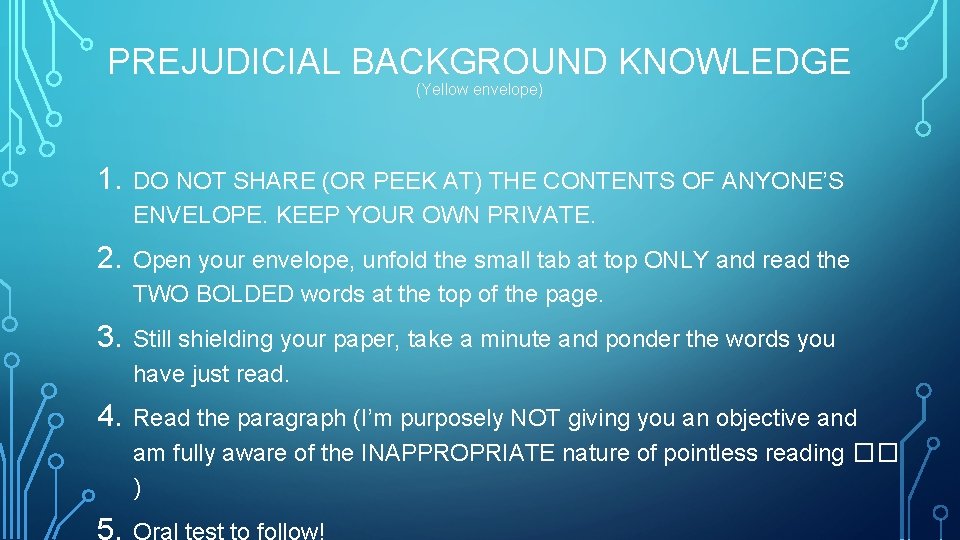
PREJUDICIAL BACKGROUND KNOWLEDGE (Yellow envelope) 1. DO NOT SHARE (OR PEEK AT) THE CONTENTS OF ANYONE’S ENVELOPE. KEEP YOUR OWN PRIVATE. 2. Open your envelope, unfold the small tab at top ONLY and read the TWO BOLDED words at the top of the page. 3. Still shielding your paper, take a minute and ponder the words you have just read. 4. Read the paragraph (I’m purposely NOT giving you an objective and am fully aware of the INAPPROPRIATE nature of pointless reading �� ) 5. Oral test to follow!
“DIFFERENTIATED” ASSESSMENT On the page/slide that follows, draw a picture or create a semantic map of the content from this passage. Use as much detail as you can remember and you MAY refer back to the text! Do NOT share your bolded words, but pretend you are “cheating” by observing everyone else’s
You will be sharing your pictures, and we will attempting to guess what background knowledge you used to “reconstruct the passage” by drawing the details.
HELPING CHILDREN DEVELOP METACOGNITION AND LITERACY SIMULTANEOUSLY 1. Unlatch the manila envelope and pull out the GREEN page ONLY. Do NOT glance at the orange page, please. 2. 3. Read the GREEN page. (wrong on your handout, sorry!) Without looking back at the passage, jot down 3 pieces of information that you learned from this passage and be prepared to explain HOW DO YOU KNOW THAT? WHAT MAKES YOU THINK THAT? __Example: Balloons… I love balloons like water, helium, party, etc. ________so I remembered there were balloons in the reading. ______________________________________ _
When all have finished, pull out the ORANGE page from the envelope. Look at the picture and read the passage again. Be prepared to answer the question, “What happened in your head that made you understand better? ” _________________________________________________________________________________________ __________ _________________________________________________________________________________________ _________________________________________________
DEVELOPING METACOGNITIVE LITERACY • I would give an assignment to find a strange picture and describe it. Then, with the pictures in a pile and unlabeled, students could read a description and pair the pic with the description, all the while jotting down one anonymous idea for how the description could be improved. • Another idea would be to make the metacognitive observations visible (the ideas regarding how/why they understood better) and then ask the students to edit the description to include the suggestions in their writing. • As a class or individually, students could write a story that includes all the details they can find in this picture representing the ending of the story. • ? ? __________________________
NO METACOGNITION, NO COMPREHENSION GROWTH KNOW METACOGNITION, KNOW COMPREHENSION GROWTH

THANK YOU! Guy Arcuri, Ph. D. drguyteacher@gmail. com 336 -345 -4891 © Guy Arcuri
- Slides: 33