
Teaching Reading and Writing 1 2 3 4

- Slides: 8
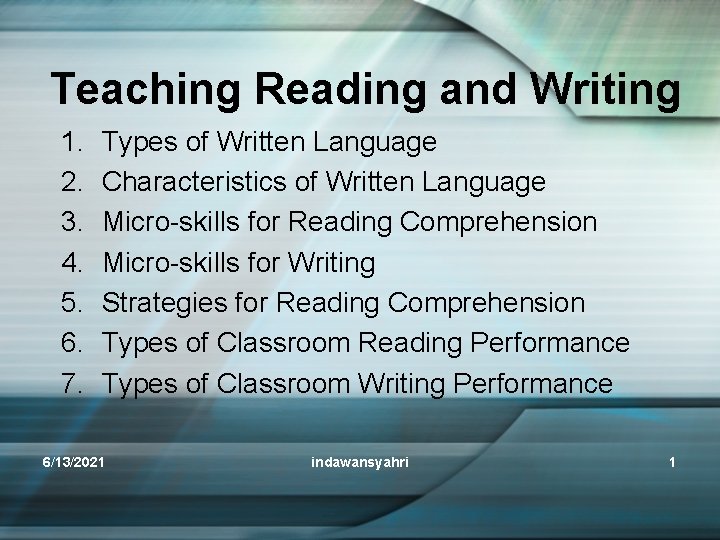
Teaching Reading and Writing 1. 2. 3. 4. 5. 6. 7. Types of Written Language Characteristics of Written Language Micro-skills for Reading Comprehension Micro-skills for Writing Strategies for Reading Comprehension Types of Classroom Reading Performance Types of Classroom Writing Performance 6/13/2021 indawansyahri 1
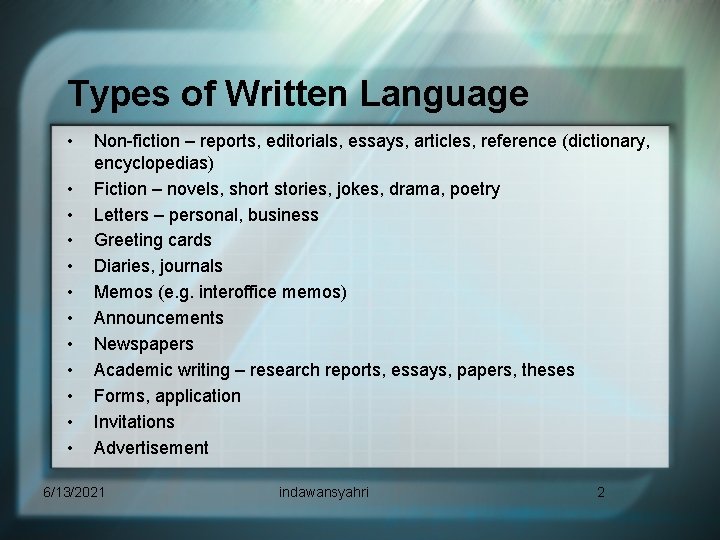
Types of Written Language • • • Non-fiction – reports, editorials, essays, articles, reference (dictionary, encyclopedias) Fiction – novels, short stories, jokes, drama, poetry Letters – personal, business Greeting cards Diaries, journals Memos (e. g. interoffice memos) Announcements Newspapers Academic writing – research reports, essays, papers, theses Forms, application Invitations Advertisement 6/13/2021 indawansyahri 2
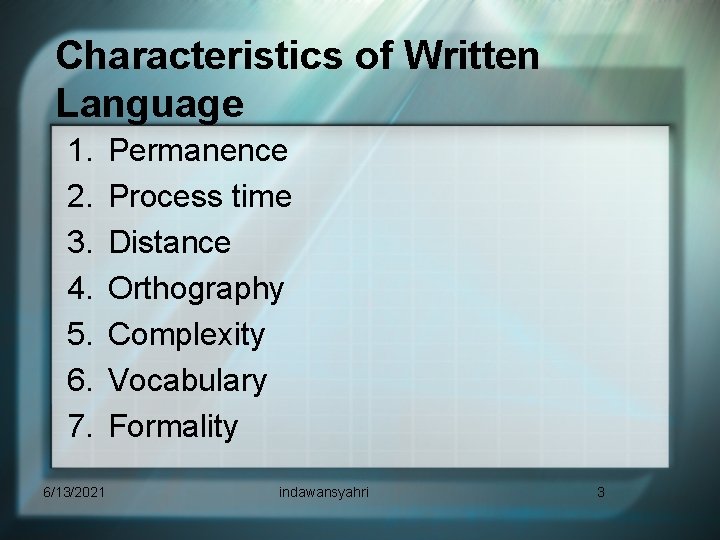
Characteristics of Written Language 1. 2. 3. 4. 5. 6. 7. 6/13/2021 Permanence Process time Distance Orthography Complexity Vocabulary Formality indawansyahri 3
Micro-skills for Reading Comprehension (1) 1. 2. 3. 4. 5. 6. 7. 6/13/2021 Discriminate among the distinctive graphemes and orthographic patterns of English. Retain chunks of language of different lengths in short-term memory. Process writing at a efficient rate of speech to suit the purpose. Recognize a core of words, and interpret word order patterns and their significance. Recognize grammatical word classes, systems, patterns, rules, and elliptical forms. Recognize that a particular meaning may be expressed in different grammatical forms. Recognize cohesive devices in written discourse and their signaling the relationship between and among clauses. indawansyahri 4
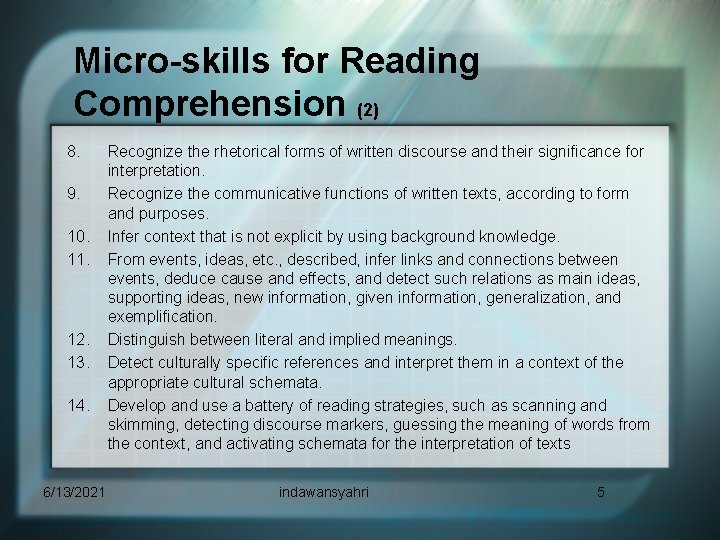
Micro-skills for Reading Comprehension (2) 8. 9. 10. 11. 12. 13. 14. 6/13/2021 Recognize the rhetorical forms of written discourse and their significance for interpretation. Recognize the communicative functions of written texts, according to form and purposes. Infer context that is not explicit by using background knowledge. From events, ideas, etc. , described, infer links and connections between events, deduce cause and effects, and detect such relations as main ideas, supporting ideas, new information, given information, generalization, and exemplification. Distinguish between literal and implied meanings. Detect culturally specific references and interpret them in a context of the appropriate cultural schemata. Develop and use a battery of reading strategies, such as scanning and skimming, detecting discourse markers, guessing the meaning of words from the context, and activating schemata for the interpretation of texts indawansyahri 5
Micro-skills for Writing (1) 1. 2. 3. 4. 5. 6. 7. 8. 6/13/2021 Produce graphemes and orthography patterns. Produce writing at an efficient rate of speed to suit the purpose. Produce an acceptable core of words and use appropriate word order patterns. Use acceptable grammatical systems, patterns, and rules. Express a particular meaning in different grammatical form. Use cohesive devices in written discourse. Use the rhetorical forms and conventions of written discourse. Appropriately accomplish the communicative functions of written texts according to the form and purpose. indawansyahri 6
Micro-skills for Writing (2) 9. Convey links and connections between events and communicate such relations as main ideas, supporting ideas, new information, given information, generalization, an exemplification. 10. Distinguish between literal and implied meanings when writing. 11. Correctly convey culturally specific references in the contexts of the written texts. 12. Develop and use a battery of writing strategies, such as accurately assessing the audience’s interpretation, using prewriting devices, writing with fluency in the first drafts, using paraphrase, soliciting peer and instructor feedback, and using feedback for revising and editing. 6/13/2021 indawansyahri 7
Reading Principles 1. Encourage students to read as often and as much as possible 2. The students need to be engaged with what they are reading 3. Encourage students to respond to the content of a text (and explore their feelings about it), not just concentrate on its construction 4. Prediction is a major factor in reading 5. Match the task to the topic when using intensive reading texts 6. Good teachers exploit reading texts to the full 6/13/2021 indawansyahri 8