
TEACHING READING Amanda Whittingham Literacy AST SLE Bw
TEACHING READING Amanda Whittingham Literacy AST/ SLE - Bw. D
Aims of the session: To have a clear understanding of the expectations in reading in the National Curriculum To understand how these can be implemented across the whole curriculum
How long do we have? . .
Share the title of your favourite: Children’s book. . . Adult book. . . Be honest! Why do I ask?
"It's great if you can read but the question is: do you read? If you do the world is yours. ” Michael Rosen – Former Children’s Laureate
‘BECOMING OR BEING A READER’ RATHER THAN ‘READING’ IS AT THE HEART OF THE NATIONAL CURRICULUM. • What does this mean? • How might we achieve this is school? • Why is it necessary?
Extensive research proves that children who read for pleasure will gain advantages that last their whole lives. Young children who enjoy reading very much are 5 x as likely to read above the expected level compared with those who don’t enjoy reading ( National Literacy Trust) The National Literacy Trust cites overwhelming evidence that literacy has a significant relationship with a person’s happiness and success. A deep engagement with storytelling and great literature link directly to emotional development in primary children. ( The Rose Review, 2008 Independent Review of the Primary School Curriculum)
Children whose parents regularly read to them make as much as twelve additional months' progress in school The academic benefits of a strong leisure reading habit are not confined to improved reading ability. Leisure reading makes students more articulate, develops higher order reasoning, and promotes critical thinking (The National Endowment for the Arts in "To read or not to read", 2007. ) Reading for pleasure is more important for children’s educational success than their family’s socio-economic status, (The Organisation for Economic Co-operation and Development )
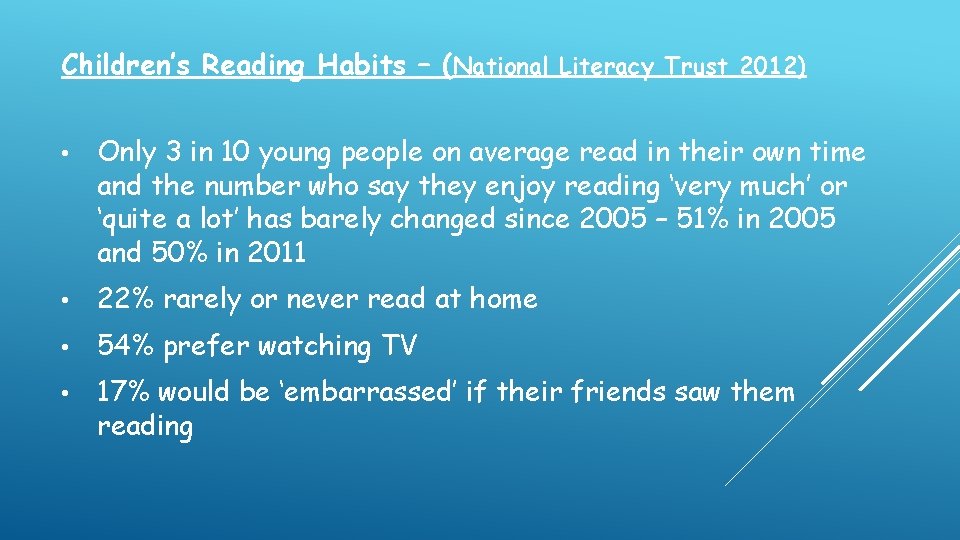
Children’s Reading Habits – (National Literacy Trust 2012) • Only 3 in 10 young people on average read in their own time and the number who say they enjoy reading ‘very much’ or ‘quite a lot’ has barely changed since 2005 – 51% in 2005 and 50% in 2011 • 22% rarely or never read at home • 54% prefer watching TV • 17% would be ‘embarrassed’ if their friends saw them reading
Is teaching children to read a technical task? Discuss
“Teaching children to read is neither a trivial matter nor just a technical task. It is probably the most momentous achievement of our school years so primary professionals should approach it thoughtfully and creatively. ” Teresa Cremin ‘Teaching English Creatively’ ‘ 2009
What do you know about primary reading or what kinds of reading have you seen in school so far? In which lessons/ subjects? Discuss
§ Shared Reading § Paired Reading § Guided Reading § Regular independent Reading § Home Reading § E. R. I. C or D. E. A. R – selecting their own texts § Hearing books read aloud and discussing them § Phoneme reading in phonic lessons § Reading for a given purpose e. g. history/ geography lesson § Teaching Comprehension skills § Using the class reading area effectively § School Library access
A brief history of Reading in the Literacy National Curriculum
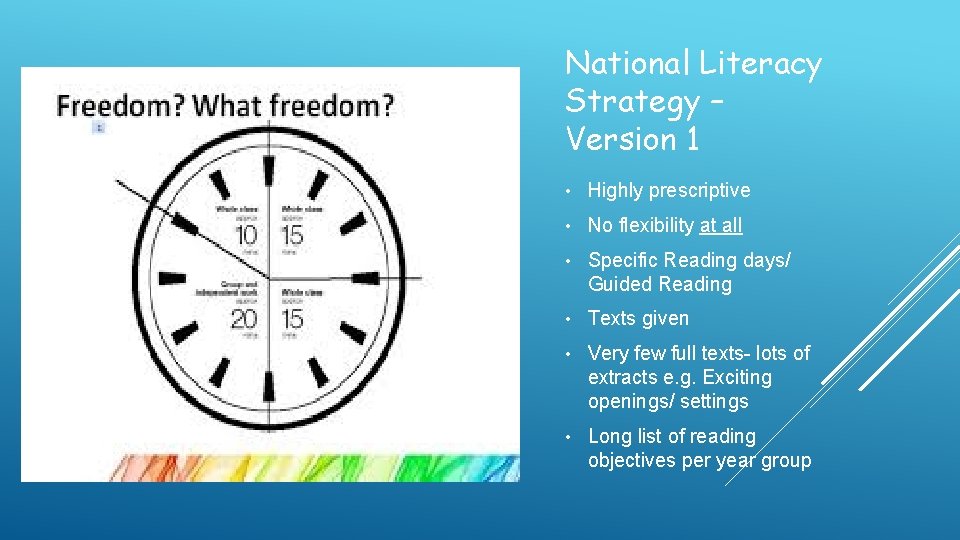
National Literacy Strategy – Version 1 • Highly prescriptive • No flexibility at all • Specific Reading days/ Guided Reading • Texts given • Very few full texts- lots of extracts e. g. Exciting openings/ settings • Long list of reading objectives per year group
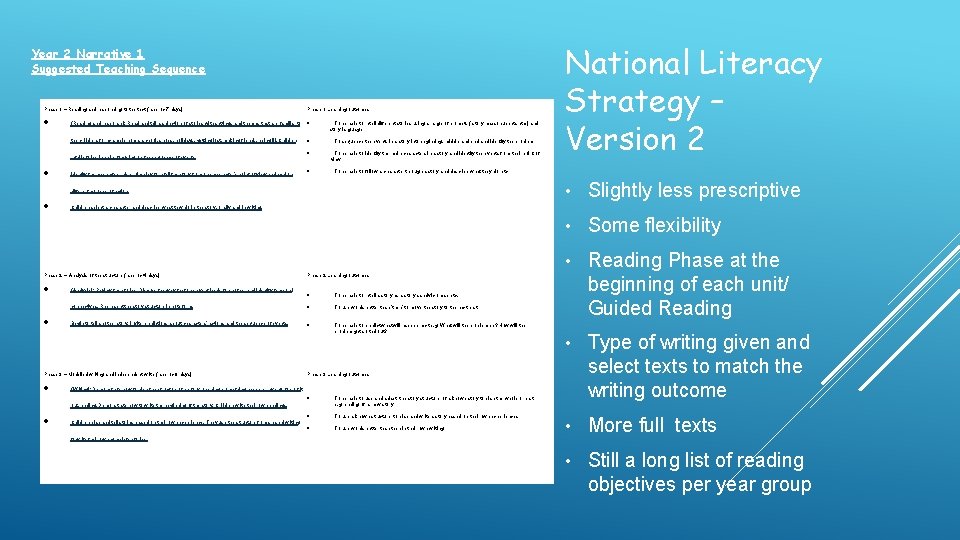
Year 2 Narrative 1 Suggested Teaching Sequence Phase 1 – Reading and responding to the text ( approx 7 days) Phase 1 Learning outcomes To be able to retell different stories using a range of prompts ( story maps/ puppets etc. ) and (Reading and response): Read and tell a selection of stories with settings and themes that are familiar to story language the children, for example home, school, shops, holidays, getting lost, making friends, being ill. Children To sequence the events in a story into beginning, middle and end and identify the problem To be able to identify the main characters in a story and identify the events from their point of retell stories in pairs focusing on the sequence of events. view To be able to follow a character through a story and describe what they do etc Identify the characters. Use role-play to retell the story from one character's point of view and explore different courses of action. Phase 2 – Analysis of the structure ( approx 4 days) (Analysis): Review the stories. Discuss the way that one event leads to another and identify temporal connectives. Represent the story structure in note form. • Slightly less prescriptive • Some flexibility • Reading Phase at the beginning of each unit/ Guided Reading • Type of writing given and select texts to match the writing outcome • More full texts • Still a long list of reading objectives per year group Children select a character and describe what they do in the story, orally and in writing. National Literacy Strategy – Version 2 Begin to tell another story. Invite predictions about characters' actions and the sequence of events. Phase 2 Learning outcomes To be able to retell a story as a story sandwich/map etc. To use words better than ‘then’ to move the story to the next part To be able to predict what will happen next e. g. What will the problem be? How will the problem get sorted out? Phase 3 – Modelled writing and independent write ( approx 8 days) Phase 3 Learning outcomes (Writing): Demonstrate how to plan the structure of a story: opening, something happens, events to sort it To be able to use and adapt the story structure of a known story to plan the whole or part e. g. ending of a new story out, ending. Demonstrate how to write the beginning of the story. Children write their own endings. To use a known structure to plan and write a story based on their own experiences Children plan and tell stories based on their own experience. They use the structure from shared writing To use words better than then in their own writing to write their own complete stories.
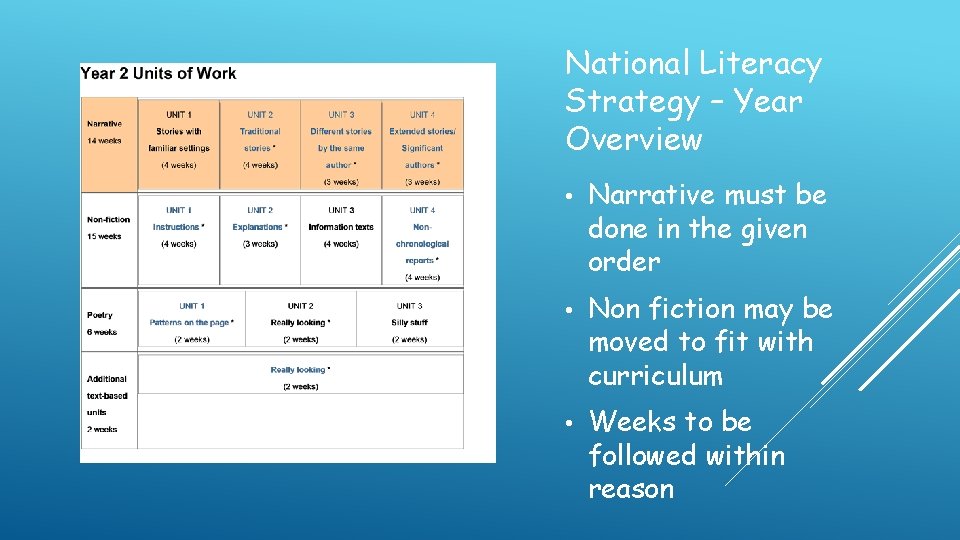
National Literacy Strategy – Year Overview • Narrative must be done in the given order • Non fiction may be moved to fit with curriculum • Weeks to be followed within reason
National Curriculum 2014 – Key Features of Reading - FLEXIBILITY/ NO PRESCRIPTION • 2 connected but clearly defined strands – teaching to read –Phonics – should be finished by the end of Year 1 and teaching to comprehend. Written as 2 strands in NC • Reading Comprehension must begin in Reception with questions about the books you read to children – lots of opportunities to infer even before the children can read. All classes develop ability to comprehend, it is just the books that get more challenging – this delivers the progression expected • Great emphasis on a wide range of quality literature/ full books (of your choice) and less emphasis on Non Fiction texts which may be spread across the other areas of the curriculum e. g. Recounts done after every trip/visit. May be little NF in english lessons • By doing lots of other reading across the curriculum it frees up more time to hone the skill of writing in English lessons. Reading is a skill used to find, magpie and develop ideas for writing •
• HUGE emphasis on reading for pleasure and attitudes to reading or wanting to read • Must learn a wide range of poems by heart. • Teacher should regularly read a range of books and text types to children at a level beyond that at which they can read independently. Read to children in some way everyday to develop motivation, vocabulary and understanding – huge emphasis on vocabulary. • Children participate in discussions and debates about books and their opinions of them. Learn to value opinions of others and take/ give advice on what to read next • Early readers should not just be reading decodable books • Reading is now very much seen as an integral part of english rather than an element
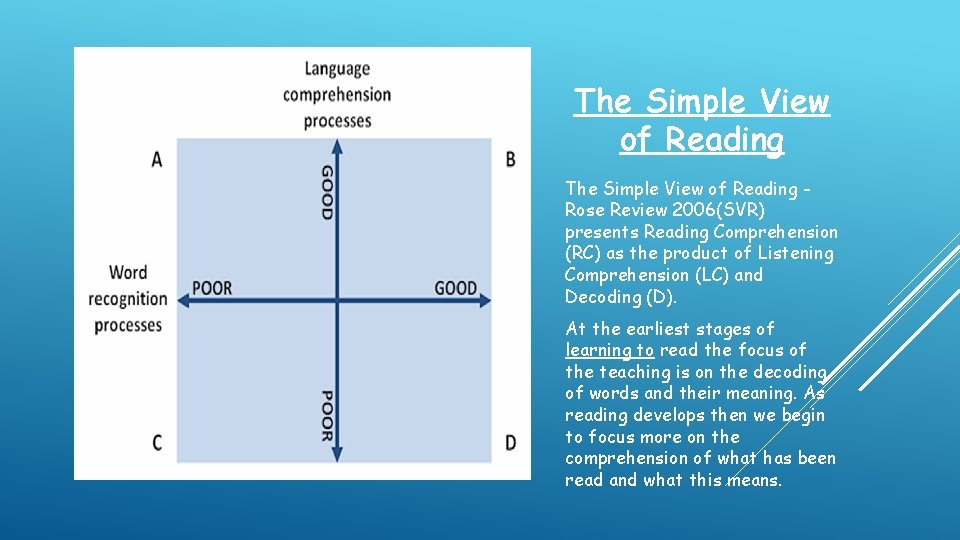
The Simple View of Reading Rose Review 2006(SVR) presents Reading Comprehension (RC) as the product of Listening Comprehension (LC) and Decoding (D). At the earliest stages of learning to read the focus of the teaching is on the decoding of words and their meaning. As reading develops then we begin to focus more on the comprehension of what has been read and what this means.
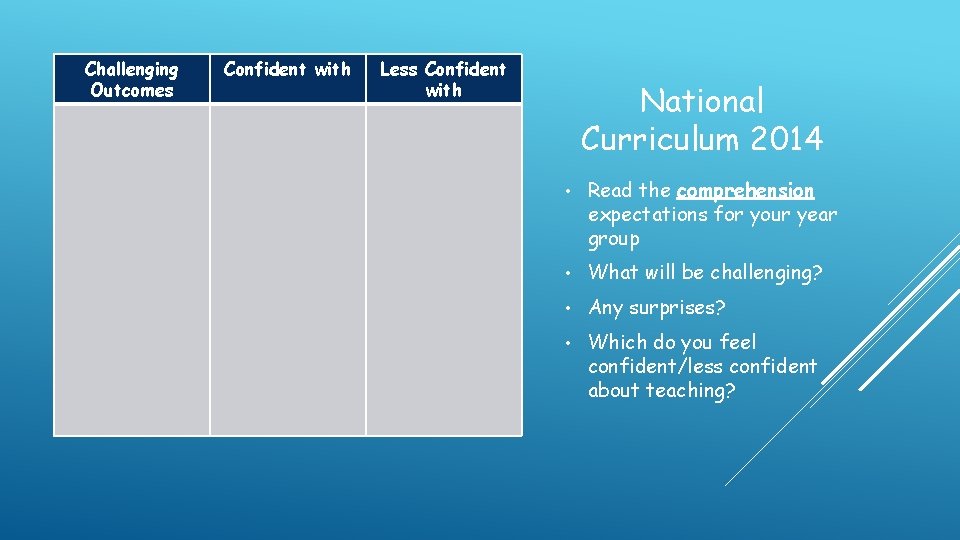
Challenging Outcomes Confident with Less Confident with National Curriculum 2014 • Read the comprehension expectations for your year group • What will be challenging? • Any surprises? • Which do you feel confident/less confident about teaching?
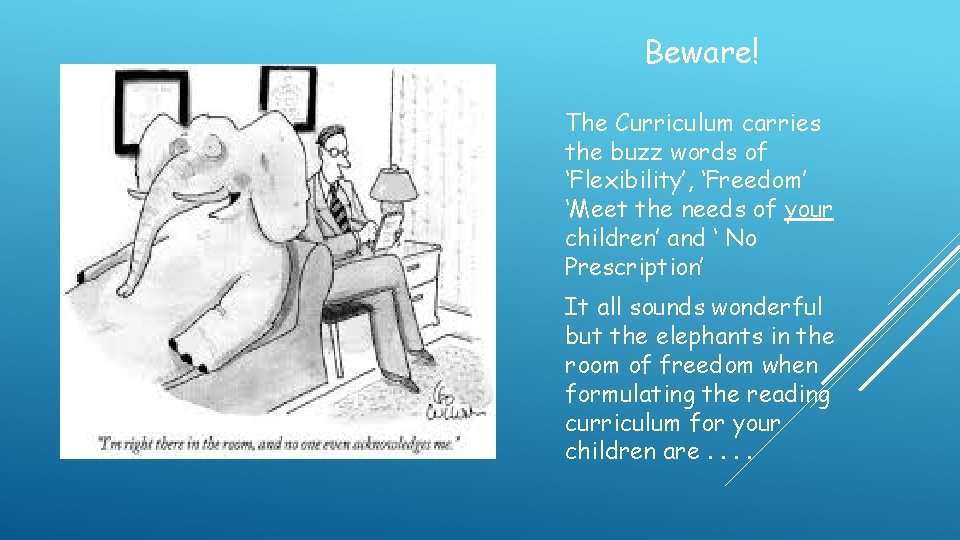
Beware! The Curriculum carries the buzz words of ‘Flexibility’, ‘Freedom’ ‘Meet the needs of your children’ and ‘ No Prescription’ It all sounds wonderful but the elephants in the room of freedom when formulating the reading curriculum for your children are. .
Ofsted and Assessment • • • Have freedom to be flexible whilst maintaining the highest standards! Ofsted will look for progress made in every lesson by every child and book enjoyment – see ‘Getting them Reading early’ – Ofsted Training Manual Questions Year Group Expectations are much higher (since Sept 2015) Only 66% of children nationally met the KS 2 reading standard in 2016 compared to 91% in 2015
Planning a unit in the English Curriculum Challenges- Freedom, Content has higher expectations, Change in outcome emphasis, more vocabulary/spoken language development needed throughout ‘Being a reader’ rather than ‘reading’ All units are writing outcomes driven and the reading is to gather ideas, learn things from, analyse the structure of etc. With creative freedom comes less structure but more responsibility – must be constantly mindful of end of year expectations Opportunities – Freedom, an opportunity to be creative and to meet the needs of your class or children and their particular interests
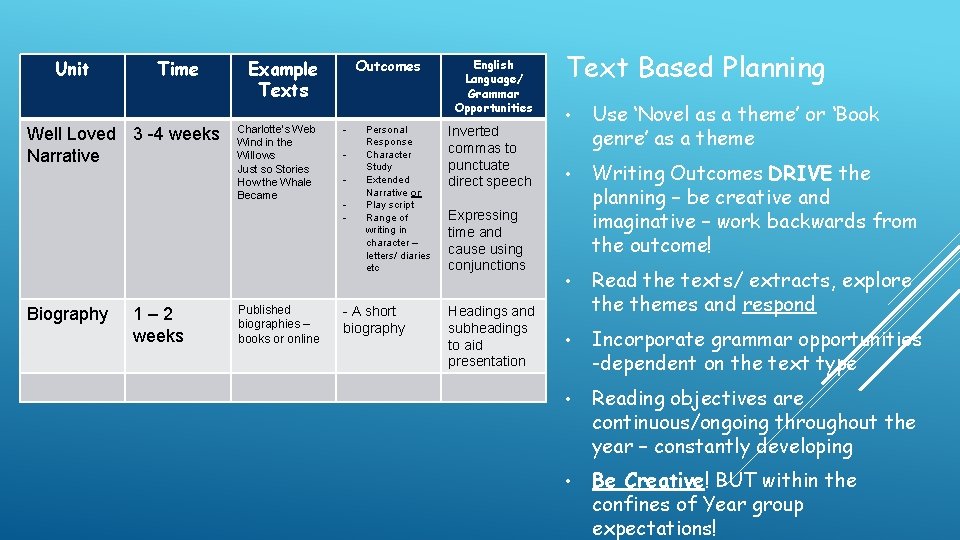
Unit Time Well Loved 3 -4 weeks Narrative Biography 1 – 2 weeks Example Texts Charlotte’s Web Wind in the Willows Just so Stories How the Whale Became Published biographies – books or online Outcomes - Personal Response Character Study Extended Narrative or Play script Range of writing in character – letters/ diaries etc - A short biography English Language/ Grammar Opportunities Inverted commas to punctuate direct speech Expressing time and cause using conjunctions Headings and subheadings to aid presentation Text Based Planning • Use ‘Novel as a theme’ or ‘Book genre’ as a theme • Writing Outcomes DRIVE the planning – be creative and imaginative – work backwards from the outcome! • Read the texts/ extracts, explore themes and respond • Incorporate grammar opportunities -dependent on the text type • Reading objectives are continuous/ongoing throughout the year – constantly developing • Be Creative! BUT within the confines of Year group expectations!
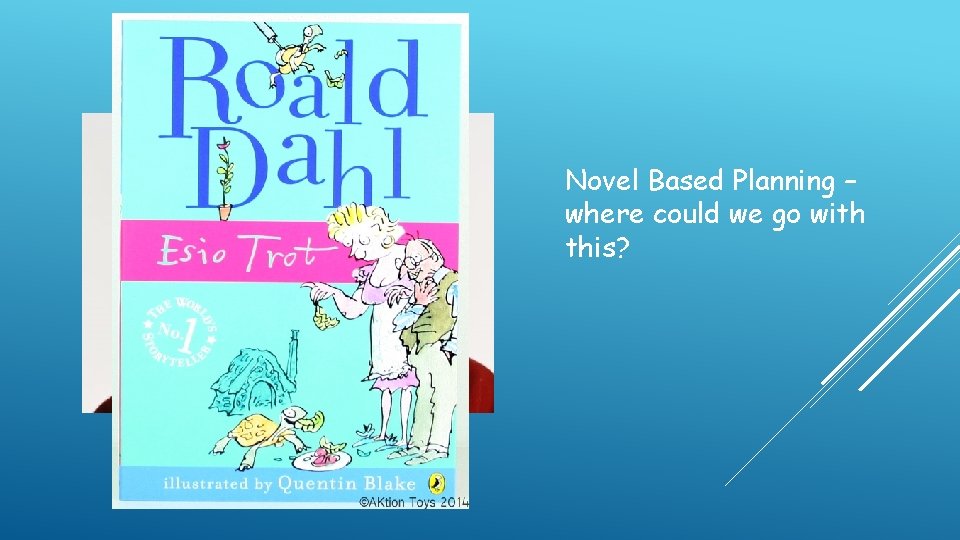
Novel Based Planning – where could we go with this?
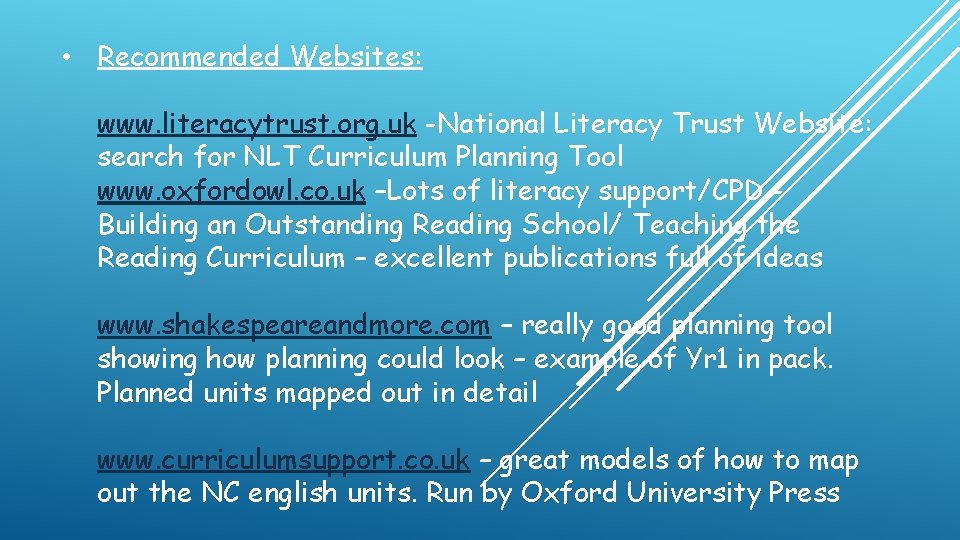
• Recommended Websites: www. literacytrust. org. uk -National Literacy Trust Website: search for NLT Curriculum Planning Tool www. oxfordowl. co. uk –Lots of literacy support/CPD Building an Outstanding Reading School/ Teaching the Reading Curriculum – excellent publications full of ideas www. shakespeareandmore. com – really good planning tool showing how planning could look – example of Yr 1 in pack. Planned units mapped out in detail www. curriculumsupport. co. uk – great models of how to map out the NC english units. Run by Oxford University Press
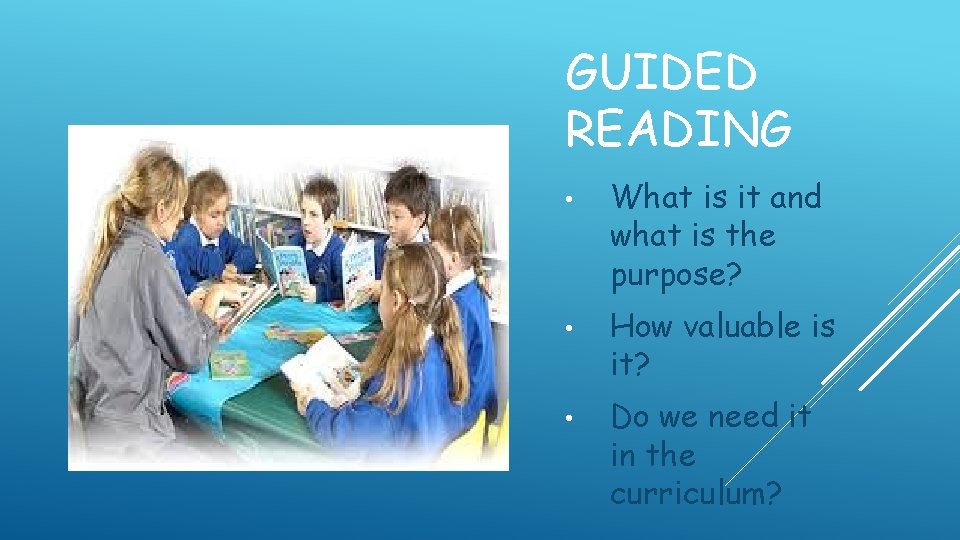
GUIDED READING • What is it and what is the purpose? • How valuable is it? • Do we need it in the curriculum?
The most powerful tool in teaching reading. . If done properly! From the earliest stages it incorporates the development of phonic decoding strategies through to the comprehension of the text at the individualised level of each group of children
KS 2 READING CONTENT DOMAINS • • • What are they? Just ‘reading more’ does not guarantee better readers – must be focused on developing comprehension skills Used to assess reading ability and set the questions in the Sat’s
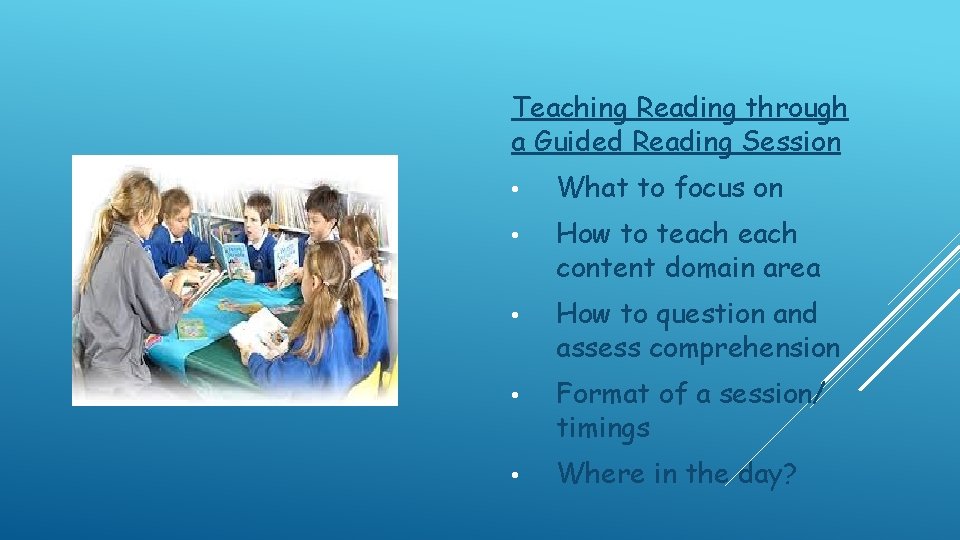
Teaching Reading through a Guided Reading Session • What to focus on • How to teach content domain area • How to question and assess comprehension • Format of a session/ timings • Where in the day?
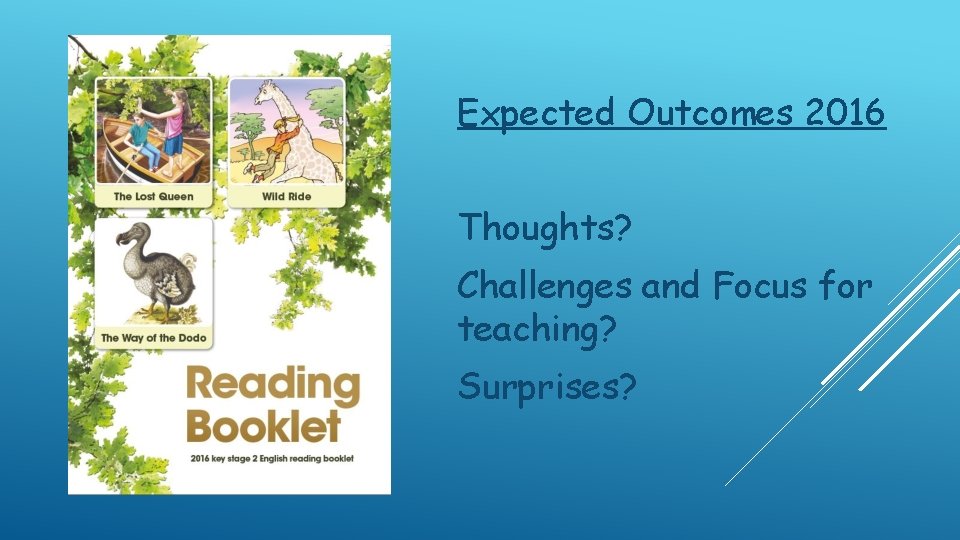
Expected Outcomes 2016 Thoughts? Challenges and Focus for teaching? Surprises?
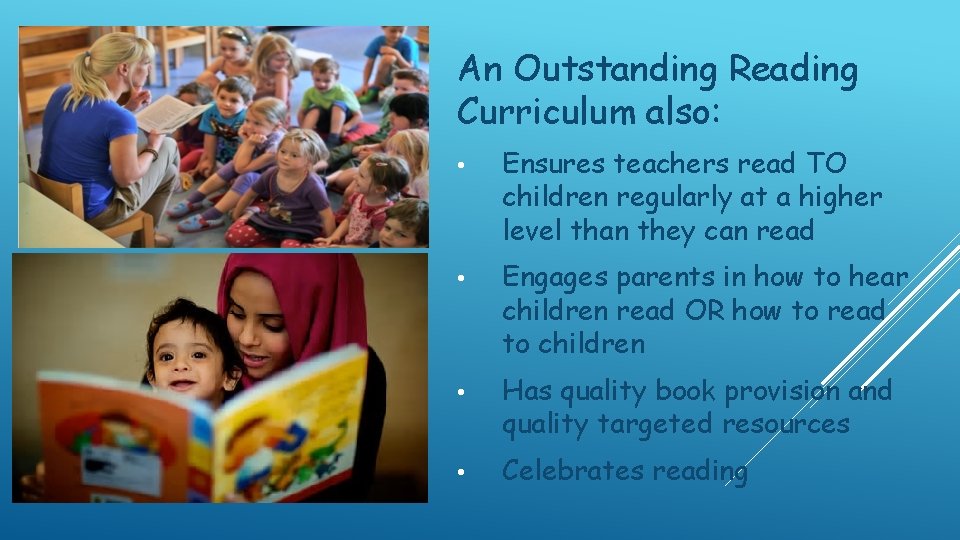
An Outstanding Reading Curriculum also: • Ensures teachers read TO children regularly at a higher level than they can read • Engages parents in how to hear children read OR how to read to children • Has quality book provision and quality targeted resources • Celebrates reading
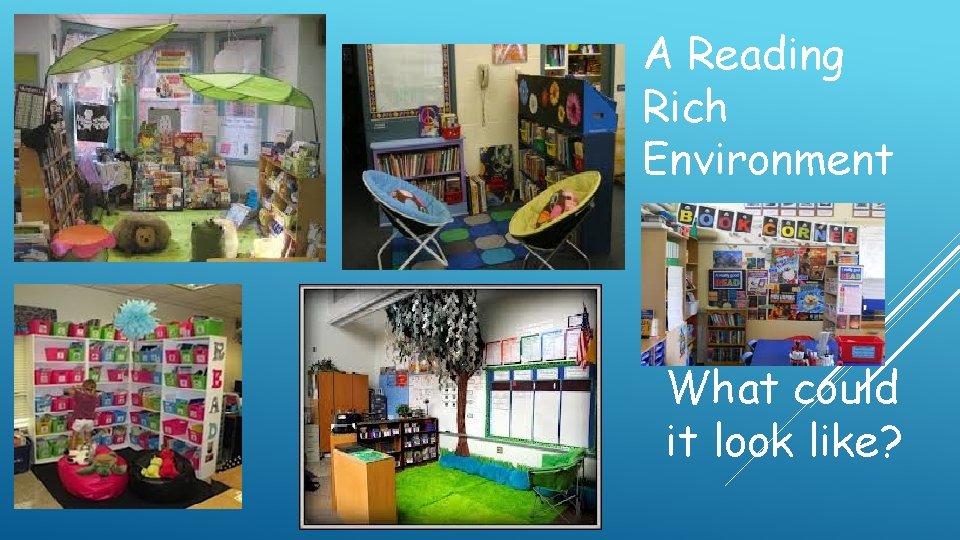
A Reading Rich Environment What could it look like?
"If you read the world is yours. ” Michael Rosen – Former Children’s Laureate
- Slides: 35