
TEACHING POINTS INTEGERS Properties of Multiplication of Integers
- Slides: 9
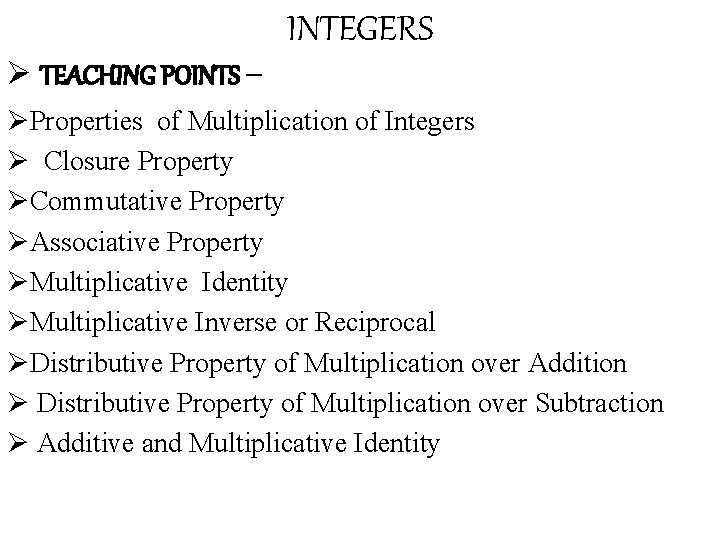
Ø TEACHING POINTS – INTEGERS ØProperties of Multiplication of Integers Ø Closure Property ØCommutative Property ØAssociative Property ØMultiplicative Identity ØMultiplicative Inverse or Reciprocal ØDistributive Property of Multiplication over Addition Ø Distributive Property of Multiplication over Subtraction Ø Additive and Multiplicative Identity
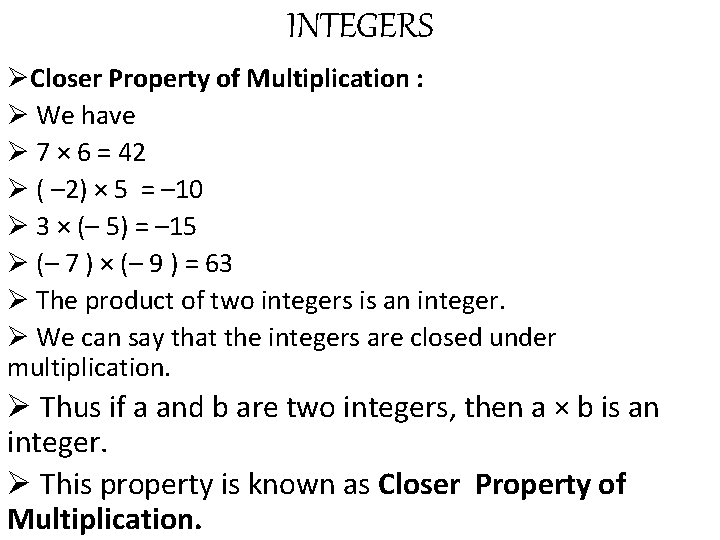
INTEGERS ØCloser Property of Multiplication : Ø We have Ø 7 × 6 = 42 Ø ( – 2) × 5 = – 10 Ø 3 × (– 5) = – 15 Ø (– 7 ) × (– 9 ) = 63 Ø The product of two integers is an integer. Ø We can say that the integers are closed under multiplication. Ø Thus if a and b are two integers, then a × b is an integer. Ø This property is known as Closer Property of Multiplication.
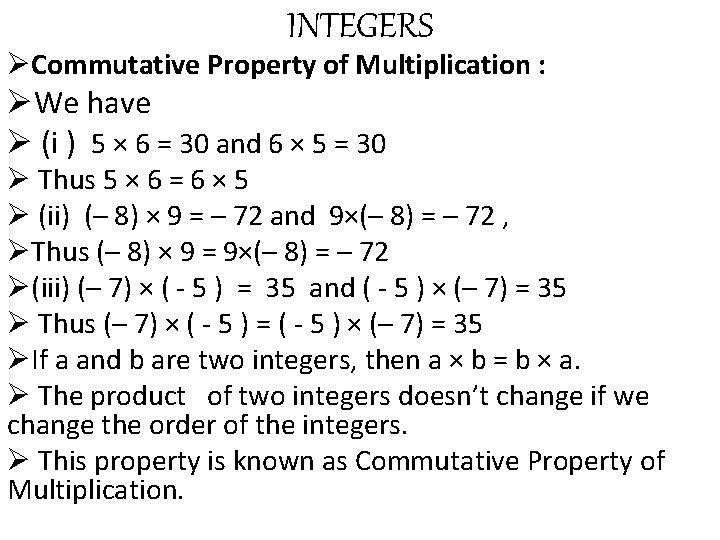
INTEGERS ØCommutative Property of Multiplication : ØWe have Ø (i ) 5 × 6 = 30 and 6 × 5 = 30 Ø Thus 5 × 6 = 6 × 5 Ø (ii) (– 8) × 9 = – 72 and 9×(– 8) = – 72 , ØThus (– 8) × 9 = 9×(– 8) = – 72 Ø(iii) (– 7) × ( - 5 ) = 35 and ( - 5 ) × (– 7) = 35 Ø Thus (– 7) × ( - 5 ) = ( - 5 ) × (– 7) = 35 ØIf a and b are two integers, then a × b = b × a. Ø The product of two integers doesn’t change if we change the order of the integers. Ø This property is known as Commutative Property of Multiplication.
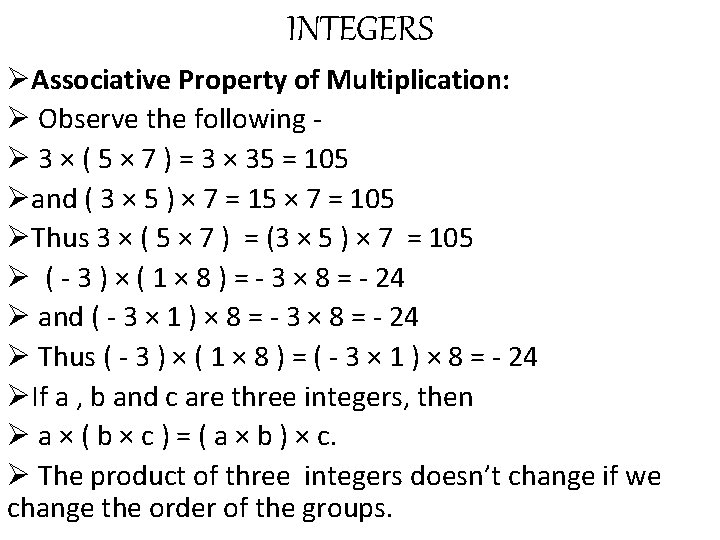
INTEGERS ØAssociative Property of Multiplication: Ø Observe the following Ø 3 × ( 5 × 7 ) = 3 × 35 = 105 Øand ( 3 × 5 ) × 7 = 15 × 7 = 105 ØThus 3 × ( 5 × 7 ) = (3 × 5 ) × 7 = 105 Ø ( - 3 ) × ( 1 × 8 ) = - 3 × 8 = - 24 Ø and ( - 3 × 1 ) × 8 = - 3 × 8 = - 24 Ø Thus ( - 3 ) × ( 1 × 8 ) = ( - 3 × 1 ) × 8 = - 24 ØIf a , b and c are three integers, then Ø a × ( b × c ) = ( a × b ) × c. Ø The product of three integers doesn’t change if we change the order of the groups.
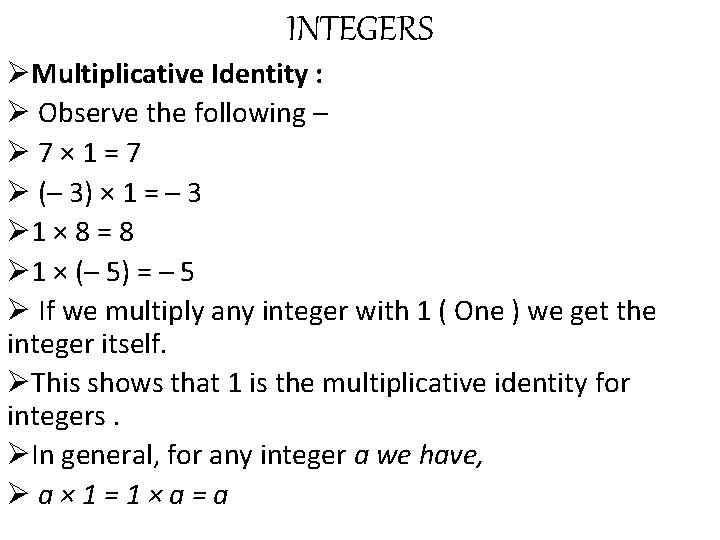
INTEGERS ØMultiplicative Identity : Ø Observe the following – Ø 7× 1=7 Ø (– 3) × 1 = – 3 Ø 1 × 8 = 8 Ø 1 × (– 5) = – 5 Ø If we multiply any integer with 1 ( One ) we get the integer itself. ØThis shows that 1 is the multiplicative identity for integers. ØIn general, for any integer a we have, Øa× 1=1×a=a
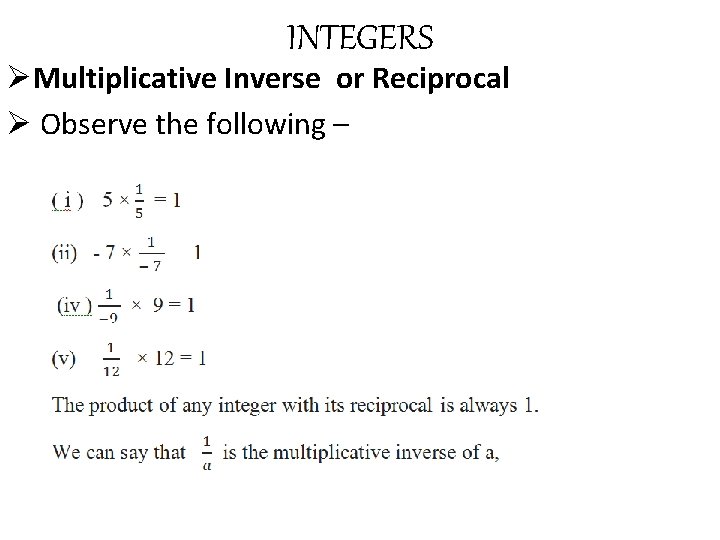
INTEGERS ØMultiplicative Inverse or Reciprocal Ø Observe the following –
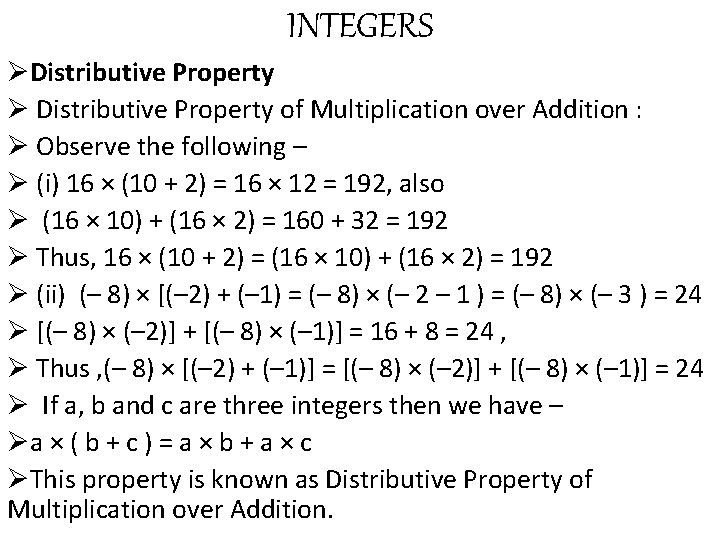
INTEGERS ØDistributive Property Ø Distributive Property of Multiplication over Addition : Ø Observe the following – Ø (i) 16 × (10 + 2) = 16 × 12 = 192, also Ø (16 × 10) + (16 × 2) = 160 + 32 = 192 Ø Thus, 16 × (10 + 2) = (16 × 10) + (16 × 2) = 192 Ø (ii) (– 8) × [(– 2) + (– 1) = (– 8) × (– 2 – 1 ) = (– 8) × (– 3 ) = 24 Ø [(– 8) × (– 2)] + [(– 8) × (– 1)] = 16 + 8 = 24 , Ø Thus , (– 8) × [(– 2) + (– 1)] = [(– 8) × (– 2)] + [(– 8) × (– 1)] = 24 Ø If a, b and c are three integers then we have – Øa × ( b + c ) = a × b + a × c ØThis property is known as Distributive Property of Multiplication over Addition.
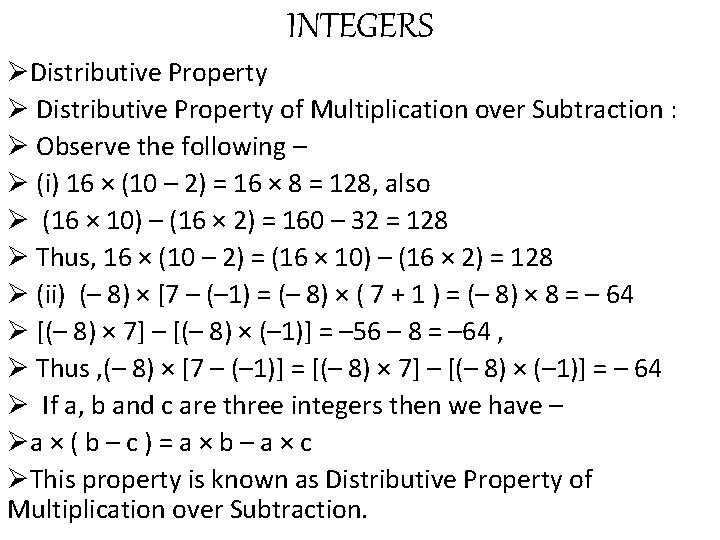
INTEGERS ØDistributive Property Ø Distributive Property of Multiplication over Subtraction : Ø Observe the following – Ø (i) 16 × (10 – 2) = 16 × 8 = 128, also Ø (16 × 10) – (16 × 2) = 160 – 32 = 128 Ø Thus, 16 × (10 – 2) = (16 × 10) – (16 × 2) = 128 Ø (ii) (– 8) × [7 – (– 1) = (– 8) × ( 7 + 1 ) = (– 8) × 8 = – 64 Ø [(– 8) × 7] – [(– 8) × (– 1)] = – 56 – 8 = – 64 , Ø Thus , (– 8) × [7 – (– 1)] = [(– 8) × 7] – [(– 8) × (– 1)] = – 64 Ø If a, b and c are three integers then we have – Øa × ( b – c ) = a × b – a × c ØThis property is known as Distributive Property of Multiplication over Subtraction.
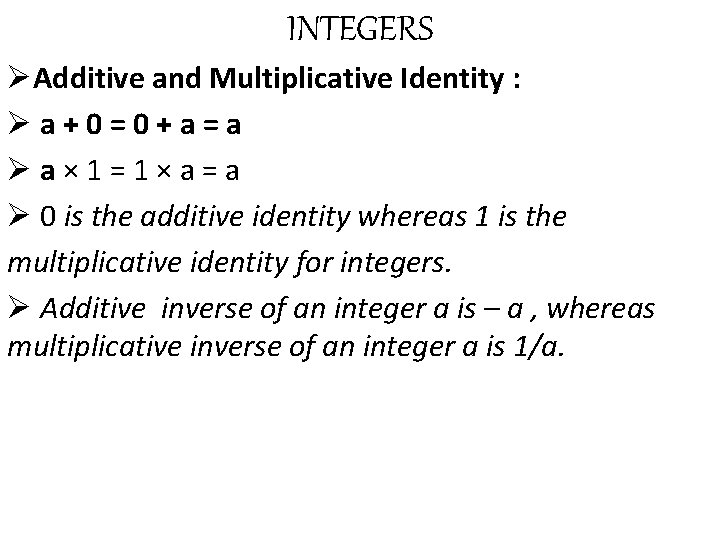
INTEGERS ØAdditive and Multiplicative Identity : Øa+0=0+a=a Øa× 1=1×a=a Ø 0 is the additive identity whereas 1 is the multiplicative identity for integers. Ø Additive inverse of an integer a is – a , whereas multiplicative inverse of an integer a is 1/a.