
Teaching methods Lecturing Seminars Dr Mai AlMaghtheh Overview




- Slides: 64
Teaching methods - Lecturing - Seminars Dr Mai Al-Maghtheh
Overview / ice breaker Context Paradigm shift Brief list of complex teaching approaches Lecturing: ◦ Transmission vs engagement lecture ◦ Effective (interactive) lecturing ◦ Alternative lecture types Seminar teaching method
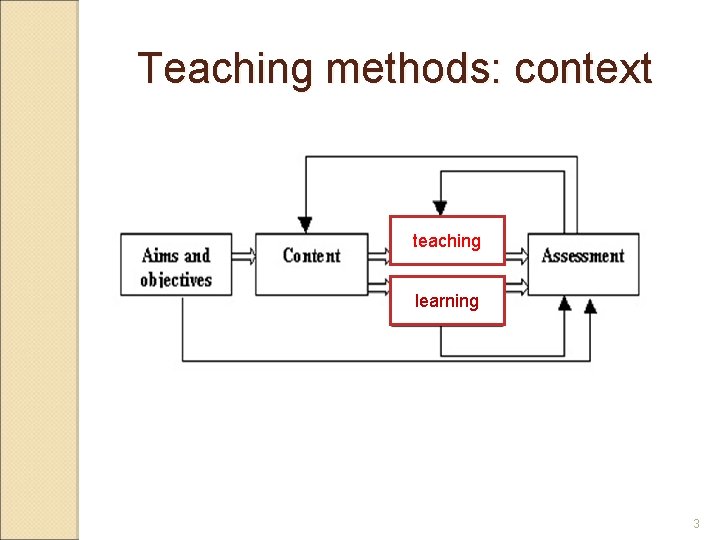
Teaching methods: context teaching learning 3
Quotes: Every truth has four corners: as a teacher I give you one corner, and it is for you to find the other three. (Confucius ) Teaching is truth mediated by personality. Phyllis Brooks The true teacher defends his pupils against his own personal influence. A. Bronson Alcott
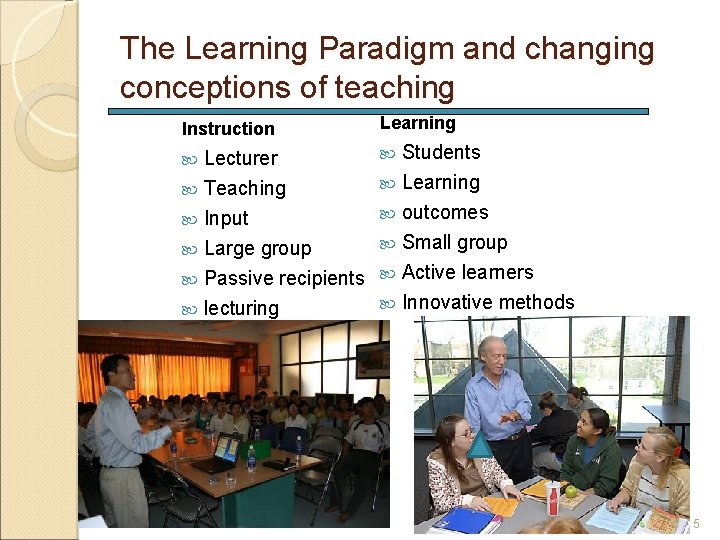
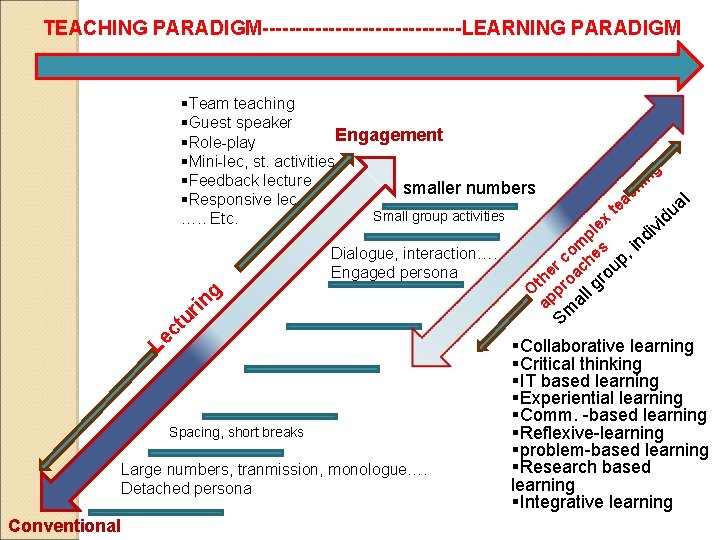
The Learning Paradigm and changing conceptions of teaching Instruction Learning Lecturer Teaching Input Large group Passive recipients lecturing Students Learning outcomes Small group Active learners Innovative methods 5
More on Current trends in teaching and learning Input outcomes Content coverage constructive alignment Knowledge skills in learning Increased focus on evaluation of teaching More sophisticated methodologies Shift towards excellent/scholarly teaching Curriculum Resource Centre: Training Materials
Teaching- learning methods Lecturing- (teaching paradigm) Seminars Complex teaching methods. Innovative (learning paradigm)
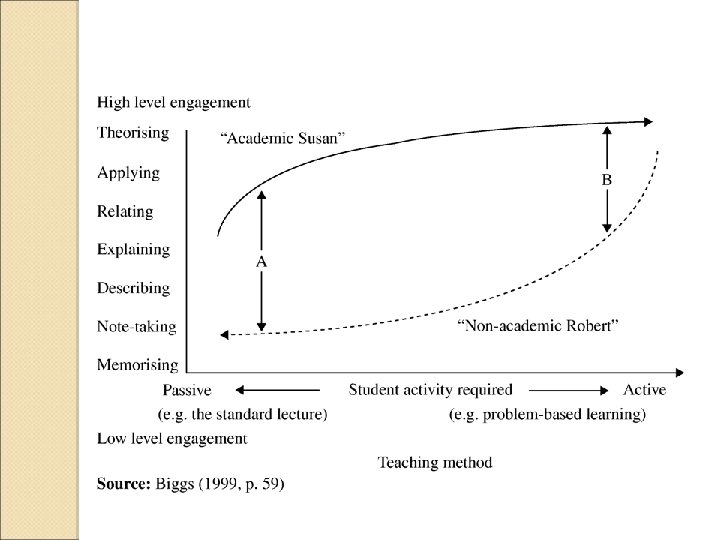
Teaching methods (John Biggs, 1999) “there may be endogenous limits to what students can do that are beyond any teacher’s control…… But there are learning-related aspects that are controllable. Capitalizing on them is what good teaching is about. Good teaching is getting most students to use the higher cognitive level processes, that the more academic students use spontaneously. Good teaching narrows the gap. ”
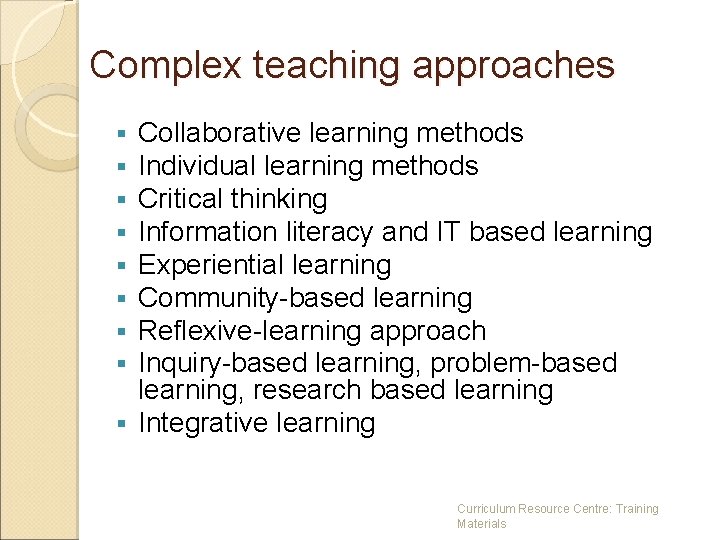
Complex teaching approaches Collaborative learning methods Individual learning methods Critical thinking Information literacy and IT based learning Experiential learning Community-based learning Reflexive-learning approach Inquiry-based learning, problem-based learning, research based learning § Integrative learning § § § § Curriculum Resource Centre: Training Materials
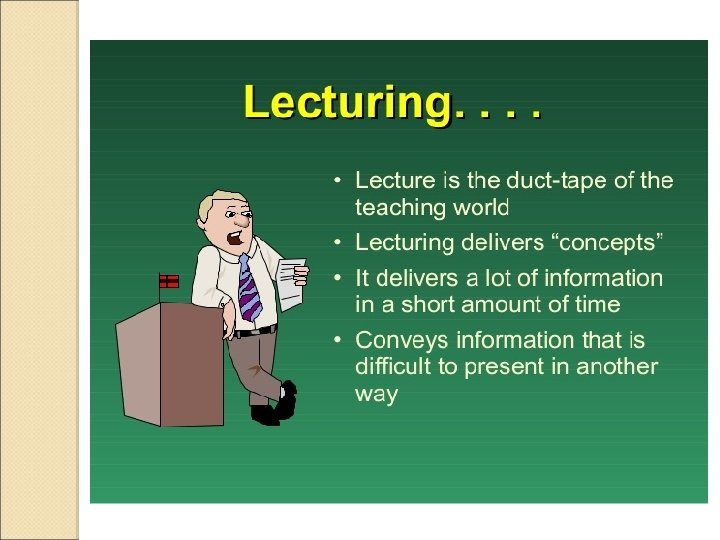
Why Lecturing? ? ? Activity, two groups: Pros and Cons of lecturing….
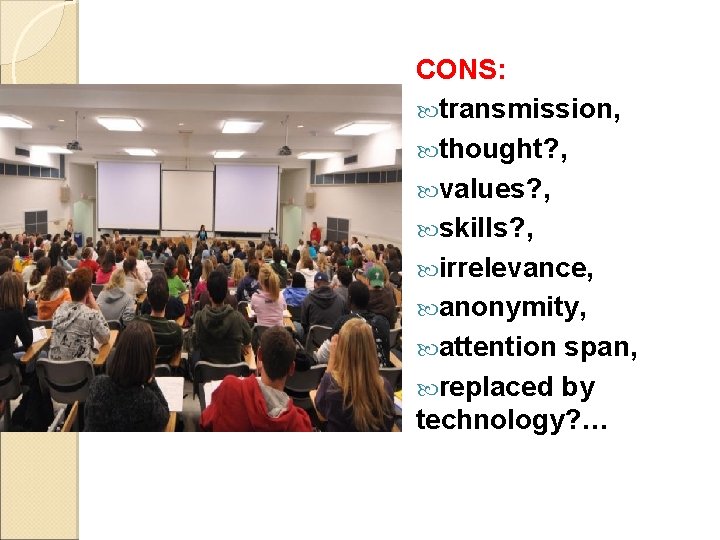
CONS: transmission, thought? , values? , skills? , irrelevance, anonymity, attention span, replaced by technology? …
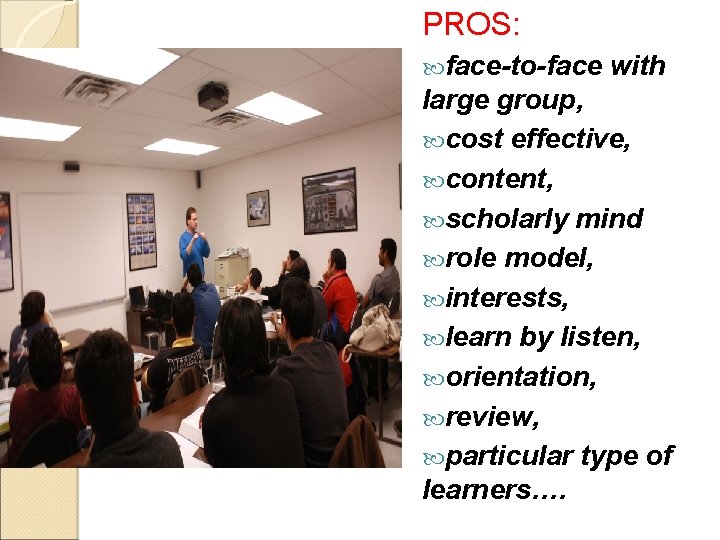
PROS: face-to-face with large group, cost effective, content, scholarly mind role model, interests, learn by listen, orientation, review, particular type of learners….
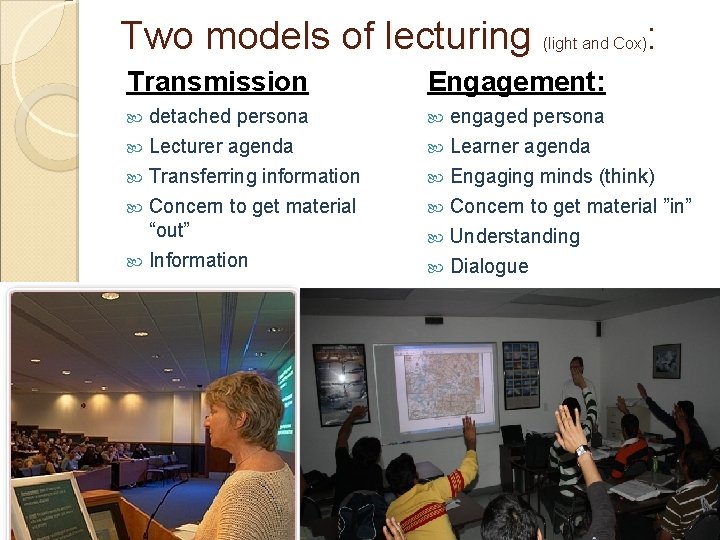
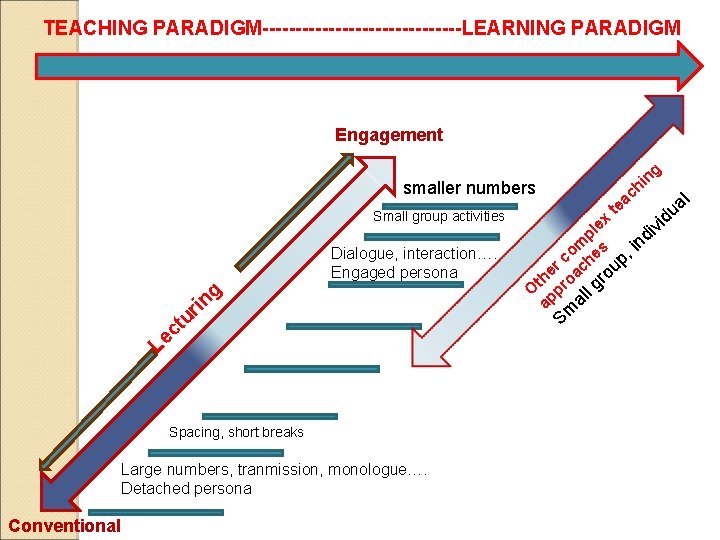
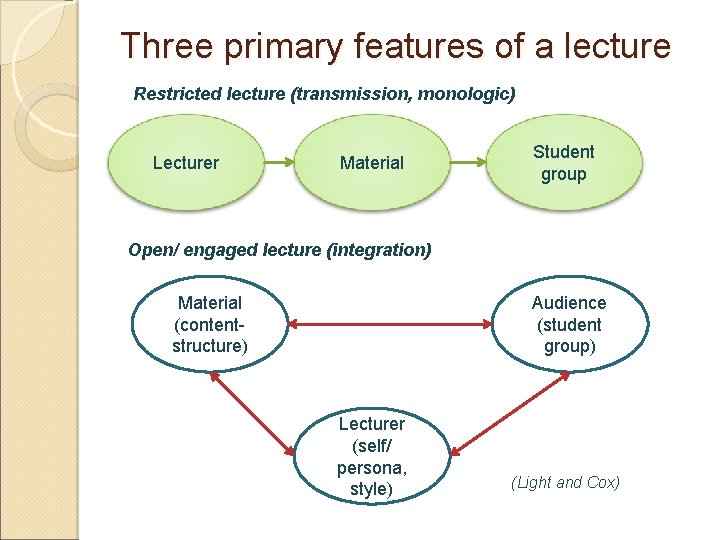
Two models of lecturing (light and Cox): Transmission Engagement: detached persona Lecturer agenda Transferring information Concern to get material “out” Information Monologue engaged persona Learner agenda Engaging minds (think) Concern to get material ”in” Understanding Dialogue
How to make lectures effective / engaging Lectures that engage effective processing Interactive lecturing Sustain student learning
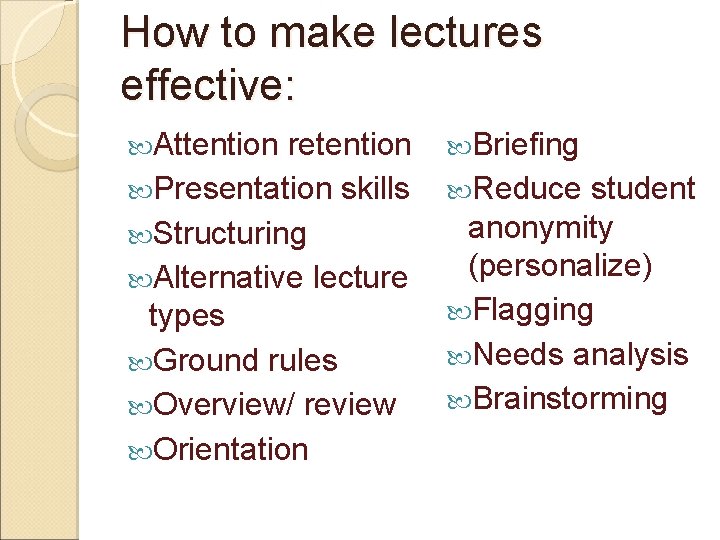
How to make lectures effective: Attention retention Presentation skills Structuring Alternative lecture types Ground rules Overview/ review Orientation Briefing Reduce student anonymity (personalize) Flagging Needs analysis Brainstorming
Managing discussion in a large class ◦ http: //www. youtube. com/watch? v=Enmp. Er. Jye 4&feature=related Eric Mazur shows interactive teaching (teaching physics) http: //www. youtube. com/watch? v=wont 2 v_LZ 1 E Active Learning Classrooms: Everyone is engaged (podium in the middle)! http: //www. youtube. com/watch? v=H 7 xidm. Vt 0 u. E
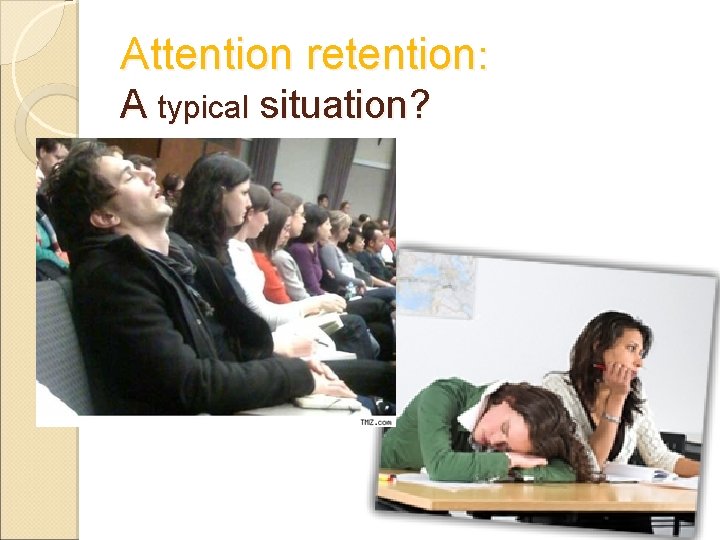
Attention retention: A typical situation?
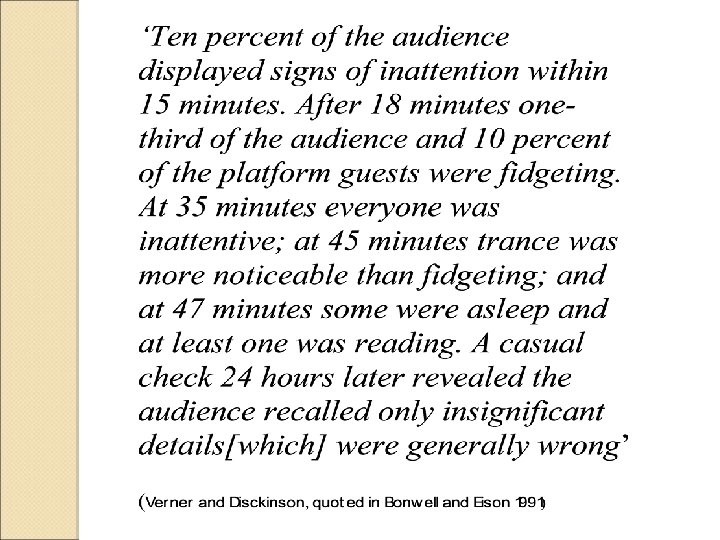
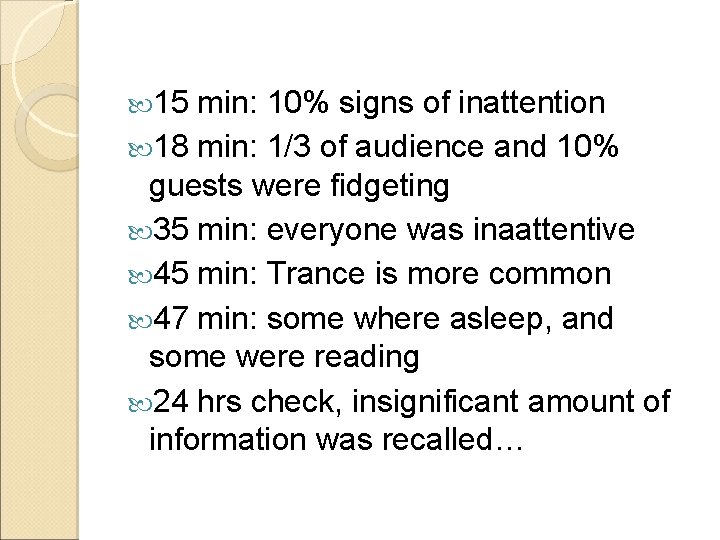
15 min: 10% signs of inattention 18 min: 1/3 of audience and 10% guests were fidgeting 35 min: everyone was inaattentive 45 min: Trance is more common 47 min: some where asleep, and some were reading 24 hrs check, insignificant amount of information was recalled…
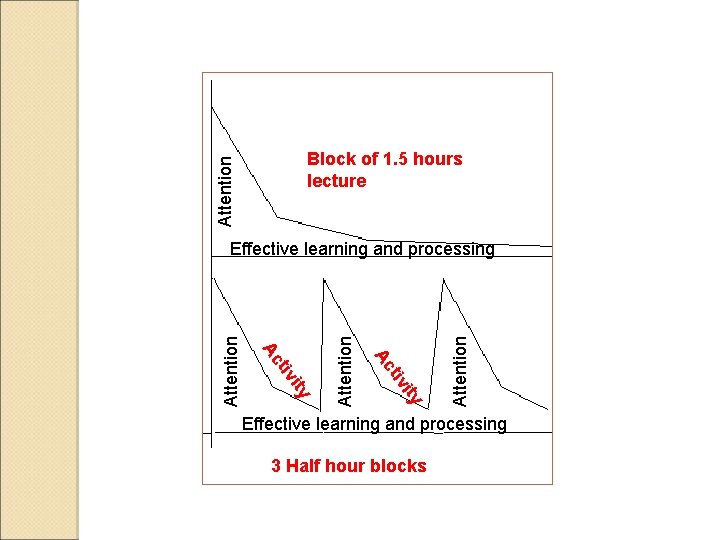
Attention Block of 1. 5 hours lecture Attention ity iv t Ac Attention Effective learning and processing 3 Half hour blocks
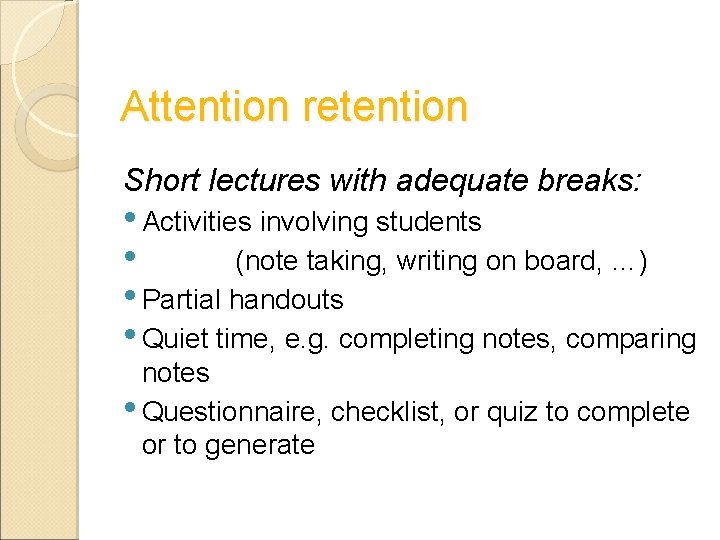
Attention retention Short lectures with adequate breaks: • Activities involving students • (note taking, writing on board, …) • Partial handouts • Quiet time, e. g. completing notes, comparing notes • Questionnaire, checklist, or quiz to complete or to generate
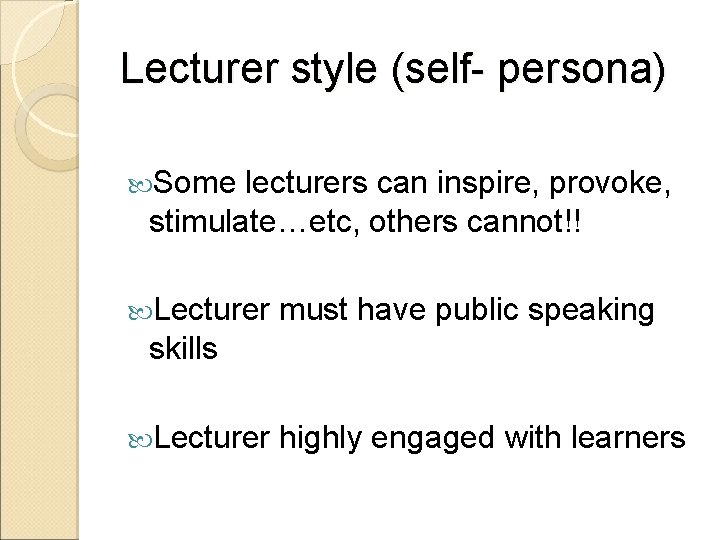
Lecturer style (self- persona) Some lecturers can inspire, provoke, stimulate…etc, others cannot!! Lecturer must have public speaking skills Lecturer highly engaged with learners
Lecturer Style ◦ A quality of birth? ◦ Can it be taught, or learned? . .
What makes a good lecturer Activity: try to remember one of your teachers that you think was distinguished…. Are Great Teachers Born or Made? (3 min) ◦ http: //www. youtube. com/watch? v=Jn. T 4 Kk. T 9 Vbg What makes great teachers great? (28 min, first 5 min are very good) ◦ http: //www. youtube. com/watch? v=FXa. LGt 460 e 4 ◦ (Richard Gerver: author: “creating tomorrow’s schools today”
Presentation skills Eye contact Posture, movement ◦ Appropriate posture, movement, gesture (1. confident 2. relaxed 3. varied 4. empathy…. . )
Body language ◦ involving the audience ◦ Call students by their name (memorize names) Visual aids Voice and pacing
Lecturer style: Using visual images and other mnemonic techniques Mental images, vivid examples Visual images: graphs, figures, pictures, slides, films…etc. Analogies (e. g. tables) Dramatization: e. g. personalisations, story, humour, movement, visuals… Humour (jokes…) Strategic placement of enthusiasm
Presenting information to engage students in effective processing (learning) Well spaced repetitions of information within and across lectures. Inducing encoding variability. Interrogating for elaboration.
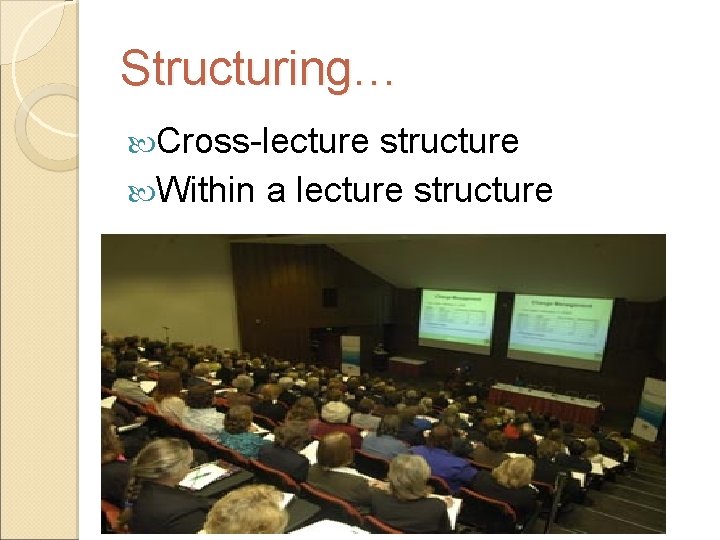
Structuring… Cross-lecture structure Within a lecture structure
Types of structuring: Progressive structure (maths) Chronological (history) Smaller to larger (matter, chemistry, biology) inside to outside (landscape, architect) Simultaneous structure: (parallel issues, technology and ethics or phylosophy)
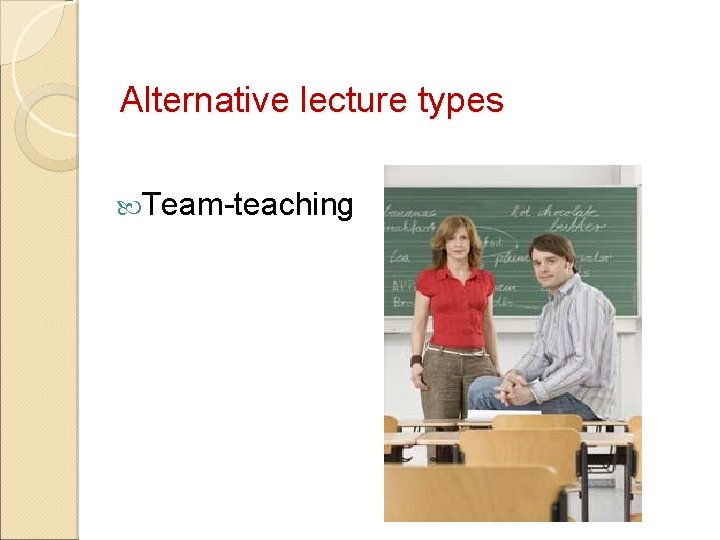
Alternative lecture types Team-teaching
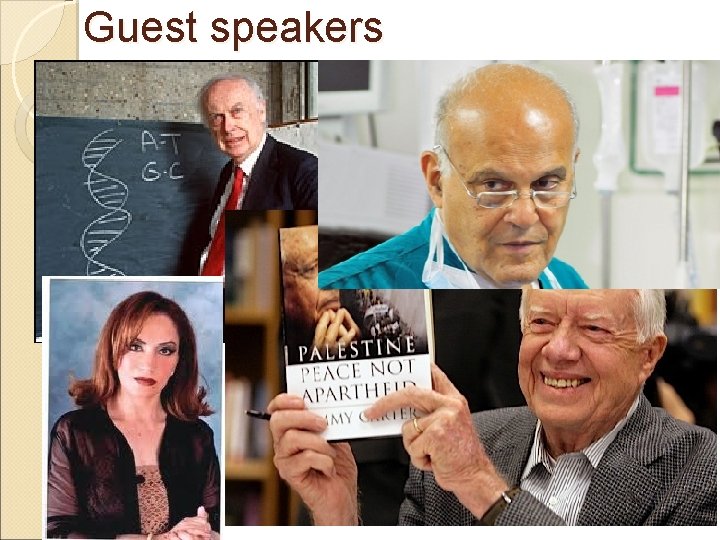
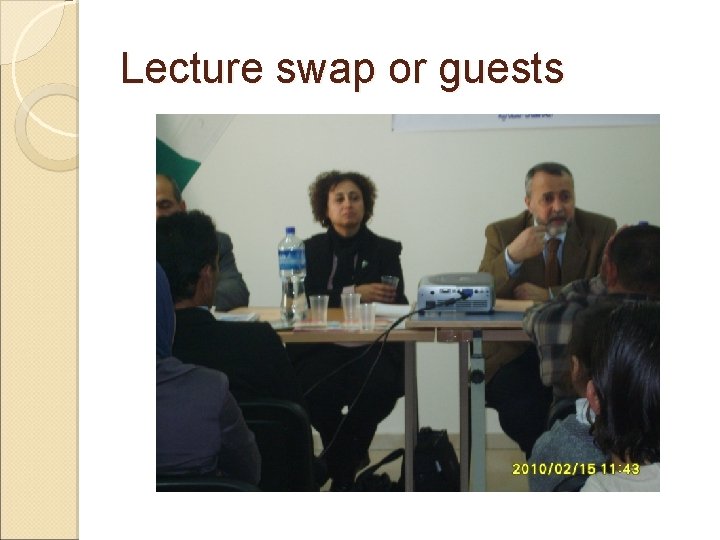
Guest speakers
Role-play lectures [Neural fold acting (biology) http: //www. youtube. com/watch? v=BWcvyip. Tb. LQ&NR=1] Mini-lecture with student activities [Implementing Interactive Activities in a Large Class to Build Community ◦http: //www. youtube. com/watch? v=Reef. NPd. Zw. Vo&feature=related (large theatre)] Guided lecture (study guide by lecturer, 2 chunks with activity in between)
Feedback lecture (25 -30 min, followed by small group work, reconstruction) The responsive lecture (one lecture every 2 -3 weeks to respond to questions) Others…? ?
Other Lecturing tips: Ground rules (management styles): implicit vs. explicit ◦ Responsibility of lecture ◦ Lecturer interruption ◦ Students asking question ◦ Attending lectures (do as you preach!!)
Overview, review ◦ Introduction lecture (week zero lecture) ◦ Should be used to remind students through the course ◦ End of term revision
Orientation: ◦ -initial few miniutes (turn attention to subject) ◦ Title or some key words on board or OHPs… ◦ Students predict the main points of the session
Briefing Describes: Sort of lecture Sort of learning activity Why rather than what going to say… (objectives). .
Flagging Draw attention to particular tasks, activities, … Break lectures into distinct sections. Use a hook.
Needs analysis Initial few minutes ◦ gain as much information: Students preparation Not to test of student knowledge, rather encourage them to manage their learning…
Brainstorming Useful to introduce topic Response to a question Elicit points write on board
TEACHING PARADIGM---------------LEARNING PARADIGM Engagement g smaller numbers Small group activities g Dialogue, interaction…. Engaged persona rin tu c e L Spacing, short breaks Large numbers, tranmission, monologue…. Detached persona Conventional a in h c te id ex v l i p d n m i s co he p, r u e ac th ro gro O pp ll a ma l a u S
Th. An. K Yo. U
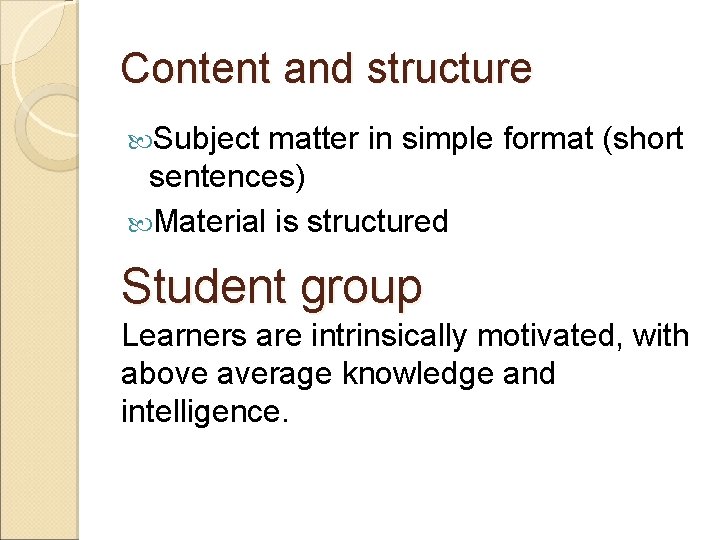
Content and structure Subject matter in simple format (short sentences) Material is structured Student group Learners are intrinsically motivated, with above average knowledge and intelligence.
Three primary features of a lecture Restricted lecture (transmission, monologic) Lecturer Material Student group Open/ engaged lecture (integration) Material (contentstructure) Audience (student group) Lecturer (self/ persona, style) (Light and Cox)
Good to see: http: //www. youtube. com/watch? v=q. Xg. X 2 WEr. XQo
Students in the best of circumstances and in their own language can take a max of 5 concepts and hour, any more will start pushing the first ones outside….
Lecture swap or guests
http: //www. youtube. com/watch? v=l. Ccl. Tgec. Lo. I (GMOs) http: //www. youtube. com/watch? v=ds. TY 7 WDWX 8&feature=related (do it)
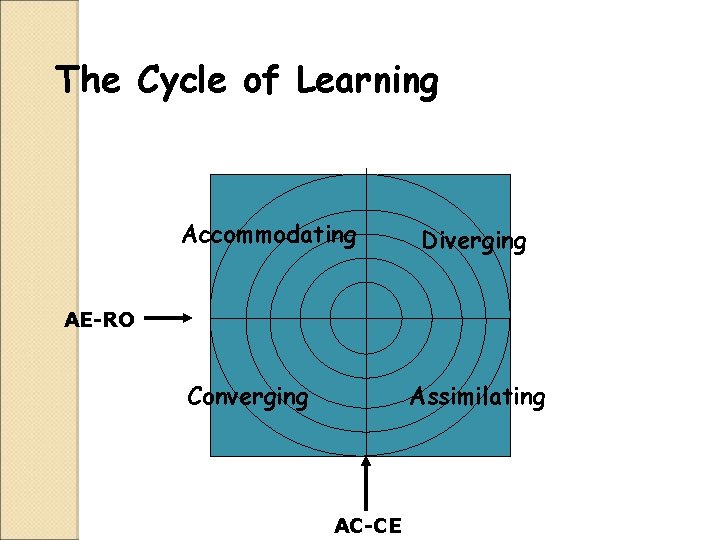
The Cycle of Learning Accommodating Diverging AE-RO Converging Assimilating AC-CE
Th. An. K Yo. U
TEACHING PARADIGM---------------LEARNING PARADIGM §Team teaching §Guest speaker Engagement §Role-play §Mini-lec, st. activities §Feedback lecture smaller numbers §Responsive lec. Small group activities …. . Etc. g Dialogue, interaction…. Engaged persona rin tu c e L Spacing, short breaks Large numbers, tranmission, monologue…. Detached persona Conventional g te a in h c id ex v l i p d n m i s co he p, r u e ac th ro gro O pp ll a ma l a u S §Collaborative learning §Critical thinking §IT based learning §Experiential learning §Comm. -based learning §Reflexive-learning §problem-based learning §Research based learning §Integrative learning
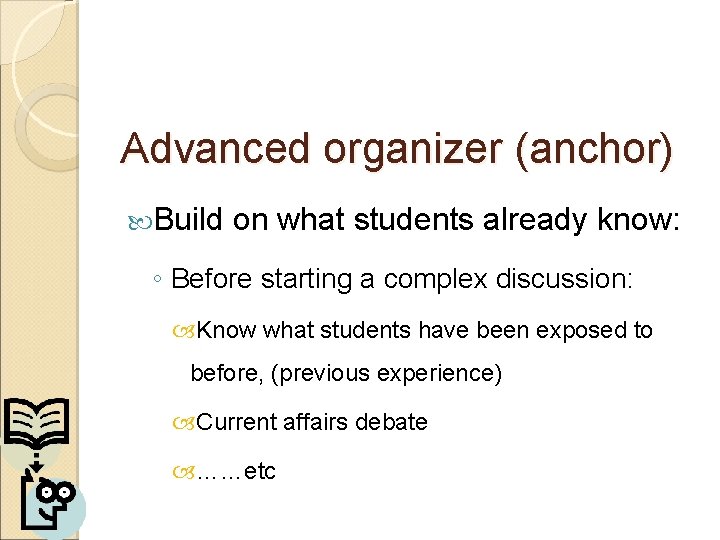
Advanced organizer (anchor) Build on what students already know: ◦ Before starting a complex discussion: Know what students have been exposed to before, (previous experience) Current affairs debate ……etc
◦ Association with pre-existing knowledge. ◦ Elaboration leads to better memory 3 - Generation and retrieval practice (active learning) ◦ Production of information (solutions to math problems, producing a word, definition, ) ◦ Retrieval, to know what student know or
Feb 2011
Tips on effective lecturing Mai Almaghtheh