
Teaching Methods in Tertiary Institutions Professor Samuel F
- Slides: 35
Teaching Methods in Tertiary Institutions Professor Samuel F. OGUNDARE Tai Solarin University of Education, Ijagun, Ijebu-Ode, Ogun State
Introduction: Teacher Accountability • Accountability is the state of being liable, blameworthy or answerable, and the expectation of account-giving. • It is responsibility to someone or for some activity. • Are the teachers doing their job to requirements? What are professional responsibilities of teachers? • These are: subject matter knowledge, skill in planning and delivering instruction that engages students, ability to address issues of equity and diversity in the classroom, and ability to monitor and assess student learning and adjust instruction accordingly. • A few others are: classroom management, student discipline and attendance patterns, interest in teaching pupils, and effort towards improvement when needed. • Another way teachers can be held accountable is by students achieving passing scores on standardized tests.
TEACHING • TEACHING: The entire teacher’ activities, student’s activities, including the utilization of materials, that result in learning. • Learning: observable, testable, measurable and relatively permanent change in behavior. • Teaching Equation: • T=P+D+E where T is Teaching, P is Planning, D is Delivery and E is Evaluation (Evaluation is outside today’s presentation) • The two most essential teaching skills are the ability to demonstrate and the ability to explain. Both are vital to the success of either an operation lesson or an information lesson
PLANNING • • Course contents and description, Reading list, Assignments Lesson plan
DELIVERY • A teaching method comprises the principles and methods used by teachers to enable student learning • These strategies are determined partly on subject matter to be taught and partly by the nature of the learner. • For a particular teaching method to be appropriate and efficient it has to be in relation with the characteristic of the learner and the type of learning it is supposed to bring about.
CATEGORIES OF TEACHING METHODS • • teacher-centred methods, learner-centred methods, content-focused methods interactive/participative methods.
Instructor/Teacher Centred Methods § Here the teacher casts himself/herself in the role of being a master of the subject matter. § The teacher is looked upon by the learners as an expert or an authority. § Learners on the other hand are presumed to be passive and copious recipients of knowledge from the teacher. § Examples of such methods are expository or lecture methods - which require little or no involvement of learners in the teaching process. It is also for this lack of involvement of the learners in what they are taught, that such methods are called “closed-ended”.
Learner-Centred Methods • In learner-centred methods, the teacher/instructor is both a teacher and a learner at the same time. • The teacher, “becomes a resource rather than an authority”. • Examples of learner-centred methods are discussion method, discovery or inquiry based approach and the Hill’s model of learning through discussion (LTD).
Content-Focused Methods • In this category of methods, both the teacher and the learners have to fit into the content that is taught. • Generally, this means the information and skills to be taught are regarded as sacrosanct or very important. • A lot of emphasis is laid on the clarity and careful analyses of content. • Both the teacher and the learners cannot alter or become critical of anything to do with the content. • An example of a method which subordinates the interests of the teacher and learners to the content is the programmed learning approach.
Interactive/Participative Methods: • This fourth category borrows a bit from the three other methods without necessarily laying emphasis unduly on either the learner, content or teacher. • These methods are driven by the situational analysis of what is the most appropriate thing for us to learn/do now given the situation of learners and the teacher. • They require a participatory understanding of varied domains and factors.
THE LECTURE METHOD A formal or semi-formal discourse is which the instructor presents a series of events, facts, or principles, explores a problem or explains relationships USES 1. To orientate students. 2. To introduce a subject. 3. To give directions on procedures. 4. To present basic material. 5. To introduce a demonstration, discussion, or performance. 6. To illustrate application of rules, principles, or concepts. 7. To review, clarify, emphasise or summarise.
Advantages of Lecture Method • 1. Saves time. 2. Permits flexibility. 3. Requires less rigid space requirement. 4. Permits adaptability. 5. Permits versatility. 6. Permits better centre over contact and sequence.
Disadvantages of Lecture Method 1. Involves one way communication. 2. Poses problems in skill teaching. 3. Encourages student passiveness. 4. Poses difficulty in gauging student reaction. 5. Require highly skilled instructors.
Qualities of a Good Lecture • 1. A good lecture should not be too long as to exceed the trainees attention span (up to 25 minutes). • 2. A good lecture should address a single theme. • 3. In a good lecture technical terms are carefully explained. • 4. Familiar examples and analogies are given. • 5. A good lecture establishes fluency in technical content. • 6. A good lecture uses illustrations and examples. • 7. A good lecture builds on existing knowledge. • 8. A good lecture employs a variety of approaches.
THE DISCUSSION METHOD • • A method in which group discussion techniques are used to reach instructional objectives. It involves two-way communication between participants. In the classroom situation an instructor and trainees all participate in discussion. During discussion, the instructor spends some time listening while the trainees spend sometimes talking. The discussion is, therefore, a more active learning experience for the trainees than the lecture. A discussion is the means by which people share experiences, ideas and attitudes. SITTING MODELES: A, C, D, H, O, U, X, V As it helps to foster trainees involvement in what they are learning, it may contribute to desired attitudinal changes. Discussion may be used in the classroom for the purpose of lesson development, making trainees apply what they have learnt or to monitor trainees learning by way of feedback.
USES OF DICUSSION METHOD • 1. To develop imaginative solutions to problems. 2. To stimulate thinking and interest and to secure student participation. 3. To emphasise main teaching points. 4. To supplement lectures, reading, or laboratory exercises. 5. To determine how well student understands concepts and principles. 6. To prepare students for application of theory of procedure. 7. To summarise, clarify points or review.
Advantages of Discussion Method • 1. Increase students interest 2. Increases students acceptance and commitments. 3. Utilises student knowledge and experience. 4. Results in more permanent learning because of high degree of student participation.
DISAVANTAGES • 1. Increase students interest 2. Increases students acceptance and commitments. 3. Utilises student knowledge and experience. 4. Results in more permanent learning because of high degree of student participation.
Conducting a Discussion • Discussion sessions can be led by the instructor, or can take place in groups. In either case, the goal is to meet the lesson objectives by allowing the trainees to: • a) Relate relevant personal experiences or events which have occurred in the work setting. • b) Contribute ideas or personal opinions. • c) Apply what has been learned to familiar situations or solving problems. • d) Express what had been learned.
THE DEMONSTRATION METHOD A method of instruction where the instructor by actually performing an operation or doing a job shows the students what to do, how to do it, and through explanations brings out why, where, and when it is done. Demonstration means any planned performance of an occupation skill, scientific principle or experiment. Uses. To teach manipulative operations or procedures. 2. To teach troubleshooting. 3. To illustrate principles. 4. To teach operation or functioning of equipment. 5. To teach teamwork. 6. To set standards of workmanship. 7. To teach safety procedures
Advantages and Disadvantages of Demonstration • Advantages • 1. Minimise damage and waste 2. Saves time 3. Can be presented to large groups • Disadvantages • 1. Require careful preparation and rehearsal. 2. Requires special classroom arrangements.
Teacher Preparation for Demonstration • • Teacher Preparation 1. Rehearse your presentation in advance of the lesson. 2. Anticipate any difficult steps, possible interruptions e. t. c. 3. Obtain all materials, tools, equipment, visual and teaching aids in advance and check their useful condition. 4. Have all materials within reach and conveniently arranged. 5. Time the demonstration NOT to exceed 15 minutes. 6. Remove all extraneous materials; check lighting, visibility, student grouping, and proximity to electric, gas and water outlets. 7. Plan to use a skill or method to advantage; work from simple to complex, one step at a time.
Presentation in Demonstration 1. Make sure all students can see and hear the lesson. 2. Be enthusiastic, professional, effective but not dramatic. 3. Relax; use any mishaps or humour to YOUR advantage. 4. Observe all safety rules and procedures. 5. Keep eye-contact with the class; ask and encourage class questions. • 6. Explain WHY and HOW: use the techniques of SHOW and TELL. • 7. Use a medial summary to strengthen your explanation. • • •
During and after Demonstration • • • • • Carrying Out a Demonstration 1. Give a good performance. Remember that the trainees learn by your good example. 2. Explain each step or process as you proceed. Follow your lesson plan. 3. Make sure the trainees see the demonstration from the angle they will perform it themselves. 4. Be sure everyone can see and hear. Maintain eye contact. 5. Emphasise key points, and if possible prepare before hand ask key questions as you go along and allow trainees to ask questions. 6. Observe all safety rules, precautions and procedures; and emphasise them. 7. Use proper instructions, aids such as chalkboard, charts, handouts e. t. c. to support your demonstration. 8. Provide for trainees participation where possible, during and after demonstration. 9. Demonstrate the correct way only. First impressions are important, therefore, make them correct ones. 10. Always summarise the steps and emphasise key points again. After Demonstration 1. Return all items used during demonstration to their storage places. 2. Make arrangements to have the trainees practice the skill as soon as possible in a practical class session. 3. Observe and analyse trainee(s) performance and correct mistakes. 4. Offer reinforcement where necessary. 5. Coach weak or slow trainees. 6. Check trainee’s completed work for accurate performance and record. 7. Allow sufficient time interval before demonstrating another operation.
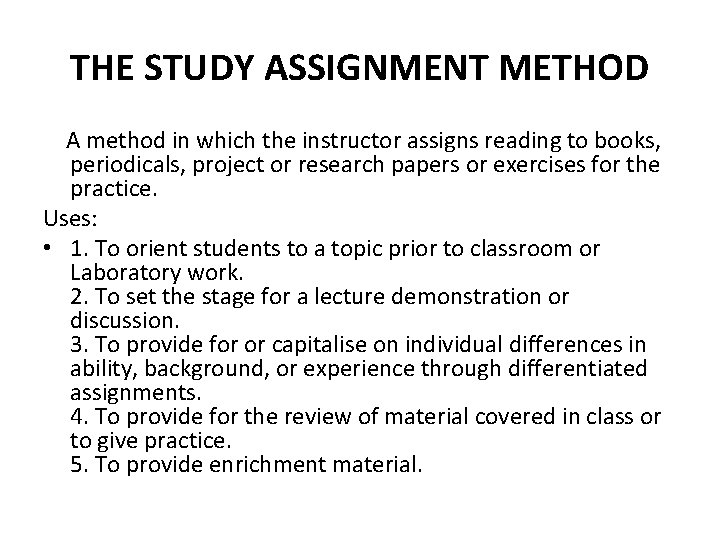
THE STUDY ASSIGNMENT METHOD A method in which the instructor assigns reading to books, periodicals, project or research papers or exercises for the practice. Uses: • 1. To orient students to a topic prior to classroom or Laboratory work. 2. To set the stage for a lecture demonstration or discussion. 3. To provide for or capitalise on individual differences in ability, background, or experience through differentiated assignments. 4. To provide for the review of material covered in class or to give practice. 5. To provide enrichment material.
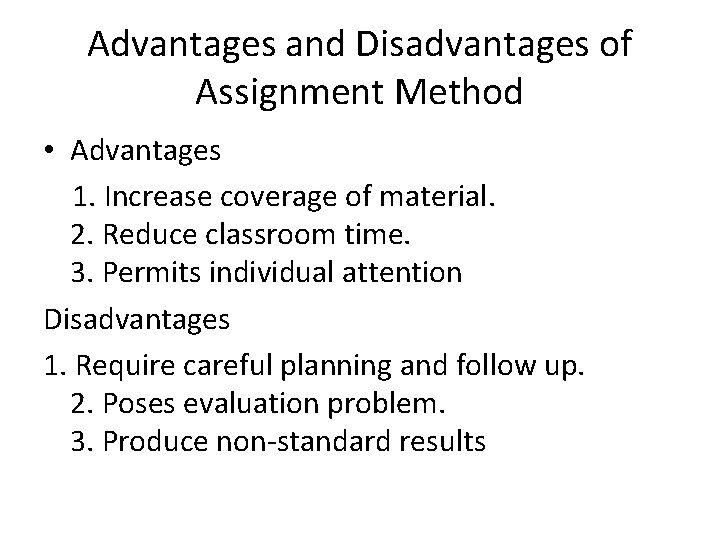
Advantages and Disadvantages of Assignment Method • Advantages 1. Increase coverage of material. 2. Reduce classroom time. 3. Permits individual attention Disadvantages 1. Require careful planning and follow up. 2. Poses evaluation problem. 3. Produce non-standard results
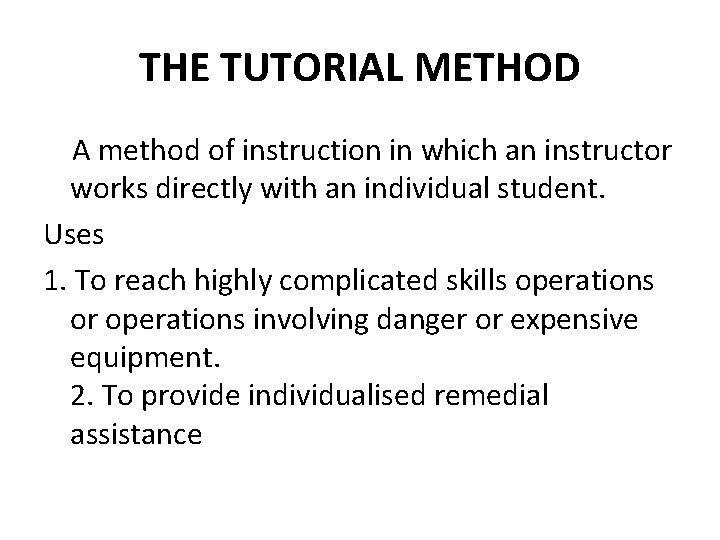
THE TUTORIAL METHOD A method of instruction in which an instructor works directly with an individual student. Uses 1. To reach highly complicated skills operations or operations involving danger or expensive equipment. 2. To provide individualised remedial assistance
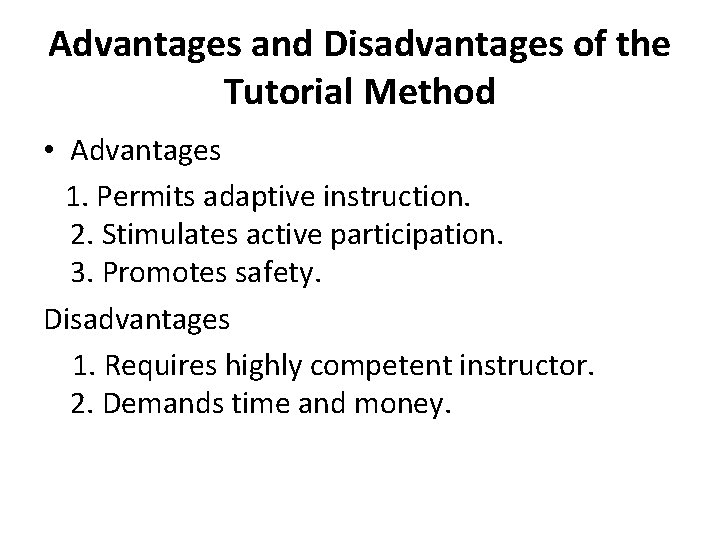
Advantages and Disadvantages of the Tutorial Method • Advantages 1. Permits adaptive instruction. 2. Stimulates active participation. 3. Promotes safety. Disadvantages 1. Requires highly competent instructor. 2. Demands time and money.
THE SEMINAR METHOD A tutorial arrangement involving the instructor and groups, rather than instructor and individual. Uses 1. To provide general guidance for a group working on an advanced study or research project. 2. To exchange information on techniques and approaches being explored by members of a study or research group. 3. To develop new and imaginative solutions to problems under study by the group
Advantages and Disadvantages of Seminar Method • Advantages 1. Provides motivation and report. 2. Stimulates active participation. 3. Permits adaptive instruction. Disadvantages 1. Requires highly competent instructor. 2. Poses evaluation problems. 3. Is more costly than most other methods
BRAINSTORMING • The purpose of a brainstorming session is to discover new ideas and responses very quickly. It is particularly a good way of getting bright ideas. • It differs from the buzz groups discussion in that the focus is on generating as many ideas as possible without judging them. • In this technique, all ideas are given equal credence. • Participants are encouraged to let ideas flow freely, building on and improving from previous ideas. • No idea, however crazy, should be rejected. These ideas are listed exactly as they are expressed on a board or flipchart, or written on bits of paper.
Uses of Brainstorming • The combination of swiftly generated ideas usually leads to a very animated and energising session. • Even the more reserved participants should feel bold enough to contribute. • The purpose of listing responses is to collect existing experiences and thoughts. • It is useful to collect answers to questions when you expect much repetition in the responses. • After a brainstorm session, the ideas can be discussed further and evaluated, for example listing the best options in a systematic way. • Ideas can be grouped analysed so that they belong to the group rather then individuals. • Unlike a buzz session, a brainstorm session can work well with a large group and usually takes less time. • It is best to limit the time for plenary brainstorms, as you might lose the attention of some participants.
Concluding Remarks Effective teaching requires, among others: • Recognition and faithfulness to teacher accountability • Application of appropriate and up-to-date instructional strategies • Hard , Soft and Smart Powers of Teachers
Practice of power in the classroom • Of particular note in the new educational paradigm is the articulation and practice of power in the classroom. • . Teachers have in their power the right to use disincentives, withhold privileges, and give consequences or punishments to students. When they do this we could say that they are exercising their hard power. • Hard power implies that if a line is crossed something will happen that will be less desirable for the student than if they choose not to cross the line. • When the teacher relies on their personality, relationship building, or the fact that they share common interests with students, they could be said to be using soft power. • Soft power can be developed through getting to know and emotionally investing in students. Soft power can also come as a result of the teacher having a personality that is perceived by the students as pleasing, such as being likeable, funny or charming. It is natural, as well as strongly encouraged by our media-driven culture, for students to want to follow and respect those that have qualities that are judged to be cool. • The use of hard powers in classes by teachers is to instill discipline and is meted on student who violates the agreed rules and regulations in the class. It is administered to bring about a desirable change in behaviour and therefore improving class discipline, if commensurate with the offense committed • The hard powers in classrooms are mostly appropriate and constructive while others are not desirable, baseless and instead intended to instill fear t although maintaining discipline remains one of the most common problems for teachers, some hard powers should not be used because no evidence suggests that they have produced better results academically, morally or that it improves class discipline
APPRECIATION • MANY THANKS • I WISH YOU ALL PERSONAL HAPPINESS AND PROFESSIONAL SUCCESS AS YOU STRIVE TO BE A GREAT TEACHER