
Teaching Medical Students in the Community Practice Setting
- Slides: 27
Teaching Medical Students in the Community Practice Setting: Applying Teaching and Learning Styles An orientation module developed by the Office of Regional Medical Education The University of Texas Medical Branch School of Medicine The University of Texas Medical Branch at Galveston (UTMB) is accredited by the Accreditation Council for Continuing Medical Education to provide continuing medical education to physicians. The University of Texas Medical Branch at Galveston designates this educational activity for a maximum of two (2) AMA PRA Category 1 Credits. TM. Physicians should only claim credit commensurate with extent of their participation in the activity. Estimated Study Time: 2 hours Medium Used: CD and web-based access Click on this button to advance to the next slide Version 1. 0 Original Release Date November 1, 2007 Expiration Date July 1, 2010
Teaching and Learning Styles Goals Identify teaching and learning styles and methods as appropriate to medical student education. Apply effective teaching methods in the community practice setting.
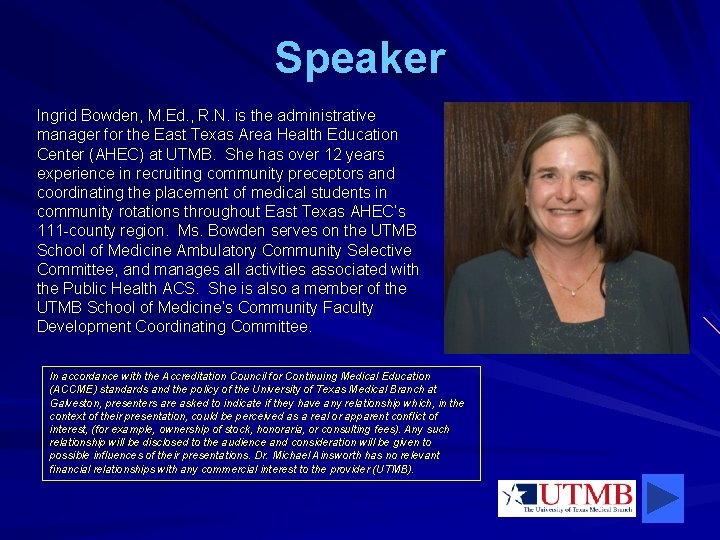
Speaker Ingrid Bowden, M. Ed. , R. N. is the administrative manager for the East Texas Area Health Education Center (AHEC) at UTMB. She has over 12 years experience in recruiting community preceptors and coordinating the placement of medical students in community rotations throughout East Texas AHEC’s 111 -county region. Ms. Bowden serves on the UTMB School of Medicine Ambulatory Community Selective Committee, and manages all activities associated with the Public Health ACS. She is also a member of the UTMB School of Medicine’s Community Faculty Development Coordinating Committee. In accordance with the Accreditation Council for Continuing Medical Education (ACCME) standards and the policy of the University of Texas Medical Branch at Galveston, presenters are asked to indicate if they have any relationship which, in the context of their presentation, could be perceived as a real or apparent conflict of interest, (for example, ownership of stock, honoraria, or consulting fees). Any such relationship will be disclosed to the audience and consideration will be given to possible influences of their presentations. Dr. Michael Ainsworth has no relevant financial relationships with any commercial interest to the provider (UTMB).
Teaching and Learning Styles Objectives Identify student learning styles and describe how to apply them in the community practice setting. Identify teaching styles and methods appropriate for teaching medical students in the community practice setting. Apply appropriate teaching methods for medical students in the community practice setting.
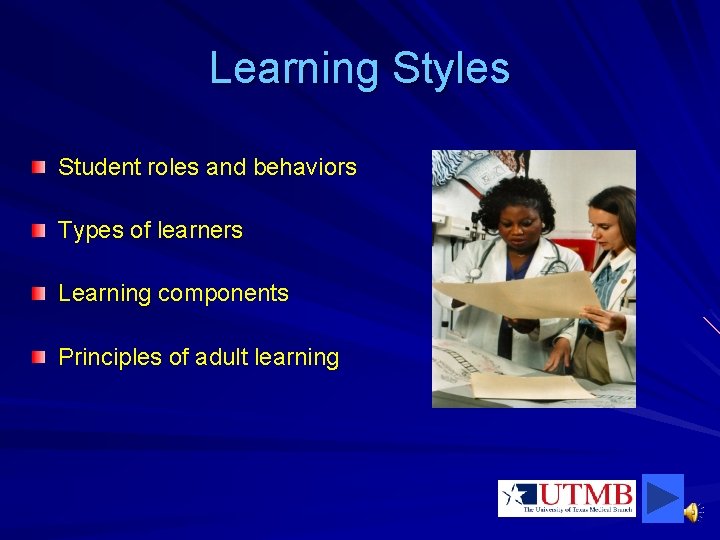
Learning Styles Student roles and behaviors Types of learners Learning components Principles of adult learning
Roles and Behaviors Compliant student Anxious-dependent student Independent student Sniper student
Types of Learners Visual learners Auditory learners Kinesthetic learners Learning Styles Inventory
Learning Components Cognitive ~ what the student should learn Affective ~ motivate the student to learn Metacognitive ~ how to learn, identify and correct areas of deficit
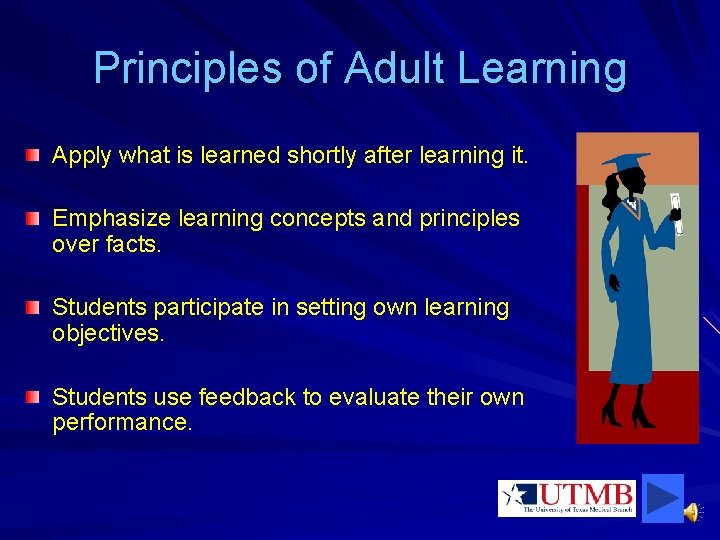
Principles of Adult Learning Apply what is learned shortly after learning it. Emphasize learning concepts and principles over facts. Students participate in setting own learning objectives. Students use feedback to evaluate their own performance.
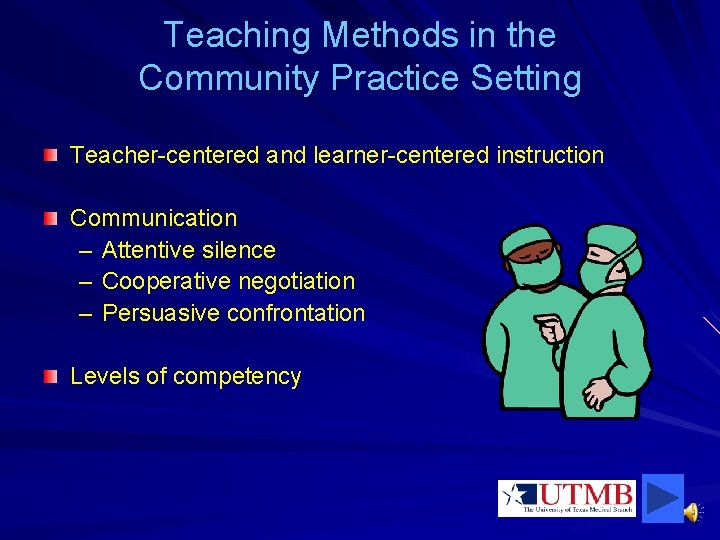
Teaching Methods in the Community Practice Setting Teacher-centered and learner-centered instruction Communication – Attentive silence – Cooperative negotiation – Persuasive confrontation Levels of competency
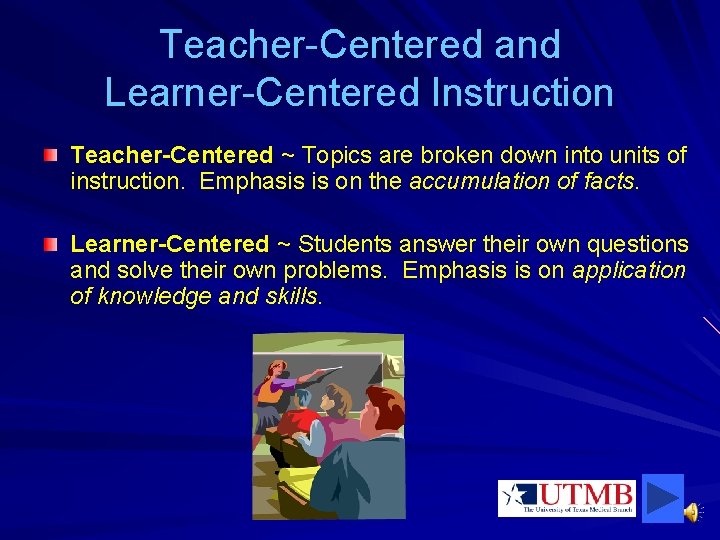
Teacher-Centered and Learner-Centered Instruction Teacher-Centered ~ Topics are broken down into units of instruction. Emphasis is on the accumulation of facts. Learner-Centered ~ Students answer their own questions and solve their own problems. Emphasis is on application of knowledge and skills.
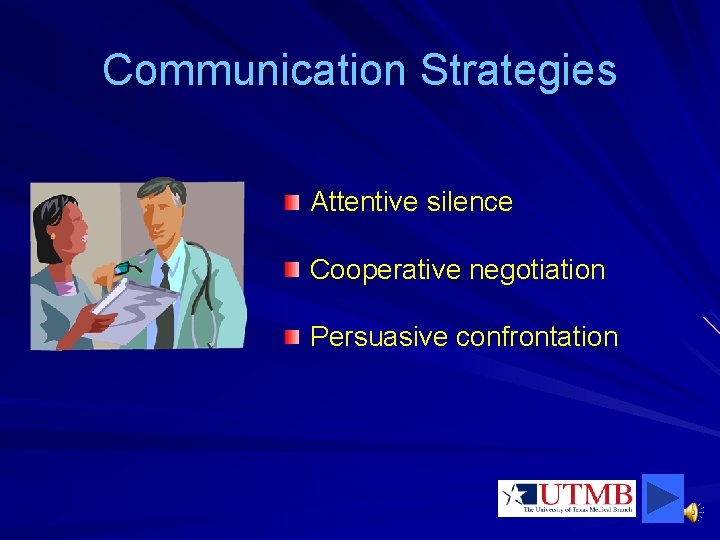
Communication Strategies Attentive silence Cooperative negotiation Persuasive confrontation
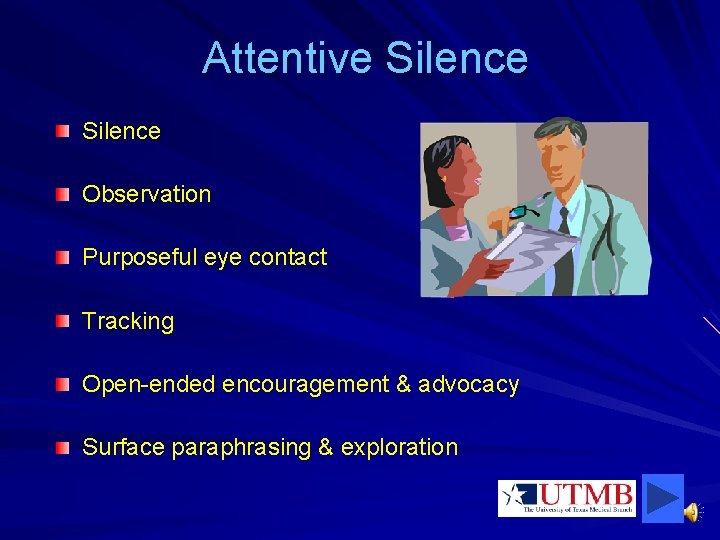
Attentive Silence Observation Purposeful eye contact Tracking Open-ended encouragement & advocacy Surface paraphrasing & exploration
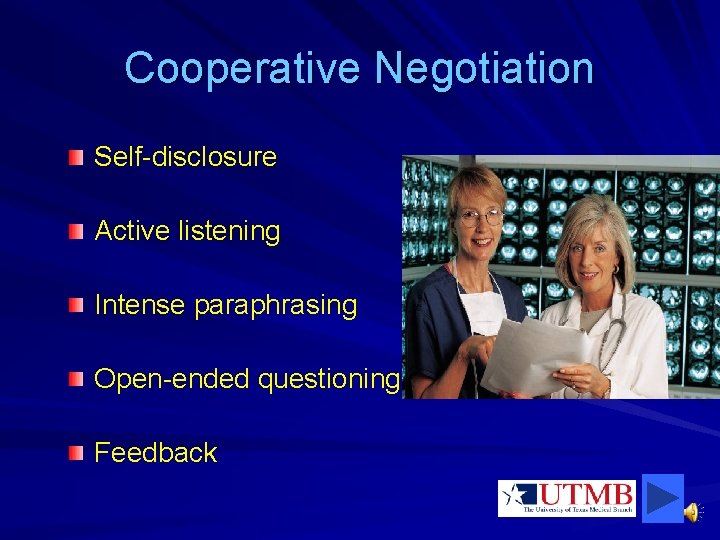
Cooperative Negotiation Self-disclosure Active listening Intense paraphrasing Open-ended questioning Feedback
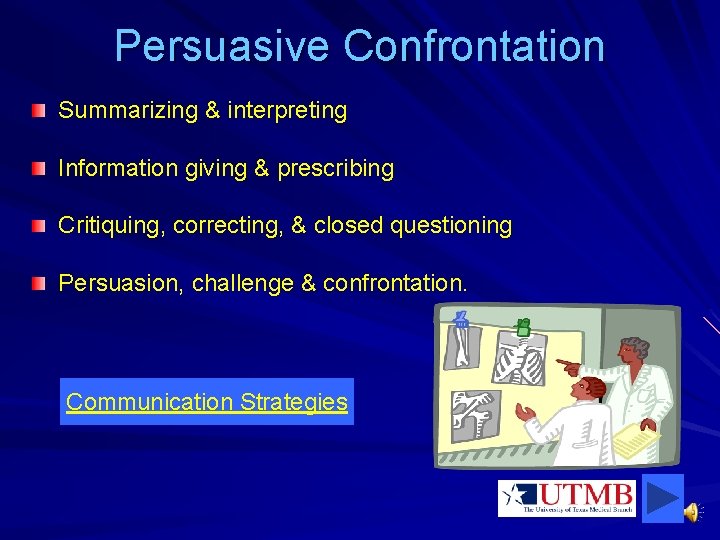
Persuasive Confrontation Summarizing & interpreting Information giving & prescribing Critiquing, correcting, & closed questioning Persuasion, challenge & confrontation. Communication Strategies
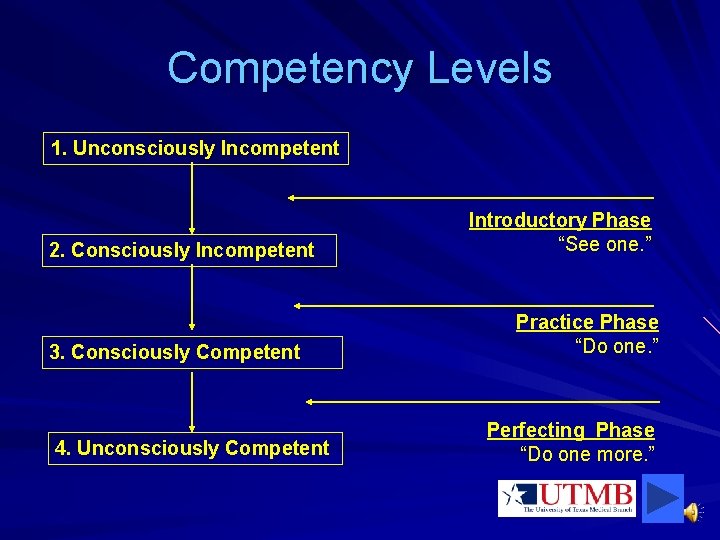
Competency Levels 1. Unconsciously Incompetent 2. Consciously Incompetent 3. Consciously Competent 4. Unconsciously Competent Introductory Phase “See one. ” Practice Phase “Do one. ” Perfecting Phase “Do one more. ”
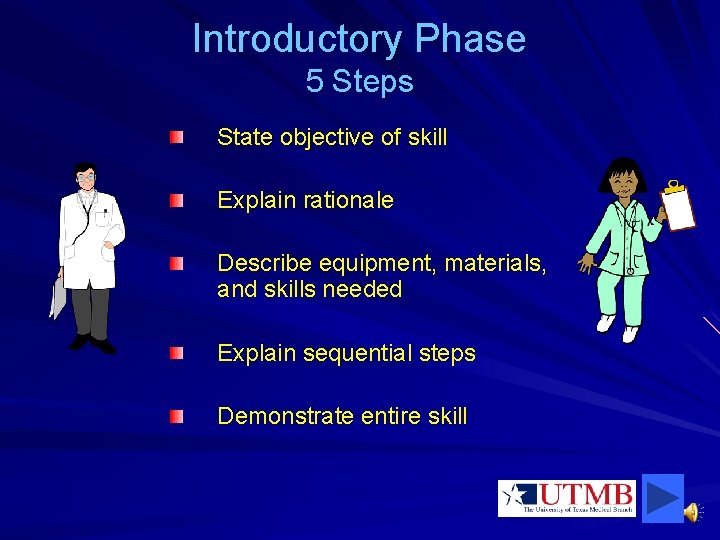
Introductory Phase 5 Steps State objective of skill Explain rationale Describe equipment, materials, and skills needed Explain sequential steps Demonstrate entire skill
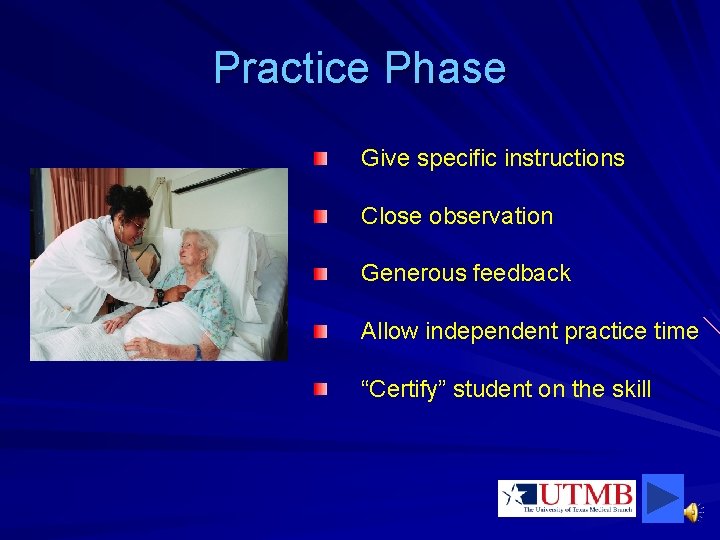
Practice Phase Give specific instructions Close observation Generous feedback Allow independent practice time “Certify” student on the skill
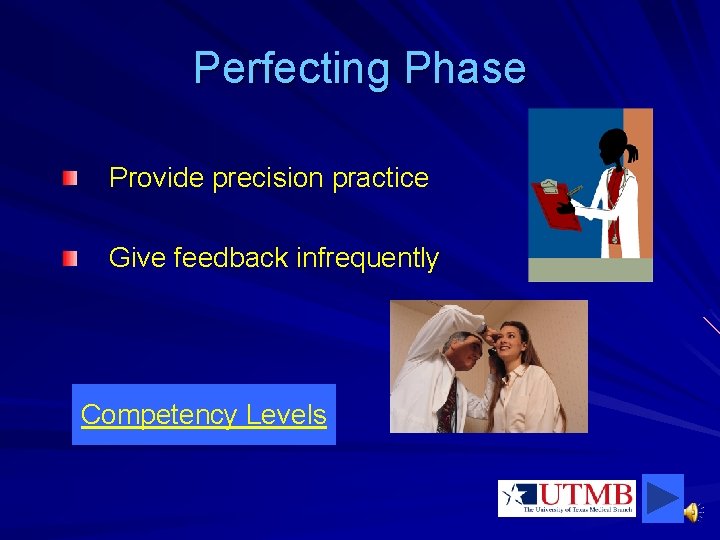
Perfecting Phase Provide precision practice Give feedback infrequently Competency Levels
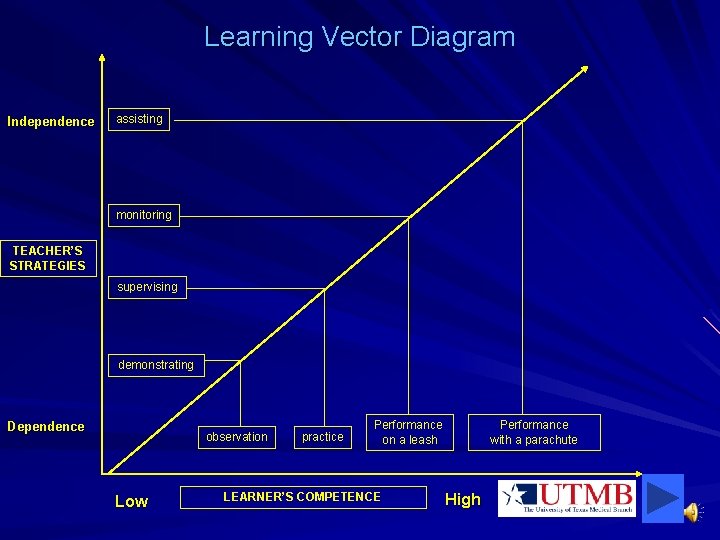
Learning Vector Diagram Independence assisting monitoring TEACHER’S STRATEGIES supervising demonstrating Dependence observation Low practice Performance on a leash LEARNER’S COMPETENCE Performance with a parachute High
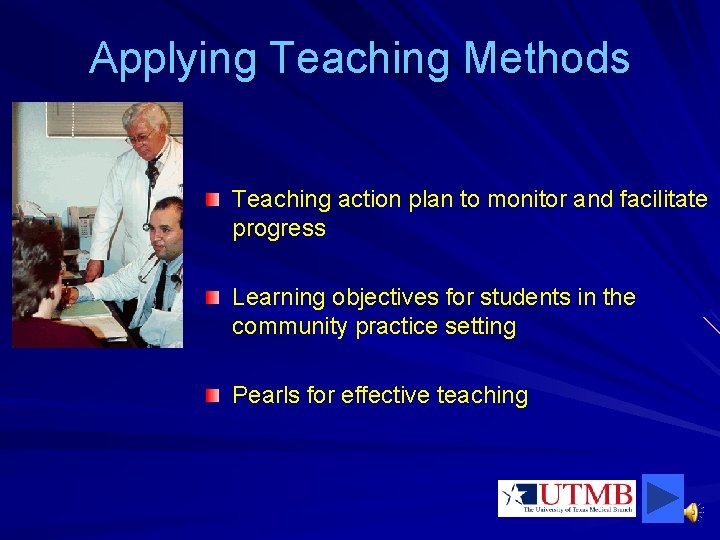
Applying Teaching Methods Teaching action plan to monitor and facilitate progress Learning objectives for students in the community practice setting Pearls for effective teaching
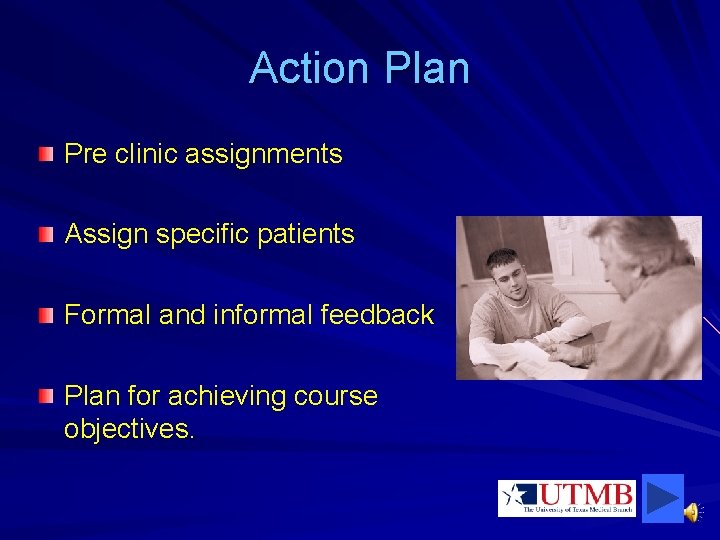
Action Plan Pre clinic assignments Assign specific patients Formal and informal feedback Plan for achieving course objectives.
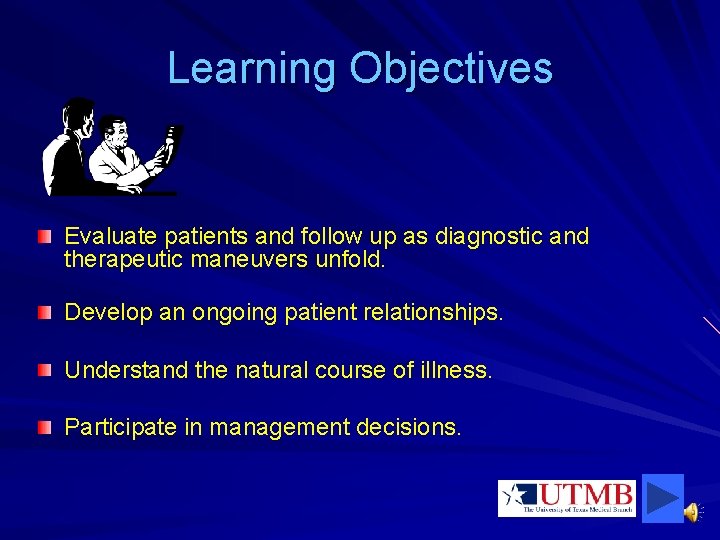
Learning Objectives Evaluate patients and follow up as diagnostic and therapeutic maneuvers unfold. Develop an ongoing patient relationships. Understand the natural course of illness. Participate in management decisions.
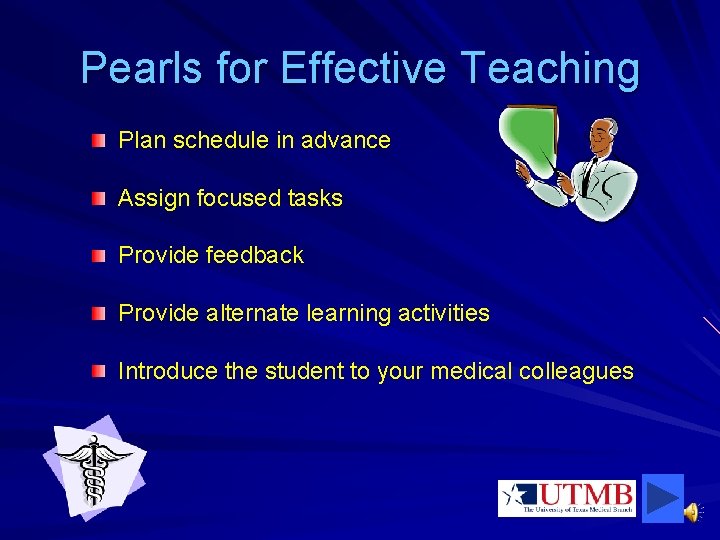
Pearls for Effective Teaching Plan schedule in advance Assign focused tasks Provide feedback Provide alternate learning activities Introduce the student to your medical colleagues
Summary The ability to select and apply appropriate teaching techniques relevant to an individual student’s learning style and level of competency will maximize the effects of your teaching efforts. Student Evaluation of Course Student Evaluation of Preceptor
References Baldwin CD & Niebuhr VN. Teaching Skills for Preceptors in the Community Setting: A Self-Directed Continuing Education Package. Developed for the Robert Wood Johnson Generalist Physician Initiative at the University of Texas Branch. 1996, re-edited in 2004. Cassidy S. (2004). Learning Styles: An overview of theories, models, and measures. Educational Psychology. 24 (4), 419 -444. Davis MH & Harden RM. (1999). AMEE Medical Education Guide No. 15: Problem-based learning: a practical guide. Medical Teacher 21 (2), 130 -140. Gordon J et all. (2000). Strategic planning in medical education: enhancing the learning environment for students in clinical settings. Medical Education. 34 (10), 841 -850. Hein T & Budny D. Teaching to Students’ Learning Styles: Approaches That Work. 29 th ASEE/IEEE Frontiers in Education Conference. 12 c 1 -7. Middlesex Community College. Modality Preference Inventory. Middletown, CT. Website: https: //olt. qut. edu. au/it/ITB 116/gen/static/VAK_Inventory. htm. O’Sullivan M, Martin J, & Murray E. (2000). Students’ perceptions of the relative advantages and disadvantages of community-based and hospital-based teaching: a qualitative study. Medical Education. 34 (8), 648 -659. Whitman N & Schwenk T. The Physician as Teacher. Salt Lake City, Utah: Whitman Associates, 1997.
Teaching Medical Students in the Community Practice Setting: Applying Teaching and Learning Styles A teaching skills module developed by the Office of Regional Medical Education The University of Texas Medical Branch Please print the links below to share evaluation feedback and School of Medicine Galveston, TX request CME credit. Credits Link to Presentation Pam Hentschel, M. S. Members of the UTMB Community Faculty Development Coordinating Committee Michael Ainsworth, MD Associate Dean for Regional Medical Education 301 University Blvd Galveston TX, 77555 -0410 (409) 772 -6928 mainswor@utmb. edu www. meded. utmb. edu/orme Evaluation Form Link to Post-Test and CME Credit Request Form End Show