
Teaching Math through Problem Solving Teaching School Mathematics
Teaching Math through Problem Solving Teaching School Mathematics through Problem Solving Diana V. Lambdin (lambdin@indiana. edu) Frank K. Lester, Jr. (lester@indiana. edu) Indiana University 1 Nationellt Centrum för Matematikutbildning vid Göteborgs Universitet

Teaching Math through Problem Solving The world is different! • Information age • Global economies • New skills and concepts are needed The mathematics curriculum must prepare students for this new world. This means that we teach and how we teach must change! 2 Nationellt Centrum för Matematikutbildning vid Göteborgs Universitet

Teaching Math through Problem Solving What does it mean to understand mathematics? • Do well on national and international assessments? • Recall facts and procedures from memory? • Solve story problems? • Apply what is learned in school in everyday situations? • IS THERE SOMETHING ELSE? 3 Nationellt Centrum för Matematikutbildning vid Göteborgs Universitet
Teaching Math through Problem Solving Students understand a mathematical concept or skill when they: • Demonstrate reasonable proficiency in using it. (proficiency) • Use it to solve problems in a variety of contexts (and not only in school) (application) • Know how it relates to other mathematical Nationellt Centrum för Matematikutbildning vid Göteborgs Universitet ideas (connection) 4
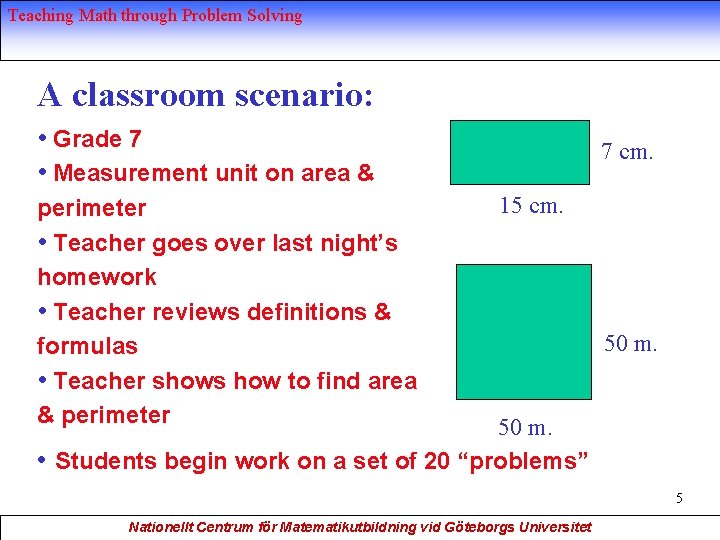
Teaching Math through Problem Solving A classroom scenario: • Grade 7 • Measurement unit on area & perimeter • Teacher goes over last night’s homework • Teacher reviews definitions & formulas • Teacher shows how to find area & perimeter 7 cm. 15 cm. 50 m. • Students begin work on a set of 20 “problems” 5 Nationellt Centrum för Matematikutbildning vid Göteborgs Universitet
Teaching Math through Problem Solving Homework • Complete work on the 20 problems • Solve the following word problem: A shop owner wants to put a new wood floor in his shop. The shop is 12 meters long and 8 meters wide. How many square meters of floor will the wood cover? [Adapted from Stein et al. , Implementing Standards-based Mathematics Instruction. New York: Teachers College Press, 2000] 6 Nationellt Centrum för Matematikutbildning vid Göteborgs Universitet
Teaching Math through Problem Solving A different sort of classroom • Grade 7 • Measurement unit on area & perimeter • Students begin work on a challenging task in small groups • Work continues for the entire class period using whatever tools the students need • Teacher goes from group to group, asks questions, gives hints, but does not give answers Nationellt Centrum för Matematikutbildning vid Göteborgs Universitet 7
Teaching Math through Problem Solving The rabbit pen problem Ms. Gomez’s class will raise rabbits for their spring science fair. They have 24 meters of fencing to build a rectangular rabbit pen for the rabbits. 1. If Ms. Gomez’s students want their rabbits to have as much room as possible, how long would each side of the pen be? 2. How long would each side be if they had only 16 meters of fencing? 3. How would you determine the pen with the most room for any amount of fencing? Organize your work so that someone else who reads it will understand it. 8 Nationellt Centrum för Matematikutbildning vid Göteborgs Universitet
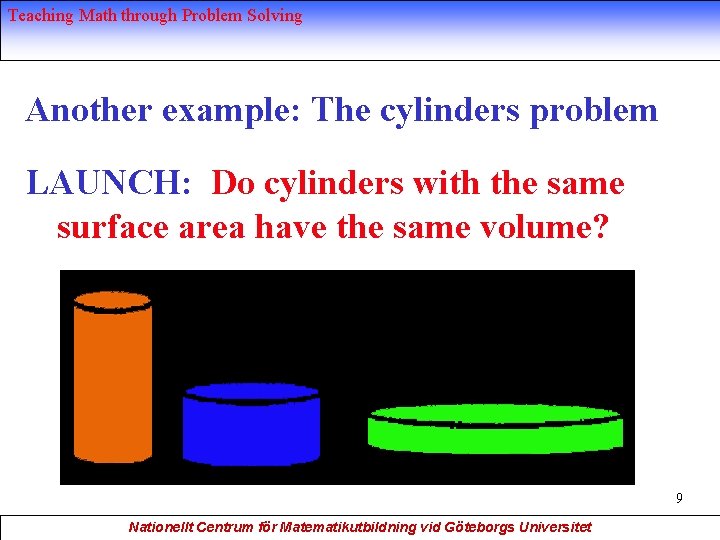
Teaching Math through Problem Solving Another example: The cylinders problem LAUNCH: Do cylinders with the same surface area have the same volume? 9 Nationellt Centrum för Matematikutbildning vid Göteborgs Universitet
Teaching Math through Problem Solving EXPLORE Questions for students: • Will all the cylinders hold the same amount? Explain your reasoning. • How does changing the height affect the circumference? Explain. • How does changing the circumference affect the volume? Explain. Nationellt Centrum för Matematikutbildning vid Göteborgs Universitet 10
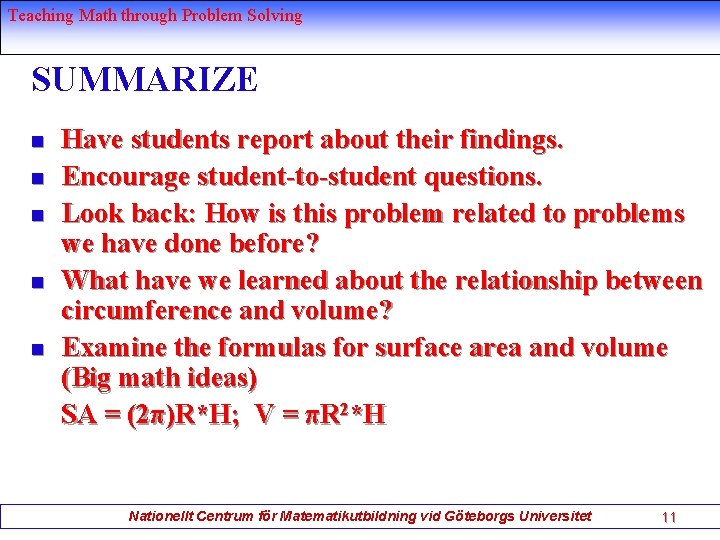
Teaching Math through Problem Solving SUMMARIZE n n n Have students report about their findings. Encourage student-to-student questions. Look back: How is this problem related to problems we have done before? What have we learned about the relationship between circumference and volume? Examine the formulas for surface area and volume (Big math ideas) SA = (2π)R*H; V = πR 2*H Nationellt Centrum för Matematikutbildning vid Göteborgs Universitet 11
Teaching Math through Problem Solving Extending the Activity • Have students conjecture about what is happening to the volume as the cylinder continues to be cut, getting shorter and shorter (and wider). • Some students may become interested in exploring the limit of the process of continuing to cut the cylinders in half and forming new ones. • What if the cylinders have a top and bottom? Nationellt Centrum för Matematikutbildning vid Göteborgs Universitet 12
Teaching Math through Problem Solving Qualities of the Lesson • A question is posed about an important mathematics concept. • Students make conjectures about the problem. • Students investigate and use mathematics to make sense of the problem. • The teacher guides the investigation through questions, discussions, and instruction. • Students expect to make sense of the problem. • Students apply their understanding to another problem or task involving these concepts. Nationellt Centrum för Matematikutbildning vid Göteborgs Universitet 13
Teaching Math through Problem Solving The Teacher’s Primary Role in TMTPS Coach, facilitator, designer, listener and observer BUT NOT Lecturer, “expert” (source of the best way to do math) Nationellt Centrum för Matematikutbildning vid Göteborgs Universitet 14
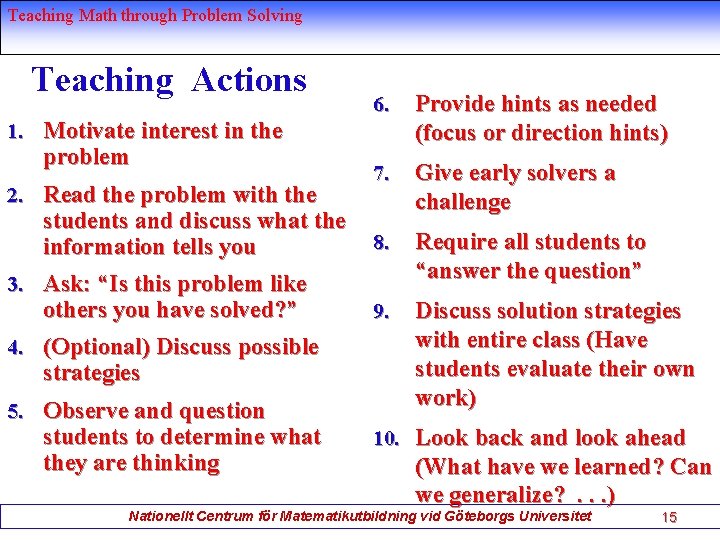
Teaching Math through Problem Solving Teaching Actions 6. Provide hints as needed (focus or direction hints) 7. Give early solvers a challenge 8. Require all students to “answer the question” 9. Discuss solution strategies with entire class (Have students evaluate their own work) 1. Motivate interest in the problem 2. Read the problem with the students and discuss what the information tells you 3. Ask: “Is this problem like others you have solved? ” 4. (Optional) Discuss possible strategies 5. Observe and question students to determine what they are thinking 10. Look back and look ahead (What have we learned? Can we generalize? . . . ) Nationellt Centrum för Matematikutbildning vid Göteborgs Universitet 15
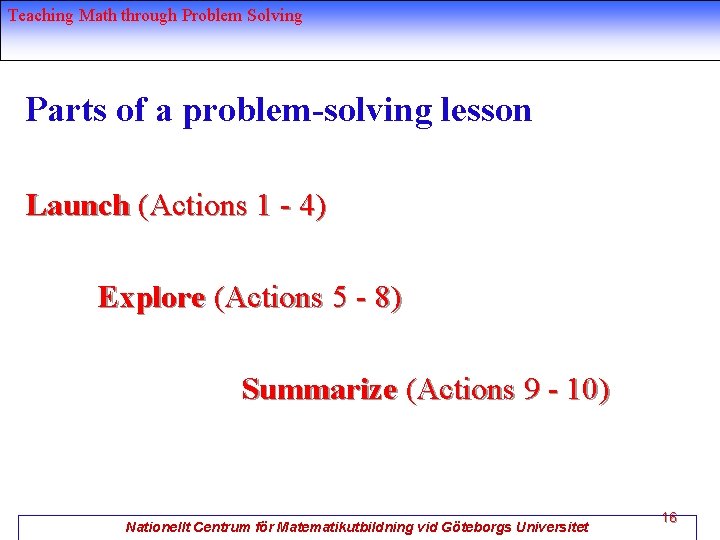
Teaching Math through Problem Solving Parts of a problem-solving lesson Launch (Actions 1 - 4) Explore (Actions 5 - 8) Summarize (Actions 9 - 10) Nationellt Centrum för Matematikutbildning vid Göteborgs Universitet 16
Teaching Math through Problem Solving Break into small groups Nationellt Centrum för Matematikutbildning vid Göteborgs Universitet 17
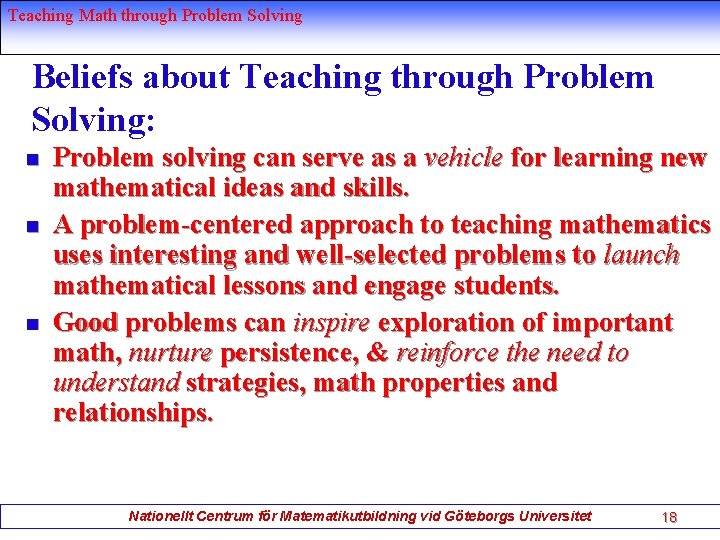
Teaching Math through Problem Solving Beliefs about Teaching through Problem Solving: n n n Problem solving can serve as a vehicle for learning new mathematical ideas and skills. A problem-centered approach to teaching mathematics uses interesting and well-selected problems to launch mathematical lessons and engage students. Good problems can inspire exploration of important math, nurture persistence, & reinforce the need to understand strategies, math properties and relationships. Nationellt Centrum för Matematikutbildning vid Göteborgs Universitet 18
Teaching Math through Problem Solving And also -n n n PS ability develops over time and through prolonged involvement Math concepts, processes, and procedures interact and develop concurrently Instruction must be systematic, organized, and teacher has a different role Content is organized around “big ideas” Lessons often involve group work, reflective writing, alternative assessment Nationellt Centrum för Matematikutbildning vid Göteborgs Universitet 19
Teaching Math through Problem Solving New roles and new expectations • New roles for teachers • New expectations for students • Different kinds of tasks • New emphases during instruction • New types of assessment 20 Nationellt Centrum för Matematikutbildning vid Göteborgs Universitet

Teaching Math through Problem Solving Challenges to teaching through problem solving • Time • Need for support • Curriculum • Alignment with assessment practices • Unfamiliar role for (some) teachers Nationellt Centrum för Matematikutbildning vid Göteborgs Universitet 21

Teaching Math through Problem Solving Benefits of teaching through problem solving • • • Promotes understanding Is motivating Helps memory Enhances transfer Influences attitudes and beliefs Promotes the development of autonomous learners Nationellt Centrum för Matematikutbildning vid Göteborgs Universitet 22
- Slides: 22