
Teaching material based on Distributed Systems Concepts and
Teaching material based on Distributed Systems: Concepts and Design, Edition 3, Addison-Wesley 2001. Distributed Systems Course Replication Copyright © George Coulouris, Jean Dollimore, Tim Kindberg 2001 email: authors@cdk 2. net This material is made available for private study and for direct use by individual teachers. It may not be included in any product or employed in any service without the written permission of the authors. 14. 1 Introduction to replication Viewing: These slides must be viewed in slide show mode. 14. 4. 1 Gossip architecture 14. 2 System model and group communication 14. 3 Fault-tolerant services 14. 4 Highly available services 14. 5 Transactions with replicated data
Introduction to replication Replication of data : - the maintenance of copies of data at multiple computers replication can provide the following performance enhancement – e. g. several web servers can have the same DNS name and the servers are selected in turn. To share the load. – replication of read-only data is simple, but replication of changing data has overheads fault-tolerant service – guarantees correct behaviour in spite of certain faults (can include timeliness) – if f of f+1 servers crash then 1 remains to supply the service – if f of 2 f+1 servers have byzantine faults then they can supply a correct service availability is hindered by – server failures w replicate data at failure- independent servers and when one fails, client may use another. Note that caches do not help with availability(they are incomplete). – network partitions and disconnected operation w Users of mobile computers deliberately disconnect, and then on re-connection, resolve conflicts 2 •
Requirements for replicated data What is replication transparency? Replication transparency – clients see logical objects (not several physical copies) w they access one logical item and receive a single result Consistency – specified to suit the application, w e. g. when a user of a diary disconnects, their local copy may be inconsistent with the others and will need to be reconciled when they connect again. But connected clients using different copies should get consistent results. These issues are addressed in Bayou and Coda. 3 •
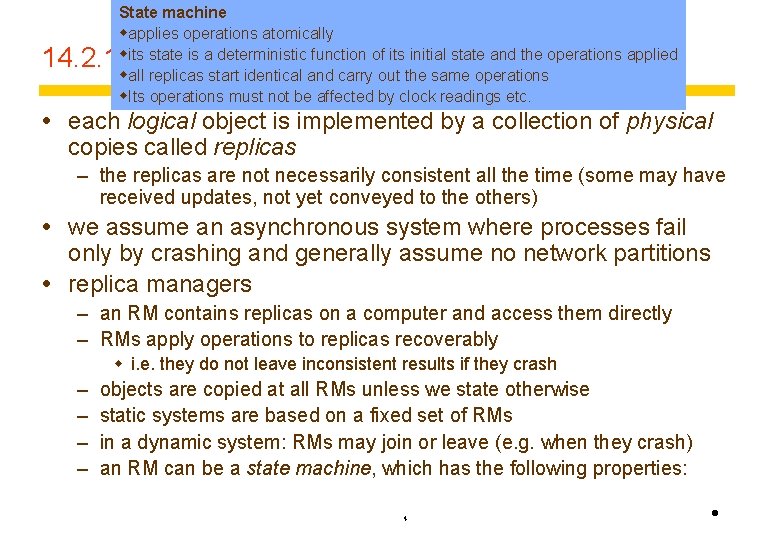
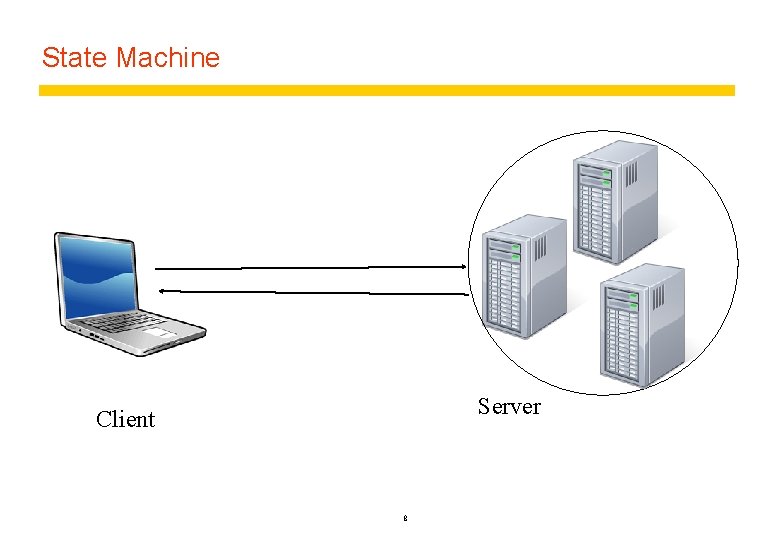
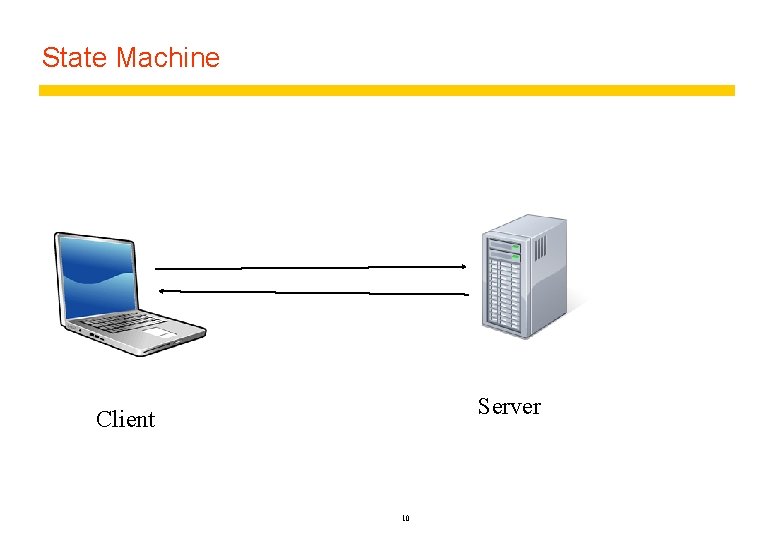
State machine wapplies operations atomically wits state is a deterministic function of its initial state and the operations applied wall replicas start identical and carry out the same operations w. Its operations must not be affected by clock readings etc. 14. 2. 1 System model each logical object is implemented by a collection of physical copies called replicas – the replicas are not necessarily consistent all the time (some may have received updates, not yet conveyed to the others) we assume an asynchronous system where processes fail only by crashing and generally assume no network partitions replica managers – an RM contains replicas on a computer and access them directly – RMs apply operations to replicas recoverably w i. e. they do not leave inconsistent results if they crash – – objects are copied at all RMs unless we state otherwise static systems are based on a fixed set of RMs in a dynamic system: RMs may join or leave (e. g. when they crash) an RM can be a state machine, which has the following properties: 4 •

State Machine Semantic Characterization Outputs of a state machine are complitely determined by the sequence of requests it processes indepedent of time and any other activity in the system. Vague about internal structure 5
![State Machine: Examples State machine Server: Word store[N] Read(int loc) { send store[loc] to](http://slidetodoc.com/presentation_image_h2/4e7a12073ea4cee5b5673642c2355d6b/image-6.jpg "State Machine: Examples State machine Server: Word store[N] Read(int loc) { send store[loc] to")
State Machine: Examples State machine Server: Word store[N] Read(int loc) { send store[loc] to client; } Write[int loc, word val] { store[loc]=val } Client Not a state machine while true do read sensor q : = compute adjustment send q to actuator end while memory. write(100, 4) Memory. read(100) Receive v from memory 6

State Machine Server Client 7
State Machine Server Client 8
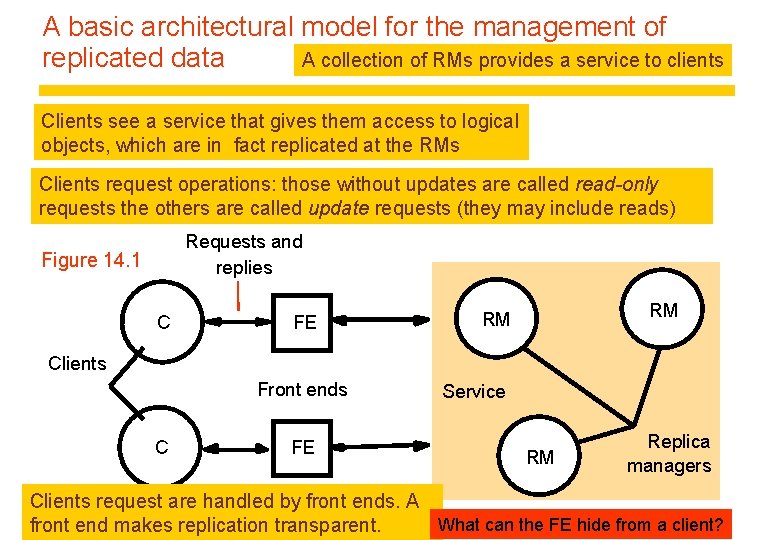
A basic architectural model for the management of replicated data A collection of RMs provides a service to clients Clients see a service that gives them access to logical objects, which are in fact replicated at the RMs Clients request operations: those without updates are called read-only requests the others are called update requests (they may include reads) Requests and replies Figure 14. 1 C RM RM FE Clients Front ends C Service FE RM Replica managers Clients request are handled by front ends. A • What can the FE hide from a client? front end makes replication transparent. 9
State Machine Server Client 10
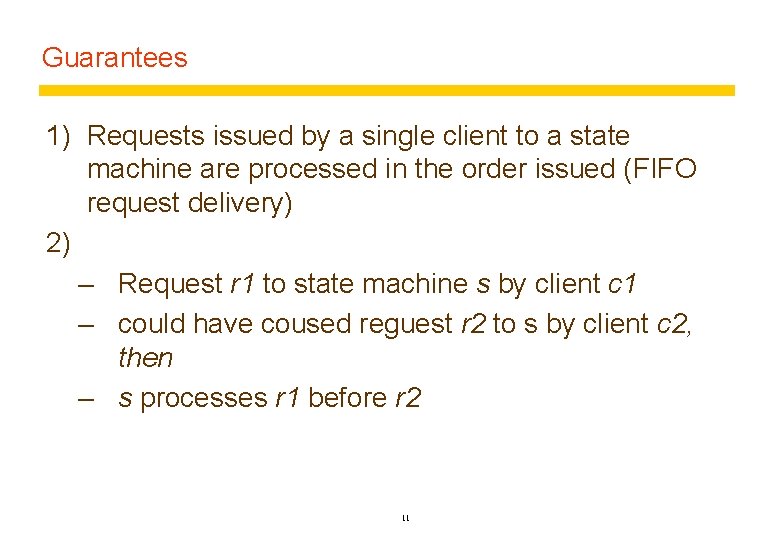
Guarantees 1) Requests issued by a single client to a state machine are processed in the order issued (FIFO request delivery) 2) – Request r 1 to state machine s by client c 1 – could have coused reguest r 2 to s by client c 2, then – s processes r 1 before r 2 11
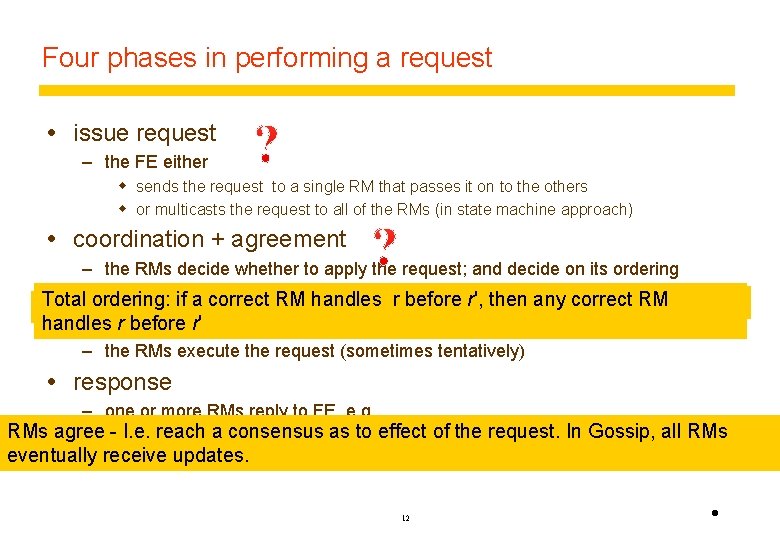
Four phases in performing a request issue request – the FE either w sends the request to a single RM that passes it on to the others w or multicasts the request to all of the RMs (in state machine approach) coordination + agreement – the RMs decide whether to apply the request; and decide on its ordering relative to other requests (according to FIFO, causal or total ordering) Total ordering: correct r before r', then. RM any correct Causal ordering: r r', RM then any r', correct RM correct handles r before r' RM FIFO ordering: ifif aaif. FE issues r handles then any handles r before r' execution handles r before r' – the RMs execute the request (sometimes tentatively) response – one or more RMs reply to FE. e. g. RMs agree - w. I. e. forreach a consensus to effect of the request. In Gossip, all RMs high availability give firstas response to client. eventually receive updates. w to tolerate byzantine faults, take a vote 12 •
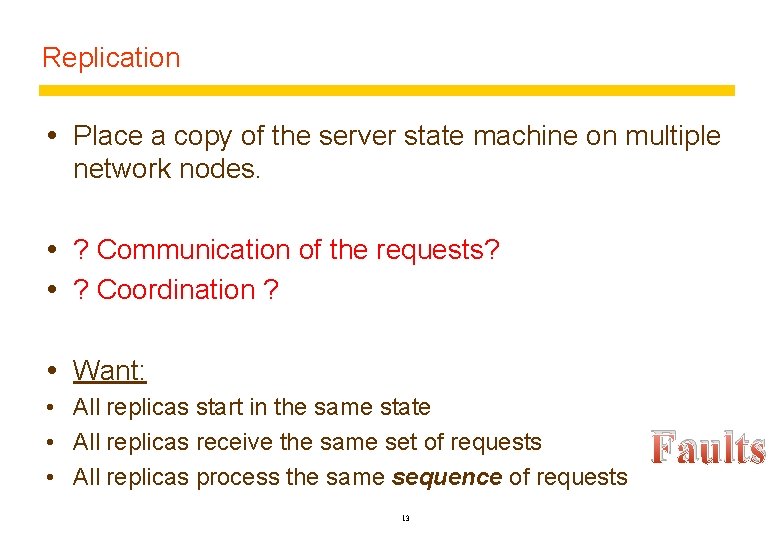
Replication Place a copy of the server state machine on multiple network nodes. ? Communication of the requests? ? Coordination ? Want: • All replicas start in the same state • All replicas receive the same set of requests • All replicas process the same sequence of requests 13 Faults
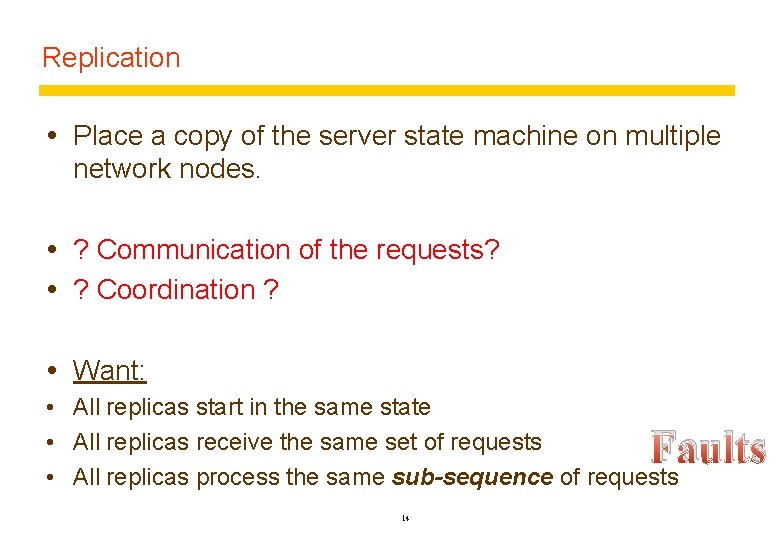
Replication Place a copy of the server state machine on multiple network nodes. ? Communication of the requests? ? Coordination ? Want: • All replicas start in the same state • All replicas receive the same set of requests • All replicas process the same sub-sequence of requests Faults 14
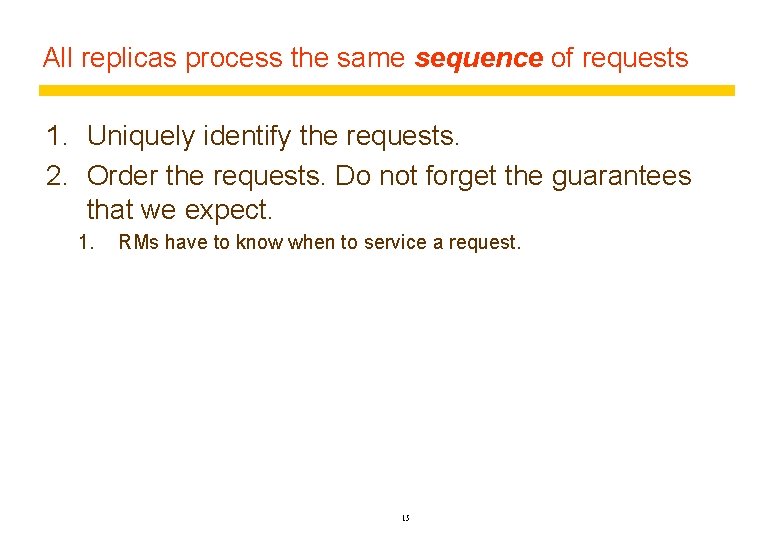
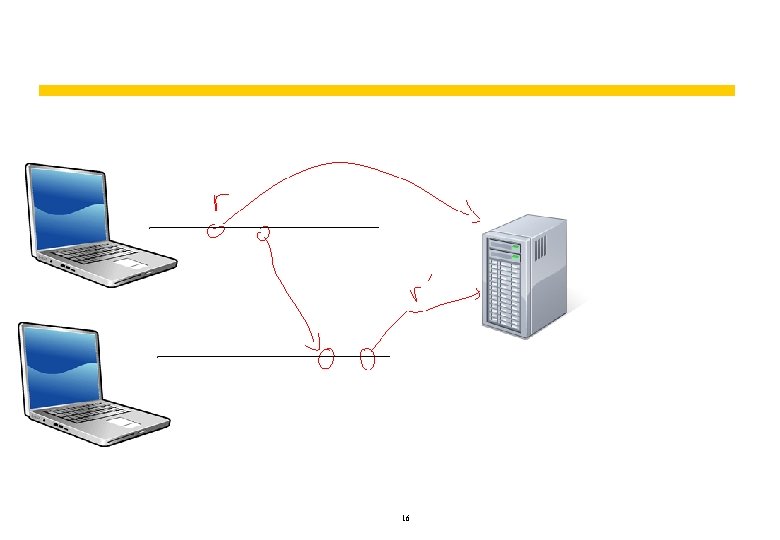
All replicas process the same sequence of requests 1. Uniquely identify the requests. 2. Order the requests. Do not forget the guarantees that we expect. 1. RMs have to know when to service a request. 15
16
Guarantees 1) Requests issued by a single client to a state machine are processed in the order issued (FIFO request delivery) 2) – Request r 1 to state machine s by client c 1 – could have coused reguest r 2 to s by client c 2, then – s processes r 1 before r 2 17
When to process a reguest - Stability 3 methods: – Logical clocks – Real-time clocks – Replica-generated ids 18
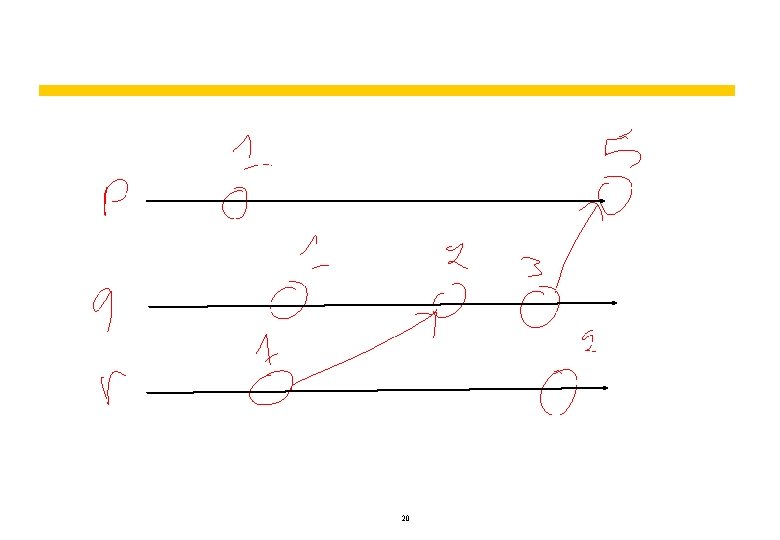
Logical Clocks Assign integer T(e, p) to event e from processor p: – If e is a sending of a message – If e is a receiving of a message – Importanat event Properties: T(e, p) < T(e 1, q) or vice-versa If e could have caused e 1, then T(e, p)<T(e 1, q) 19
20
Stability Consider – Fail-Stop model – Messages can be delayed arbitrarily Rely on: – use sequence numbers to ensure FIFO Channels – You need failure detection Each process peridical makes requests to thers, then a message is stable if a ”later” message has been received from every non-faulty client. 21
Synchronized Real-Time Clocks – If a message sent with uid t will be received no later than t+D by local clock. – Uids differ by D at most at any time 22
- Slides: 22