
Teaching Literature Lecture 2 5 Literary Text Before
Teaching Literature Lecture 2

5. Literary Text • Before probing into skills and strategies proper to literary text reading and comprehending, it seems convenient to draw a clear definition and the main characteristics of this type of text. • Alderson (2000, p. 65) affirms that Any discussion of text types is incomplete without at least some consideration of the distinction popularly made between literary and non-literary texts.
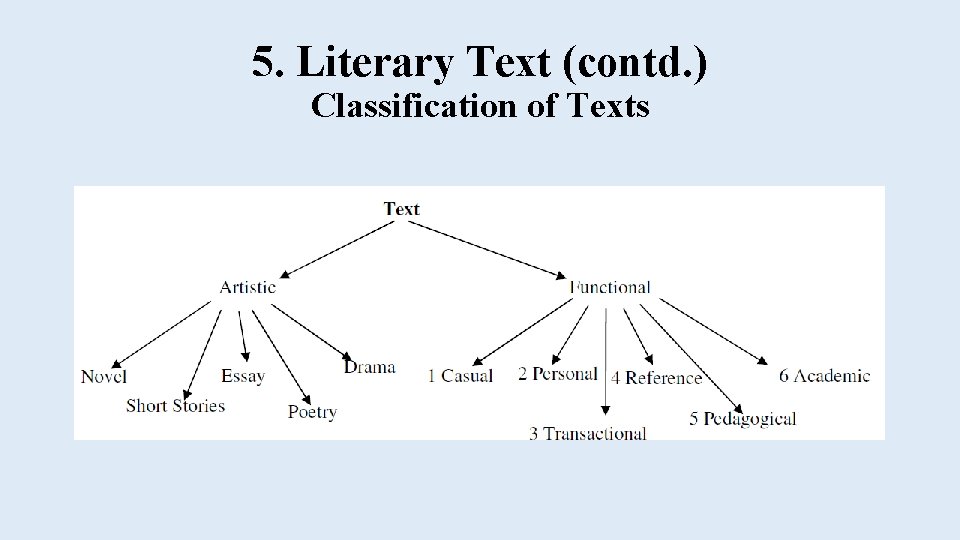
5. Literary Text (contd. ) • Clearly, before discussing how learners should read and comprehend literary texts, it is necessary to distinguish it from the other types of text. • Lucas (1990) divided texts into two major types: artistic and functional. • Artistic texts include novels, short stories, essays, poems and plays. • Functional texts consist of whatever texts other than the artistic as shown in the figure below:
5. Literary Text (contd. ) Classification of Texts
5. Literary Text (contd. ) • From the diagram above, we deduce that literary text is artistic, as opposed to functional text, with five major literary categories which are typically the literary genres: • novel and short stories- generally referred to as fiction-, • essay, • poetry and • drama.
5. Literary Text (contd. ) Functional text comprises six categories: 1 - Casual texts include newspapers, magazines and non-fiction. 2 - Personal texts include letters and diaries. 3 - Transactional texts include business letters, legal documents, reports and instructions. 4 - Reference texts include dictionaries, catalogues, directories and inventories. 5 - Pedagogical texts include text books, encyclopedias. 6 - Academic texts include research papers, theses, specialist books and journals.
5. Literary Text (contd. ) • Furthermore, it is assumed that literary texts are somewhat harder to comprehend. • Alderson (2000) explains this that literature uses formal devices like deviation in order to defamiliarise language and hence raising special effects, the thing which would lead readers to reflect and process literary text differently. • He also explains this by the use of figurative language like metaphor which makes readers use more personal associations according to the reader’s socio-cultural knowledge of the text.
5. 1 Characteristics of literary text Arab (1993) considers four main characteristics for literary texts: • A literary text is a sample of language use to be read and understood. • The illustration and expression of artistic sensibility embedded in a specific literary genres (fiction, poetry, drama) having its own history and its own formal laws. • An artefact to be related to its socio-historical context of which the writer’s biography is one element.
5. 1 Characteristics of literary text (contd. ) • A semiotic construct with a set of devices and codes which definitely marks it off as literary and which therefore amenable to interpretation and evaluation. On the whole, literary text is an artistic product with its specific genres (fiction, essay, poetry, drama) and with some artistic features and devices which distinguish it from non-artistic text. These features manifest generally in grammar deviation and the use of figurative language.
5. 1 Characteristics of literary text (contd. ) • Also, literary text should be studied within its sociocultural context in which the writer’s society and convictions have to be highly considered. • Thus, it seems insufficient to apply approaches and methods devised for non-literary text in order to fully understand evaluate such highly marked kind of text. • Accordingly, readers need to acquire some literary competence that would enable them comprehend and interpret decently literary texts.
5. 2 Literary text and metalanguage • As distinguished from non-literary texts, literary texts exhibit considerable use of metalanguage or what is commonly known as literary terminology. • Lazer (2000, p. 45) affirms that: Using terminology means ensuring that students are familiar with it and encouraging them to apply metalinguistic terms to any text that they are reading and studying.
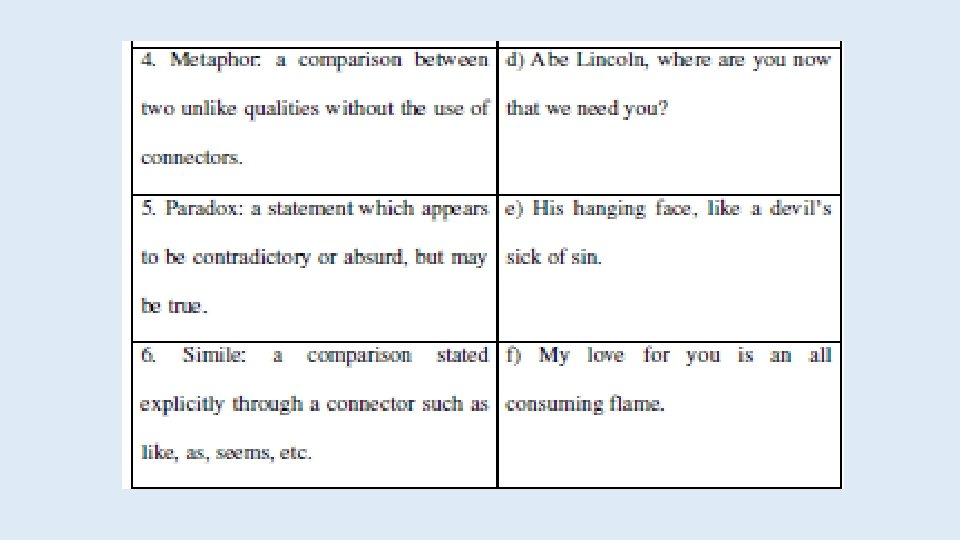
5. 2 Literary text and metalanguage (contd. ) • It seems quite important to equip students with the necessary literary terms – literary metalanguage – to enable them processing any kind of literary texts. • In view of the importance of literary terminology in understanding literary texts and genres, Lazer (2000) argues that presenting a list of literary terms with definitions is not sufficient enough to help learners and he proposes matching activities to ensure a good manipulation of these terms as follows: Match the definitions of literary terms with their corresponding examples.
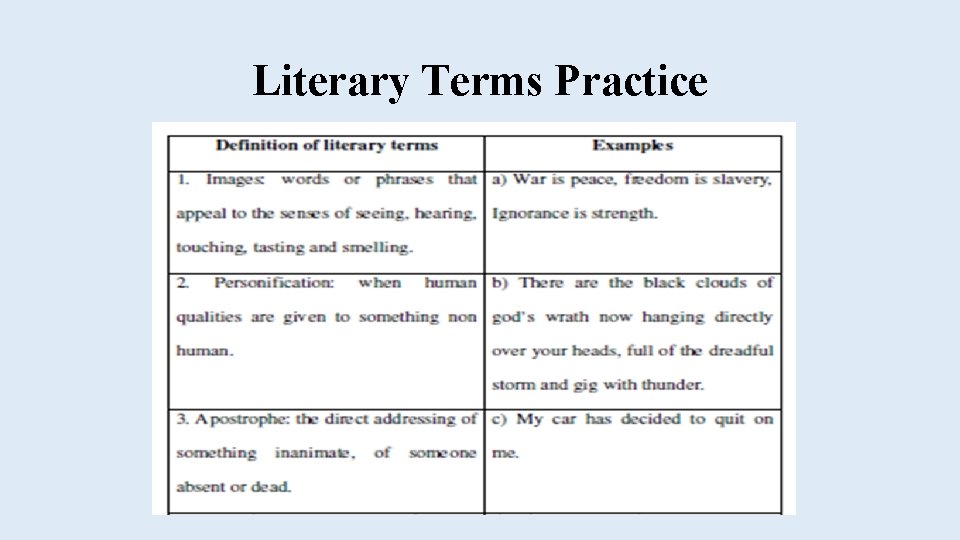
Literary Terms Practice
5. 2 Literary text and metalanguage (contd. ) Regarding the utility of metalanguage in literary reading classes, Lazer (2000) suggests three major advantages. a. Literary terminology provides students with the tools for identifying distinctive features in a literary text and so appreciating it more fully. b. Students may expect to know the terminology, and will feel frustrated if they lack the means to acquire and use it, especially if they are expected to be familiar with it in exams.
5. 2 Literary text and metalanguage (contd. ) c. Students may be familiar with the terms in their own language, so providing the equivalents in English may be a simple and easy way of facilitating the transfer of literary knowledge from one language to another. • In conclusion, the amount of literary terms is not restricted, yet it is dependent on the genre and text to be studied. • The teacher thus has to identify carefully the literary terms in the reading text in relation to their genre then presenting them in the form of activities rather than definitions.
6. Literary Extensive Reading 6. 1 Introduction • Since literature is a reading-centred activity extensive reading, or reading extensively, seems to be a very efficient strategy to cope with the great body of literature particularly for pleasurable reasons. • Since the early seventies, so many definitions have been suggested to extensive reading. Susser (1990, p. 3) points out that:
6. 1 Introduction (contd. ) Extensive reading is (a) reading a large quantities of material or long texts, (b) For global or general understanding, (c) with the intension of obtaining pleasure from the text. • By definition, large quantities of books are very essential. • This could be achieved by exploiting the large quantities of novels, anthologies and readers literature provides. • Yet, the overall purpose of literary extensive reading is related to pleasure, and general understanding. • Thus literary works could be the best means of including pleasurable reading.
6. 2 Reasons for literary extensive reading • Generally speaking, teachers of literature rely on intensive reading strategies which imply close study and interpretation of shorter text or selected extracts from novels. • Theorists mainly Krashen, Stotsky, Elly, Nunan and others, on the other hand emphasize the great role of extensive reading programme in fostering the learners’ progress in reading and comprehending. • Krashen (1982) argues that extensive reading will lead to language acquisition provided that some conditions are met.
6. 2 Reasons for literary extensive reading (contd. ) • This involves interesting material and relaxed, tension-free reading environment. • Thus teachers should give opportunities to readers to choose their novels, poems, or plays to be read after guiding them towards the required books just through increasing their motivation taking into consideration the official programme. • Grabe (1991) also has emphasized the importance of extensive reading in that it enhances the learners’ general language competence and provides them with practice in automaticity and independent pleasurable reading.
6. 2 Reasons for literary extensive reading (contd. ) • Nagy et al. (1987), Stotsky (1983) and Krashen (1984) affirm that extensive reading increases the students’ exposure to the target language particularly literary material, this will increase the students’ vocabulary growth and grammar manipulation the thing which can lead to improvement in reading and writing skills.
6. 2 Reasons for literary extensive reading (contd. ) • On the whole, theorists and applied linguists affirm that extensive reading mainly literary extensive reading energize and motivate students to read whole books and works thus, if properly used by teachers, it provides the potential for reinforcing language acquisition, ensures sustained interest in reading whole works and helps students to build strong confidence with long extended texts.
6. 3 Principles for literary extensive reading • If appropriately taught, extensive reading programmes can provide very effective tools for promoting reading improvement and fostering learning as well as pleasurable reading skills. • Bell (1998) and Prowse (2002) Widdowson (1979) suggest some useful directives for teaching extensive reading.
6. 3 Principles for literary extensive reading (contd. ) A- Selecting interesting and pleasurable works considering the learners’ motivation and level. • The students should be given the opportunity to choose the works to be read. • The teacher can arrange regular meetings between the students in which he motivates them to read and to show them lists of novels or short stories, and anthologies of poems and plays related to the syllabus then guide them in their choice of title by giving them brief accounts and summaries about the works as well as the author’s lives and achievements.
6. 3 Principles for literary extensive reading (contd. ) B- Reading with the three NO’s. NO dictionaries, NO comprehension questions and NO tests • Widdowson (1979) asserts that the natural response to reading a work is either emotional or intellectual, yet comprehension questions are neither of these. • It is commonly assumed that comprehension questions require the learner to leaf out a text just for information to answer questions and this has no relevance to real, voluntary and pleasurable reading.
6. 3 Principles for literary extensive reading (contd. ) • Moreover, the use of a dictionary actually prevents the extensive reader from developing valuable interpretive and guessing skills. • If learners turn to the dictionary every time, they will focus on the language itself, and not on the message conveyed. • This habit would result in inefficient reading and destroy the pleasure that reading novels and other literary genres are expected to provide.
6. 3 Principles for literary extensive reading (contd. ) • Extensive reading should also go without the pressures of tests and marks. • The only true test of reading is when a learner starts another new work. • Thus, extensive reading done at home should be under the learner’s control and not an obligation imposed by the teacher. • Teachers should help their students to create stress-free conditions in order to enhance their love of pleasurable reading.
6. 3 Principles for literary extensive reading (contd. ) • C- Writing activities as outcome. It is assumed that extensive reading will naturally lead learners to respond in writing. Students thus can be asked to write questions they wish to ask their teachers or other students in class or outside. • They also can write lists of characters and events and write short accounts or summaries about the significant event or plot. • Critical compositions could be opted for but only for advanced students or voluntary presentations this includes research papers and exposés.
6. 3 Principles for literary extensive reading (contd. ) D- Recording and entertainment. • Teachers have to exploit all audio-visual means to enhance the reading abilities of their students. • Recordings of books read aloud on cassettes and watching plays and films based on books, and even inviting visiting teachers to give talks and speech on recently read works seem to be very efficient platforms for promoting pleasurable reading and fostering the students listening/ speaking abilities.
7. Conclusion • In fact, teaching literature at university has become too much concerned with vocabulary development and comprehension in which the literary text is used as a sample for grammar exercises and paraphrasing. • Moreover, the teacher of literature enjoys a place of a dominant know-all master who supplies ready made interpretations and views usually taken from writers and critics about literary works.
7. Conclusion (contd. ) • In order to reconsider the effective role of literature in TEFL classes, it is highly advisable to develop an adequate pedagogy which will assume a place for the teacher to lead the learners towards an independent ability to read and appreciate literary texts as well as to enhance their language skills and cultural awareness about the target language.
- Slides: 31