
Teaching Learning Policy Supporting the continuous improvement of

- Slides: 43
Teaching & Learning Policy Supporting the continuous improvement of teaching and learning in our school
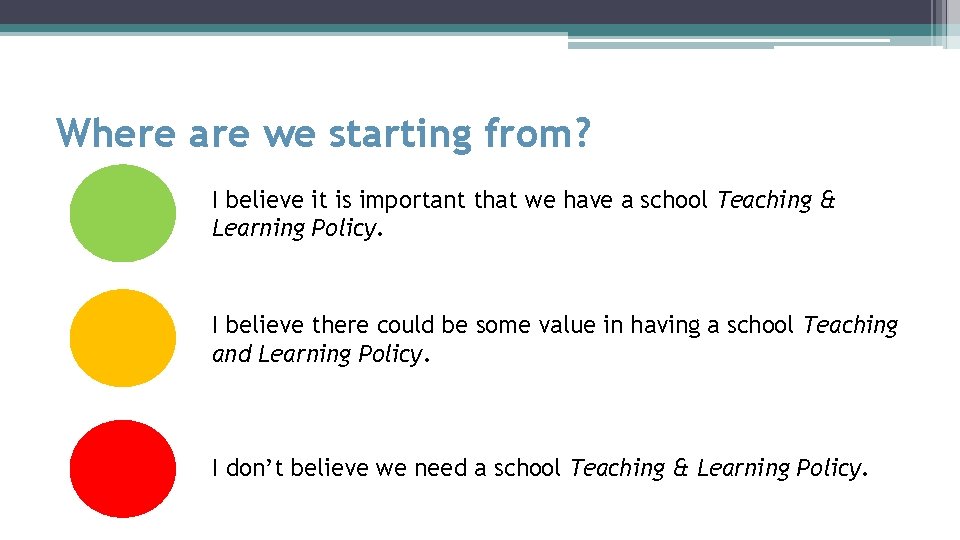
Where are we starting from? I believe it is important that we have a school Teaching & Learning Policy. I believe there could be some value in having a school Teaching and Learning Policy. I don’t believe we need a school Teaching & Learning Policy.
Aims 1. Summarise our recent teaching- and learning-focused improvement work. 2. Start to make the case for why we need a school Teaching and Learning Policy. 3. Explain why I believe there is a need to focus on particular teaching practices, depending on what we are aiming to teach.
Part 1 A great school
For discussion (and show-me boards) 1. To what extent would you say that Eyemouth High School is ‘a great school’? 2. What, specifically, would make it ‘a great school’ (or make it an ‘even greater school’)? 3. What would you say is your single-most important contribution in helping to make our school ‘a great school’?
Thoughts related to this • Attainment is important – very important – but it isn’t the key measure of greatness. ▫ I doubt if our attainment statistics will top national league tables any time soon ▫ But, regardless, we can still be a great school • The key measure of greatness is the quality of teaching and learning ▫ Every teacher can directly influence this ▫ Supported by great leadership, relationships, curriculum and support
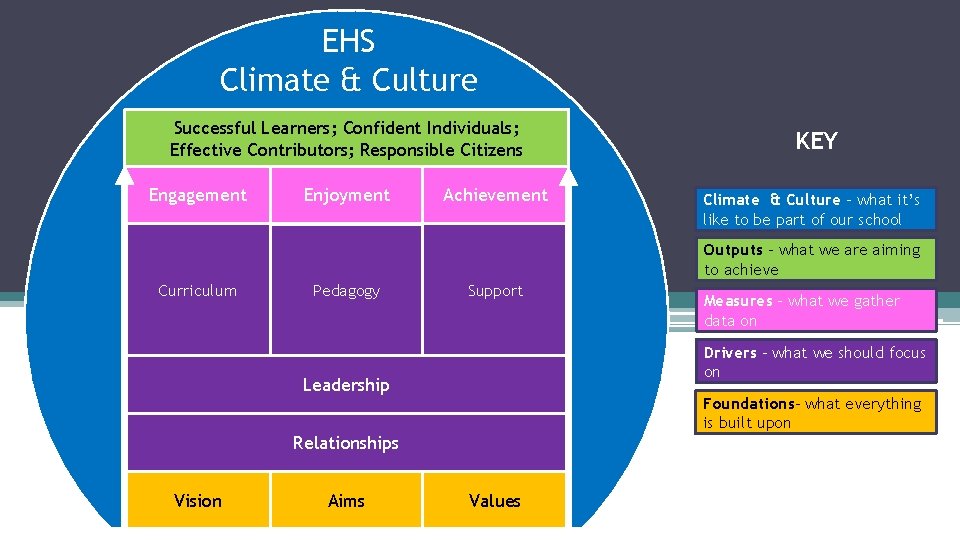
EHS Climate & Culture Successful Learners; Confident Individuals; Effective Contributors; Responsible Citizens Engagement Enjoyment Achievement KEY Climate & Culture – what it’s like to be part of our school Outputs – what we are aiming to achieve Curriculum Pedagogy Support Drivers – what we should focus on Leadership Foundations– what everything is built upon Relationships Vision Aims Measures – what we gather data on Values
Another thought related to this • Attainment is important – very important – but it isn’t the key measure of greatness. ▫ I doubt if our attainment statistics will top national league tables any time soon ▫ But, regardless, we can still be a great school • The key measure of greatness is the quality of teaching and learning ▫ Every teacher can directly influence this ▫ Supported by great leadership, relationships, curriculum and support. • There is nothing to stop the quality of teaching and learning in Eyemouth High School being the best in the Borders, or indeed, the best in the country. ▫ But how do we do that?
1. By ensuring that teaching and learning is ‘the thing’ – that we are always thinking about it and always talking about it. 2. By ensuring that we have a shared understanding of what we mean by great teaching and learning. �A Teaching and Learning Policy is designed to support this 3. By ensuring that we have a culture of professional learning (or learning). �Not seeing classrooms as discrete and autonomous – rather, we steep ourselves in collaboration. 4. By ensuring that we think about barriers and do something to address these. �Not seeing the idea of ‘continuous improvement’ as being about criticism that we aren’t good enough – we value learning and we value learning from each other. �Accepting that time will always be an issue but to strive to make time for our own learning every week – otherwise we are just busy ‘doing’, not ‘improving’.
The word ‘improvement’ • We need to embrace this word. • We need to overcome anxieties or tensions we have about it meaning ‘not good enough’ and see it as ‘let’s all get better and better – together’. • We need to encourage feedback – from other teachers, the Extended Management Team, and students. • We need to make time to learn through reading, watching others and discussing.
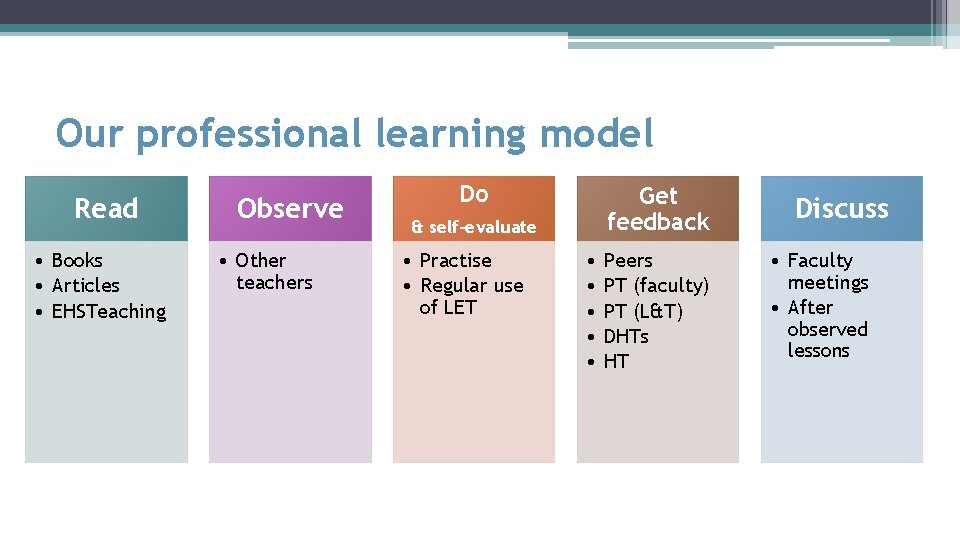
Our professional learning model Read • Books • Articles • EHSTeaching Observe • Other teachers Do Get feedback & self-evaluate • Practise • Regular use of LET • • • Peers PT (faculty) PT (L&T) DHTs HT Discuss • Faculty meetings • After observed lessons
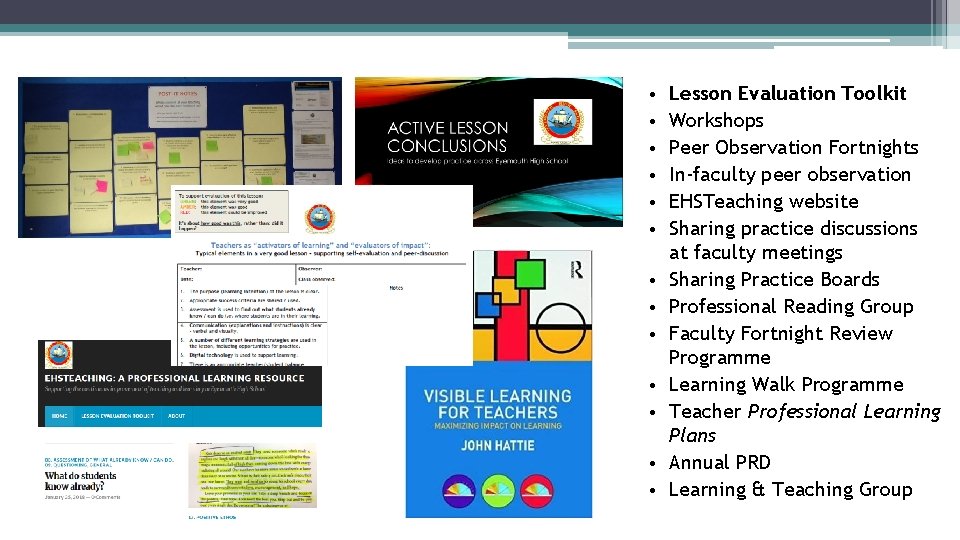
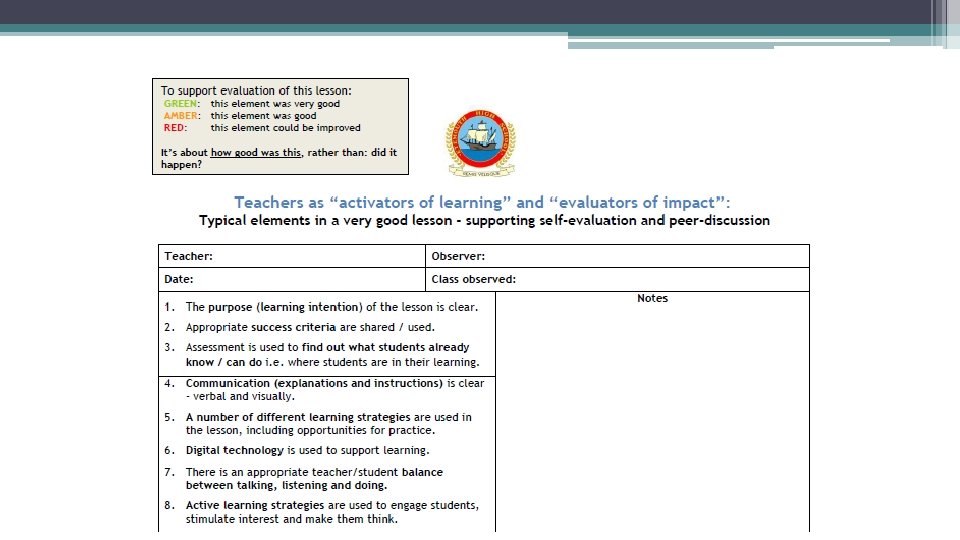
• • • • Lesson Evaluation Toolkit Workshops Peer Observation Fortnights In-faculty peer observation EHSTeaching website Sharing practice discussions at faculty meetings Sharing Practice Boards Professional Reading Group Faculty Fortnight Review Programme Learning Walk Programme Teacher Professional Learning Plans Annual PRD Learning & Teaching Group
Where are we now? • Our learning culture has really developed. • Our shared understanding of very good teaching & learning has really improved. • We are more collaborative. • Teaching and learning has improved. • Our attainment has improved.
Part 2 Let’s make teaching & learning even better
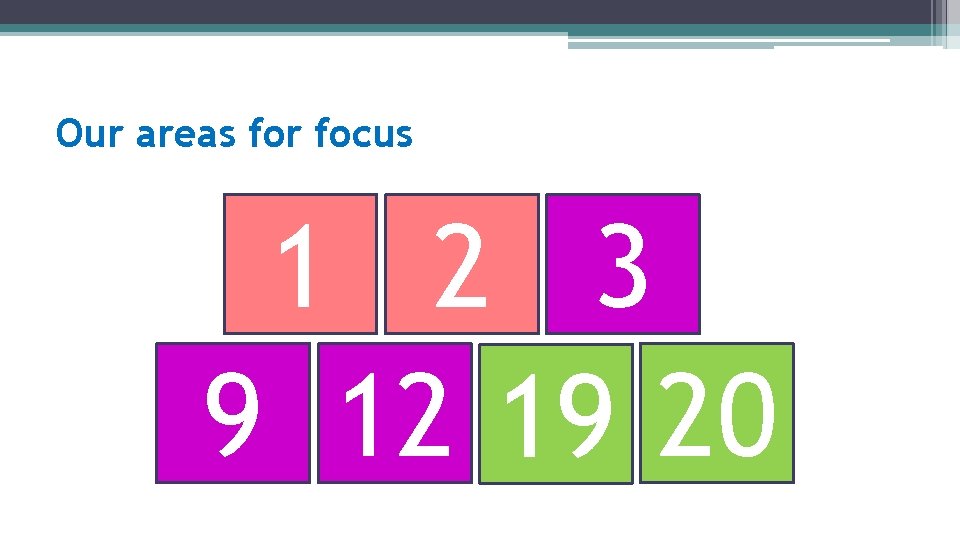
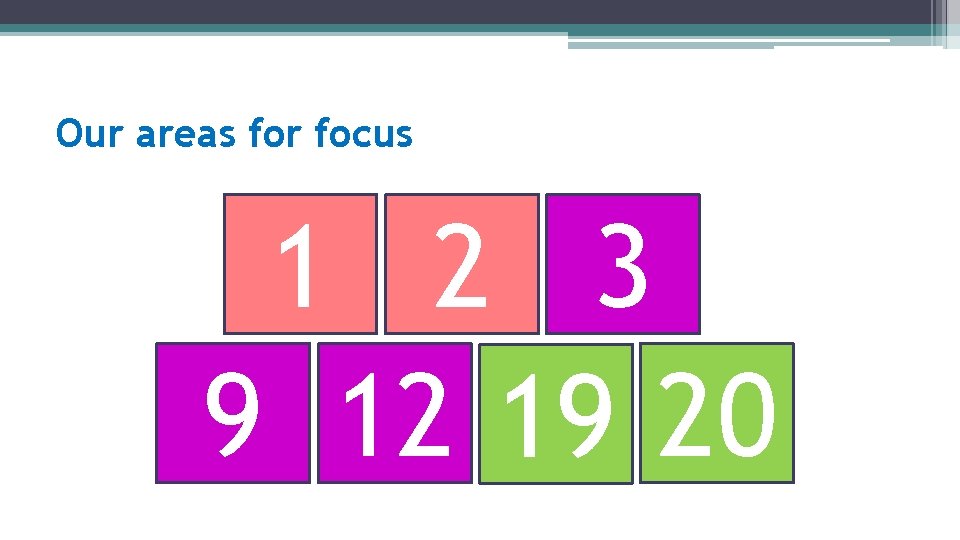
Our areas for focus 1 2 3 9 12 19 20
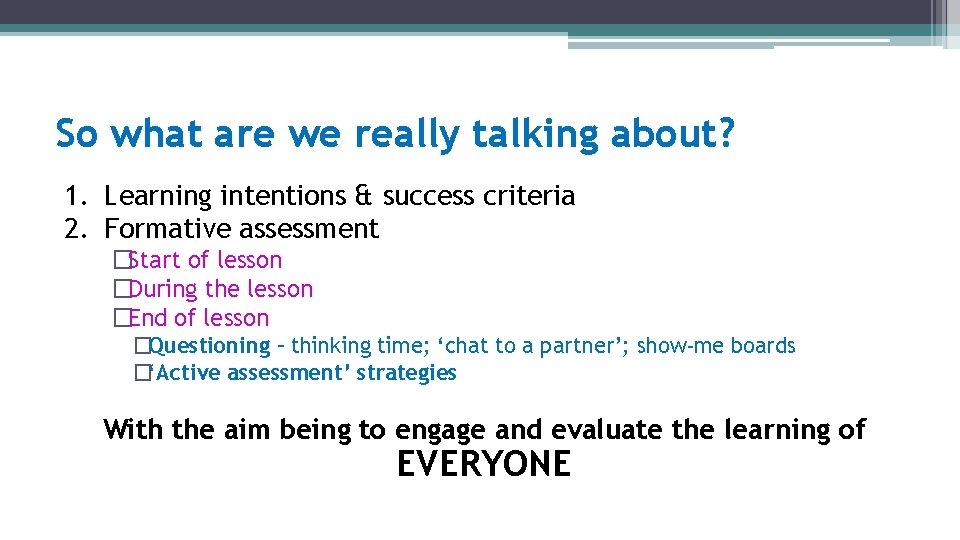
So what are we really talking about? 1. Learning intentions & success criteria 2. Formative assessment �Start of lesson �During the lesson �End of lesson �Questioning – thinking time; ‘chat to a partner’; show-me boards �‘Active assessment’ strategies With the aim being to engage and evaluate the learning of EVERYONE
‘Activators of Learning’ & ‘Evaluators of Impact’ • What do those terms mean? ▫ Chat to a partner – take 30 seconds • ‘Activators of learning’ ▫ Focusing on the use of practices which have the largest effect sizes ▫ Workshop in August 2017 • ‘Evaluators of impact’ ▫ Using formative assessment evidence from a lesson to find out what difference the lesson made to the learning of everyone ▫ Workshop in October 2017
Effect Sizes: where are you now? • Discuss with a partner – what were the top 10? (1 minute). • List the three that you are most certain of on a show-me board.
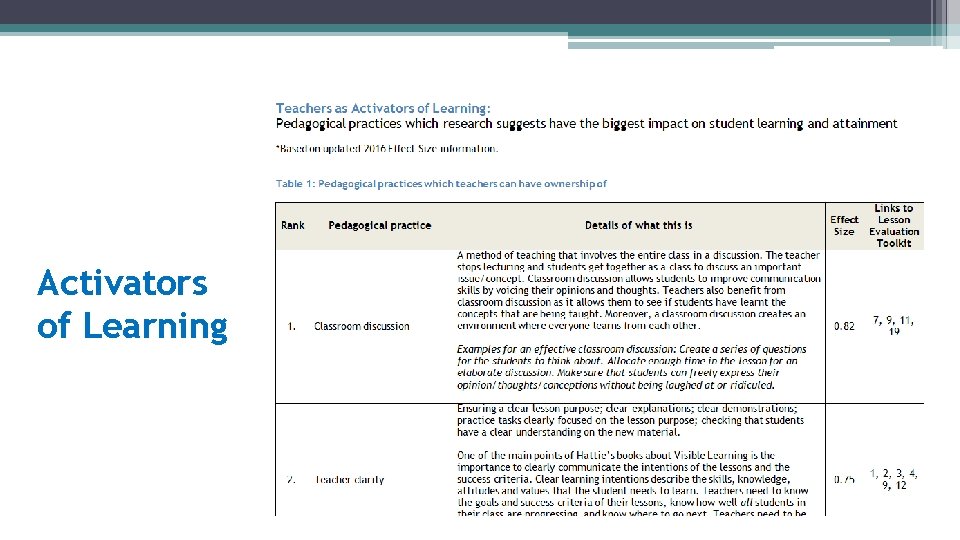
Activators of Learning
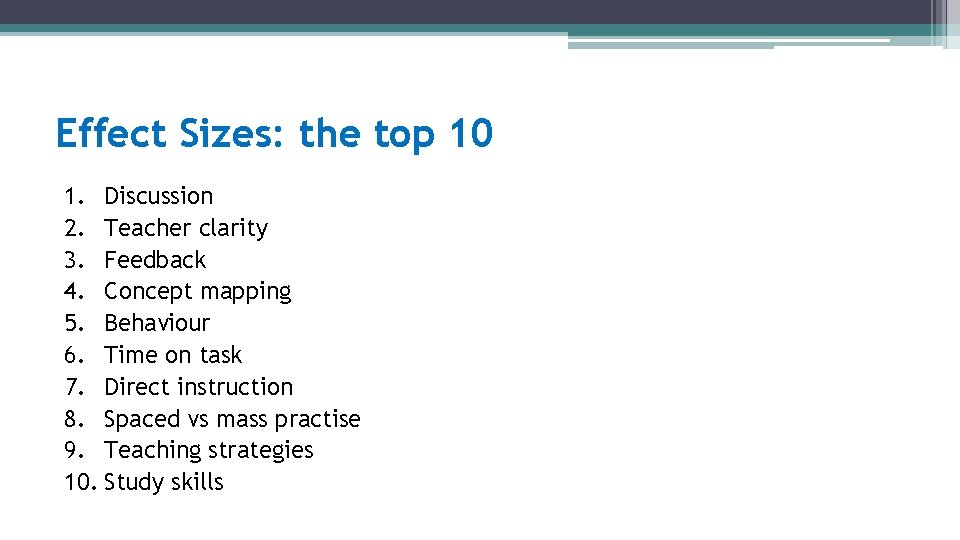
Effect Sizes: the top 10 1. Discussion 2. Teacher clarity 3. Feedback 4. Concept mapping 5. Behaviour 6. Time on task 7. Direct instruction 8. Spaced vs mass practise 9. Teaching strategies 10. Study skills
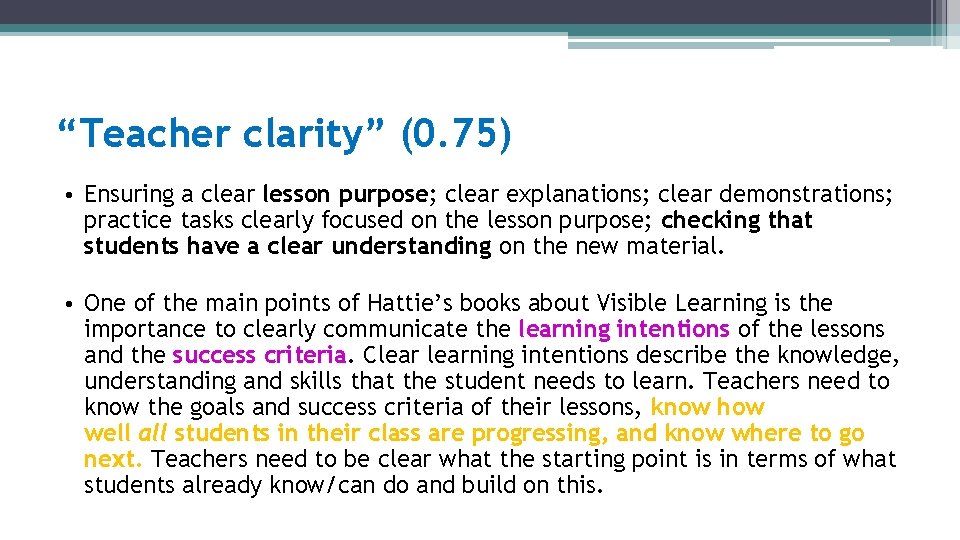
“Teacher clarity” (0. 75) • Ensuring a clear lesson purpose; clear explanations; clear demonstrations; practice tasks clearly focused on the lesson purpose; checking that students have a clear understanding on the new material. • One of the main points of Hattie’s books about Visible Learning is the importance to clearly communicate the learning intentions of the lessons and the success criteria. Clearning intentions describe the knowledge, understanding and skills that the student needs to learn. Teachers need to know the goals and success criteria of their lessons, know how well all students in their class are progressing, and know where to go next. Teachers need to be clear what the starting point is in terms of what students already know/can do and build on this.
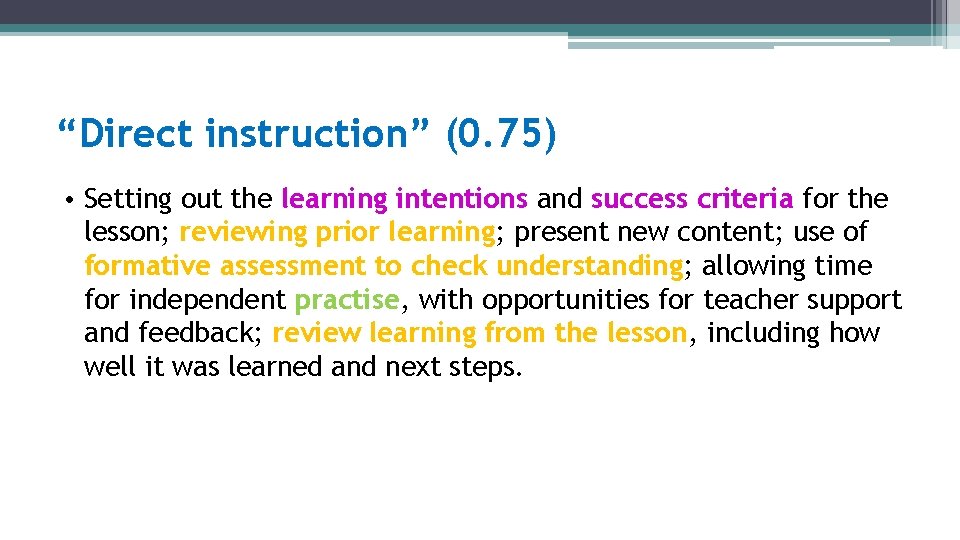
“Direct instruction” (0. 75) • Setting out the learning intentions and success criteria for the lesson; reviewing prior learning; present new content; use of formative assessment to check understanding; allowing time for independent practise, with opportunities for teacher support and feedback; review learning from the lesson, including how well it was learned and next steps.
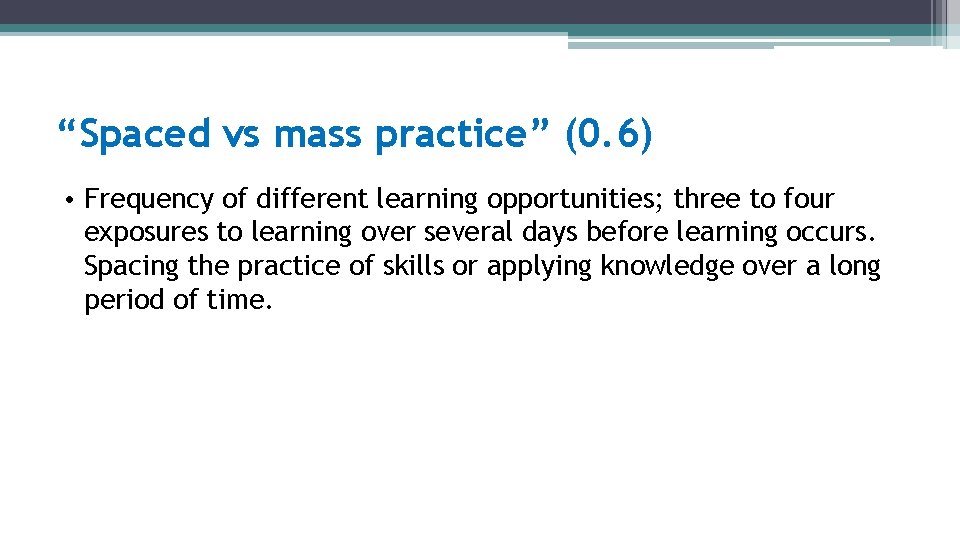
“Spaced vs mass practice” (0. 6) • Frequency of different learning opportunities; three to four exposures to learning over several days before learning occurs. Spacing the practice of skills or applying knowledge over a long period of time.
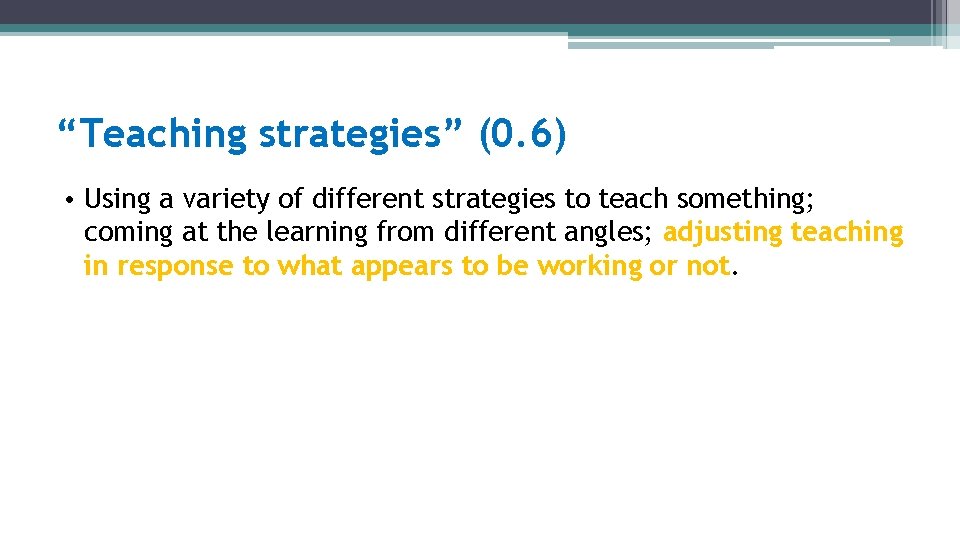
“Teaching strategies” (0. 6) • Using a variety of different strategies to teach something; coming at the learning from different angles; adjusting teaching in response to what appears to be working or not.
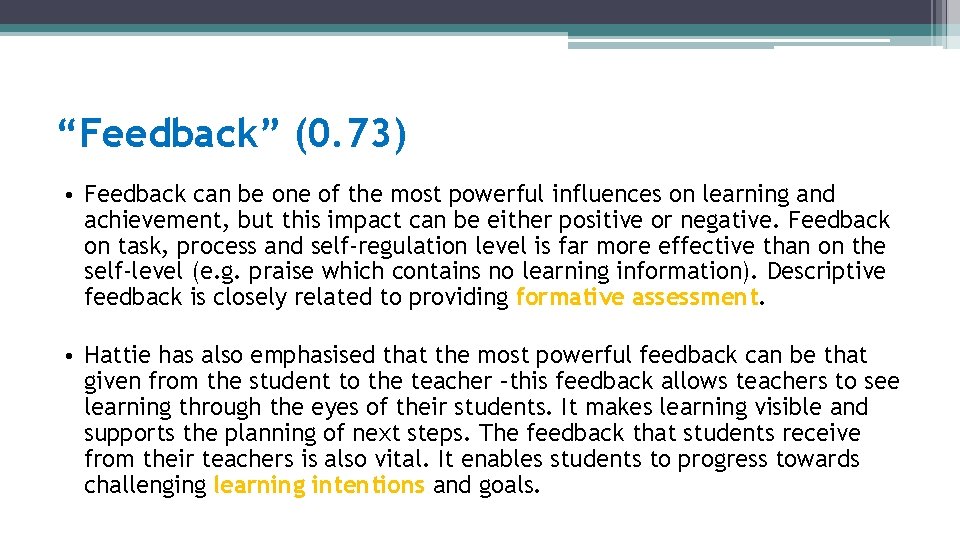
“Feedback” (0. 73) • Feedback can be one of the most powerful influences on learning and achievement, but this impact can be either positive or negative. Feedback on task, process and self-regulation level is far more effective than on the self-level (e. g. praise which contains no learning information). Descriptive feedback is closely related to providing formative assessment. • Hattie has also emphasised that the most powerful feedback can be that given from the student to the teacher –this feedback allows teachers to see learning through the eyes of their students. It makes learning visible and supports the planning of next steps. The feedback that students receive from their teachers is also vital. It enables students to progress towards challenging learning intentions and goals.
Our areas for focus 1 2 3 9 12 19 20
Part 3 Drawing on research to deliver better and better teaching & learning
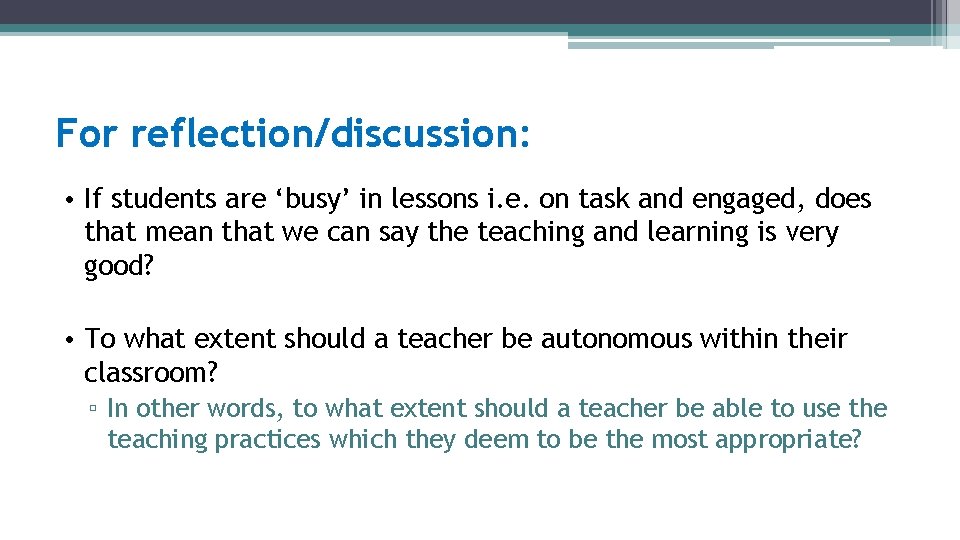
For reflection/discussion: • If students are ‘busy’ in lessons i. e. on task and engaged, does that mean that we can say the teaching and learning is very good? • To what extent should a teacher be autonomous within their classroom? ▫ In other words, to what extent should a teacher be able to use the teaching practices which they deem to be the most appropriate?
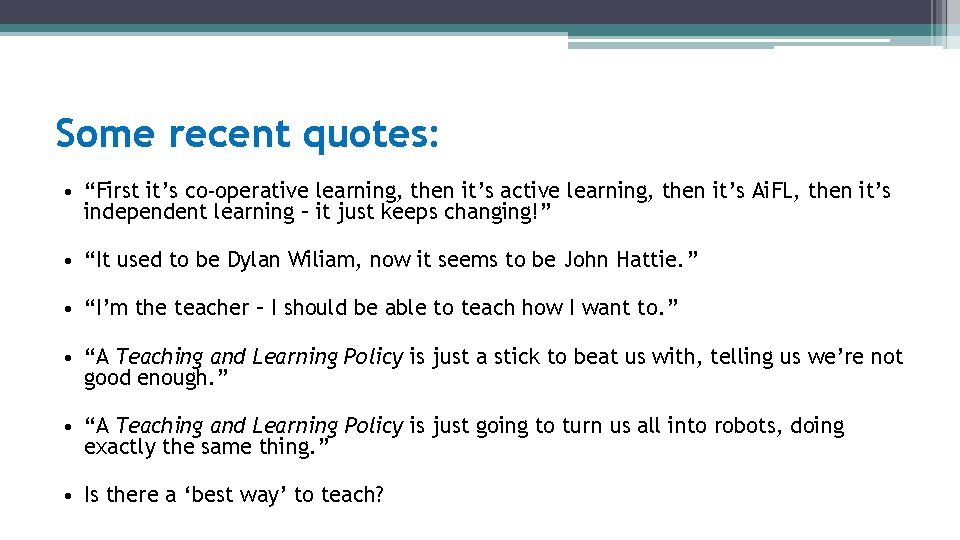
Some recent quotes: • “First it’s co-operative learning, then it’s active learning, then it’s Ai. FL, then it’s independent learning – it just keeps changing!” • “It used to be Dylan Wiliam, now it seems to be John Hattie. ” • “I’m the teacher – I should be able to teach how I want to. ” • “A Teaching and Learning Policy is just a stick to beat us with, telling us we’re not good enough. ” • “A Teaching and Learning Policy is just going to turn us all into robots, doing exactly the same thing. ” • Is there a ‘best way’ to teach?
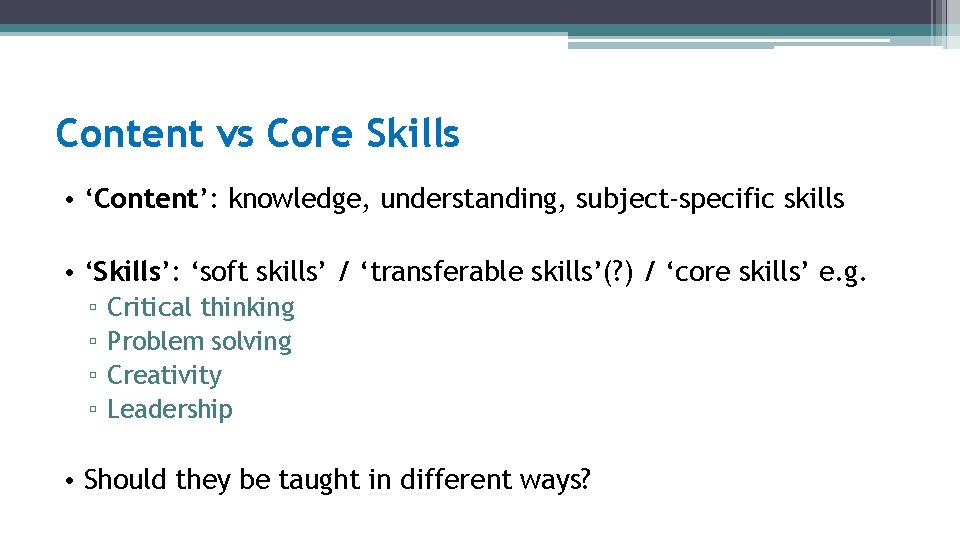
Content vs Core Skills • ‘Content’: knowledge, understanding, subject-specific skills • ‘Skills’: ‘soft skills’ / ‘transferable skills’(? ) / ‘core skills’ e. g. ▫ ▫ Critical thinking Problem solving Creativity Leadership • Should they be taught in different ways?
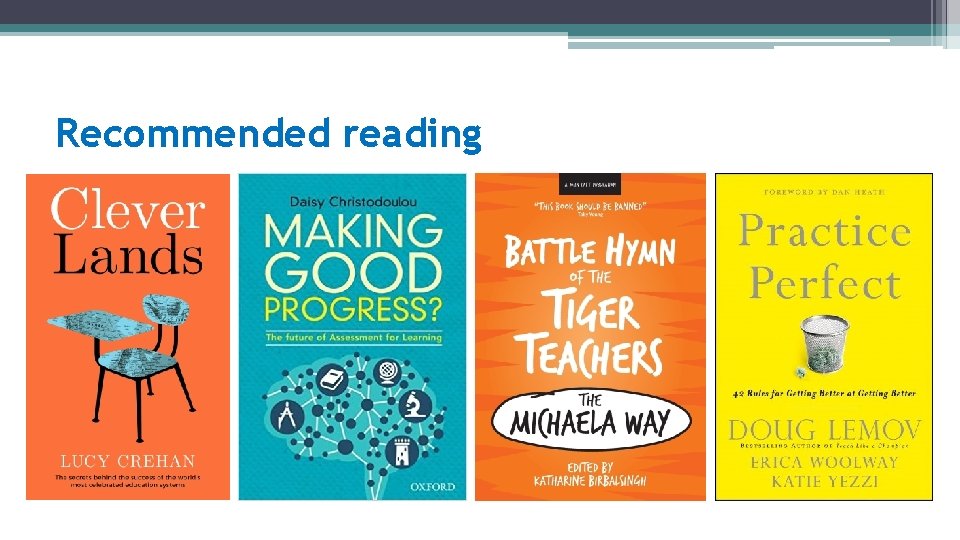
Recommended reading
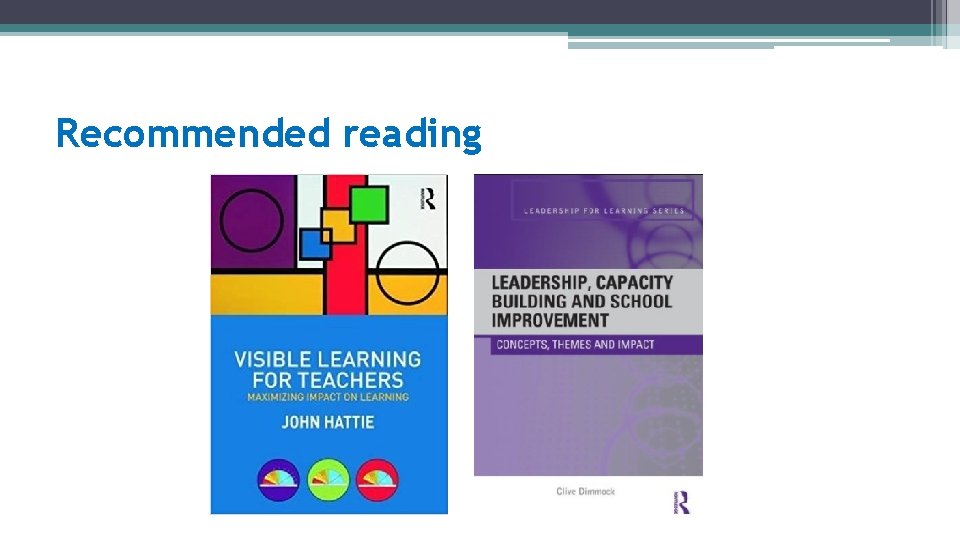
Recommended reading
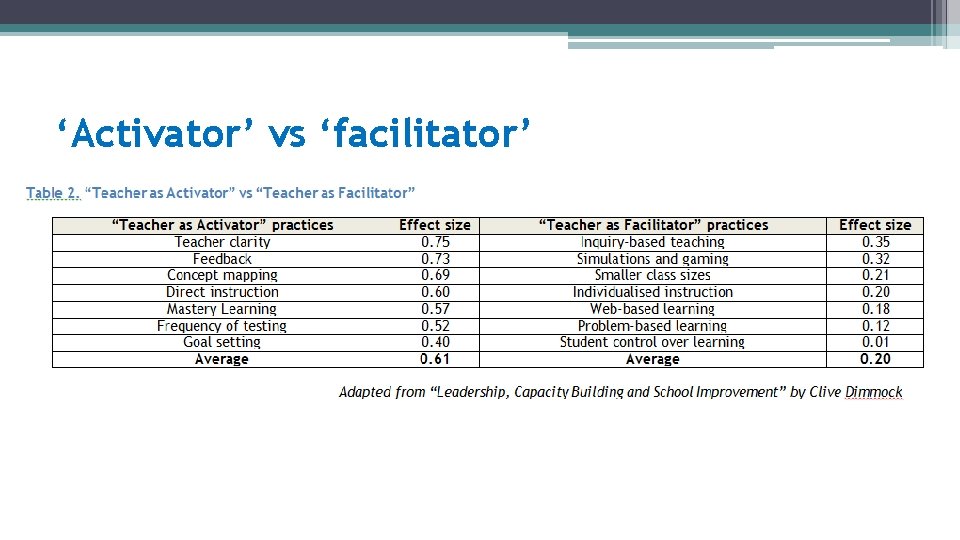
‘Activator’ vs ‘facilitator’
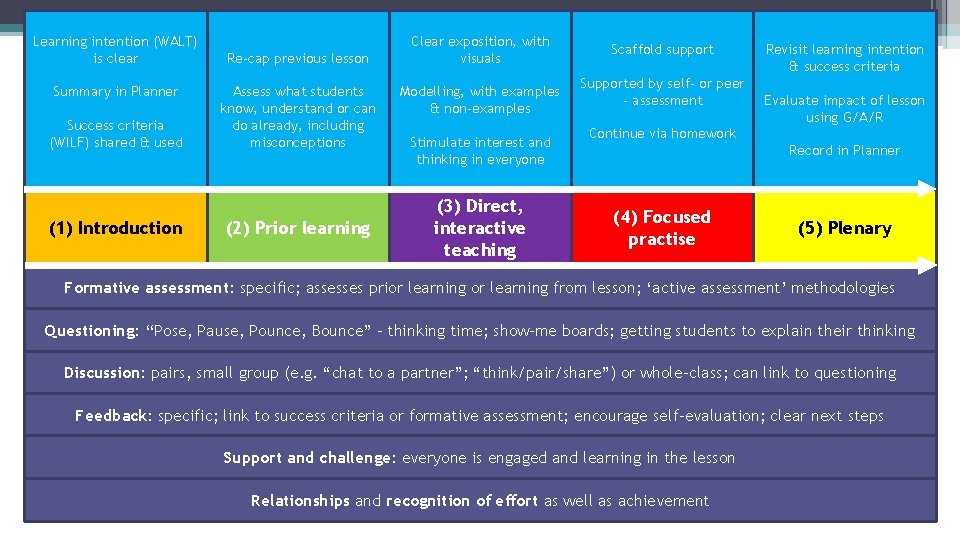
Teacher as ACTIVATOR of learning Teaching ‘content’
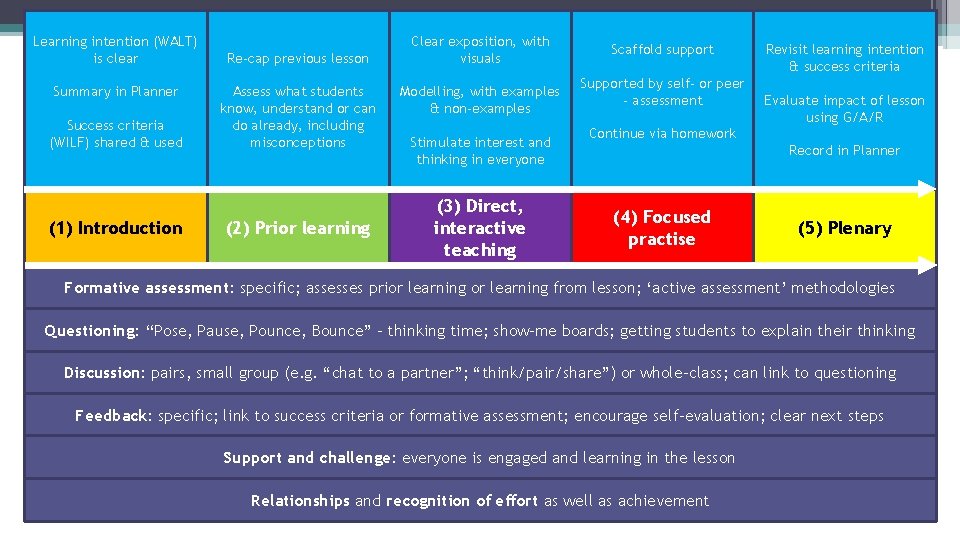
Learning intention (WALT) is clear Summary in Planner Success criteria (WILF) shared & used (1) Introduction Re-cap previous lesson Assess what students know, understand or can do already, including misconceptions (2) Prior learning Clear exposition, with visuals Modelling, with examples & non-examples Stimulate interest and thinking in everyone (3) Direct, interactive teaching Scaffold support Supported by self- or peer - assessment Revisit learning intention & success criteria Evaluate impact of lesson using G/A/R Continue via homework Record in Planner (4) Focused practise (5) Plenary Formative assessment: specific; assesses prior learning from lesson; ‘active assessment’ methodologies Questioning: “Pose, Pause, Pounce, Bounce” – thinking time; show-me boards; getting students to explain their thinking Discussion: pairs, small group (e. g. “chat to a partner”; “think/pair/share”) or whole-class; can link to questioning Feedback: specific; link to success criteria or formative assessment; encourage self-evaluation; clear next steps Support and challenge: everyone is engaged and learning in the lesson Relationships and recognition of effort as well as achievement
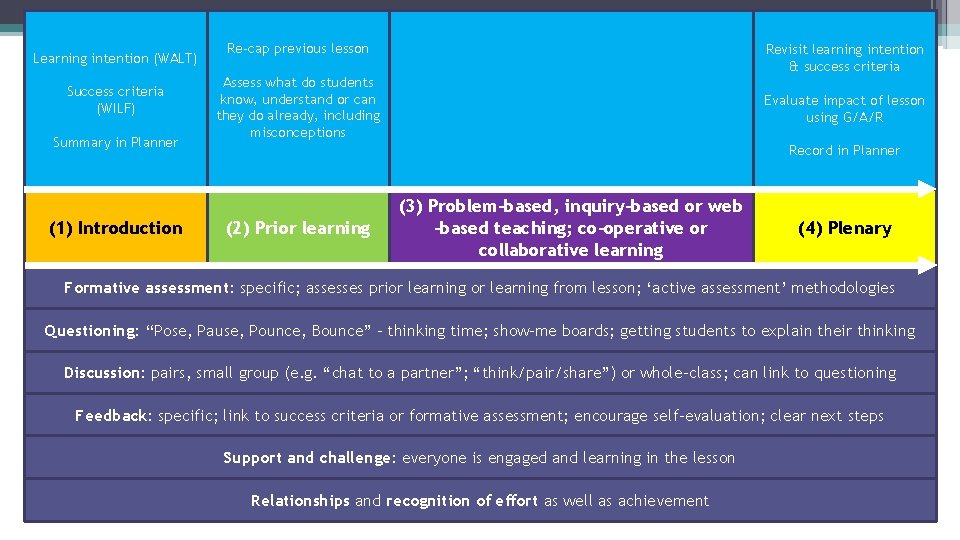
Teacher as FACILITATOR of learning Teaching ‘core skills’
Learning intention (WALT) Success criteria (WILF) Summary in Planner (1) Introduction Re-cap previous lesson Revisit learning intention & success criteria Assess what do students know, understand or can they do already, including misconceptions Evaluate impact of lesson using G/A/R Record in Planner (2) Prior learning (3) Problem-based, inquiry-based or web -based teaching; co-operative or collaborative learning (4) Plenary Formative assessment: specific; assesses prior learning from lesson; ‘active assessment’ methodologies Questioning: “Pose, Pause, Pounce, Bounce” – thinking time; show-me boards; getting students to explain their thinking Discussion: pairs, small group (e. g. “chat to a partner”; “think/pair/share”) or whole-class; can link to questioning Feedback: specific; link to success criteria or formative assessment; encourage self-evaluation; clear next steps Support and challenge: everyone is engaged and learning in the lesson Relationships and recognition of effort as well as achievement
What does this mean for us? • Continue with our focus on the continuous improvement of teaching and learning, but with a specific focus on ensuring that the practices used in every classroom, every lesson, are the best practices for achieving the outcomes that we are aiming for. ▫ Distinction between ‘content’ and ‘core skills’. ▫ A focus on ‘content’ (before ‘core skills’). • This means a relentless and collaborative focus on specific teaching practices. ▫ Our Lesson Evaluation Toolkit can be applied to either the ‘activator’ or the ‘facilitator’ model of teaching. ▫ The ‘Teacher as Activator’ model should be seen as the principal model for us as a school.
Learning intention (WALT) is clear Summary in Planner Success criteria (WILF) shared & used (1) Introduction Re-cap previous lesson Assess what students know, understand or can do already, including misconceptions (2) Prior learning Clear exposition, with visuals Modelling, with examples & non-examples Stimulate interest and thinking in everyone (3) Direct, interactive teaching Scaffold support Supported by self- or peer - assessment Revisit learning intention & success criteria Evaluate impact of lesson using G/A/R Continue via homework Record in Planner (4) Focused practise (5) Plenary Formative assessment: specific; assesses prior learning from lesson; ‘active assessment’ methodologies Questioning: “Pose, Pause, Pounce, Bounce” – thinking time; show-me boards; getting students to explain their thinking Discussion: pairs, small group (e. g. “chat to a partner”; “think/pair/share”) or whole-class; can link to questioning Feedback: specific; link to success criteria or formative assessment; encourage self-evaluation; clear next steps Support and challenge: everyone is engaged and learning in the lesson Relationships and recognition of effort as well as achievement
Follow-up activity (in faculties) • Discuss and re-visit this presentation, including: ▫ ▫ Your initial thoughts Implications for your faculty Implications for the school Next steps for you • Read the extracts from Battle Hymn For The Tiger Teachers ▫ Discuss in faculty • Continue your discussions regarding the first 10 pages of the policy. • Complete an individual or group return. • Forward returns to me by Friday 9 th March 2018.
Aims 1. Summarise our recent teaching- and learning-focused improvement work. 2. Start to make the case for why we need a school Teaching and Learning Policy. 3. Explain why I believe there is a need to focus on particular teaching practices, depending on what we are aiming to teach.
Where are we starting from? I believe it is important that we have a school Teaching & Learning Policy. I believe there could be some value in having a school Teaching and Learning Policy. I don’t believe we need a school Teaching & Learning Policy.